REVIEW 4 major objections 5 minor 30 references
On the relative $L$-theory and the relative signature of PL manifolds with boundary
T0 review · 4 major / 5 minor · reviewed 2026-08-14 · deepseek-v4-flash
Pith's one-line read This paper proves that the relative higher rho invariant is a group homomorphism from the relative topological structure group of PL manifolds with boundary to the K-theory of the relative obstruction algebra, making the relative surgery…
desk verdict A genuinely new relative version of Weinberger–Xie–Yu, but two load-bearing shortcuts (normal-group identification and product formula) need real proofs before I'd rely on it. read the letter →
The pith
A machine-rendered reading of the paper's core claim, the machinery that carries it, and where it could break.
The reading
What carries the argument
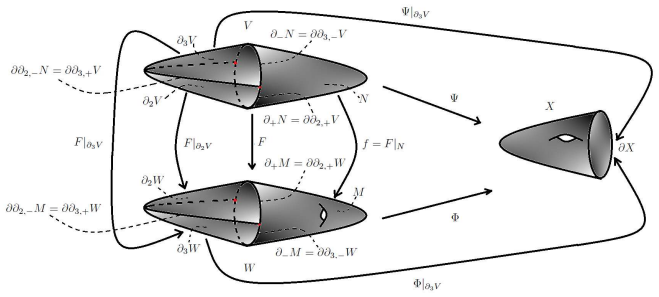
The load-bearing object is $S_n(X,\partial X;\omega)$: a controlled relative structure group whose elements are homotopy equivalences of manifold 2-ads over $(X,\partial X)$, with the positive-boundary part an infinitesimally controlled homotopy equivalence over $X$, and whose addition is disjoint union. The paper proves this group is isomorphic to the classical relative topological structure group, using topological periodicity, which makes the statement that $\mathrm{rel}\rho$ is additive meaningful on the classical object. The analytic side is carried by three relative geometric C*-algebras: the relative Roe algebra, the relative localization algebra, and the relative obstruction algebra $C^*_{L,0}(\tilde X,\tilde\partial X)_{G,\Gamma}$, all built from the mapping-cone C*-algebra of the inclusion $\partial X\to X$. The invariant $\mathrm{rel}\rho$ is assembled by concatenating the path, from the mapping-surgery-to-analysis construction, that kills the signature class of the difference $M\sqcup -N$ with the relative K-homology path; additivity is proved through an auxiliary homomorphism $\mathrm{rel}\hat\rho$ on an L-theory group of manifold 3-ads, together with the product formula $\mathrm{rel}\rho(\theta\times\mathbb{R})=k_n\alpha_*(\mathrm{rel}\rho(\theta)\otimes \mathrm{Ind}_L(\mathbb{R}))$.
What would settle it
Take $X=M\times[0,1]$ for a closed PL manifold $M$ with a nontrivial higher rho class, and let $\theta\in S_n(X,\partial X)$ come from a nontrivial homotopy equivalence of $M$. Compute both sides of the product formula $\mathrm{rel}\rho(\theta\times\mathbb{R})=k_n\alpha_*(\mathrm{rel}\rho(\theta)\otimes \mathrm{Ind}_L(\mathbb{R}))$ in the K-theory of the relative obstruction algebra; a mismatch disproves the additivity theorem. Equally directly, one can compare $\mathrm{rel}\rho(\theta_1+\theta_2)$ with $\mathrm{rel}\rho(\theta_1)+\mathrm{rel}\rho(\theta_2)$ under the disjoint-union addition for two explicitly given elements.
Extended reading notes
Core claim
The central claim is Theorem 6.8: for a compact PL manifold with boundary $(X,\partial X)$ of dimension $n\ge 6$, the relative higher rho invariant $\mathrm{rel}\rho$ induces a group homomorphism from the relative structure group $S_n(X,\partial X;\omega)$ (a group whose operation is disjoint union, shown isomorphic to the classical relative structure group) to the K-theory group $K_n(C^*_{L,0}(\tilde X,\tilde\partial X)_{G,\Gamma})$ of the relative obstruction algebra, and the surgery-to-analysis diagram (1.1) commutes. In the course of the proof the paper establishes a new description of the relative topological surgery exact sequence, identifies the classical relative structure group with the controlled group $S_n(X,\partial X;\omega)$, and shows that the relative signature class, the relative K-homology class of the signature operator, and $\mathrm{rel}\rho$ fit into the analytic surgery exact sequence via $\mathrm{relInd}$ and $\mathrm{relInd}_L$.
Load-bearing premise
The argument assumes that making the geometric control scale arbitrarily small does not change the relative normal cobordism groups; if this control-topology identification fails, the controlled group $S_n(X,\partial X;\omega)$ is not the classical relative structure group and the domain of $\mathrm{rel}\rho$ is different.
Editorial extensions
If this is right
- Additivity of $\mathrm{rel}\rho$ means the invariant behaves linearly under disjoint union in the relative structure group, so it can serve as a group homomorphism rather than merely a label on each structure element.
- The isomorphism $S_n(X,\partial X;\omega)\cong S^{TOP}(X,\partial X)$ supplies an explicit abelian group structure on the classical relative structure set for $n\ge 6$, with addition by disjoint union.
- The commutative diagram (1.1) makes the relative topological surgery exact sequence compatible with the K-theory exact sequence of relative geometric C*-algebras, so L-theoretic surgery obstructions and normal invariants map to analytic index classes coherently.
- By Lemma 6.2, $\mathrm{rel}\rho$ vanishes on infinitesimally controlled homotopy equivalences, so a nonzero value is an obstruction to making a boundary-preserving homotopy equivalence controlled.
- The product formula computes $\mathrm{rel}\rho$ after crossing with the real line, giving a suspension behavior for the invariant that matches the closed-manifold case.
Reading between the lines
- One natural extension is to use the additivity of $\mathrm{rel}\rho$ to distinguish elements in relative structure groups in explicit examples, for instance manifolds with boundary arising from spin geometry or positive scalar curvature, where the K-theory of the relative obstruction algebra is more computable.
- The same disjoint-union group structure may be the right domain for secondary invariants in other controlled settings, such as stratified spaces or foliations, where control is imposed along a subspace instead of a boundary.
- Because the identification of the controlled normal group with the classical one is only sketched, a fully detailed proof of that step would determine exactly which fundamental groups and orientation characters the present statement covers; the analytic construction itself is likely to remain well defined on the controlled group regardless.
Signed reviews
Editorial analysis
A structured set of objections, weighed in public.
Referee Report
Summary. This paper extends the Weinberger–Xie–Yu framework for additive higher rho invariants from closed topological/PL manifolds to PL manifolds with boundary. The authors define a controlled relative structure group S_n(X,∂X;ω) whose addition is disjoint union, prove a relative surgery exact sequence in this category, and show for dim X ≥ 6 that S_n(X,∂X;ω) is isomorphic to the classical relative topological structure group STOP(X,∂X). They then introduce the relative obstruction algebra C*_{L,0}(~X,~∂X)_{G,Γ}, define a relative higher rho invariant relρ valued in its K-theory, prove that relρ is well defined and additive on S_n(X,∂X;ω), and assemble the relative surgery and analytic K-theory sequences into the commutative diagram (1.1) (Theorem 6.8).
Significance. The paper's main contribution, if all steps are made rigorous, is to make the relative structure group an abelian group in a geometrically transparent way and to produce an additive secondary invariant mapping the relative surgery sequence into operator K-theory. This would generalize the closed-manifold additivity theorem of [27] and supply a relative version of 'mapping surgery to analysis,' with potential applications to relative Novikov-type rigidity questions. The authors deserve credit for giving full definitions of the controlled groups and relative C*-algebras and for clearly stating the main theorems. The main caveats are that several load-bearing steps are quoted from or left to the reader rather than proved in the text.
major comments (4)
- [Section 2, Theorem 2.16] The isomorphism α_*: N^{TOP}_{∂+}(X×D^i, ∂(X×D^i)) → N_{n+i}(X,∂X;ω) is load-bearing: it is used in Theorem 2.20 and, through the five-lemma argument, in Lemma 2.21 and Theorem 2.23 to identify S_n(X,∂X;ω) with the classical STOP(X,∂X). The proof is a single diagram asserting that the algebraic normal invariant maps on both sides are isomorphisms onto H_{n+i}(X,∂X;L•) 'by the idea of control topology [8,28]'. No inverse of α_* is constructed, and no specific result in [8] or [28] is quoted that covers the ∂+-relative normal group with its restriction-to-homeomorphism condition. Without a proof or a precise citation at this level of generality, the identification between the formally defined S_n and the classical relative structure group is not established; this in turn affects the interpretation of relρ as a map on STOP(X,∂X).
- [Section 6.3, Theorem 6.5] Theorem 6.5, the product formula kn α_*(relρ(θ)⊗Ind_L(R)) = relρ(θ×R), is the step that identifies the geometrically defined relρ with the cone construction relρ̂ and is used in Corollary 6.7 to prove additivity. The proof in the text says only that it is 'elementary and exactly the same with the proof of Theorem 6.8 of [27] (Appendix D of [27])' and omits the details. Since [27] treats closed manifolds and the present setting has boundary and corner contributions, the transfer is not automatic; the boundary conditions in the relative localization algebra need to be verified explicitly. As written, the main additivity theorem rests on an unproved assertion.
- [Section 6.3, Theorem 6.6] The commutativity of the central diagram connecting L_{n+1}(π_1X, π_1∂X, X), S_n(X,∂X), and the K-theory of the relative obstruction algebra is established by 'direct comparison' after displaying liftings a_{θ×[0,1]} and a_{θ×R}. This comparison is the heart of the proof that relρ is a group homomorphism, and the text does not carry out the computation of ∂_*(relρ̂(θ×[0,1])) and ∂_MV(relρ(θ×R)) in sufficient detail to verify equality. A more explicit proof, or at least a reduction to the closed case that tracks the relative boundary terms, is needed before Corollary 6.7 can be considered proved.
- [Section 3.3, Theorem 3.6] Theorem 3.6, the quantitative K-theory vanishing for the relative obstruction algebra, is proved by invoking Proposition 3.5 of Chen–Yu–Liu [4] and asserting that 'the argument... can be applied verbatim to a PL manifold.' Proposition 3.5 is stated for complete manifolds with a proper, free, cocompact group action by isometries, whereas the present paper needs PL manifolds with boundary equipped with simplicial metrics. The adaptation requires checking bounded geometry and cocompactness of the universal cover boundary pair, and because [4] has a co-author in common with the present paper, the reader cannot simply take this extension on faith. This vanishing is used in Lemma 6.2 to show that relρ vanishes on infinitesimally controlled maps, so it is load-bearing for the well-definedness of relρ on S_n.
minor comments (5)
- [Definition 2.7] In item 2 of Definition 2.7, the formula `∂V = N (=∂1V)∪∂2W∪∂3W` appears to be a typo for `∂V = N (=∂1V)∪∂2V∪∂3V`.
- [Theorem 5.5] In the statement of Theorem 5.5, the displayed formula `i∗(relIndL(M,∂M ) = 0` is missing a closing parenthesis.
- [Section 6.3] The name 'Mayor-Vietoris' should be 'Mayer–Vietoris' in the discussion of the sequences and connecting maps.
- [Section 2, Lemmas 2.21–2.23] The notation for the relative structure set is not uniform: `STOP(X,∂X)`, `STOP_∂(X,∂X)`, and `STOP_∂(X,∂X;ω)` are used in Theorem 2.20 and Lemmas 2.21–2.23; the authors should fix one convention.
- [Throughout] There are scattered typos such as 'discripition', 'homotopoy', and 'opressed'; a careful proofreading pass is recommended.
Circularity Check
No circularity; the central derivation is a relative generalization of external results, not a reduction to its own inputs.
full rationale
The paper's advertised result, that the relative higher rho invariant defines a group homomorphism from the relative topological structure group to K-theory of the relative obstruction algebra, is not obtained by definitionally renaming its inputs. The new group S_n(X,∂X;ω) is defined independently, with group law by disjoint union, and the proof that it is isomorphic to the classical relative structure group is a genuine geometric comparison via Theorems 2.16, 2.20, and 2.23. The one-line proof of Theorem 2.16, which identifies the relative normal group with the controlled normal group by asserting both algebraic normal invariant maps are isomorphisms 'by the idea of control topology [8,28]', is terse and may be a correctness risk, but it is not circular: α* is explicitly defined, and the cited isomorphisms are external inputs, not the theorem being proved. Similarly, Theorem 3.6 uses Proposition 3.5 from [4], a paper whose second author is also a co-author here; however, Proposition 3.5 is a quantitative K-theory vanishing statement about complete manifolds with proper free cocompact actions, stated independently of the relative rho invariant or the additivity theorem, so it is an external technical input rather than a self-referential assumption. The omitted proof of the product formula, Theorem 6.5, is justified by reference to Theorem 6.8 of [27]; again this is an external result, not a restatement of the paper's own conclusion. No fitted parameter is relabeled as a prediction, no uniqueness theorem from the same authors is used to force a choice, and no definition of relρ presupposes additivity. Thus there is no demonstrated circularity in the derivation chain.
Assumptions & free parameters
assumptions (6)
- domain assumption Wall's relative surgery exact sequence for topological manifolds with boundary is available and fits the diagram in Section 2.
- domain assumption Siebenmann periodicity holds for compact topological manifolds with boundary, as used in Lemma 2.22.
- ad hoc to paper The algebraic normal invariant maps from N^{TOP}_{∂+}(X×D^i, ∂(X×D^i)) to H_{n+i}(X,∂X; L•) are isomorphisms, making Theorem 2.16 true.
- ad hoc to paper Proposition 3.5 of Chen-Yu-Liu [4] extends verbatim from complete manifolds with proper group actions to PL manifolds with boundary.
- domain assumption The Weinberger-Xie-Yu hybrid C*-algebra and additivity machinery for closed manifolds can be imported into the relative setting.
- standard math Higson-Roe signature classes and homotopy paths for Hilbert-Poincare complexes are valid as background.
Cite this review
Pith. "Pith review of On the relative $L$-theory and the relative signature of PL manifolds with boundary." pith.science (2026). https://pith.science/paper/BQ5DEVG4
@misc{pith2026190807451,
  author       = {Pith},
  title        = {Pith review of: On the relative $L$-theory and the relative signature of PL manifolds with boundary},
  year         = {2026},
  howpublished = {\url{https://pith.science/paper/BQ5DEVG4}},
  note         = {Machine review of arXiv:1908.07451}
}
abstract
In this paper, we give a new description of the group structure of the relative structure group of PL manifolds with boundary, and obtain a surgery exact sequence in the category of groups. Then we focus on the relative $L$-group of PL manifolds with boundary, and map it to the $K$-theory additively.
Figures

Reference graph
Works this paper leans on
-
[27]
Addi tivity of higher rho invariants and nonrigidity of topological manifolds
Shmuel Weinberger, Zhizhang Xie, and Guoliang Yu. Addi tivity of higher rho invariants and nonrigidity of topological manifolds. Communications on Pure and Applied Mathematics , to appear
-
[4]
Higher rho in variant is an obstruction to the inverse being local
Xiaoman Chen, Guoliang Yu, and Hongzhi Liu. Higher rho in variant is an obstruction to the inverse being local. J. Geom. Phys. , to appear, 2019
work page 2019
-
[8]
Steven C. Ferry and Erik K. Pedersen. Epsilon surgery the ory. In Novikov conjectures, index theorems and rigidity, Vol. 2 (Oberwolfac h, 1993) , vol- ume 227 of London Math. Soc. Lecture Note Ser. , pages 167–226. Cam- bridge Univ. Press, Cambridge, 1995
work page 1993
-
[28]
L-groups of crystallographic groups
Masayuki Yamasaki. L-groups of crystallographic groups. Invent. Math. , 88(3):571–602, 1987
work page 1987
-
[1]
Arithmetic manif olds of positive scalar curvature
Jonathan Block and Shmuel Weinberger. Arithmetic manif olds of positive scalar curvature. J. Differential Geom. , 52(2):375–406, 1999
work page 1999
-
[2]
A geometric inte rpretation of Siebenmann’s periodicity phenomenon
Sylvain Cappell and Shmuel Weinberger. A geometric inte rpretation of Siebenmann’s periodicity phenomenon. In Geometry and topology (Athens, Ga., 1985) , volume 105 of Lecture Notes in Pure and Appl. Math. , pages 47–52. Dekker, New York, 1987
work page 1985
-
[3]
Posi tive scalar cur- vature and a new index theory for noncompact manifolds
Stanley Chang, Shmuel Weinberger, and Guoliang Yu. Posi tive scalar cur- vature and a new index theory for noncompact manifolds. arXiv preprint , (arXiv:1506.03859), 2015
arXiv 2015
-
[5]
The additivity of the ρ-invariant and periodicity in topological surgery
Diarmuid Crowley and Tibor Macko. The additivity of the ρ-invariant and periodicity in topological surgery. Algebr. Geom. Topol. , 11(4):1915–1959, 2011. 54
work page 1915
Show all 30 references
-
[6]
Deeley and Magnus Goffeng
Robin J. Deeley and Magnus Goffeng. Relative geometric as sembly and mapping cones Part II: Chern characters and the Novikov prop erty. Mün- ster J. Math. , 12(1):57–92, 2019
2019
-
[7]
Deeley and Magnus Goffeng
Robin J. Deeley and Magnus Goffeng. Relative geometric as sembly and mapping cones Part I: The geometric model and applications. arXiv preprint, (arXiv 1507.01735), 2015
2015 arXiv
-
[9]
Mapping surgery to analysis
Nigel Higson and John Roe. Mapping surgery to analysis. I . Analytic sig- natures. K-Theory, 33(4):277–299, 2005
2005
-
[10]
Mapping surgery to analysis
Nigel Higson and John Roe. Mapping surgery to analysis. II. Geometric signatures. K-Theory, 33(4):301–324, 2005
2005
-
[11]
Mapping surgery to analysis
Nigel Higson and John Roe. Mapping surgery to analysis. III. Exact se- quences. K-Theory, 33(4):325–346, 2005
2005
-
[12]
On Siebenmann periodicity
Steven Hutt. On Siebenmann periodicity. Pacific J. Math. , 183(2):291–303, 1998
1998
-
[13]
Higher eta-invariants
John Lott. Higher eta-invariants. K-Theory, 6(3):191–233, 1992
1992
-
[14]
Andrew J. Nicas. Induction theorems for groups of homot opy manifold structures. Mem. Amer. Math. Soc. , 39(267):vi+108, 1982
1982
-
[15]
On quantitative ope ratorK-theory
Hervé Oyono-Oyono and Guoliang Yu. On quantitative ope ratorK-theory. Ann. Inst. Fourier (Grenoble) , 65(2):605–674, 2015
2015
-
[16]
Stratified surgery and K-theory invariants of the signature operator
Paolao Piazza and Pierre Albin. Stratified surgery and K-theory invariants of the signature operator. arXiv preprint , (arXiv:1710.00934v1), 2017
2017 arXiv
-
[17]
The surgery exact seque nce, K-theory and the signature operator
Paolo Piazza and Thomas Schick. The surgery exact seque nce, K-theory and the signature operator. Ann. K-Theory, 1(2):109–154, 2016
2016
-
[18]
B(TOPn)∗∗∗bt∗∗ and the surgery obstruction
Frank Quinn. B(TOPn)∗∗∗bt∗∗ and the surgery obstruction. Bull. Amer. Math. Soc. , 77:596–600, 1971
1971
-
[19]
A. A. Ranicki. Algebraic L-theory and topological manifolds , volume 102 of Cambridge Tracts in Mathematics . Cambridge University Press, Cam- bridge, 1992
1992
-
[20]
Coarse cohomology and index theory on complet e Riemannian manifolds
John Roe. Coarse cohomology and index theory on complet e Riemannian manifolds. Mem. Amer. Math. Soc. , 104(497):x+90, 1993. 55
1993
-
[21]
Periodicity in topological sur gery
Laurence C Siebenmann. Periodicity in topological sur gery. In Appendix C to Essay V in Foundational Essays on Topological Manifolds, Smoothings, and Triangulations by R. Kirby and L. Siebenmann . Princeton University Press, 1977
1977
-
[22]
The strong Novikov conjecture
Geng Tian. The strong Novikov conjecture . 2019. Thesis (Ph.D.)–The Texas A & M University
2019
-
[23]
The strong relative Novikov conjecture and g eometry of Banach spaces, preprint, 2019
Geng Tian. The strong relative Novikov conjecture and g eometry of Banach spaces, preprint, 2019
2019
-
[24]
Naturality of split injectivity and the relative Novikov conjecture, preprint, 2019
Geng Tian, Zhizhang Xie, and Guoliang Yu. Naturality of split injectivity and the relative Novikov conjecture, preprint, 2019
2019
-
[25]
The relative B aum-Connes conjecture and relative Novikov conjecture, preprint, 201 9
Geng Tian, Zhizhang Xie, and Guoliang Yu. The relative B aum-Connes conjecture and relative Novikov conjecture, preprint, 201 9
-
[26]
C. T. C. Wall. Surgery on compact manifolds , volume 69 of Mathematical Surveys and Monographs. American Mathematical Society, Providence, RI, second edition, 1999. Edited and with a foreword by A. A. Rani cki
1999
-
[29]
Localization algebras and the coarse Baum -Connes conjec- ture
Guoliang Yu. Localization algebras and the coarse Baum -Connes conjec- ture. K-Theory, 11(4):307–318, 1997
1997
-
[30]
Mapping the surgery exact sequence for topological manifolds to analysis
Vito Felice Zenobi. Mapping the surgery exact sequence for topological manifolds to analysis. J. Topol. Anal. , 9(2):329–361, 2017. 56
2017
Reviewed August 14, 2026 · model on record in the stance chip above.
Discussion (0). Continue with ORCID to comment.