REVIEW 2 major objections 4 minor 42 references
Particle acceleration in a nearby galaxy cluster pair: the role of cluster dynamics
T0 review · 2 major / 4 minor · reviewed 2026-08-14 · deepseek-v4-flash
Pith's one-line read In a pre-merger cluster pair, only the disturbed cluster hosts a giant radio halo.
desk verdict Solid LOFAR discovery of a faint giant radio halo in a merging low-mass cluster, with a clean non-detection in its relaxed companion; worth publishing after careful attention to source subtraction. read the letter →
The pith
A machine-rendered reading of the paper's core claim, the machinery that carries it, and where it could break.
The reading
What carries the argument
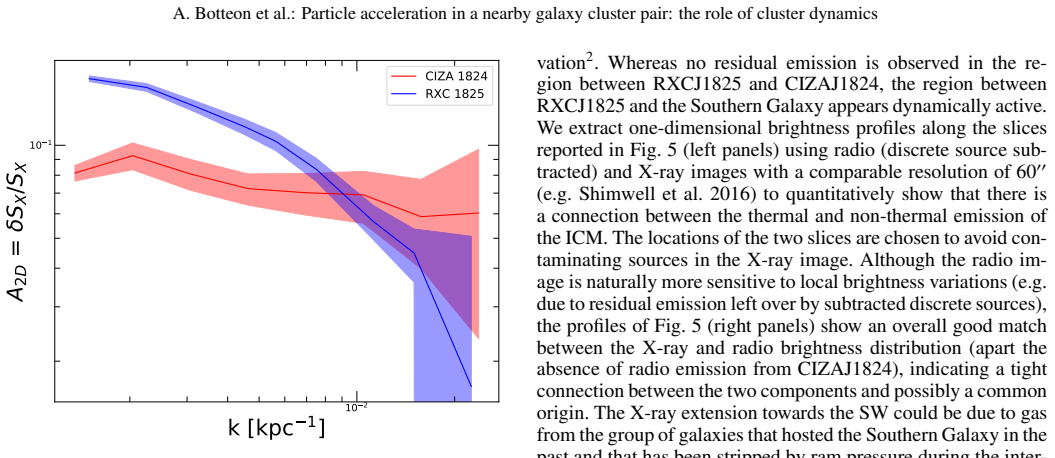
The argument is carried by a controlled comparison embedded in one binary system: two clusters at similar redshift, same line of sight, and same observations, but opposite dynamical states. The radio side uses LOFAR images at $60''$ and $90''$ resolution with careful subtraction of 18 embedded discrete sources to isolate the diffuse halo, while the X-ray side uses Fourier power spectra of surface-brightness fluctuations within 200 kpc of each X-ray peak to estimate turbulent gas motions. The match between the radio and X-ray brightness profiles along two slices, and the factor-of-two difference in fluctuation amplitude between the two clusters, are what tie the non-thermal emission to merger-driven turbulence.
What would settle it
A deep, high-resolution ($\lesssim10''$) observation at 1.4 GHz or 300 MHz that resolves the three extended discrete sources contributing $\sim208$ mJy and re-images the halo after model subtraction would settle the claim: if the recovered diffuse flux is consistent with zero or does not trace the X-ray extension, the halo classification and the merger-support conclusion would collapse.
Extended reading notes
Core claim
On the paper's own terms, the central discovery is a giant radio halo in RXC J1825.3+3026 with $S_{144}=163\pm47$ mJy and $P_{144}=(1.7\pm0.5)\times10^{24}$ W Hz$^{-1}$, making it the least powerful giant radio halo known and one of the least massive cluster hosts. The halo has a low-surface-brightness extension up to $\sim1.8$ Mpc that follows the X-ray morphology toward the remnant of a galaxy group, and the X-ray surface-brightness fluctuation amplitude of the host is consistent with other halo clusters. No diffuse radio emission is detected in the relaxed companion CIZA J1824.1+3029, whose upper limit lies more than a factor of 10 below the extrapolated scaling relation, nor in the region between the two pre-merger clusters. This within-system detection/non-detection pair is the quantitative support the paper offers for the merger-driven origin of non-thermal components in the intracluster medium.
Load-bearing premise
The load-bearing premise is that the residual flux attributed to the radio halo is genuine intracluster emission after subtracting the 18 embedded discrete sources, with the adopted $163\pm47$ mJy assumed to lie between the two measurement methods; if the extended structures of the three largest discrete sources are mis-modeled, the halo flux and the faint SW extension could be biased or spurious.
Editorial extensions
If this is right
- RXC J1825.3+3026 joins a small set of low-mass, low-power systems with giant radio halos, extending the $P_{1.4}$–$M_{500}$ and $P_{1.4}$–$L_{500}$ relations into a regime where sensitivity had previously prevented detection.
- The spatial coincidence of the radio extension and the X-ray tail toward the Southern Galaxy implies that a merger with an infalling group can leave a synchrotron trace advected or reaccelerated in the cluster outskirts.
- The non-detection in CIZA J1824.1+3029 sets an upper limit on diffuse emission at least a factor of 10 below the halo scaling relation, sharpening the dichotomy between relaxed and merging clusters.
- The absence of diffuse emission between the pre-merger pair indicates that the early interaction phase, before core crossing, has not yet converted a detectable fraction of kinetic energy into non-thermal components.
- Assuming a typical halo spectral index $\alpha=1.3$, the halo's expected 1.4 GHz power is $(8.7\pm2.5)\times10^{22}$ W Hz$^{-1}$, providing a specific target for deep follow-up observations.
Reading between the lines
- If the halo flux holds up under deeper imaging, the low-mass end of the halo scaling relation may be steeper than previous fits suggested, since RXC J1825.3+3026 falls 2–4 times below the extrapolated relation.
- A clean test of the two proposed mechanisms for the SW extension—in-situ turbulent reacceleration versus advection of central plasma—would be a spectral-index map: a steepening gradient toward the outskirts would favor reacceleration along the stripped wake.
- The same observational setup could be applied to other pre-merger pairs to establish whether the absence of inter-cluster emission is generic or depends on viewing geometry and mass ratio.
Signed reviews
Editorial analysis
A structured set of objections, weighed in public.
Referee Report
Summary. The paper presents LOFAR HBA (120–168 MHz) and XMM-Newton observations of the nearby galaxy cluster pair RXC J1825.3+3026 and CIZA J1824.1+3029. The authors report the discovery of a Mpc-scale giant radio halo in RXCJ1825 with a 144 MHz flux density of S144 = 163 ± 47 mJy (P144 = 1.7 ± 0.5 × 10^24 W Hz^-1), including a low-surface-brightness extension toward the Southern Galaxy that follows the X-ray morphology. They do not detect diffuse radio emission in CIZAJ1824 or in the region between the two clusters, and they place an upper limit on any such emission. The X-ray surface brightness fluctuation power spectra of the two clusters are presented, and the paper interprets the combined radio/X-ray picture as quantitative support for the role of cluster mergers in generating non-thermal components in the intracluster medium.
Significance. If the flux measurement is robust, RXCJ1825 is the least powerful and one of the least massive giant radio halos known, directly probing the poorly constrained low-power end of the P1.4–M500 scaling relation. The cluster pair provides a clean, controlled comparison between a merging system (RXCJ1825) and a relaxed cool-core system (CIZAJ1824), which is well suited to testing the merger-driven origin of radio halos. The paper is carefully written, uses two flux estimation approaches, and makes a conservative effort to treat the non-detection; these are strengths. The discovery is timely and of clear interest to the low-frequency radio and galaxy cluster communities.
major comments (2)
- [Section 3.1] Please note: I am treating the two flux estimates as sharing the same high-resolution source models; the paper should explicitly address this limitation or perform an additional check.
- [Section 3.1] The dimensional issue is present in the manuscript text; the authors should clarify whether A is a dimensionless number of beams or whether the noise was rescaled.
minor comments (4)
- [Section 3.1] Typo in Section 5, item 2.
- [Section 3.1] The paper states this assumption explicitly, but the scaling-relation comparison would benefit from a brief sensitivity check.
- [Section 4] Figure 4 is informative, but the text does not provide a statistical comparison.
- [Figure 2] Minor clarity issue.
Circularity Check
No circularity: the radio-halo detection and the merger/relaxed comparison are observational results derived from LOFAR and X-ray data, not from the conclusions they support.
full rationale
The central claim--discovery of a Mpc-scale radio halo in RXCJ1825 with S144=163±47 mJy and the absence of diffuse radio emission in CIZAJ1824--is an observational result obtained from LOFAR imaging and two source-subtraction methods. The flux density is measured directly from the images in the blue box; no equation defines the halo flux in terms of the dynamical-state or merger conclusion. The adopted value is the average of two independently described estimates (153±31 and 173±35 mJy), and the spread between them is treated as a systematic uncertainty, not as a predicted quantity. The comparison with the P1.4-M500 scaling relation of Cassano et al. (2013) uses an external literature fit to quantify how faint the halo is; it is not an input to the detection or to the radio classification. The X-ray power-spectrum analysis follows the method of Eckert et al. (2017) and compares with previously published halo and non-halo cluster samples; the radio and X-ray classifications are independent observables. The dynamical-state classification (pre-merger pair, RXCJ1825 disturbed, CIZAJ1824 relaxed) is taken from Clavico et al. (2019) and Girardi et al. (2019), which are prior X-ray/optical analyses by partly overlapping authors; these citations are not load-bearing for the radio flux measurement and do not import an unproven uniqueness or ansatz. The paper itself flags the main limitation: the two source-subtraction methods share the same high-resolution models of the 18 embedded discrete sources, so their agreement does not bound a common-mode under-subtraction of extended discrete-source flux. That is a measurement systematic, not a circular reduction: the claimed halo flux is not defined as the thing it is used to predict, and no fitted parameter is renamed as a prediction. There is therefore no significant circularity in the derivation chain.
Assumptions & free parameters
free parameters (2)
- Assumed spectral index alpha =
1.3 (assumed, not fitted)
- Upper-limit integration area A =
250^2 pi kpc^2 (chosen)
assumptions (4)
- domain assumption LambdaCDM cosmology with Omega_Lambda=0.7, Omega_m=0.3, H0=70 km/s/Mpc
- domain assumption The X-ray surface brightness fluctuation power spectrum method (Eckert et al. 2017) traces gas density fluctuations and relates them to turbulent velocity dispersion via sigma_v ~ 3.7 cs delta_rho/rho
- domain assumption The dynamical state and pre-merger phase of the system (RXCJ1825 in complex merger, CIZAJ1824 relaxed, pair pre-merger, Southern Galaxy group remnant) are taken from Clavico et al. (2019) and Girardi et al. (2019)
- domain assumption The 18 discrete sources identified at high resolution and subtracted are genuine sources with no significant diffuse component beyond their models
Cite this review
Pith. "Pith review of Particle acceleration in a nearby galaxy cluster pair: the role of cluster dynamics." pith.science (2026). https://pith.science/paper/CFRXGPUB
@misc{pith2026190807527,
  author       = {Pith},
  title        = {Pith review of: Particle acceleration in a nearby galaxy cluster pair: the role of cluster dynamics},
  year         = {2026},
  howpublished = {\url{https://pith.science/paper/CFRXGPUB}},
  note         = {Machine review of arXiv:1908.07527}
}
abstract
Diffuse radio emission associated with the intra-cluster medium (ICM) is observed in a number of merging galaxy clusters. It is currently believed that in mergers a fraction of the kinetic energy is channeled into non-thermal components, such as turbulence, cosmic rays and magnetic fields, that may lead to the formation of giant synchrotron sources in the ICM. Studying merging galaxy clusters in different evolutionary phases is fundamental to understanding the origin of radio emission in the ICM. We observed the nearby galaxy cluster pair RXC J1825.3+3026 ($z\sim0.065$) and CIZA J1824.1+3029 ($z\sim0.071$) at 120-168 MHz with the LOw Frequency ARray (LOFAR) and made use of a deep (240 ks) XMM-Newton dataset to study the non-thermal and thermal properties of the system. RXC J1825.3+3026 is in a complex dynamical state, with a primary on-going merger in the E-W direction and a secondary later stage merger with a group of galaxies in the SW, while CIZA J1824.1+3029 is dynamically relaxed. These two clusters are in a pre-merger phase. We report the discovery of a Mpc-scale radio halo with a low surface brightness extension in RXC J1825.3+3026 that follows the X-ray emission from the cluster center to the remnant of a galaxy group in the SW. This is among the least massive systems and the faintest giant radio halo known to date. Contrary to this, no diffuse radio emission is observed in CIZA J1824.1+3029 nor in the region between the pre-merger cluster pair. The power spectra of the X-ray surface brightness fluctuations of RXC J1825.3+3026 and CIZA J1824.1+3029 are in agreement with the findings for clusters exhibiting a radio halo and the ones where no radio emission has been detected, respectively. We provide quantitative support to the idea that cluster mergers play a crucial role in the generation of non-thermal components in the ICM.
Figures


Figures from the paper (2 more)

Reference graph
Works this paper leans on
-
[1]
1982, ApJ, 257, 23 Bîrzan, L., Rafferty, D., Cassano, R., et al
Beers, T., Geller, M., & Huchra, J. 1982, ApJ, 257, 23 Bîrzan, L., Rafferty, D., Cassano, R., et al. 2019, MNRAS, 487, 4775
work page 1982
-
[2]
Bonafede, A., Brüggen, M., Rafferty, D., et al. 2018, MNRAS, 478, 2927
work page 2018
-
[3]
Botteon, A., Shimwell, T., Bonafede, A., et al. 2018, MNRAS, 478, 885
work page 2018
-
[4]
Botteon, A., Shimwell, T., Bonafede, A., et al. 2019, A&A, 622, A19
work page 2019
-
[5]
1995, in Bulletin of the American Astronomical Society, V ol
Briggs, D. 1995, in Bulletin of the American Astronomical Society, V ol. 27, American Astronomical Society Meeting Abstracts, 1444
work page 1995
- [6]
-
[7]
Cassano, R., Brunetti, G., Norris, R., et al. 2012, A&A, 548, A100
work page 2012
-
[8]
2013, ApJ, 777, 141 Article number, page 6 of 7 A
Cassano, R., Ettori, S., Brunetti, G., et al. 2013, ApJ, 777, 141 Article number, page 6 of 7 A. Botteon et al.: Particle acceleration in a nearby galaxy cluster pair: the role of cluster dynamics
work page 2013
Show all 42 references
-
[9]
2019, A&A, 627, A176
Clarke, A., Scaife, A., Shimwell, T., et al. 2019, A&A, 627, A176
2019
-
[10]
2019, arXiv e-prints, arXiv:1908.02276
Clavico, S., De Grandi, S., Ghizzardi, S., et al. 2019, arXiv e-prints, arXiv:1908.02276
2019 arXiv
-
[11]
1998, AJ, 115, 1693
Condon, J., Cotton, W., Greisen, E., et al. 1998, AJ, 115, 1693
1998
-
[12]
2015, A&A, 580, A97 de Gasperin, F., Dijkema, T., Drabent, A., et al
Cuciti, V ., Cassano, R., Brunetti, G., et al. 2015, A&A, 580, A97 de Gasperin, F., Dijkema, T., Drabent, A., et al. 2019, A&A, 622, A5
2015
-
[13]
2017, ApJ, 843, L29
Eckert, D., Gaspari, M., Vazza, F., et al. 2017, ApJ, 843, L29
2017
-
[14]
2019, A&A, 621, A40
Eckert, D., Ghirardini, V ., Ettori, S., et al. 2019, A&A, 621, A40
2019
-
[15]
2019, A&A, 621, A39
Ettori, S., Ghirardini, V ., Eckert, D., et al. 2019, A&A, 621, A39
2019
-
[16]
2012, A&A Rev., 20, 54
Feretti, L., Giovannini, G., Govoni, F., & Murgia, M. 2012, A&A Rev., 20, 54
2012
-
[17]
& Churazov, E
Gaspari, M. & Churazov, E. 2013, A&A, 559, A78
2013
-
[18]
2014, A&A, 569, A67
Gaspari, M., Churazov, E., Nagai, D., Lau, E., & Zhuravleva, I. 2014, A&A, 569, A67
2014
-
[19]
2019, A&A, 621, A41
Ghirardini, V ., Eckert, D., Ettori, S., et al. 2019, A&A, 621, A41
2019
-
[20]
2019, arXiv e-prints, arXiv:1908.02277
Girardi, M., Boschin, W., De Grandi, S., et al. 2019, arXiv e-prints, arXiv:1908.02277
2019 arXiv
-
[21]
2019, Science, 364, 981
Govoni, F., Orrù, E., Bonafede, A., et al. 2019, Science, 364, 981
2019
-
[22]
& Thompson, L
Gregory, S. & Thompson, L. 1984, ApJ, 286, 422
1984
-
[23]
2018, ApJ, 857, 26
Ha, J.-H., Ryu, D., & Kang, H. 2018, ApJ, 857, 26
2018
-
[24]
2016, MNRAS, 462, 1910
Hardcastle, M., Gürkan, G., van Weeren, R., et al. 2016, MNRAS, 462, 1910
2016
-
[25]
2018, MNRAS, 478, 2218
Hoang, D., Shimwell, T., van Weeren, R., et al. 2018, MNRAS, 478, 2218
2018
-
[26]
2017, A&A, 598, A78
Intema, H., Jagannathan, P., Mooley, K., & Frail, D. 2017, A&A, 598, A78
2017
-
[27]
2019, A&A, 622, A22
Mandal, S., Intema, H., Shimwell, T., et al. 2019, A&A, 622, A22
2019
-
[28]
1980, ARA&A, 18, 165 Offringa, A., McKinley, B., Hurley-Walker, N., et al
Miley, G. 1980, ARA&A, 18, 165 Offringa, A., McKinley, B., Hurley-Walker, N., et al. 2014, MNRAS, 444, 606
1980
-
[29]
2015, MNRAS, 452, 3064
Rawes, J., Worrall, D., & Birkinshaw, M. 2015, MNRAS, 452, 3064
2015
-
[30]
& Bressert, E
Robitaille, T. & Bressert, E. 2012, APLpy: Astronomical Plotting Library in
2012
-
[31]
2019, A&A, 622, A24
Savini, F., Bonafede, A., Brüggen, M., et al. 2019, A&A, 622, A24
2019
-
[32]
2016, MNRAS, 459, 277
Shimwell, T., Luckin, J., Brüggen, M., et al. 2016, MNRAS, 459, 277
2016
-
[33]
2017, A&A, 598, A104
Shimwell, T., Röttgering, H., Best, P., et al. 2017, A&A, 598, A104
2017
-
[34]
2019, A&A, 622, A1
Shimwell, T., Tasse, C., Hardcastle, M., et al. 2019, A&A, 622, A1
2019
-
[35]
& Tasse, C
Smirnov, O. & Tasse, C. 2015, MNRAS, 449, 2668
2015
-
[36]
2008, A&A, 478, 615
Snowden, S., Mushotzky, R., Kuntz, K., & Davis, D. 2008, A&A, 478, 615
2008
- [37]
-
[38]
2018, A&A, 611, A87 van Haarlem, M., Wise, M., Gunst, A., et al
Tasse, C., Hugo, B., Mirmont, M., et al. 2018, A&A, 611, A87 van Haarlem, M., Wise, M., Gunst, A., et al. 2013, A&A, 556, A2 van Weeren, R., de Gasperin, F., Akamatsu, H., et al. 2019, Space Sci. Rev., 215, 16 van Weeren, R., Williams, W., Hardcastle, M., et al. 2016, ApJS, 223, 2
2018
-
[39]
2017, MNRAS, 464, 210
Vazza, F., Jones, T., Brüggen, M., et al. 2017, MNRAS, 464, 210
2017
-
[40]
2019, A&A, 622, A25
Wilber, A., Brüggen, M., Bonafede, A., et al. 2019, A&A, 622, A25
2019
-
[41]
2016, MNRAS, 460, 2385
Williams, W., van Weeren, R., Röttgering, H., et al. 2016, MNRAS, 460, 2385
2016
-
[42]
2014, ApJ, 788, L13 Article number, page 7 of 7
Zhuravleva, I., Churazov, E., Schekochihin, A., et al. 2014, ApJ, 788, L13 Article number, page 7 of 7
2014
Reviewed August 14, 2026 · model on record in the stance chip above.
Discussion (0). Continue with ORCID to comment.