REVIEW 4 major objections 5 minor 34 references
Runaway Young Stars in the Orion Nebula
T0 review · 4 major / 5 minor · reviewed 2026-08-14 · deepseek-v4-flash
Pith's one-line read Using Gaia DR2 proper motions, the paper identifies 26 young stars near the Orion Nebula that were likely ejected by three-body encounters within the last million years.
desk verdict A useful, reproducible candidate list of 26 runaway young stars in the ONC, but the origin breakdown (Trapezium vs OB-star vs visitor) is over-interpreted without a statistical null hypothesis. read the letter →
The pith
A machine-rendered reading of the paper's core claim, the machinery that carries it, and where it could break.
The reading
What carries the argument
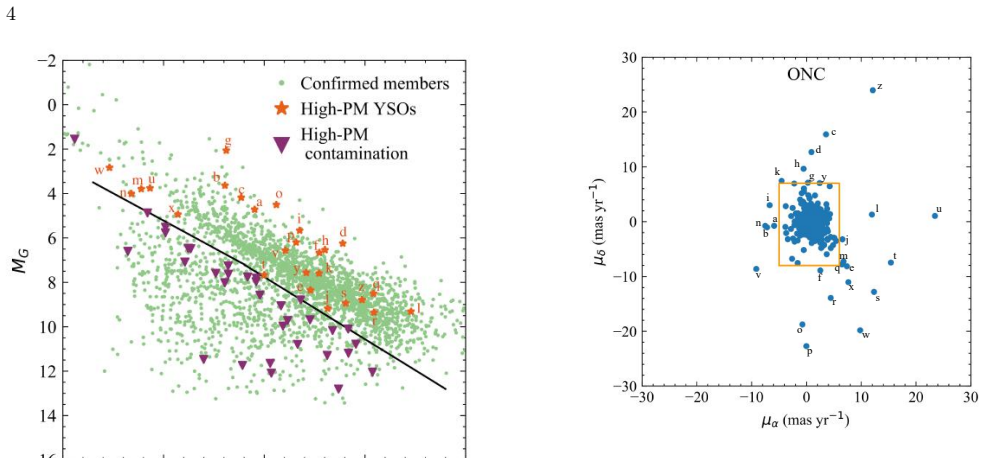
The machinery is a proper-motion outlier selection combined with a photometric youth filter and linear traceback. First, 5988 literature-confirmed Orion A young stellar objects are intersected with Gaia DR2 astrometry and the color-magnitude cuts from Kounkel et al. (2018), leaving 1867 stars. High proper motion is defined as falling outside a box of -5 to +6 mas/yr in right ascension and -8 to +7 mas/yr in declination around the cluster mean, corresponding to roughly 10-20 km/s at the distance of the Orion Nebula Cluster. The traceback then treats the ejected star as traveling in a straight line at constant velocity in the cluster rest frame, projecting its apparent path backward for up to one million years and looking for a dense region, an OB star, or another known population lying within the uncertainty cone.
What would settle it
A decisive check is to re-derive astrometric solutions with Gaia DR3 and take radial velocities for all 26 candidates: if the eight sources with poor astrometric fits resolve into binaries with cluster-like proper motions, or if more than a few of the 26 show lithium depletion indicating field-star ages older than 15-20 Myr, the ejection census would shrink.
Extended reading notes
Core claim
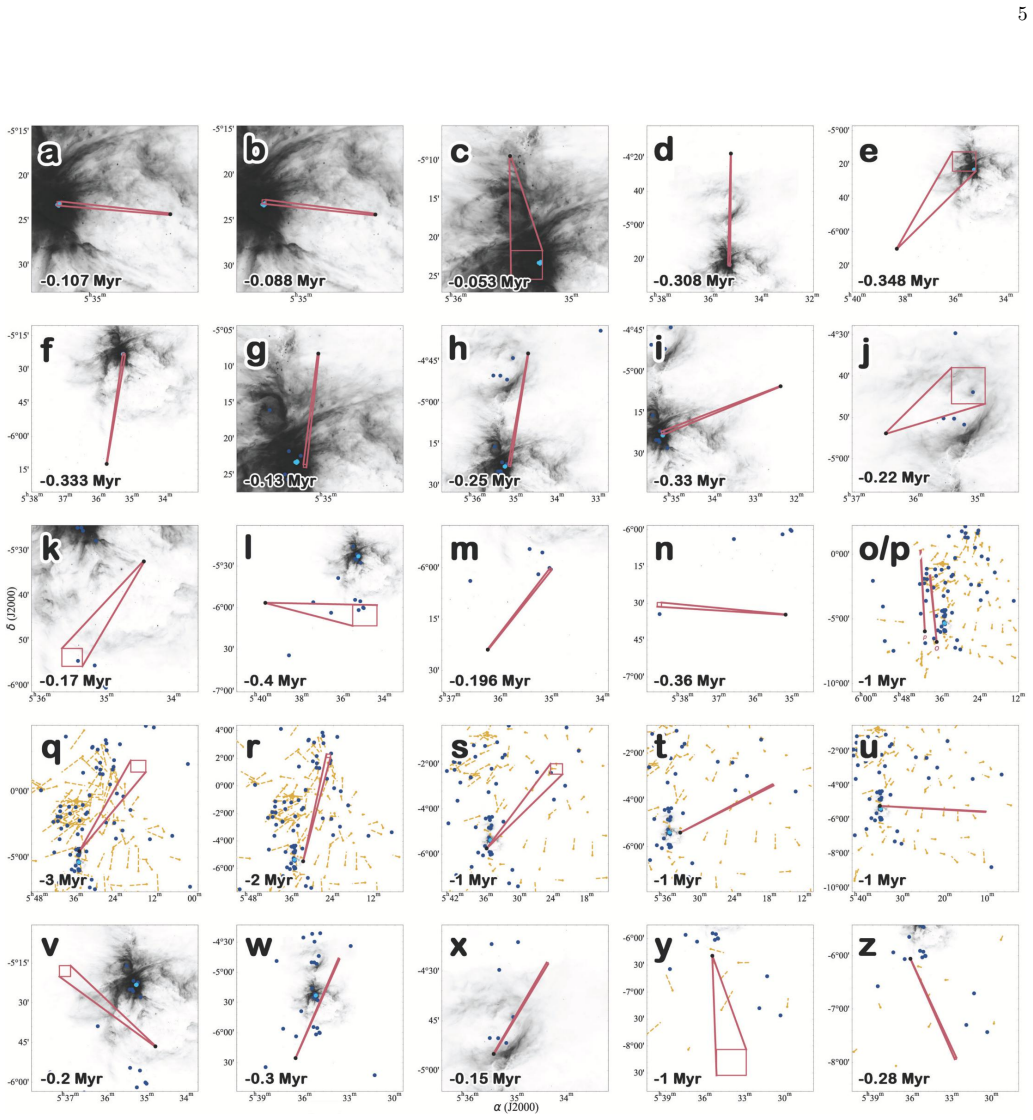
The central claim is that the Orion Nebula Cluster has produced at least 26 runaway pre-main-sequence stars through dynamical three-body encounters within the past roughly one million years. The evidence is kinematic: each candidate's proper motion is inconsistent with the cluster's cold velocity dispersion, and the youth criteria (membership catalogs, photometry, disks, lithium absorption, X-rays, low surface gravity) rule out old field stars as the bulk of the sample. For each candidate the authors subtract the cluster mean motion and project the position backward, identifying a plausible birthplace: the Trapezium for nine stars, another OB star for five, another Orion population for seven, and no unique origin for five. The paper also notes that eight candidates have poor astrometric fits (unit weight error greater than one) and should be rechecked with future Gaia data.
Load-bearing premise
The census rests on the literature-based catalog of confirmed young stars, cleaned by photometric cuts, being nearly free of old field stars; if even a few of the 26 high-proper-motion candidates are actually older field stars, the derived ejection fraction of about 1.4% would be inflated.
Editorial extensions
If this is right
- The nine Trapezium sources place the ejection events in the last 0.05-0.3 Myr, making the Orion Nebula Cluster core an ongoing, not ancient, dynamical laboratory.
- Seven candidates are visitors from other Orion populations, so the true number of ejected stars around the cluster is likely higher than 26; the search area and membership coverage bias the census low.
- The disk fraction among ejected stars (32 ± 13%, excluding older populations) is consistent with but slightly lower than the cluster average, suggesting ejections can strip or disrupt protoplanetary disks in some cases.
- Pairs like V1961 Ori and Brun 259, moving together at similar speeds and separated by only 17 arcseconds, indicate that a single three-body event can eject multiple stars at once.
- Because lower-velocity ejections (below 2 km/s) are hidden inside the cluster velocity dispersion, the 1.4% fraction counts only the most extreme tail of ejection events.
Reading between the lines
- If the census is complete only for the high-velocity tail, the total number of three-body encounters in the Orion Nebula Cluster over its history is likely many times larger than 26; scaling from the ejection velocity distribution would put the true rate in the hundreds.
- A testable prediction follows from the reported disk deficit: ejected stars should show smaller disk radii, lower accretion rates, or higher disk photoevaporation than cluster members of the same age; targeted observations of sources like V360 Ori and ESO-HA 1713 could test this.
- The fastest candidate (2MASS J05360962-0603316, roughly 58 km/s) may be unbound from the Orion Complex; if a future radial velocity measurement confirms this, it becomes a probe of the field runaway population born in Orion.
- The same proper-motion outlier plus traceback method, applied to other Gaia-mapped young clusters in the Orion Complex, could quantify whether the Trapezium's high ejection rate is typical of dense cluster cores.
Signed reviews
Editorial analysis
A structured set of objections, weighed in public.
Referee Report
Summary. The paper uses Gaia DR2 astrometry together with a literature-based catalog of 5988 confirmed young stellar objects in Orion A to search for stars with unusually high proper motions relative to the ONC mean. After photometric youth cuts and a proper-motion selection box, the authors identify 26 candidate runaway/ejected stars. For each candidate they project the two-dimensional proper motion backward in time and assign an origin: 9 to the Trapezium, 5 to interactions with OB stars, 7 to other Orion Complex populations ('visitors'), and 5 to no definitive origin. They report an ejection fraction of about 1.4% of the analyzed sample and a disk fraction among the ejected stars that is somewhat lower than the cluster average. The paper argues that three-body interactions in dense young clusters are frequent enough to produce such a census.
Significance. If the origin assignments are statistically robust, this would be a valuable census of dynamical ejections in the nearest massive young cluster, complementing earlier studies of individual runaways such as AE Aur and mu Col. The selection procedure is transparent and reproducible from the described cuts, and the candidate list is a useful resource for follow-up. The paper also correctly cross-checks against previously identified runaways (V1961 Ori, V1321 Ori) and explicitly flags the eight high-RUWE sources. However, the central quantitative claims—the 9/5/7 origin breakdown and the 1.4% ejection fraction—currently rest on visual traceback projections without a null-hypothesis test for chance alignments, and the use of only two-dimensional proper motions leaves the individual origin assignments underdetermined. The census of high-proper-motion stars is likely real, but the 'likely encounter' classification needs a statistical grounding before the main conclusions can be accepted.
major comments (4)
- [Section 3, Figure 4] The assignment of 9/26 Trapezium, 5/26 OB-star, and 7/26 visitor origins is made by projecting two-dimensional paths backward in time and stopping when a plausible interaction site is encountered, but no statistical test is reported for how many such origin assignments would occur by chance. At the ONC distance 1 mas/yr is about 2 km/s, so a 10 km/s star sweeps roughly 1.4 degrees in 1 Myr—a substantial fraction of the 2-degree search radius—and the Trapezium and OB stars sit at the center of that field. I ask the authors to add a Monte Carlo or analytic chance-alignment calculation under a null hypothesis of isotropically oriented high proper motions; the abstract's quantitative breakdown and the ejection fraction in Section 4 depend on these origin classifications not being chance coincidences.
- [Section 2] The photometric and membership cuts are stated to have 1–2% contamination on the 3-sigma level, but that estimate applies to the full catalog, not specifically to the high-proper-motion tail. Because the selection box deliberately excludes the bulk of the cluster's velocity dispersion, any residual field-star contamination will be concentrated in exactly the tail used to define the 26 candidates. Please quantify the expected number of contaminants among the 26 candidates—for example, using a Galactic model, a control sample of sources that pass the photometric cuts but fail the membership list, or an isochrone-based vetting—and recompute the 1.4% ejection fraction under that correction.
- [Section 3, Section 4] The traceback uses only the two-dimensional proper motions after subtracting the ONC mean, and the uncertainty cones in Figure 4 include only proper-motion errors, not the unknown line-of-sight component or individual parallax distances. A star's true three-dimensional trajectory could pass well outside any identified interaction site, and the paper's own Discussion concedes that 'it is necessary to involve distances and radial velocities in the analysis' to identify low-velocity ejections in a statistical manner. This limitation is load-bearing for the individual origin classifications, which are the paper's headline result, even if the census of high-proper-motion stars itself is not affected.
- [Section 3] Eight of the 26 candidates have RUWE greater than 1, indicating that their Gaia DR2 astrometric solutions are not well fit by the five-parameter model. The authors appropriately flag these sources, but they are still retained in all of the counts, including the origin breakdown and the disk-fraction comparison in Section 4. Because this is nearly one-third of the sample, I ask the authors to recompute the origin statistics and the ejection and disk fractions with and without the high-RUWE sources, to demonstrate that the conclusions are not driven by the astrometrically marginal subset.
minor comments (5)
- [Section 2] The citation '[reipurth2010]' is not rendered in the standard author-year format and should be corrected to Reipurth et al. (2010).
- [Section 2] The parallax cut is written as '2<π < 5' without stating the units; it should read 2 < ϖ < 5 mas, with the parallax symbol ϖ rather than π.
- [Section 2 and Section 4] The final sample size is given as 1867 stars in Section 2 but as 1871 stars in Section 4; the discrepancy should be reconciled, and the ejection-fraction denominator should be checked.
- [Figure 4 caption] The caption reads 'Spitzer µm background'; the wavelength (8 µm) appears to be missing from the printed text.
- [Section 3.2] The text says 'Several stars appear to originate from NGC 1980' but only three stars (V1116 Ori, ESO-HA 1713, Parenago 2374) are described for that region; 'Three' would be more precise.
Circularity Check
No significant circularity: the high-proper-motion candidate census and origin classifications are derived from external Gaia astrometry and literature membership catalogs, not from fitted parameters or self-referential definitions.
full rationale
The paper's selection pipeline starts from Gaia DR2 astrometry and a literature-based catalog of confirmed Orion A young stars. The high-proper-motion cut is a fixed, user-defined box in proper-motion space, not a parameter fitted to the 26 candidates; the ejection interpretation is then an inference from the observed proper-motion excess after youth selection. The traceback origin assignments (Trapezium, OB-star encounters, visitors, and unknown) are interpretive projections of the measured proper motions, and the paper explicitly labels them as candidates. The ~1.4% ejection fraction is simply the candidate count divided by the analyzed sample, with no fitted quantity being renamed as a prediction. Self-citations to Kounkel et al. (2018) and Kounkel & Covey (2019) supply empirical photometric cuts and the independent kinematic statement that other Orion young populations have near-zero proper motions in this reference frame; these are external, falsifiable data products rather than uniqueness theorems or ansatze that pre-impose the conclusion. The statement that all identified ejected stars have high proper motions is a restatement of the selection cut, but it is descriptive and not load-bearing. The absence of a formal chance-alignment test for the 2D tracebacks is a statistical robustness concern, not circularity. Overall, the derivation chain is self-contained against external data and shows no significant circularity.
Assumptions & free parameters
free parameters (3)
- Proper motion selection box =
-5 < mu_alpha < 6 mas/yr, -8 < mu_delta < 7 mas/yr
- Parallax and radius cuts =
2 < pi < 5 mas, search radius 2 degrees around alpha=83.833, delta=-5.391
- Photometric youth cuts =
MG < 2.46*|GBP-GRP|+2.76 for 0.3<|GBP-GRP|<1.8; MG < 2.8*|GBP-GRP|+2.16 for |GBP-GRP|>1.8
assumptions (4)
- domain assumption The literature membership catalog of 5988 stars is a reliable list of young Orion A objects with only 1-2% main sequence contamination.
- domain assumption A confirmed young star in the ONC field with proper motion outside the box must have been accelerated by a 3-body interaction rather than by any other process.
- domain assumption The traceback can ignore the cluster potential and treat the stars as moving with constant proper motion and no radial acceleration.
- domain assumption OB stars along a projected path are treated as stationary in the cluster frame and are assumed to be the likely interaction partners.
Cite this review
Pith. "Pith review of Runaway Young Stars in the Orion Nebula." pith.science (2026). https://pith.science/paper/7PI6XYHV
@misc{pith2026190807550,
  author       = {Pith},
  title        = {Pith review of: Runaway Young Stars in the Orion Nebula},
  year         = {2026},
  howpublished = {\url{https://pith.science/paper/7PI6XYHV}},
  note         = {Machine review of arXiv:1908.07550}
}
read the original abstract
The star forming region of the Orion Nebula (ONC) is ideal to study the stellar dynamics of young stars in a clustered environment. Using Gaia DR2 we search for the pre-main sequence stars with unusually high proper motions that may be representative of a dynamical ejection from unstable young triple systems or other close three-body encounters. We identify twenty-six candidate stars that are likely to have had such an encounter in the last 1 Myr. Nine of these stars could be traced back to the densest central-most region of the ONC, the Trapezium, while five others have likely interactions with other OB-type stars in the cluster. Seven stars originate from other nearby populations within the Orion Complex that coincidentally scattered towards the ONC. A definitive point of origin cannot be identified for the remaining sources. These observations shed light on the frequency of the ejection events in young clusters.
Figures


Figures from the paper (1 more)
Reference graph
Works this paper leans on
-
[1]
Multiplicity of the Orion Trapezium stars
Costero, R. 2019, arXiv e-prints, arXiv:1906.11956 Da Rio, N., Robberto, M., Hillenbrand, L. A., Henning, T., & Stassun, K. G. 2012, ApJ, 748, 14 Da Rio, N., Robberto, M., Soderblom, D. R., et al. 2010, ApJ, 722, 1092
work page Pith review arXiv 2019
-
[2]
Daemgen, S., Correia, S., & Petr-Gotzens, M. G. 2012, A&A, 540, A46
work page 2012
-
[3]
A., Loinard, L., Rodr´ ıguez, L
Dzib, S. A., Loinard, L., Rodr´ ıguez, L. F., et al. 2017, ApJ, 834, 139
work page 2017
-
[4]
Fang, M., Kim, J. S., van Boekel, R., et al. 2013, ApJS, 207, 5
work page 2013
-
[5]
2009, A&A, 504, 461
Fang, M., van Boekel, R., Wang, W., et al. 2009, A&A, 504, 461
2009
-
[6]
Fang, M., Kim, J. S., Pascucci, I., et al. 2017, AJ, 153, 188 F˝ ur´ esz, G., Hartmann, L. W., Megeath, S. T., Szentgyorgyi, A. H., & Hamden, E. T. 2008, ApJ, 676, 1109 Gaia Collaboration, Brown, A. G. A., Vallenari, A., et al. 2018, A&A, 616, A1
work page 2017
-
[7]
Getman, K. V., Feigelson, E. D., Grosso, N., et al. 2005, ApJS, 160, 353
work page 2005
-
[8]
Getman, K. V., Feigelson, E. D., Kuhn, M. A., et al. 2014b, ApJ, 787, 108 Großschedl, J. E., Alves, J., Teixeira, P. S., et al. 2019, A&A, 622, A149
work page 2019
Show all 34 references
-
[9]
2016, A&A, 593, A7
Hasenberger, B., Forbrich, J., Alves, J., et al. 2016, A&A, 593, A7
2016
-
[10]
Hillenbrand, L. A. 1997, AJ, 113, 1733
1997
-
[11]
Hoogerwerf, R., de Bruijne, J. H. J., & de Zeeuw, P. T. 2001, A&A, 365, 49
2001
-
[12]
2012, ApJ, 752, 59 —
Hsu, W.-H., Hartmann, L., Allen, L., et al. 2012, ApJ, 752, 59 —. 2013, ApJ, 764, 114
2012
-
[13]
F., & Walker, M
Jones, B. F., & Walker, M. F. 1988, AJ, 95, 1755
1988
-
[14]
R., Konopacky, Q., et al
Kim, D., Lu, J. R., Konopacky, Q., et al. 2019, AJ, 157, 109
2019
-
[15]
2019, arXiv e-prints, arXiv:1907.07709
Kounkel, M., & Covey, K. 2019, arXiv e-prints, arXiv:1907.07709
2019 arXiv
-
[16]
J., et al
Kounkel, M., Hartmann, L., Tobin, J. J., et al. 2016, ApJ, 821, 8
2016
-
[17]
2018, AJ, 156, 84
Kounkel, M., Covey, K., Su´ arez, G., et al. 2018, AJ, 156, 84
2018
-
[18]
2019, arXiv e-prints, arXiv:1903.10523
Kounkel, M., Covey, K., Moe, M., et al. 2019, arXiv e-prints, arXiv:1903.10523
2019 arXiv
-
[19]
A., Feigelson, E
Kuhn, M. A., Feigelson, E. D., Getman, K. V., et al. 2014, ApJ, 787, 107
2014
-
[20]
Luhman, K. L. 2018, AJ, 156, 271
2018
-
[21]
L., Robberto, M., Tan, J
Luhman, K. L., Robberto, M., Tan, J. C., et al. 2017, ApJL, 838, L3
2017
-
[22]
Mamajek, E. E. 2009, in American Institute of Physics Conference Series, Vol. 1158, American Institute of Physics Conference Series, ed. T. Usuda, M. Tamura, & M. Ishii, 3–10
2009
-
[23]
McNamara, B. J. 1976, AJ, 81, 375
1976
-
[24]
T., Gutermuth, R., Muzerolle, J., et al
Megeath, S. T., Gutermuth, R., Muzerolle, J., et al. 2012, AJ, 144, 192
2012
-
[25]
J., Megeath, S
Pillitteri, I., Wolk, S. J., Megeath, S. T., et al. 2013, ApJ, 768, 99
2013
-
[26]
Looney, L. W. 1995, ApJL, 455, L189
1995
-
[27]
M., Hillenbrand, L
Rebull, L. M., Hillenbrand, L. A., Strom, S. E., et al. 2000, AJ, 119, 3026
2000
-
[28]
M., Stauffer, J
Rebull, L. M., Stauffer, J. R., Megeath, S. T., Hora, J. L., & Hartmann, L. 2006, ApJ, 646, 297
2006
-
[29]
2010, ApJL, 725, L56 Rodr´ ıguez, L
Reipurth, B., Mikkola, S., Connelley, M., & Valtonen, M. 2010, ApJL, 725, L56 Rodr´ ıguez, L. F., Poveda, A., Lizano, S., & Allen, C. 2005, ApJL, 627, L65
2010
-
[30]
J., Arnold, B., et al
Schoettler, C., Parker, R. J., Arnold, B., et al. 2019, arXiv e-prints, arXiv:1905.10317
2019 arXiv
-
[31]
W., Szentgyorgyi, A
Sicilia-Aguilar, A., Hartmann, L. W., Szentgyorgyi, A. H., et al. 2005, AJ, 129, 363
2005
-
[32]
Strand, K. A. 1958, ApJ, 128, 14
1958
-
[33]
Tan, J. C. 2004, ApJL, 607, L47
2004
-
[34]
Zeeuw, P. T. 2018, A&A, 620, A172
2018
Reviewed August 14, 2026 · model on record in the stance chip above.
Discussion (0). Continue with ORCID to comment.