REVIEW 3 major objections 4 minor 46 references
Reactive Probabilistic Programming
T0 review · 3 major / 4 minor · reviewed 2026-08-14 · deepseek-v4-flash
Pith's one-line read ProbZelus is the first synchronous probabilistic programming language: it puts Bayesian inference inside unbounded reactive streams while keeping memory bounded for a large class of models.
desk verdict ProbZelus is the real deal as the first synchronous PPL; the practical bounded-memory results hold up, but the advertised guarantee is informal and needs either a proof or a more careful statement. read the letter →
The pith
A machine-rendered reading of the paper's core claim, the machinery that carries it, and where it could break.
The reading
What carries the argument
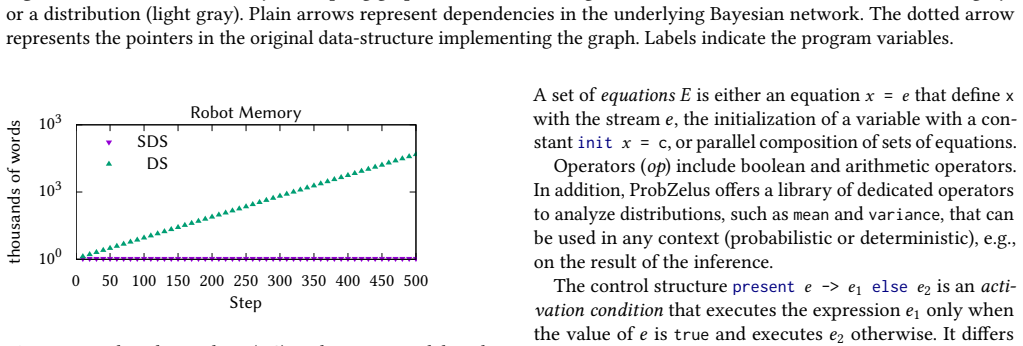
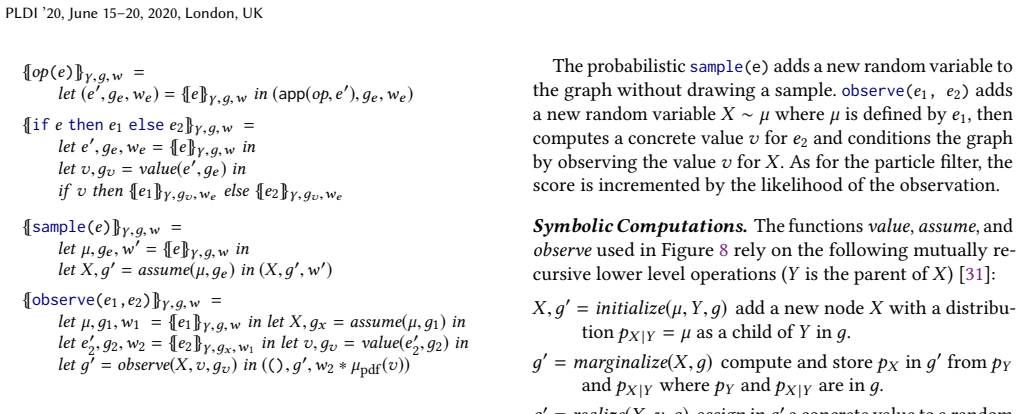
The load-bearing mechanism is the co-iterative semantics of stream functions, in which a program is an initial state plus a transition function; the probabilistic variant returns a measure over pairs (value, next state), adapted from measure-theoretic semantics of probabilistic programs. Around this semantics the paper builds a compiler to the first-order functional language $\mu$F, and re-implements delayed sampling with a pointer-minimal graph: initialized nodes keep only a parent pointer, marginalized nodes only a child pointer, so nodes that the program no longer references can be garbage-collected. The graph is what carries symbolic exact inference, and the pointer discipline is what turns an algorithm whose memory grew with the number of random variables into one whose memory stays flat for bounded-dependency models.
What would settle it
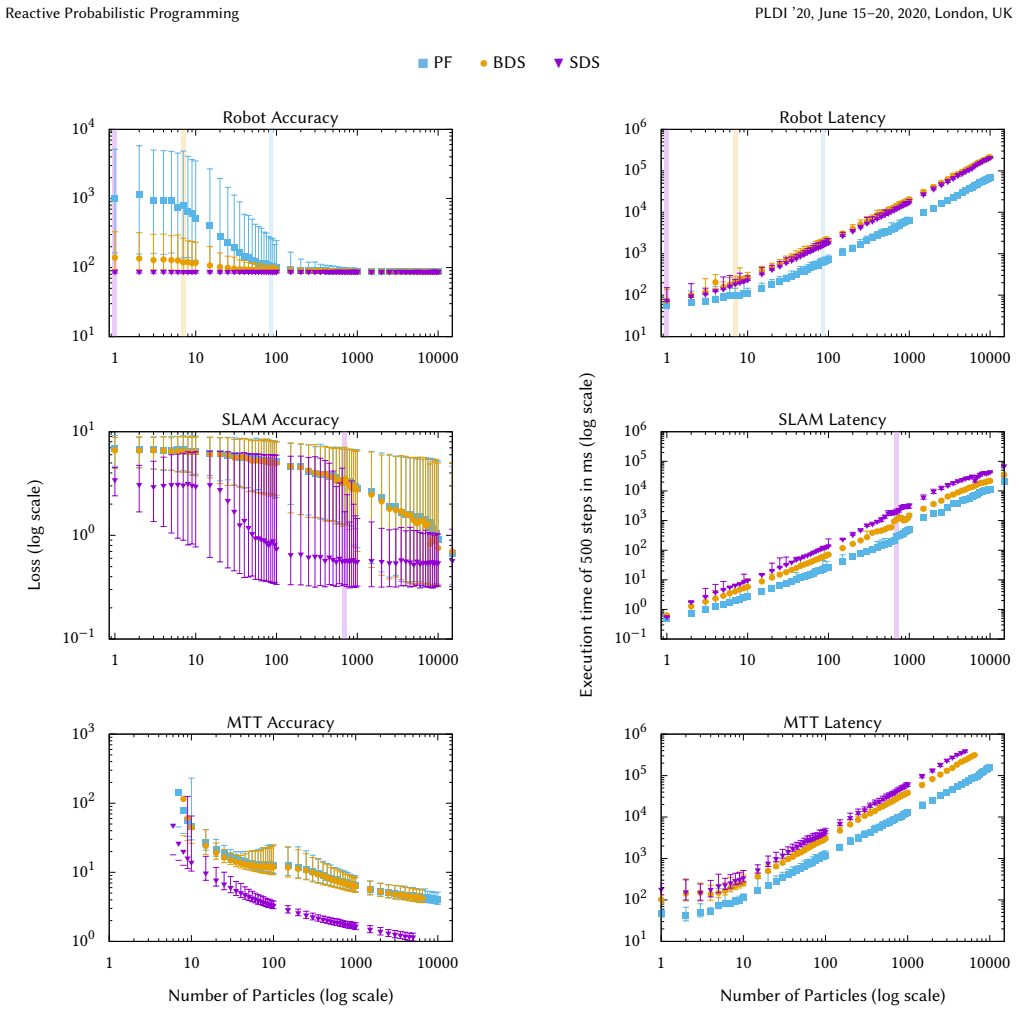
Instrument the published SDS implementation on the Robot benchmark from Section 2 and plot the number of live heap words per step for 10,000 steps; the bounded-memory claim stands only if that curve is flat. A linear increase in live heap words with step number would refute the central guarantee.
Extended reading notes
Core claim
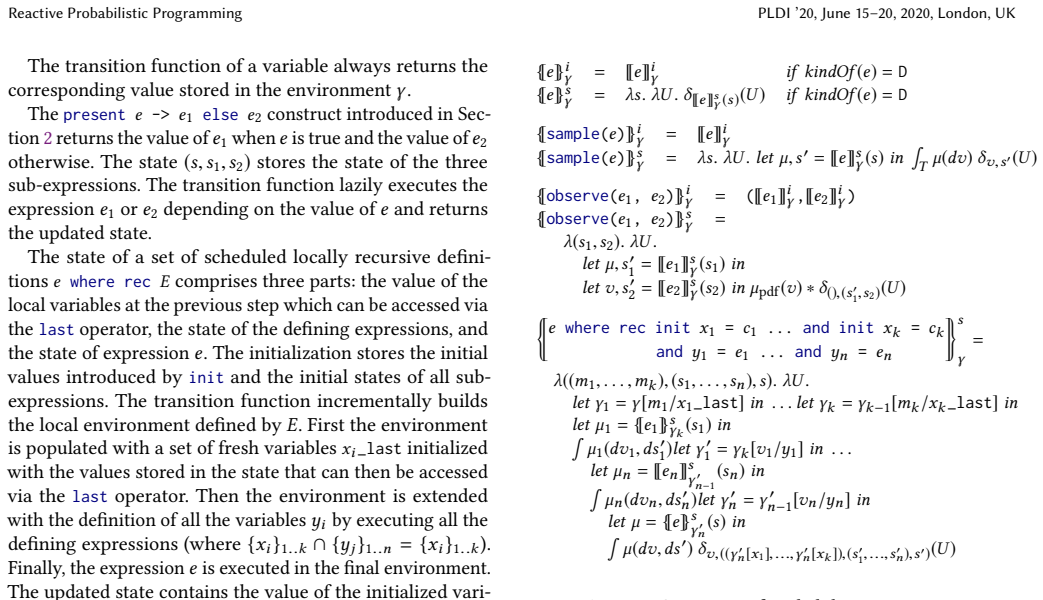
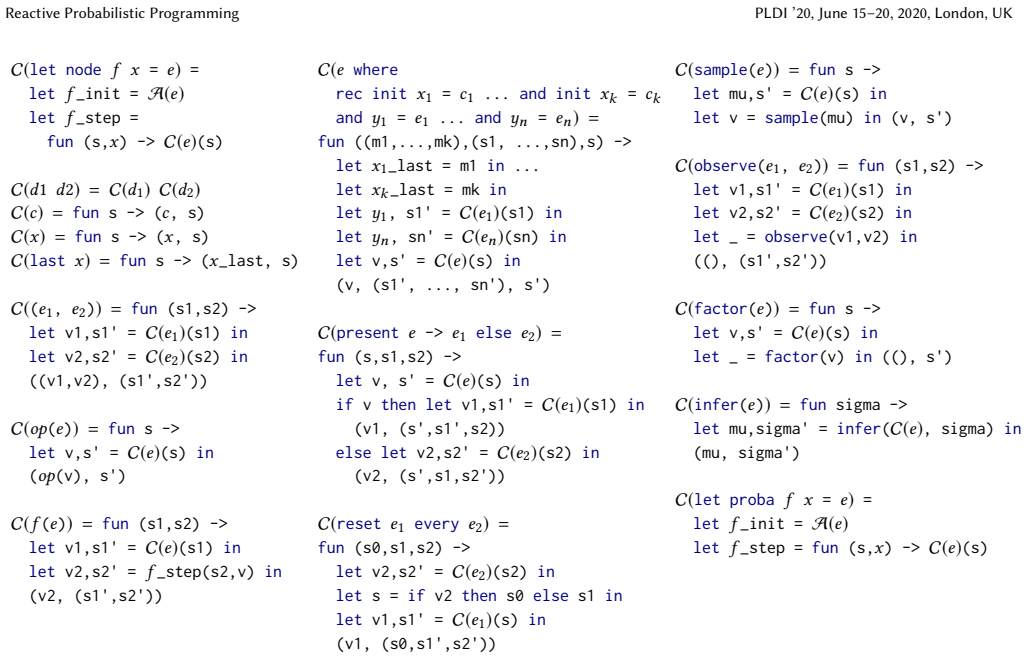
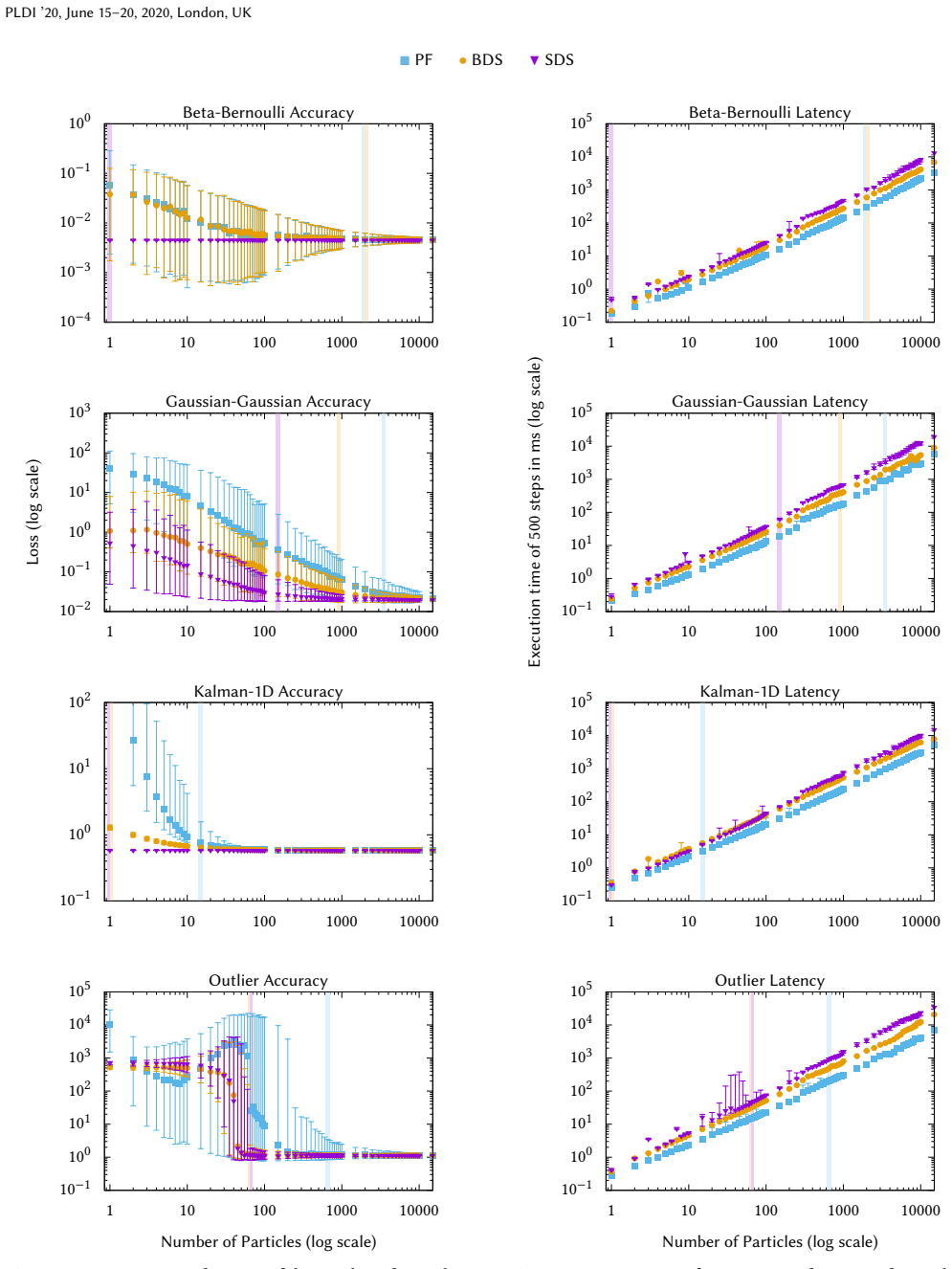
The paper's central claim is that probabilistic programming can be embedded in the synchronous data-flow paradigm without losing its resource guarantees. ProbZelus is claimed to be the first synchronous probabilistic programming language: it extends the Zelus language with sample, observe, and infer, gives probabilistic stream functions a measure-theoretic co-iterative semantics, and separates deterministic from probabilistic code by a kind system so that infer is the only bridge from the probabilistic world back to the deterministic one. The paper proves that compilation from ProbZelus to the first-order language $\mu$F preserves this semantics, and on the inference side it contributes streaming delayed sampling, a pointer-minimal version of delayed sampling that keeps partial exact inference over infinite streams in bounded memory. Evaluation on Kalman, robot, SLAM, and multi-target tracking benchmarks demonstrates that SDS reaches target accuracy with far fewer particles than a particle filter, and on conjugate state-space models it is exact with a single particle.
Load-bearing premise
The bounded-memory guarantee of SDS rests on an informal condition—the model keeps only bounded dependency chains between variables—that the paper neither defines formally, proves, nor checks statically; if that condition cannot be made precise, the headline guarantee has no clear scope.
Editorial extensions
If this is right
- ProbZelus programs can run Bayesian inference at every clock tick and feed the inferred distribution back into the controller, all in the same source.
- For state-space models with conjugate updates, SDS is exact with one particle, so the accuracy-versus-particle-count tradeoff disappears for that class.
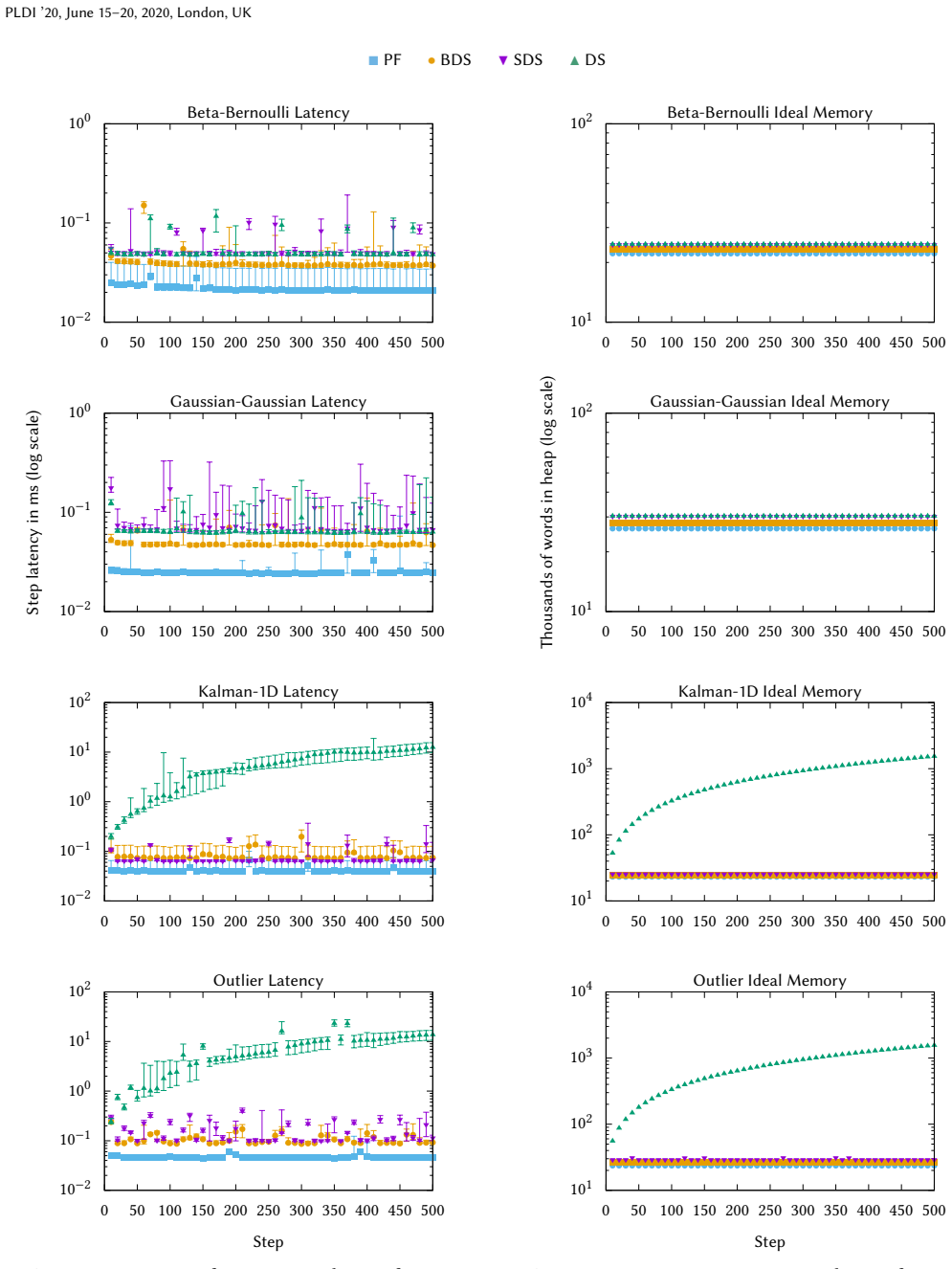
- SDS keeps live memory constant on non-terminating streams for models with bounded dependency chains, whereas the original delayed sampling grows linearly.
- On SLAM and multi-target tracking, SDS reaches target accuracy while a particle filter times out, widening the set of feasible online inference problems.
Reading between the lines
- Beyond the paper, the bounded-dependency condition could likely be turned into a static analysis on ProbZelus programs, so compilers could reject programs that violate the memory bound instead of relying on the programmer to write them.
- Because SDS is defined on the compiled $\mu$F core, the same streaming inference engine could be reused by other front-ends that lower into that core.
- The pointer-minimal graph idea applies beyond synchronous languages: any long-running online Bayesian inference task that must forget old latent variables could use the same pruning discipline.
- The paper leaves continuous-time probabilistic models open; combining SDS with the base language's support for ordinary differential equations is a natural extension.
Signed reviews
Editorial analysis
A structured set of objections, weighed in public.
Referee Report
Summary. The paper presents ProbZelus, an extension of the synchronous data-flow language Zelus with probabilistic constructs (sample, observe, infer). It contributes a co-iterative measure-based semantics for probabilistic stream functions, a type system separating deterministic and probabilistic expressions, and a semantics-preserving compilation to a first-order functional language µF. On the inference side, it adapts particle filtering to stateful stream processes and proposes two delayed-sampling variants: BDS, which resets the symbolic graph each step, and SDS, a pointer-minimal graph representation intended to keep memory bounded on infinite streams for models with bounded dependency chains. The paper reports an open-source implementation and an empirical evaluation on seven benchmarks, showing that SDS achieves exact or near-exact inference with few particles and large speedups over particle filtering.
Significance. If the claims hold, ProbZelus is a notable step: it is the first synchronous probabilistic programming language and the first to bring probabilistic inference into the feedback loop of safety-critical reactive systems while retaining the bounded-resource execution style of synchronous languages. The measure-theoretic semantics and the typed compilation provide a clean foundation, and the evaluation is broad, including benchmarks where particle filtering times out. The paper ships an open-source implementation and an artifact, which is a strength. However, the central bounded-memory guarantee for SDS is not established at the same formal level as the rest of the paper: the class of models with 'bounded chains of dependencies' is described informally and the memory measurements cover only 500 steps. This is the main weakness, and it matters because bounded memory is the key practical motivation for the work.
major comments (3)
- [Section 5.3, Limitations] The headline claim that SDS provides 'efficient, bounded memory inference' (Abstract and Section 1) is not formally established. Section 5.3 defines the applicable class only informally: models that 'maintain bounded chains of dependencies between variables' are said to run in bounded memory, but no formal definition of this class is given, no theorem states that the size of the delayed-sampling graph is bounded per particle for programs in this class, and no static or dynamic check is provided to reject programs like p1 and p2. The empirical memory plots in Figures 26 and 28 show flat heap for 500 steps, but this does not establish an asymptotic bound, particularly for benchmarks such as Robot whose sporadic GPS observations condition when dependency chains are pruned. I recommend either (a) formalizing the bounded-chain condition, proving that SDS keeps the graph size bounded for programs satisfying it, and providing a checkable criterion, or (b) weakening the abstract and introduction claims to describe the memory behavior as empirically demonstrated for the evaluated benchmarks.
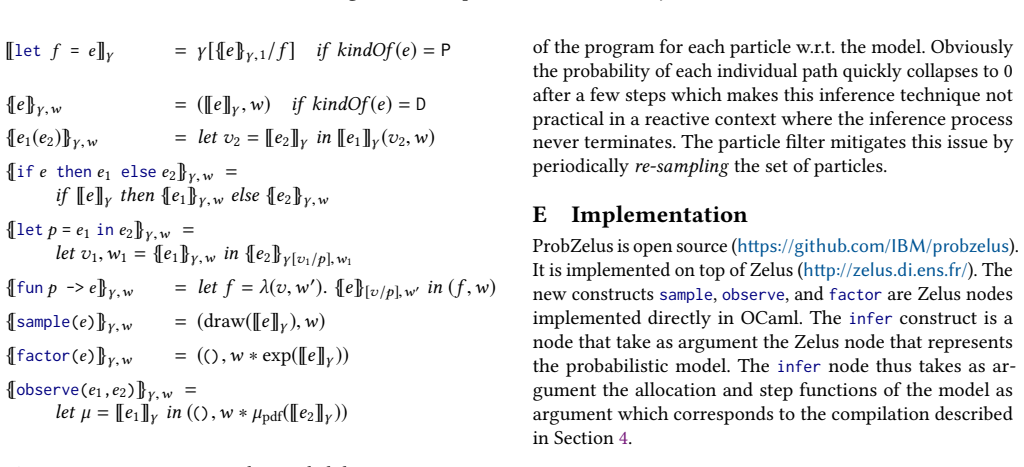
- [Section 4.3, Semantics equivalence] The Theorem in Section 4.3 states that compilation from ProbZelus to µF is semantics-preserving for all expressions, but the proof only works out the case of sample(e) and says the rest follows by induction. Since the equivalence of the co-iterative semantics and the compiled µF semantics underpins the presentation of all inference algorithms in Section 5, the journal version should supply the complete induction, or at least a detailed sketch covering present, reset, local recursive equations, observe, and infer; the current one-case proof is too thin for a load-bearing theorem.
- [Section 6 and Appendix F.3] The text states 'In all cases, the inference runs in bounded memory (see Appendix F.3)', but Appendix F.3 only reports empirical measurements over 500 steps, and for the multi-target tracker the memory is random. This is an overclaim: the measurements cannot establish an asymptotic guarantee, and the sentence should be qualified to say that memory is observed to stabilize over the measured horizon for the benchmarks tested.
minor comments (4)
- [Appendix E, Artifact] There is a typo: 'passord' should be 'password', and 'The credential to log into' should be 'The credentials to log into'.
- [Section 6, Accuracy methodology] The accuracy criterion |log(P90%(loss)) − log(loss_target)| < 0.5 is not fully explained; please clarify whether P90% is the 90th percentile of loss over runs and justify the chosen threshold.
- [Section 5.3, p1 and p2] The two counterexamples p1 and p2 are described verbally as forming unbounded chains; a small diagram or an explicit expression for the graph size as a function of the number of steps would make the boundary of the class easier to verify and would strengthen the presentation.
- [Section 3.3 and Appendix A.3] The discussion of the alternative Scott-style semantics in Appendix A.3 is interesting but very brief; a sentence stating why this alternative is rejected beyond 'not practical in a reactive context' would help the reader.
Circularity Check
No material circularity found: the semantic, compilation, and inference claims are either proved in the paper (inductive equivalence theorem) or honestly adapted from external prior work (Staton's measure semantics; Murray et al.'s delayed sampling); the informal 'bounded dependency chains' scope of the streaming delayed sampling guarantee is a rigor gap, not a derivation that reduces to its own…
full rationale
The derivation chain is largely self-contained, and where it leans on prior work, that work is external or carries independent content. The co-iterative semantics of deterministic streams is cited to Caspi and Pouzet [12] (an author's earlier work), but the paper's actual contribution, the measure-based co-iterative semantics of probabilistic stream functions, is new and explicitly 'adapted from [39]' (Staton), an external published semantics. The compilation to µF is accompanied by a theorem stating ⟦e⟧ = ⟦C(e)⟧ for every expression, with a proof by induction whose sample case is spelled out, so the compiled semantics is derived rather than assumed. Delayed sampling is taken from Murray et al. [31] (Section 5.2: 'value, assume, and observe ... defined in [31]'), and the streaming redesign (SDS) is presented with a concrete mechanism (pointer-minimal graph, pruning of unreferenced nodes), honest counterexamples p1 and p2, and empirical memory curves (Figures 5, 26, 28); it is not a renamed known result, and no fitted parameter is renamed as a prediction. The one self-referential element is the evaluation protocol (Section 6: 'the baseline is the median loss of SDS at 1000 particles'), but that is a benchmarking target, not a derivation of SDS's efficiency claims, and the exactness claims for Beta-Bernoulli, Kalman-1D, and Robot rest on conjugacy and measured accuracy rather than on the target definition. The skeptic's concern is real but does not amount to circularity: Section 5.3 scopes the bounded-memory guarantee to 'models ... that only maintain bounded chains of dependencies between variables', and that class is left informal, with no formal definition, no proof of the memory bound, and no static check rejecting p1 and p2, while the 500-step memory plots cannot by themselves establish an asymptotic bound. That is an unproven, informally delimited guarantee (a rigor and correctness risk), not an input made equivalent to its output by construction, and the paper candidly discloses the limitation and offers a user-level mitigation (eval), pointing away from any attempt to pass the hypothesis off as a theorem. The 'first synchronous probabilistic programming language' claim is supported by the construction in the paper and by critical comparison with Lutin, ProPL, and CTPPL in Section 7, not by self-citation.
Assumptions & free parameters
assumptions (4)
- domain assumption The synchronous abstraction: computations and communications are instantaneous and paced on a global clock.
- standard math Measure-theoretic semantics of probabilistic programs as in Staton [39].
- domain assumption Conjugacy relationships between distributions support closed-form marginalization in delayed sampling.
- ad hoc to paper Bounded-memory execution is guaranteed for models whose dependency chains are bounded.
invented entities (4)
-
ProbZelus
independent evidence
-
muF
independent evidence
-
Streaming Delayed Sampling (SDS)
independent evidence
-
Bounded Delayed Sampling (BDS)
independent evidence
Cite this review
Pith. "Pith review of Reactive Probabilistic Programming." pith.science (2026). https://pith.science/paper/OP3HES77
@misc{pith2026190807563,
  author       = {Pith},
  title        = {Pith review of: Reactive Probabilistic Programming},
  year         = {2026},
  howpublished = {\url{https://pith.science/paper/OP3HES77}},
  note         = {Machine review of arXiv:1908.07563}
}
read the original abstract
Synchronous modeling is at the heart of programming languages like Lustre, Esterel, or Scade used routinely for implementing safety critical control software, e.g., fly-by-wire and engine control in planes. However, to date these languages have had limited modern support for modeling uncertainty -- probabilistic aspects of software's environment or behavior -- even though modeling uncertainty is a primary activity when designing a control system. In this paper we present ProbZelus the first synchronous probabilistic programming language. ProbZelus conservatively provides the facilities of a synchronous language to write control software, with probabilistic constructs to model uncertainties and perform inference-in-the-loop. We present the design and implementation of the language. We propose a measure-theoretic semantics of probabilistic stream functions and a simple type discipline to separate deterministic and probabilistic expressions. We demonstrate a semantics-preserving compilation into a first-order functional language that lends itself to a simple presentation of inference algorithms for streaming models. We also redesign the delayed sampling inference algorithm to provide efficient streaming inference. Together with an evaluation on several reactive applications, our results demonstrate that ProbZelus enables the design of reactive probabilistic applications and efficient, bounded memory inference.
Figures



Figures from the paper (19 more)





Reference graph
Works this paper leans on
-
[1]
Guillaume Baudart, Louis Mandel, Eric Atkinson, Benjamin Sherman, Marc Pouzet, and Michael Carbin. 2020. Reactive Probabilistic Pro- gramming. In PLDI. ACM
work page 2020
-
[2]
Edwards, Nicolas Halb- wachs, Paul Le Guernic, and Robert de Simone
Albert Benveniste, Paul Caspi, Stephen A. Edwards, Nicolas Halb- wachs, Paul Le Guernic, and Robert de Simone. 2003. The synchronous languages 12 years later. Proc. IEEE 91, 1 (2003), 64–83
work page 2003
-
[3]
Keni Bernardin and Rainer Stiefelhagen. 2008. Evaluating Multiple Object Tracking Performance: The CLEAR MOT Metrics. EURASIP J. Image and Video Processing 2008 (2008)
work page 2008
-
[4]
Gérard Berry. 1989. Real Time Programming: Special Purpose or General Purpose Languages. In IFIP Congress. North-Holland/IFIP, 11– 17
work page 1989
-
[5]
Dariusz Biernacki, Jean-Louis Colaço, Grégoire Hamon, and Marc Pouzet. 2008. Clock-directed modular code generation for synchronous data-flow languages. In LCTES. ACM, 121–130
work page 2008
-
[6]
Chen, Martin Jankowiak, Fritz Obermeyer, Neeraj Pradhan, Theofanis Karaletsos, Rohit Singh, Paul A
Eli Bingham, Jonathan P. Chen, Martin Jankowiak, Fritz Obermeyer, Neeraj Pradhan, Theofanis Karaletsos, Rohit Singh, Paul A. Szerlip, Paul Horsfall, and Noah D. Goodman. 2019. Pyro: Deep Universal Probabilistic Programming. J. Mach. Learn. Res. 20 (2019), 28:1–28:6
work page 2019
-
[7]
Timothy Bourke and Marc Pouzet. 2013. Zélus, a Hybrid Synchronous Language. École normale supérieure. http://zelus.di.ens.fr Distribution at: zelus.di.ens.fr
work page 2013
-
[8]
Timothy Bourke and Marc Pouzet. 2013. Zélus: a synchronous lan- guage with ODEs. In HSCC. ACM, 113–118
work page 2013
Show all 46 references
-
[9]
Wilson, and Michael I
Tamara Broderick, Nicholas Boyd, Andre Wibisono, Ashia C. Wilson, and Michael I. Jordan. 2013. Streaming Variational Bayes. In NIPS. 1727–1735
2013
-
[10]
Bob Carpenter, Andrew Gelman, Matthew D Hoffman, Daniel Lee, Ben Goodrich, Michael Betancourt, Marcus Brubaker, Jiqiang Guo, Peter Li, and Allen Riddell. 2017. Stan: A probabilistic programming language. J. Statistical Software 76, 1 (2017), 1–37
2017
-
[11]
Paul Caspi. 1992. Clocks in Dataflow Languages. Theor. Comput. Sci. 94, 1 (1992), 125–140
1992
-
[12]
Paul Caspi and Marc Pouzet. 1998. A Co-iterative Characterization of Synchronous Stream Functions. In CMCS (Electronic Notes in Theoreti- cal Computer Science), Vol. 11. Elsevier, 1–21
1998
-
[13]
Jean-Louis Colaço, Grégoire Hamon, and Marc Pouzet. 2006. Mixing signals and modes in synchronous data-flow systems. In EMSOFT. ACM, 73–82
2006
-
[14]
Jean-Louis Colaço, Bruno Pagano, and Marc Pouzet. 2017. SCADE 6: A formal language for embedded critical software development (invited paper). In TASE. IEEE Computer Society, 1–11. 14 Reactive Probabilistic Programming PLDI ’20, June 15–20, 2020, London, UK
2017
-
[15]
Jean-Louis Colaço and Marc Pouzet. 2004. Type-based initialization analysis of a synchronous dataflow language.Int. J. Softw. Tools Technol. Transf. 6, 3 (2004), 245–255
2004
-
[16]
Pierre Del Moral, Arnaud Doucet, and Ajay Jasra. 2006. Sequential Monte Carlo samplers. J. Royal Statistical Society: Series B (Statistical Methodology) 68, 3 (2006), 411–436
2006
-
[17]
Murphy, and Stuart J
Arnaud Doucet, Nando de Freitas, Kevin P. Murphy, and Stuart J. Rus- sell. 2000. Rao-Blackwellised Particle Filtering for Dynamic Bayesian Networks. In UAI. Morgan Kaufmann, 176–183
2000
-
[18]
Daniel Fink. 1997. A Compendium of Conjugate Priors
1997
-
[19]
Timon Gehr, Sasa Misailovic, and Martin T. Vechev. 2016. PSI: Exact Symbolic Inference for Probabilistic Programs. In CA V (1) (Lecture Notes in Computer Science) , Vol. 9779. Springer, 62–83
2016
-
[20]
Goodman and Andreas Stuhlmüller
Noah D. Goodman and Andreas Stuhlmüller. 2014. The Design and Implementation of Probabilistic Programming Languages. http: //dippl.org Accessed April 2020
2014
-
[21]
N. J. Gordon, D. J. Salmond, and A. F. M. Smith. 1993. Novel approach to nonlinear/non-Gaussian Bayesian state estimation. IEE Proceedings F - Radar and Signal Processing 140, 2, 107–113
1993
-
[22]
Halbwachs, P
N. Halbwachs, P. Caspi, P. Raymond, and D. Pilaud. 1991. The Syn- chronous Dataflow Programming Language Lustre. Proc. IEEE 79, 9 (September 1991), 1305–1320
1991
-
[23]
Daniel Huang, Jean-Baptiste Tristan, and Greg Morrisett. 2017. Compil- ing Markov chain Monte Carlo algorithms for probabilistic modeling. In PLDI. ACM, 111–125
2017
-
[24]
Gilles Kahn. 1974. The Semantics of a Simple Language for Parallel Programming. In IFIP Congress. North-Holland, 471–475
1974
-
[25]
Rudolph Emil Kalman. 1960. A New Approach to Linear Filtering and Prediction Problems. Journal of Basic Engineering 82, 1 (03 1960), 35–45
1960
-
[26]
Daniel Lundén. 2017. Delayed sampling in the probabilistic program- ming language Anglican. Master’s thesis. KTH Royal Institute of Tech- nology
2017
-
[27]
Daniel Lundén, David Broman, Fredrik Ronquist, and Lawrence M. Murray. 2018. Automatic Alignment of Sequential Monte Carlo Infer- ence in Higher-Order Probabilistic Programs. CoRR abs/1812.07439 (2018)
2018 arXiv
-
[28]
David Lunn, David Spiegelhalter, Andrew Thomas, and Nicky Best
-
[29]
Thomas P. Minka. 2001. Expectation Propagation for approximate Bayesian inference. In UAI. Morgan Kaufmann, 362–369
2001
-
[30]
Michael Montemerlo, Sebastian Thrun, Daphne Koller, and Ben Weg- breit. 2002. FastSLAM: A Factored Solution to the Simultaneous Local- ization and Mapping Problem. In AAAI/IAAI. AAAI Press / The MIT Press, 593–598
2002
-
[31]
Murray, Daniel Lundén, Jan Kudlicka, David Broman, and Thomas B
Lawrence M. Murray, Daniel Lundén, Jan Kudlicka, David Broman, and Thomas B. Schön. 2018. Delayed Sampling and Automatic Rao- Blackwellization of Probabilistic Programs. In AISTATS (Proceedings of Machine Learning Research), Vol. 84. PMLR, 1037–1046
2018
-
[32]
Murray and Thomas B
Lawrence M. Murray and Thomas B. Schön. 2018. Automated learning with a probabilistic programming language: Birch. Annual Reviews in Control 46 (2018), 29–43
2018
-
[33]
Praveen Narayanan, Jacques Carette, Wren Romano, Chung-chieh Shan, and Robert Zinkov. 2016. Probabilistic Inference by Program Transformation in Hakaru (System Description). In FLOPS (Lecture Notes in Computer Science) , Vol. 9613. Springer, 62–79
2016
-
[34]
Avi Pfeffer. 2005. Functional Specification of Probabilistic Process Models. In AAAI. AAAI Press / The MIT Press, 663–669
2005
-
[35]
Avi Pfeffer. 2009. CTPPL: A Continuous Time Probabilistic Program- ming Language. In IJCAI. 1943–1950
2009
-
[36]
Pascal Raymond, Yvan Roux, and Erwan Jahier. 2008. Lutin: A Lan- guage for Specifying and Executing Reactive Scenarios. EURASIP Journal of Embedded Sytems 2008 (2008)
2008
-
[37]
Daniel Ritchie, Andreas Stuhlmüller, and Noah D. Goodman. 2016. C3: Lightweight Incrementalized MCMC for Probabilistic Programs using Continuations and Callsite Caching. In AISTATS (JMLR Workshop and Conference Proceedings), Vol. 51. JMLR.org, 28–37
2016
-
[38]
Eduardo D Sontag. 2013. Mathematical control theory: deterministic finite dimensional systems. Vol. 6. Springer Science & Business Media
2013
-
[39]
Sam Staton. 2017. Commutative Semantics for Probabilistic Program- ming. In ESOP (Lecture Notes in Computer Science), Vol. 10201. Springer, 855–879
2017
-
[40]
David Tolpin, Jan-Willem van de Meent, Hongseok Yang, and Frank D. Wood. 2016. Design and Implementation of Probabilistic Programming Language Anglican. In IFL. ACM, 6:1–6:12
2016
-
[41]
Hoffman, Rif A
Dustin Tran, Matthew D. Hoffman, Rif A. Saurous, Eugene Brevdo, Kevin Murphy, and David M. Blei. 2017. Deep Probabilistic Program- ming. In ICLR (Poster). OpenReview.net
2017
-
[42]
Russell, and Rastislav Bodík
Yi Wu, Lei Li, Stuart J. Russell, and Rastislav Bodík. 2016. Swift: Com- piled Inference for Probabilistic Programming Languages. In IJCAI. IJCAI/AAAI Press, 3637–3645. 15 PLDI ’20, June 15–20, 2020, London, UK A ProbZelus In this section, we provide the complete definitions o...
2016
-
[44]
let µ ={[e]}sγ(s) in ∫ µ(dv, ds′)δop(v ),s′(U) {[f (e)]}iγ = (⟦e⟧iγ ,γ(f _init)) {[f (e)]}sγ = λ(s1, s2).λU
let µ2 ={[e2]}sγ(s2) in∫ µ2(dv2, ds′ 2)δ(v1,v2),(s′ 1,s′ 2)(U) {[op(e)]}iγ = {[e]}iγ {[op(e)]}sγ = λs.λU . let µ ={[e]}sγ(s) in ∫ µ(dv, ds′)δop(v ),s′(U) {[f (e)]}iγ = (⟦e⟧iγ ,γ(f _init)) {[f (e)]}sγ = λ(s1, s2).λU . letv1, s′ 1 = ⟦e⟧sγ(s1) in let µ2 =γ(f _step)(v1)(s1) in ∫ µ...
-
[45]
and init xk = ck and y1 = e1 and
let µ1 = ⟦e1⟧sγ(if v2 then s0 else s1) in∫ µ(dv1, ds′ 1)δv1,(s0,s′ 1,s′ 2)(U) e where rec init x1 = c1 and ... and init xk = ck and y1 = e1 and ... and yn = en i γ = © « (c1, . . . ,ck), ({[e1]}iγ , . . . ,{[en]}...
-
[46]
letγ′ 1 =γk[v1/y1] in∫ . . . let µn = ⟦en ⟧s γ′ n−1 (sn) in∫ µn(dvn, ds′n) letγ′n =γ′ n−1[vn/yn] in let µ ={[e]}s γ′n (s) in∫ µ(dv, ds′)δv,((γ′n[x1], ...,γ′n[xk]),(s′ 1, ..., s′n),s′)(U) {[sample(e)]}iγ = ⟦e⟧iγ {[sample(e)]}sγ = λs.λU . let µ, s′ = ⟦e⟧sγ(s) in ∫ T µ(dv)δv,s′(U...
2020
-
[2009]
Statistics in medicine 28, 25 (2009), 3049–3067
The BUGS project: Evolution, critique and future directions. Statistics in medicine 28, 25 (2009), 3049–3067
2009
Reviewed August 14, 2026 · model on record in the stance chip above.
Discussion (0). Continue with ORCID to comment.