REVIEW 4 major objections 7 minor 28 references
Finding the right scale of a network: Efficient identification of causal emergence through spectral clustering
T0 review · 4 major / 7 minor · reviewed 2026-08-14 · deepseek-v4-flash
Pith's one-line read This paper claims that a modified spectral-clustering algorithm identifies causally emergent macro-scales in networks faster and as well as or better than greedy and gradient-descent methods, and that these macro-scales improve…
desk verdict A useful engineering contribution to causal-emergence search, with an unproven pruning rule and no exact baseline; deserves a serious referee but needs revision. read the letter →
The pith
A machine-rendered reading of the paper's core claim, the machinery that carries it, and where it could break.
The reading
What carries the argument
The load-bearing object is the spectral embedding of the transition matrix $W^{\mathrm{out}}$ (for a random walk on the network). The algorithm takes the eigendecomposition, drops the kernel, forms the weighted basis $E'=\{\lambda_i e_i : \lambda_i \neq 0\}$, and uses the entries of these weighted eigenvectors as coordinates for each node. A cosine-similarity distance is then computed between node pairs, with the distance set to $\infty$ for pairs that are not in each other's Markov blanket (parents, children, and co-parents). The OPTICS clustering routine turns this distance matrix into macro-nodes, and the algorithm scans distance thresholds to find the clustering with the highest effective information. This machinery works, the paper argues, because the kernel dimension of the adjacency matrix quantifies degeneracy: distributions that collide after one step correspond to kernel vectors, so the spectrum outside the kernel carries exactly the information needed to decide which subgraphs can be grouped into a better scale.
What would settle it
Run an exhaustive search over all partitions of a small network (12–15 nodes), compute effective information for every partition, and compare the maximum against what the spectral algorithm finds under the Markov-blanket restriction; a single network where a non-blanket merge yields higher EI than any blanket-restricted grouping would falsify the restriction and show the algorithm's search is incomplete.
Extended reading notes
Core claim
On the paper's own terms, the central discovery is that a spectral approach to searching the space of network coarse-grainings outperforms previously used search heuristics. The algorithm embeds each node using the nonzero eigenvectors of the transition matrix weighted by their eigenvalues, computes cosine-similarity distances between nodes (setting to infinity any pair not in each other's Markov blanket), and clusters the distance matrix with OPTICS across a range of distance thresholds to maximize effective information gain. In preferential attachment networks, the spectral method runs orders of magnitude faster than the greedy and gradient-descent baselines and finds equal or larger EI increases. The paper interprets this success as a consequence of a linear-algebra fact it demonstrates: degenerate dynamics—many states converging to the same future state—correspond exactly to vectors in the kernel of the adjacency matrix, so removing the kernel and using the remaining spectrum isolates the topological structure that carries scale information. It concludes that macroscales should be modeled explicitly because they can be peaks of efficiency, centrality, and information transmission.
Load-bearing premise
The algorithms assume that merging two nodes that are not in each other's Markov blankets can never increase effective information, so all candidate groupings are restricted to blanket pairs; if that restriction is false, both the greedy and spectral searches can miss the true maximally informative scale.
Editorial extensions
If this is right
- Spectral clustering makes it practical to find informative macroscales in networks of thousands of nodes, where greedy search becomes prohibitive.
- The hardest networks to analyze are those with genuine mesoscales (roughly preferential-attachment exponent between 1 and 2); the spectral method keeps runtime roughly constant there, so it is the recommended tool for such systems.
- Causal emergence is not confined to contrived examples: superlinear preferential attachment networks show real EI gains at the macroscale, along with lower entropy rate and higher global efficiency.
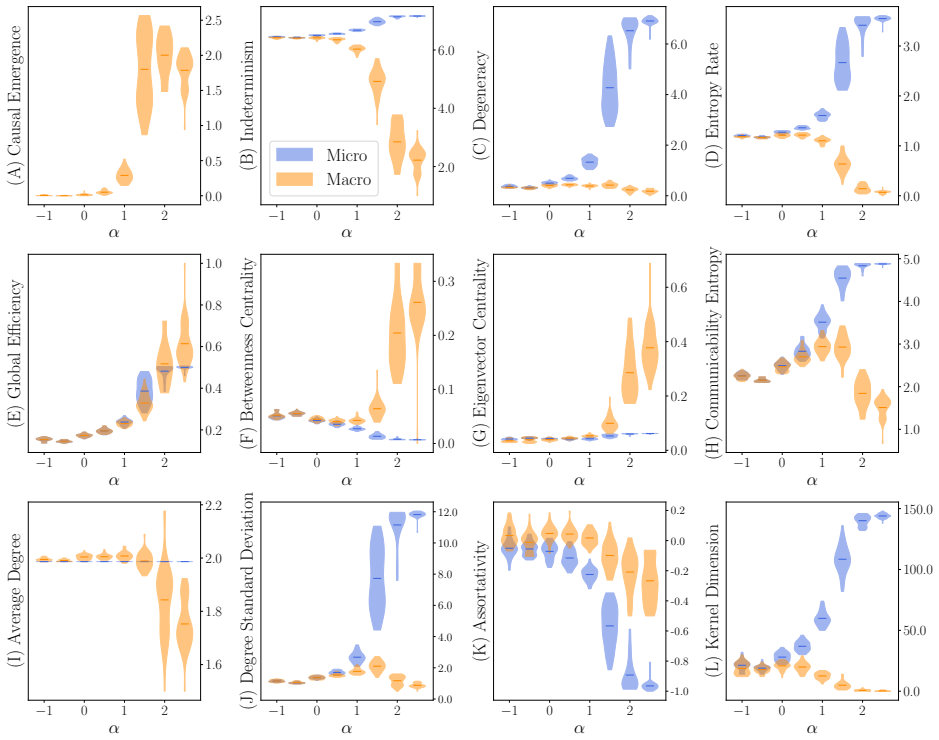
- Network analyses that stop at the microscale may mislocate control and information transmission: macro-nodes show higher betweenness and eigenvector centrality, suggesting that scale matters for conclusions about network function.
- Kernel dimension of the adjacency matrix can serve as a diagnostic of a network's potential for causal emergence, connecting spectral graph theory to the study of scale.
Reading between the lines
- The kernel-dimension link, if it holds beyond preferential attachment, suggests that hub-dominated and attractor-heavy networks (star-like topologies, hierarchical systems) are the natural candidates for causal emergence, so the method could transfer to biological or social networks with such structure.
- The Markov-blanket restriction is testable: on very small networks one can enumerate all partitions and check whether any merge outside a blanket raises EI; a positive case would indicate the spectral search has a blind spot fixable by a different distance construction.
- The same spectral embedding plus OPTICS could be reused with other scale-quality measures (e.g., other information or dynamics-based objectives), making it a generic template for scale detection rather than a single-purpose algorithm.
Signed reviews
Editorial analysis
A structured set of objections, weighed in public.
Referee Report
Summary. This paper addresses the problem of finding informative higher-scale (macro) representations of networks under the effective information (EI) criterion of causal emergence. The authors compare three search heuristics: a greedy algorithm from prior work, gradient descent on a relaxed soft-assignment matrix, and a spectral clustering method that uses eigenvectors of the transition matrix, cosine similarity, and an OPTICS clustering step with a Markov-blanket restriction on permissible merges. On preferential attachment networks, the spectral method is reported to be orders of magnitude faster and to find EI equal to or greater than the other heuristics. The paper also reports variations of network properties (entropy rate, efficiency, centrality, assortativity, kernel dimension) between micro and macro scales. The spectral algorithm has been added to the publicly available einet Python package.
Significance. If the central claims are correct, the paper makes a useful methodological contribution: it identifies a scalable heuristic for network coarse-graining under an information-theoretic objective. The reported runtime advantage of the spectral method is substantial, and the inclusion of the algorithm in a public repository is a strength. The significance, however, is conditional on the validity of the EI objective and on the completeness of the search. The paper relies on an unproved assertion that only Markov-blanket pairs can be merged to increase EI, and the empirical evaluation is only against other heuristics. If that assertion is false, the claimed 'right scale' is not the true EI-maximizing scale. The paper also does not currently provide the hyperparameter details needed for exact reproduction of the comparisons.
major comments (4)
- [Section 2.2.2] The assertion that 'If a pair of nodes are not in each other's Markov blankets, then grouping them together cannot increase EI' is load-bearing for both the spectral algorithm (it sets pairwise distances to infinity) and the greedy algorithm inherited from [2]. The statement is given without proof, reference, or empirical support. The subsequent kernel-dimension derivation is a global statement about the transition matrix and does not imply anything about whether merging two specific non-blanket nodes can increase EI. Because Figure 1 compares only against other heuristics, a scenario in which all tested methods miss the true optimum would be invisible. The authors should add a brute-force exhaustive search over all partitions for small networks (n <= 10) to test this rule directly: if any EI-maximizing partition merges nodes that are not in each other's Markov blankets, the rule is false and the reported causal emergence values are systematically biased. This is the decisive missing experiment.
- [Section 3.1, Fig. 1C/D] The comparison in Section 3.1 establishes only that the spectral heuristic finds EI at least as high as the greedy and gradient-descent heuristics on the tested instances. In the absence of a brute-force EImax baseline, the abstract's claim that the spectral method finds 'the right scale' is unsupported; it may find the best restricted scale, not the best scale. This matters because gradient descent is not restricted to Markov-blanket merges, so if the pruning rule of Section 2.2.2 is false, gradient descent is in principle capable of finding better EI than the spectral method, and the reported ordering of algorithms could reverse. I request an exact enumeration on small networks (e.g., all partitions for n = 5 to 10) reporting the ratio of each heuristic's EI to the true EImax, together with the fraction of instances on which each heuristic attains the global optimum.
- [Section 3.2, Fig. 2E-G] The claims that macroscales have higher global efficiency, betweenness centrality, and eigenvector centrality are based on comparisons between networks of different sizes. Global efficiency is defined as the inverse of the mean shortest path length, which trivially tends to increase as the number of nodes decreases; average betweenness and eigenvector centrality also scale with n. Without a null model (e.g., random coarse-grainings with the same number of macro-nodes) or size-normalized indices, the observed differences in Fig. 2E-G may be artifacts of dimension reduction rather than evidence that macroscales are more efficient or more central. The authors should re-analyze these properties with appropriate normalization or explicitly state the size-dependence caveat.
- [Sections 2.2.2 and 2.2.3] The spectral algorithm depends on the OPTICS distance threshold epsilon (over which a range is scanned) and on OPTICS parameters such as min_samples; the gradient-descent method depends on learning rate, momentum, maximum iterations, and initialization. None of these settings are reported in the text or figure captions. Since Figure 1 compares runtimes and achieved EI, and since the spectral method's epsilon scanning may dominate its runtime, the absence of these details makes the comparison irreproducible and leaves open the possibility that the algorithms were not compared on equal footing. Please report all hyperparameters, the epsilon grid, and the selection rule for the reported results.
minor comments (7)
- [Section 2.1, Eq. (1)] The notation <Wout_i> and <H(Wout_i)> is not defined precisely; the average is presumably uniform over nodes, but this should be stated explicitly.
- [Section 2.2.2] The complexity statement that 'computing the OPTICS reachability graph is O(n log n)' is not accurate for a precomputed dense distance matrix, where OPTICS requires O(n^2) distance comparisons. Please revise the complexity claim.
- [Section 2.2.2] If the transition matrix is not symmetric, the eigendecomposition can have complex eigenvalues and eigenvectors, and the cosine similarity of complex vectors is not defined in the text. Please state the assumption (e.g., undirected graphs, for which the transition matrix is similar to a symmetric matrix) or specify the complex similarity measure.
- [Section 2.2.1] The description of the greedy algorithm contains a notational inconsistency: 'a list of neighboring nodes is constructed, {vj} in Bi' should read 'v_j in B_i'; the text also uses 'it's' instead of 'its' in several places.
- [Section 2.2.3] The number of macro-nodes k in the gradient descent relaxation is not specified; the paper should state how k is chosen or optimized.
- [Section 3.2, Fig. 2L] The text says 'the kernel dimension of the micro-nodes increasing rapidly, while the macro-nodes decrease,' but it is not clear whether the figure shows kernel dimension for the micro-network, the macro-network, or both. Please clarify the legend.
- [Section 1] The claim that 'the number of possible dimension reductions exponentially increases with the size of the system' is imprecise; the number of partitions grows super-exponentially (according to the Bell numbers), not merely exponentially.
Circularity Check
No significant circularity: the spectral-vs-greedy/vs-gradient comparison is empirical and the EI objective is a fixed input, though one unproved pruning rule creates correctness risk.
full rationale
The paper's central operational claim is that spectral clustering finds higher-EI scales faster than, or at least as fast as, greedy and gradient-descent baselines (Fig. 1). This is an empirical comparison on a common, pre-defined objective: EI is given by Eq. (1) and is not redefined by the algorithm's output. The spectral method's epsilon is chosen by evaluating EI over a grid, but that is standard objective-function optimization, not a prediction that is statistically forced by a fit to the target quantity. The µ|π macro-node construction and the EI metric originate in the authors' prior work, but they are fixed inputs rather than conclusions derived from the algorithm; the algorithmic comparison is self-contained and would remain meaningful even if one disputed the macro-node summary. The main weakness is Section 2.2.2's unproved assertion that grouping non-Markov-blanket pairs cannot increase EI; this restricts the search and could cause all compared methods to miss the true optimum, so it is a correctness/falsifiability gap, not a circular reduction. The kernel-degeneracy derivation supports an intuition about why spectral structure matters but does not inject the target result into the algorithm. No equation or fitted parameter was found that reduces to its own input; the reported network-property changes (entropy rate, efficiency, centrality) are distinct quantities measured after the EI-selected scale is fixed, not restatements of the EI objective itself.
Assumptions & free parameters
free parameters (3)
- OPTICS distance threshold epsilon =
not stated; selected by sweeping values to maximize EI gain
- OPTICS clustering parameters (e.g., min_samples) =
not stated
- Gradient descent hyperparameters (learning rate, momentum, max iterations, initialization) =
not stated
assumptions (6)
- domain assumption Effective information, as defined by Eq. (1), is the correct objective for choosing the most informative scale of a network.
- domain assumption Macro-nodes constructed as stationary-distribution-weighted averages (mu|pi type) accurately recapitulate micro-scale random-walk dynamics.
- ad hoc to paper If two nodes are not in each other's Markov blankets, grouping them cannot increase EI.
- ad hoc to paper The kernel dimension of the transition matrix corresponds to degeneracy in the network's dynamics.
- domain assumption Clusters found by OPTICS on the eigenvalue-weighted cosine similarity embedding correspond to macro-nodes that increase EI.
- domain assumption Preferential attachment networks are a suitable testbed for evaluating methods for finding informative higher scales.
Cite this review
Pith. "Pith review of Finding the right scale of a network: Efficient identification of causal emergence through spectral clustering." pith.science (2026). https://pith.science/paper/XXA2EU25
@misc{pith2026190807565,
  author       = {Pith},
  title        = {Pith review of: Finding the right scale of a network: Efficient identification of causal emergence through spectral clustering},
  year         = {2026},
  howpublished = {\url{https://pith.science/paper/XXA2EU25}},
  note         = {Machine review of arXiv:1908.07565}
}
read the original abstract
All networks can be analyzed at multiple scales. A higher scale of a network is made up of macro-nodes: subgraphs that have been grouped into individual nodes. Recasting a network at higher scales can have useful effects, such as decreasing the uncertainty in the movement of random walkers across the network while also decreasing the size of the network. However, the task of finding such a macroscale representation is computationally difficult, as the set of all possible scales of a network grows exponentially with the number of nodes. Here we compare various methods for finding the most informative scale of preferential attachment networks, discovering that an approach based on spectral analysis outperforms greedy and gradient descent-based methods. We then use this procedure to show how several structural properties of these networks vary across scales. We describe how meso- and macroscale representations of networks can have significant benefits over their underlying microscale in terms of information transmission, which include properties such as increase in determinism, a decrease in degeneracy, a lower entropy rate of random walkers on the network, an increase in global network efficiency, and higher values for a variety of centrality measures than the microscale.
Figures

Reference graph
Works this paper leans on
-
[2]
The emergence of informative higher scales in complex networks
Brennan Klein and Erik Hoel. “Uncertainty and causal emergence in complex networks”. In:arXiv preprint arXiv:1907.03902 (2019). url: https://arxiv.org/abs/1907.03902
work page Pith review arXiv 2019
-
[1]
Albert-László Barabási. Network Science. Cambridge University Press, 2016.isbn: 9781107076266
work page 2016
-
[3]
Richard Gallagher and Tim Appenzeller. “Beyond reductionism”. In:Science 284.5411 (1999), pp. 79–
work page 1999
-
[4]
Quantifying causal emergence shows that macro can beat micro
Erik Hoel, Larissa Albantakis, and Giulio Tononi. “Quantifying causal emergence shows that macro can beat micro”. In:Proceedings of the National Academy of Sciences110.49 (2013), pp. 19790–19795. doi: 10.1073/pnas.1314922110
-
[5]
Can the macro beat the micro? Integrated information across spatiotemporal scales
Erik Hoel et al. “Can the macro beat the micro? Integrated information across spatiotemporal scales”. In: Neuroscience of Consciousness2016.1 (2016). doi: 10.1093/nc/niw012
-
[6]
When the map is better than the territory
Erik Hoel. “When the map is better than the territory”. In:Entropy 19.5 (2017), p. 188.doi: 10.3390/ e19050188. 9
work page 2017
-
[7]
OPTICS: Ordering points to identify the clustering structure
Mihael Ankerst et al. “OPTICS: Ordering points to identify the clustering structure”. In:Proc. ACM SIGMOD’99 Int. Conf. on Management of Data. ACM Press, 1999, pp. 49–60.doi: 10.1145/304182. 304187
doi:10.1145/304182 1999
-
[8]
Representing higher-order dependencies in networks
Jian Xu, Thanuka L Wickramarathne, and Nitesh V Chawla. “Representing higher-order dependencies in networks”. In:Science Advances2.5 (2016), e1600028.doi: 10.1126/sciadv.1600028
Show all 28 references
-
[9]
Probabilistic Reasoning in Intelligent Systems: Networks of Plausible Inference
Judea Pearl. Probabilistic Reasoning in Intelligent Systems: Networks of Plausible Inference. Elsevier,
-
[10]
Laplacian of graphs and algebraic connectivity
Miroslav Fiedler. “Laplacian of graphs and algebraic connectivity”. eng. In:Banach Center Publications 25.1 (1989), pp. 57–70.url: http://eudml.org/doc/267812
1989
-
[11]
On the performance of spectral graph partitioning methods
Stephen Guattery and Gary L. Miller. “On the performance of spectral graph partitioning methods”. In: SODA. 1995
1995
-
[12]
Spectral partitioning works: Planar graphs and finite ele- ment meshes
Daniel A. Spielman and Shang-Hua Teng. “Spectral partitioning works: Planar graphs and finite ele- ment meshes”. In:Linear Algebra and its Applications421.2 (2007). Special Issue in honor of Miroslav Fiedler, pp. 284–305.issn: 0024-3795. url: 10.1016/j.laa.2006.07.020
2007 doi
-
[13]
Spectra of random graphs with given expected degrees
Fan Chung, Linyuan Lu, and Van Vu. “Spectra of random graphs with given expected degrees”. In: Proceedings of the National Academy of Sciences100.11 (2003), pp. 6313–6318.issn: 0027-8424. doi: 10.1073/pnas.0937490100
2003 doi
-
[14]
Spectra of some simple graphs
Essam El Seidy, Salah Eldin Hussein, and Atef AboElkher. “Spectra of some simple graphs”. In: Mathematical Theory and Modeling5 (2 2015), pp. 115–121.doi: 10.14419/ijamr.v5i2.6106
2015 doi
-
[15]
Introduction to Linear Algebra
Gilbert Strang. Introduction to Linear Algebra. Wellesley-Cambridge Press, 2009.isbn: 9780980232714
2009
-
[16]
An overview of gradient descent optimization algorithms
Sebastian Ruder. “An overview of gradient descent optimization algorithms”. In:arXiv:1609.04747 (2016). url: https://arxiv.org/abs/1609.04747
2016 arXiv
-
[17]
A method for unconstrained convex minimization problem with the rate of convergence O (1/kˆ 2)
Yurii Nesterov. “A method for unconstrained convex minimization problem with the rate of convergence O (1/kˆ 2)”. In:Doklady AN USSR. Vol. 269. 1983, pp. 543–547
1983
-
[18]
Scale-free networks: a decade and beyond
Albert-László Barabási. “Scale-free networks: a decade and beyond”. In:science 325.5939 (2009), pp. 412–413.doi: 10.1126/science.1173299
2009 doi
-
[19]
Efficient behavior of small-world networks
Vito Latora and Massimo Marchiori. “Efficient behavior of small-world networks”. In:Phys. Rev. Lett. 87 (19 Oct. 2001), p. 198701.doi: 10.1103/PhysRevLett.87.198701
2001 doi
-
[20]
A set of measures of centrality based on betweenness
Linton C Freeman. “A set of measures of centrality based on betweenness”. In:Sociometry (1977), pp. 35–41.doi: 10.2307/3033543
1977 doi
-
[21]
Eigenvector-centrality—a node-centrality?
Britta Ruhnau. “Eigenvector-centrality—a node-centrality?” In:Social networks22.4 (2000), pp. 357–
2000
-
[22]
Communicability in complex networks
Ernesto Estrada and Naomichi Hatano. “Communicability in complex networks”. In:Physical Review E 77.3 (2008), p. 036111.doi: 10.1103/PhysRevE.77.036111
2008 doi
-
[23]
Complex network comparison based on communicability sequence entropy
Dan Chen et al. “Complex network comparison based on communicability sequence entropy”. In:Phys- ical Review E98.1 (2018), p. 012319.doi: 10.1103/PhysRevE.98.012319
2018 doi
-
[24]
Empirical comparison of algorithms for network community detection
Jure Leskovec, Kevin J Lang, and Michael Mahoney. “Empirical comparison of algorithms for network community detection”. In:Proceedings of the 19th international conference on World wide web. ACM. 2010, pp. 631–640
2010
-
[25]
The minicolumn hypothesis in neuroscience
Daniel P Buxhoeveden and Manuel F Casanova. “The minicolumn hypothesis in neuroscience”. In: Brain 125.5 (2002), pp. 935–951.doi: 10.1093/brain/awf110
2002 doi
-
[26]
From the neuron doctrine to neural networks
Rafael Yuste. “From the neuron doctrine to neural networks”. In:Nature reviews neuroscience16.8 (2015), p. 487.doi: 10.1038/nrn3962. 10
2015 doi
-
[80]
doi: 10.1126/science.284.5411.79
-
[365]
url: 10.1016/S0378-8733(00)00031-9
Reviewed August 14, 2026 · model on record in the stance chip above.
Discussion (0). Continue with ORCID to comment.