REVIEW 4 major objections 8 minor 12 references
A Three-dimensional Reconstruction of Cosmic Ray Events in IceCube
T0 review · 4 major / 8 minor · reviewed 2026-08-14 · deepseek-v4-flash
Pith's one-line read IceCube's new three-dimensional reconstruction, which fits surface and in-ice signals with one unified likelihood, recovers cosmic-ray showers whose cores land outside IceTop and points them as well as or better than either array alone.
desk verdict Useful methods paper from IceCube on a joint 3-D reconstruction, but the headline IT-Uncontained gain is asserted on an uncontrolled QC comparison and needs a matched-sample check. read the letter →
The pith
A machine-rendered reading of the paper's core claim, the machinery that carries it, and where it could break.
The reading
What carries the argument
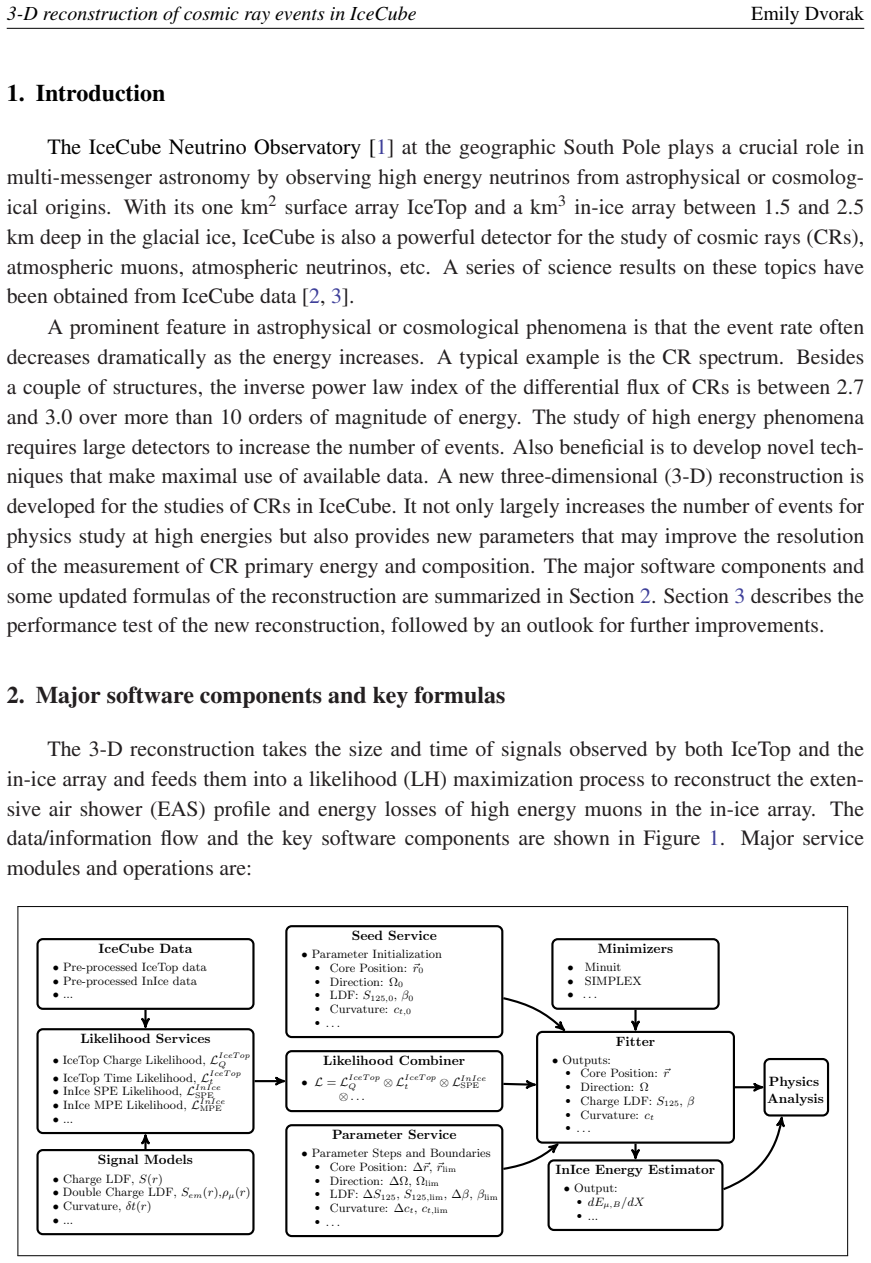
The load-bearing object is the unified likelihood function $L = L^{\rm IceTop}_Q \otimes L^{\rm IceTop}_t \otimes L^{\rm InIce}_{\rm SPE}$, whose three terms describe the signal charge and arrival time in IceTop tanks and the photon arrival times in the in-ice DOMs. The shower signal is modeled by the lateral distribution function $S(r) = S_{\rm ref}(r/r_{\rm ref})^{-\beta - 0.30264\log_{10}(r/r_{\rm ref})}$ and a curvature term $\delta t(r) = c_t r^2 + 19.41(1-e^{-r^2/(2(118.1)^2)})$, with $c_t$ left free per event; the per-station time fluctuation is redefined as $\sigma_{t_i}=C_1\sqrt{\sum_{j=1}^2(t_{ij}-\frac{t_{i1}+t_{i2}}2)^2}/(\sum_j Q_{ij})+C_2$ with MC-derived constants. A likelihood combiner feeds these terms to Minuit or SIMPLEX, seeded by parameter and boundary services, and the reconstructed track is then passed to a Millipede-based energy estimator for muon energy losses. The mechanism works because the in-ice term provides a long lever arm that anchors the direction, while the IceTop terms constrain the core and lateral profile, so events outside the surface array are no longer stranded.
What would settle it
Apply the 3-D reconstruction to real IceCube data for IT-Uncontained events and compare reconstructed core positions against an independent in-ice-only muon track: if reconstructed cores still cluster toward the IceTop center, or if the expected gain in recovered events over in-ice-alone reconstruction does not appear, the central claim is refuted. A sharper test would check the improved pointing resolution using the Moon shadow or a known source as an independent arrival-direction reference.
Extended reading notes
Core claim
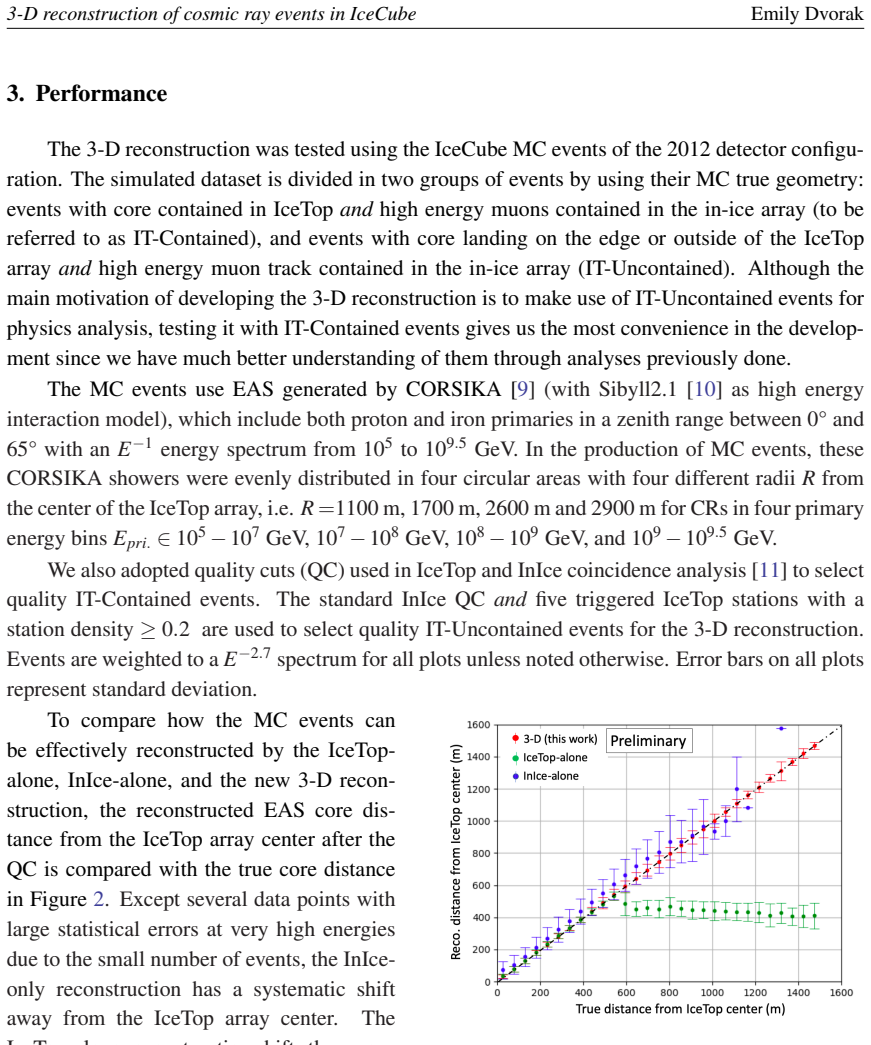
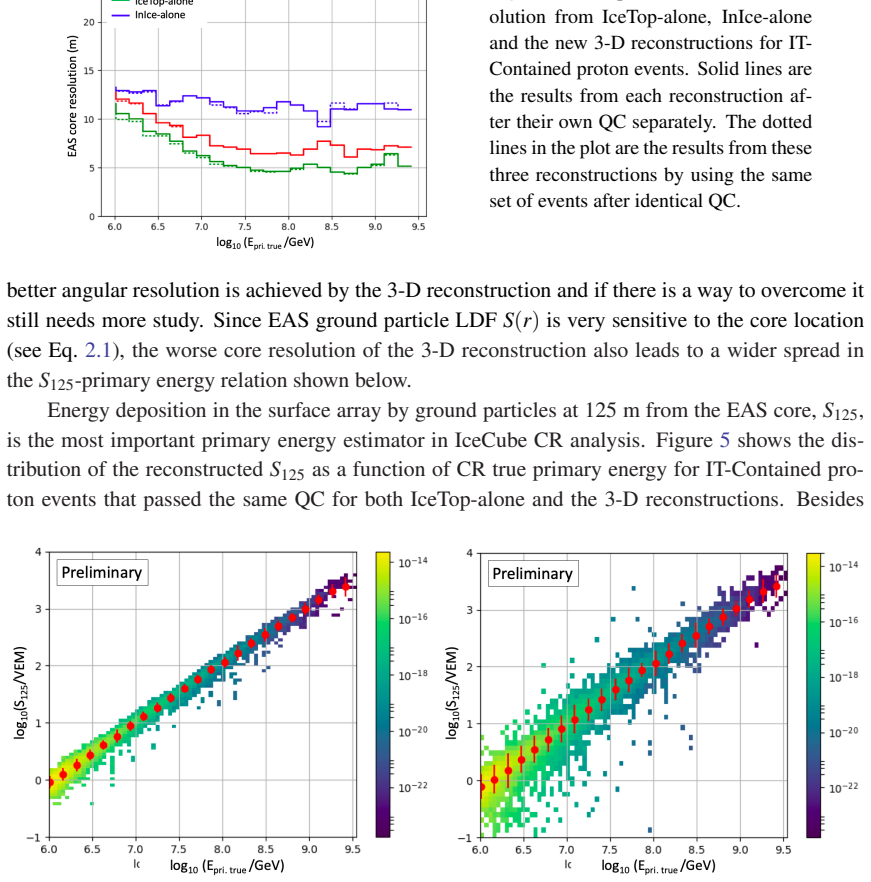
The paper's central claim is that a single likelihood function combining IceTop charge and time information with in-ice photon-arrival information reconstructs the full three-dimensional air-shower footprint more reliably than either detector alone. On Monte Carlo showers from CORSIKA with Sibyll2.1, the 3-D reconstruction determines the shower core, arrival direction, lateral distribution parameter $S_{125}$, slope $\beta$, and curvature parameter $c_t$ by maximizing this combined likelihood. For cores contained in IceTop it gives the best 68% pointing resolution of the three methods across the studied energy range, while its core resolution is about 2-3 m worse than IceTop-alone, which widens the $S_{125}$-energy relation. For cores on or outside IceTop, where IceTop-alone systematically pulls reconstructed cores inward and in-ice-alone is biased outward, the combined fit finds the true core and raises the successful reconstruction rate after quality cuts from 13.7% (in-ice alone) to 25.3% in the highest energy bin, with similar large gains at lower energies. This event recovery is the paper's central discovery: the two arrays together see the three-dimensional footprint that neither alone reconstructs reliably.
Load-bearing premise
The load-bearing premise is that the CORSIKA/Sibyll2.1 Monte Carlo and the 2012 IceCube detector simulation reproduce the real spatial and temporal signals of showers with cores outside IceTop, so that the gains measured on Monte Carlo events transfer to real data.
Editorial extensions
If this is right
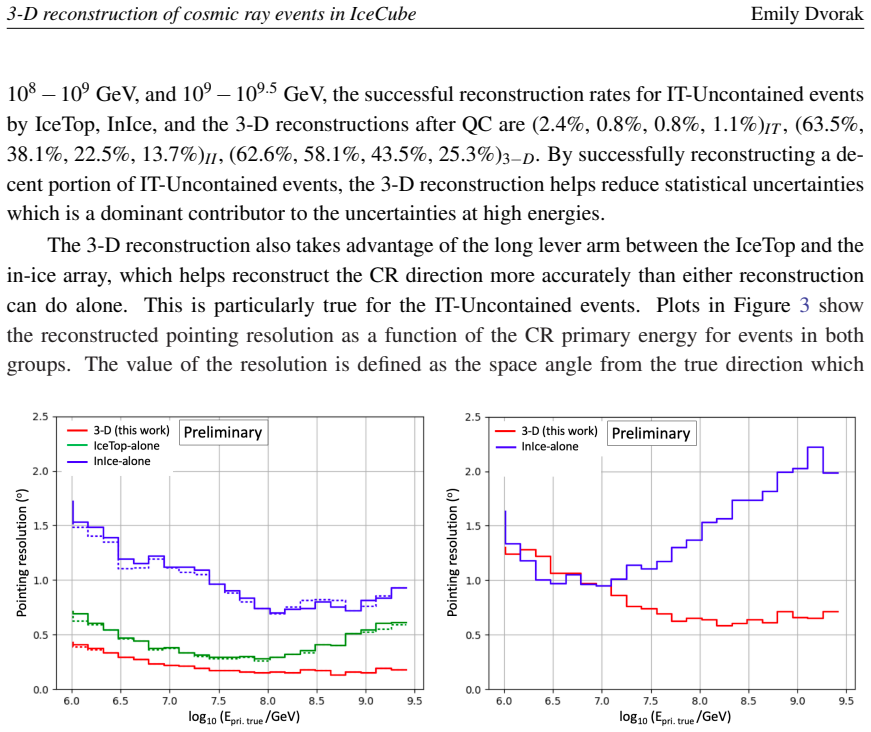
- For IT-Contained proton Monte Carlo events, the 3-D reconstruction gives the best 68% pointing resolution of the three methods over the whole studied energy range, at the cost of a 2-3 m worse core resolution than IceTop-alone.
- For IT-Uncontained events, the successful reconstruction rate after quality cuts rises from 13.7% (in-ice alone) to 25.3% in the $10^9$-$10^{9.5}$ GeV bin, directly reducing statistical uncertainty at high energy.
- Recovered IT-Uncontained events extend to zenith angles near 60 degrees, versus about 30 degrees for contained events, letting the detector sample higher-energy showers near their $X_{\rm max}$.
- The reconstruction yields per-event curvature $c_t$, an electromagnetic/muonic LDF option, and muon-bundle energy-loss information, opening new handles on primary mass and composition.
- The widened $S_{125}$-energy relation caused by the slightly worse core resolution marks the main price of the method and a target for future optimization.
Reading between the lines
- If the Monte Carlo-demonstrated pointing improvement holds in data, the 3-D reconstruction should sharpen IceCube's cosmic-ray anisotropy maps, especially for events whose cores are outside IceTop, since those events currently enter anisotropy analyses with much larger directional errors.
- A testable extension would be a two-stage fit that first obtains the direction from the unified likelihood and then re-fits the core using only IceTop charge information; this could recover the IceTop-alone core resolution while keeping the improved pointing.
- The paper describes the likelihood-combiner architecture as open to additional observables, so the same approach could be applied to future surface/deep hybrid arrays where the surface density and in-ice lever arm differ.
- Because the mean $S(r_{\rm ref})$ versus energy for IT-Uncontained events is shown to separate by primary mass and zenith, a mass estimator built from these relations may extend composition measurements to energies and angles previously inaccessible.
Signed reviews
Editorial analysis
A structured set of objections, weighed in public.
Referee Report
Summary. This paper presents a new three-dimensional (3-D) maximum-likelihood reconstruction for cosmic-ray events in IceCube that jointly uses IceTop surface signals and in-ice muon signals. The algorithm combines a charge and time likelihood for IceTop tanks with an in-ice photon-arrival likelihood, and is tested on CORSIKA/Sibyll2.1 Monte Carlo with proton and iron primaries for the 2012 detector configuration. Two event classes are considered: IT-Contained (core inside IceTop, muon contained in the in-ice detector) and IT-Uncontained (core outside/at edge, muon contained). The paper reports that the 3-D reconstruction achieves better 68% pointing resolution than IceTop-alone or InIce-alone reconstructions for both event classes (except below ~10^6.6 GeV for IT-Uncontained), recovers more IT-Uncontained events, and provides additional EAS parameters, at the cost of a slightly worse core position resolution (2–3 m) and a wider S125–energy spread.
Significance. If the reported performance holds, the 3-D reconstruction would increase the number of usable high-energy cosmic-ray events in IceCube by recovering events with cores outside IceTop, and would improve angular resolution through the IceTop–in-ice lever arm. The paper clearly describes the software architecture and makes concrete, falsifiable MC-based predictions. However, the central performance comparisons for IT-Uncontained events are not controlled for event selection, and the success-rate claims lack a definition and uncertainties. With the missing identical-QC analysis added, the paper would be a useful methods contribution to the field.
major comments (4)
- [Section 3, Figure 3 (right)] The IT-Uncontained pointing resolution comparison is uncontrolled: the solid lines are results after each reconstruction's own QC, and the identical-QC dotted-line comparison shown for IT-Contained events (left panel) is absent for the IT-Uncontained case. Because the 3-D QC requires at least five triggered IceTop stations while the InIce-alone reconstruction has no such requirement, the apparent 3-D advantage above about 10^6.6 GeV may be a selection effect rather than a property of the unified likelihood. Please provide the identical-QC comparison for IT-Uncontained events, or explicitly limit the claim to the separate-QC scenario.
- [Section 3, 'successful reconstruction rates' paragraph] The quoted success rates for IT-Uncontained events (e.g., 62.6% vs 63.5% in the first bin) are not defined, are quoted without statistical uncertainties, and are evaluated after different QC for each reconstruction. This prevents a quantitative assessment of the claimed event-recovery improvement. Please define what constitutes a 'successful' reconstruction, provide uncertainties (the lower-energy bins appear to have limited MC statistics), and present a comparison on a common event set.
- [Section 3, Figure 2] The statement that 'only the 3-D reconstruction ... is able to correctly find the core' is based on events passing each method's own QC; for example, IceTop-alone retains only 2.4% of IT-Uncontained events in the lowest energy bin. The figure thus conflates reconstruction accuracy with selection effects. A comparison on an identical event sample is required to support the claim that the 3-D method removes the systematic core bias.
- [Section 2, 'Likelihood Combiner'] The combined likelihood function is not explicitly defined: the paper does not state whether the IceTop charge, IceTop time, and in-ice likelihoods are summed in log-space with unit weights, or how the relative normalizations are determined. Since the combination is the core of the new method, a precise definition is needed for reproducibility. Also, the derivation of C1 and C2 in Eq. (2.3) from 'a MC study' is described only briefly; please specify the procedure and whether these constants are fixed before evaluating the performance metrics.
minor comments (8)
- [Equation (2.2)] The notation '2· (118.1))2' is ambiguous; please clarify the intended expression, likely 2(118.1)^2.
- [Figure 3 caption] Please state explicitly that the right panel does not include the identical-QC comparison, or add it.
- [Section 2, after Eq. (2.3)] The sentence 'The values of C1 and C2 derived from a MC study' should state the MC sample and fitting procedure.
- [Section 3] The phrase 'Events are weighted to a E^-2.7 spectrum' should read 'an E^-2.7 spectrum'.
- [Section 3, Figure 2 text] The phrase 'extraordinary improvement' is subjective; replace it with a quantitative statement of the systematic-core-bias reduction.
- [Abstract and Section 4] The abstract and Section 4 state the advantages in present tense without noting that all performance numbers are from Monte Carlo; please add a qualifier such as 'in simulation'.
- [Reference [11]] Reference [11] (arXiv:1906.04317) should be cited with its title and venue if available.
- [Figure 5] The colorbar label 'relative intensity after the spectrum is weighted to E^-2.7' is unclear; please define the normalization.
Circularity Check
No significant circularity: the 3-D reconstruction is an independent likelihood-based method whose performance is evaluated against Monte Carlo truth.
full rationale
The paper's central claim is that a new 3-D reconstruction, combining IceTop and in-ice likelihoods, improves cosmic-ray event reconstruction relative to IceTop-alone or InIce-alone reconstruction. This claim is tested against Monte Carlo truth, not against the algorithm's own fitted outputs: reconstructed directions, cores, and S125 values are compared directly with true MC geometry and energy (Section 3, Figures 2-6). The only explicitly fitted quantities, C1 and C2 in Eq. (2.3), are calibration constants internal to the time-fluctuation likelihood and are not renamed as predictions; no result in the paper reduces to them by construction. The paper's self-citations to IceCube and AMANDA detector/reconstruction papers provide standard signal models and likelihood descriptions, but none is invoked as a uniqueness theorem or as the sole justification for a claimed prediction. The IT-Uncontained comparison uses different quality cuts for 3-D versus InIce-alone, and the paper does not show an identical-QC dotted-line comparison for that subset, so the comparison may be affected by event selection; however, this is a statistical fairness concern, not a circular derivation. The paper does show identical-QC comparisons for IT-Contained events (Figure 3 left, Figure 4 dotted lines), demonstrating that the method's advantage there is not solely an artifact of its own selection. Therefore the derivation chain is self-contained with respect to circularity, and the appropriate finding is no significant circularity.
Assumptions & free parameters
free parameters (2)
- C1 =
4.0 VEM
- C2 =
1.22 ns
assumptions (3)
- domain assumption CORSIKA with Sibyll2.1 and the IceCube detector simulation of the 2012 configuration accurately model air showers and detector response.
- domain assumption The IceTop LDF, curvature, and time-fluctuation models of Eqs. (2.1)-(2.3) are valid signal models for EAS particles in the surface tanks.
- domain assumption The in-ice likelihood functions (SPE/MPE) from [5,8] and the Millipede muon energy loss estimator from [7,8] accurately describe photon arrival times and muon energy losses in deep ice.
Cite this review
Pith. "Pith review of A Three-dimensional Reconstruction of Cosmic Ray Events in IceCube." pith.science (2026). https://pith.science/paper/OSJBYXWE
@misc{pith2026190807582,
  author       = {Pith},
  title        = {Pith review of: A Three-dimensional Reconstruction of Cosmic Ray Events in IceCube},
  year         = {2026},
  howpublished = {\url{https://pith.science/paper/OSJBYXWE}},
  note         = {Machine review of arXiv:1908.07582}
}
read the original abstract
The IceCube Neutrino Observatory at the geographic South Pole consists of two components, a km2 surface array IceTop and a km3 in-ice array between 1.5 and 2.5 km below the surface. Cosmic ray events with primary energy above a few tens of TeV may trigger both the IceTop and in-ice array and leave a three-dimensional footprint of the electromagnetic and muonic components in the extensive air shower. A new reconstruction based on the minimization of a unified likelihood function involving quantities measured by both IceTop and in-ice detectors was developed. This report describes the new reconstruction algorithm and summarizes its performance tested with Monte Carlo events under two different containment conditions. The advantages of the new reconstruction are discussed in comparison with reconstructions that use IceTop or in-ice data separately. Some possible improvements are also summarized.
Figures
Figures from the paper (3 more)


Reference graph
Works this paper leans on
-
[1]
IceCube: South Pole Neutrino Observatory, https://icecube.wisc.edu
-
[2]
Dawn Williams, for the IceCube Collaboration, PoS(ICRC2019)016
-
[3]
Dennis Soldin, for the IceCube Collaboration, PoS(ICRC2019)014
-
[4]
R. Abbasi, et al. (IceCube Collaboration), Nucl. Instrum. Meth. A700 (2013) 188-220, arXiv:1207.6326
arXiv 2013
-
[5]
Muon Track Reconstruction and Data Selection Techniques in AMANDA
J. Ahrens, et al. (AMANDA Collaboration), Nucl. Instrum. Meth. A 524 (2004) 169-194, arXiv:astro-ph/0407044
work page Pith review arXiv 2004
- [6]
-
[7]
The IceCube Collaboration: contributions to the 30th International Cosmic Ray Conference (ICRC 2007)
S. Grullon, D. J. Boersma, G. Hill, K. Hoshina, K. Mase, in Proceedings of the 30 th International Cosmic Ray Conference, Merida, Yucatan, Mexico, 2007, pp. 1457-1460, arXiv:0711.0353
work page Pith review arXiv 2007
-
[8]
Aartsen, M.G. et al. (IceCube Collaboration), JINST 9 (2014) P03009, arXiv:1311.4767
arXiv 2014
Show all 12 references
-
[9]
CORSIKA: An Air Shower Simulation Program, http://www-ik.fzk.de/corsika/
-
[10]
E. Ahn, R. Engel, T. Gaisser, P. Lipari, and T. Stanev, Phys. Rev. D 80, 94003 (2009)
2009
-
[11]
M. G. Aartsen, et al. (IceCube Collaboration), arXiv:1906.04317
1906 arXiv
-
[12]
dissertation, Ghent University, 2013; Sam De Ridder, Ph.D
See details of the formulism and previous work on muon bundle energy loss in deep ice in Tom Feusels, Ph.D. dissertation, Ghent University, 2013; Sam De Ridder, Ph.D. dissertation, Ghent University, 2019. 7
2013
Reviewed August 14, 2026 · model on record in the stance chip above.
Discussion (0). Continue with ORCID to comment.