REVIEW 3 major objections 5 minor 27 references
Classic dynamic fracture recovered as the limit of a nonlocal peridynamic model: The single edge notch in tension
T0 review · 3 major / 5 minor · reviewed 2026-08-14 · deepseek-v4-flash
Pith's one-line read As the peridynamic horizon shrinks to zero, a double-well cohesive fracture model converges to classical plane elastodynamics with a running crack and its crack-speed kinetic relation emerges from the nonlocal dynamics rather than being…
desk verdict A serious paper that genuinely derives the crack-lip traction and kinetic-relation energy balance from a nonlocal model, but only under unproved hypotheses that the authors themselves flag. read the letter →
The pith
A machine-rendered reading of the paper's core claim, the machinery that carries it, and where it could break.
The reading
What carries the argument
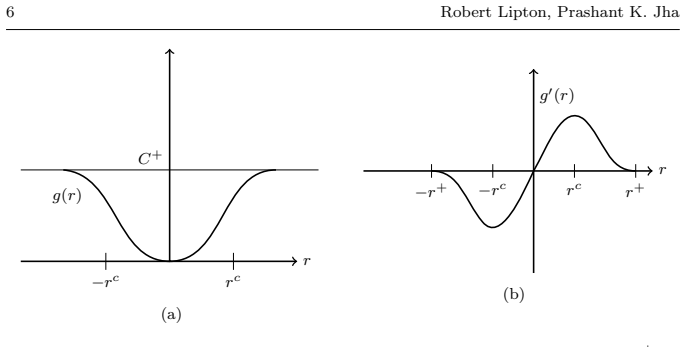
The load-bearing object is the pairwise double-well cohesive potential $W_\epsilon(S)=J_\epsilon(|y-x|)\epsilon^{-3}\omega_2^{-2}|y-x|g(\sqrt{|y-x|}S)$, with $g(r)=h(r^2)$ for concave $h$: linear elastic for small strain, softening past a critical strain, and zero force past $S_+$. Its horizon scaling makes the fracture toughness $G_c$ independent of $\epsilon$, so the same material toughness is present at every horizon. The argument runs through a new nonlocal divergence theorem and the nonlocal power balance (53), together with the assumptions that the softening zone is a thin strip, that softened bonds immediately fail, and that the opening displacement stays positive; these allow the energy integral over the two sides of the crack face to deliver exactly $-G_c V(t)$ in the limit.
What would settle it
Run the single-edge-notch simulation with horizons $\epsilon = 2.5, 1.25, 0.625$ mm and smaller, extract crack length versus time, and check whether the inferred crack-tip velocity satisfies (44) with the specified $G_c$; if the two sides of that relation diverge as $\epsilon$ shrinks, the recovered kinetic relation (58) fails.
Extended reading notes
Core claim
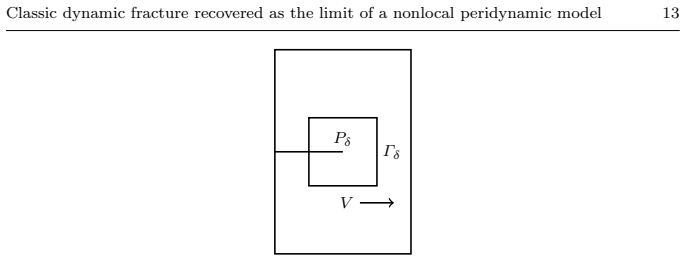
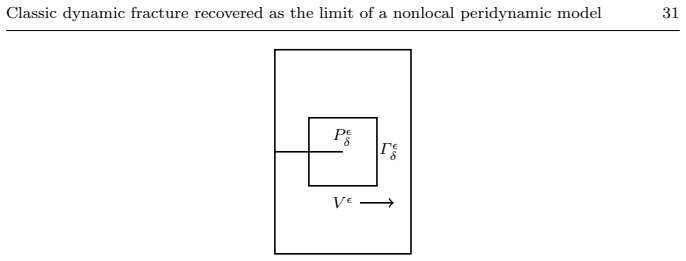
The central claim is that solutions $u^\epsilon$ of the nonlocal initial-boundary value problem (15), with forces from the double-well potential (3), converge in $L^2$ to a limit $u^0$ that is the weak solution of $\rho \ddot u^0 = \operatorname{div}(C E u^0)+b$ on $D\setminus J_{u^0}(t)$, with $C E u^0 n=0$ on the crack faces, and with crack-tip speed $V(t)$ tied to the energy flux $\mathcal{J}$ by $G_c V(t)=\mathcal{J}$. The paper proves this through Propositions 2\textendash 5 (crack set equals jump set, momentum balance, zero traction) and Proposition 7, which passes the nonlocal power balance (53) to the limit and obtains $\lim_{\epsilon\to0} \frac{d}{dt}\int_{P_\delta^\epsilon}(T^\epsilon+W^\epsilon)\,dx = \int_{\Gamma_\delta} C E u^0 n\cdot \dot u^0\,ds - G_c V(t)+O(\delta)$. Setting the internal-energy rate to zero gives the kinetic relation; substituting the classical flux formula (43) yields the semi-explicit relation (44). The paper emphasizes that this is a recovery of the kinetic relation from the model, not an input to it.
Load-bearing premise
The proof depends on the unproved Hypotheses 1 through 3 together with the uniform-convergence assumption in Proposition 7: the softening zone must have the assumed thin-strip shape, every softened bond must immediately fail, the crack opening displacement must stay bounded away from zero, and the nonlocal fields must converge uniformly away from the crack tip.
Editorial extensions
If this is right
- For every horizon $\epsilon>0$, the nonlocal evolution has a unique solution, so the convergence program supplies a well-posed path from nonlocal dynamics to the classical sharp-crack equations.
- In the small-horizon limit, the crack set coincides with the jump set of the limiting displacement, and the normal traction on the crack lips vanishes.
- The crack-tip velocity satisfies $G_c V(t)=\mathcal{J}$ and the semi-explicit form (44), so the classic dynamic fracture criterion becomes a corollary of the nonlocal model rather than an extra postulate.
- Because $G_c$ is independent of the horizon, shrinking $\epsilon$ yields numerical crack evolutions that can be compared directly with classical predictions while avoiding explicit crack-tip tracking.
Reading between the lines
- If this recovery extends to other loadings and geometries, peridynamic simulations with finite horizon could be used in reverse: measuring crack speed numerically and reading off the dynamic stress-intensity factor through the classical formula $\mathcal{J}(K_I,V)$.
- The paper notes that a Lennard-Jones-type potential is a natural next step; the same limit procedure could then deliver a sharp fracture model whose crack lips do not interpenetrate, a property the current bond-based well does not enforce.
- A testable consequence is that crack speeds computed for successively smaller horizons should converge to the solution of (44); a systematic offset would identify which of Hypotheses 1\textendash 3 or the uniform-convergence assumption needs modification.
Signed reviews
Editorial analysis
A structured set of objections, weighed in public.
Referee Report
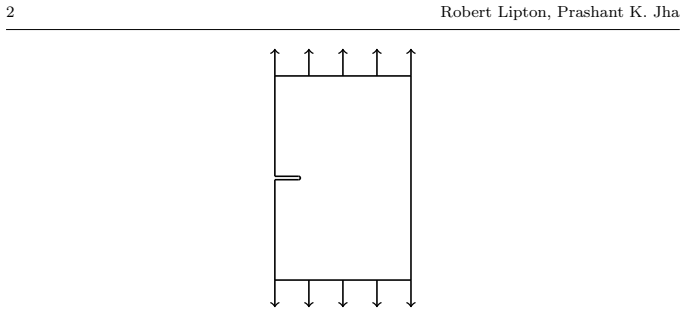
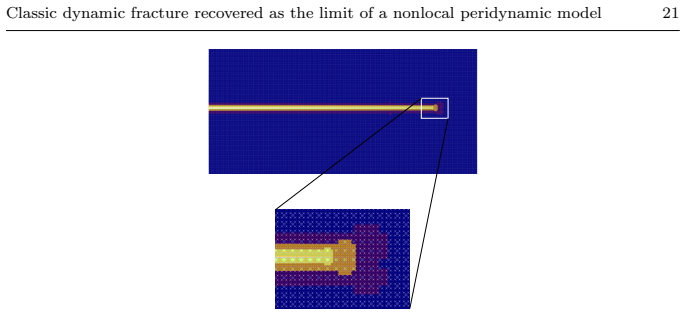
Summary. The paper studies a bond-based peridynamic model with a double-well (cohesive) potential for a single-edge-notch specimen under mode-I loading. The authors claim that as the peridynamic horizon ε tends to zero, solutions of the nonlocal initial-value problem (15) converge to the classical dynamic fracture problem: linear elastodynamics away from the crack, zero traction on the crack faces, and the kinetic relation G_c V(t) = J. The kinetic relation is not postulated as a power balance but is derived by passing to the ε → 0 limit in the nonlocal energy-rate identity (Proposition 6), yielding Proposition 7 and Eq. (58). The analysis is conditional on three hypotheses stated in Section 5 (geometric structure of the softening zone, immediate bond failure after softening, and ε^{-1} strain growth across the crack with a positive limit jump) and on an additional uniform-convergence assumption in Proposition 7. The paper also presents numerical simulations for three horizons that are offered as qualitative support for the hypotheses.
Significance. If the conditional results are accepted, the paper provides a substantive bridge between peridynamic fracture and classical dynamic fracture mechanics. The nonlocal divergence theorem (Proposition 9) and the exact nonlocal power-balance identity (Proposition 6) are genuine technical contributions, and deriving the energy-rate identity G_c V = J from an ε > 0 balance rather than postulating it is a meaningful step. The numerical experiments for three horizons are a useful sanity check. However, the strength of the central claim is substantially tempered by the fact that the main theorem and the kinetic relation depend on Hypotheses 1–3 and on an unproved uniform-convergence assumption in Proposition 7, and by the fact that the semi-explicit kinetic relation (44) relies on the classical formula (43) imported from Freund and Clifton rather than being computed from the nonlocal model.
major comments (3)
- [Section 5, Hypotheses 1–3; Proposition 7 (Eqs. (55)–(58))] The central convergence claims—Propositions 2, 4, 5, and 7—are all conditional on Hypotheses 1–3, and Proposition 7 adds a further unproved uniform-convergence assumption on u^{ε}, dot u^{ε}, and S(y,x,u^{ε}) to u^0, dot u^0, and E u^0 e·e away from the crack tip. The key limit (55), especially the replacement of the nonlocal flux integrand by the local flux (129), requires exactly this uniformity; it is not derived from Eq. (15) or from Hypotheses 1–3. Hypothesis 3 itself, Eq. (34), postulates an ε^{-1} strain growth across the crack line, which is a singular-behavior input rather than a consequence of the dynamics. Since the kinetic relation (58) is derived through Proposition 7, the paper's main claim is conditional. The authors do state the hypotheses explicitly, but the title, abstract, and conclusions do not carry this qualifier, and the numerical section provides only qualitative support (Figures 5–8), not a quantitative verification of the ε^{-1} scaling or of the uniform-convergence assumption.
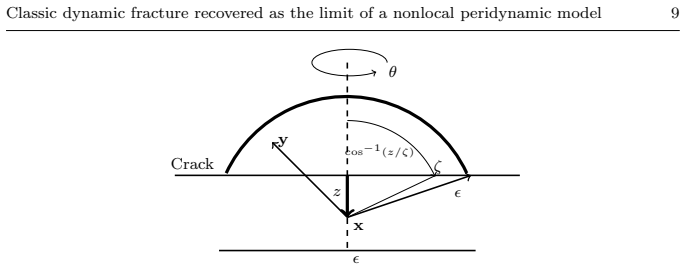
- [Section 5 and Section 11, Eqs. (43)–(44)] The semi-explicit kinetic relation (44) is not recovered from the nonlocal model: formula (43) for J is quoted from Freund and Clifton (1974) and Freund (1990), not computed from the peridynamic model. What Proposition 7 actually establishes is the energy-rate identity (58), G_c V = J with J = lim_{δ→0} ∫_{Γ_δ} C E u^0 n · dot u^0 ds. The further reduction to (44), which is the practically useful crack-tip velocity law, uses an external elastodynamic calculation of the energy flux in terms of K_I and V. Thus the statements in the Introduction and Conclusions that 'the kinetic relation for crack tip velocity is recovered directly from the nonlocal model' overstate the result: the nonlocal model supplies the energy balance, while the dependence of J on K_I and V is classical input. The paper should be reframed accordingly.
- [Section 4, uniform bound assertion] The paper states in Section 4 that 'it is assumed as in [Lipton(2016)] that the magnitude of the displacement u^{ε} is bounded uniformly in (x,t) for all horizons ε>0.' This is an additional regularity hypothesis on the nonlocal solutions that is not listed among Hypotheses 1–3 and is not derived from Eq. (15). It is used in the compactness arguments leading to Proposition 3 and the SBD limit. The paper should either prove this bound under stated assumptions on the data or explicitly list it as a standing hypothesis, so that the reader can see the full set of conditions on which the convergence rests.
minor comments (5)
- [Section 8, Eq. (46)] The norm in Eq. (46) is written with a square '(∫ |w|^2 dx + ∫ |∇w|^2 dx)^2'; it should be the square root, i.e. the exponent should be 1/2.
- [Section 3, Eq. (25)] The identity 'µ = λ = M 1/4 h′(0)' is notationally ambiguous; it should read 'µ = λ = (M/4) h′(0)' or an equivalent explicit product.
- [Section 6, first paragraph] The body-force definition 'b(x,t) = (0, f_0 h(t)/ε)' is missing a closing parenthesis, and the corresponding formula for the bottom layer should be written with matching parentheses for clarity.
- [Section 5, Eq. (43)] The prefactor (1+ν)/E in Eq. (43) should be checked against the plane-strain convention used elsewhere in the paper; for plane strain one generally expects an expression such as (1−ν^2)/E or an equivalent combination of elastic constants, and the present notation with α_t is not standard.
- [Section 5, around Eq. (39)] Equation (39) mixes the limit ε→0 with an O(δ) term in a single display; it would be clearer to state the limit first and then bound the remainder uniformly for small δ, so that the order of the two limiting processes is unambiguous.
Circularity Check
Zero traction is built into Hypothesis 2 and the kinetic relation is extracted only under an unproved uniform-convergence plus zero-energy-rate condition; the central energy-balance derivation is otherwise self-contained.
-
self definitional
[Section 5, Hypothesis 2 and Proposition 5 (eqs. (37), (52))]
"Hypothesis 2 We suppose that SZϵ =Fϵ, i.e., once bonds soften they fail. ... Thus the displacements adjacent to this zone are not influenced by forces on the other side of the zone. ... Equation (52) is the weak formulation of zero traction on the crack lips (37)."
The traction-free condition on the crack lips is not an emergent result of the nonlocal dynamics in the limit; it is written into Hypothesis 2, which states that all bonds crossing the crack zone have already failed, so that no force is transmitted from one side of the crack to the other. Proposition 5 then returns this same statement as the weak zero-traction identity (52). The claimed recovery of (37) is therefore, up to weak-form transcription, the input hypothesis itself.
-
other
[Section 5, Proposition 7 (eqs. (55)–(58))]
"In addition to hypothesis 1 through 3 we suppose that uϵn(t), ˙uϵn(t),S(y, x, uϵn) converge uniformly to u0(t), ˙u0(t), andEu0e·e on subsets away from the the crack tip for t∈ [0,T ]. ... From this proposition we see that when the rate of change of internal energy is zero the kinetic relation for the crack tip velocity is ... GcV (t) =J."
The local energy flux that supplies J is obtained by assuming uniform convergence of the nonlocal velocity and strain fields to their local limits; that uniformity is not proved from the nonlocal balance law. The final kinetic relation is then selected by the additional condition that the rate of change of internal energy in the moving tip region vanish, which is not derived from the model. Thus GcV=J is recovered only under hypotheses that already contain the classical balance structure, so the advertised 'direct recovery' is conditional rather than unconditional.
full rationale
The paper's central step is not circular in the strict sense: Proposition 6 is an exact identity following from the nonlocal equation of motion, and the calculation in Section 11 evaluates the GcV term from the same double-well potential that defines the model, with no parameter fitted to the target kinetic relation. However, two pieces of the advertised limit are inputs rather than consequences. Hypothesis 2 already imposes failed bonds across the crack, making zero traction on the crack lips nearly tautological. Proposition 7 relies on an unproved uniform-convergence hypothesis and then imposes zero rate of change of internal energy to turn the balance identity (56) into the kinetic relation GcV=J; moreover, the explicit form (44) uses the J(K_I,V) formula imported from Freund and Clifton rather than derived from the nonlocal model. The paper also leans on the authors' earlier compactness results from Lipton (2014, 2016), but those are published theorems with assumptions independent of the kinetic relation, so I do not count the self-citation itself as circular. Overall, the energy-balance derivation has independent mathematical content, but the advertised 'recovery' is weakened by hypotheses that partly encode the conclusions, justifying a modest circularity/conditionality score.
Assumptions & free parameters
assumptions (8)
- domain assumption Small deformation assumption: displacement u is infinitesimal and deformed configuration is identified with reference configuration (Section 2).
- domain assumption Uniform bound on displacement magnitude independent of horizon epsilon (Section 4, after (21)).
- ad hoc to paper Hypothesis 1: for x in SZ epsilon, all bonds crossing the x2 = 0 axis are beyond the critical strain while same-side bonds are below it.
- ad hoc to paper Hypothesis 2: SZ epsilon = F epsilon, i.e. once bonds soften they fail.
- ad hoc to paper Hypothesis 3: displacement is directed away from the crack, strain across the crack line grows as epsilon^{-1}, and the limit jump satisfies [u0] dot n > alpha > 0 (Eqs. (34)-(35)).
- ad hoc to paper Uniform convergence of u epsilon, u epsilon dot, and strain to u0, u0 dot, and E u0 e dot e on subsets away from the crack tip (Proposition 7).
- standard math SBD compactness and difference quotient estimates (68) and (94) from Lipton (2016) and Ambrosio, Coscia, and Dal Maso (1997).
- standard math Classical representation of the dynamic energy flux J in terms of K_I(t) and V(t) (Eq. (43), cited to Atkinson-Eshelby, Kostrov-Nikitin, Freund, and Willis).
Cite this review
Pith. "Pith review of Classic dynamic fracture recovered as the limit of a nonlocal peridynamic model: The single edge notch in tension." pith.science (2026). https://pith.science/paper/KMSRU6KK
@misc{pith2026190807589,
  author       = {Pith},
  title        = {Pith review of: Classic dynamic fracture recovered as the limit of a nonlocal peridynamic model: The single edge notch in tension},
  year         = {2026},
  howpublished = {\url{https://pith.science/paper/KMSRU6KK}},
  note         = {Machine review of arXiv:1908.07589}
}
read the original abstract
A simple nonlocal field theory of peridynamic type is applied to model brittle fracture. The fracture evolution is shown to converge in the limit of vanishing nonlocality to classic plane elastodynamics with a running crack. The kinetic relation for the crack is recovered directly from the nonlocal model in the limit of vanishing nonlocality. We carry out our analysis for a single crack in a plate subject to mode one loading. The convergence is corroborated by numerical experiments.
Figures
Figures from the paper (9 more)





Reference graph
Works this paper leans on
- [1]
-
[17]
Journal of Peri- dynamics and Nonlocal Modeling
Com- plex fracture nucleation and evolution with nonlocal elastodynamics. Journal of Peri- dynamics and Nonlocal Modeling. Online First. URL https://doi.org/10.1007/ s42102-019-00010-0 Mengesha and Du(2015). Mengesha, T. and Du, Q.,
work page 2015
-
[22]
Journal of Elasticity 88 (2), 151–184
Peridynamic states and constitutive modeling. Journal of Elasticity 88 (2), 151–184. Silling and Lehoucq (2008). Silling, S. A. and Lehoucq, R. B.,
work page 2008
-
[25]
Computers and Structures 83, 1526–1535
A meshfree method based on the peridynamic model of solid mechanics. Computers and Structures 83, 1526–1535. Classic dynamic fracture recovered as the limit of a nonlocal peridynamic model 39 Slepian (2002). Slepian, Y.,
work page 2002
-
[27]
Computer Methods in Applied Mechanics and Engineering 343, 151–165
An asymptoti- cally compatible mesh free quadrature rule for nonlocal problems with applications to peridynamics. Computer Methods in Applied Mechanics and Engineering 343, 151–165. Willis (1975). Willis, J. R., 1975, Equations of motion for propagating cracks, The mechan- ics and physics of fracture, The Metals Society. 57–67
work page 1975
-
[1948]
Fracture in mild steel plates. Engineering 165, 16–18. Ravi-Chandar (2004). Ravi-Chandar, K.,
work page 2004
-
[1968]
The flow of energy into the tip of a moving crack. Int. J. Fract. 4, 3–8. Ambrosio, Coscia and Dal Maso(1997). Ambrosio, L., Coscia, A., and Dal Maso, G.,
work page 1997
-
[1970]
Some general problems of mechanics of brittle fracture. Arch. Mech. Stosowanej. 22, 749–775. Lipton(2014). Lipton, R.,
work page 2014
Show all 27 references
-
[1972]
Energy flux into the tip of an extending crack in an elastic solid. J. Elasticity 2, 341–349. Freund(1990). Freund, B
1990
-
[1974]
Journal of Elasticity 4, 293–299
On the uniqueness of plane elastodynamic solutions for running cracks. Journal of Elasticity 4, 293–299. Jha and Lipton(2018a). Jha, P. K. and Lipton, R., 2018a. Numerical analysis of nonlocal fracture models in H¨ older space. SIAM Journal on Numerical Analysis 56 (2), 906–94...
2018 doi
-
[1990]
Cambridge Monographs on Mechanics and Applied Mathematics
Dynamic Fracture Mechanics. Cambridge Monographs on Mechanics and Applied Mathematics. Cambridge University Press. Cambridge. Freund and Clifton(1974). Freund, B. and Clifton, R J.,
1974
-
[1997]
Fine properties of functions with bounded deformation. Arch. Ration. Mech. Anal. 139, 201–238. Anderson(2005). Anderson, T. L
2005
-
[1998]
American Mathematical Society
Partial Differential Equations. American Mathematical Society. Providence, RI. Fineberg and Marder(1999). Fineberg, J. and Marder, M
1999
-
[1999]
Physics Reports, 313, 1–108
Instability in dynamic frac- ture. Physics Reports, 313, 1–108. Freund(1972). Freund, L. B.,
1972
-
[2000]
Journal of the Mechanics and Physics of Solids 48 (1), 175–209
Reformulation of elasticity theory for discontinuities and long-range forces. Journal of the Mechanics and Physics of Solids 48 (1), 175–209. Silling et al. (2007). Silling, S. A., Epton, M., Weckner, O., Xu, J. and Askari, E.,
2007
-
[2002]
Founda- tions of Engineering Mechanics
Models and Phenomena in Fracture Mechanics. Founda- tions of Engineering Mechanics. Springer-Verlag. Berlin. Trask et al. (2018). Trask, N., You, H., Yu, Y., and Parks, M. L.,
2018
-
[2004]
Elsevier
Dynamic Fracture. Elsevier. Oxford. Silling (2000). Silling, S. A.,
2000
-
[2005]
3rd edition
Fracture Mechanics: Fundamentals and Applica- tions. 3rd edition. Taylor & Francis, Boca Raton. 38 Robert Lipton, Prashant K. Jha Bobaru and Zhang(2015). Bobaru, F. and Zhang, G.,
2015
-
[2007]
Communications in Mathematical Sciences 5, 851–864
On the well-posedness of the linear peridynamic model and its convergence towards the Navier equation of linear elasticity. Communications in Mathematical Sciences 5, 851–864. Evans(1998). Evans, L. C.,
1998
-
[2008]
Journal of Elasticity 93 (1), 13–37
Convergence of peri- dynamics to classical elasticity theory. Journal of Elasticity 93 (1), 13–37. Silling and Lehoucq (2010). Silling, S. A. and Lehoucq, R. B.,
2010
-
[2010]
Advances in Applied Mechanics 44, 73–168
Peridynamic theory of solid mechanics. Advances in Applied Mechanics 44, 73–168. Silling and Askari (2005). S. A. and Askari, E.,
2005
-
[2014]
Journal of Elasticity 117 (1), 21–50
Dynamic brittle fracture as a small horizon limit of peri- dynamics. Journal of Elasticity 117 (1), 21–50. Lipton(2016). Lipton, R.,
2016
-
[2015]
International Journal of Fracture 196, 59–98
Why do cracks branch? A peri- dynamic investigation of dynamic brittle fracture. International Journal of Fracture 196, 59–98. Emmrich and Weckner(2007). Emmrich, E. and Weckner, O.,
2007
-
[2016]
Journal of Elasticity 124 (2), 143–191
Cohesive dynamics and brittle fracture. Journal of Elasticity 124 (2), 143–191. Lipton et al.(2018). Lipton, R., Said, E., and Jha, P. K.,
2018
-
[2018]
Handbook of Nonlocal Con- tinuum Mechanics for Materials and Structures, 1–27
Dynamic brittle fracture from nonlocal double-well potentials: A state-based model. Handbook of Nonlocal Con- tinuum Mechanics for Materials and Structures, 1–27. URL https://doi.org/10.1007/ 978-3-319-22977-5_33-1 Lipton, Lehoucq, and Jha (2019). Lipton, R., Lehoucq, R., and ...
2019
-
[2019]
Kostrov, B
Kostrov and Nikitin(1970). Kostrov, B. V. and Nikitin, L. V.,
1970
-
[3999]
Mott (1948). Mott, N. F.,
1948
Reviewed August 14, 2026 · model on record in the stance chip above.
Discussion (0). Continue with ORCID to comment.