REVIEW 4 major objections 5 minor 27 references
Spallation-altered accreted compositions for X-ray bursts: Impact on ignition conditions and burst ashes
T0 review · 4 major / 5 minor · reviewed 2026-08-14 · deepseek-v4-flash
Pith's one-line read This paper shows that cascading spallation in the atmosphere of an accreting neutron star replenishes CNO elements, so the metal content fueling X-ray bursts depends on the accretion rate and alters predicted burst ashes.
desk verdict First full cascading-spallation calculation for accreted neutron star atmospheres; the CNO-replenishment direction is credible, but the quantitative headline rests on an unspecified proton energy, a single exposure time for all species, and no propagated cross-section uncertainties. read the letter →
The pith
A machine-rendered reading of the paper's core claim, the machinery that carries it, and where it could break.
The reading
What carries the argument
The load-bearing machinery is a single-zone nuclear reaction network containing 486 isotopes from hydrogen to iron, coupled by 13,076 reactions, with proton-induced spallation reactions treated as decays because protons are continuously supplied by accretion. Spallation cross sections come from the semi-empirical systematics of Silberberg et al. (1998) with energy-dependent updates from Gallo et al. (2019), and $\beta$-decay rates from the Nuclear Wallet Cards. The exposure time for spallation is taken from the Bildsten et al. (1992) stopping and diffusion picture, $t_{\rm exposure} \approx [0.5\,{\rm kg\,cm^{-2}}/\dot{m}]\,(1-A/Z^2)$, with a single exposure time (that of 12C) adopted for all elements at a given accretion rate. Evolving the network over this exposure time is what produces the cascading replenishment of CNO elements and the accretion-rate-dependent metal distribution.
What would settle it
A multi-species atmosphere simulation that tracks each element's stopping depth and diffusion separately, combined with measured spallation yields, could test the single-exposure-time assumption; if the fully resolved calculation gives CNO survival orders of magnitude below the cascading-network result across the same accretion rates, the paper's quantitative claim would be undermined.
Extended reading notes
Core claim
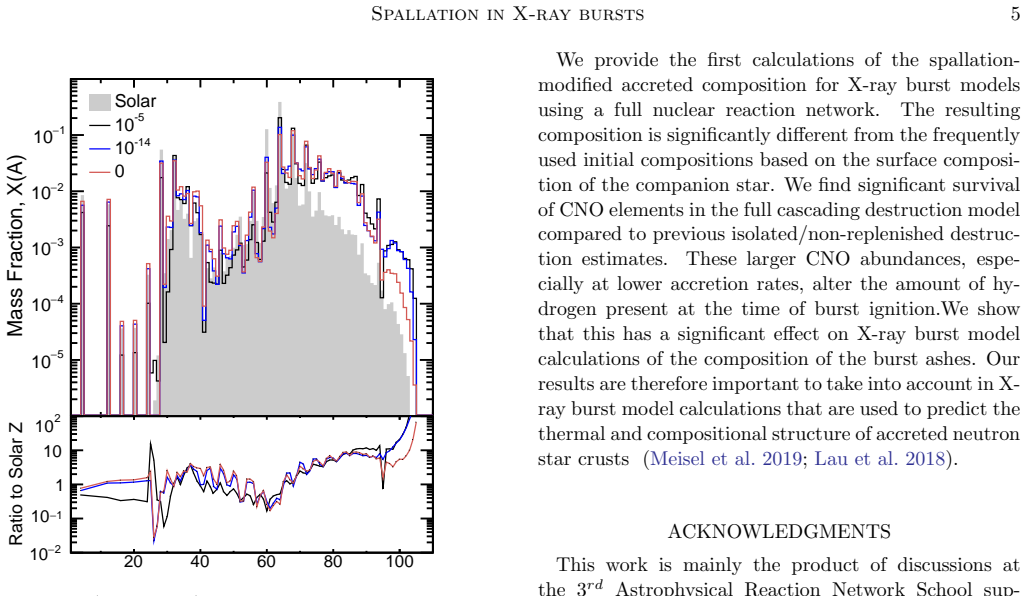
The central discovery is that proton-induced spallation in the neutron-star atmosphere, modeled as a full 486-isotope reaction network with cascading fragmentation, leaves substantially more CNO material than the isolated-destruction treatment of Bildsten et al. (1992). Carbon in particular is replenished through spallation of neon, fluorine, oxygen, and nitrogen, with the main production channels being the destruction of 14N and 16O; these channels are absent when each CNO element is destroyed alone. The paper further finds that the surviving metal abundances are a function of mass accretion rate, and that using this spallation-altered composition in multi-zone X-ray burst calculations enhances the abundances of high-mass nuclei in the burst ashes compared with lower-metallicity models, with the largest changes in the A ~ 30-60 region.
Load-bearing premise
The calculation assumes that a single exposure time, taken from 12C and derived from the Bildsten et al. (1992) diffusion formula, applies to all elements at a given accretion rate; if real atmospheres give element-dependent diffusion times, the predicted CNO survival and its accretion-rate dependence would change.
Editorial extensions
If this is right
- CNO destruction in X-ray burst models is overestimated whenever replenishment is ignored, so models must use the cascading, accretion-rate-dependent metal distribution rather than a fixed solar or metal-poor composition.
- At the accretion rates studied, the spallation-altered composition changes the hydrogen mass fraction at burst ignition, particularly at low accretion rates, shifting bursts between helium-rich and hydrogen-rich ignition regimes.
- Multi-zone burst calculations with the cascading composition produce ashes with enhanced mass fractions at A ~ 30-60, which alters predicted Urca cooling and the electron-ion impurity parameter in the neutron-star crust.
- The accretion-rate dependence of the surviving metals provides a natural way for burst observables to vary between systems that accrete at different rates.
Reading between the lines
- If the exposure time really is nearly element-independent, the same cascading treatment could be extended to other accreting compact objects where energetic protons drive spallation, though the stopping energies would differ.
- The accretion-rate dependence suggests that burst ash composition, and hence crust cooling curves, should correlate with accretion rate across a population of bursters; this is a testable prediction the paper does not make explicitly.
- Because the cascading network relies on semi-empirical spallation cross sections, the surviving CNO abundances carry cross-section uncertainties; measuring partial spallation cross sections for 14N and 16O at roughly 200 MeV/u would directly benchmark the main replenishment channels.
- The finding that reduced metallicity enhances high-mass ashes implies that discrepancies between predicted and observed burst light curves could be partly an input-composition effect rather than a nuclear-rate effect.
Signed reviews
Editorial analysis
A structured set of objections, weighed in public.
Referee Report
Summary. This paper investigates how proton-induced spallation in the atmosphere of an accreting neutron star alters the accreted composition before it reaches the burning layers, using for the first time a full cascading spallation network. The authors use a single-zone reaction network with 486 isotopes and 13076 reactions, compute spallation rates as j_p times sigma(E_p) with semi-empirical cross sections, and evolve the abundances for an exposure time derived from Bildsten et al. (1992) as a function of mass accretion rate. They find that cascading spallation replenishes CNO elements, giving carbon abundances several orders of magnitude higher than in the isolated-destruction estimate, and they provide an accretion-rate-dependent metal distribution. They then apply the altered composition in the settle code to compute hydrogen fractions at ignition and in MESA multizone burst models to show changes in burst ashes, particularly for A ~ 30-60.
Significance. If correct, this is the first full-cascade treatment of spallation in this context and provides a physically motivated, accretion-rate-dependent metal distribution for X-ray burst models, with implications for ignition conditions, burst light curves, and crust cooling. The paper's strengths include the use of an open-source network, an explicit comparison of cascading versus isolated destruction, and the direct application to both ignition and ash calculations. However, the quantitative claims rest on several underspecified or simplifying assumptions that need to be tested before the results can be used as reliable input for burst models.
major comments (4)
- [Section 2, Eq. (2) and Fig. 1] The statement that the exposure time is nearly the same for elements from 12C to 56Fe is not supported by Eq. (2). The factor (1 - A/Z^2) is 0.667 for 12C and 0.917 for 56Fe, a 37% difference, with intermediate values for 20Ne (0.800) and 28Si (0.857). Using the 12C exposure time for all species changes the spallation rates of heavier elements, which are the parents of the replenished CNO, and thus can directly alter the central result. Please provide a sensitivity test or use element-specific exposure times.
- [Section 2, spallation rates] The spallation rates are defined as j_p times sigma(E_p), but the proton energy E_p is never specified. Accreting protons start near 200 MeV/u and lose energy while penetrating the column, and spallation cross sections are strongly energy dependent. Without stating the adopted E_p or, better, integrating over the proton energy distribution during slowing, the rates are not reproducible and the balance between CNO destruction and replenishment is not quantitatively fixed. Please specify the assumed energy or implement a more realistic proton energy treatment.
- [Section 4.1, sedimentation caveat] The paper explicitly acknowledges that for mdot below about 5 kg cm^-2 s^-1 sedimentation affects the isotope distribution and ignition, yet this is exactly the regime where the cascading enhancement is largest (the conclusions state that the larger CNO abundances occur especially at lower accretion rates) and where Figure 5 shows the strongest effects on X_H at ignition. The manuscript then uses these low-mdot results to draw quantitative conclusions about ignition and ashes. This is a load-bearing caveat: the authors should either include sedimentation in the model or explicitly restrict their quantitative claims to higher accretion rates and test how sedimentation changes CNO survival in the affected regime.
- [Figure 4 and Section 3] The isolated-destruction comparison is not described in sufficient detail for it to support the central claim. The paper only states that the abundance evolution of 12C is followed in an isolated destruction process, without specifying the initial composition, the exact set of reactions included, or whether the same network and same exposure time are used. If the isolated case uses a truncated version of the network, this should be stated explicitly; otherwise the comparison may not cleanly isolate the effect of cascading production. Please document the isolated calculation precisely.
minor comments (5)
- [Abstract] The phrase 'Spallation model provides' should be 'The spallation model provides'.
- [Section 2] There is a typo: 'and and rest are spallation reactions' should be 'and the rest are spallation reactions'.
- [Section 2, paragraph before Fig. 1] The sentence 'texposure for C, Ne, Si and Fe elements over a range of mass accretion rates are shown in Figure 1' has a subject-verb agreement issue; it should read 'The exposure times for C, Ne, Si, and Fe are shown...'.
- [Figure 4] The x-axis label appears garbled in the typeset manuscript, rendering as 'kg cmm9' rather than a clear unit expression. Please check the figure rendering.
- [References] The author name in the reference list appears as '¨Ozel' due to a LaTeX accent issue; it should be 'Özel'.
Circularity Check
No significant circularity: the cascading-spallation result is a forward network output, and the self-citations are methodological or experimental-calibration references that are not load-bearing.
full rationale
The load-bearing claim—that a full cascading spallation network yields higher surviving CNO abundances than isolated destruction—is a forward network calculation, not an input. The paper evolves a 486-isotope, 13,076-reaction NucNet Tools network from solar composition, with spallation rates jp*sigma(Ep) from Silberberg et al. (1998) plus experimental scaling from Gallo et al. (2019), and exposure times from Bildsten et al. (1992). The CNO survival and the reaction-flow paths (e.g., 12C production via 14N and 16O spallation) are outputs. The exposure-time formula is an external, stated assumption; using a single exposure time for all elements and adopting 12C is a simplification, not a fit to the predicted abundances. The comparison against isolated destruction is a controlled model contrast: the cascading network contains production channels that the isolated model omits by definition, but the magnitude of the effect (orders-of-magnitude carbon enhancement, accretion-rate dependence) and the net flows are genuine network results. Self-citations to Gallo et al. (2019), Meisel (2018), and Meisel et al. (2019) are methodological or cross-section calibrations against experimental data; none is a uniqueness theorem or an unverified premise that forces the conclusion. The paper's own caveat that sedimentation below ~5 kg cm^-2 s^-1 may alter the ignition results (Sec. 4.1) is a physical limitation, and the unspecified proton energy/spectrum in the spallation-rate expression is a robustness concern, but neither constitutes circularity. Therefore no circular step is identified.
Assumptions & free parameters
free parameters (3)
- Diffusion factor R in exposure time =
Not recomputed; taken from Bildsten et al. (1992)
- Base heating flux F_b =
0.15 MeV per accreted nucleon
- Spallation cross-section scaling =
Calibrated to experimental data in Gallo et al. (2019)
assumptions (6)
- domain assumption Heavier elements thermalize at shallower depths than protons, so they are exposed to high-energy protons while diffusing downward.
- domain assumption All elements can be assigned the same exposure time, taken as the 12C exposure time.
- domain assumption Protons are continuously supplied by accretion, so proton-induced spallation can be treated as decay reactions in the network.
- domain assumption Helium spallation is negligible because H and He have the same stopping depth and any destroyed He re-assembles.
- domain assumption Sedimentation is negligible at the accretion rates studied; below about 5 kg cm^-2 s^-1 it can change the composition.
- domain assumption Spallation cross sections from Silberberg et al. (1998) with energy-dependent scaling from Gallo et al. (2019) are reliable.
Cite this review
Pith. "Pith review of Spallation-altered accreted compositions for X-ray bursts: Impact on ignition conditions and burst ashes." pith.science (2026). https://pith.science/paper/FEFTR4C6
@misc{pith2026190807614,
  author       = {Pith},
  title        = {Pith review of: Spallation-altered accreted compositions for X-ray bursts: Impact on ignition conditions and burst ashes},
  year         = {2026},
  howpublished = {\url{https://pith.science/paper/FEFTR4C6}},
  note         = {Machine review of arXiv:1908.07614}
}
read the original abstract
Dependable predictions of the X-ray burst ashes and light curves require a stringent constraint on the composition of the accreted material as an input parameter. Lower metallicity models are generally based on a metal deficient donor and all metals are summed up in CNO abundances or solar metal distribution is assumed. In this work, we study the alteration of accreted composition due to spallation in the atmosphere of accreting neutron stars considering a cascading destruction process. We find that the inclusion of the cascading process brings the replenishment of CNO elements and overall survival probability is higher compared to isolated destruction of CNO elements. Spallation model provides the distribution of metals as a function of mass accretion rate. Multi-zone X-ray burst models calculated with reduced metallicities have enhanced abundances for high-mass nuclei in X-ray burst ashes. The increased metallicity due to the replenishment of CNO elements changes the composition of burst ashes compared to lower metallicity conditions. This will modify the thermal and compositional structure of accreted neutron star crusts.
Figures


Figures from the paper (2 more)

Reference graph
Works this paper leans on
-
[1]
Bildsten, L., Salpeter, E. E., & Wasserman, I. 1992, ApJ, 384, 143, doi: 10.1086/170860 —. 1993, ApJ, 408, 615, doi: 10.1086/172621
doi:10.1086/170860 1992
-
[2]
2000, ApJ, 544, 453, doi: 10.1086/317191
Cumming, A., & Bildsten, L. 2000, ApJ, 544, 453, doi: 10.1086/317191
doi:10.1086/317191 2000
-
[3]
Cumming, A., Macbeth, J., in ’t Zand, J. J. M., & Page, D. 2006, The Astrophysical Journal, 646, 429, doi: 10.1086/504698
doi:10.1086/504698 2006
-
[4]
Cyburt, R. H., Amthor, A. M., Heger, A., et al. 2016, The Astrophysical Journal, 830, 55, doi: 10.3847/0004-637x/830/2/55
-
[5]
Cyburt, R. H., Amthor, A. M., Ferguson, R., et al. 2010, The Astrophysical Journal Supplement Series, 189, 240, doi: 10.1088/0067-0049/189/1/240
-
[6]
L., Schatz, H., & Thielemann, F.-K
Fisker, J. L., Schatz, H., & Thielemann, F.-K. 2008, The Astrophysical Journal Supplement Series, 174, 261, doi: 10.1086/521104 6 Randhawa et al
doi:10.1086/521104 2008
-
[7]
Gallo, L. C., Randhawa, J. S., Waddell, S. G. H., et al. 2019, Monthly Notices of the Royal Astronomical Society, 484, 3036, doi: 10.1093/mnras/stz260
-
[8]
1998, Space Science Reviews, 85, 161, doi: 10.1023/A:1005161325181
Grevesse, N., & Sauval, A. 1998, Space Science Reviews, 85, 161, doi: 10.1023/A:1005161325181
Show all 27 references
-
[9]
K., & Woosley, S
Heger, A., Cumming, A., Galloway, D. K., & Woosley, S. E. 2007, The Astrophysical Journal, 671, L141, doi: 10.1086/525522
2007 doi
-
[10]
S., & Bodenheimer, P
Henyey, L., Vardya, M. S., & Bodenheimer, P. 1965, ApJ, 142, 841, doi: 10.1086/148357 Jos´ e, J., Moreno, F., Parikh, A., & Iliadis, C. 2010, The Astrophysical Journal Supplement Series, 189, 204, doi: 10.1088/0067-0049/189/1/204
1965 doi
-
[11]
S., et al
Lau, R., Beard, M., Gupta, S. S., et al. 2018, The Astrophysical Journal, 859, 62, doi: 10.3847/1538-4357/aabfe0
2018 doi
-
[12]
Lewin, W. H. G., van Paradijs, J., & Taam, R. E. 1993, SSRv, 62, 223, doi: 10.1007/BF00196124
1993 doi
-
[13]
2018, The Astrophysical Journal, 860, 147, doi: 10.3847/1538-4357/aac3d3
Meisel, Z. 2018, The Astrophysical Journal, 860, 147, doi: 10.3847/1538-4357/aac3d3
2018 doi
-
[14]
2017, The Astrophysical Journal, 837, 73, doi: 10.3847/1538-4357/aa618d
Meisel, Z., & Deibel, A. 2017, The Astrophysical Journal, 837, 73, doi: 10.3847/1538-4357/aa618d
2017 doi
-
[15]
2019, The Astrophysical Journal, 872, 84, doi: 10.3847/1538-4357/aafede ¨Ozel, F., & Freire, P
Meisel, Z., Merz, G., & Medvid, S. 2019, The Astrophysical Journal, 872, 84, doi: 10.3847/1538-4357/aafede ¨Ozel, F., & Freire, P. 2016, Annual Review of Astronomy and Astrophysics, 54, 401, doi: 10.1146/annurev-astro-081915-023322
2019 doi
-
[16]
2010, The Astrophysical Journal Supplement Series, 192, 3, doi: 10.1088/0067-0049/192/1/3
Paxton, B., Bildsten, L., Dotter, A., et al. 2010, The Astrophysical Journal Supplement Series, 192, 3, doi: 10.1088/0067-0049/192/1/3
2010 doi
-
[17]
2013, The Astrophysical Journal Supplement Series, 208, 4, doi: 10.1088/0067-0049/208/1/4
Paxton, B., Cantiello, M., Arras, P., et al. 2013, The Astrophysical Journal Supplement Series, 208, 4, doi: 10.1088/0067-0049/208/1/4
2013 doi
-
[18]
2015, The Astrophysical Journal Supplement Series, 220, 15, doi: 10.1088/0067-0049/220/1/15
Paxton, B., Marchant, P., Schwab, J., et al. 2015, The Astrophysical Journal Supplement Series, 220, 15, doi: 10.1088/0067-0049/220/1/15
2015 doi
-
[19]
B., et al
Paxton, B., Schwab, J., Bauer, E. B., et al. 2018, The Astrophysical Journal Supplement Series, 234, 34, doi: 10.3847/1538-4365/aaa5a8
2018 doi
-
[20]
F., & Truran, J
Peng, F., Brown, E. F., & Truran, J. W. 2007, The Astrophysical Journal, 654, 1022, doi: 10.1086/509628
2007 doi
-
[21]
2006, Nuclear Physics A, 777, 601 , doi: https://doi.org/10.1016/j.nuclphysa.2005.05.200
Schatz, H., & Rehm, K. 2006, Nuclear Physics A, 777, 601 , doi: https://doi.org/10.1016/j.nuclphysa.2005.05.200
2006 doi
-
[22]
2001, Phys
Schatz, H., Aprahamian, A., Barnard, V., et al. 2001, Phys. Rev. Lett., 86, 3471, doi: 10.1103/PhysRevLett.86.3471
2001 doi
-
[23]
H., & Barghouty, A
Silberberg, R., Tsao, C. H., & Barghouty, A. F. 1998, The Astrophysical Journal, 501, 911, doi: 10.1086/305862
1998 doi
-
[24]
2006, In: Compact Stellar X-ray Sources, Cambridge Astrophysics (Cambridge University Press), doi: 10.1017/CBO9780511536281
Strohmayer, T., & Bildsten, L. 2006, In: Compact Stellar X-ray Sources, Cambridge Astrophysics (Cambridge University Press), doi: 10.1017/CBO9780511536281
2006 doi
-
[25]
Tuli, J. K. 2011, Nuclear Wallet Cards, 8th edition
2011
- [26]
-
[27]
E., Heger, A., Cumming, A., et al
Woosley, S. E., Heger, A., Cumming, A., et al. 2004, The Astrophysical Journal Supplement Series, 151, 75, doi: 10.1086/381533 Zamfir, M., Cumming, A., & Galloway, D. K. 2012, The Astrophysical Journal, 749, 69, doi: 10.1088/0004-637x/749/1/69
2004 doi
Reviewed August 14, 2026 · model on record in the stance chip above.
Discussion (0). Continue with ORCID to comment.