REVIEW 4 major objections 3 minor 23 references
Tree Builder Random Walk: recurrence, transience and ballisticity
T0 review · 4 major / 3 minor · reviewed 2026-08-14 · deepseek-v4-flash
Pith's one-line read The paper proves a clean dichotomy: for odd growth period s the Tree Builder Random Walk is ballistic under uniform ellipticity, while for even s it is null recurrent or trapped.
desk verdict Plausible and significant classification for a natural unifying model, but the written proofs have a few load-bearing gaps, so treat as conditional pending completion. read the letter →
The pith
A machine-rendered reading of the paper's core claim, the machinery that carries it, and where it could break.
The reading
What carries the argument
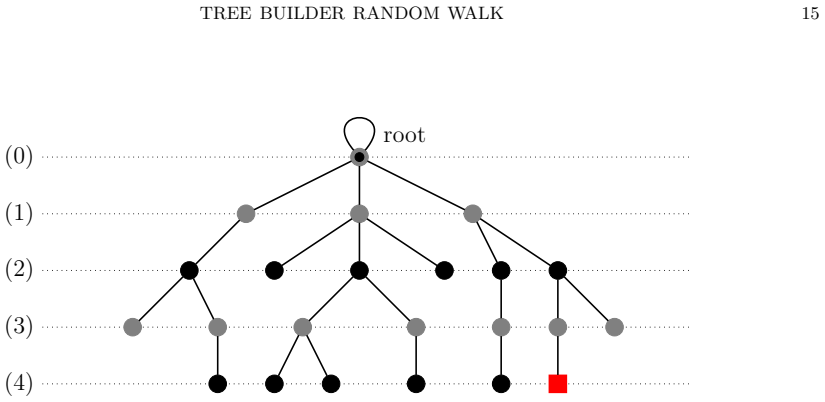
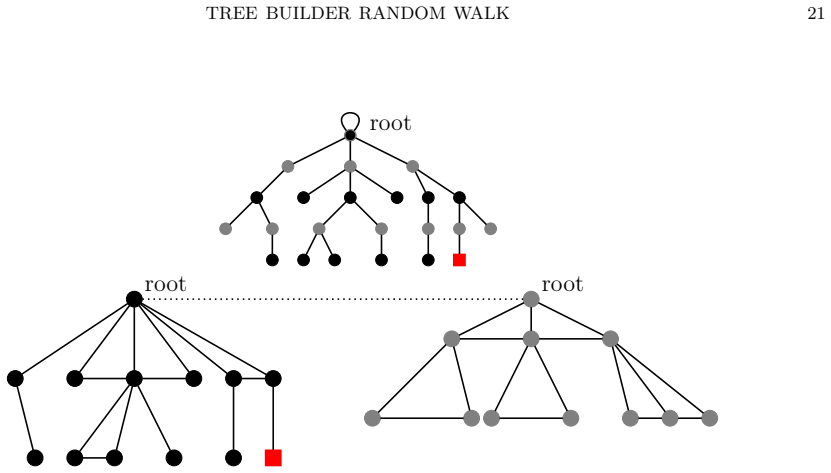
The central object is the TBRW process itself, a Markov chain when the environment $\xi$ is independent. The proof of ballisticity is carried by two conditions, $(R)$ and $(L)$: $(R)$ says that with probability at least $1-\varepsilon/2$ the walker reaches distance $2r$ from the root within $\exp\{r^\alpha\}$ steps, and $(L)$ says that the probability of climbing back $r$ steps within that window is at most $1/2-\varepsilon$. Lemma 4.1 turns these into a stochastic domination of the rescaled distance by a $\frac{1}{2(1+\varepsilon)}$-right-biased simple random walk. The auxiliary Generalized Loop Process, a path with loops added to the current vertex, supplies the stretched-exponential hitting-time upper bounds that yield $(L)$; the parity-correction lemma (Lemma 4.6) is the key local estimate that lets an odd-period walker push a new leaf forward with uniform probability, bootstrapping $(R)_{1/2}$ to $(R)_{M+1/2}$.
What would settle it
Simulate or construct a TBRW with s odd and independent ξ_n with P(ξ_n≥1) bounded below; if for some finite rooted tree the walker's distance from the root divided by n has liminf 0 on a positive-probability event, Theorem 1.3 is false. A less drastic check is to test, for a process satisfying (R) and (L), the conditional inequality inf P(Δ d_{k+1}=r | F_k) ≥ 1/(2(1+ε)) used to couple with the right-biased walk.
Extended reading notes
Core claim
At the paper's core is Theorem 1.3: for a $(\xi,s)$-TBRW with $s$ odd and an independent environment satisfying $\inf_n P(\xi_n\ge 1)>0$, the walker is ballistic, meaning $\liminf_n \operatorname{dist}_{T_n}(X_n,\mathrm{root})/n \ge c$ almost surely for a positive constant $c$. The proof works through a general criterion: if a tree-building walk has a large enough chance to push the tree forward by $r$ in $\exp\{r^\alpha\}$ steps (condition $(R)$) and a small enough chance to climb back $r$ in the same window (condition $(L)$), then its distance from the root, observed at suitable stopping times, stochastically dominates a right-biased simple random walk; the law of large numbers then gives positive speed. For even $s$ the paper proves a dichotomy instead: condition $(S)$ implies recurrence and, together with uniform ellipticity, null recurrence; condition $(I)$ implies almost sure trapping, so the walker eventually bounces forever between a vertex and its neighbours.
Load-bearing premise
The ballisticity argument depends on an unproved transfer: condition (R) on the whole tree is assumed to hold on the subtree rooted at the walker's current position, and the proof says only that this is possible to show.
Editorial extensions
If this is right
- For odd $s$ and uniformly elliptic independent environments, the walker is transient with positive speed, settling the odd-$s$ transient conjecture for the No Restart Random Walk.
- For even $s$, a slowly growing environment (condition $(S)$) forces every vertex eventually added to the tree to be recurrent, and with $(UE)$ the recurrence is null rather than positive.
- For even $s$, an environment with very fast growth (condition $(I)$) causes almost sure trapping: the walker eventually stays in a finite set and the height of the tree stops growing.
- Under $(UE)$ alone, the hitting time of a vertex at distance at least $\ell_0$ has infinite expectation, so the TBRW is never positive recurrent in any regime covered by the paper's assumptions.
- For odd $s$ and $(UE)$, the height of the generated tree grows linearly; for even $s$ with $(S)$ and $(UE)$, the height still diverges to infinity almost surely.
Reading between the lines
- Because the paper's $(R)+(L)$ criterion is stated abstractly, the same coupling could be tried on other self-interacting walks; the TBRW is only one instance.
- A natural extension the authors only ask about: replacing uniform ellipticity by a slowly decaying probability $P(\xi_n\ge 1)\to 0$ might produce zero-speed transient or positive-recurrent regimes between ballistic and trapped.
- Example 6.1 suggests that for infinite initial trees with growing vertex degrees the even-$s$ trap regime can disappear; characterizing such trees would be a direct next step.
Signed reviews
Editorial analysis
A structured set of objections, weighed in public.
Referee Report
Summary. The paper studies the Tree Builder Random Walk (TBRW), a walk on a rooted tree that grows by attaching a random number of leaves to the walker's current location every s steps. The main results are: for s even, under the growth condition (S) every vertex is recurrent, while under the independent heavy-growth condition (I) the walker is eventually trapped, and if (S) and (UE) hold then the recurrence is null; for s odd, the walker is ballistic under (UE) alone, proving a conjecture from [11] and generalizing the Bernoulli-growth ballisticity result of [12]. The proof strategy is to introduce a Generalized Loop Process to control hitting times of distant vertices, to use martingale and Doob-decomposition arguments for the even case, and to establish a general ballisticity criterion based on conditions (R) and (L), then to verify these conditions by bootstrapping a sequence of growth conditions (R)_M.
Significance. If the technical gaps are repaired, the paper makes a substantial contribution: Theorem 1.3 resolves the transience conjecture for odd s under a natural uniform ellipticity assumption, and the even-s results give a sharp-looking dichotomy between recurrence and trapping. The ballisticity criterion in Proposition 4.2 is a useful abstraction that could apply beyond the specific model. The paper also has a clean structure: the environment conditions (UE), (S), (I), and (M)_r are stated independently of the theorems and are not calibrated to the conclusions, which is a genuine strength. The main weaknesses are that three load-bearing arguments are omitted, sketched, or contain a quantitative error, so the current version is not fully justified as it stands.
major comments (4)
- [Section 2, Lemma 2.4] The proof of Lemma 2.4 asserts that one can choose epsilon sufficiently small so that c1 = (1/4)log(1+epsilon*kappa/s) is greater than 1/3. For fixed s and kappa the largest possible value is c1* = (1/4)log(1+kappa/s), so the claim requires kappa/s > exp(4/3)-1; for example kappa=0.1 and s=2 give c1* approximately 0.012, far below 1/3. When this inequality fails, the displayed second summation diverges and the argument as written does not establish that E(eta_z) is infinite. The conclusion may be repairable with a different choice of K or a more refined tail estimate, but the present proof contains a concrete quantitative error.
- [Section 2, Proposition 2.2] The coupling between the TBRW and the Generalized Loop Process is stated as a Proposition but its proof is omitted, with a reference to Proposition 4.4 of [12]. This coupling is load-bearing: it is used in Corollary 2.3, Lemma 2.4, and ultimately in the verification of condition (L). Because the current setting allows arbitrary s and environments that may add more than one leaf at a time, the adaptation is not a purely cosmetic change of a parameter. A proof, or at least a detailed statement of how the argument in [12] transfers, should be included.
- [Section 4.1, Lemma 4.1] The treatment of event (c) in the proof sketch is the main gap in the ballisticity proof. The text says 'It is possible to show' that the probability that the walker neither advances nor retreats by r within exp{r^alpha} steps equals the probability that a TBRW on the subtree hung from the ancestor z fails to reach distance 2r from z, and then invokes condition (R). This transfer is not a direct consequence of (R) as stated: it changes the distinguished root from the original root to z, restricts the tree to the descendant subtree, and applies to the process after the random stopping time sigma_k with the shifted environment. None of these ingredients is present in the statement of (R). Without a proof of this equality or of a uniform applicability of (R) after the shift, the lower bound in (4.1) is unsupported, and the coupling in Lemma 4.1 and hence Proposition 4.2 collapse. The same unproved transfer is reused in Lemma 4.7, so this is a load-bearing step for Theorem 1.3.
- [Section 4.2.4, Lemma 4.7] Lemma 4.7, which is the iteration step from (R)_M to (R)_{M+1/2}, is presented only as a sketch and refers to Proposition 3.4 of [12] for details. In particular, the estimate for mu^k in the proof contains an 'essentially' line involving terms of order (log log n)^2 and o((log log n)^2) inside an exponent that must be compared with n^{1/4}. This comparison is not fully derived, and the application of Lemma 4.4 to indicators indexed by consecutive successes requires a rigorous check of the conditional-probability lower bounds after each success. Since Lemma 4.7 is essential for establishing condition (R), the proof needs to be completed in the manuscript.
minor comments (3)
- [Section 4.2.2, Lemma 4.3] The displayed lower bound has a typesetting problem: the expression 'kappa1 2 floor((s+1)/2)' should presumably read kappa times 2^{-floor((s+1)/2)}, and the sentence 'Repeating this bouncing back argument on the leafs' should say 'leaves'.
- [Section 1.2] The notation (M)_r is used for the moment condition, but later in Section 4 the conditions (R)_M and (R)M appear with inconsistent typography. The subscript notation should be unified throughout.
- [Section 3, proof of Theorem 1.1(ii)] The bound c(T_sk) <= c(T0) + sum_{i=0}^k 1{X_{ik} is a quasi-star} is asserted without proof. A one-sentence justification would help, since the argument depends on the distinction between adding leaves to a quasi-star and to a non-quasi-star vertex.
Circularity Check
No circular derivation: the main theorems do not reduce to their assumptions; self-citations to [12] are technique-sharing rather than a circular dependency.
full rationale
The paper's environment conditions (UE), (S), (I), (M)_r and the auxiliary conditions (R), (L) are stated before the theorems and are not calibrated to the conclusions; Theorems 1.1 and 1.3 follow from explicit arguments in Sections 3 and 4 rather than from a definitional identity. No fitted parameter is relabeled as a prediction: the constants in Lemmas 2.1, 4.3, and 4.6 depend on s and κ and are not chosen to force the ballistic limit. The main self-citation pattern is the delegation of technical proofs to the authors' earlier BGRW paper [12], e.g., Proposition 2.2 is stated as a generalization of Proposition 4.4 of [12] with proof omitted, and Lemma 4.7 is sketched 'in line with' Proposition 3.4 of [12]. This is proof-delegation, not circularity: [12] is a separate published result for the special case s=1 with Bernoulli growth, and the present Theorem 1.3 requires new ingredients for general odd s and general uniformly elliptic environments, including Lemmas 4.3, 4.5, 4.6, and the (R)_M bootstrap. The unproved transfer in Lemma 4.1, where the probability of event (c) is asserted to equal the probability of a shifted process on the subtree rooted at z, is a genuine proof gap; it is not, however, a reduction of the conclusion to the hypothesis by construction, because condition (R) is an independent input and the transfer is a homogeneity claim distinct from the target ballisticity. No self-definitional, fitted-prediction, or imported-uniqueness circularity is present.
Assumptions & free parameters
assumptions (6)
- domain assumption The environment variables ξ_n are independent when independence is assumed, giving the Markov property at block times for the TBRW.
- domain assumption Uniform ellipticity (UE): inf_n P(ξ_n ≥ 1) = κ > 0.
- domain assumption Condition (S): S_n ≤ c g(n) eventually, with ∑ 1/g(n) = ∞.
- domain assumption Condition (I): S_n ≥ c f(n) eventually, with ∑ 1/f(n) < ∞.
- ad hoc to paper Proposition 2.2: TBRW hitting time is stochastically larger than the Generalized Loop Process hitting time, stated without proof and cited to Proposition 4.4 of [12].
- ad hoc to paper Lemma 4.1 event (c) bound: the probability that the walker neither advances nor retreats by r within exp{r^α} steps is at most ε/2 by applying condition (R) to the subtree rooted at the starting vertex.
invented entities (2)
-
Generalized Loop Process (GLP)
-
Quasi-star vertices
Cite this review
Pith. "Pith review of Tree Builder Random Walk: recurrence, transience and ballisticity." pith.science (2026). https://pith.science/paper/HWY6AC3T
@misc{pith2026190807616,
  author       = {Pith},
  title        = {Pith review of: Tree Builder Random Walk: recurrence, transience and ballisticity},
  year         = {2026},
  howpublished = {\url{https://pith.science/paper/HWY6AC3T}},
  note         = {Machine review of arXiv:1908.07616}
}
read the original abstract
The Tree Builder Random Walk is a special random walk that evolves on trees whose size increases with time, randomly and depending upon the walker. After every s steps of the walker, a random number of vertices are added to the tree and attached to the current position of the walker. These processes share similarities with other important classes of markovian and non-markovian random walks presenting a large variety of behaviors according to parameters specifications. We show that for a large and most significant class of tree builder random walks, the process is either null recurrent or transient. If s is odd, the walker is ballistic and thus transient. If s is even, the walker's behavior can be explained from local properties of the growing tree and it can be either null recurrent or it gets trapped on some limited part of the growing tree.
Figures

Reference graph
Works this paper leans on
-
[11]
D. Figueiredo, G. Iacobelli, G. Neglia: Transient and slim versus recurrent and fat: random walks an d the trees they grow , Journal of Applied Probability, 56(3), 769-786, (2019)
work page 2019
-
[12]
D. Figueiredo, G. Iacobelli, R. Oliveira, B. Reed, R. Ribeiro: On a random walk that grows its own tree , Electronic Journal of Probability, 26(6), 40 pp, (2021)
work page 2021
- [1]
-
[2]
L. Baum, M. Katz: Convergence Rates in the Law of Large Numbers , Transactions of the American Mathematical Society, 120, 108-123, (1965)
work page 1965
-
[3]
´E Bouchet, A. F. Ram ´ ırez, and C. Sabot: Sharp ellipticity conditions for ballistic behavior of ran dom walks in random environment . Bernoulli, 22(2), 969-994,(2016)
work page 2016
-
[4]
D. Campos and A. F. Ram ´ ırez: Ellipticity criteria for ballistic behavior of random walk s in random environment, Probability Theory and Related Fields, 160(1), 189-251, 2014
work page 2014
-
[5]
Davis: Reinforced Random Walk, Probability Theory and Related Fields, 84(2), 203-229, (1990)
B. Davis: Reinforced Random Walk, Probability Theory and Related Fields, 84(2), 203-229, (1990)
work page 1990
- [6]
Show all 23 references
-
[7]
Durrett: Probability: Theory and Examples , 4th ed., Cambridge University Press, (2010)
R. Durrett: Probability: Theory and Examples , 4th ed., Cambridge University Press, (2010)
2010
-
[8]
Durrett: Random Graphs Dynamics , Cambridge University Press, (2007)
R. Durrett: Random Graphs Dynamics , Cambridge University Press, (2007)
2007
-
[9]
Disertori, C
M. Disertori, C. Sabot, P. Tarres: Transience of edge-reinforced random walk , Communications in Mathematical Physics, 339(1), 121-148, (2015)
2015
-
[10]
Eichelsbacher, M
P. Eichelsbacher, M. L¨ owe: Moderate deviations for IID random variables , ESAIM: Probability and Statistics, 7, 209-218, (2003)
2003
-
[13]
Fribergh and D
A. Fribergh and D. Kious: Local trapping for elliptic random walks in random environm ents in Zd. Probability Theory and Related Fields, 165(3-4), 795-834, (2016)
2016
-
[14]
Pemantle: Phase transition in reinforced random walk and RWRE on trees
R. Pemantle: Phase transition in reinforced random walk and RWRE on trees. The Annals of Probability, 16(3), 1229-1241, (1988)
1988
-
[15]
Pemantle: A survey of random processes with reinforcement
R. Pemantle: A survey of random processes with reinforcement . Probability surveys, 4, 1-79, (2007)
2007
-
[16]
van der Hofstad
R. van der Hofstad. Random graphs and complex networks (Vol. 1) . Cambridge university press, (2016)
2016
-
[17]
Janson, T
S. Janson, T. Luczak and A. Rucinski: Random graphs. John Wiley & Sons, 45, (2011)
2011
-
[18]
Kosygina and M
E. Kosygina and M. Zerner: Excited random walks: results, met hods, open problems. Bulletin of the Institute of Mathematics, Academia Sinica (New Series), 8(1), 105 -157, (2013)
2013
-
[19]
Lyons, R
R. Lyons, R. Pemantle and Y. Peres: Biased random walks on Galton–Watson trees . Probability Theory and Related Fields, 106 (2), 249-264, (1996)
1996
-
[20]
Peres, A
Y. Peres, A. Stauffer and J.E. Steif. Random walks on dynamical percolation: mixing times, mean squared displacement and hitting times . Probability Theory and Related Fields, 162 (3-4), 487-530, (2015)
2015
-
[21]
A. S. Sznitman: On a class of transient random walks in random environment , The Annals of Proba- bility, 29(2), 724-765, (2001)
2001
-
[22]
A. S. Sznitman and M. Zerner. A law of large numbers for random walks in random environment . The Annals of Probability, 1851-1869, (1999)
1999
-
[23]
Zeitouni
O. Zeitouni. Random walks in random environment . Lecture notes in Mathematics, 1837, 190-312, (2004). 48 GIULIO IACOBELLI 1, RODRIGO RIBEIRO 2, GLAUCO V ALLE3 AND LEONEL ZUAZN ´ABAR4 1 UFRJ - Instituto de Matem ´atica. Caixa Postal 68530, 21945-970, Rio de Janeiro, Brasil. e-...
2004
Reviewed August 14, 2026 · model on record in the stance chip above.
Discussion (0). Continue with ORCID to comment.