REVIEW 4 major objections 5 minor 43 references
Heat kernel estimates and parabolic Harnack inequalities for symmetric Dirichlet forms
T0 review · 4 major / 5 minor · reviewed 2026-08-14 · deepseek-v4-flash
Pith's one-line read For symmetric diffusions with jumps, two-sided heat kernel estimates are equivalent to a parabolic Harnack inequality plus an upper bound on the jumping kernel.
desk verdict Genuinely new stability results for mixed local-and-jump Dirichlet forms, probably correct, but a load-bearing self-improvement proof is 'omitted' and needs to be supplied. read the letter →
The pith
A machine-rendered reading of the paper's core claim, the machinery that carries it, and where it could break.
The reading
What carries the argument
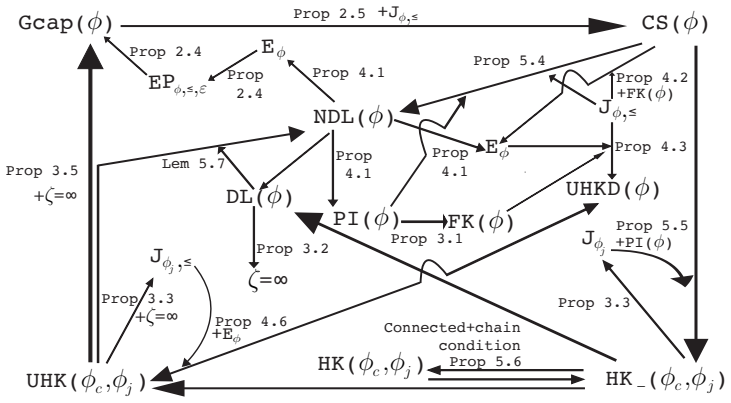
The workhorse is the cut-off Sobolev inequality $\mathrm{CS}(\varphi)$: for every pair of concentric balls $B(x_0,R)\subset B(x_0,R+r)$ there is a cut-off function $\phi$ whose energy, weighted by $f^2$, is bounded by the local and jump energies of $f$ on a slightly enlarged ball plus an $L^2$-term with constant $1/\varphi(r)$. Together with the jumping-kernel upper bound $J_{\varphi_j}$ and the generalized capacity inequality $\mathrm{Gcap}(\varphi)$ (a capacity bound $\mathrm{cap}^{(\kappa)}_f(B(x_0,R),B(x_0,R+r))\le C\varphi(r)^{-1}\int f^2$), the self-improving form of $\mathrm{CS}(\varphi)$ yields Caccioppoli and mean-value inequalities, which in turn produce exit-time estimates $E_\varphi$ and the diagonal heat kernel upper bound. The weak Poincaré inequality $\mathrm{PI}(\varphi)$ supplies the lower bounds, and the parabolic Harnack inequality $\mathrm{PHI}(\varphi)$ is characterized through these same ingredients together with the upper jumping-kernel bound $J_{\varphi,\le}$ and the uniform jump-size condition $\mathrm{UJS}$.
What would settle it
Take the reflected diffusion with jumps on a Lipschitz domain from Example 1.1, with $\varphi_c(r)=r^2$ and $\varphi_j(r)=r^\alpha$, and compute the on-diagonal heat kernel $p(t,x,x)$ at small times. The theorem predicts $p(t,x,x)\asymp 1/V(x,\varphi^{-1}(t))$ with $\varphi(r)=r^2\wedge r^\alpha$; if for some $t,x$ the ratio $p(t,x,x)V(x,\varphi^{-1}(t))$ grows without bound while the Poincaré, cut-off Sobolev and jumping-kernel conditions all hold, the implication (v)$\Rightarrow$(i) of Theorem 1.13 fails. A more direct check is to verify the self-improved cut-off Sobolev inequality (2.6) on $\mathbb{R}$ with a local $u''$-type energy and jump kernel $|x-y|^{-1-\alpha}$, since the upper-bound chain depends on that inequality holding with an arbitrarily small leading constant.
Extended reading notes
Core claim
The central claim is a stability theorem: under volume doubling, reverse volume doubling, and mild comparability assumptions on the scale functions $\varphi_c$ (the diffusive scale) and $\varphi_j$ (the jump scale), the two-sided heat kernel estimate $\mathrm{HK}^-(\varphi_c,\varphi_j)$ is equivalent to each of the following: the upper heat kernel bound plus a near-diagonal lower bound plus the jumping-kernel upper bound $J_{\varphi_j}$; the diagonal upper bound plus a Dirichlet near-diagonal lower bound plus $J_{\varphi_j}$; the weak Poincaré inequality plus $J_{\varphi_j}$ plus the generalized capacity inequality; and the weak Poincaré inequality plus $J_{\varphi_j}$ plus the cut-off Sobolev inequality. The paper further proves that $\mathrm{HK}^-(\varphi_c,\varphi_j)$ holds if and only if the parabolic Harnack inequality $\mathrm{PHI}(\varphi)$ holds and $J_{\varphi_j}$ holds, where $\varphi=\varphi_c\wedge\varphi_j$; on connected spaces satisfying the chain condition, the full two-sided estimate $\mathrm{HK}(\varphi_c,\varphi_j)$ is also equivalent to the same pair of conditions.
Load-bearing premise
The load-bearing premise is that the analytic arguments imported from the purely local and purely jump settings—particularly the self-improvement of the cut-off Sobolev inequality and the mean-value inequalities, several of which are deferred to earlier papers with details omitted—continue to work unchanged when the Dirichlet form has both a strongly local and a jumping part.
Editorial extensions
If this is right
- On any doubling, reverse-doubling metric measure space, the two-sided heat kernel estimate $\mathrm{HK}^-(\varphi_c,\varphi_j)$ is determined by the combination $\mathrm{PI}(\varphi)+\mathrm{CS}(\varphi)+J_{\varphi_j}$; verifying these three Dirichlet-form conditions is as good as knowing the heat kernel.
- A parabolic Harnack inequality $\mathrm{PHI}(\varphi)$ alone is strictly weaker than two-sided heat kernel estimates when jumps are present: the extra datum $J_{\varphi_j}$ (an upper bound on the jump kernel) is essential, and without it only the weak upper estimate $\mathrm{UHK}_{\mathrm{weak}}(\varphi)$ follows.
- On connected spaces satisfying the chain condition, the full two-sided estimate $\mathrm{HK}(\varphi_c,\varphi_j)$ follows from $\mathrm{PHI}(\varphi)+J_{\varphi_j}$, so sharp off-diagonal decay (Gaussian for the local part, stable-like for the jump part) is a consequence of the same hypotheses.
- The equivalent conditions are stable under rough isometries, so heat kernel estimates proved for one diffusion with jumps transfer to every rough isometric process with comparable scale functions and comparable jumping kernels.
- The framework covers walk dimensions larger than 2, giving heat kernel control on fractal-like spaces where the diffusive part alone cannot produce Gaussian estimates.
Reading between the lines
- An implication the authors leave implicit: the equivalence $\mathrm{HK}^-(\varphi_c,\varphi_j)\Leftrightarrow \mathrm{PHI}(\varphi)+J_{\varphi_j}$ gives practitioners a two-step receipt—prove or assume the parabolic Harnack inequality, then check the upper density of the jump kernel; the lower density needed for the full estimate is then automatic from the Harnack side.
- The subordination route in Example 7.2 suggests a transfer principle: any diffusion with sub-Gaussian heat kernel, when subordinated and then compared through the stability theorems, yields mixed heat kernel estimates; testing whether the same holds for general subordinators whose Laplace exponent satisfies (1.15) is a direct extension the authors flag in Remark 7.3.
- A natural next question is whether the chain condition can be weakened for the full estimate $\mathrm{HK}(\varphi_c,\varphi_j)$: the paper uses it only to chain small-time off-diagonal lower bounds, so one could look for examples of connected, non-chain spaces where $\mathrm{HK}^-$ holds but $\mathrm{HK}$ fails.
Signed reviews
Editorial analysis
A structured set of objections, weighed in public.
Referee Report
Summary. The paper studies symmetric regular Dirichlet forms on metric measure spaces whose Beurling-Deny decomposition contains both a strongly local part and a pure-jump part, with no killing term. Under volume doubling, reverse volume doubling, and power-type scale-function assumptions, it establishes stable characterizations of upper heat kernel bounds (Theorem 1.14), two-sided heat kernel estimates (Theorem 1.13), and parabolic Harnack inequalities (Theorem 1.17). The main structural result is the equivalence HK^-(φc,φj) ⇔ PHI(φ) + Jφj, together with intermediate equivalences involving cut-off Sobolev inequalities, generalized capacity inequalities, Faber-Krahn inequalities, Poincaré inequalities, and near-diagonal lower bounds.
Significance. If the omitted proofs are supplied, this is a substantial contribution: it unifies and extends the earlier stability results for pure-jump Dirichlet forms and strongly local Dirichlet forms to the mixed local/nonlocal case, under the weak VD/RVD hypotheses rather than an Ahlfors d-set condition. The paper is honest about what is new, gives concrete applications (Example 1.1 for reflected diffusions with jumps, Example 7.2 for d-sets via subordination), and provides a valuable counterexample showing that PHI(φ) alone does not imply the sharp jumping-kernel upper bound. The logical architecture is transparent and there are no fitted free parameters. However, the manuscript as written leaves several keystone analytic steps to prior papers or to 'details omitted here', and these steps are load-bearing for the main theorems.
major comments (4)
- [Section 2.4, Proposition 2.9 and Corollary 2.10] Proposition 2.9 is load-bearing: its ε-improvement of the cut-off Sobolev inequality produces the 1/8 coefficient in Corollary 2.10, which is used in the Caccioppoli inequality (Lemma 2.14) and hence in the upper-bound half of Theorems 1.13 and 1.14. The proof says only that the function ϕ = Σ (b_{n-1}-b_n)ϕ_n satisfies (2.6) by combining [AB, Lemma 5.1] with [CKW1, Proposition 2.4], and that 'the details are omitted here'. This is not a routine transcription: the form (1.1) has two energy measures with different scalings, and the omitted verification must control Γ^c simultaneously with the jump energy over the enlarged ball B(x0,R+2r). The full proof, or a precise statement of the adapted lemma with all hypotheses, should be included.
- [Section 2.2, Proposition 2.5] The proof that Gcap(φ) plus Jφ,≤ implies CS(φ) is only a sketch: after deriving a key inequality, it says to follow the proof of [GHH, Lemma 2.4] from the corresponding display to the end, replacing the balls B and Ω by B2 and B3. The displayed calculation gives a bound on integrals over B2 and B3×B3, but the final passage to the full Γ(ϕ,ϕ) includes a tail term over B1×B3^c and requires Lemma 2.1. Since Proposition 2.5 supplies the implication (iv)⇒(v) in Theorem 1.13 and (iii)⇒(iv) in Theorem 1.14, the mixed-energy adaptation should be written out explicitly rather than left as an instruction to re-run a prior proof.
- [Sections 2.5, 4.1, 4.2, 4.3 and 6] Several propositions that are central to the main equivalences are deferred with no proof or with only a statement that the proof is 'the same as' in [CKW1] or [CKW2]. These include Proposition 2.16 (L2/L1 mean-value inequalities for truncated forms), Proposition 4.1 (NDL implies PI and Eφ), Proposition 4.2 (FK + Jφ,≤ + CS implies Eφ), Proposition 4.3 (FK + Eφ + Jφ,≤ implies UHKD), and Proposition 6.2 (NDL + Eφ,≤ + Jφ,≤ implies PHR and EHR). These results are used in the proofs of Theorems 1.14 and 1.17. The manuscript should either provide complete proofs or identify precisely which statements are being imported and what modifications are needed because the form has both a local and a nonlocal part.
- [Theorem 1.17 and its proof] The headline equivalence HK^-(φc,φj) ⇔ PHI(φ) + Jφj depends on the implication (v)⇒(i) in Theorem 1.13, proved in Proposition 5.5. That proof in turn uses Proposition 5.4 (NDL follows from PI + Jφ,≤ + CS) and Proposition 5.3 (PI + Jφ,≤ + CS implies EHR), both of which are asserted to follow by adapting [CKW2]. Because the lower-bound estimate (1.31) requires the off-diagonal term t/(V φj), the adaptation is not purely formal. As written, the chain of equivalences is not fully self-contained, and the reader cannot verify the main theorem without reconstructing several long arguments from earlier papers.
minor comments (5)
- [Abstract and Introduction] The abstract contains a typo: 'symmetric Random measure' should be 'symmetric Radon measure'. The phrase 'reps.' should be 'resp.', and in the proof of Proposition 2.4 the reference '[GHH, Leamm 2.8]' should read '[GHH, Lemma 2.8]'.
- [Section 1.3 and Definition 5.1] The notation PHR(φ) and EHR is used in Theorem 1.17 before the definitions are given in Definition 5.1. A forward reference would improve readability.
- [Remark 4.9] The notation UHKweak(φ) is introduced in Remark 4.9 but is used as item (ii) of Theorem 1.17; it would be clearer to give this a numbered definition together with UHK(φc,φj) in Definition 1.11.
- [Section 2.4, equation (2.7)] In the construction of ϕ, the coefficients (b_{n-1}-b_n) with b_n = e^{-nλ} sum to 1, but the text does not explicitly justify that the series converges in F_b. This is presumably straightforward because the terms are truncated cut-off functions and the coefficients decay geometrically, but a one-line justification would help.
- [Figure 2] The diagram in Figure 2 is informative but the arrow labels are small and dense; in the published version, a larger or simplified diagram with all referenced proposition numbers would be easier to read.
Circularity Check
No circular derivation: the main equivalences relate independently defined analytic conditions; self-citations are prior lemmas, not restatements of the target results.
full rationale
I find no circular step. The paper's main theorems assert equivalences among conditions that are defined independently: HK, HK^-, UHK, FK(phi), PI(phi), CS(phi), Gcap(phi), NDL(phi), Jphi_j, and the various Harnack notions. None of these definitions quantifies over the target heat kernel or Harnack inequality in a way that makes the conclusion true by construction. The proof proceeds by compiling implications, e.g., Gcap(phi) + Jphi,<= implies CS(phi) in Proposition 2.5; CS(phi) self-improves in Proposition 2.9; CS(phi) yields Caccioppoli and mean-value inequalities in Section 2.5; those imply exit-time estimates and UHKD, and the reverse directions come from tail estimates and capacity arguments. No parameter is fitted to a subset of data and then announced as a prediction. The paper does rely heavily on the authors' earlier works [CKW1], [CKW2], and on [AB] and [GHH], sometimes with proofs omitted, e.g., Proposition 2.9 says 'The details are omitted here' and Proposition 4.1 says 'The proof is the same as that of [CKW2, Proposition 3.5], so it is omitted.' These self-citations are load-bearing in the sense that they carry part of the proof burden, but they are prior results whose stated settings (pure-jump or strongly local forms) do not include the present mixed local-plus-jump theorem, and they are not being invoked as a restatement of the target equivalence. At most this is a completeness or adaptation risk, not circularity. Under the hard rules, an omitted proof or a deferred citation is not itself a circular reduction unless the cited result is being used as the definition of the conclusion, which is not the case here.
Assumptions & free parameters
assumptions (6)
- standard math The regular Dirichlet form has the Beurling-Deny decomposition (1.1) with no killing term, and neither the local nor the jump part is identically zero.
- domain assumption The metric measure space satisfies volume doubling (VD) and reverse volume doubling (RVD) as in Definition 1.2.
- ad hoc to paper The scale functions φc and φj satisfy the growth bounds (1.10) and the ordering (1.11), which forces φc ≤ φj on (0,1] and φc ≥ φj on [1,∞).
- standard math A heat kernel p(t,x,y) exists for the semigroup and can be regularized to satisfy (1.2) through (1.4) on M0 × M0.
- domain assumption The jumping kernel measure J has a density satisfying either Jφj or Jφ,≤ (Definition 1.3) in the respective theorems.
- domain assumption The technical lemmas imported from [GHH], [AB], [CKW1], [CKW2], and [CKW3] are correct and extend to the mixed local and nonlocal setting.
Cite this review
Pith. "Pith review of Heat kernel estimates and parabolic Harnack inequalities for symmetric Dirichlet forms." pith.science (2026). https://pith.science/paper/IGPNXSSV
@misc{pith2026190807650,
  author       = {Pith},
  title        = {Pith review of: Heat kernel estimates and parabolic Harnack inequalities for symmetric Dirichlet forms},
  year         = {2026},
  howpublished = {\url{https://pith.science/paper/IGPNXSSV}},
  note         = {Machine review of arXiv:1908.07650}
}
abstract
In this paper, we consider the following symmetric Dirichlet forms on a metric measure space $(M,d,\mu)$: $$\mathcal{E}(f,g) = \mathcal{E}(^{(c)}(f,g)+\int_{M\times M} (f(x)-f(y))(g(x)-g(y))\,J(dx,dy),$$ where $\mathcal{E}(^{(c)}$ is a strongly local symmetric bilinear form and $J(dx,dy)$ is a symmetric Random measure on $M\times M$. Under general volume doubling condition on $(M,d,\mu)$ and some mild assumptions on scaling functions, we establish stability results for upper bounds of heat kernel (resp.\ two-sided heat kernel estimates) in terms of the jumping kernels, the cut-off Sobolev inequalities, and the Faber-Krahn inequalities (resp.\ the Poincar\'e inequalities). We also obtain characterizations of parabolic Harnack inequalities. Our results apply to symmetric diffusions with jumps even when the underlying spaces have walk dimensions larger than $2$.
Figures

Reference graph
Works this paper leans on
-
[1]
Andres and M.T
S. Andres and M.T. Barlow. Energy inequalities for cutoff-functions and some applications. J. Reine Angew. Math. 699 (2015), 183--215
2015
-
[2]
M.T. Barlow. Diffusions on fractals. In: Lectures on Probability Theory and Statistics, Ecole d'\'Ete de Probabilit\'es de Saint-Flour XXV - 1995 , 1--121. Lect. Notes Math. 1690 , Springer 1998
work page 1995
-
[3]
M.T. Barlow and R.F. Bass. Brownian motion and harmonic analysis on Sierpi\' n ski carpets. Canad. J. Math. 51 (1999), 673--744
work page 1999
-
[4]
Barlow and R.F
M.T. Barlow and R.F. Bass. Stability of parabolic Harnack inequalities. Trans. Amer. Math. Soc. 356 (2003), 1501--1533
2003
-
[5]
Barlow, R.F
M.T. Barlow, R.F. Bass, Z.-Q. Chen and M. Kassmann. Non-local Dirichlet forms and symmetric jump processes. Trans. Amer. Math. Soc. 361 (2009), 1963--1999
2009
-
[6]
Barlow, R.F
M.T. Barlow, R.F. Bass and T. Kumagai. Stability of parabolic Harnack inequalities on metric measure spaces. J. Math. Soc. Japan 58 (2006), 485--519
2006
-
[7]
Barlow, R
M.T. Barlow, R. F. Bass and T. Kumagai. Parabolic Harnack inequality and heat kernel estimates for random walks with long range jumps. Math. Z. 261 (2009), 297--320
2009
-
[8]
Barlow, A
M.T. Barlow, A. Grigor'yan and T. Kumagai. On the equivalence of parabolic Harnack inequalities and heat kernel estimates. J. Math. Soc. Japan 64 (2012), 1091--1146
2012
Show all 43 references
-
[9]
Barlow and E.A
M.T. Barlow and E.A. Perkins. Brownian motion on the Sierpi\' n ski gasket. Probab. Theory Relat. Fields 79 (1988), 543--623
1988
-
[10]
Bass and D
R.F. Bass and D. A. Levin. Transition probabilities for symmetric jump processes. Trans. Amer. Math. Soc. 354 (2002), 2933--2953
2002
-
[11]
J. Bae, J. Kang, P. Kim and J. Lee. Heat kernel estimates for symmetric jump processes with mixed polynomial growths. To appear in Ann. Probab. , available at arXiv:1804.06918
-
[12]
Bingham, C.M
N.H. Bingham, C.M. Goldie and J.L. Teugels. Regular Variation . Cambridge University Press, Cambridge, 1987
1987
-
[13]
Biroli and U
M. Biroli and U. A. Mosco. Saint-Venant type principle for Dirichlet forms on discontinuous media. Ann. Mat. Pura Appl. 169 (1995), 125--181
1995
-
[14]
Carlen, S
E.A. Carlen, S. Kusuoka and D.W. Stroock. Upper bounds for symmetric Markov transition functions. Ann. Inst. Henri Poincar\' e -Probab. Stat. 23 (1987), 245--287
1987
-
[15]
Z.-Q. Chen. On notions of harmonicity. Proc. Amer. Math. Soc. 137 (2009), 3497--3510
2009
-
[16]
Chen and M
Z.-Q. Chen and M. Fukushima. Symmetric Markov Processes, Time Change, and Boundary Theory . Princeton Univ. Press, Princeton and Oxford, 2012
2012
-
[17]
Z.-Q. Chen, P. Kim and T. Kumagai. Weighted Poincar\'e inequality and heat kernel estimates for finite range jump processes. Math. Ann. 342 (2008), 833--883
2008
-
[18]
Z.-Q. Chen, P. Kim and T. Kumagai. On heat kernel estimates and parabolic Harnack inequality for jump processes on metric measure spaces. Acta Math. Sin. (Engl. Ser.) 25 (2009), 1067--1086
2009
-
[19]
Z.-Q. Chen, P. Kim, T. Kumagai and J. Wang. Time fractional poisson equations: representations and estimates. Available at arXiv:1812.04902
-
[20]
Z.-Q. Chen, P. Kim, T. Kumagai and J. Wang. Heat kernel estimates for reflected diffusions with jumps on metric measure spaces. In preparation
-
[21]
Chen and T
Z.-Q. Chen and T. Kumagai. Heat kernel estimates for stable-like processes on d -sets. Stochastic Process Appl. 108 (2003), 27--62
2003
-
[22]
Chen and T
Z.-Q. Chen and T. Kumagai. Heat kernel estimates for jump processes of mixed types on metric measure spaces. Probab. Theory Relat. Fields 140 (2008), 277--317
2008
-
[23]
Chen and T
Z.-Q. Chen and T. Kumagai. A priori H\"older estimate, parabolic Harnack principle and heat kernel estimates for diffusions with jumps. Revista Mat. Iberoamericana 26 (2010), 551--589
2010
-
[24]
Z.-Q. Chen, T. Kumagai and J. Wang. Stability of heat kernel estimates for symmetric non-local Dirichlet forms. To appear in Memoirs Amer. Math. Soc. , available at arXiv:1604.04035
-
[25]
Z.-Q. Chen, T. Kumagai and J. Wang. Stability of parabolic Harnack inequalities for symmetric non-local Dirichlet forms. To appear in J. European Math. Soc. , available at arXiv:1609.07594
-
[26]
Z.-Q. Chen, T. Kumagai and J. Wang. Elliptic Harnack inequalities for symmetric non-local Dirichlet forms. J. Math. Pures Appl. 125 (2019), 1--42
2019
-
[27]
Chen and K
Z.-Q. Chen and K. Kuwae. On subhamonicity for symmetric Markov processes. J. Math. Soc. Japan 64 (2012), 1181--1209
2012
-
[28]
Delmotte
T. Delmotte. Parabolic Harnack inequality and estimates of Markov chains on graphs. Revista Mat. Iberoamericana 15 (1999), 181--232
1999
-
[29]
Fukushima, Y
M. Fukushima, Y. Oshima and M. Takeda. Dirichlet Forms and Symmetric Markov Processes . de Gruyter, Berlin, 2nd rev. and ext. ed., 2011
2011
-
[30]
Grigor'yan
A. Grigor'yan. The heat equation on noncompact Riemannian manifolds. (in Russian) Matem. Sbornik. 182 (1991), 55--87. (English transl.) Math. USSR Sbornik 72 (1992), 47--77
1991
-
[31]
Grigor'yan
A. Grigor'yan. Heat Kernel and Analysis on Manifolds. Amer. Math. Soc., Providence, RI, International Press, Boston, MA, 2009
2009
-
[32]
Grigor'yan and J
A. Grigor'yan and J. Hu. Upper bounds of heat kernels on doubling spaces. Mosco Math. J. 14 (2014), 505--563
2014
-
[33]
Grigor'yan, E
A. Grigor'yan, E. Hu and J. Hu. Two-sided estimates of heat kernels of jump type Dirichlet forms. Adv. Math. 330 (2018), 433--515
2018
-
[34]
Grigor'yan, J
A. Grigor'yan, J. Hu and K.-S. Lau. Generalized capacity, Harnack inequality and heat kernels on metric spaces. J. Math. Soc. Japan 67 (2015), 1485--1549
2015
-
[35]
Grigor'yan and A
A. Grigor'yan and A. Telcs. Two-sided estimates of heat kernels on metric measure spaces. Ann. Probab. 40 (2012), 1212--1284
2012
-
[36]
Gyrya and L
P. Gyrya and L. Saloff-Coste. Neumann and Dirichlet heat kernels in inner uniform domains. Ast\'erisque 336 , 2011
2011
-
[37]
Hambly and T
B.M. Hambly and T. Kumagai. Transition density estimates for diffusion processes on post critically finite self-similar fractals. Proc. London Math. Soc. 78 (1999), 431--458
1999
-
[38]
Murugan and L
M. Murugan and L. Saloff-Coste. Heat kernel estimates for anomalous heavy-tailed random walks. To appear in Ann. Inst. Henri Poincar\' e -Probab. Stat. , available at arXiv:1512.02361
-
[39]
Saloff-Coste
L. Saloff-Coste. A note on Poincar\' e , Sobolev, and Harnack inequalities. Inter. Math. Res. Notices 2 (1992), 27--38
1992
-
[40]
Saloff-Coste
L. Saloff-Coste. Aspects of Sobolev-type Inequalities . Cambridge Univ. Press, Cambridge, 2002
2002
-
[41]
Song and Z
R. Song and Z. Vondracek. Parabolic Harnack inequality for the mixture of Brownian motion and stable process. Tohoku Math. J. 59 (2007), 1--19
2007
-
[42]
K.-T. Sturm. Analysis on local Dirichlet spaces II. Gaussian upper bounds for the fundamental solutions of parabolic Harnack equations. Osaka J. Math. 32 (1995), 275--312
1995
-
[43]
K.-T. Sturm. Analysis on local Dirichlet spaces III. The parabolic Harnack inequality. J. Math. Pures Appl. 75 (1996), 273--297
1996
Reviewed August 14, 2026 · model on record in the stance chip above.
Discussion (0). Continue with ORCID to comment.