REVIEW 3 major objections 5 minor 9 references
A Generalization of Parking Functions Allowing Backward Movement
T0 review · 3 major / 5 minor · reviewed 2026-08-14 · deepseek-v4-flash
Pith's one-line read This paper proves a recursive formula that counts $k$-Naples parking functions, in which a car whose preferred spot is taken may first back up to $k$ spaces before driving on.
desk verdict A useful new family of parking functions with a plausible recursion, but two proofs need work before the results are fully trustworthy. read the letter →
The pith
A machine-rendered reading of the paper's core claim, the machinery that carries it, and where it could break.
The reading
What carries the argument
The load-bearing mechanism is a two-sided decomposition of the parking lot at the place where the last car parks. The cars ending up west of that place form a $k$-Naples parking function of length $i$; the cars ending up east form a contained $k$-Naples parking function, defined as one that would leave an extra spot $0$ west of spot $1$ empty. The count of contained functions is $(n+1)^{n-1}$ for every $k$, obtained by arranging $n+1$ spots on a circle, parking all $n$ cars, and rotating preferences so that spot $0$ is the one left empty; this circle step is what converts the east block into the factor $(n-i+1)^{n-i-1}$. For the $k=1$ characterization the central object is the map $T$ that subtracts one from a preferred spot the moment that spot has already been claimed earlier in the tuple, and for the lattice-path result it is the $k$-lattice path, a Dyck path whose height may exceed the diagonal by up to $k$.
What would settle it
Brute-force all $7^7$ length-7 preferences under the $1$-Naples rule, record the final parking spot of the seventh car, and compare the number landing in each spot $i+1$ with the summand $\binom{6}{i}\min(i+2,7)|PF_{i,1}|(7-i)^{5-i}$ from Theorem 1.1; a mismatch for any $i$ would show the independent-left-block assumption fails.
Extended reading notes
Core claim
The central claim is Theorem 1.1: for $0\le k\le n-1$, the number of $k$-Naples parking functions of length $n+1$ is $$|PF_{n+1,k}|=\sum_{i=0}^n \binom{n}{i}\min(i+1+k,n+1)|PF_{i,k}|(n-i+1)^{n-i-1}.$$ The proof fixes the spot $i+1$ where the last car parks, splits the earlier $n$ cars into those that end up west and east of that spot, counts the west block as a $k$-Naples parking function of length $i$, the east block as a contained $k$-Naples parking function (one that would leave an extra west spot empty), and counts the last car's allowed preferences as $\min(i+1+k,n+1)$. For $k=1$ the paper proves that a preference $\alpha$ is a Naples parking function exactly when the map $T$ that lowers every repeated preferred entry by $1$ sends $\alpha$ to a classical parking function, and for decreasing preferences it gives a bijection to $k$-lattice paths, i.e. Dyck paths allowed to stay up to $k$ units above the diagonal.
Load-bearing premise
The recursion's count of the west block assumes that the cars that end up in the first $i$ spots have preferences forming a $k$-Naples parking function of length $i$ on their own, with no car preferring a spot east of the cut and then backing into that block.
Editorial extensions
If this is right
- For every pair $(n,k)$ with $0\le k\le n-1$, the recursion determines $|PF_{n,k}|$ by a finite computation, so no exhaustive test of $n^n$ preferences is needed.
- At $k=0$ the formula reduces to the classical recursion for parking functions, and at $k=n-1$ it yields $n^n$, so the two endpoints of the interpolation are consistent.
- The closed forms $|PF_{n,n-1}|=n^n$ and $|PF_{n,n-2}|=n^n-n^{n-2}$ pin down the top two diagonals of the enumeration table, leaving the intermediate cases to the recursion.
- The transformation $T$ gives a membership test for $1$-Naples parking functions: apply the classical increasing-rearrangement criterion to $T(\alpha)$.
- The bijection in Theorem 1.3 means decreasing $k$-Naples parking functions are counted by the number of signature Dyck paths with signature $(k+1,2,\ldots,2,1,\ldots,1)$, matching the known sequences listed for $k=1,2,3$.
Reading between the lines
- The recursion's shape mirrors the set-partition and labeled-forest recurrences, so one could extract asymptotic growth rates for $|PF_{n,k}|$ from its dominant summand; the paper does not carry this out.
- The map $T$ may generalize to $k>1$ by lowering entries that have already appeared in a block of size $k$; if such a map exists, it would give membership tests for all $k$, not just $k=1$.
- The experimental observation that the largest gain $|PF_{n,k}\setminus PF_{n,k-1}|$ occurs at $k=1$ suggests a stronger statement: the incremental benefit of backward flexibility is greatest for the very first step, and a proof would likely use the recursion to bound successive differences.
- Since $k$-lattice paths with this signature have known counts only for small $k$, the bijection points to a family of lattice-path counts whose uniform enumeration is open; deriving it would also enumerate decreasing $k$-Naples parking functions.
Signed reviews
Editorial analysis
A structured set of objections, weighed in public.
Referee Report
Summary. The paper introduces k-Naples parking functions, in which a car whose preferred spot is occupied may first back up up to k spaces before continuing east. The authors prove three main results: a recursion (Theorem 1.1) for the number |PF_{n+1,k}| of k-Naples parking functions, a characterization of the k=1 case via a map T to classical parking functions (Theorem 1.2), and a bijection between decreasing k-Naples parking functions and k-lattice paths (Theorem 1.3). The recursion is checked against a table of values computed by code posted on GitHub. The paper also gives a Pollak-style counting argument for a set of 'contained' parking functions and a bijection for the top two diagonal cases. The overall narrative is clear and the conjectured family is natural, but the proof of the main recursion and the proof of the k=1 characterization contain gaps that need to be repaired before the claims are fully established.
Significance. If the gaps are repaired, the paper would be a worthwhile contribution: the recursion genuinely interpolates between the classical parking-function count (n+1)^{n-1} at k=0 and the full set n^n at k>=n-1, the circular-counting idea is elegant, and the lattice-path bijection gives a new enumerative handle on decreasing k-Naples parking functions. The computational table and the GitHub code are a useful check and a reproducible complement to the proofs. The paper also identifies several natural open problems and gives explicit OEIS connections. The main deficits are in proof completeness rather than in the plausibility of the results.
major comments (3)
- [Section 3, Eq. (2), proof of Theorem 1.1] The proof asserts, after fixing the subset S of cars that park to the left of spot i+1, that the number of preference assignments to S is |PF_{i,k}| and that the number of assignments to the complement is |B_{n-i,k}|, without proving either factorization. For S, one must show that no car in S can have a preference east of spot i+1, and that the induced parking process on spots 1 through i is exactly the k-Naples process on i cars; because spot i+1 is empty until the last car, this is plausible but not automatic. For the complement, one must show that after relabeling spots i+2 through n+1 as 1 through n-i, the condition 'these cars avoid parking in spot i+1' is exactly the contained-parking condition in Definition 3.2. These two factors are the core of the recursion, so Eq. (2) is not established by the present argument.
- [Section 3, Definition 3.2 and Lemma 3.4] Definition 3.2 is not well-formed as written: the condition 'if cars c1,...,c_{i-1} have already filled spaces 1,...,a_i, then there is no car c_i with a parking preference 1 <= a_i <= k' uses i both as a running index and as the length parameter, and does not clearly define the set B_{n,k}. Lemma 3.4 then states |B_{n,k}|=(n+1)^{n-1}; because the defining set is ambiguous, this count is not verifiable as stated. The proof of Lemma 3.4 also switches inconsistently between 'spot 0' and 'spot n+1' in the circular construction, and it asserts the equivalence between B_{n,k} and 'the cars park leaving the extra spot empty' without proof. This is load-bearing, since Eq. (2) uses the value |B_{n-i,k}|=(n-i+1)^{n-i-1}.
- [Section 4, proof of Theorem 1.2] The forward direction argues that if car c_i can park under the Naples rule, then there is an empty spot q between a_i-1 and n, and concludes that c_i can park under the classical rule with preference b_i in T(alpha). This ignores that the set of occupied spots when c_i arrives is different in the two processes: earlier cars may occupy different spots under the Naples rule than under the classical rule, so q need not be empty in the T(alpha) process. The converse direction has the same problem in reverse. The proof needs an invariant relating the partial parking configuration of alpha to that of T(alpha), or a different argument. As written, the characterization of Naples parking functions is not established.
minor comments (5)
- [Example 4.2] The text says 'tau(a1)=a1=4', but for alpha=(2,4,4,1) the first entry is 2, so the example should read tau(a1)=2.
- [Lemma 3.4] The paragraph following Lemma 3.4 refers to 'the proof of Theorem 3.4', but the result is numbered Lemma 3.4.
- [Lemma 2.2] The proof only analyzes the last car. To conclude beta in PF_{n,n-2}, it should also justify that when b_n != n, no earlier car ever uses the full n-1 backward steps; otherwise the earlier cars' parking positions could change when k is reduced. This is likely repairable but should be stated.
- [Section 5, proof of Theorem 1.3] The equivalence between the path condition and the inequality a_i <= min(n,n+k+1-i) is stated without explaining the coordinate convention; the proof checks the bound at the right endpoint of each east step, and this convention should be made explicit in Definition 5.3.
- [General presentation] There are several minor typographical issues, including 'Cellabos' for 'Ceballos' and an incomplete author listing in reference [9]; these should be corrected in revision.
Circularity Check
No significant circularity: the main recursion is a genuine recurrence and the auxiliary Pollak-style counting is independent.
full rationale
The main result (Theorem 1.1) is a recursive formula for |PF_{n+1,k}| in terms of the smaller quantities |PF_{i,k}| and (n-i+1)^{n-i-1}; this is an ordinary recurrence, not a prediction that is forced by its own inputs. The factor |PF_{i,k}| is a lower-order instance of the object being counted, and the factor (n-i+1)^{n-i-1} is derived independently in Lemma 3.4 via a Pollak-style circular parking argument, not by assuming the theorem. The paper does not fit any parameter to data and then rename that fit as a prediction; the GitHub-computed table is presented as computational evidence and is not used to prove the main formula. The proof of Theorem 1.1 does contain an asserted block factorization: it says without a fully detailed proof that the preferences of the cars to the left of spot i+1 are counted by |PF_{i,k}| and those to the right by |B_{n-i,k}|. That is a potential gap or a point needing a stronger independence lemma, but it is not circularity: the key counting factors are independent of the target recursion and would need independent justification rather than being definitions of the result. The proofs of Theorems 1.2 and 1.3 are self-contained combinatorial arguments, and the connection to signature Dyck paths is a translation of the newly introduced k-lattice paths, not a repackaging of a known result as a derivation. There are no load-bearing self-citations: the cited classical parking function results, Pollak technique, and signature Dyck path framework are external and not supplied by the present authors. Overall, the derivation chain is self-contained and no step reduces by construction to its own inputs.
Assumptions & free parameters
assumptions (2)
- standard math A preference tuple is a classical parking function iff its increasing rearrangement b satisfies b_i <= i.
- standard math A decreasing preference tuple (a1 >= ... >= an) is a classical parking function iff a_i <= n-i+1 for all i.
Cite this review
Pith. "Pith review of A Generalization of Parking Functions Allowing Backward Movement." pith.science (2026). https://pith.science/paper/J2DSOABG
@misc{pith2026190807658,
  author       = {Pith},
  title        = {Pith review of: A Generalization of Parking Functions Allowing Backward Movement},
  year         = {2026},
  howpublished = {\url{https://pith.science/paper/J2DSOABG}},
  note         = {Machine review of arXiv:1908.07658}
}
abstract
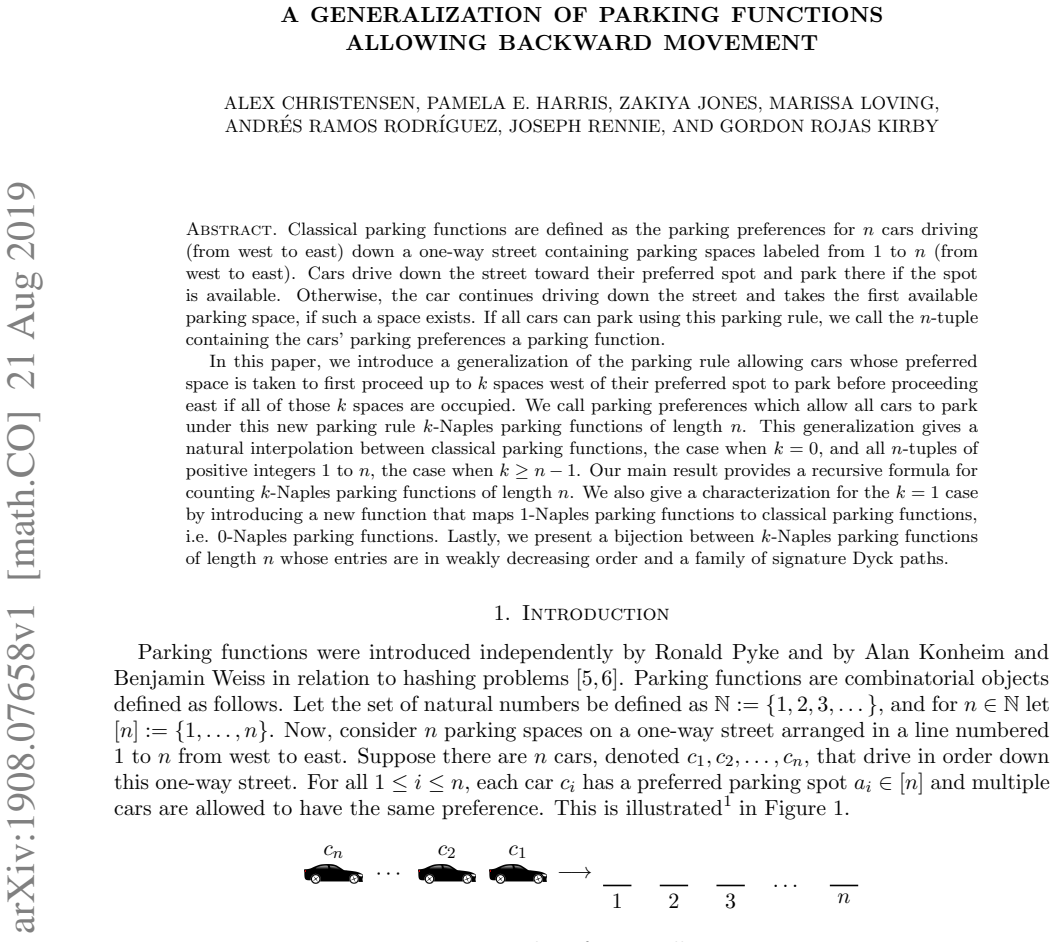
Classical parking functions are defined as the parking preferences for $n$ cars driving (from west to east) down a one-way street containing parking spaces labeled from $1$ to $n$ (from west to east). Cars drive down the street toward their preferred spot and park there if the spot is available. Otherwise, the car continues driving down the street and takes the first available parking space, if such a space exists. If all cars can park using this parking rule, we call the $n$-tuple containing the cars' parking preferences a parking function. In this paper, we introduce a generalization of the parking rule allowing cars whose preferred space is taken to first proceed up to $k$ spaces west of their preferred spot to park before proceeding east if all of those $k$ spaces are occupied. We call parking preferences which allow all cars to park under this new parking rule $k$-Naples parking functions of length $n$. This generalization gives a natural interpolation between classical parking functions, the case when $k=0$, and all $n$-tuples of positive integers $1$ to $n$, the case when $k\geq n-1$. Our main result provides a recursive formula for counting $k$-Naples parking functions of length $n$. We also give a characterization for the $k=1$ case by introducing a new function that maps $1$-Naples parking functions to classical parking functions, i.e. $0$-Naples parking functions. Lastly, we present a bijection between $k$-Naples parking functions of length $n$ whose entries are in weakly decreasing order and a family of signature Dyck paths.
Figures


Figures from the paper (7 more)


Reference graph
Works this paper leans on
-
[1]
Alyson Baumgardner, The naples parking function, Honors Contract-Graph Theory, Florida Gulf Coast University, 2019.↑2
work page 2019
-
[2]
Peter J. Cameron, Daniel Johannsen, Thomas Prellberg, and Pascal Schweitzer, Counting defective parking func- tions, Electron. J. Combin. 15 (2008), no. 1, Research Paper 92, 15. MR2426155 ↑2
work page 2008
-
[3]
Cesar Ceballos and Rafael S. Gonz´ alez D’Le´ on,Signature catalan combinatorics , Journal of Combinatorics 10 (2019), 725–773.↑4, 10, 12
work page 2019
-
[4]
Dominique Foata and John Riordan, Mappings of acyclic and parking functions , Aequationes Math. 10 (1974), 10–22. MR0335294 ↑7
work page 1974
-
[5]
Alan G. Konheim and Benjamin Weiss, An occupancy discipline and applications , Siam Journal on Applied Mathematics - SIAMAM 14 (196611).↑1, 2, 6
-
[6]
Ronald Pyke, The supremum and infimum of the poisson process, Ann. Math. Statist. 30 (195906), no. 2, 568–576. ↑1
-
[7]
Paul R. F. Schumacher, Descents in parking functions, J. Integer Seq. 21 (2018), no. 2, Art. 18.2.3, 8. MR3779772 ↑8
work page 2018
-
[8]
Yan, Generalized parking functions, tree inversions, and multicolored graphs , Adv
Catherine H. Yan, Generalized parking functions, tree inversions, and multicolored graphs , Adv. in Appl. Math. 27 (2001), no. 2-3, 641–670. Special issue in honor of Dominique Foata’s 65th birthday (Philadelphia, PA, 2000). MR1868985↑2
work page 2001
Show all 9 references
-
[9]
, Parking functions, Handbook of enumerative combinatorics, 2015, pp. 835–893. ↑2 14 University of Arizona, Department of Mathematics, United States E-mail address: ajc333@comcast.net Department of Mathematics and Statistics, Williams College, United States E-mail address: peh...
2015
Reviewed August 14, 2026 · model on record in the stance chip above.
Discussion (0). Continue with ORCID to comment.