REVIEW 4 major objections 5 minor 2 cited by
A wind-based unification model for NGC 5548: spectral holidays, non-disk emission, and implications for changing-look quasars
T0 review · 4 major / 5 minor · reviewed 2026-08-14 · deepseek-v4-flash
Pith's one-line read The BLR holiday in NGC 5548 is a slight thickening of the disk wind.
desk verdict First concrete physical scenario for the NGC 5548 BLR holiday, with honest caveats but a load-bearing fine-tuned assumption about where the wind's ionization front sits. read the letter →
The pith
A machine-rendered reading of the paper's core claim, the machinery that carries it, and where it could break.
The reading
What carries the argument
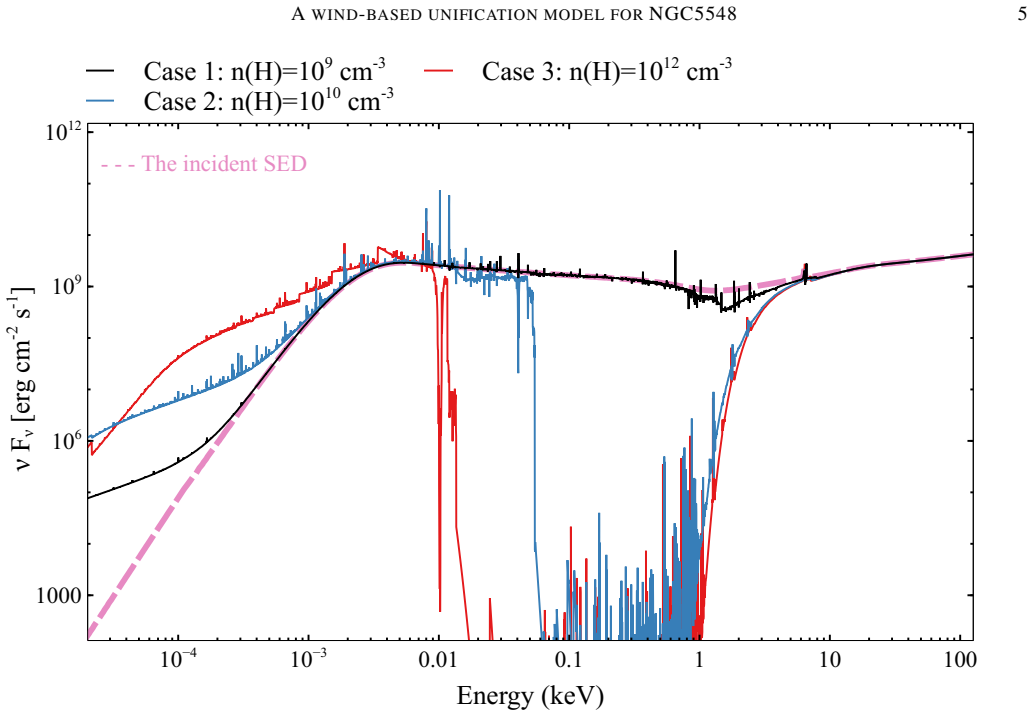
The equatorial obscurer: an axisymmetric disk wind whose streamlines rise from the accretion disk, pass through the BLR sight line, and whose lower, high-column base sits between the black hole and the BLR. In the model the transmitted SED is controlled by the hydrogen density of this wind through the ionization parameter; the three regimes are a fully ionized transparent wind, a wind with a He$^{2+}$/He$^{+}$ front that absorbs XUV, and a wind with both H and He fronts that absorbs most ionizing radiation. The ionization fronts sit near the outer edge of the wind because radiative acceleration drops at recombination, making the front Rayleigh-Taylor unstable, so the transmitted SED is highly sensitive to small density changes. Photoionization calculations translate the filtered SED into BLR emission-line equivalent widths for a fixed BLR cloud.
What would settle it
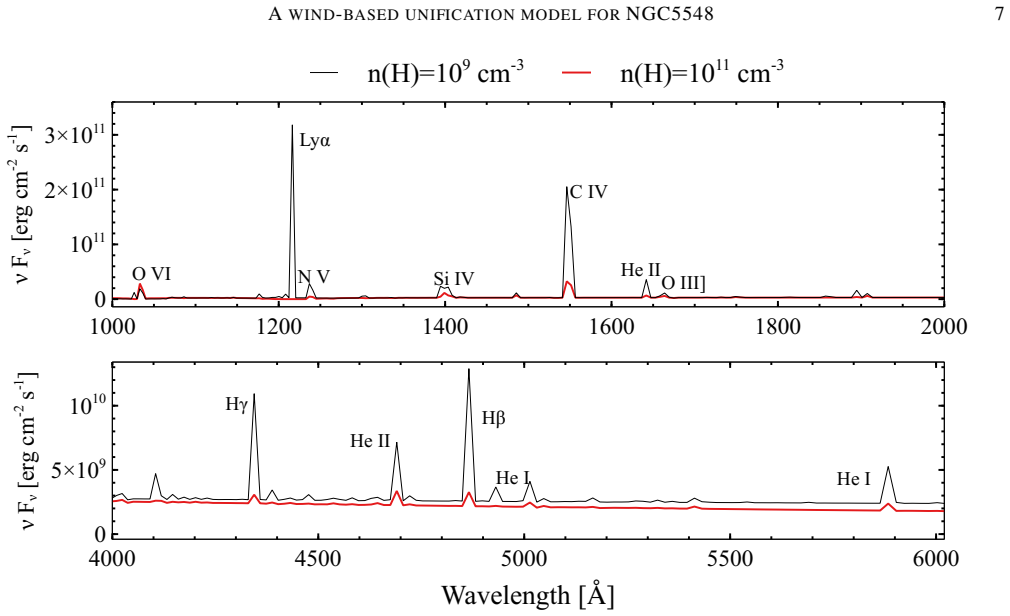
Observe a fresh holiday in a type-1 AGN with simultaneous X-ray, FUV, and optical monitoring. The model predicts the line deficits must follow a fixed ordering, with C IV and He II dropping much more than Hβ, and the longward continuum staying bright while the XUV is absorbed. A holiday in which Hβ drops as much as C IV, or in which the observed far-UV continuum itself dips, would falsify the equatorial-wind filter picture.
Extended reading notes
Core claim
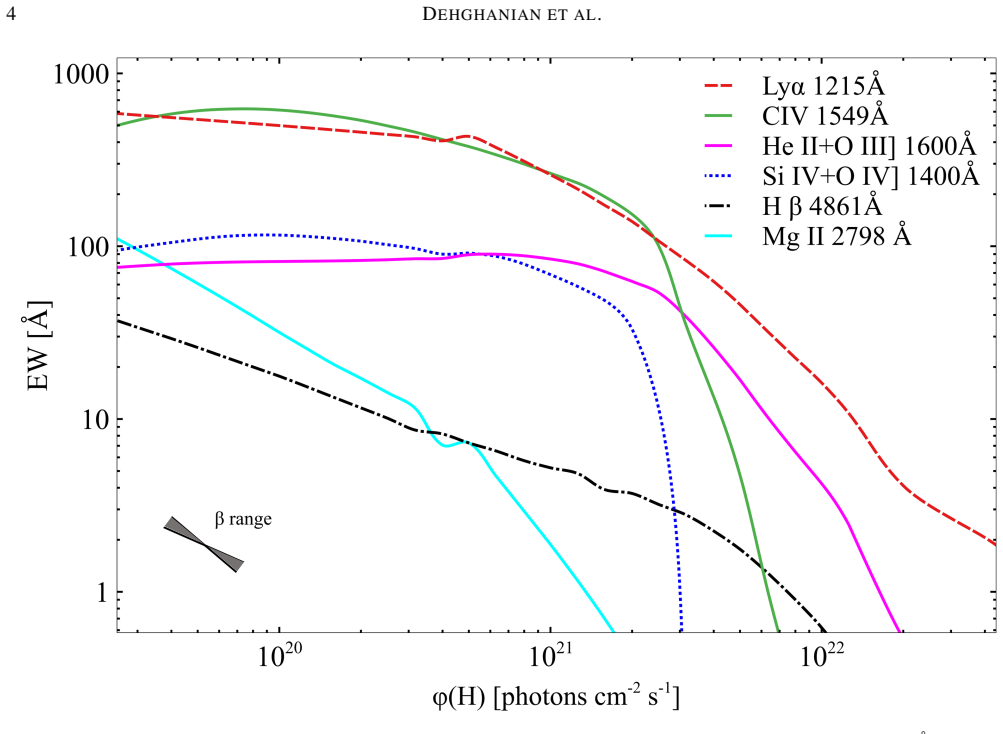
The central claim is that the disk wind in NGC 5548 has a dense equatorial base that lies inside the BLR and acts as a variable filter on the ionizing radiation reaching it. When the wind density is low, the filter is fully ionized and transparent; when the density rises only a few percent, the helium and hydrogen ionization fronts move to the outer edge of the wind, the EUV/XUV part of the SED is absorbed, and the BLR's emission-line equivalent widths drop even though the longward continuum does not change. Photoionization calculations with a fixed BLR column and density reproduce the observed ordering of line deficits, with Si IV+O IV], He II+O III], and C IV dropping most, Lyα dropping less, and Hβ dropping least, and they reproduce the observed ~19% C IV deficit with a density increase of roughly 8%. At densities a hundred times higher, nearly all ionizing radiation is blocked and broad lines disappear, providing a mechanism for changing-look transitions without any change in the intrinsic AGN luminosity.
Load-bearing premise
The model assumes the equatorial wind is a continuous, full 360-degree flow between the black hole and the entire BLR; if it is patchy or does not extend around the full circle, part of the BLR would still see the unshielded continuum and no true holiday would occur.
Editorial extensions
If this is right
- Reverberation-mapping masses assume continuum and line flux track each other; during a holiday the observed continuum is not a proxy for the ionizing flux, so RM campaigns must watch for wind-filtered states or the derived masses will be biased.
- A mostly transparent equatorial wind can be present in many AGN; the holiday is not a rare catastrophe but a slight temporary change in a common structure.
- The absorption-line and emission-line holidays are unified as two manifestations of one wind: a denser base produces both a larger LOS covering factor and a filtered SED at the BLR.
- Dense equatorial winds can create changing-look AGN transitions without any change in the black hole accretion rate.
- The wind's own recombination and bremsstrahlung emission can contribute to the non-disk optical/IR continuum, potentially explaining excess continuum components that have been attributed to other sources.
Reading between the lines
- If wind shielding is common, some of the scatter in reverberation-mapping mass estimates may actually track how much of the ionizing SED the wind transmits rather than the true continuum-luminosity response.
- The model predicts that during a holiday the line deficits must follow a fixed ordering; a future STORM-like campaign that catches a holiday could test this by measuring the ratio of C IV to Hβ deficits, which are predicted to differ by roughly a factor of three.
- A testable extension is to look for the wind's own optical/IR continuum in the difference spectrum between normal and holiday states; the model predicts excess emission longward of about 1 eV that should disappear when the wind returns to the transparent state.
- The same mechanism might explain changing-look events in which broad lines vanish but the optical/UV continuum stays constant; archival light curves with simultaneous X-ray and UV monitoring could distinguish wind blocking from true accretion-rate changes.
Signed reviews
Editorial analysis
A structured set of objections, weighed in public.
Referee Report
Summary. This paper proposes a wind-based unification model for the 2014 AGN STORM campaign on NGC 5548. The authors argue that the disk wind responsible for the line-of-sight (LOS) obscurer also has a dense equatorial base lying between the black hole and the broad-line region (BLR). Depending on its hydrogen density, this equatorial obscurer can be transparent (Case 1), can absorb the XUV/EUV part of the SED while transmitting most hydrogen-ionizing photons (Case 2), or can block nearly all ionizing radiation (Case 3). The central claim is that the emission-line holiday is produced when the wind density increases only slightly above its transparent state, moving an ionization front to the outer edge of the wind and changing the SED transmitted to the BLR independently of the observed far-UV continuum. The model also links this to the absorption-line holiday through a common wind structure and suggests that the dense equatorial obscurer could contribute to changing-look AGN and to non-disk optical/UV continuum emission. The calculations are performed with Cloudy photoionization models, and the predicted ordering of line EW deficits (Si IV+O IV], He II+O III], C IV large; Ly alpha smaller; H beta smallest) matches the observed sense of the holiday deficits.
Significance. If the mechanism holds, this would be the first physical model of the NGC 5548 BLR holiday and would have broad implications: it would imply that the observed continuum is not a reliable proxy for the ionizing continuum during such episodes, that wind shielding is an important process in AGN inner regions, and that dense disk-wind bases may contribute to changing-look phenomena. The paper's strength is that it makes an explicit, testable prediction for the relative size of line deficits and connects the emission-line holiday to the independently studied LOS obscurer of Dehghanian et al. (2019). The Cloudy calculations are internally consistent and clearly presented. However, the model is qualitative and relies on several unconstrained parameters, most importantly the density, column, and location of the equatorial obscurer, and the assumed placement of the ionization front at the outer edge of the wind. The significance is therefore contingent on whether this fine-tuned condition is physically natural rather than merely possible.
major comments (4)
- [Section 5 and Figure 4] The holiday mechanism is load-bearing on the requirement that the normal-state equatorial obscurer has its H/He ionization front near the outer edge of the wind. The paper explicitly acknowledges this in Section 5 ('Our model requires...' and 'This model appears fine-tuned...'), and the only physical support is the Mathews & Blumenthal (1977) Rayleigh-Taylor instability argument, which is qualitative and was developed for radiatively driven clouds in a different context. If the front is interior to the outer edge in the normal state, a modest density increase moves the front inside the wind and the transmitted SED changes little; if the front is already outside, the wind is transparent and small changes have no effect. The manuscript should quantify the allowed parameter range—for example, a grid over the wind outer radius, density profile, or filling factor—and show whether the required front location is natural or requires fine-tuning. Without such an exploration, the central claim rests on an assumed boundary condition.
- [Section 4] The BLR holiday is a temporal phenomenon: the emission lines decorrelate from the continuum for about 60-70 days and then recover. Figure 4 presents a static sequence of EW versus n(H) at fixed incident flux, which demonstrates that a particular SED shape produces smaller EWs, but it does not by itself establish a holiday. A holiday requires that a time-varying wind density produce decorrelation between the observed continuum light curve and the line light curves over the observed duration, including the return to normal behavior afterward. The manuscript should either implement a simple time-dependent calculation, such as convolving the observed continuum light curve with the relevant reverberation lags and the density-dependent line responses, or explicitly justify why the static sequence captures the essential physics of the decorrelation. This is not a request for a full hydrodynamic simulation; a toy light-curve realization would test whether the proposed mechanism actually yields the observed temporal behavior.
- [Section 2] The assumption that the equatorial obscurer is a continuous, axisymmetric flow that fully shields the BLR is inferred from the four-year persistence of the LOS obscurer. This inference is reasonable for the single sight line probed, but it does not directly constrain the structure of the wind base near the disk plane. If the equatorial flow is patchy, clumpy, or does not extend the full 360 degrees, some BLR sight lines would still receive direct ionizing radiation and the holiday mechanism would fail. The paper should clearly state this as an assumption and, ideally, test the sensitivity of the line deficits to partial covering of the BLR by the equatorial obscurer. A short discussion of whether current disk-wind simulations produce a continuous equatorial base would also strengthen the argument.
- [Section 3] The model parameters for the equatorial obscurer are chosen by hand: N(H)=10^23 cm^-2, phi(H)=10^20.3 cm^-2 s^-1, and the location at 0.7 r_BLR. The paper notes, correctly, that there are no observational constraints on the equatorial obscurer. While the ionization-parameter scaling is a useful simplification, the choice of N(H) and location affects the transmitted SED and thus the predicted line deficits. The authors should show how the Case 1/2/3 boundaries in Figure 4 shift with reasonable variations in these parameters, or state more explicitly that the model is only illustrative. As written, the quantitative claim of an ~8% density increase producing the observed C IV deficit depends on the specific adopted column and location.
minor comments (5)
- [Section 3] The sentence ending 'more distant LOS obscurer..' has a duplicated period; please correct the typo.
- [Section 5] In the paragraph beginning 'The observed holiday corresponds...', the phrase 'We suggests that wind shielding...' should read 'We suggest that wind shielding...'.
- [References] In the bibliography, 'V oit' should be 'Voit' in the Murray et al. (1995) entry.
- [Figure 4] The gray shaded region that represents the holiday range would be easier to evaluate if the observed EW deficits (with uncertainties) from G16 and Pei et al. (2017) were overlaid on the same figure, so the reader can see how the model comparison is made.
- [Section 5] The connection between a denser equatorial obscurer and a more extensive LOS obscurer is stated as a plausible inference but is not modeled. A sentence clarifying that this is a conjecture rather than a derived consequence would be helpful.
Circularity Check
Minor calibration of the density step to the observed C IV deficit; the line-ratio predictions and wind-transmission mechanism remain self-contained.
-
fitted input called prediction
[Section 4, Case 2 (paragraph beginning 'One check of this model...') and Figure 4 caption]
"One check of this model of the holiday is the ∼19% deficit in C IV EW observed by G16. A smaller deficit, ∼6%, was observed by Pei et al. (2017) for Hβ. Figure 4 shows that only small changes in the density (∼8%) are needed to produce this C IV deficit. The change needed to produce the holiday is shown by the gray shaded area."
The hydrogen-density step (and the gray shaded region in Figure 4) is chosen so that the Cloudy sequence reproduces the observed 19% C IV deficit that defines the holiday interval. The existence of a model holiday and the C IV deficit magnitude are therefore inputs used to select the model location, not independent predictions of it. The relative ordering of the other emission-line deficits (Si IV+O IV], He II+O III], C IV large; Lyα smaller; Hβ smallest) is not forced by this choice, because that ordering emerges from the computed transmitted SED and the BLR photoionization response. The circularity is thus partial and confined to using the C IV deficit as a 'check' of a parameter chosen to match that same deficit.
full rationale
The central derivation is not circular. The paper builds a Cloudy BLR baseline in Section 2, computes transmitted SEDs through an equatorial wind as a function of hydrogen density in Section 3, and then calculates BLR line EWs for each transmitted SED in Section 4. No term in these calculations is defined in terms of the holiday, and the relative line-deficit ordering is an emergent output of the microphysics rather than an input. The LOS-obscurer arguments from the authors' earlier Dehghanian et al. (2019) paper are used only to support the geometry and the incident SED shape; even if that paper were set aside, the equatorial-wind transmission calculation stands on its own. The main caveats are honest ones rather than circularities: the paper explicitly states 'There are no observational constraints on the equatorial obscurer' and concedes 'This model appears fine-tuned since it is sensitive to the location of the ionization front.' The only reduction-like step is the choice of the density interval (gray shaded area in Figure 4) that reproduces the observed 19% C IV deficit; using that same deficit as a 'check' is partly circular, but the cross-line predictions and the holiday mechanism are not forced by that choice. Self-citations are corroborating published results and not invoked as uniqueness theorems, and the Mathews & Blumenthal Rayleigh-Taylor argument is an external dynamical justification, not a self-referential premise. Overall: no significant circularity, with one minor calibration issue.
Assumptions & free parameters
free parameters (5)
- Equatorial obscurer hydrogen density n(H) =
10^9 to 10^12 cm^-3 (cases); holiday at ~10^10
- Equatorial obscurer column density N(H) =
10^23 cm^-2
- Equatorial obscurer location / ionizing flux phi(H) =
10^20.3 cm^-2 s^-1 (0.7 r_BLR)
- BLR hydrogen density n(H) =
10^11 cm^-3
- BLR column density N(H) =
10^23 cm^-2
assumptions (5)
- domain assumption The disk wind is axisymmetric and extends 360 degrees around the black hole, forming a continuous equatorial obscurer that fully shields the BLR.
- domain assumption The BLR is ionized only by the SED transmitted through the equatorial obscurer, with no additional radiation paths.
- domain assumption In the normal state, the ionization front of the equatorial obscurer sits near the outer edge of the wind, so small density changes strongly affect the transmitted SED.
- ad hoc to paper A denser equatorial obscurer implies a more extensive LOS obscurer, linking the emission-line and absorption-line holidays.
- domain assumption The BLR cloud parameters (N(H)=1e23 cm^-2, n(H)=1e11 cm^-3, solar abundances) are representative of the real BLR in NGC 5548.
invented entities (1)
-
Equatorial obscurer (dense base of the disk wind)
independent evidence
Cite this review
Pith. "Pith review of A wind-based unification model for NGC 5548: spectral holidays, non-disk emission, and implications for changing-look quasars." pith.science (2026). https://pith.science/paper/YCBXBPYJ
@misc{pith2026190807686,
  author       = {Pith},
  title        = {Pith review of: A wind-based unification model for NGC 5548: spectral holidays, non-disk emission, and implications for changing-look quasars},
  year         = {2026},
  howpublished = {\url{https://pith.science/paper/YCBXBPYJ}},
  note         = {Machine review of arXiv:1908.07686}
}
read the original abstract
The 180-day Space Telescope and Optical Reverberation Mapping campaign on NGC 5548 discovered an anomalous period, the broad-line region (BLR) holiday, in which the emission lines decorrelated from the continuum variations. This is important since the correlation between the continuum-flux variations and the emission-line response is the basic assumption for black hole (BH) mass determinations through reverberation mapping. During the BLR holiday, the high-ionization intrinsic absorption lines also decorrelated from the continuum as a result of variable covering factor of the line of sight (LOS) obscurer. The emission lines are not confined to the LOS, so this does not explain the BLR holiday. If the LOS obscurer is a disk wind, its streamlines must extend down to the plane of the disk and the base of the wind would lie between the BH and the BLR, forming an equatorial obscurer. This obscurer can be transparent to ionizing radiation, or can be translucent, blocking only parts of the SED, depending on its density. An emission-line holiday is produced if the wind density increases only slightly above its transparent state. Both obscurers are parts of the same wind, so they can have associated behavior in a way that explains both holidays. A very dense wind would block nearly all ionizing radiation, producing a Seyfert 2 and possibly providing a contributor to the changing-look AGN phenomenon. Disk winds are very common and we propose that the equatorial obscurers are too, but mostly in a transparent state.
Figures

Figures from the paper (2 more)

Forward citations
Cited by 2 Pith papers
-
Physically motivated AGN emissivity profiles and their effects on quasar microlensing signatures. 1. Multi-epoch accretion disc size inference
Interpreting composite disc-plus-BLR emission as a single compact disc systematically overestimates microlensing half-light radii, with the bias set mainly by the BLR flux fraction and the compact-disc emissivity shape.
-
X-ray Absorption Variability in NGC 1142: Another Constraint on the Nature of the Torus/Broad-Line Region in Active Galactic Nuclei
NGC 1142’s NH varies across nine epochs; detection probability scales with observation count, and simple cloud simulations favor many simultaneous eclipsing clouds.
Reference graph
Works this paper leans on
- [1]
- [2]
- [3]
-
[4]
2019, ApJ...877..119D De Rosa, G., Peterson, B
Dehghanian, M., Ferland, G.J., Kriss, G.A., Peterson, B.M., et al. 2019, ApJ...877..119D De Rosa, G., Peterson, B. M., Ely, J., et al. 2015, ApJ, 806:128
work page 2019
-
[5]
M., Horne, K., et al
Edelson, R., Gelbord, J. M., Horne, K., et al. 2015, ApJ, 806, 129
2015
-
[6]
M., Denney, K
Fausnaugh, M. M., Denney, K. D., Barth, A. J., et al. 2016, ApJ, 821, 56
2016
- [7]
-
[8]
J., Chatzikos, M., Guzm´an, F., et al
Ferland, G. J., Chatzikos, M., Guzm´an, F., et al. 2017, RMxAA, 53,385
work page 2017
Show all 27 references
-
[9]
J., Korista, K
Ferland, G. J., Korista, K. T., Peterson, B. M. 1990,ApJ,363L, 21F
1990
-
[10]
and Koratkar, A
Goad, M. and Koratkar, A. 1998, ApJ, 495, 718G
1998
-
[11]
T., De Rosa, G., et al
Goad, M., Korista, K. T., De Rosa, G., et al. 2016, ApJ, 824, 11
2016
-
[12]
Goad, M. R. ,Knigge, C.,Korista,K. T.,Cackett, E., et al. 2019, MNRAS, 10, 1093
2019
-
[13]
T., Gondhalekar,P.M.1993,MNRAS.263..149G
Goad, M., O’Brien, P. T., Gondhalekar,P.M.1993,MNRAS.263..149G
1993
-
[14]
A., Cappi, M., et al
Kaastra, J., S., Kriss, G. A., Cappi, M., et al. 2014, Science, 345, 64
2014
-
[15]
Netzer, H
Kaspi, Sh. Netzer, H. 1999, ApJ...524...71
1999
-
[16]
2019, ApJ in press
Kriss, G.A., De Rosa, G., Ely, J., et al. 2019, ApJ in press. Korista,K. T. & Goad, M. R. 2000, ApJ, 536, 284 Korista,K. T. & Goad, M. R. 2001, ApJ, 553, 695
2019
-
[17]
Leighly, K. M. 2004, ApJ, 611, 125
2004
-
[18]
Mathews, W. G. & Blumenthal, G. R.1977, ApJ, 214: 10
1977
-
[19]
2017, ApJ, 846:55
Mathur, S., Gupta, A., Page, K., et al. 2017, ApJ, 846:55
2017
-
[20]
A., et al
Mehdipour, M., Kaastra, J., S., Kriss, G. A., et al. 2015, A&A, 575, 22
2015
-
[21]
A., et al
Mehdipour, M., Kaastra, J., S., Kriss, G. A., et al. 2016, A&A, 588, 139
2016
-
[22]
A., V oit, G, M
Murray, N., Chiang, J., Grossman, S. A., V oit, G, M. 1995, ApJ, 451, 498 Osterbrock D. E., & Ferland G. J., 2006, Astrophysics of Gaseous Nebulae and Active Galactic Nuclei , 2nd ed., Univ. Science
1995
-
[23]
M., Barth, A
Pei, L., Fausnaugh, M. M., Barth, A. J., et al. 2017, ApJ, 837: 131
2017
-
[24]
2015, ApJ, 805, 124
Shemmer, O., Lieber, S. 2015, ApJ, 805, 124
2015
-
[25]
C., Ferland, G
Shields, J. C., Ferland, G. J., Peterson, B. M. 1995, ApJ, 441, 507
1995
-
[26]
M., et al
Starkey, D., Horne, K., Fausnaugh, M. M., et al. 2017, ApJ, 835: 65
2017
-
[27]
2018, ApJ, 857:86
Sun, M., Xue, Y ., Cai, Z.& Guo, H. 2018, ApJ, 857:86
2018
Reviewed August 14, 2026 · model on record in the stance chip above.
Discussion (0). Continue with ORCID to comment.