REVIEW 2 major objections 5 minor 10 references
Isoperimetric Inequality for Disconnected Regions
T0 review · 2 major / 5 minor · reviewed 2026-08-14 · deepseek-v4-flash
Pith's one-line read The paper proves a sharp isoperimetric threshold for disconnected polygons in Euclidean, spherical, and hyperbolic geometry.
desk verdict The hyperbolic threshold question is real, but the side-length formulas are inverted; as written the main theorems don't follow, and the paper needs a correction pass. read the letter →
The pith
A machine-rendered reading of the paper's core claim, the machinery that carries it, and where it could break.
The reading
What carries the argument
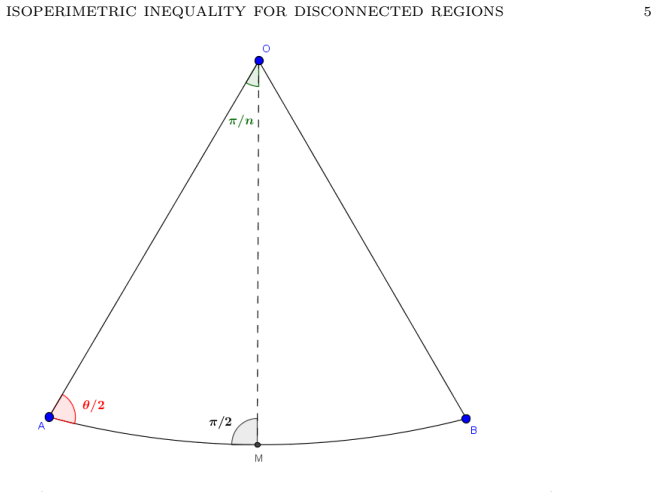
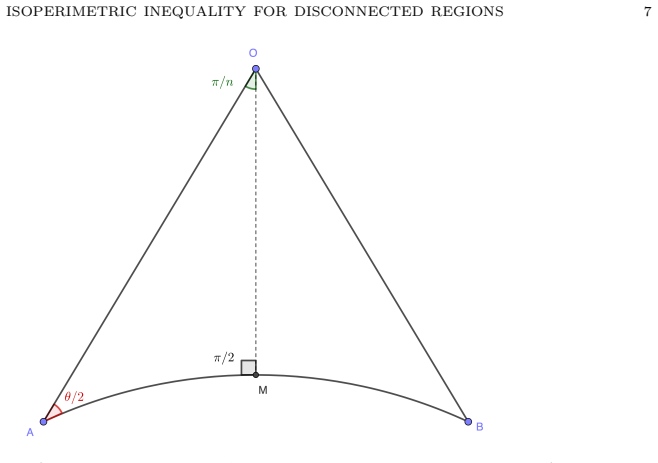
The argument turns the geometric comparison into a one-variable calculus problem. For a regular $n$-gon with interior angle $\theta$, the perimeter is $2n\,g_n(\theta)$, where $g_n$ comes from the side-length formula in the right triangle formed by the circumcenter, a vertex, and a side midpoint; in the hyperbolic case $g_n$ is an inverse-hyperbolic-cosine function of a trigonometric half-angle expression, and in the spherical case the analogous function is an inverse cosine. The paper shows that the spherical analogue of $g_n$ is strictly concave, so a concavity lemma forces two polygons with the same total area to have total perimeter at least that of one polygon. In the hyperbolic case the derivative $g_n'$ is strictly concave, which constrains the sum $g_n(\theta_1)+g_n(\theta_2)$ for fixed $\theta_1+\theta_2$; the critical threshold $\Theta(n)$ is defined as the unique zero of $\varphi_n(x)=2g_n(x/2+\pi/2-\pi/n)-g_n(x)$ on the allowed interval for $\theta$.
What would settle it
Choose $n=3$. Compute the unique zero $\Theta(3)$ of $2g_3(x/2+\pi/6)=g_3(x)$ using the hyperbolic side-length formula, where $g_3(x)$ is the inverse-hyperbolic-cosine of the half-angle side-length expression. Then take a regular hyperbolic triangle with interior angle just below and just above $\Theta(3)$, split its area into two congruent triangles by giving each the interior angle $(\theta+\pi/3)/2$, and compare total perimeters from standard hyperbolic trigonometry; the side of the inequality must switch exactly at $\Theta(3)$.
Extended reading notes
Core claim
Let $P$ be a regular $n$-gon and let $P_1,\dots,P_k$ be disjoint $n$-gons with total area equal to $\mathrm{area}(P)$. The paper proves that $\operatorname{perim}(P) \le \sum_i \operatorname{perim}(P_i)$ always holds when the ambient space is Euclidean or spherical. In hyperbolic space the same inequality holds for every such configuration if and only if the interior angle $\theta$ of $P$ is at least the unique root $\Theta(n)$ of the function $\varphi_n(x)=2g_n(x/2+\pi/2-\pi/n)-g_n(x)$, where $g_n$ is the side-length function appearing in the hyperbolic perimeter formula; below that root the paper constructs two regular $n$-gons with the same total area and smaller total perimeter. The hyperbolic condition can be read as an area bound: the inequality holds exactly when $\mathrm{area}(P)\le (n-2)\pi-n\Theta(n)$. When $\theta>\Theta(n)$, equality forces $k=1$, so the single polygon is the unique minimizer.
Load-bearing premise
The entire proof depends on the standard side-length identities that relate the interior angle of a regular polygon in a constant-curvature space to its side length; if those identities do not hold on the stated domain of angles, the concavity lemmas and the threshold $\Theta(n)$ do not follow.
Editorial extensions
If this is right
- In $\mathbb{R}^2$ and on $S^2$, among all configurations of $n$-gons with fixed total area, a single regular $n$-gon uniquely minimizes total perimeter.
- In $\mathbb{H}^2$, the single regular $n$-gon remains the unique minimizer when its interior angle satisfies $\theta>\Theta(n)$; at $\theta=\Theta(n)$ it still minimizes, but two-polygon configurations can tie it.
- For $\theta<\Theta(n)$, the inequality fails already with two regular $n$-gons, so the threshold is sharp: any configuration whose total area exceeds $(n-2)\pi-n\Theta(n)$ admits a lower-perimeter split.
- By the classical isoperimetric inequality, these results for regular polygons transfer to arbitrary configurations of $n$-gons, since any perimeter-minimizing configuration can be taken to be regular.
- The threshold $\Theta(n)$ depends only on the number of sides $n$, so for each $n$ one can determine the largest total area for which the disconnected isoperimetric inequality is guaranteed.
Reading between the lines
- The threshold is defined as the unique root of a single equation, so for small $n$ the value $\Theta(n)$ could be tabulated numerically; the paper does not give explicit numerical values.
- For configurations mixing polygons with different numbers of sides, the safe regime may differ from $\Theta(n)$, because the perimeter of a regular $n$-gon at fixed area varies with $n$; the paper notes this direction but does not resolve it.
- The Euclidean proof's right-triangle form hints that the whole family of inequalities may be a triangle inequality in an auxiliary metric; if made precise, it might unify the three geometry cases and extend the result to polygons bounded by arcs of constant geodesic curvature.
- A computational experiment near $\theta=\Theta(n)$ could reveal the shape of all equality cases, since at the threshold the two-polygon tie is symmetric; no such numerical data appear in the paper.
Signed reviews
Editorial analysis
A structured set of objections, weighed in public.
Referee Report
Summary. This paper studies a discrete isoperimetric problem for disconnected regions in constant-curvature geometries. For a regular n-gon P of given area, it asks whether every configuration of n-gons with the same total area has total perimeter at least perim(P). The authors prove that in Euclidean and spherical geometry the inequality always holds (Proposition 1.1), and in hyperbolic geometry it holds exactly when the interior angle θ is at least a dimension-dependent threshold Θ(n) (Theorem 1.2). The proof compares perimeters through side-length functions derived from trigonometric identities, using convexity/concavity and a threshold root.
Significance. If the results are correct, they provide a clean and nontrivial extension of Fejes Tóth's and Bezdek's discrete isoperimetric theorems to disconnected regions. The Euclidean case is an elegant reduction to the triangle inequality; the spherical/hyperbolic threshold phenomenon is interesting. The paper's strategy of reducing perimeter comparison to concavity of a function of the interior angle is natural. However, as written, the spherical and hyperbolic side-length formulas are inverted, leaving the perimeter function undefined in the hyperbolic case, and one of the key lemmas in the hyperbolic proof contains an invalid monotonicity argument. These are load-bearing issues.
major comments (2)
- [§2.2 and §3, Eq. (2)] The displayed side-length formulas are inverted. In §2.2 the paper states cos(s/2)=cos(π/n) sin(θ/2), and in §3, equation (2) states cosh(s/2)=cos(π/n) sin(θ/2). The correct relations are cos(s/2)=cos(π/n)/sin(θ/2) and cosh(s/2)=cos(π/n)/sin(θ/2). With the stated hyperbolic formula, the argument of arccosh is cos(π/n) sin(θ/2)<1 for every admissible θ, so perim(P) is not real; in particular, the counterexample T_ε in §1 requires perim(T_ε)→∞ as ε→0, which the stated formula cannot deliver. The derivative computations in Theorem 2.4 and Lemma 3.2 are precisely the derivatives of the reciprocal formulas, so the proofs are not for the perimeter function that is defined. Theorem 2.4, Theorem 3.1, and Theorem 1.2 are therefore not established as written. This appears to be a global sign/inversion typo, but it must be corrected and the proofs checked against the corrected formulas.
- [§3.1, Lemma 3.3] The proof of Lemma 3.3 contains an invalid inference. It asserts that, for fixed x1, g'_n(x1+y)-g'_n(x1) strictly decreases as y increases, and justifies this by strict concavity of g'_n. Strict concavity of g'_n means g'''_n<0; it does not imply that the first difference is decreasing. In fact, from the displayed formula for g''_n in Lemma 3.2, g''_n(x)>0 for x sufficiently close to 0 (for n=3, g''_3(0.1)>0), so g'_n increases over an initial interval and the claimed monotonicity fails. Since the uniqueness of the solution to equation (5) relies on this claim, Lemma 3.3 is unproved, and with it the 'if and only if' reduction in the proof of Theorem 3.1.
minor comments (5)
- [§1, counterexample] The displayed formula for perim(T2) has argument of arccosh equal to cos^2(π/6+ε)+cos(π/6+ε) sin^2(π/6+ε), which tends to less than 1 as ε→0; this is inconsistent with the corrected side-length formula and should be rechecked.
- [§3.1, Lemma 3.4] In the proof of Lemma 3.4, the text says "since g' is convex (by Lemma 3.2)", but Lemma 3.2 states that g'_n is strictly concave. The subsequent reasoning uses the concave shape (unique maximum), so this appears to be a typo, but it should be corrected for consistency.
- [§2.2, Theorem 2.4] The application of Lemma 2.3 in the proof of Theorem 2.4 is not explicit. The reader should be told to take a=(n-2)π/n, b=θ, c=θ1, d=θ2, and to note that f(a)=0 in the corrected formula.
- [References] The reference list is incomplete: [5] and [7] are not cited in the text, and [6] lacks complete bibliographic data (volume, pages, and year).
- [§4, item 3] The assertion that, for fixed area, the perimeter of a regular n-gon is monotonically decreasing in n is stated without proof or reference; it is not central, but should be justified if retained.
Circularity Check
No significant circularity: the hyperbolic threshold is defined as a root of the relevant comparison function and then proved, not assumed; all cited inputs are external to the authors.
full rationale
The paper's central derivation is not circular in any of the tracked senses. The threshold Θ(n) in Theorem 1.2 is introduced as the unique root of the explicitly defined function φ_n(x) = 2g_n(x/2 + π/2 − π/n) − g_n(x), and the proof of Theorem 3.1 establishes that the two-polygon inequality h_n(θ_1) ≥ g_n(θ) reduces exactly to φ_n(θ) ≥ 0. Defining a threshold as the root of the governing function and then deriving the equivalence is a legitimate constructive proof, not a case of fitting an input and calling it a prediction. The paper does not fit any parameter to data. It does not rely on a self-citation chain: the discrete isoperimetric results are attributed to Bezdek and Fejes Tóth, and the trigonometric identities are attributed to Buser and Todhunter, none of which are the present authors. The reduction to regular polygons is justified by the classical isoperimetric inequality applied polygon-by-polygon, so it is not an ansatz smuggled in via the authors' prior work. The alleged inversion of the spherical and hyperbolic side-length formulas, if correct, would be a mathematical correctness or rigor defect, not a circularity: the derivation would still not be equivalent to its own inputs by construction. Accordingly, the appropriate circularity score is 0.
Assumptions & free parameters
assumptions (3)
- standard math The standard discrete isoperimetric inequality for n-gons in constant curvature geometries, used to reduce the problem to regular n-gons.
- standard math Gauss-Bonnet theorem for polygon areas in spherical and hyperbolic geometry.
- standard math Spherical and hyperbolic trigonometric identities for right triangles (cited [10] and [4]).
Cite this review
Pith. "Pith review of Isoperimetric Inequality for Disconnected Regions." pith.science (2026). https://pith.science/paper/M3JQLLEN
@misc{pith2026190807697,
  author       = {Pith},
  title        = {Pith review of: Isoperimetric Inequality for Disconnected Regions},
  year         = {2026},
  howpublished = {\url{https://pith.science/paper/M3JQLLEN}},
  note         = {Machine review of arXiv:1908.07697}
}
abstract
The discrete isoperimetric inequality in Euclidean geometry states that among all $n$-gons having a fixed perimeter $p$, the one with the largest area is the regular $n$-gon. The statement is true in spherical geometry and hyperbolic geometry as well. In this paper, we generalize the discrete isoperimetric inequality to disconnected regions, i.e. we allow the area to be split between regions. We give necessary and sufficient conditions for the result (in Euclidean, spherical and hyperbolic geometry) to hold for multiple $n$-gons whose areas add up.
Figures
Reference graph
Works this paper leans on
-
[1]
K. Bezdek, Ein elementarer Beweis f¨ ur die isoperimetrische Ungleichung in der Euklidischen und hy- perbolischen Ebene, Ann. Univ. Sci. Budapest, Eotvos Sect. Math. 27 (1984), 107-112
work page 1984
-
[2]
Bieberbach, Uber eine Extremaleigenschaft des Kreises , Jber
L. Bieberbach, Uber eine Extremaleigenschaft des Kreises , Jber. Deutsch. Math.-Verein., 24 (1915), 247-250
work page 1915
-
[3]
K.J. B¨ or¨ oczky, A. Sagmeister,Isodiametric problem on the sphere and in the hyperbolic space , Acta Math. Hungarica, 160 (2020), 13-32
work page 2020
-
[4]
Peter Buser, Geometry and Spectra of Compact Riemann Surfaces , Progress in Mathematics, Vol. 106
-
[5]
Isaac Chavel, Isoperimetric Inequalities: Differential Geometric and Analytic Perspectives , Chapter 2
-
[6]
B. Csik´ os, Z. L´ angi, M. Nasz´ odi,A generalization of the Discrete Isoperimetric Inequality for Piecewise Smooth Curves of Constant Geodesic Curvature , Periodica Mathematica Hungarica
-
[7]
Familiari-Calapso, M.T., Sur une classe di triangles et sur le theor´ em` e de Pythagore en g´ eom´ etrie hyperbolique. C. R. Acad. Sci. Paris Ser. A-B 268 (1969), A603-A604
work page 1969
-
[8]
Fejes T´ oth,Regular Figures, Pergamon Press, 1964
L. Fejes T´ oth,Regular Figures, Pergamon Press, 1964
work page 1964
Show all 10 references
-
[9]
O’Neill, Elementary Differential Geometry, Revised 2nd edition , Elsevier
B. O’Neill, Elementary Differential Geometry, Revised 2nd edition , Elsevier
-
[10]
Isaac Todhunter, Spherical Trigonometry. 14 BIDYUT SANKI AND ARYA V ADNERE Department of Mathematics and Statistics, Indian Institute of Technology, Kanpur, Uttar Pradesh - 208016, India Email address: bidyut@iitk.ac.in Department of Mathematics, University of Buffalo, New Yor...
Reviewed August 14, 2026 · model on record in the stance chip above.
Discussion (0). Continue with ORCID to comment.