REVIEW 3 major objections 4 minor 17 references
A Search for IceCube Neutrinos from the First 33 Detected Gravitational Wave Events
T0 review · 3 major / 4 minor · reviewed 2026-08-14 · deepseek-v4-flash
Pith's one-line read This paper searches for neutrinos from the first 33 gravitational-wave events and finds no significant correlation, placing 90% confidence upper limits on their time-integrated flux and isotropic equivalent energy.
desk verdict Clean null search from IceCube covering all first 33 GW events; conclusions hold up, but the global claim needs a trials correction that is missing. read the letter →
The pith
A machine-rendered reading of the paper's core claim, the machinery that carries it, and where it could break.
The reading
What carries the argument
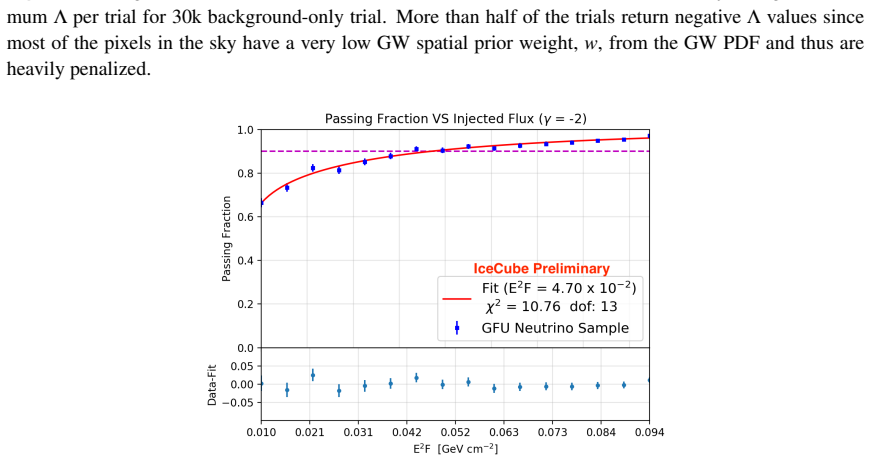
The load-bearing mechanism is an unbinned maximum-likelihood ratio test. Each neutrino event contributes a signal probability density that combines a spatial term and an energy term for a trial spectral index $\gamma$, while the gravitational-wave sky map enters as a per-pixel prior weight $w = P_{\mathrm{GW}}(x_s)/\Omega_{\mathrm{pixel}}$. The modified test statistic $\Lambda = \mathrm{TS} + 2\ln w$ is maximized over all pixels, and the resulting significance is calibrated against 30,000 background trials with scrambled neutrino arrival times; sensitivity and upper limits are set by injecting Monte Carlo signal neutrinos with an $E^{-2}$ power-law spectrum.
What would settle it
Take one of these 33 events and find a neutrino within its ±500 s window with a trial-corrected p-value small enough to pass the detection threshold; alternatively, rerun the same likelihood analysis on the same events with windows of hours to days and find a significant excess that the short window missed. Either result would undercut the paper's null conclusion and its reliance on the ±500 s assumption.
Extended reading notes
Core claim
The paper reports a null result across the first 33 compact binary mergers detected by gravitational-wave observatories through July 28, 2019. In a ±500 s window centered on each gravitational-wave trigger, no neutrino event shows a statistically significant correlation with the source localization, and the smallest reported p-value (0.014) is still consistent with background. For every event the analysis sets 90% confidence upper limits on the time-integrated neutrino flux $E^{2}F$ under an $E^{-2}$ spectrum assumption and on the isotropic-equivalent neutrino energy $E_{\mathrm{iso}}$, with values derived using the distance and sky localization information provided with each event. The paper's claim is that prompt neutrino emission from these mergers, if any, is below the quoted limits.
Load-bearing premise
The search assumes that any neutrino emission from these mergers arrives within ±500 seconds of the gravitational-wave signal, so if the neutrinos are emitted later, the reported limits do not constrain them.
Editorial extensions
If this is right
- The quoted 90% upper limits apply only to the 1000 s window centered on each trigger, so they do not constrain neutrino emission that occurs later.
- A coincident neutrino with a sufficiently small trial-corrected p-value could improve source localization compared to gravitational waves alone; none of the 33 events provides such a localizing event.
- With gravitational-wave detection rates near one per week for binary black holes, the analysis can grow to a population sample of dozens of mergers, enabling per-class constraints on binary black hole and binary neutron star neutrino emission.
- Extending the same likelihood search to longer time windows, particularly the kilonova phase of binary neutron star mergers, may test emission scenarios the present ±500 s window cannot.
Reading between the lines
- A stacked search that combines all 33 events in one likelihood would be more sensitive to a population of faint emitters than the per-event limits reported here; the paper leaves this as a natural extension.
- If kilonova-phase neutrinos are delayed by hours to days, the null result says nothing about the dominant neutrino output of binary neutron star mergers, and the same machinery could be rerun with widened windows.
- Models predicting prompt isotropic-equivalent neutrino energies above the individual 90% limits can be ruled out with the quoted numbers; comparing model predictions event-by-event would convert the table into astrophysical constraints.
- As gravitational-wave localizations improve with more detectors and smaller sky areas, the same method should yield correspondingly tighter per-event neutrino flux limits, so future observing runs are a direct sensitivity upgrade.
Signed reviews
Editorial analysis
A structured set of objections, weighed in public.
Referee Report
Summary. The paper reports a systematic search for IceCube high-energy neutrinos coincident with the first 33 gravitational-wave events detected by LIGO/Virgo through 28 July 2019. The analysis uses an unbinned maximum-likelihood ratio with LVC skymaps as spatial priors, a ±500 s time window around each trigger, and 30,000 background scrambles per event to assign p-values. For each event it reports 90% C.L. upper limits on the time-integrated flux E^2F (GeV cm^-2) and on the isotropic equivalent neutrino energy E_iso, assuming an E^-2 spectrum. No significant neutrino correlation is reported; the smallest p-value is 0.014 for S190728q. The paper also notes that the results have been circulated via GCN circulars and that longer-timescale searches are planned for future work.
Significance. If the null result holds, the paper provides a useful constraint on high-energy neutrino emission from compact binary mergers during the prompt phase, covering the largest sample of gravitational-wave events available at the time. The main strengths are the explicit Monte Carlo background calibration with 30,000 trials per event, the use of publicly available LVC skymaps as spatial priors, and the simultaneous reporting of flux and E_iso upper limits. The overall null conclusion appears robust: even the most significant event, S190728q with p=0.014, would not survive a simple 33-trial Bonferroni correction. The principal weaknesses are an algebraic inconsistency in the quoted test statistic, the absence of a catalog-level trials correction for the global 'no correlation' claim, and the lack of a systematic-uncertainty assessment for the quoted upper limits.
major comments (3)
- [Section 2, Eq. (2.4)] The simplification of the likelihood ratio is incomplete. Starting from the likelihood in Eq. (2.1), the ratio L(ns,hat gamma)/L(ns=0) also contains a Poisson normalization factor e^{-ns}(1+ns/nb)^N, which contributes 2N ln(1+ns/nb) to the log-likelihood-ratio test statistic. The expression shown in Eq. (2.4), Lambda = 2(-ns + sum ln[1+ns Si/(nb Bi)]) + 2 ln w, is therefore not the log-likelihood ratio of Eq. (2.1). Since the subsequent p-values and sensitivity limits are computed from this test statistic, the equation should be corrected, or the statistic should be explicitly defined as an unbinned likelihood ratio with the number of events N fixed. It should also be confirmed that the Monte Carlo trials use the same definition as the equation.
- [Table 1 and Sections 4-5] The paper states in Sections 4 and 5 that 'No significant neutrino correlation was found' for the 33 events, but it reports only per-event p-values and does not provide a combined p-value or any multiple-trials correction. S190728q has p=0.014, which is significant at the 5% level for a single search; the quoted global conclusion therefore relies implicitly on a trials correction that is never stated. A simple Bonferroni correction for 33 independent searches would give corrected p approx 0.46, so the null conclusion is probably robust, but the global claim should be backed by either a combined test statistic or an explicit statement of the trials-corrected threshold.
- [Section 4] The upper limits on E^2F and E_iso are presented without any assessment of systematic uncertainties. These quantities depend on detector angular resolution, energy scale, effective area, and the assumed E^-2 spectrum, and at least the dominant systematic contributions should be quantified or referenced, or the limits should be clearly labeled as preliminary. The figures carry the 'IceCube Preliminary' label, but the text does not identify which uncertainties are included in the quoted numbers.
minor comments (4)
- [Section 2, paragraph after Eq. (2.4)] The description of background trials says neutrinos are randomized by 'scrambling their arrival time and recomputing their direction based on their new randomly assigned time'; this should clarify that the reconstructed direction is re-projected to the detector coordinates appropriate to the scrambled time, rather than being itself randomly redrawn.
- [Table 1] The FAR column entries such as '<1.00 x 10^-7' should include the unit yr^-1 for consistency with the column header and with the other rows.
- [Section 4, Eiso paragraph] The statement that Eiso is tuned so that the mean expected number of neutrino events at IceCube is 2.3 should state explicitly whether the expected background in the search window is included in this calculation; if the 2.3 threshold is used regardless of background, the resulting limit is conservative but the assumption should be stated.
- [Figures 1 and 2] The captions describe GW170104 as an example but do not explain the axes or units; adding axis labels in the figures or a sentence in the caption would make the background distribution and sensitivity curves easier to interpret.
Circularity Check
No significant circularity: the search uses external LVC skymaps, IceCube data, and standard frequentist calibration, with no parameter fitted to the quantity being predicted.
full rationale
The analysis is self-contained against external inputs and does not reduce any claimed result to its own construction. The unbinned likelihood (Eq. 2.1) uses LVC skymaps as spatial priors and IceCube GFU events as data; the test statistic is evaluated against a background distribution built from 30,000 scrambled-time trials, and p-values are per-event results of that comparison. The 90% upper limits on E^2F are obtained by signal injection with a fixed E^-2 spectrum and comparing the observed test statistic to the background distribution, which is standard frequentist calibration rather than a fit renamed as a prediction. The Eiso limits are set by tuning the mean expected number of events to 2.3, the Poisson 90% upper limit for zero observed events, which is an explicit statistical convention and not a circular derivation of the limit from itself. The paper's only limiting assumption, the +/-500 s window, is stated as a scope choice and explicitly flagged for future extension, not hidden or fitted. Citations to prior IceCube work describe the detector sample and realtime infrastructure, not the central result, and no uniqueness theorem or ansatz is imported from self-citations. Therefore the derivation chain is not circular.
Assumptions & free parameters
free parameters (2)
- ns (signal event count) =
not reported (maximized per pixel)
- gamma (spectral index) =
not reported (maximized per pixel)
assumptions (5)
- standard math The test statistic TS follows the asymptotic chi-square distribution used to compute sensitivity via a chi2 CDF fit.
- domain assumption The LVC skymaps provide accurate spatial probability distributions for the GW source locations.
- domain assumption The background of the GFU sample can be modeled by time-scrambling the neutrino arrival times.
- domain assumption Neutrino emission from these sources, if any, follows an E^-2 power-law spectrum; limits are quoted under this assumption.
- standard math The Poisson 90% C.L. upper limit corresponds to a mean of 2.3 expected events.
Cite this review
Pith. "Pith review of A Search for IceCube Neutrinos from the First 33 Detected Gravitational Wave Events." pith.science (2026). https://pith.science/paper/KTXNC6SK
@misc{pith2026190807706,
  author       = {Pith},
  title        = {Pith review of: A Search for IceCube Neutrinos from the First 33 Detected Gravitational Wave Events},
  year         = {2026},
  howpublished = {\url{https://pith.science/paper/KTXNC6SK}},
  note         = {Machine review of arXiv:1908.07706}
}
read the original abstract
The discoveries of high-energy astrophysical neutrinos by IceCube in 2013 and of gravitational waves by LIGO in 2015 have enabled a new era of multi-messenger astronomy. Gravitational waves can identify the merging of compact objects such as neutron stars and black holes. These compact mergers, especially neutron star mergers, are potential neutrino sources. We present an analysis searching for neutrinos from gravitational wave sources reported by the LIGO Virgo Collaboration (LVC). We use a dedicated transient likelihood analysis combining IceCube events with source localizations provided by LVC as spatial priors. We report results for all gravitational wave events from the O1, O2, and O3 observing runs.
Figures


Reference graph
Works this paper leans on
-
[1]
LIGO Scientific, Virgo Collaboration, B. P. Abbott et al., arXiv:1811.12907
- [2]
-
[3]
LIGO Scientific Collaboration, B. P. Abbott et al., Astrophys. J. 848 (2017) L12
work page 2017
-
[4]
Albert et al., Astrophys
ANTARES, IceCube, Pierre Auger, LIGO Scientific, VirgoCollaboration, A. Albert et al., Astrophys. J. 850 (2017) L35
2017
-
[5]
LIGO Scientific, Virgo, Fermi-GBM, INTEGRAL Collaboration, B. P. Abbott et al., Astrophys. J. 848 (2017) L13
work page 2017
- [6]
- [7]
- [8]
Show all 17 references
-
[9]
Adrian-Martinez et al., Phys
ANTARES, IceCube, LIGO Scientific, Virgo Collaboration, S. Adrian-Martinez et al., Phys. Rev. D93 (2016) 122010
2016
-
[10]
Albert et al., Astrophys
ANTARES, IceCube, LIGO, VirgoCollaboration, A. Albert et al., Astrophys. J. 870 (2019) 134
2019
-
[11]
Kintscher, J
IceCube Collaboration, T. Kintscher, J. Phys. Conf. Ser .718 (2016) 062029
2016
-
[12]
K. M. Górski, E. Hivon, A. J. Banday, B. D. Wandelt, F. K. Hansen, M. Reinecke, and M. Bartelmann, Astrophys. J. 622 (Apr., 2005) 759–771
2005
-
[13]
Baret et al., Astropart
B. Baret et al., Astropart. Phys. 35 (2011) 1–7
2011
-
[14]
IceCube Collaboration, M. G. Aartsen et al., Astropart. Phys. 92 (2017) 30–41
2017
-
[15]
Keivani et al., PoS(ICRC2019)930 (these proceedings)
IceCube Collaboration, A. Keivani et al., PoS(ICRC2019)930 (these proceedings)
-
[16]
S. S. Kimura, K. Murase, I. Bartos, K. Ioka, I. S. Heng, and P. Meszaros, Phys. Rev. D98 (2018) 043020
2018
-
[17]
Fang and B
K. Fang and B. D. Metzger, Astrophys. J. 849 (2017) 153. [Astrophys. J.849,153(2017)]. 8
2017
Reviewed August 14, 2026 · model on record in the stance chip above.
Discussion (0). Continue with ORCID to comment.