REVIEW 3 major objections 6 minor 45 references
One- and three-dimensional quantum phase transitions and anisotropy in Rb$_{2}$Cu$_{2}$Mo$_{3}$O$_{12}$
T0 review · 3 major / 6 minor · reviewed 2026-08-14 · deepseek-v4-flash
Pith's one-line read Heat capacity, magnetization, and ESR on single crystals of Rb2Cu2Mo3O12 show a 3D magnon-BEC transition at the lower critical field and a 1D-dominated quantum critical point at saturation, with strongly anisotropic lower critical fields.
desk verdict First single-crystal phase diagram for Rb2Cu2Mo3O12, with a plausible 1D/3D quantum-critical dichotomy that needs quantitative support; deserves peer review. read the letter →
The pith
A machine-rendered reading of the paper's core claim, the machinery that carries it, and where it could break.
The reading
They found two field-induced transitions. At low fields (around 2 to 3 T), the material leaves a non-magnetic, gapped state and enters a magnetically ordered phase. This transition behaves as if the magnetic degrees of freedom are three-dimensional: heat capacity grows as temperature to the 3/2 power, and magnetization rises linearly with field. At high fields near saturation (around 12 T), the ordered state melts into a fully polarized state. This second transition behaves as if the spins are one-dimensional chains: heat capacity grows as the square root of temperature, and magnetization approaches saturation as a square root. The lower transition field differs by more than 50% depending on whether the field is applied along or perpendicular to the copper-oxygen chains, while the upper field is almost isotropic.
The results matter because they show three-dimensional and one-dimensional quantum fluctuations coexisting in a single material, and they give theorists a concrete experimental target for frustrated spin-chain models. The microwave data also hint that spiral magnetic correlations persist even above the ordering temperature, which is relevant to the material's proposed multiferroic behavior.
Extended reading notes
Core claim
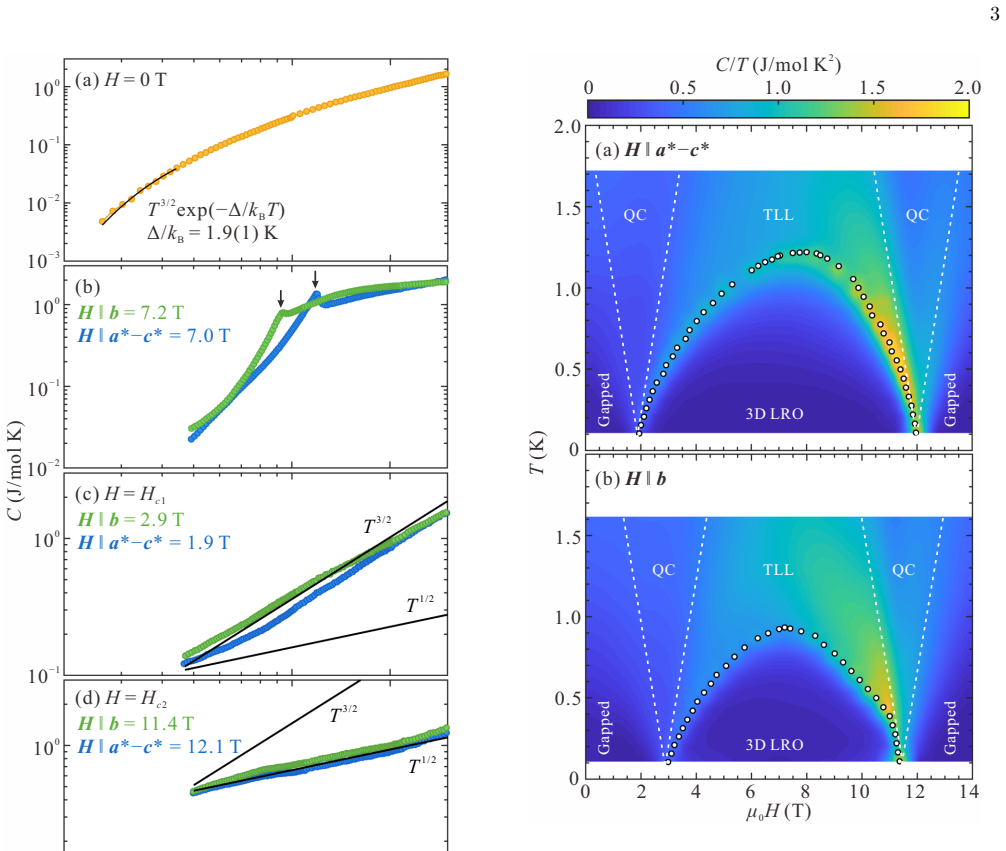
The most intriguing result is that while the field-induced ordering transition is of a distinct three-dimensional character, the quantum phase transition at saturation is entirely dominated by one-dimensional fluctuations (Section I, Introduction). If correct, the lower transition is a 3D magnon-BEC (mean-field, CV proportional to T^{3/2}, linear M(H)), while the saturation transition is a d=1, z=2 quantum critical point (CV proportional to T^{1/2}, M approaching saturation as a square root).
Load-bearing premise
The central dimensionality claim rests on identifying the measured heat capacity at exactly Hc1 and Hc2 with the asymptotic quantum critical power laws CV proportional to T^{d/2} over the accessible temperature range (Figs. 3(c) and 3(d)). This identification presupposes that the specific heat is dominated by the quantum critical contribution with negligible lattice, nuclear, or Schottky background (no background subtraction is reported), that the applied field is tuned with sufficient precision to the critical field, and that the limited temperature range (roughly one decade) is sufficient to unambiguously distinguish the 1/2 and 3/2 exponents from other values. The paper presents the power laws as guides without fit ranges or confidence intervals, so a failure of any of these assumptions would weaken the 3D-versus-1D conclusion.
Signed reviews
Editorial analysis
A structured set of objections, weighed in public.
Referee Report
Summary. The paper reports single-crystal measurements of the frustrated quasi-one-dimensional magnet Rb2Cu2Mo3O12, including heat capacity, magnetization, and ESR. The authors map the H–T phase diagram for two field orientations and identify two quantum phase transitions: the lower one at Hc1, interpreted as a three-dimensional magnon BEC (heat capacity C_V ∝ T^{3/2}, magnetization linear in H), and the upper one at Hc2, interpreted as a one-dimensional z=2 quantum critical point (C_V ∝ T^{1/2}, magnetization approaching saturation as a square root). The paper also reports a strong anisotropy of the lower critical fields, a near-isotropic upper critical field and saturation magnetization, and ESR evidence for helical correlations.
Significance. If the central claim holds, this material provides a rare example in which, within a single compound, the field-induced ordering transition is governed by 3D fluctuations while the saturation transition is dominated by 1D fluctuations. The experimental dataset—single-crystal heat capacity, magnetization, and ESR over a wide field-temperature range—is a valuable contribution to the study of frustrated quasi-1D magnets. The identification of the two quantum critical regimes, however, rests on visual power-law comparisons over a limited temperature range without quantitative fitting or background subtraction; this is the main weakness that must be addressed before the conclusion can be accepted.
major comments (3)
- [§III.A, Figs. 3(c), 3(d)] The central claim that C_V at Hc2 follows T^{1/2} and at Hc1 follows T^{3/2} is supported only by visual comparison with solid guide lines; the fit ranges, functional forms, and confidence intervals are not reported. The accessible temperature window is only about one decade (0.1–1.7 K), and the measurements were made without background subtraction (as stated in §II). A combination of a small T^{3/2} term from finite 3D interchain coupling plus a lattice T^3 term or a nuclear Schottky H^2/T^2 term can mimic an apparent T^{1/2} over this window. The authors should provide quantitative fits with specified ranges and uncertainty estimates, and either subtract or explicitly estimate the background contributions, in order to substantiate the d=1,z=2 assignment.
- [§III.A, Fig. 4] The statement that the saturation transition is 'entirely dominated by one-dimensional fluctuations' is stronger than the data support. Because the same material shows 3D long-range order at Hc1, the interchain coupling is finite, and at sufficiently low temperature the Hc2 transition must ultimately cross over to 3D quantum critical behavior. The observed T^{1/2} over 0.1–1.7 K may therefore represent an intermediate quasi-1D regime rather than the true asymptotic quantum critical exponent. The manuscript does not estimate the crossover scale or discuss this possibility; the phase diagram in Fig. 4 labels the QC region simply as 'd=1,z=2' without addressing the expected 3D crossover.
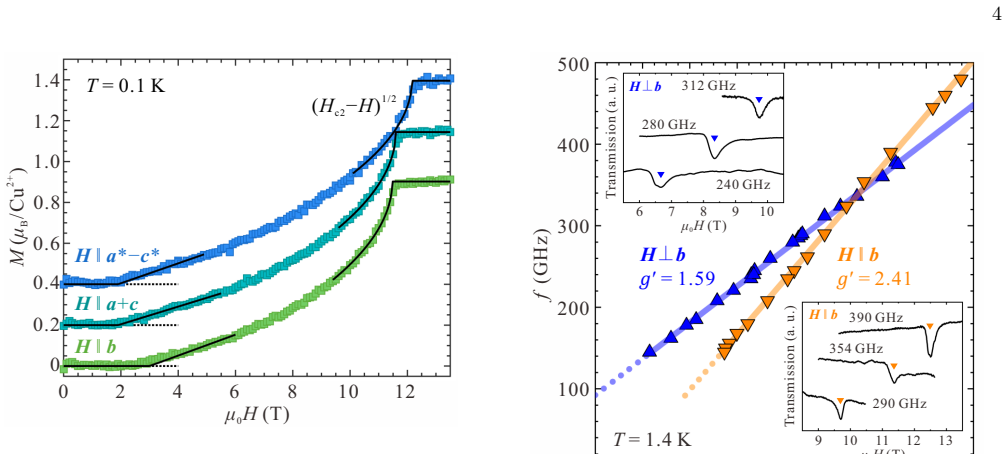
- [§III.B, Fig. 5] The magnetization data near Hc1 and Hc2 are presented with linear and square-root fits, respectively, but the fits are not described quantitatively: no fit ranges, parameters, or residuals are given, and no uncertainty is reported on the critical fields used as the fit origins. Since the magnetization behavior is an independent pillar of the dimensionality claim, the authors should report the fitting procedure and its uncertainties, and ideally compare the data with other exponents (e.g., α = 0.5 ± 0.1) to demonstrate that the square-root form is uniquely favored.
minor comments (6)
- [Abstract and §I] The abstract states that the saturation transition is 'entirely dominated by one-dimensional fluctuations'; given the quantitative concerns above, the wording 'dominated' is acceptable but should be qualified in the main text to acknowledge the possibility of a quasi-1D regime rather than asymptotic 1D criticality.
- [§II] The sentence 'The experiments were set in the Faraday or Voigt configurations' is slightly awkward; 'measurements were performed in the Faraday and Voigt configurations' would be clearer.
- [Fig. 3 caption] The in-panel labels for field values (e.g., 'H || b = 11.4 T') are small and could be misread; listing the field values in the caption would improve readability.
- [§III.A, paragraph after Fig. 3(d)] The phrase 'the lower transition behaves much as we would expect for 3D ordering' is vague; it would be more precise to state that the data are consistent with C_V ∝ T^{3/2}, the expected form for a d=3,z=2 quantum critical point.
- [§III.C] There are minor grammar issues in 'The effective g'-factor ... They clearly do not correspond to the g factor', and the sentence 'This suggests that at 1.4 K one-dimensional spiral correlations are already well established ... or may even be a signature of three-dimensional chiral order' would benefit from separating the two alternatives more clearly.
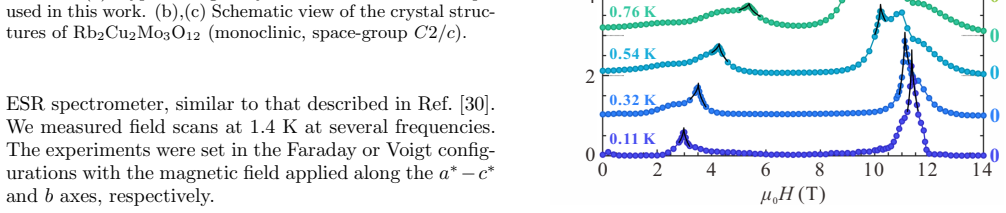
- [§III.A, Fig. 4] The kink on the phase boundary at H~11 T and T~0.5 K for H || b is mentioned but not discussed; a brief comment on its possible origin would complete the phase-diagram description.
Circularity Check
No circularity: the critical-exponent claims are judged against standard literature scaling forms, and the only self-citation is illustrative rather than load-bearing.
full rationale
The paper makes no derivation that reduces to its inputs. The central dimensionality claims are comparisons of measured specific-heat and magnetization curves to well-established scaling predictions: C_V ∝ T^{d/2} is taken from Ref. [39], the T^{1/2} and square-root magnetization behavior at saturation from Refs. [32,33,40], and the T^{3/2} mean-field magnon-BEC behavior from Refs. [41,42]. These are external benchmarks, not quantities fitted inside this paper and then renamed as predictions. The heat-capacity power laws in Figs. 3(c) and 3(d) are stated as guides rather than fitted values, and the critical fields Hc1 and Hc2 are located from lambda anomalies; the observed T^{1/2} and T^{3/2} behaviors at those fields are not generated by construction from the same fits. The fitted quantities that do appear, such as the activation temperature Δ/k_B = 1.9(1) K and the ESR parameters Δ and g′, are descriptive characterizations and are not used to construct the phase diagram or the exponent assignment. The only self-citation is Ref. [36] (Blosser et al.), cited alongside other works for the observation that broad specific-heat humps near saturation are seen in other one-dimensional magnets; this is an illustrative supporting remark, not a load-bearing step, and the central conclusion does not depend on it. Concerns about background subtraction, fit ranges, and identifying exponents over a limited temperature window are legitimate scientific-correctness risks, but they are not circularity: an unproven assumption about background or asymptotic regime does not make the experimental observation equivalent to its input by definition. The paper is self-contained against external benchmarks, so the appropriate circularity score is 0.
Assumptions & free parameters
free parameters (4)
- Critical fields Hc1, Hc2 for two orientations =
Hc1,⊥=1.9 T, Hc2,⊥=12.0 T; Hc1,∥=3.0 T, Hc2,∥=11.4 T
- Activation gap Δ/k_B =
1.9(1) K
- ESR effective parameters for H⊥b =
g'=1.59, Δ=92.2 GHz
- ESR effective parameters for H∥b =
g'=2.41, Δ=-36.5 GHz
assumptions (5)
- domain assumption The relation C_V proportional to T^{d/2} for field-induced quantum phase transitions in gapped spin systems with quadratic magnon dispersion (Ref 39).
- domain assumption The d=1, z=2 quantum critical scaling forms (C_V proportional to T^{1/2} and M-M_sat proportional to (H-Hc2)^{1/2}) from Refs 32, 33, 40.
- domain assumption The magnon BEC description of field-induced ordering in gapped quantum magnets (mean-field, d=3, z=2) from Refs 41, 42.
- domain assumption The crystal structure and stoichiometry of the single crystals are as reported (C2/c, CuO4 chains along b), validated by single-crystal x-ray diffraction against Ref 13.
- domain assumption The ESR linear frequency-field relation f = Δ + g' μ_B H/h and the interpretation of anisotropic g' as a helimagnetic spin-rotation plane effect.
Cite this review
Pith. "Pith review of One- and three-dimensional quantum phase transitions and anisotropy in Rb$_{2}$Cu$_{2}$Mo$_{3}$O$_{12}$." pith.science (2026). https://pith.science/paper/ZU3MU5BQ
@misc{pith2026190807739,
  author       = {Pith},
  title        = {Pith review of: One- and three-dimensional quantum phase transitions and anisotropy in Rb$_2$Cu$_2$Mo$_3$O$_12$},
  year         = {2026},
  howpublished = {\url{https://pith.science/paper/ZU3MU5BQ}},
  note         = {Machine review of arXiv:1908.07739}
}
abstract
Single crystal samples of the frustrated quasi one-dimensional quantum magnet Rb$_{2}$Cu$_{2}$Mo$_{3}$O$_{12}$ are investigated by magnetic, thermodynamic, and electron spin resonance (ESR) measurements. Quantum phase transitions between the gapped, magnetically ordered and fully saturated phases are observed. Surprisingly, the former has a distinctive three-dimensional character, while the latter is dominated by one-dimensional quantum spin fluctuations. The entire $H$-$T$ phase diagram is mapped out and found to be substantially anisotropic. In particular, the lower critical fields differ by over 50\% depending on the direction of applied field, while the upper ones are almost isotropic, as is the magnetization above saturation. The ESR spectra are strongly dependent on field orientation and point to a helical structure with a rigidly defined spin rotation plane.
Figures

Figures from the paper (1 more)
Reference graph
Works this paper leans on
-
[1]
A. V. Chubukov, Phys. Rev. B 44, 4693 (1991)
work page 1991
- [2]
-
[3]
T. Hikihara, L. Kecke, T. Momoi, and A. Furusaki, Phys. Rev. B 78, 144404 (2008)
work page 2008
-
[4]
Sudan, A
J. Sudan, A. L¨ uscher, and A. M. L¨ auchli, Phys. Rev. B 80, 140402(R) (2009)
2009
-
[5]
Furukawa, M
S. Furukawa, M. Sato, and S. Onoda, Phys. Rev. Lett. 105, 257205 (2010)
2010
-
[6]
S. Furukawa, M. Sato, S. Onoda, and A. Furusaki, Phys. Rev. B 86, 094417 (2012)
work page 2012
- [7]
- [8]
Show all 45 references
-
[9]
Kecke, T
L. Kecke, T. Momoi, and A. Furusaki, Phys. Rev. B 76, 060407(R) (2007)
2007
-
[10]
M. E. Zhitomirsky and H. Tsunetsugu, EPL (Europhysics Letters) 92, 37001 (2010)
2010
-
[11]
M. Sato, T. Hikihara, and T. Momoi, Phys. Rev. Lett. 110, 077206 (2013)
2013
-
[12]
Nishimoto, S.-L
S. Nishimoto, S.-L. Drechsler, R. Kuzian, J. Richter, and J. van den Brink, Phys. Rev. B 92, 214415 (2015)
2015
-
[13]
S. F. Solodovnikov and Z. A. Solodovnikova, J. Struct. Chem. 38, 765 (1997)
1997
-
[14]
M. Hase, H. Kuroe, K. Ozawa, O. Suzuki, H. Kitazawa, G. Kido, and T. Sekine, Phys. Rev. B 70, 104426 (2004)
2004
-
[15]
M. Hase, K. Ozawa, O. Suzuki, H. Kitazawa, G. Kido, H. Kuroe, and T. Sekine, J. Appl. Phys. 97, 10B303 (2005)
2005
-
[16]
Yasui, R
Y. Yasui, R. Okazaki, I. Terasaki, M. Hase, M. Hagi- hala, T. Masuda, and T. Sakakibara, JPS Conf. Proc. 3, 014014 (2014)
2014
-
[17]
Yasui, Y
Y. Yasui, Y. Yanagisawa, R. Okazaki, and I. Terasaki, Phys. Rev. B 87, 054411 (2013)
2013
-
[18]
Yasui, Y
Y. Yasui, Y. Yanagisawa, R. Okazaki, I. Terasaki, Y. Ya- maguchi, and T. Kimura, Journal of Applied Physics 113, 17D910 (2013)
2013
-
[19]
Reynolds, A
N. Reynolds, A. Mannig, H. Luetkens, C. Baines, T. Goko, R. Scheuermann, L. Keller, M. Bartkowiak, A. Fujimura, Y. Yasui, C. Niedermayer, and J. S. White, Phys. Rev. B 99, 214443 (2019)
2019
-
[20]
Kuroe, T
H. Kuroe, T. Hamasaki, T. Sekine, M. Hase, T. Naka, and N. Maeshima, AIP Conf. Proc. 850, 1049 (2006)
2006
-
[21]
Hamasaki, H
T. Hamasaki, H. Kuroe, T. Sekine, T. Naka, M. Hase, N. Maeshima, Y. Saiga, and Y. Uwatoko, Journal of Magnetism and Magnetic Materials 310, e394 (2007), proceedings of the 17th International Conference on Mag- netism
2007
-
[22]
A. Yagi, K. Matsui, T. Goto, M. Hase, and T. Sasaki, J. Phys.: Conf. Ser. 828, 012016 (2017)
2017
-
[23]
Matsui, A
K. Matsui, A. Yagi, Y. Hoshino, S. Atarashi, M. Hase, T. Sasaki, and T. Goto, Phys. Rev. B 96, 220402(R) (2017)
2017
-
[24]
Tomiyasu, M
K. Tomiyasu, M. Fujita, A. I. Kolesnikov, R. I. Bewley, M. Bull, and S. Bennington, Applied Physics Letters 94, 092502 (2009)
2009
-
[25]
Ohira-Kawamura, K
S. Ohira-Kawamura, K. Tomiyasu, A. Koda, D. P. Sari, R. Asih, S. Yoon, I. Watanabe, and K. Nakajima, JPS Conf. Proc. 21, 011007 (2018)
2018
-
[26]
Katsura, N
H. Katsura, N. Nagaosa, and A. V. Balatsky, Phys. Rev. Lett. 95, 057205 (2005)
2005
-
[27]
Mostovoy, Phys
M. Mostovoy, Phys. Rev. Lett. 96, 067601 (2006)
2006
-
[28]
C. Jia, S. Onoda, N. Nagaosa, and J. H. Han, Phys. Rev. B 76, 144424 (2007)
2007
-
[29]
H. J. Xiang and M.-H. Whangbo, Phys. Rev. Lett. 99, 257203 (2007)
2007
-
[30]
Zvyagin, J
S. Zvyagin, J. Krzystek, P. van Loosdrecht, G. Dhalenne, and A. Revcolevschi, Physica B: Condensed Matter 346- 347, 1 (2004)
2004
-
[31]
V. Zapf, M. Jaime, and C. D. Batista, Rev. Mod. Phys. 86, 563 (2014)
2014
-
[32]
V. E. Korepin and N. A. Slavnov, Commun. Math. Phys. 129, 103 (1990)
1990
-
[33]
Sachdev, T
S. Sachdev, T. Senthil, and R. Shankar, Phys. Rev. B 50, 258 (1994)
1994
-
[34]
R¨ uegg, K
C. R¨ uegg, K. Kiefer, B. Thielemann, D. F. McMor- row, V. Zapf, B. Normand, M. B. Zvonarev, P. Bouil- lot, C. Kollath, T. Giamarchi, S. Capponi, D. Poilblanc, D. Biner, and K. W. Kr¨ amer, Phys. Rev. Lett. 101, 247202 (2008)
2008
-
[35]
Breunig, M
O. Breunig, M. Garst, A. Kl¨ umper, J. Rohrkamp, M. M. Turnbull, and T. Lorenz, Science Advances 3, eaao3773 (2017)
2017
-
[36]
Blosser, V
D. Blosser, V. K. Bhartiya, D. J. Voneshen, and A. Zhe- ludev, Phys. Rev. Lett. 121, 247201 (2018)
2018
-
[37]
Troyer, H
M. Troyer, H. Tsunetsugu, and D. W¨ urtz, Phys. Rev. B 50, 13515 (1994)
1994
-
[38]
T. Hong, Y. H. Kim, C. Hotta, Y. Takano, G. Tremelling, M. M. Turnbull, C. P. Landee, H.-J. Kang, N. B. Chris- tensen, K. Lefmann, K. P. Schmidt, G. S. Uhrig, and C. Broholm, Phys. Rev. Lett. 105, 137207 (2010)
2010
-
[39]
Continentino, Quantum scaling in many-body systems (Cambridge University Press, Cambridge, 2017)
M. Continentino, Quantum scaling in many-body systems (Cambridge University Press, Cambridge, 2017)
2017
-
[40]
J. C. Bonner and M. E. Fisher, Phys. Rev. 135, A640 (1964)
1964
-
[41]
E. G. Batyev and L. S. Braginski, Sov. Phys. JETP 60, 781 (1984)
1984
-
[42]
Giamarchi and A
T. Giamarchi and A. M. Tsvelik, Phys. Rev. B 59, 11398 (1999). 6
1999
-
[43]
L. E. Svistov, L. A. Prozorova, A. A. Bush, and K. E. Kamentsev, J. Phys.: Conf. Ser. 200, 022062 (2010)
2010
-
[44]
Fujita, M
T. Fujita, M. Hagiwara, M. Inada, Y. Yasui, and I. Terasaki, JPS Conf. Proc. 3, 014028 (2014)
2014
-
[45]
L. A. Prozorova, L. E. Svistov, A. M. Vasiliev, and A. Prokofiev, Phys. Rev. B 94, 224402 (2016)
2016
Reviewed August 14, 2026 · model on record in the stance chip above.
Discussion (0). Continue with ORCID to comment.