REVIEW 3 major objections 4 minor 14 references
Random Mode Coupling Assists Kerr Beam Self-Cleaning in a Graded-Index Multimode Optical Fiber
T0 review · 3 major / 4 minor · reviewed 2026-08-14 · deepseek-v4-flash
Pith's one-line read Random coupling among modes with equal mode number, added to a coupled-mode model, reproduces both the linear speckle and the nonlinear beam self-cleaning observed in a graded-index multimode fiber.
desk verdict A numerically useful model showing that degenerate-mode random coupling explains Kerr self-cleaning, but a sign error in the central equation and missing quantitative support make the current claims unverifiable. read the letter →
The pith
A machine-rendered reading of the paper's core claim, the machinery that carries it, and where it could break.
The reading
What carries the argument
The central object is a random Hermitian coupling matrix C inserted into the coupled-mode equations for a graded-index fiber. Each off-diagonal element is normally distributed with zero mean and changes randomly along propagation with a 10 cm correlation length; the particular variant that works restricts coupling to modes with equal mode number n, i.e., degenerate modes. This matrix models fiber imperfections such as bending, tilting, and fabrication irregularities. It randomizes the phases and energy distribution among higher-order modes to create linear speckle, while leaving the fundamental mode energetically isolated, which the Kerr term then exploits to condense the beam into a stable bell-shaped output.
What would settle it
Launch a single higher-order mode into a real 62.5-micrometer graded-index fiber and measure how its power leaks into modes with different mode numbers over sub-meter scales; if significant non-degenerate coupling appears at the 10 cm scale, or if the coupling strength required to fit the speckle statistics is far outside measured fiber perturbations, the degenerate-mode coupling model would be ruled out.
Extended reading notes
Core claim
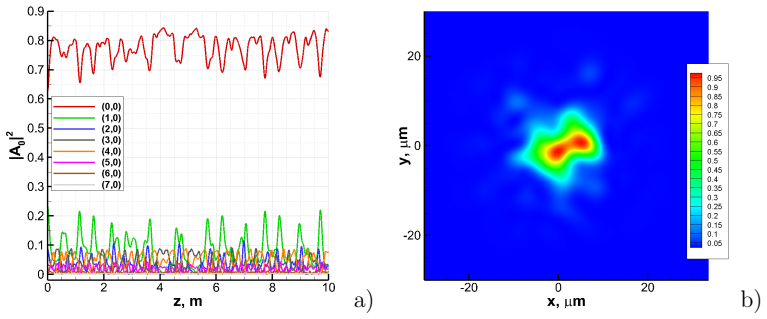
The central claim is that random linear coupling between degenerate modes, meaning modes with equal mode number n = 2p + |m|, is the key mechanism that lets Kerr nonlinearity clean a noisy multimode beam. In the linear regime this coupling scrambles energy among modes of the same n and, for an input beam slightly displaced from the fiber axis, produces a realistic speckle pattern; in the nonlinear regime the fundamental mode, being the only n = 0 mode, cannot lose energy through this coupling, so its power stabilizes and dominates, giving an output beam close to the fundamental mode. Other coupling prescriptions, such as coupling all modes or only neighboring modes, fail to reproduce the observed speckle and self-cleaning. The paper concludes that the degenerate-mode coupling model is in complete agreement with the available experimental data.
Load-bearing premise
The model's agreement depends on real fiber imperfections behaving like random coupling that mixes only modes with the same mode number, reshuffled along a 10 cm length, with a strength that the paper does not report.
Editorial extensions
If this is right
- The coupled-mode model with degenerate-mode random coupling reproduces the linear speckled output observed in experiments, provided the input beam is slightly off-center.
- In the nonlinear regime, the same model yields robust beam self-cleaning to a near-fundamental-mode output at 10 kW input power.
- Coupling all modes, or only neighboring modes with n1 = n ± 1 and m1 = m ± 1, does not reproduce the experimental speckle or self-cleaning; only equal-n coupling works.
- Because the fundamental mode is the sole n = 0 mode, its power is insensitive to degenerate coupling and can stabilize under Kerr nonlinearity.
- Using the coupled-mode model with a large integration step reduces computation time compared with full three-dimensional nonlinear Schrödinger propagation.
Reading between the lines
- If degenerate-mode coupling is indeed the operative perturbation, fiber designs that minimize non-degenerate perturbations, such as precisely controlled micro-bending, should show a sharper self-cleaning threshold, which could be tested experimentally.
- The paper does not report the variance or full statistics of the coupling matrix; a natural next step is to extract these statistics from single-mode-launch experiments and test whether the model's quantitative predictions survive without tuning.
- The equal-n coupling rule suggests a connection to mode condensation: the Kerr nonlinearity acts on a beam whose higher-order modes have already been randomized by disorder, which may link this work to hydrodynamic descriptions of multimode fibers.
Signed reviews
Editorial analysis
A structured set of objections, weighed in public.
Referee Report
Summary. The manuscript reports numerical simulations of Kerr beam self-cleaning in a graded-index multimode fiber using a coupled-mode model. Random linear coupling between modes is added to the base model of Ref. [14], and three coupling scenarios are compared: coupling between all modes, coupling between neighboring modes satisfying n1=n±1 and m1=m±1, and coupling only among degenerate modes with equal mode number n. The authors find that only the degenerate-mode coupling reproduces a speckled output in the linear regime and a stable self-cleaned beam in the nonlinear regime, and they claim that the results are in complete agreement with their own experimental data from Ref. [14].
Significance. If the model were fully specified and the agreement with experiment quantified, this would be a useful contribution: it offers a computationally efficient coupled-mode description and identifies degenerate-mode random coupling as the minimal ingredient that preserves the self-cleaning mechanism while generating realistic speckle. The paper's strengths are the systematic comparison of three coupling models, the direct calculation of modal overlap integrals, and the clear separation of linear and nonlinear regimes. The significance is currently limited, however, because the central claim of complete agreement is not backed by a single quantitative comparison, the random-coupling parameters are not reported, and the printed evolution equation appears to contain an error that breaks power conservation.
major comments (3)
- [Section 2, Eqs. (4) and (6)] The matrix form in Eq. (6) reads dA/dζ = M A with M = -iD L/2 - (1/2) C - i p NL/2, but substituting Eq. (4) gives a coupling term of -(i/2) C A. Because C is declared Hermitian in order to preserve total power, the printed -C/2 term is Hermitian with the wrong sign of the imaginary unit, making the linear evolution non-unitary and capable of introducing spurious exponential growth or decay. If the leapfrog scheme in Eq. (9) solves Eq. (6) literally, the reported speckle and self-cleaning could be numerical artifacts of this gain or loss; if it solves Eq. (4), then Eq. (6) is a typo that must be corrected. In either case the text needs a clear statement of which equation is actually integrated.
- [Section 3, random-coupling models] The parameters of the random coupling matrix C are never fully specified. The text states that each element is normally distributed with zero mean, but it does not give the standard deviation or variance of that distribution, and it gives a correlation length of 10 cm only for the n±1 model, not for the equal-mode-number model that is claimed to reproduce the experiments. The all-modes model is said to have coefficients that change at every integration step, which would make the correlation length equal to the step size rather than a physical value. Since the speckle contrast and the self-cleaning dynamics depend on the coupling strength, the model is under-specified and the reported agreement cannot be reproduced or checked.
- [Section 3 and Conclusion] The statement that the numerical results are in complete agreement with the experimental data of Ref. [14] is not supported by any quantitative comparison in the manuscript. There is no side-by-side plot of simulated and measured output intensity profiles, no metric such as speckle contrast or output beam radius versus power, and no error bars. The conclusion repeats the claim without evidence. Please add at least one quantitative comparison, for example a plot of fundamental-mode fraction or output beam radius versus input power for the same fiber parameters and launch conditions as in Ref. [14].
minor comments (4)
- [Section 3, first paragraph of Numerical results] The sentence 'the beam will not change during propagation in the linear regime' is not correct for Eq. (4) with C=0: the D(n+1)^2 term produces power-conserving phase evolution among modes and hence self-imaging of the beam. Please either account for this phase evolution in the discussion or state explicitly that D is neglected in that argument.
- [Throughout] The symbol p is used both for normalized power (p = P/Psf) and as a mode index in A_{p,m} and in the subscripts of the overlap integrals, which makes equations such as (4) and (8) unnecessarily hard to read. Please use separate notation, for example P0 for normalized power.
- [Throughout] There are several typographical and grammatical errors that should be corrected in a revision: 'Intoduction' in the section heading, 'profle' instead of 'profile', 'we start out investigation', and 'completely agreement' in the abstract-like phrasing.
- [Section 3, Eq. (9)] The numerical scheme is presented as an explicit leapfrog finite-difference method, but the text does not discuss the chosen integration step size, numerical stability, or convergence checks. A sentence reporting these details would be useful, especially because the random coefficients vary along the propagation distance.
Circularity Check
Validation reduces to self-citation and in-sample model selection: random-coupling parameters are unspecified and chosen to reproduce the authors' own [14] speckle data.
-
fitted input called prediction
[Sec. 3, random-coupling model selection; Sec. 4 conclusion]
"Finally, we considered a model with random linear coupling between spatial modes with equal mode numbers n only."
The equal-n coupling rule was not derived from first principles; it was selected after trying all-mode and nearest-neighbour couplings, using the need to reproduce the experimentally observed speckle as the selection criterion ("To obtain a speckled intensity pattern in the linear regime, in further research we used the full system of equations (4) with a non-zero matrix C"). The variance of C is never reported, so the model has a free parameter that can be adjusted to match the output. Calling the resulting simulations "in complete agreement with our experimental data" is thus an in-sample fit presented as a prediction, not a parameter-free derivation.
-
self citation load bearing
[Introduction and Conclusion; Ref. [14]]
"It was found that the results obtained using the model with a random linear coupling between modes with equal mode numbers are in complete agreement with available experimental data."
Ref. [14] (Podivilov et al., PRL 2018) supplies both the coupled-mode model ("in this work we use the coupled-mode model [14]") and the experimental data against which the agreement is asserted; several authors overlap with the present paper. No independent dataset, code reproduction, or machine-checked theorem is provided. Thus the validation chain that supports the paper's main claim terminates in the authors' own prior work, making the self-citation load-bearing.
full rationale
Score 6: partial circularity. The paper's own derivation is self-contained at the level of writing down the coupled-mode equations (Eq. (4)) and solving them numerically; no 'prediction' is mathematically equivalent to an input by construction. The circularity enters in the validation claim. The random-coupling matrix is specified only as Hermitian, zero-mean and normal, with no variance; the degenerate-mode coupling rule and 10 cm correlation length are chosen, after trying other rules, because they produce the observed speckle. The experiments and the base model are both from Ref. [14], whose authors overlap with the present paper. Therefore the 'complete agreement with our experimental data' is in-sample model selection plus self-citation rather than an independent confirmation. Separately, Eq. (6) writes the coupling term as -(1/2)C instead of -(i/2)C as required by Eq. (4); taken literally this makes the linear evolution non-unitary. That is a correctness/reproducibility issue, not itself a circular step.
Assumptions & free parameters
free parameters (3)
- standard deviation of random coupling matrix C =
not reported
- correlation length of random coupling =
10 cm
- mode truncation order =
n ≤ 16 (153 modes)
assumptions (3)
- standard math Rapidly oscillating four-wave mixing terms can be neglected (rotating wave approximation)
- domain assumption Fiber imperfections can be modeled as a Hermitian random linear coupling with zero-mean normal distribution, random along propagation
- ad hoc to paper Coupling only among modes with equal mode number n models the relevant imperfections
Cite this review
Pith. "Pith review of Random Mode Coupling Assists Kerr Beam Self-Cleaning in a Graded-Index Multimode Optical Fiber." pith.science (2026). https://pith.science/paper/FTGCLRJE
@misc{pith2026190807745,
  author       = {Pith},
  title        = {Pith review of: Random Mode Coupling Assists Kerr Beam Self-Cleaning in a Graded-Index Multimode Optical Fiber},
  year         = {2026},
  howpublished = {\url{https://pith.science/paper/FTGCLRJE}},
  note         = {Machine review of arXiv:1908.07745}
}
read the original abstract
In this paper, we numerically investigate the process of beam self-cleaning in a graded-index multimode optical fiber, by using the coupled-mode model. We introduce various models of random linear coupling between spatial modes, including coupling between all modes, or only between degenerate ones, and investigate the effects of random mode coupling on the beam self-cleaning process. The results of numerical investigations are in complete agreement with our experimental data.
Figures


Figures from the paper (4 more)


Reference graph
Works this paper leans on
-
[14]
E. V. Podivilov, D. S. Kharenko, V. A. Gonta, K. Krupa, O. S. Sidel- nikov, S. Turitsyn, M. P. Fedoruk, S. A. Babin, S. Wabnitz, Hydro- dynamic 2D turbulence and spatial beam condensation in multimode optical fibers, Phys. Rev. Lett. 122 (2018) 103902. 12
work page 2018
-
[1]
D. J. Richardson, J. M. Fini, L. E. Nelson, Space-division multiplexing in optical fibres, Nat. Photonics 7 (2013) 354–362
work page 2013
-
[2]
D. J. Richardson, J. Nilsson, W. A. Clarkson, High power fiber lasers: current status and future perspectives, J. Opt. Soc. Am. B 27 (2010) B63
work page 2010
-
[3]
L. G. Wright, D. N. Christodoulides, F. W. Wise, Controllable spa- tiotemporal nonlinear effects in multimode fibres, Nature Photonics (2015) 1–5
work page 2015
- [4]
-
[5]
W. H. Renninger, F. W. Wise, Optical solitons in graded-index multi- mode fibres, Nat. Commun. 4 (2013)
work page 2013
-
[6]
L. G. Wright, W. H. Renninger, D. N. Christodoulides, F. W. Wise, Spatiotemporal dynamics of multimode optical solitons, Opt. Express 23 (2015) 3492–3506
work page 2015
-
[7]
L. G. Wright, S. Wabnitz, D. N. Christodoulides, F. W. Wise, Ultra- broadband Dispersive Radiation by Spatiotemporal Oscillation of Mul- timode Waves, Phys. Rev. Lett. 115 (2015) 223902
work page 2015
Show all 14 references
-
[8]
Longhi, Modulational instability and space time dynamics in nonlin- ear parabolic-index optical fibers, Opt
S. Longhi, Modulational instability and space time dynamics in nonlin- ear parabolic-index optical fibers, Opt. Lett. 28 (2007) 2363
2007
-
[9]
Lopez-Galmiche, Z
G. Lopez-Galmiche, Z. Sanjabi Eznaveh, M. A. Eftekhar, J. Antonio Lopez, L. G. Wright, F. Wise, D. Christodoulides, R. Amezcua Correa, Visible supercontinuum generation in a graded index multimode fiber pumped at 1064 nm, Opt. Lett. 41 (2016) 2553
2016
-
[10]
Krupa, C
K. Krupa, C. Louot, V. Couderc, M. Fabert, R. Guenard, B. M. Shal- aby, A. Tonello, D. Pagnoux, P. Leproux, A. Bendahmane, R. Dupiol, G. Millot, S. Wabnitz, Spatiotemporal characterization of supercon- tinuum extending from the visible to the mid-infrared in a multimode graded...
2016
-
[11]
Krupa, A
K. Krupa, A. Tonello, B. M. Shalaby, M. Fabert, A. Barth´ el´ emy, G. Mil- lot, S. Wabnitz, V. Couderc, Spatial beam self-cleaning in multimode fibres, Nat. Photonics 11 (2017) 237–241
2017
-
[12]
Z. Liu, L. G. Wright, D. N. Christodoulides, F. W. Wise, Kerr self- cleaning of femtosecond-pulsed beams in graded-index multimode fiber, Opt. Lett. 41 (2016) 3675
2016
-
[13]
L. G. Wright, Z. Liu, D. A. Nolan, M. J. Li, D. N. Christodoulides, F. W. Wise, Self-organized instability in graded-index multimode fibres, Nat. Photonics 10 (2016) 771–776
2016
Reviewed August 14, 2026 · model on record in the stance chip above.
Discussion (0). Continue with ORCID to comment.