REVIEW 4 major objections 8 minor 72 references
Supernova lightCURVE POPulation Synthesis II: Validation against supernovae with an observed progenitor
T0 review · 4 major / 8 minor · reviewed 2026-08-14 · deepseek-v4-flash
Pith's one-line read Light-curve fitting alone recovers type IIP supernova progenitor masses with precision rivaling progenitor imaging.
desk verdict Useful validation of a large-grid lightcurve fitting method for IIP SNe, but the precision claim rests on an uncalibrated 0.25 mag model-error floor. read the letter →
The pith
A machine-rendered reading of the paper's core claim, the machinery that carries it, and where it could break.
The reading
What carries the argument
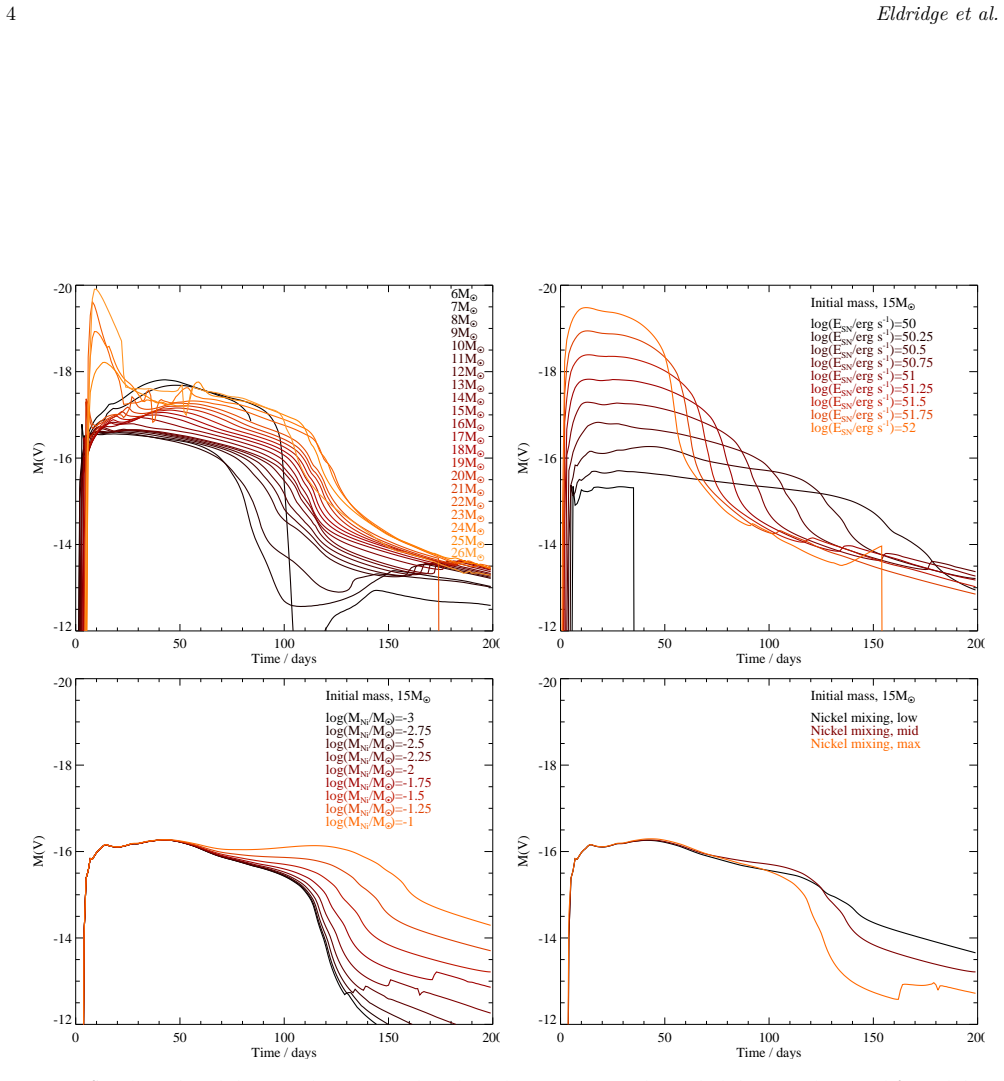
The load-bearing machinery is a grid of 5,346 synthetic V-band light curves computed by the SuperNova Explosion Code (SNEC) from single-star stellar models of the BPASS population synthesis, covering initial masses from 5 to 26 solar masses, explosion energies log(E_exp/ergs) from 50 to 52, nickel masses log(M_Ni/M_sun) from -3 to -1, and three nickel mixing prescriptions. Each observed light curve is fitted to every model by minimising $chi^{2}$, with the explosion epoch also searched and a fixed 0.25 magnitude model error added in quadrature to the photometric uncertainty. The best-fitting model assigns initial mass, explosion energy, nickel mass, mixing parameter and explosion date, with parameter uncertainties read off from the range of the $chi^{2}$ surface in each parameter.
What would settle it
Apply the same fitting grid to a larger sample of type IIP supernovae that have independent mass estimates from late-time nebular spectra or host stellar populations, avoiding any use of pre-explosion imaging. If the fitted masses systematically disagree with those independent estimates by more than the quoted uncertainties, the fixed 0.25 magnitude error is too small and the precision claim fails.
Extended reading notes
Core claim
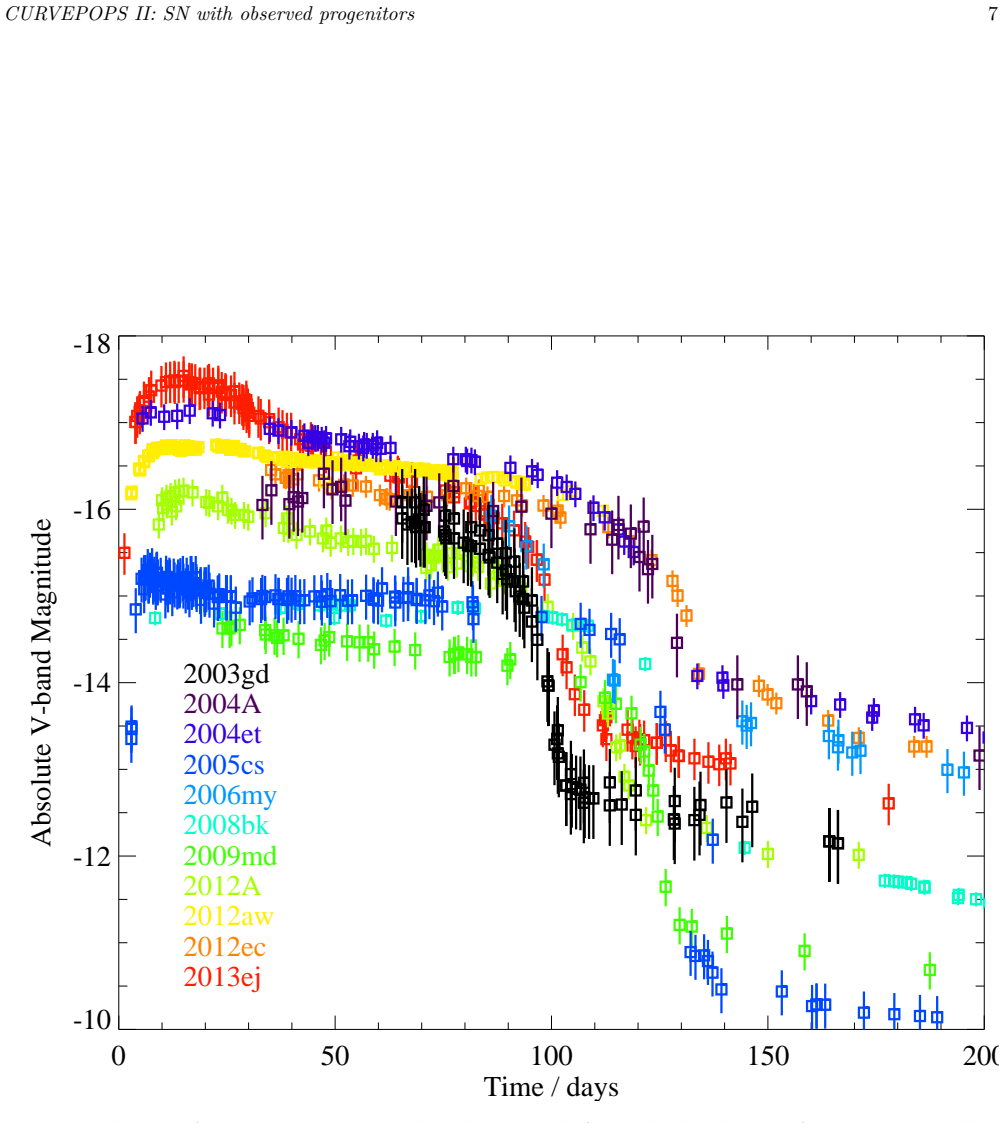
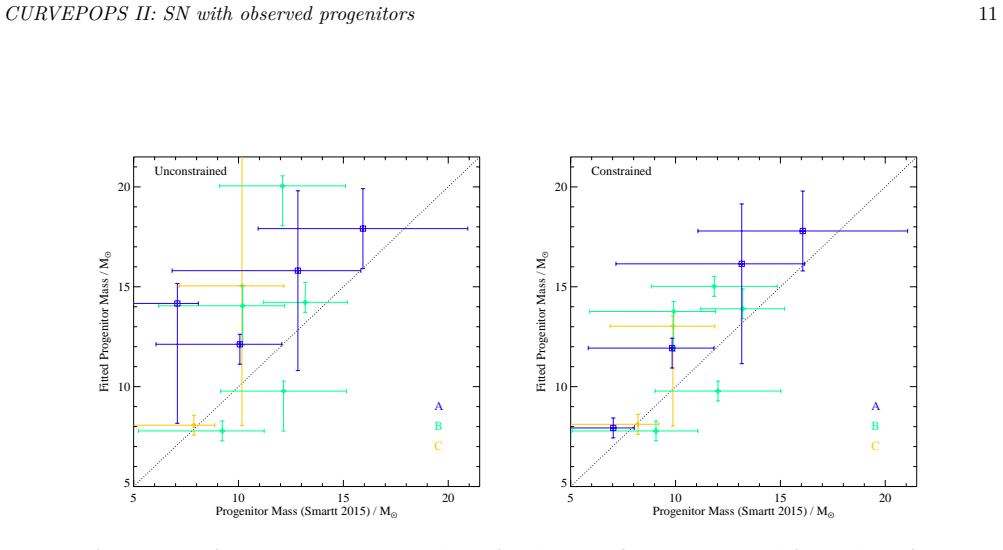
The paper's central claim is that light-curve fitting over a large grid of synthetic models recovers the initial progenitor mass and nickel-56 mass of type IIP supernovae with precision comparable to what is achieved by detecting and modelling the progenitor star in pre-explosion images. The validation is against eleven nearby supernovae with directly observed progenitors; nine of the eleven are well fitted and their derived parameters are consistent with the progenitor-imaging values within the quoted uncertainties. The paper also finds a typical explosion energy of log(E_exp/ergs)=50.52±0.10 for the group, no strong dependence of explosion energy on initial mass, and tentative indications that both nickel mass and nickel mixing depend on the initial progenitor mass. In short, the light curve itself is positioned as a usable probe of the progenitor, not just of the explosion.
Load-bearing premise
The load-bearing premise is that the synthetic light curves never deviate from the true light curve by more than the adopted 0.25 magnitude model error; if the real systematic errors from binary progenitors, differing metallicities, uncertain wind mass loss and the unmodelled final stellar evolution stages are larger, the quoted parameter uncertainties and the claimed precision are not justified.
Editorial extensions
If this is right
- A well fitted light curve by itself gives an initial progenitor mass that can stand in for a detected progenitor, extending mass measurements to supernovae beyond the local volume where the progenitor is resolvable.
- The narrow typical explosion energy, log(E_exp/ergs)=50.52±0.10, provides a quantitative prior for core-collapse explosion models.
- The tentative dependence of nickel mass on initial mass suggests a link from explosion nucleosynthesis to the pre-collapse carbon-oxygen core mass.
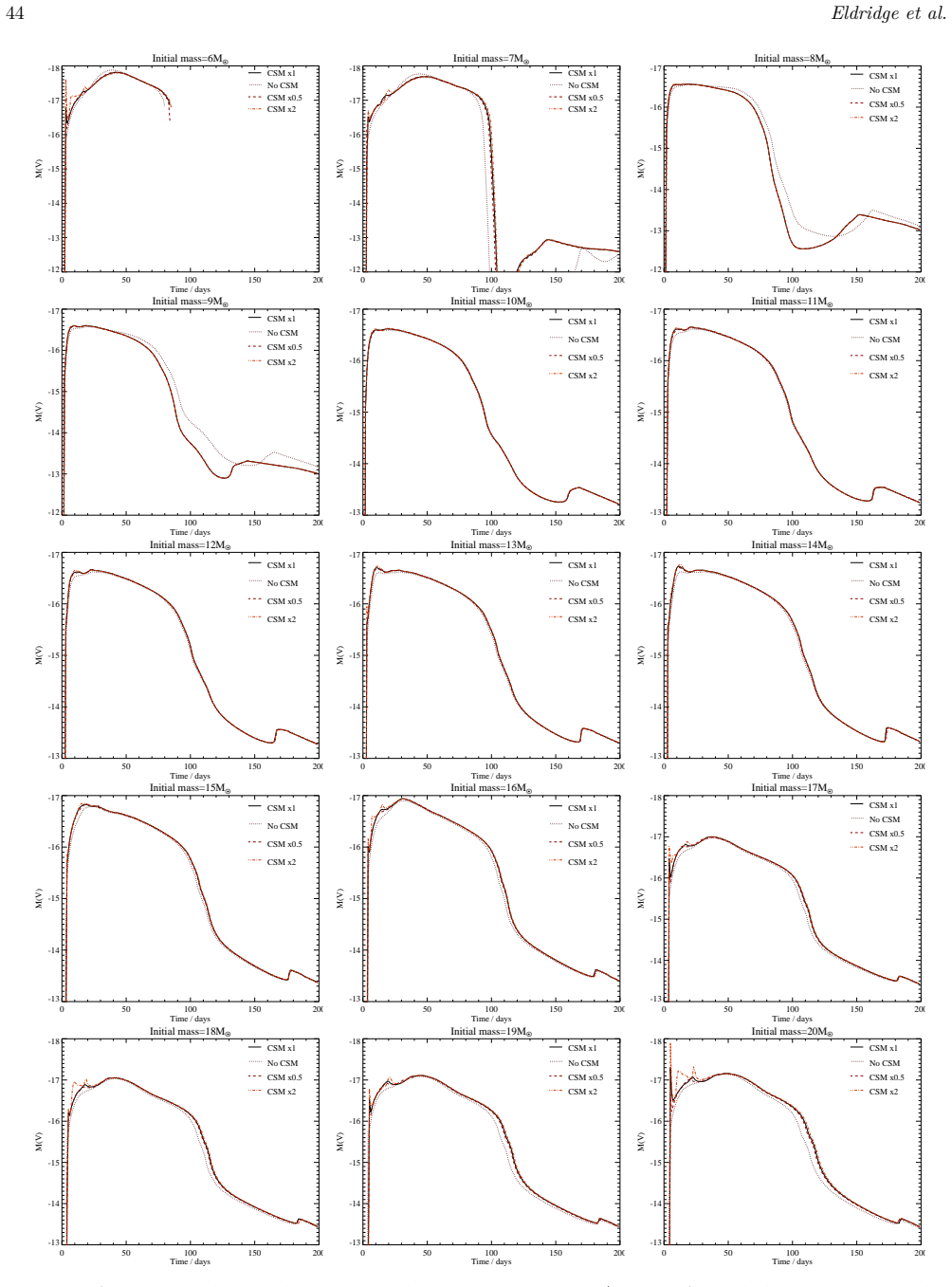
- Including a circumstellar medium tied to the red supergiant wind reproduces the early light-curve brightening without tuning wind parameters supernova by supernova.
- Two of the eleven supernovae are not well reproduced by any single-star model, marking a clear target for adding binary interactions or metallicity variations to the grid.
Reading between the lines
- If the precision holds in a larger sample, light-curve fitting can measure progenitor masses for type IIP supernovae at distances where photometry is possible but the progenitor is not resolvable, effectively enlarging the statistical sample of core-collapse progenitors by an order of magnitude.
- The mass-energy degeneracy the paper notes in the chi^2 surfaces might be broken by fitting the same grid to multi-band light curves, since the paper uses only V-band data; this is a testable extension of the same machinery.
- The 0.25 magnitude model error is a placeholder; re-deriving it by calibrating against supernovae with independent mass anchors would directly test whether the precision claim is robust to the model's known simplifications.
Signed reviews
Editorial analysis
A structured set of objections, weighed in public.
Referee Report
Summary. The paper presents a supernova lightcurve population synthesis (CURVEPOPS) validation study. The authors compute a grid of 5,346 SNEC supernova lightcurve models from BPASS single-star progenitors, varying initial mass (6-26 M_sun), explosion energy (log E = 50-52 in 0.25 dex steps), nickel mass (10^-3 to 10^-1 M_sun in 0.25 dex steps), and nickel mixing (three boundary fractions). They fit V-band lightcurves of 11 type IIP supernovae that have pre-explosion progenitor detections, using a chi-square statistic with a fixed 0.25 mag model error floor. They compare derived initial masses and nickel masses to progenitor-imaging and literature values, report a mean explosion energy of log(E/erg) = 50.52 +/- 0.10, and suggest correlations of nickel mass and mixing with initial mass. Two objects (SN2005cs, SN2006my) with poor (class C) fits are excluded from the quantitative analysis. The central claim is that, where a good fit is obtained, lightcurve fitting alone yields progenitor and nickel mass estimates with precision comparable to progenitor imaging.
Significance. If the central claim is established, this would be a valuable result: it would show that, for a subset of type IIP supernovae, lightcurve fitting can recover progenitor masses with precision comparable to pre-explosion imaging, and it would constrain the typical explosion energy of these events. The paper has clear strengths: the initial-mass validation against the independent Smartt (2015) progenitor-imaging sample is genuine and generally consistent; the public release of the SNEC input files and model lightcurves is a community resource; and the authors are transparent about many limitations (single-star only, fixed metallicity, coarse nickel-mixing grid, simplified bolometric corrections). However, the quantitative uncertainty estimates are built on an ad hoc and uncalibrated model error floor, the nickel-mass comparison is partly circular, and two of eleven objects are excluded from the population conclusions. These issues are load-bearing for the headline precision claim and must be addressed before the paper can be accepted.
major comments (4)
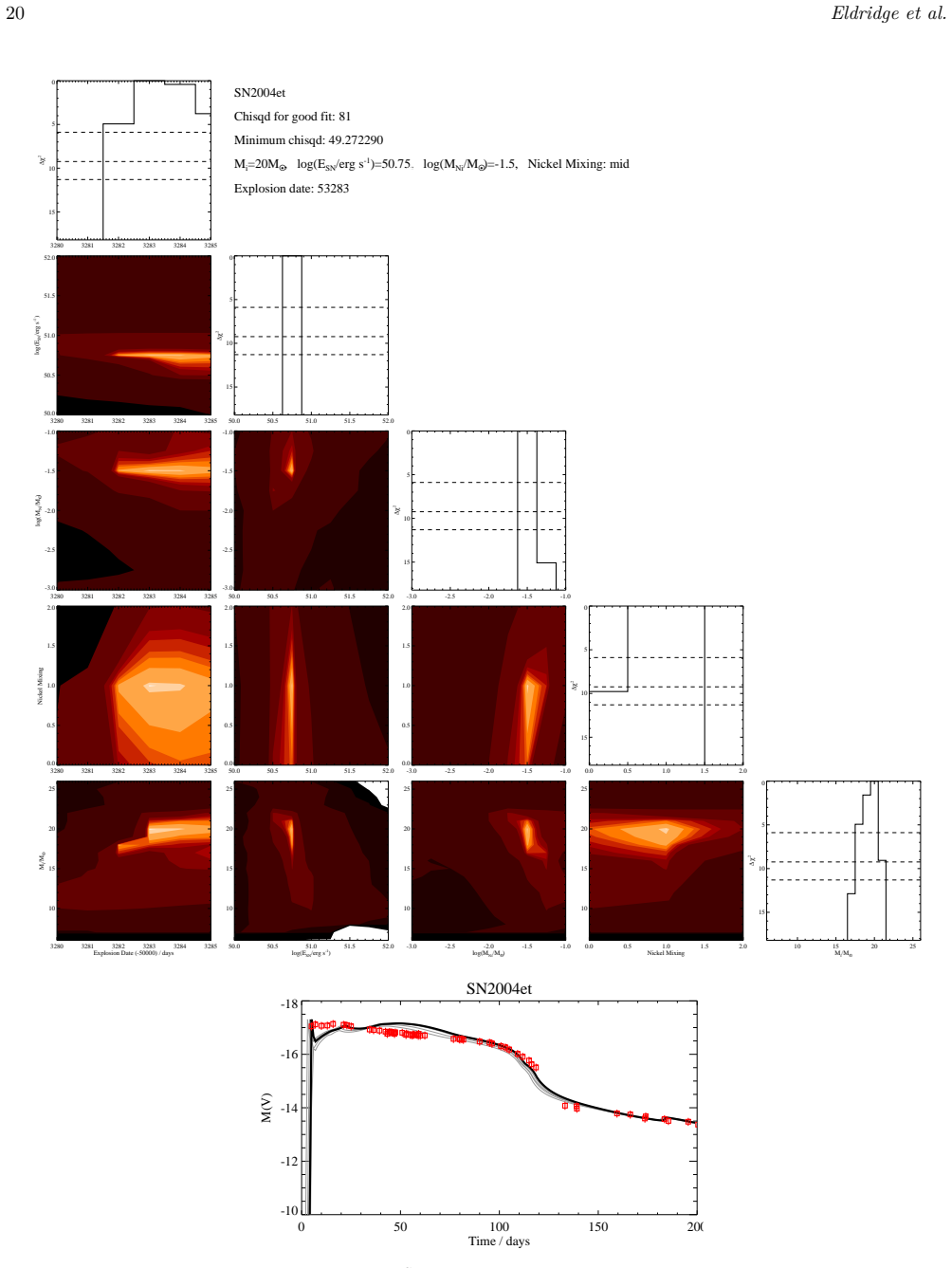
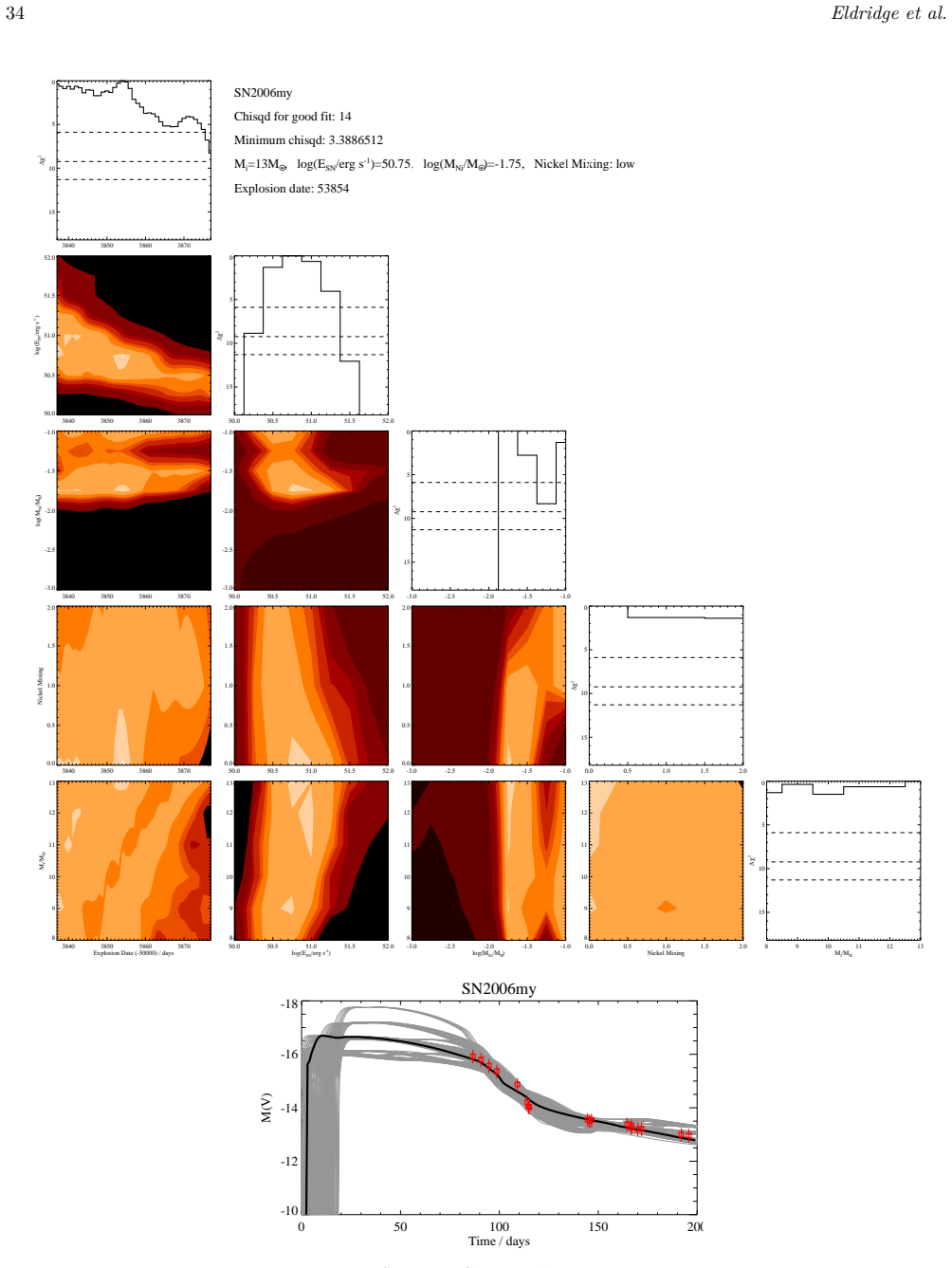
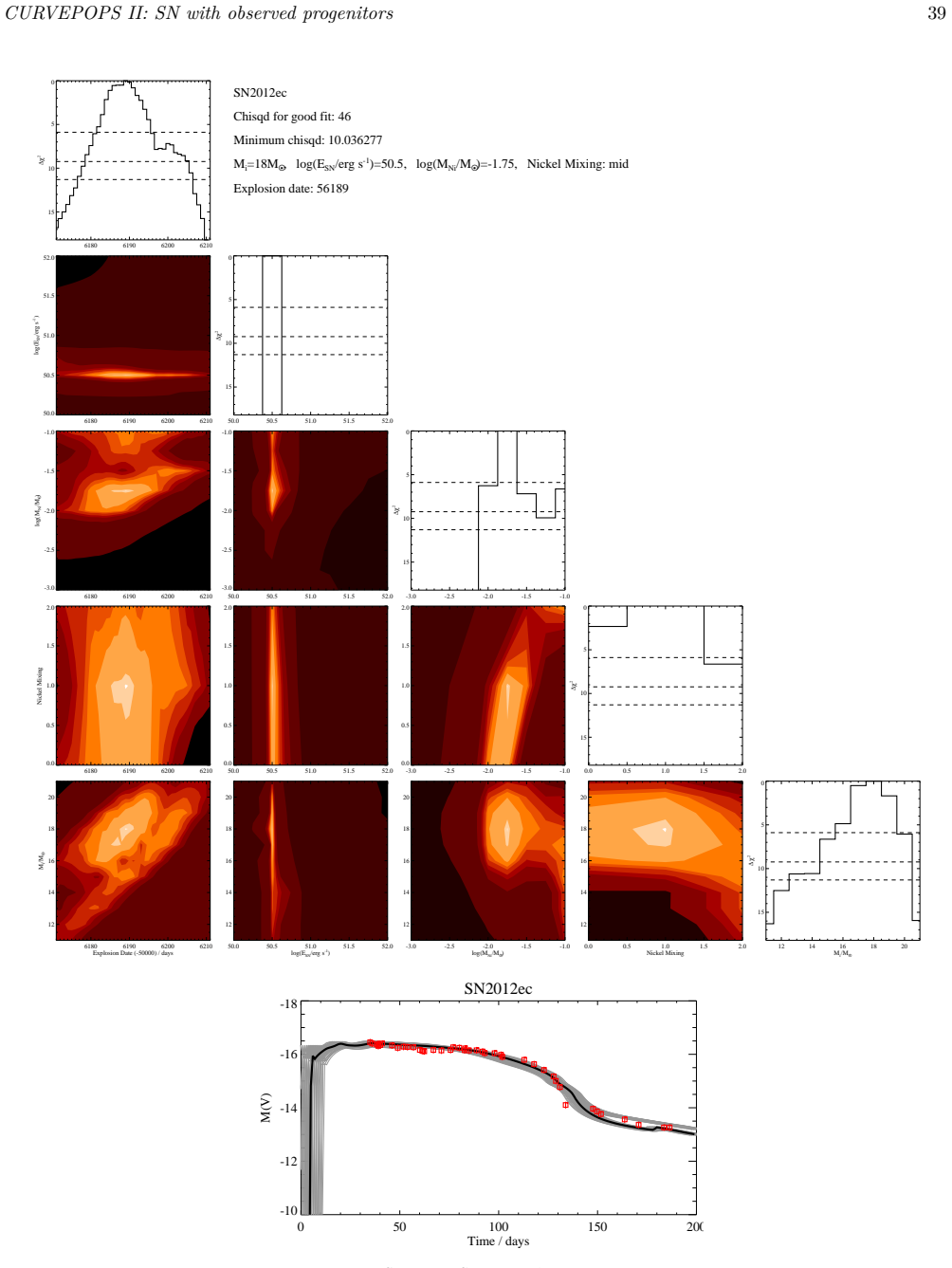
- [Sec. 4.2, Eq. (1)] The model error floor of 0.25 mag is introduced as 'half of the magnitude difference between models of successive explosion energies,' but no justification is given for why this represents a valid statistical error model for the residuals, nor why it should be added in quadrature as an independent Gaussian error. The resulting chi2_min values are far below N_obs for most objects (e.g., SN2003gd chi2_min=21.6 vs N_obs=93; SN2004A chi2_min=7.7 vs N_obs=39; SN2012ec chi2_min=10.0 vs N_obs=46), showing that the adopted sigma_tot dominates as a random-error term while the actual model deficiencies (end-of-plateau shape, early-time CSM features) are systematic and time-correlated. Because the quoted parameter uncertainties in Tables 2 and 3 are all derived from Delta(chi2)=5.89 contours using this sigma_tot, the claimed precision comparable to progenitor imaging is not underpinned by a validated error model. The authors should either calibrate the model error against the residuals of the best-fitting models or explicitly propagate the known systematic uncertainties (single-star assumption, fixed Z and beta, simplified bolometric corrections) into the parameter ranges. This is the central issue for the paper's headline claim.
- [Sec. 5 and Sec. 5.2.1] The quantitative conclusions, including the mean explosion energy log(E/erg)=50.52+/-0.10, exclude SN2005cs and SN2006my because their fits are classified as poor (C). SN2005cs, however, is one of the best-observed low-mass IIP supernovae and a canonical object for progenitor studies. The paper states that the poor fits indicate missing model physics, but it does not test how the mean explosion energy or the nickel-mass relation would change if these objects were included with plausible parameters (e.g., from the literature or from the mass-constrained fits). The abstract's phrase 'most of the type IIP supernovae' is based on at most 9 of 11 objects, and the sensitivity of the population conclusions to the excluded objects should be quantified.
- [Sec. 5.1 and Tables 2-3] The validation of the recovered nickel mass is partly circular. Many of the 'literature' nickel masses listed in Tables 2-3 are derived from lightcurve modeling with similar one-dimensional explosion-plus-radiation-transport assumptions, sometimes with the same kind of code (e.g., Hendry et al. 2005a, 2006; Smartt et al. 2009; Fraser et al. 2011; Tomasella et al. 2013; Dall'Ora et al. 2014; Bose et al. 2015). The agreement between 'This Work' and 'Literature' in Figure 5 is therefore not a fully independent check on the accuracy of the nickel mass recovery. The authors should explicitly separate which literature nickel masses are independent of lightcurve fitting (e.g., from late-time nebular spectroscopy, as in Jerkstrand et al. 2015b) and base the validation claim on that subset.
- [Sec. 5.2.1] The population statement 'most of the type IIP supernovae have an explosion energy of the order of log(E_exp/ergs)=50.52+/-0.10' does not specify the exact sample, weighting, or error propagation used. From Table 2, class A fits alone (SN2003gd, SN2004A, SN2012A, SN2012ec) give a mean near 50.56 with a small scatter, while including class B fits gives a mean near 50.53 but with a larger spread; the individual uncertainty bars are asymmetric and often comparable to the grid spacing. Because the per-object uncertainties from the Delta(chi2) method are unreliable (see the first major comment), the quoted +/-0.10 is not a robust measure of the uncertainty on the typical explosion energy. The authors should state the sample size, the sample standard deviation, and the standard error explicitly, and show how the result changes if class C objects are included.
minor comments (8)
- [Sec. 2] There are several typographical issues, including 'codeB PA S S' (missing spaces) and '1050.5erg s-1' in Figure 1 captions, which should read 10^50.5 erg (energy, not power); the same unit error appears in the grid definition in Section 2.
- [Eq. (1)] The summation notation is ambiguous; the expression should be written as sum over observed data points i of [(y_model(t_i) - y_obs,i)/sigma_tot]^2, with sigma_tot explicitly defined as the quadrature sum of the photometric error and the 0.25 mag model error.
- [Tables 2 and 3] Several table entries are garbled or hard to read, e.g., SN2006my's explosion energy appears as '50.751.13 -0.63' in Table 2, and SN2012aw's initial mass appears as '140.5-2' in Table 3; these need careful reformatting, especially for the asymmetric uncertainties.
- [Sec. 4.2] The sentence 'The first magnitude measurement of the SNe is not necessarily the explosion date' should refer to a single supernova ('the SN'), and the phrase 'the difference between minimum and maximum is larger than 10 days' could be restated as 'if the allowed explosion-date range exceeds 10 days.'
- [Sec. 5.1] The phrase 'directed in pre-explosion imaging' should be 'detected in pre-explosion imaging.'
- [Appendix A] The sentence 'we plot the best fitting model (black line) along with the lightcurves at are within the 1-sigma uncertainty in grey' contains a grammatical error and should read '...along with the lightcurves that are within the 1-sigma uncertainty in grey.'
- [Appendix C] The model identifier 'MESAv10398' should be written as 'MESA r10398.'
- [Sec. 6] The sentence about constrained and unconstrained fits appears to have the comparison reversed: the text says 'the scatter is less in the latter case' (the unconstrained case), but the constrained fits should have less scatter in mass; the wording should be clarified.
Circularity Check
No circular derivation: the fitted light-curve parameters are validated against independent pre-explosion progenitor imaging, and the self-citations are tool provenance rather than load-bearing circular support.
full rationale
The paper's central validation is genuinely external: unconstrained light-curve fits are compared with progenitor initial masses from Smartt (2015), which come from direct pre-explosion imaging, not from the authors' own models. The CURVEPOPS grid is built from BPASS single-star structures (Eldridge et al. 2017) exploded with the open-source SNEC code, and the fitted quantities (initial mass, explosion energy, nickel mass, nickel mixing) are read off the grid by minimum chi-square against observed light curves; they are not defined in terms of the comparison quantities. The mean explosion energy and the nickel-mass/initial-mass trend are summaries of the fitted grid values, not predictions derived from those same summaries. The fixed 0.25 mag model-error term in Eq. (1) is an a priori uncertainty assumption that affects the claimed precision, but it does not enter the derivation of the best-fit parameters themselves; this is a statistical-calibration concern rather than circularity. The paper's extensive self-citations (paper I, BPASS) supply the model grid and prior motivation, but the load-bearing validation step against Smartt (2015) is independent, so the central claim does not reduce to a self-citation chain. The nickel-mass comparison to literature values is weaker as an independent check because some literature nickel estimates are themselves light-curve-derived, but the paper's nickel fits are not constructed from those literature values, so this is an independence-of-validation caveat rather than a circular derivation step.
Assumptions & free parameters
free parameters (5)
- Model uncertainty sigma_model =
0.25 mag
- Nickel mixing boundary fractions =
0.1, 0.5, 0.9
- Explosion energy grid step =
0.25 dex
- Nickel mass grid step =
0.25 dex
- Initial mass grid step =
1 Msun
assumptions (5)
- domain assumption BPASS single-star models evolved to the end of core carbon burning are sufficiently close to core-collapse structure for lightcurve modeling.
- domain assumption Mass-loss rates from de Jager et al. (1988) and wind acceleration beta=5 describe the circumstellar medium around these progenitors.
- domain assumption All type IIP SNe in the sample arise from single-star progenitors with no significant binary interaction and metallicity Z=0.014.
- domain assumption SNEC's bolometric corrections to V-band magnitudes are adequate for fitting observed V-band lightcurves.
- domain assumption The observed V-band lightcurves assembled from the Open Supernova Catalog have accurate distances and extinctions.
Cite this review
Pith. "Pith review of Supernova lightCURVE POPulation Synthesis II: Validation against supernovae with an observed progenitor." pith.science (2026). https://pith.science/paper/6CUQOKHW
@misc{pith2026190807762,
  author       = {Pith},
  title        = {Pith review of: Supernova lightCURVE POPulation Synthesis II: Validation against supernovae with an observed progenitor},
  year         = {2026},
  howpublished = {\url{https://pith.science/paper/6CUQOKHW}},
  note         = {Machine review of arXiv:1908.07762}
}
read the original abstract
We use the results of a supernova light-curve population synthesis to predict the range of possible supernova light curves arising from a population of single-star progenitors that lead to type IIP supernovae. We calculate multiple models varying the initial mass, explosion energy, nickel mass and nickel mixing and then compare these to type IIP supernovae with detailed light curve data and pre-explosion imaging progenitor constraints. Where a good fit is obtained to observations, we are able to achieve initial progenitor and nickel mass estimates from the supernova lightcurve that are comparable in precision to those obtained from progenitor imaging. For two of the eleven IIP supernovae considered our fits are poor, indicating that more progenitor models should be included in our synthesis or that our assumptions, regarding factors such as stellar mass loss rates or the rapid final stages of stellar evolution, may need to be revisited in certain cases. Using the results of our analysis we are able to show that most of the type IIP supernovae have an explosion energy of the order of log(E_exp/ergs)=50.52+/-0.10 and that both the amount of nickel in the supernovae and the amount of mixing may have a dependence on initial progenitor mass.
Figures


Figures from the paper (32 more)








Reference graph
Works this paper leans on
-
[1]
Abbott B. P., et al., 2017, [ ] 10.3847/2041-8213/aa91c9 , http://adsabs.harvard.edu/abs/2017ApJ...848L..12A 848, L12
-
[2]
Anderson J. P., et al., 2014, [ ] 10.1088/0004-637X/786/1/67 , http://adsabs.harvard.edu/abs/2014ApJ...786...67A 786, 67
-
[3]
Beasor E. R., Davies B., 2018, [ ] 10.1093/mnras/stx3174 , http://adsabs.harvard.edu/abs/2018MNRAS.475...55B 475, 55
-
[4]
Bersten M. C., Benvenuto O., Hamuy M., 2011, [ ] 10.1088/0004-637X/729/1/61 , http://adsabs.harvard.edu/abs/2011ApJ...729...61B 729, 61
-
[5]
Bersten M. C., et al., 2012, [ ] 10.1088/0004-637X/757/1/31 , http://adsabs.harvard.edu/abs/2012ApJ...757...31B 757, 31
-
[6]
Bersten M. C., et al., 2014, [ ] 10.1088/0004-6256/148/4/68 , http://adsabs.harvard.edu/abs/2014AJ....148...68B 148, 68
-
[7]
Bose S., Kumar B., 2013, [Proceedings of the International Astronomical Union] 10.1017/S1743921313009289 , 9, 90–94
-
[8]
Bose S., et al., 2013, [ ] 10.1093/mnras/stt864 , http://adsabs.harvard.edu/abs/2013MNRAS.433.1871B 433, 1871
Show all 72 references
-
[9]
Bose S., et al., 2015, [ ] 10.1088/0004-637X/806/2/160 , http://adsabs.harvard.edu/abs/2015ApJ...806..160B 806, 160
2015 doi
-
[10]
A., Fransson C., Nymark T
Chevalier R. A., Fransson C., Nymark T. K., 2006, [ ] 10.1086/500528 , http://adsabs.harvard.edu/abs/2006ApJ...641.1029C 641, 1029
2006 doi
-
[12]
Dall'Ora M., et al., 2014, [ ] 10.1088/0004-637X/787/2/139 , http://adsabs.harvard.edu/abs/2014ApJ...787..139D 787, 139
2014 doi
-
[13]
R., 2018, [ ] 10.1093/mnras/stx2734 , http://adsabs.harvard.edu/abs/2018MNRAS.474.2116D 474, 2116
Davies B., Beasor E. R., 2018, [ ] 10.1093/mnras/stx2734 , http://adsabs.harvard.edu/abs/2018MNRAS.474.2116D 474, 2116
2018 doi
-
[14]
J., 2019, [ ] 10.1051/0004-6361/201834732 , http://adsabs.harvard.edu/abs/2019A
Dessart L., Hillier D. J., 2019, [ ] 10.1051/0004-6361/201834732 , http://adsabs.harvard.edu/abs/2019A
2019 doi
-
[17]
J., Waldman R., Livne E., 2013, [ ] 10.1093/mnras/stt861 , http://adsabs.harvard.edu/abs/2013MNRAS.433.1745D 433, 1745
Dessart L., Hillier D. J., Waldman R., Livne E., 2013, [ ] 10.1093/mnras/stt861 , http://adsabs.harvard.edu/abs/2013MNRAS.433.1745D 433, 1745
2013 doi
-
[18]
Dessart L., et al., 2014, [ ] 10.1093/mnras/stu417 , http://adsabs.harvard.edu/abs/2014MNRAS.440.1856D 440, 1856
2014 doi
-
[19]
J., Woosley S., Livne E., Waldman R., Yoon S.-C., Langer N., 2016, [ ] 10.1093/mnras/stw418 , http://adsabs.harvard.edu/abs/2016MNRAS.458.1618D 458, 1618
Dessart L., Hillier D. J., Woosley S., Livne E., Waldman R., Yoon S.-C., Langer N., 2016, [ ] 10.1093/mnras/stw418 , http://adsabs.harvard.edu/abs/2016MNRAS.458.1618D 458, 1618
2016 doi
-
[21]
J., Stanway E
Eldridge J. J., Stanway E. R., Xiao L., McClelland L. A. S., Taylor G., Ng M., Greis S. M. L., Bray J. C., 2017, [ ] 10.1017/pasa.2017.51 , http://adsabs.harvard.edu/abs/2017PASA...34...58E 34, e058
2017 doi
-
[22]
H., 2003, , http://adsabs.harvard.edu/abs/2003IAUC.8150....2E 8150
Evans R., McNaught R. H., 2003, , http://adsabs.harvard.edu/abs/2003IAUC.8150....2E 8150
2003
-
[23]
Faran T., et al., 2014, [ ] 10.1093/mnras/stu955 , http://adsabs.harvard.edu/abs/2014MNRAS.442..844F 442, 844
2014 doi
-
[24]
Fraser M., et al., 2011, [ ] 10.1111/j.1365-2966.2011.19370.x , http://adsabs.harvard.edu/abs/2011MNRAS.417.1417F 417, 1417
2011
-
[25]
Fraser M., et al., 2014, [ ] 10.1093/mnrasl/slt179 , http://adsabs.harvard.edu/abs/2014MNRAS.439L..56F 439, L56
2014 doi
-
[26]
Galbany L., et al., 2016, [ ] 10.3847/0004-6256/151/2/33 , http://adsabs.harvard.edu/abs/2016AJ....151...33G 151, 33
2016 doi
-
[27]
Garnavich P., Bass E., 2003, , http://adsabs.harvard.edu/abs/2003IAUC.8163....3G 8163
2003
-
[28]
A., Bildsten L., Paxton B., 2019, arXiv e-prints, http://adsabs.harvard.edu/abs/2019arXiv190309114G
Goldberg J. A., Bildsten L., Paxton B., 2019, arXiv e-prints, http://adsabs.harvard.edu/abs/2019arXiv190309114G
2019
-
[29]
S., 2016, [ ] 10.1093/mnras/stv2283 , http://adsabs.harvard.edu/abs/2016MNRAS.455..112G 455, 112
Gr \"a fener G., Vink J. S., 2016, [ ] 10.1093/mnras/stv2283 , http://adsabs.harvard.edu/abs/2016MNRAS.455..112G 455, 112
2016 doi
-
[30]
Z., Margutti R., 2017, [ ] 10.3847/1538-4357/835/1/64 , http://adsabs.harvard.edu/abs/2017ApJ...835...64G 835, 64
Guillochon J., Parrent J., Kelley L. Z., Margutti R., 2017, [ ] 10.3847/1538-4357/835/1/64 , http://adsabs.harvard.edu/abs/2017ApJ...835...64G 835, 64
2017 doi
-
[32]
A., et al., 2005b, [Monthly Notices of the Royal Astronomical Society] 10.1111/j.1365-2966.2005.08928.x , 359, 906
Hendry M. A., et al., 2005b, [Monthly Notices of the Royal Astronomical Society] 10.1111/j.1365-2966.2005.08928.x , 359, 906
2005
-
[33]
A., et al., 2006, [ ] 10.1111/j.1365-2966.2006.10374.x , http://adsabs.harvard.edu/abs/2006MNRAS.369.1303H 369, 1303
Hendry M. A., et al., 2006, [ ] 10.1111/j.1365-2966.2006.10374.x , http://adsabs.harvard.edu/abs/2006MNRAS.369.1303H 369, 1303
2006
-
[34]
Huang F., et al., 2015, [ ] 10.1088/0004-637X/807/1/59 , http://adsabs.harvard.edu/abs/2015ApJ...807...59H 807, 59
2015 doi
-
[36]
Jerkstrand A., et al., 2015b, [ ] 10.1093/mnras/stv087 , http://adsabs.harvard.edu/abs/2015MNRAS.448.2482J 448, 2482
-
[37]
Li L.-X., Paczy \'n ski B., 1998, [ ] 10.1086/311680 , http://adsabs.harvard.edu/abs/1998ApJ...507L..59L 507, L59
1998 doi
-
[38]
A., Szabo M., Martignoni M., Stanishev V., Pursimo T., 2012, Central Bureau Electronic Telegrams, http://adsabs.harvard.edu/abs/2012CBET.2974....2L 2974
Luppi F., Yusa T., Koff R. A., Szabo M., Martignoni M., Stanishev V., Pursimo T., 2012, Central Bureau Electronic Telegrams, http://adsabs.harvard.edu/abs/2012CBET.2974....2L 2974
2012
-
[39]
Maguire K., et al., 2010, [ ] 10.1111/j.1365-2966.2010.16332.x , http://adsabs.harvard.edu/abs/2010MNRAS.404..981M 404, 981
2010
-
[40]
Mart \' nez L., Bersten M., 2018, Boletin de la Asociacion Argentina de Astronomia La Plata Argentina, https://ui.adsabs.harvard.edu/abs/2018BAAA...60...23M 60, 23
2018
-
[41]
Mart \' nez L., Bersten M., 2019, MNRAS in press
2019
-
[42]
R., 2017, [ ] 10.1093/mnras/stx879 , http://adsabs.harvard.edu/abs/2017MNRAS.469.2202M 469, 2202
Maund J. R., 2017, [ ] 10.1093/mnras/stx879 , http://adsabs.harvard.edu/abs/2017MNRAS.469.2202M 469, 2202
2017 doi
-
[43]
R., et al., 2013, [ ] 10.1093/mnrasl/slt017 , http://adsabs.harvard.edu/abs/2013MNRAS.431L.102M 431, L102
Maund J. R., et al., 2013, [ ] 10.1093/mnrasl/slt017 , http://adsabs.harvard.edu/abs/2013MNRAS.431L.102M 431, L102
2013 doi
-
[44]
R., Reilly E., Mattila S., 2014, [ ] 10.1093/mnras/stt2131 , http://adsabs.harvard.edu/abs/2014MNRAS.438..938M 438, 938
Maund J. R., Reilly E., Mattila S., 2014, [ ] 10.1093/mnras/stt2131 , http://adsabs.harvard.edu/abs/2014MNRAS.438..938M 438, 938
2014 doi
-
[45]
Mauron N., Josselin E., 2011, [ ] 10.1051/0004-6361/201013993 , http://adsabs.harvard.edu/abs/2011A
2011 doi
-
[46]
o rster F., Yoon S.-C., Gr \
Moriya T. J., F \"o rster F., Yoon S.-C., Gr \"a fener G., Blinnikov S. I., 2018, [ ] 10.1093/mnras/sty475 , http://adsabs.harvard.edu/abs/2018MNRAS.476.2840M 476, 2840
2018 doi
-
[47]
L., Renzo M., Ott C
Morozova V., Piro A. L., Renzo M., Ott C. D., Clausen D., Couch S. M., Ellis J., Roberts L. F., 2015, [ ] 10.1088/0004-637X/814/1/63 , http://adsabs.harvard.edu/abs/2015ApJ...814...63M 814, 63
2015 doi
-
[48]
L., Renzo M., Ott C
Morozova V., Piro A. L., Renzo M., Ott C. D., 2016, [ ] 10.3847/0004-637X/829/2/109 , http://adsabs.harvard.edu/abs/2016ApJ...829..109M 829, 109
2016 doi
-
[49]
L., Valenti S., 2017, [ ] 10.3847/1538-4357/aa6251 , http://adsabs.harvard.edu/abs/2017ApJ...838...28M 838, 28
Morozova V., Piro A. L., Valenti S., 2017, [ ] 10.3847/1538-4357/aa6251 , http://adsabs.harvard.edu/abs/2017ApJ...838...28M 838, 28
2017 doi
-
[50]
L., Valenti S., 2018, [ ] 10.3847/1538-4357/aab9a6 , http://adsabs.harvard.edu/abs/2018ApJ...858...15M 858, 15
Morozova V., Piro A. L., Valenti S., 2018, [ ] 10.3847/1538-4357/aab9a6 , http://adsabs.harvard.edu/abs/2018ApJ...858...15M 858, 15
2018 doi
-
[51]
Muendlein R., Li W., Yamaoka H., Itagaki K., 2005, , http://adsabs.harvard.edu/abs/2005IAUC.8553....1M 8553
2005
-
[52]
Nakano S., Itagaki K., 2006, Central Bureau Electronic Telegrams, http://adsabs.harvard.edu/abs/2006CBET..727....1N 727
2006
-
[53]
Nieva M.-F., Przybilla N., 2012, [ ] 10.1051/0004-6361/201118158 , http://adsabs.harvard.edu/abs/2012A
2012 doi
-
[54]
Ohnaka K., Weigelt G., Hofmann K.-H., 2017, [ ] 10.1038/nature23445 , http://adsabs.harvard.edu/abs/2017Natur.548..310O 548, 310
2017 doi
-
[56]
Paxton B., Bildsten L., Dotter A., Herwig F., Lesaffre P., Timmes F., 2011, [ ] 10.1088/0067-0049/192/1/3 , http://adsabs.harvard.edu/abs/2011ApJS..192....3P 192, 3
2011 doi
-
[57]
Paxton B., et al., 2013, [ ] 10.1088/0067-0049/208/1/4 , http://adsabs.harvard.edu/abs/2013ApJS..208....4P 208, 4
2013 doi
-
[58]
Paxton B., et al., 2015, [ ] 10.1088/0067-0049/220/1/15 , http://adsabs.harvard.edu/abs/2015ApJS..220...15P 220, 15
2015 doi
-
[59]
Paxton B., et al., 2018, [ ] 10.3847/1538-4365/aaa5a8 , http://adsabs.harvard.edu/abs/2018ApJS..234...34P 234, 34
2018 doi
-
[60]
Schroeder K.-P., 1985, , http://adsabs.harvard.edu/abs/1985A
1985
-
[61]
J., 2015, [ ] 10.1017/pasa.2015.17 , http://adsabs.harvard.edu/abs/2015PASA...32...16S 32, e016
Smartt S. J., 2015, [ ] 10.1017/pasa.2015.17 , http://adsabs.harvard.edu/abs/2015PASA...32...16S 32, e016
2015 doi
-
[62]
J., Eldridge J
Smartt S. J., Eldridge J. J., Crockett R. M., Maund J. R., 2009, [ ] 10.1111/j.1365-2966.2009.14506.x , http://adsabs.harvard.edu/abs/2009MNRAS.395.1409S 395, 1409
2009
-
[63]
J., et al., 2015, [ ] 10.1051/0004-6361/201425237 , http://adsabs.harvard.edu/abs/2015A
Smartt S. J., et al., 2015, [ ] 10.1051/0004-6361/201425237 , http://adsabs.harvard.edu/abs/2015A
2015 doi
-
[64]
R., Levan A
Tanvir N. R., Levan A. J., Fruchter A. S., Hjorth J., Hounsell R. A., Wiersema K., Tunnicliffe R. L., 2013, [ ] 10.1038/nature12505 , http://adsabs.harvard.edu/abs/2013Natur.500..547T 500, 547
2013 doi
-
[65]
Tomasella L., et al., 2013, [ ] 10.1093/mnras/stt1130 , http://adsabs.harvard.edu/abs/2013MNRAS.434.1636T 434, 1636
2013 doi
-
[66]
Y., 2008
Tsvetkov D. Y., 2008
2008
-
[67]
Utrobin V., 1994, , http://adsabs.harvard.edu/abs/1994A
1994
-
[68]
P., 2005, [Astronomy Letters] 10.1134/1.2138767 , http://adsabs.harvard.edu/abs/2005AstL...31..806U 31, 806
Utrobin V. P., 2005, [Astronomy Letters] 10.1134/1.2138767 , http://adsabs.harvard.edu/abs/2005AstL...31..806U 31, 806
2005 doi
-
[69]
P., 2007, [ ] 10.1051/0004-6361:20066078 , http://adsabs.harvard.edu/abs/2007A
Utrobin V. P., 2007, [ ] 10.1051/0004-6361:20066078 , http://adsabs.harvard.edu/abs/2007A
2007 doi
-
[70]
P., Chugai N
Utrobin V. P., Chugai N. N., 2008, [ ] 10.1051/0004-6361:200810272 , http://adsabs.harvard.edu/abs/2008A
2008 doi
-
[71]
P., Chugai N
Utrobin V. P., Chugai N. N., 2009, [ ] 10.1051/0004-6361/200912273 , http://adsabs.harvard.edu/abs/2009A
2009 doi
-
[72]
D., Li W., Filippenko A
Van Dyk S. D., Li W., Filippenko A. V., 2003, [ ] 10.1086/378308 , http://adsabs.harvard.edu/abs/2003PASP..115.1289V 115, 1289
2003 doi
-
[73]
D., et al., 2012, [ ] 10.1088/0004-6256/143/1/19 , http://adsabs.harvard.edu/abs/2012AJ....143...19V 143, 19
Van Dyk S. D., et al., 2012, [ ] 10.1088/0004-6256/143/1/19 , http://adsabs.harvard.edu/abs/2012AJ....143...19V 143, 19
2012 doi
-
[74]
Wenger M., et al., 2000, [ ] 10.1051/aas:2000332 , http://adsabs.harvard.edu/abs/2000A
2000 doi
-
[75]
J., Stanway E
Xiao L., Galbany L., Eldridge J. J., Stanway E. R., 2018, preprint, http://adsabs.harvard.edu/abs/2018arXiv180501213X ( @eprint arXiv 1805.01213 )
2018 arXiv
-
[76]
Yuan F., et al., 2016, [ ] 10.1093/mnras/stw1419 , http://adsabs.harvard.edu/abs/2016MNRAS.461.2003Y 461, 2003
2016 doi
-
[77]
Zwitter T., Munari U., Moretti S., 2004, , http://adsabs.harvard.edu/abs/2004IAUC.8413....1Z 8413
2004
-
[78]
A., 1988, , http://adsabs.harvard.edu/abs/1988A
de Jager C., Nieuwenhuijzen H., van der Hucht K. A., 1988, , http://adsabs.harvard.edu/abs/1988A
1988
-
[79]
write newline
" write newline "" before.all 'output.state := FUNCTION fin.entry write newline FUNCTION new.block output.state before.all = 'skip after.block 'output.state := if FUNCTION new.sentence output.state after.block = 'skip output.state before.all = 'skip after.sentence 'output.stat...
Reviewed August 14, 2026 · model on record in the stance chip above.
Discussion (0). Continue with ORCID to comment.