REVIEW 4 major objections 4 minor 36 references
Event-Triggered Output Synchronization of Heterogeneous Nonlinear Multi-Agents
T0 review · 4 major / 4 minor · reviewed 2026-08-14 · deepseek-v4-flash
Pith's one-line read Under Assumptions 1–6, the paper's two-step design achieves asymptotic output synchronization with Zeno-free event triggering and no continuous monitoring.
desk verdict Real extension and plausible two-step design, but the Zeno-free claim for the perturbed regulation half rests on an unproven transfer from an unpublished companion paper. read the letter →
The pith
A machine-rendered reading of the paper's core claim, the machinery that carries it, and where it could break.
The reading
What carries the argument
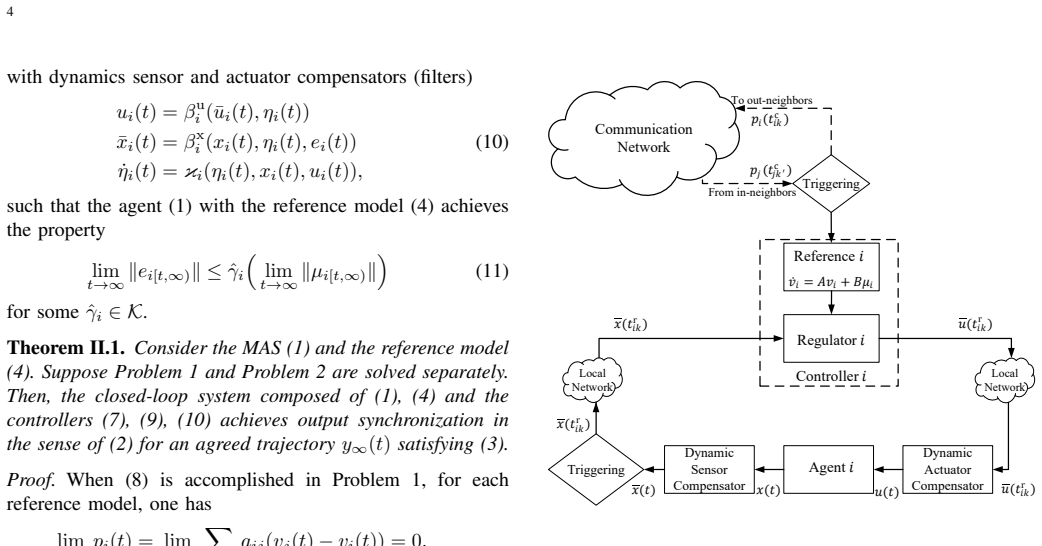
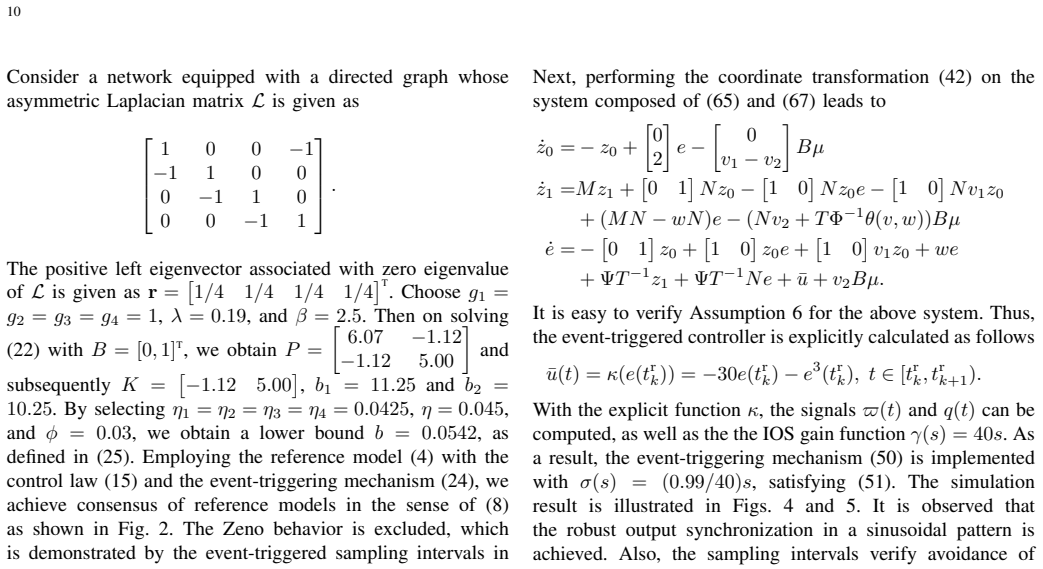
The carrying object is the two-step composition of an event-triggered consensus law for the reference models and an event-triggered perturbed output regulation law for each agent. In the consensus step, the central identity is the transformed error $p=-(L\otimes I_q)v$ with Lyapunov function $V(p)=\tfrac12 p^T(GR\otimes P)p$; Lemma III.1 supplies a weighted Laplacian estimate that handles the asymmetry of a directed graph through the left eigenvector $r$, and the controller gains come from the Riccati equation (22). The event rule (24) compares each agent's hold-error $\epsilon_i$ with the local consensus error $p_i$, and the fixed timer $b$ in (25) supplies the minimum inter-event interval. In the regulation step, the central object is the perturbed closed loop $\dot\xi=f_c(\xi,\nu)+E(w)\varpi+\bar\mu$ with dynamic actuator and sensor compensators, and the triggering rule (50) compares the holding error $\varpi$ with the rate signal $q=d\kappa(\bar x)/dt$; the IOS gain $\gamma$ is used to choose $\sigma$ so that $\gamma(\sigma(s))=cs$ with $c<1$, which is the contraction that turns a practical bound into an asymptotic one. Together these two mechanisms produce the synchronization result with no continuous monitoring.
What would settle it
Construct or simulate a single nonlinear agent satisfying Assumptions 3–6 whose event rule (50) is driven by a bounded but persistent $\mu$ (for example, a small sinusoid), and measure the inter-event intervals. If the intervals have no positive lower bound, or if the output error fails to converge to zero with $\mu$ present, the central claim fails; the numerical example in Section V is the natural place to run this test.
Extended reading notes
Core claim
The central claim is that output synchronization in the sense of $\lim_{t\to\infty}\|y_i(t)-y_\infty(t)\|=0$ holds for all agents when each agent runs two independent event-triggered mechanisms. In the first step, each agent maintains a linear reference model $\dot v_i=Av_i+B\mu_i$; the sampled controller $\mu_i(t)=g_iKp_i(t^c_{ik})$ with $K=B^TP$ drives the reference models to consensus, and the triggering instants satisfy $t^c_{i,k+1}\ge t^c_{ik}+b$ for an explicit positive constant $b$, under a strongly connected directed graph and a Riccati equation $PA+A^TP-\lambda PBB^TP+\beta I=0$. In the second step, each agent uses an event-triggered output regulation controller $\bar u_i(t)=\kappa_i(\bar x_i(t^r_{ik}))$ built from dynamic actuator and sensor compensators; the closed loop is input-to-state stable from the holding error and from the reference-model input $\mu_i$, and the triggering rule (50) uses the IOS gain to enforce $\gamma(\sigma(s))=cs$ with $c<1$, which makes the asymptotic error satisfy $\lim_{t\to\infty}\|e_i[t,\infty)\|\le\hat\gamma_i(\lim_{t\to\infty}\|\mu_i[t,\infty)\|)$. Since the first step drives $\mu_i$ to zero, the second step drives $e_i=y_i-c(v_i)$ to zero, and the composition yields output synchronization. The proof also provides the explicit event-time lower bound (35) for the consensus step and refers to the companion paper for the Zeno-free proof of the regulation step.
Load-bearing premise
The entire regulation step assumes that the companion paper [32] has already produced a smooth event-triggered controller making the unperturbed closed loop ISS/IOS with locally Lipschitz gain, and that its Zeno-exclusion proof remains valid when the perturbation $\bar\mu$ is present; the present paper defers that proof and says the details are ignored.
Editorial extensions
If this is right
- Each agent's two triggering sequences are independent, so the consensus events and regulation events can be scheduled separately without a shared clock.
- The minimum inter-event interval in the consensus step is at least the explicit constant $b$ in (25), so infinite triggering in finite time cannot occur.
- The output error converges to zero asymptotically, not just to a prescribed ball, even though the agents are nonlinear and uncertain and the network is directed.
- The design weakens the usual ISS requirement from sensor-to-state to actuator-to-state, which is easier to satisfy for nonlinear systems.
- The method extends the fixed-timer event-triggered/sampled-data consensus approach from undirected to directed strongly connected networks.
Reading between the lines
- The paper leaves open whether the two event clocks can be implemented on separate processors with different triggering laws; because each agent's design is decoupled, a natural test is to run the consensus step with a fixed timer and the regulation step with the event rule (50), or vice versa.
- The lower bound $b$ depends on global quantities such as the largest eigenvalue of $LG$ and the second-smallest eigenvalue of $\hat L$; a distributed extension would estimate these quantities locally, and the proof suggests the bound would degrade gracefully but this is not shown.
- If the companion paper's Zeno-exclusion proof does not survive the extra perturbation $\bar\mu$, the asymptotic claim would collapse to practical synchronization with a residual error; injecting a small persistent sinusoidal $\mu$ into the Section V example would test exactly that.
Signed reviews
Editorial analysis
A structured set of objections, weighed in public.
Referee Report
Summary. The paper addresses output synchronization of heterogeneous nonlinear multi-agent systems under directed communication graphs using a two-step event-triggered design. In Problem 1, linear reference models are driven to consensus by an event-triggered controller with an explicit minimum inter-event interval; in Problem 2, each nonlinear agent solves an event-triggered perturbed output regulation problem using an ISS/IOS construction, and the two problems are combined in Theorem II.1 to yield asymptotic output synchronization with Zeno behavior excluded. The main technical contents are Theorem III.1 for consensus of the reference models and Theorem IV.1 for perturbed output regulation, the latter relying substantially on the authors' companion manuscript [32].
Significance. The two-step decomposition in Theorem II.1 is clean, and Problem 1 is a meaningful contribution: it gives an explicit event-triggering rule for general linear reference models on a directed graph with a positive lower bound on inter-event times, extending earlier undirected-graph results. The numerical example demonstrates the design. If the gaps identified below are repaired, the paper would provide a useful framework for event-triggered output synchronization of heterogeneous nonlinear multi-agents without continuous neighbor monitoring and with a milder actuator-disturbance ISS condition. As it stands, however, the central nonlinear claim is not self-contained and the Zeno-free proof for the perturbed case has a concrete technical gap.
major comments (4)
- [Lemma III.2 / Eq. (20)] The triggering interval τ_ik in (20) is defined through the future signal w_i(τ) = ‖BB^T P ∑_{j∈N_i} a_ij g_j p_j^c(τ)‖ over the future interval τ ∈ [t_ik^c, t_ik^c + t]. Since p_j^c(τ) is the piecewise-constant broadcast value of neighbor j and can change at neighbor triggering instants inside that interval, agent i cannot compute τ_ik at time t_ik^c from information available to it. Thus the rule (24) is not a causal event-triggering law, and the claim in Problem 1 that continuous monitoring is avoided is not supported. The authors need to replace τ_ik by a computable self-triggered bound using only currently available broadcast data, or add and prove an assumption on future neighbor behavior.
- [Lemma III.2] The proof of Lemma III.2 contains a circular step. From the differential inequality d/dt‖ϵ_i(t)‖ ≤ ‖A‖‖ϵ_i(t)‖ + w_ik + w_i(t), the paper concludes ‖ϵ_i(t)‖ ≤ s_ik by comparing with the integral in (20). However, (20) uses the constant s_ik inside the integral, whereas the differential inequality contains ‖ϵ_i(τ)‖. The step therefore presupposes the bound ‖ϵ_i(τ)‖ ≤ s_ik on the whole interval, which is exactly what is being proved. A bootstrap or comparison argument is needed to establish the bound; without it, the key inequality (21) and the subsequent lower bound (35) are not rigorously justified.
- [Theorem IV.1] The core of Problem 2 is delegated to the authors' unpublished submitted manuscript [32]. The existence of the smooth function κ, the ISS/IOS estimates (49), the local Lipschitz property of γ, and the Zeno-exclusion proof are all asserted by reference to [32], with only a brief statement that κ can be constructed 'following the recursive technique given in [1]'. Since Theorem IV.1 is the load-bearing component of the output-synchronization claim, the paper is not self-contained. The authors should provide complete proofs of (49), of the local Lipschitz property, and of the Zeno-free property for the perturbed system, or replace [32] by a published reference whose stated results can be verified.
- [Eq. (50) / Eq. (55) / Zeno proof] The claim that the event rule (50) guarantees ‖ϖ(t)‖ ≤ σ(‖q(t)‖) for all t between events is not valid in the present closed loop. In (47), q(t) = dκ(\bar{x}(t))/dt inherits the argument \bar{µ}, which contains the consensus input µ(t) from Problem 1; µ is piecewise constant and jumps at the consensus event times of Theorem III.1, so q(t) can jump downward at those instants. The signal ϖ(t), being the integral of −q, is continuous. Immediately after such a downward jump of σ(‖q(t)‖), it is possible that ‖ϖ(t)‖ > σ(‖q(t)‖) without the equality in (50) ever being attained, so (55) can fail and the next regulation event need not occur. The statement in the proof that the Zeno analysis is 'irrelevant to the additional \bar{µ}' is therefore incorrect. The event rule and the Zeno/IOS analysis must be modified to handle discontinuities in q, for example by triggering on ‖ϖ(t)‖ ≥ σ(‖q(t)‖) and proving that this still excludes Zeno.
minor comments (4)
- [Section V] There are duplicated words in Section V: 'the the event-triggered perturbed output regulation problem' and 'the the IOS gain function' should be corrected.
- [Reference [32]] Reference [32] is listed only as 'Submitted, 2018'. If it remains essential to the proofs, a preprint number or a published version should be provided; otherwise the manuscript should be made self-contained.
- [Theorem III.1] The lower bound b in (25) depends on b1 and b2, which involve the largest eigenvalue λ_LG of LG and the norm ‖BB^T P‖; the statement in Remark II.1 that the two designs are 'completely distributed' would benefit from a clarification of which quantities are global and how they are obtained in a distributed implementation.
- [Eq. (11)] In Problem 2, the notation ‖e_i[t,∞)‖ and ‖µ_i[t,∞)‖ is used before being defined; a brief definition of the restricted sup-norm would improve readability.
Circularity Check
Problem 2's ISS/IOS and Zeno-free conclusions are imported from the same authors' submitted paper [32], making the nonlinear half of the synchronization claim self-citation load-bearing.
-
self citation load bearing
[Section IV, paragraph before Theorem IV.1 and proof of (49)]
"For the system (47) with the ideal case ¯µ = 0, the same theorem was given in [32]. Due to this additional perturbation, the problem studied in this paper, called a perturbed output regulation problem, becomes more complicated. ... More details can also be referred to in [32]."
Theorem IV.1's central ISS/IOS property (49) is not derived in this paper for the perturbed system. The proof says that a smooth κ can be constructed following [1] and that 'more details' are in [32], a submitted paper by overlapping authors. Since (49) is the key input used to conclude (52) and hence Problem 2, the nonlinear output-regulation result rests on an unverified self-citation rather than on a derivation contained in this manuscript.
-
self citation load bearing
[Section IV, proof of Theorem IV.1, after equation (54)]
"The remaining proof for the avoidance of Zeno behavior (53) is referred to in the proof of [32]. As the proof is irrelevant to the additional ¯µ in the system, it can be directly used here and the details are thus ignored."
The Zeno-free guarantee (53) is an explicit part of Problem 2's solution and of the paper's central claim. Instead of proving it for the perturbed closed loop, the paper defers entirely to [32], a same-author submitted paper, and asserts without proof that the additional ¯µ is irrelevant. In the coupled setting µ jumps at consensus events, making q(t) discontinuous, so the equality-based rule (50) may be missed and the transfer from the ideal case is exactly what needs proof. The claimed conclusion is thus supported by an unverified self-citation chain.
full rationale
Problem 1 (Theorem III.1) is self-contained: it gives an explicit ARE-based Lyapunov proof, a concrete triggering rule (24), and a positive lower bound b for inter-event intervals, so that part does not rely on the authors' own unpublished work. There is also no parameter fitting or renaming of a known result. However, the second pillar of the paper, Problem 2, is not self-contained. The ISS/IOS property (49) is declared to be the same theorem as in [32], and the Zeno-free proof for the perturbed case is referred to [32] with 'details are thus ignored.' Since [32] is a submitted paper by the same authors and is not machine-checked or otherwise independently verified, the nonlinear output-regulation and Zeno-free conclusions reduce to a load-bearing self-citation. The paper explicitly acknowledges the perturbed problem is 'more complicated,' but does not show how the additional ¯µ terms affect (49) or the Zeno argument. This makes the central claim partially circular, although not definitionally forced by the problem setup.
Assumptions & free parameters
assumptions (6)
- domain assumption Assumption 1: eigenvalues of A are simple with zero real part and (A,B) is stabilizable
- domain assumption Assumption 2: the directed communication graph G is strongly connected
- domain assumption Assumptions 3-5: positive input coefficients, solvable regulator equations, and a linear observable steady-state generator
- domain assumption Assumption 6: minimum-phase zero dynamics with a quadratic ISS Lyapunov function satisfying the growth limits in (48)
- standard math Lemma III.1 from [34]: the symmetrized Laplacian has the eigenvalue bound λ2/N
- domain assumption Theorem and Zeno construction from [32] for the ideal case µ=0
Cite this review
Pith. "Pith review of Event-Triggered Output Synchronization of Heterogeneous Nonlinear Multi-Agents." pith.science (2026). https://pith.science/paper/EF56BVM2
@misc{pith2026190807803,
  author       = {Pith},
  title        = {Pith review of: Event-Triggered Output Synchronization of Heterogeneous Nonlinear Multi-Agents},
  year         = {2026},
  howpublished = {\url{https://pith.science/paper/EF56BVM2}},
  note         = {Machine review of arXiv:1908.07803}
}
read the original abstract
This paper addresses the output synchronization problem for heterogeneous nonlinear multi-agent systems with distributed event-based controllers. Employing the two-step synchronization process, we first outline the distributed event-triggered consensus controllers for linear reference models under a directed communication topology. It is further shown that the subsequent triggering instants are based on intermittent communication. Secondly, by using certain input-to-state stability (ISS) property, we design an event-triggered perturbed output regulation controller for each nonlinear multi-agent. The ISS technique used in this paper is based on the milder condition that each agent has a certain ISS property from input (actuator) disturbance to state rather than measurement (sensor) disturbance to state. With the two-step design, the objective of output synchronization is successfully achieved with Zeno behavior avoided.
Figures

Figures from the paper (1 more)

Reference graph
Works this paper leans on
-
[32]
A new approach for event- triggered stabilization and output regulation of nonlinear systems,
G. D. Khan, Z. Chen, and L. Zhu, “A new approach for event- triggered stabilization and output regulation of nonlinear systems,” IEEE Transactions on Automatic Control , p. Submitted, 2018
work page 2018
-
[1]
Robust perturbed output regulation and synchro- nization of nonlinear heterogeneous multiagents,
X. Chen and Z. Chen, “Robust perturbed output regulation and synchro- nization of nonlinear heterogeneous multiagents,” IEEE Transactions on Cybernetics, vol. 46, no. 12, pp. 3111–3122, 2016
work page 2016
-
[2]
A general framework for robust output synchronization of heterogeneous nonlinear networked systems,
L. Zhu, Z. Chen, and R. H. Middleton, “A general framework for robust output synchronization of heterogeneous nonlinear networked systems,” IEEE Transactions on Automatic Control, vol. 61, no. 8, pp. 2092–2107, 2016
2016
-
[3]
Distributed event-triggered control for multi-agent systems,
D. V . Dimarogonas, E. Frazzoli, and K. H. Johansson, “Distributed event-triggered control for multi-agent systems,” IEEE Transactions on Automatic Control, vol. 57, no. 5, pp. 1291–1297, 2012
2012
-
[4]
Event-triggered control for multi-agent systems,
D. V . Dimarogonas and K. H. Johansson, “Event-triggered control for multi-agent systems,” in Proceedings of the 48h IEEE Conference on Decision and Control (CDC) held jointly with 2009 28th Chinese Control Conference. IEEE, 2009, pp. 7131–7136
work page 2009
-
[5]
Event-triggered cooperative control,
——, “Event-triggered cooperative control,” in 2009 European Control Conference (ECC). IEEE, 2009, pp. 3015–3020
work page 2009
-
[6]
Comparison of periodic and event based sampling for first-order stochastic systems,
K. J. Aström and B. Bernhardsson, “Comparison of periodic and event based sampling for first-order stochastic systems,” in Proceedings of the 14th IFAC World congress, vol. 11. Citeseer, 1999, pp. 301–306
work page 1999
-
[7]
Event-separation properties of event-triggered control systems,
D. N. Borgers and W. M. Heemels, “Event-separation properties of event-triggered control systems,” IEEE Transactions on Automatic Con- trol, vol. 59, no. 10, pp. 2644–2656, 2014
work page 2014
Show all 36 references
-
[8]
Decentralised event-triggered cooperative control with limited communication,
E. Garcia, Y . Cao, H. Yu, P. Antsaklis, and D. Casbeer, “Decentralised event-triggered cooperative control with limited communication,” Inter- national Journal of Control , vol. 86, no. 9, pp. 1479–1488, 2013
2013
-
[9]
Event-based consensus of multi- agent systems with general linear models,
W. Zhu, Z.-P. Jiang, and G. Feng, “Event-based consensus of multi- agent systems with general linear models,” Automatica, vol. 50, no. 2, pp. 552–558, 2014
2014
-
[10]
Event-based consensus for linear multiagent systems without continuous communication,
L. Xing, C. Wen, F. Guo, Z. Liu, and H. Su, “Event-based consensus for linear multiagent systems without continuous communication,” IEEE Transactions on Cybernetics , vol. 47, no. 8, pp. 2132–2142, 2017. 11 0 10 20 30 -0.5 0 0.5 vi1 0 10 20 30 time [s] -0.5 0 0.5 vi2 Fig. 2. C...
2017
-
[11]
Distributed event-triggered control of multi-agent systems with combinational measurements,
Y . Fan, G. Feng, Y . Wang, and C. Song, “Distributed event-triggered control of multi-agent systems with combinational measurements,” Au- tomatica, vol. 49, no. 2, pp. 671–675, 2013
2013
-
[12]
Comments on Distributed event-triggered control of multi-agent systems with combina- tional measurements,
Z. Sun, N. Huang, B. D. Anderson, and Z. Duan, “Comments on Distributed event-triggered control of multi-agent systems with combina- tional measurements,” Automatica: A journal of IFAC the International Federation of Automatic Control , no. 92, pp. 264–265, 2018
2018
-
[13]
Consensus of linear multi-agent systems by distributed event-triggered strategy,
W. Hu, L. Liu, and G. Feng, “Consensus of linear multi-agent systems by distributed event-triggered strategy,” IEEE transactions on cybernetics , vol. 46, no. 1, pp. 148–157, 2016
2016
-
[14]
Distributed event-triggered consensus control for general linear multi-agent systems under directed graph,
C. Du, X. Liu, H. Liu, and P. Lu, “Distributed event-triggered consensus control for general linear multi-agent systems under directed graph,” in Decision and Control (CDC), 2017 IEEE 56th Annual Conference on . IEEE, 2017, pp. 4550–4555
2017
-
[15]
Event-triggered average-consensus of multi-agent systems with weighted and direct topology,
Z. Liu, Z. Chen, and Z. Yuan, “Event-triggered average-consensus of multi-agent systems with weighted and direct topology,” Journal of Systems Science and Complexity , vol. 25, no. 5, pp. 845–855, 2012
2012
-
[16]
Distributed event-triggered coordination for average consensus on weight-balanced digraphs,
C. Nowzari and J. Cortés, “Distributed event-triggered coordination for average consensus on weight-balanced digraphs,” Automatica, vol. 68, pp. 237–244, 2016
2016
-
[17]
Event-based broadcasting for multi-agent average consensus,
G. S. Seyboth, D. V . Dimarogonas, and K. H. Johansson, “Event-based broadcasting for multi-agent average consensus,” Automatica, vol. 49, no. 1, pp. 245–252, 2013
2013
-
[18]
Dynamic triggering mechanisms for event-triggered control,
A. Girard, “Dynamic triggering mechanisms for event-triggered control,” IEEE Transactions on Automatic Control, vol. 60, no. 7, pp. 1992–1997, 2015. 0 10 20 30 time [s] -0.5 0 0.5Output Fig. 4. Synchronization profiles of the four agents. 0 5 10 15 20 25 0 0.05 t1,k+1 r - t1k r...
1992
-
[19]
A new distributed zeno-free event-triggered algorithm for multi-agent consensus,
Z. Sun, N. Huang, B. D. Anderson, and Z. Duan, “A new distributed zeno-free event-triggered algorithm for multi-agent consensus,” in Deci- sion and Control (CDC), 2016 IEEE 55th Conference on . IEEE, 2016, pp. 3444–3449
2016
-
[20]
Event based agreement protocols for multi-agent networks,
X. Meng and T. Chen, “Event based agreement protocols for multi-agent networks,” Automatica, vol. 49, no. 7, pp. 2125–2132, 2013
2013
-
[21]
A distributed event-triggered trans- mission strategy for sampled-data consensus of multi-agent systems,
G. Guo, L. Ding, and Q.-L. Han, “A distributed event-triggered trans- mission strategy for sampled-data consensus of multi-agent systems,” Automatica, vol. 50, no. 5, pp. 1489–1496, 2014
2014
-
[22]
Decentralized event-triggered control over wireless sensor/actuator networks,
M. Mazo and P. Tabuada, “Decentralized event-triggered control over wireless sensor/actuator networks,” IEEE Transactions on Automatic control, vol. 56, no. 10, pp. 2456–2461, 2011
2011
-
[23]
Decentralized event-triggering for control of nonlinear systems,
P. M. Tallapragada and N. Chopra, “Decentralized event-triggering for control of nonlinear systems,” IEEE Transactions on Automatic control, vol. 59, no. 12, pp. 3312–3324, 2014
2014
-
[24]
Self-triggered consensus for multi-agent systems with zeno-free triggers,
Y . Fan, L. Liu, G. Feng, and Y . Wang, “Self-triggered consensus for multi-agent systems with zeno-free triggers,” IEEE Transactions on Automatic Control, vol. 60, no. 10, pp. 2779–2784, 2015
2015
-
[25]
Output consensus of heterogeneous linear multi-agent systems by distributed event-triggered/self-triggered strategy,
W. Hu, L. Liu, and G. Feng, “Output consensus of heterogeneous linear multi-agent systems by distributed event-triggered/self-triggered strategy,” IEEE transactions on cybernetics , vol. 47, no. 8, pp. 1914– 1924, 2017
1914
-
[26]
Event-triggered schemes on leader- following consensus of general linear multiagent systems under different topologies,
W. Xu, D. W. Ho, L. Li, and J. Cao, “Event-triggered schemes on leader- following consensus of general linear multiagent systems under different topologies,” IEEE Transactions on Cybernetics, vol. 47, no. 1, pp. 212– 223, 2017
2017
-
[27]
A small-gain approach to robust event-triggered 12 control of nonlinear systems,
T. Liu and Z.-P. Jiang, “A small-gain approach to robust event-triggered 12 control of nonlinear systems,” IEEE Transactions on Automatic Control, vol. 60, no. 8, pp. 2072–2085, 2015
2015
-
[28]
Event-based control of nonlinear systems with partial state and output feedback,
——, “Event-based control of nonlinear systems with partial state and output feedback,” Automatica, vol. 53, pp. 10–22, 2015
2015
-
[29]
Event-triggered global robust output regulation for a class of nonlinear systems,
W. Liu and J. Huang, “Event-triggered global robust output regulation for a class of nonlinear systems,” IEEE Transactions on Automatic Control, vol. 62, no. 11, pp. 5923–5930, 2017
2017
-
[30]
Cooperative global robust output regulation for a class of nonlinear multi-agent systems by distributed event-triggered control,
——, “Cooperative global robust output regulation for a class of nonlinear multi-agent systems by distributed event-triggered control,” Automatica, vol. 93, pp. 138–148, 2018
2018
-
[31]
Event-based practical output regulation for a class of multiagent nonlinear systems,
J. Wang, A. Sheng, D. Xu, Z. Chen, and Y . Su, “Event-based practical output regulation for a class of multiagent nonlinear systems,” IEEE transactions on cybernetics , no. 99, pp. 1–10, 2018
2018
-
[33]
Performance analysis of nonlinear sampled- data emulated controllers,
Z. Chen and H. Fujioka, “Performance analysis of nonlinear sampled- data emulated controllers,” IEEE Transactions on Automatic Control , vol. 59, no. 10, pp. 2778–2783, 2014
2014
-
[34]
Consensus of second-order heterogeneous multi-agent systems under a directed graph,
J. Mei, W. Ren, and J. Chen, “Consensus of second-order heterogeneous multi-agent systems under a directed graph,” in American Control Conference (ACC), 2014 . IEEE, 2014, pp. 802–807
2014
-
[35]
A contribution to matrix quadratic equations,
V . Kucera, “A contribution to matrix quadratic equations,” IEEE Trans- actions on Automatic Control , vol. 17, no. 3, pp. 344–347, 1972
1972
-
[36]
Chen and J
Z. Chen and J. Huang, Stabilization and regulation of nonlinear systems. Springer, 2015
2015
Reviewed August 14, 2026 · model on record in the stance chip above.
Discussion (0). Continue with ORCID to comment.