REVIEW 3 major objections 5 minor 30 references
Multimode probing of superfluid $\mathbf{^4He}$ by tuning forks
T0 review · 3 major / 5 minor · reviewed 2026-08-14 · deepseek-v4-flash
Pith's one-line read A single tuning fork can create quantum turbulence with one of its vibrational modes and detect it with another, at the same driving force on the same device.
desk verdict A promising two-mode tuning fork scheme for local quantum turbulence generation and detection, but the central claim rests on a single dataset with an unexcluded acoustic coupling channel. read the letter →
The pith
A machine-rendered reading of the paper's core claim, the machinery that carries it, and where it could break.
The reading
What carries the argument
The load-bearing object is the double-mode tuning fork itself: a piezoelectric quartz fork whose electrode pattern excites two independent resonances, the flexural mode (tines moving in and out, 76 kHz) and the torsional mode (tines twisting in opposite directions, 393 kHz). The flexural mode acts as the turbulence generator, while the torsional mode acts as the detector, responding predominantly to shear forces at the fluid interface. The conversion from electrical drive to mechanical response is carried by two calibrated 'fork constants', $a_f = 2.81\times 10^{-6}\,\mathrm{C\,m^{-1}}$ for flexure and $a_t = 7.51\times 10^{-10}\,\mathrm{C\,rad^{-1}}$ for torsion, obtained by laser-Doppler optical calibration. The paper's interpretation of the observed transition rests on the critical-velocity relation $v_c = \sqrt{\gamma\omega\kappa}$ as applied to the flexural mode.
What would settle it
Cool the same fork in 4He to just above the superfluid transition (where quantized vortices cannot form), drive the flexural mode through its critical force, and watch the torsional-mode velocity at constant torque: if the torsional damping still jumps, the effect is acoustic, not vorticity.
Extended reading notes
Core claim
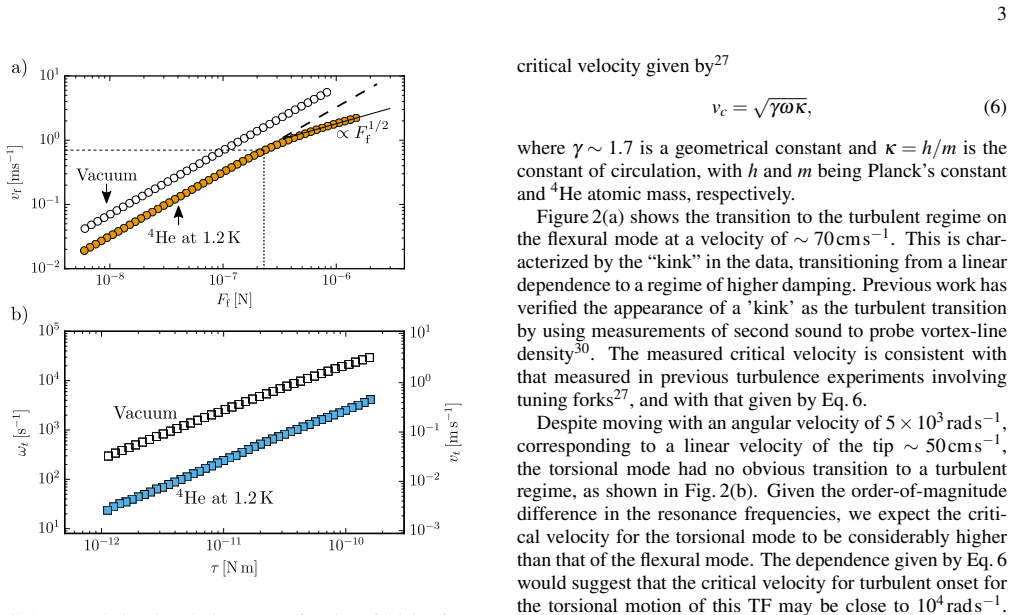
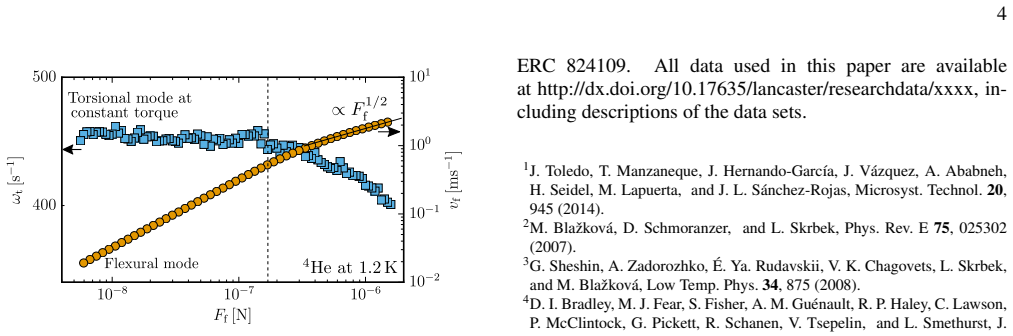
On the paper's own terms, the discovery is that two well-separated vibrational modes of one piezoelectric tuning fork can be operated together as a local generator-detector pair for quantum turbulence. In superfluid 4He at 1.2 K the flexural mode (76 kHz) shows the familiar sharp crossover to higher damping, the turbulent 'kink', at a tip velocity near 70 cm/s, consistent with $v_c = \sqrt{\gamma\omega\kappa}$ with $\gamma \approx 1.7$ and $\kappa = h/m$. The torsional mode (393 kHz), whose damping in helium is dominated by first-sound emission ($Q \sim 5.5 \times 10^3$ versus $4.8 \times 10^4$ in vacuum), remains linear up to about $5\times 10^3$ rad/s (about 50 cm/s) with no transition, making it a passive detector in this range. When both modes are driven simultaneously, the torsional velocity at constant torque drops at the same flexural force at which the flexural mode turns turbulent; the paper attributes this to vorticity generated by the flexural tines, ruling out electrical crosstalk and acoustic sidebands as explanations.
Load-bearing premise
The central claim rests on the assumption that the extra drag seen by the twisting mode at the bending mode's transition point comes from tiny whirlpools the bending tines create, rather than from extra sound waves they emit; the twisting mode already loses much of its motion to sound in liquid helium, so the acoustic path is a real alternative.
Editorial extensions
If this is right
- A single device can generate and detect quantum turbulence locally, avoiding the spatial separation of separate emitter-detector experiments and the need to calibrate the detector mode in vacuum.
- The torsional mode can serve as a detector in a regime where it remains laminar, up to about 5,000 rad/s (50 cm/s tip speed), so self-generated vorticity does not confuse the reading.
- Because the torsional mode mainly feels shear forces while the flexural mode also sees density changes, the pair gives complementary views of the same fluid excitation.
- The scheme stops working at very high drives, where higher-order mixing between the two modes becomes non-negligible and the response is no longer that of simple harmonic oscillators.
- Lowering the torsional frequency, through longer or more flexible tines, should reduce acoustic damping and make the detector more sensitive to localized topological defects.
Reading between the lines
- A decisive test not reported in the paper would be to repeat the two-mode sweep just above the superfluid transition, where quantized vortices cannot form; a torsional damping jump there would implicate acoustic coupling rather than vorticity.
- If the vorticity reading is confirmed, the same fork becomes a local-clock experiment: the delay between flexural turbulence onset and the torsional response would constrain how quickly vortices travel from one tine region to another.
- The generator-detector split should transfer to other quantum fluids and to solid-fluid interfaces, with one mode creating quasiparticles, cavitation, or defects and the other mode reading the shear response at the same location.
- The strong acoustic damping of the torsional mode suggests that adding sound-absorbing geometry, or operating below an acoustic cutoff, could push high-frequency torsional forks toward detecting individual vortex events rather than the collective transition.
Editorial analysis
A structured set of objections, weighed in public.
Referee Report
Summary. This manuscript reports a method for operating a quartz tuning fork simultaneously in its 76 kHz flexural mode and 393 kHz torsional mode in superfluid 4He at 1.2 K. The authors calibrate both modes by laser Doppler vibrometry, observe a turbulence onset on the flexural mode at about 70 cm/s, and find no comparable onset on the torsional mode up to about 50 cm/s. In the main experiment, the torsional mode is driven at constant torque while the flexural drive is increased; the torsional angular velocity drops at the same applied force at which the flexural mode enters its turbulent regime (Fig. 3). The authors interpret this correlated kink as evidence that the torsional mode is sensitive to vorticity generated by the flexural mode, and propose the two-mode scheme as a combined generator and detector for local quantum-turbulence studies.
Significance. The proposed two-mode tuning fork is a clever and potentially useful local probe: if the Fig. 3 coincidence is genuine, it would allow generation and detection of quantum turbulence on the same device without a vacuum calibration of the detection mode. The paper has clear strengths: the fork constants are calibrated independently by laser Doppler vibrometry, the flexural critical velocity is consistent with Eq. (6) and with prior work, and the authors are candid about the regime in which their scheme fails. The measurement is not circular: the correlated kink is not produced by a fitted parameter. However, the central claim currently rests on a single correlated feature with no repeated runs or error bars, and the two most plausible alternative mechanisms—electrical drive-chain nonlinearity and acoustic radiation coupling between the modes—are not excluded. The result is therefore promising but conditional, and the abstract's 'directly sensitive' is stronger than the body's 'suggesting' until controls are provided.
major comments (3)
- [Fig. 3] The central observation that the torsional-mode velocity drops at the same applied force as the flexural turbulence onset rests on a single dataset with no error bars, no repeated runs, and no quoted uncertainty on the flexural critical force. Because the entire abstract and conclusion depend on this coincidence, the authors should provide repeated measurements and quantify the reproducibility of the correlated kink.
- [p. 4, limitation statement] The paper does not exclude drive-chain nonlinearity. As the flexural drive increases, the summing amplifier and I-V converter can compress or intermodulate, reducing the actual torsional drive voltage even though the VNA source amplitude is held constant. The manuscript itself states that at very high drives 'higher-order mixing terms between the different resonant modes become non-negligible,' and no measurement is shown demonstrating that the Fig. 3 drive levels lie below that regime. A control that monitors the actual torsional drive current or voltage at the fork, or a direct characterization of the amplifier transfer function with both drives applied, is needed to rule out an electrical origin for the torsional velocity drop.
- [Fig. 2(b) and Fig. 3] The dominant alternative physical channel is not addressed. The torsional mode in 4He is already acoustic-emission-dominated (Q drops from 4.8e4 in vacuum to 5.5e3 in 4He), so an increase in broadband first-sound emission, acoustic streaming, or radiation-pressure changes from the flexural mode can alter the torsional mode's acoustic damping without any vortex tangle being present. The paper rules out spectral crosstalk and sidebands but does not test for such a fluid-mediated coupling; a control with the flexural mode driven below its turbulence onset but at comparable acoustic power, or with an independent vortex detector, would be required to attribute the torsional response specifically to vorticity.
minor comments (5)
- [Abstract vs. Conclusion] The abstract says the torsional mode was 'directly sensitive' to fluid excitations linked to quantum turbulence, while the conclusion says the data are 'suggesting' this sensitivity; the wording should be aligned with the evidence presented.
- [p. 3, Eq. (6)] The critical-velocity estimate for the torsional mode converts Eq. (6), which is written for a linear velocity, into an angular velocity near 10^4 rad/s; the conversion via r = sqrt(t^2 + w^2)/2 should be stated explicitly, and the uncertainty in this estimate should be noted.
- [p. 4, paragraph before Fig. 3] There is a typo, 'increaseing', which should be corrected to 'increasing'.
- [Data availability] The data availability statement contains the placeholder 'xxxx' in the DOI; the actual DOI should be provided before publication.
- [Fig. 3 axis labels] The horizontal axis is labeled 'force' but refers specifically to the force applied to the flexural mode; this should be made explicit in the caption or axis label.
Circularity Check
No significant circularity: the coupled-mode kink is an experimental correlation, not a fitted or self-defined prediction.
full rationale
This is an experimental measurement paper rather than a derivation. The central claim is the Fig. 3 observation that, with fixed torsional torque, the torsional-mode velocity drops at the same flexural drive where the flexural mode reaches its critical velocity. That observation is not produced by any fitted parameter: the fork constants are calibrated independently by laser Doppler vibrometry, the flexural critical velocity is checked against Eq. 6 from external turbulence work rather than fitted to the new data, and the torsional critical-velocity estimate is a side extrapolation, not an input to the simultaneous measurement. The one overlapping-author citation used to identify the flexural kink with turbulence (ref 30, second-sound vortex-line density measurements) is independent external support and is not load-bearing for the new multimode claim. The paper's own limitation statement that "higher-order mixing terms between the different resonant modes become non-negligible" at very high drives is a validity caveat about a possible acoustic or electronic coupling channel; it identifies an unexcluded confound, but it is not a circular reduction of the claimed result to its inputs. No step of the paper's reasoning equates a prediction with an input by construction.
Assumptions & free parameters
free parameters (3)
- Flexural fork constant a_f =
2.81e-6 C/m
- Torsional fork constant a_t =
7.51e-10 C/rad
- Torsional effective radius r =
sqrt(t^2+w^2)/2, about 0.13 mm
assumptions (4)
- ad hoc to paper The torsional mode acoustic damping follows an octupole emission model, with each twisting tine acting as an acoustic quadrupole.
- domain assumption The critical velocity for vortex generation is given by v_c = sqrt(gamma omega kappa) with gamma about 1.7, from flexural tuning fork literature.
- domain assumption The electrical-mechanical relations for the torsional mode (torque proportional to voltage, current proportional to angular velocity) mirror the established flexural fork constants.
- domain assumption The fluid flow around the fork can be described by a classical Reynolds number and drag coefficient in the quantum fluid.
Cite this review
Pith. "Pith review of Multimode probing of superfluid $\mathbf{^4He}$ by tuning forks." pith.science (2026). https://pith.science/paper/MASTXMWL
@misc{pith2026190807853,
  author       = {Pith},
  title        = {Pith review of: Multimode probing of superfluid $\mathbf^4He$ by tuning forks},
  year         = {2026},
  howpublished = {\url{https://pith.science/paper/MASTXMWL}},
  note         = {Machine review of arXiv:1908.07853}
}
abstract
Flexural mode vibrations of miniature piezoelectric tuning forks (TF) are known to be highly sensitive to superfluid excitations and quantum turbulence in $\mathrm{^3He}$ and $\mathrm{^4He}$ quantum fluids, as well as to the elastic properties of solid $\mathrm{^4He}$, complementing studies by large scale torsional resonators. Here we explore the sensitivity of a TF, capable of simultaneously operating in both the flexural and torsional modes, to excitations in the normal and superfluid $\mathrm{^4He}$. The torsional mode is predominantly sensitive to shear forces at the sensor - fluid interface and much less sensitive to changes in the density of the surrounding fluid when compared to the flexural mode. Although we did not reach the critical velocity for quantum turbulence onset in the torsional mode, due to its order of magnitude higher frequency and increased acoustic damping, the torsional mode was directly sensitive to fluid excitations, linked to quantum turbulence created by the flexural mode. The combination of two dissimilar modes in a single TF sensor can provide a means to study the details of elementary excitations in quantum liquids, and at interfaces between solids and quantum fluid.
Figures

Reference graph
Works this paper leans on
-
[1]
author author J. Toledo , author T. Manzaneque , author J. Hernando-Garc \'i a , author J. V \'a zquez , author A. Ababneh , author H. Seidel , author M. Lapuerta , \ and\ author J. L. \ S \'a nchez-Rojas ,\ 10.1007/s00542-014-2095-x journal journal Microsyst. Technol. \ volume 20 ,\ pages 945 ( year 2014 ) NoStop
-
[2]
author author M. Bla z kov \'a , author D. Schmoranzer , \ and\ author L. Skrbek ,\ 10.1103/PhysRevE.75.025302 journal journal Phys. Rev. E \ volume 75 ,\ pages 025302 ( year 2007 ) NoStop
-
[3]
author author G. Sheshin , author A. Zadorozhko , author \'E . Ya. Rudavskii , author V. K. Chagovets , author L. Skrbek , \ and\ author M. Bla z kov \'a ,\ 10.1063/1.3009577 journal journal Low Temp. Phys. \ volume 34 ,\ pages 875 ( year 2008 ) NoStop
-
[4]
author author D. I. Bradley , author M. J. Fear , author S. Fisher , author A. M. \ Guénault , author R. P. Haley , author C. Lawson , author P. McClintock , author G. Pickett , author R. Schanen , author V. Tsepelin , \ and\ author L. Smethurst ,\ 10.1007/s10909-009-9901-3 journal journal J. Low Temp. Phys. \ volume 156 ,\ pages 116 ( year 2009 ) NoStop
-
[5]
author author M. Bla z kov \'a , author D. Schmoranzer , author L. Skrbek , \ and\ author W. F. \ Vinen ,\ 10.1103/PhysRevB.79.054522 journal journal Phys. Rev. B \ volume 79 ,\ pages 054522 ( year 2009 ) NoStop
-
[6]
author author D. Schmoranzer , author M. Jackson , author S. Midlik , author M. Skyba , author J. Bahyl , author T. Skokankova , author V. Tsepelin , \ and\ author L. Skrbek ,\ 10.1103/PhysRevB.99.054511 journal journal Phys. Rev. B: Condens. Matter Mater. Phys. \ volume 99 ( year 2019 ),\ 10.1103/PhysRevB.99.054511 NoStop
-
[7]
author author D. I. \ Bradley , author M. C C love c c ko , author S. N. \ Fisher , author D. Garg , author E. Guise , author R. P. \ Haley , author O. Kolosov , author G. R. \ Pickett , author V. Tsepelin , author D. Schmoranzer , \ and\ author L. Skrbek ,\ 10.1103/PhysRevB.85.014501 journal journal Phys. Rev. B \ volume 85 ,\ pages 014501 ( year 2012 ) NoStop
-
[8]
author author A. Salmela , author J. Tuoriniemi , \ and\ author J. Rysti ,\ 10.1007/s10909-010-0246-8 journal journal J. Low Temp. Phys. \ volume 162 ,\ pages 678 ( year 2011 ) NoStop
Show all 30 references
-
[9]
Schmoranzer , author M
author author D. Schmoranzer , author M. La Mantia , author G. Sheshin , author I. Gritsenko , author A. Zadorozhko , author M. Rotter , \ and\ author L. Skrbek ,\ 10.1007/s10909-011-0353-1 journal journal J. Low Temp. Phys. \ volume 163 ,\ pages 317 ( year 2011 ) NoStop
-
[10]
Bla z kov \'a , author T
author author M. Bla z kov \'a , author T. V. \ Chagovets , author M. Rotter , author D. Schmoranzer , \ and\ author L. Skrbek ,\ 10.1007/s10909-007-9533-4 journal journal J. Low Temp. Phys. \ volume 150 ,\ pages 194 ( year 2008 a ) NoStop
-
[11]
Bla z kov \'a , author D
author author M. Bla z kov \'a , author D. Schmoranzer , \ and\ author L. Skrbek ,\ 10.1063/1.2908890 journal journal Low Temp. Phys. \ volume 34 ,\ pages 298 ( year 2008 b ) NoStop
2008 doi
-
[12]
author author D. I. \ Bradley , author M. C love c ko , author E. Ga z o , \ and\ author P. Skyba ,\ 10.1007/s10909-008-9815-5 journal journal J. Low Temp. Phys. \ volume 152 ,\ pages 147 ( year 2008 ) NoStop
2008 doi
-
[13]
author author D. I. \ Bradley , author P. Crookston , author S. N. \ Fisher , author A. Ganshin , author A. M. \ Gu \'e nault , author R. P. \ Haley , author M. J. \ Jackson , author G. R. \ Pickett , author R. Schanen , \ and\ author V. Tsepelin ,\ 10.1007/s10909-009-9982-z j...
-
[14]
C love c ko , author E
author author M. C love c ko , author E. Ga z o , author M. Kupka , author M. Skyba , \ and\ author P. Skyba ,\ 10.1007/s10909-010-0330-0 journal journal J. Low Temp. Phys. \ volume 162 ,\ pages 669 ( year 2011 ) NoStop
2011 doi
-
[15]
C C love c c ko , author E
author author M. C C love c c ko , author E. Ga z z o , author M. Skyba , \ and\ author P. Skyba ,\ 10.1103/PhysRevB.99.104518 journal journal Phys. Rev. B \ volume 99 ,\ pages 104518 ( year 2019 ) NoStop
2019 doi
-
[16]
Bradley , author A
author author D. Bradley , author A. Guénault , author R. Haley , author G. Pickett , \ and\ author V. Tsepelin ,\ 10.1146/annurev-conmatphys-031016-025411 journal journal Annual Review of Condensed Matter Physics \ volume 8 ,\ pages 407 ( year 2017 ) NoStop
-
[17]
Andronikashvili ,\ @noop journal journal J
author author E. Andronikashvili ,\ @noop journal journal J. Phys. USSR \ volume 10 ,\ pages 201 ( year 1946 ) NoStop
1946
-
[18]
author author D. I. \ Bradley , author D. O. \ Clubb , author S. N. \ Fisher , author A. M. \ Gu \'e nault , author R. Haley , author C. J. \ Matthews , author G. R. \ Pickett , \ and\ author K. L. \ Zaki ,\ 10.1007/s10909-005-2240-0 journal journal J. Low Temp. Phys. \ volume...
-
[19]
Nago , author T
author author Y. Nago , author T. Ogawa , author K. Obara , author H. Yano , author O. Ishikawa , \ and\ author T. Hata ,\ 10.1007/s10909-010-0277-1 journal journal J. Low Temp. Phys. \ volume 162 ,\ pages 322 ( year 2011 ) NoStop
2011 doi
-
[20]
Holt \ and\ author P
author author S. Holt \ and\ author P. Skyba ,\ 10.1063/1.4725526 journal journal Rev. Sci. Instrum. \ volume 83 ,\ pages 064703 ( year 2012 ) NoStop
2012 doi
-
[21]
Song \ and\ author B
author author Y. Song \ and\ author B. Bhushan ,\ 10.1063/1.2195021 journal journal Journal of Applied Physics \ volume 99 ,\ pages 094911 ( year 2006 ) NoStop
2006 doi
-
[22]
Blaauwgeers , author M
author author R. Blaauwgeers , author M. Bla z kov \'a , author M. C love c ko , author V. B. \ Eltsov , author R. de Graaf , author J. Hosio , author M. Krusius , author D. Schmoranzer , author W. Schoepe , author L. Skrbek , author P. Skyba , author R. E. \ Solntsev , \ and\...
-
[23]
Ecole Th \'e matique du CNRS
author author K. Karrai ,\ @noop journal journal Proceedings of the Work presented at the “Ecole Th \'e matique du CNRS” on near-field optics, La Londe les Maures, France \ ,\ pages 1 ( year 2000 ) NoStop
2000
-
[24]
Kawashima \ and\ author K
author author H. Kawashima \ and\ author K. Sunaga ,\ 10.1143/jjap.35.3050 journal journal Japanese Journal of Applied Physics \ volume 35 ,\ pages 3050 ( year 1996 ) NoStop
1996 doi
-
[25]
Gao \ and\ author X
author author F. Gao \ and\ author X. Li ,\ @noop journal journal Sensors (Basel, Switzerland) \ volume 15 ,\ pages 24530 ( year 2015 ) NoStop
2015
-
[26]
author author V. B. \ Efimov , author D. Garg , author O. Kolosov , \ and\ author P. V. E. \ McClintock ,\ 10.1007/s10909-009-0026-5 journal journal J. Low Temp. Phys. \ volume 158 ,\ pages 456 ( year 2009 ) NoStop
2009 doi
-
[27]
author author S. L. \ Ahlstrom , author D. I. \ Bradley , author M. C C love c c ko , author S. N. \ Fisher , author A. M. \ Gu\'enault , author E. A. \ Guise , author R. P. \ Haley , author O. Kolosov , author P. V. E. \ McClintock , author G. R. \ Pickett , author M. Poole ,...
-
[28]
author author R. J. \ Donnelly \ and\ author C. F. \ Barenghi ,\ 10.1063/1.556028 journal journal Journal of Physical and Chemical Reference Data \ volume 27 ,\ pages 1217 ( year 1998 ) NoStop
1998 doi
-
[29]
Landau \ and\ author E
author author L. Landau \ and\ author E. Lifshitz ,\ in\ https://doi.org/10.1016/B978-0-08-033933-7.50016-7 booktitle Fluid Mechanics \ ( publisher Pergamon ,\ year 1987 )\ edition 2nd \ ed.,\ pp.\ pages 251 -- 312 NoStop
1987 doi
-
[30]
author author M. J. \ Jackson , author O. Kolosov , author D. Schmoranzer , author L. Skrbek , author V. Tsepelin , \ and\ author A. J. \ Woods ,\ 10.1007/s10909-015-1397-4 journal journal J. Low Temp. Phys. \ volume 183 ,\ pages 208 ( year 2016 ) NoStop
Reviewed August 14, 2026 · model on record in the stance chip above.
Discussion (0). Continue with ORCID to comment.