REVIEW 1 major objections 1 minor 4 references
Large Area Photo-Detection System using 3-inch PMTs for the Hyper-Kamiokande Outer Detector
T0 review · 1 major / 1 minor · reviewed 2026-08-14 · deepseek-v4-flash
Pith's one-line read The paper reports that the R14374 and R14689 photomultiplier tubes meet the Hyper-Kamiokande outer-detector dark-rate specification, with measured rates of 210 and 250 Hz.
desk verdict Useful HK OD PMT data undermined by an unreported threshold parameter N; the dark rates are real but not uniquely defined. read the letter →
The pith
A machine-rendered reading of the paper's core claim, the machinery that carries it, and where it could break.
The reading
What carries the argument
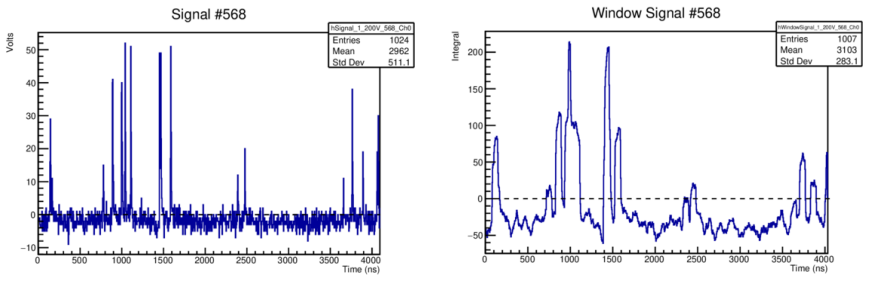
The mechanism carrying the argument is a calibration-free dark-count measurement. Waveforms are cut into bunches of 64 samples, and a sliding-window integration over 16 samples fills a histogram of local baseline values. That histogram yields the pedestal mean $\mu_{\rm dark}$ and its standard deviation $\sigma_{\mu_{\rm dark}}$, which define an effective threshold $\theta = \mu_{\rm dark} + N\sigma_{\mu_{\rm dark}}$, with $N$ an arbitrary parameter. Bunches whose 16-sample integrated value exceeds $\theta$ are flagged as containing a dark pulse; a constant-fraction discriminator locates the pulse, and a 32-sample integration measures its charge. The resulting charge histogram is fitted with the single-photoelectron response function to extract pedestal and pulse positions, gain, photoelectron resolution, and dark rate normalized to acquisition time. This is the method that produces the quoted dark rates without prior calibration, and the paper validates it against a pre-calibrated analysis.
What would settle it
The decisive check is to rerun the same sliding-window analysis on the recorded waveforms with the threshold parameter $N$ varied from 1 to 5, and to compare the resulting dark rates for the R14374 and R14689 with a prior-calibration measurement at a fixed photoelectron threshold; agreement across $N$ and with calibration would support the quoted numbers, while strong variation with $N$ would show they are not uniquely determined.
Extended reading notes
Core claim
On the paper's own terms, the central discovery is that two compact photomultiplier tubes satisfy the Hyper-Kamiokande outer-detector requirements. The R14374 (3-inch) shows a dark rate of $210 \pm 80$ Hz, a gain of $2.7 \pm 0.1 \times 10^6$, and a single-photoelectron width of $30 \pm 10\%$ of the mean; the R14689 (3.5-inch) shows $250 \pm 100$ Hz, a gain of $2.8 \pm 0.1 \times 10^6$, and a width of $17 \pm 11\%$. These values are presented as meeting the dark-rate specification for the 13,300-PMT veto array, and as evidence that smaller tubes are a sound replacement for the earlier 8-inch design. The paper further claims that its calibration-free dark-count measurement reproduces the result of a calibration-based analysis, so the quoted dark rates do not require prior photoelectron calibration.
Load-bearing premise
The quoted dark rates rest on the unreported arbitrary threshold parameter $N$ in $\theta = \mu_{\rm dark} + N\sigma_{\mu_{\rm dark}}$; if $N$ were different, the measured rates would change, and the paper gives no study of that dependence.
Editorial extensions
If this is right
- The outer detector can be built with 13,300 three-inch PMTs, giving two to three times more photosensors than the 8-inch design at lower cost while keeping the veto threshold low.
- The calibration-free dark-count method can qualify or monitor outer-detector PMTs using normal data-taking triggers, without dedicated calibration runs.
- Dark rates near or below 250 Hz support a low cluster threshold for vetoing cosmic-ray muons and low-energy radioactivity backgrounds.
- The R14374 and R14689 are viable candidates for the Hyper-Kamiokande outer detector, with the ETEL and HZC models still to be compared.
Reading between the lines
- If the method is robust, it could be adapted to other large PMT arrays as a continuous in-situ dark-rate monitor using random triggers, without interrupting physics data taking.
- The free threshold parameter $N$ makes the quoted rates somewhat arbitrary until a systematic scan is published; reporting $N$ or a scan would make the numbers reproducible.
- Because dark rate depends on temperature, a natural follow-up is to test the same two PMTs under the underground cavern conditions and over time to see whether the specification compliance holds during operation.
- The same charge histograms also yield gain and photoelectron resolution, so the calibration-free approach could potentially replace several separate calibration procedures in one analysis.
Signed reviews
Editorial analysis
A structured set of objections, weighed in public.
Referee Report
Summary. The paper reports the characterization of two Hamamatsu photomultipliers, the 3-inch R14374 and the 3.5-inch R14689, as candidate sensors for the Hyper-Kamiokande outer detector. The author describes a dark-count measurement method that does not require a prior calibration of the single-photoelectron peak: waveforms are searched for dark pulses using a sliding-window integration, a threshold is built from the baseline mean and standard deviation, charge histograms are fitted with the Bellamy response function, and the dark rate and gain are extracted. The quoted results are a dark rate of 210 +/- 80 Hz for the R14374 and 250 +/- 100 Hz for the R14689, both presented as consistent with the outer-detector specifications. A consistency check using a prior calibration is reported as giving agreeing results. The paper concludes that the measured tubes are suitable for the planned 13,300-PMT outer-detector array.
Significance. If the dark-rate measurements are reliable, the paper provides useful input to the Hyper-Kamiokande outer-detector photosensor selection and a potentially convenient calibration-free characterization method for future PMT batches. The calibration-free procedure, combined with the external Bellamy response function and an independent calibrated cross-check, is a sensible approach and the reported dark rates are in a plausible range for these PMTs. The main value is technical and practical rather than conceptual. However, the paper's central quantitative claim rests on an unreported threshold parameter, and the quoted uncertainties omit the dominant systematic associated with that parameter. As a result, the significance of the specific numbers in Table I is currently not fully established.
major comments (1)
- [Abstract and Section 4] The abstract and conclusion claim that the characterized PMTs 'all show a very low dark counts and good collection efficiency,' but the body of the paper reports results for only two Hamamatsu tubes; no measured data are shown for the Electron Tubes ET9320KFL or the HZC XP82B20. Furthermore, 'collection efficiency' is not measured or quantified anywhere in the paper: Table I lists gain, dark rate, and sigma_SPE/mu_SPE, but not quantum efficiency or collection efficiency. Please either remove the unsupported claim or present the corresponding measurements.
minor comments (1)
- [Section 3.2] The phrase 'yielding to according results' is vague. Please specify the quantitative level of agreement between the calibrated and uncalibrated analyses, for example the difference in extracted dark rate and gain relative to their combined uncertainties.
Circularity Check
No circularity found: the dark-rate measurement is an operational measurement, not a derivation from an input that assumes the target result.
full rationale
The paper reports a measurement of PMT dark rates and compares the results to the Hyper-Kamiokande outer-detector specifications. No derived quantity is constructed from an input that already contains the target result. The threshold definition θ = μ_dark + N×σ_μ_dark in Section 3.1 is an operational cut, not a fit to the measured dark rate; the dark rate is the count of pulses above that cut. The parameter N being unreported makes the quoted rates underdetermined and is a reproducibility concern, but it is not circular: the method does not assume the dark rate it then reports. The cross-check in Section 3.2 uses a prior calibration and an external response function from Bellamy et al., providing an independent benchmark. Equation 1, H = −log2(2^−N) = N, is tautological but explicitly motivational and not load-bearing for the measured quantities. There are no self-citations load-bearing in the argument, and no prediction is reduced by construction to a fitted parameter. Therefore the circularity score is 0.
Assumptions & free parameters
free parameters (1)
- Threshold multiplier N
assumptions (3)
- domain assumption The Bellamy et al. response function correctly describes the charge spectrum of these PMTs.
- ad hoc to paper The sliding-window integration with Nbunch=64, Nwindow=16, and Ncharge=32 reliably separates dark pulses from baseline without bias.
- domain assumption No light reaches the PMT during the dark count measurement.
Cite this review
Pith. "Pith review of Large Area Photo-Detection System using 3-inch PMTs for the Hyper-Kamiokande Outer Detector." pith.science (2026). https://pith.science/paper/P7KEHWHK
@misc{pith2026190807864,
  author       = {Pith},
  title        = {Pith review of: Large Area Photo-Detection System using 3-inch PMTs for the Hyper-Kamiokande Outer Detector},
  year         = {2026},
  howpublished = {\url{https://pith.science/paper/P7KEHWHK}},
  note         = {Machine review of arXiv:1908.07864}
}
read the original abstract
Hyper-Kamiokande, scheduled to begin construction as soon as 2020, is a next generation underground water Cherenkov detector, based on the highly successful Super-Kamiokande experiment. It will serve as a far detector, 295 km away, of a long baseline neutrino experiment for the upgraded J-PARC beam in Japan. It will also be a detector capable of observing --- far beyond the sensitivity of the Super-Kamiokande detector --- proton decay, atmospheric neutrinos, and neutrinos from astronomical sources. An Outer Detector (OD) consisting of PMTs mounted behind the inner detector PMTs and facing outwards to view the outer shell of the cylindrical tank, would provide topological information to identify interactions originating from particles outside the inner detector. Any optimization would lead to a significant improvement for the physics goals of the experiment, which are the measurement of the CP leptonic phase and the determination of the neutrino mass hierarchy. An original setup using small 3" PMTs is being designed for the Hyper-Kamiokande OD. They would give better redundancy, spatial, and angular resolution, as they would be twice or three times more photosensors that the original 8" design proposal of the experiment, and for a reduce cost. Several 3" PMTs candidates considered for the Hyper-Kamiokande OD have been characterized at Queen Mary University London. They all show a very low dark counts and good collection efficiency, which makes them excellent choice to be used in the experiment.
Figures


Figures from the paper (3 more)


Reference graph
Works this paper leans on
Reviewed August 14, 2026 · model on record in the stance chip above.
Discussion (0). Continue with ORCID to comment.