REVIEW 2 major objections 3 minor 24 references
Free self-decomposability and unimodality of the Fuss-Catalan distributions
T0 review · 2 major / 3 minor · reviewed 2026-08-14 · deepseek-v4-flash
Pith's one-line read The paper classifies which Fuss-Catalan distributions are freely self-decomposable: precisely the diagonal laws μ(p,p) with 1≤p≤2.
desk verdict The main classification is likely right and worth publishing, but the written proof has a genuine gap at p=2r and a false inequality in the p>2 unimodality argument. read the letter →
The pith
A machine-rendered reading of the paper's core claim, the machinery that carries it, and where it could break.
The reading
What carries the argument
The central object is the free Lévy density k_{p,r}(x)=xW_{p-r,r}(x), defined on the freely infinitely divisible region 0<r≤min{p/2,p-1}. It carries the argument because free self-decomposability is equivalent to k_{p,r}(x)dx being unimodal with mode 0; the sign of k'_{p,r}(x) just to the right of 0 is therefore decisive. Two auxiliary instruments do the heavy lifting: the parametrization of the support by ρ(φ) from Proposition 1.1 together with the asymptotic k_{p,r}(x)∼(1/π)sin(rπ/(p-r))$x^{{r/(p-r)}}$ as x→0+, which excludes every off-diagonal case in the proof; and, for μ(p,p), the integral representation of (n+2) binom(p,n+2) that makes the cumulant sequence {n r_n} manifestly conditionally positive definite for 1≤p≤2.
What would settle it
Run the cumulant-criterion test on the untouched p=2r edge: for μ(4,2) the free cumulants are A_n(2,2), and the 2×2 Hankel minor of {n r_n} equals (2·5)(4·42)−(3·14)^2 = 10·168−42² = −84<0, so Proposition 2.2 rules out free self-decomposability for this case; any off-diagonal pair whose Hankel minors are all nonnegative would refute the classification.
Extended reading notes
Core claim
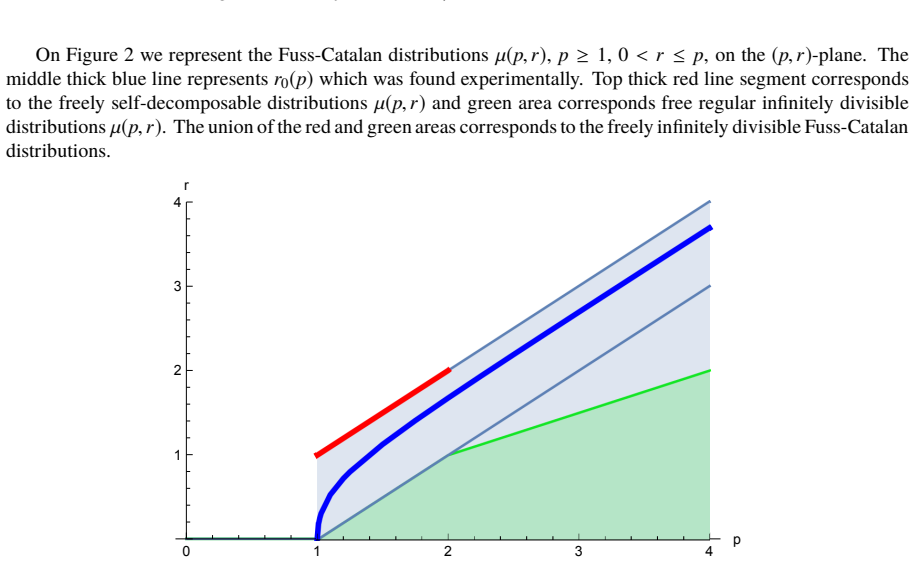
The paper's central claim is a complete classification: for p≥1 and 0<r≤p, μ(p,r) is freely self-decomposable if and only if p=r and 1≤p≤2. The mechanism is the free Lévy measure. Every freely infinitely divisible Fuss-Catalan law has Lévy density k_{p,r}(x)=xW_{p-r,r}(x), and free self-decomposability is equivalent to k_{p,r}(x)dx being unimodal with mode 0. In the off-diagonal freely infinitely divisible region, the near-zero asymptotic of W_{p-r,r} forces k_{p,r} to increase from 0, so the mode-0 condition fails; on the diagonal μ(p,p), 1≤p≤2, the free cumulants are binomial coefficients and the sequence {n binom(p,n)} is conditionally positive definite, which by the cumulant criterion proves free self-decomposability. The paper also completes the description of free infinite divisibility for the family and gives the associated free Lévy-Khintchine representations.
Load-bearing premise
The proof of the off-diagonal exclusion depends on the asymptotic k_{p,r}(x)∼(1/π)sin(rπ/(p-r))$x^{{r/(p-r)}}$ near x=0; when p=2r the sine factor is 0, so the written argument supplies no sign information and leaves cases such as μ(4,2) uncovered.
Editorial extensions
If this is right
- In the whole two-parameter family, free self-decomposability occurs only on the diagonal segment p=r with 1≤p≤2; every law with 0<r<p, including the freely infinitely divisible off-diagonal laws, fails it.
- For 1≤p≤2 each μ(p,p) is not only freely self-decomposable but lies in the free L1 class: the remainder ρ_c in the dilation decomposition is itself freely self-decomposable for every c∈(0,1).
- Free regularity holds exactly for 0<r≤min{p/2,p-1} and for p=r=1 or 2; in particular the diagonal interior 1<p<2 is freely self-decomposable yet not free regular.
- The diagonal law μ(p,p) is unimodal for every p≥1, and the paper proves unimodality for μ(p,p-1), μ(2r,r), and for μ(2,r) with 1<r<r0; μ(1,r) is not unimodal for 0<r<1.
- The paper's Conjecture 4.10 proposes a phase transition for every p>1: μ(p,r) is unimodal for r=p or 0<r≤r0(p), with r0(2)≈1.6756 supported by numerics.
Reading between the lines
- The unhandled p=2r edge in the written proof can be settled directly: for μ(4,2), the cumulant Hankel test gives a negative 2×2 minor, so the classification survives that case even though the asymptotic argument does not cover it.
- The proof strategy—reading free self-decomposability off the sign of the Lévy density near 0—suggests that for p=2r one needs the second term of the expansion of W_{p-r,r}; computing it would close the only written gap and could be checked against the same cumulant minors.
- If the phase-transition conjecture holds, the curve r0(p) would split the off-diagonal region into a unimodal side near r=0 and a non-unimodal band below r=p, giving a natural upper boundary for any future extension of the free-self-decomposability classification.
Signed reviews
Editorial analysis
A structured set of objections, weighed in public.
Referee Report
Summary. The paper studies the two-parameter Fuss-Catalan (Raney) distributions μ(p,r), whose moments are the Raney numbers A_k(p,r). Its main results are a classification of free infinite divisibility (Theorem 1.3(1)), a classification of free self-decomposability (Theorem 1.3(2)), a classification of free regularity (Theorem 1.3(3)), and a number of unimodality statements for special families μ(p,p), μ(p,p−1), μ(2r,r), μ(1,r), and μ(2,r). The positive directions are based on integral representations of binomial-type sequences (Propositions 3.1 and 3.3) and on the free-cumulant criterion of Hasebe–Thorbjørnsen–Sakuma; the negative directions use the Forrester–Liu density asymptotics and determinantal positivity checks.
Significance. If the main classification is correct, Theorem 1.3(2) gives a complete characterization of free self-decomposability in the Fuss-Catalan family and corrects the earlier claim in [16] about free infinite divisibility. The explicit free Lévy–Khintchine representations (Propositions 3.6, 4.2, Corollary 4.8) and the hypergeometric computations are careful and useful. The arguments are mostly analytic and do not rely on numerical fitting, and the paper is honest about correcting an earlier oversight. However, the only-if direction of the central Theorem 4.3 has a genuine missing boundary case, so the main classification is not fully proved as written.
major comments (2)
- [Section 4.3, Theorem 4.3] The only-if direction for 0<r≤min{p/2,p−1} uses the asymptotic k_{p,r}(x)∼(1/π)sin(rπ/(p−r))x^{r/(p−r)} as x→0+ and concludes that k'_{p,r}(x)≥0 near 0. On the subfamily p=2r, the sine factor is sin(π)=0, so the displayed leading term carries no sign information. This subfamily is nonempty in the range to be excluded (for instance μ(4,2), μ(6,3), and more generally μ(2r,r) for r>1); for r=1,p=2, there is the additional issue that W_{1,1} is the Dirac mass at 1 rather than a density, so formula (16) is not directly applicable. No separate analysis of p=2r appears in the manuscript, and therefore the classification of free self-decomposability in Theorem 1.3(2) is not established for this one-parameter family. The conclusion may well be true, but the written proof has a genuine gap.
- [Section 4.5.2, Proposition 4.6] The proof asserts that rϕ and (2r−1)ϕ both lie in (0,π/2) for all ϕ∈(0,π/(2r)) when r>1. The first is true, but the second is false because (2r−1)π/(2r)>π/2 for r>1. Consequently, the term containing cos((2r−1)ϕ) is not necessarily nonnegative on the whole interval, and the inequality that drops this term is not justified. This invalidates the proof that g'_r(ϕ)≥0. The unimodality claim for μ(2r,r) needs a corrected argument; this does not affect the central free-self-decomposability classification, but it is a technical error in a stated result.
minor comments (3)
- [Section 4.1, Theorem 4.1 proof] The case statement 'p>2 and p−1<r<p/2' is empty because p−1>p/2 for p>2; from the surrounding argument the intended case appears to be p/2<r<p−1 (with boundary cases handled separately). Please correct this typo, as it makes the exclusion of the region r≤p−1, r>p/2 unclear.
- [Section 4.2, Proposition 4.2] The support formula (p−r)^{p−r}(p−r−1)^{1−(p−r)} gives the indeterminate form 0^0 when p−r=1, i.e. for μ(2,1); the boundary case p−r=1 should be excluded or treated separately.
- [Section 3.3, equation (12) and Remark 3.7] The notation writes the Lebesgue measure as 'dx' inside the integrand after the indicator function, which is slightly misleading for a Lévy measure of the form k(x)dx/|x|; this is a presentational issue only.
Circularity Check
No circularity: the free self-decomposability classification is derived from external criteria and prior published inputs; the p=2r gap in Theorem 4.3 is a correctness issue, not a circular reduction.
full rationale
The paper's derivation chain is self-contained against external benchmarks. The central classification (Theorem 1.3(2)) rests on (i) the free cumulant formula r_n(μ(p,r)) = A_n(p−r,r), quoted from the prior published paper [15] and used only as an input; (ii) the characterization of free self-decomposability via conditional positive definiteness of {n r_n} and via unimodality of the free Lévy density, quoted from [13] and [4]; and (iii) the explicit density formula of Forrester–Liu (Proposition 1.1) and the asymptotic k_{p,r}(x) ∼ (1/π) sin(rπ/(p−r)) x^{r/(p−r)} from [9]. None of these inputs is defined in terms of the target classification, and no parameter is fitted to data. The self-citations [15] and [16] are prior published results used as lemmas; [16] is explicitly corrected for a separate issue, which is not circular. The proof does contain a genuine missing case at p=2r in Theorem 4.3, where the sine factor in the [9] asymptotic vanishes and the statement 'Hence k'_{p,r}(x) ≥ 0' is unsupported; this is a correctness gap, not a circular reduction, because the asymptotic and the criterion come from outside the paper and the missing case is not used to define the conclusion. Accordingly, no circular step is present.
Assumptions & free parameters
assumptions (8)
- standard math Euler's reflection formula Γ(p)Γ(1−p)=π/sin(pπ) for p∉Z
- standard math Integral representation of the Gauss hypergeometric function 2F1(a,b,c;z) (equation (10))
- standard math Positive definiteness of a sequence with a positive integral kernel implies the sequence is a moment sequence
- domain assumption Bercovici-Voiculescu analytic extension theorem (Theorem 2.1) characterizing free infinite divisibility
- domain assumption Criterion from [13, Prop 2.2]: compactly supported µ is freely self-decomposable iff {n r_n(µ)} is conditionally positive definite
- domain assumption Free Levy measure criterion (Barndorff-Nielsen-Thorbjørnsen [4]): free self-decomposability implies ν(dx)=k(x)/|x| dx with k(x)dx unimodal with mode 0
- domain assumption Asymptotic k_{p,r}(x) ∼ (1/π) sin(rπ/(p−r)) x^{r/(p−r)} as x→0+ (Forrester-Liu [9, Corollary 2.5])
- domain assumption Free regularity criterion via R-transform (Theorem 2.4 from [3])
Cite this review
Pith. "Pith review of Free self-decomposability and unimodality of the Fuss-Catalan distributions." pith.science (2026). https://pith.science/paper/OR2B5PSL
@misc{pith2026190807887,
  author       = {Pith},
  title        = {Pith review of: Free self-decomposability and unimodality of the Fuss-Catalan distributions},
  year         = {2026},
  howpublished = {\url{https://pith.science/paper/OR2B5PSL}},
  note         = {Machine review of arXiv:1908.07887}
}
abstract
We study properties of the Fuss-Catalan distributions $\mu(p,r)$, $p\geq1$, $0<r\leq p$: free infinite divisibility, free self-decomposability, free regularity and unimodality. We show that the Fuss-Catalan distribution $\mu(p,r)$ is freely self-decomposable if and only if $1 \leq p=r \leq 2$.
Figures

Reference graph
Works this paper leans on
-
[16]
W . Młotkowski, K. A. Penson, Probability distribution s with binomial moments. Infin. Dimens. Anal. Quantum Probab. Relat. Top., 17 (2014), no. 2, 1450014, 32 pp
work page 2014
-
[9]
P . J. Forrester, D.-Z. Liu, P . Zinn-Justin, Equilibriumproblems for Raney densities.Nonlinearity, 28 (2015), no. 7, 2265-2277
work page 2015
-
[1]
G. E. Andrews, R. Askey, R. Roy, Special Functions. Encyclopedia of Mathematics and its Applications , 71, Cambridge University Press, Cambridge, 1999. xvi+664 pp
work page 1999
-
[2]
O. Arizmendi, T. Hasebe, Classical and free infinite divi sibility for Boolean stable laws. Proc. Amer. Math. Soc., 142 (2014), no. 5, 1621-1632
work page 2014
-
[3]
O. Arizmendi, T. Hasebe, N. Sakuma, On the law of Free Subo rdinators. ALEA, Lat. Am. J. Probab. Math. Stat., 10 (2013), no. 1, 271–291. 15
work page 2013
-
[4]
O. E. Barndorff-Nielsen, S. Thorbjørnsen, Classical and free infinite divisibility and Lévy processes. Quantum independent increment processes. II , 33–159, Lecture Notes in Math. , 1866, Springer, Berlin, 2006
work page 2006
-
[5]
S.T. Belinschi, M. Bożejko; F. Lehner; R. Speicher, The n ormal distribution is ⊞-infinitely divisible. Adv. Math., 226 (2011), no. 4, 3677-3698
work page 2011
-
[6]
Benaych-Georges, Taylor expansions of R-transforms : application to supports and moments
F. Benaych-Georges, Taylor expansions of R-transforms : application to supports and moments. Indiana Univ. Math. J., 55 (2006), no. 2, 465–481
work page 2006
Show all 24 references
-
[7]
Bercovici, D
H. Bercovici, D. Voiculescu, Free convolution of measur es with unbounded support. Indiana Univ. Math. J., 42 (1993), no. 3, 733–773
1993
-
[8]
P . J. Forrester, D.-Z. Liu, Raney distributions and rand om matrix theory. J. Stat. Phys., 158 (2015), no. 5, 1051–1082
2015
-
[10]
R. L. Graham, D. E. Knuth, O. Patashnik, Concrete Mathem atics. A foundation for computer science , Addison-Wesley, 1994. xiv+657 pp
1994
-
[11]
Hasebe, Free infinite divisibility for beta distribu tions and related ones
T. Hasebe, Free infinite divisibility for beta distribu tions and related ones. Electron. J. Probab., 19 (2014), No. 81, 1-33
2014
-
[12]
Hasebe, S
T. Hasebe, S. Thorbjørnsen, Unimodality of the freely s elfdecomposable probability laws. J. Theoret. Probab., 29 (2016), no. 3, 922–940
2016
-
[13]
Hasebe, S
T. Hasebe, S. Thorbjørnsen, N.Sakuma, The normal distr ibution is freely self-decomposable. Int. Math. Res. Not. IMRN 2019, no. 6, 1758–1787
2019
-
[14]
Liu and R
J.-G. Liu and R. Pego, On generating functions of Hausdo rff moment sequences. Trans. Am. Math. Soc. , 368 (2016), no. 12, 8499–8518
2016
-
[15]
Młotkowski, Fuss-Catalan numbers in noncommutativ e probability
W . Młotkowski, Fuss-Catalan numbers in noncommutativ e probability. Doc. Math., 15 (2010), 939–955
2010
-
[17]
Młotkowski, K
W . Młotkowski, K. A. Penson, K. Życzkowski, Densities of the Raney distributions. Doc. Math., 18 (2013), 1573–1596
2013
-
[18]
A. Nica, R. Speicher, Lectures on the combinatorics of f ree probability. London Mathematical Society Lecture Note Series, 335, Cambridge University Press, Cambridge, 2006. xvi+417 pp
2006
-
[19]
F. W . J. Olver, D. W . Lozier, R. F. Boisvert, C. W . Clark, NIST Handbook of Mathematical Functions. U.S. Department of Commerce, National Institute of Standards an d Technology, Washington, DC; Cambridge University Press, Cambridge 2010. xvi+951 pp
2010
-
[20]
R. P . Stanley, Catalan numbers. Cambridge University P ress, New Y ork, 2015. viii+215 pp
2015
-
[21]
Penson, K
K. Penson, K. Życzkowski, Product of Ginibre matrices: Fuss-Catalan and Raney distributions. Phys. Rev. E, 83, 061118 (2011)
2011
-
[22]
Sato, Class L of multivariate distributions of its su bclasses
K. Sato, Class L of multivariate distributions of its su bclasses. J. Multivariate Anal. , 10 (1980), no. 2, 207-232
1980
-
[23]
Sato, Fractional integrals and extensions of selfde composability.Lévy matters I, 1–91, 197–198, Lecture Notes in Math., 2001, Lévy Matters, Springer, Berlin, (2010)
K. Sato, Fractional integrals and extensions of selfde composability.Lévy matters I, 1–91, 197–198, Lecture Notes in Math., 2001, Lévy Matters, Springer, Berlin, (2010)
2010
-
[24]
Y amazato, Unimodality of infinitely divisible distr ibution functions of class L, Ann
M. Y amazato, Unimodality of infinitely divisible distr ibution functions of class L, Ann. Probab., 6 (1978), no. 4, 523–531. 16
1978
Reviewed August 14, 2026 · model on record in the stance chip above.
Discussion (0). Continue with ORCID to comment.