REVIEW 3 major objections 6 minor 15 references
The lateral distribution function of cosmic-ray induced air showers studied with the HAWC observatory
T0 review · 3 major / 6 minor · reviewed 2026-08-14 · deepseek-v4-flash
Pith's one-line read HAWC's modified NKG lateral distribution function best describes cosmic-ray air showers from $10^{3.5}$ to $10^{5.5}$ GeV, and its fitted lateral age separates proton from iron primaries above $10^{3.8}$ GeV.
desk verdict Useful first HAWC cosmic-ray LDF comparison, but the ranking and composition claim rest on an uncalibrated error model and an internal consistency issue. read the letter →
The pith
A machine-rendered reading of the paper's core claim, the machinery that carries it, and where it could break.
The reading
What carries the argument
The load-bearing object is the modified NKG lateral distribution function $f(r)=A(r/r_M)^{s-3}(1+r/r_M)^{s-4.5}$, with $r_M=124.21$ m fixed at HAWC's altitude, where $A$ is a normalization and $s$ is the lateral age. The argument runs through three pieces: (i) a charge-error model $\log_{10} Q_{\mathrm{error}} = 0.3 - 0.06667\log_{10}Q_{\mathrm{eff}}$ for $\log_{10}Q_{\mathrm{eff}} \le 3$ and $0.1$ above, which sets the weights in every fit; (ii) a $\chi^2$ per degree of freedom comparison of four LDFs on binned mean effective charge; and (iii) the figure of merit $\mathrm{FOM}=|s_{\mathrm{Fe}}-s_p|/\sqrt{\sigma_p^2+\sigma_{\mathrm{Fe}}^2}$ from simulated proton and iron showers, which converts the fitted age into a composition-separation metric.
What would settle it
Recompute the four LDF fits using charge uncertainties taken from PMT charge-resolution calibrations or from shower-to-shower fluctuations in place of Eq. (3.1), and check whether HAWC's LDF still has the lowest $\chi^2/\mathrm{NDOF}$; as a second check, evaluate the lateral-age proton-iron separation on independent simulated showers generated with a different hadronic interaction model.
Extended reading notes
Core claim
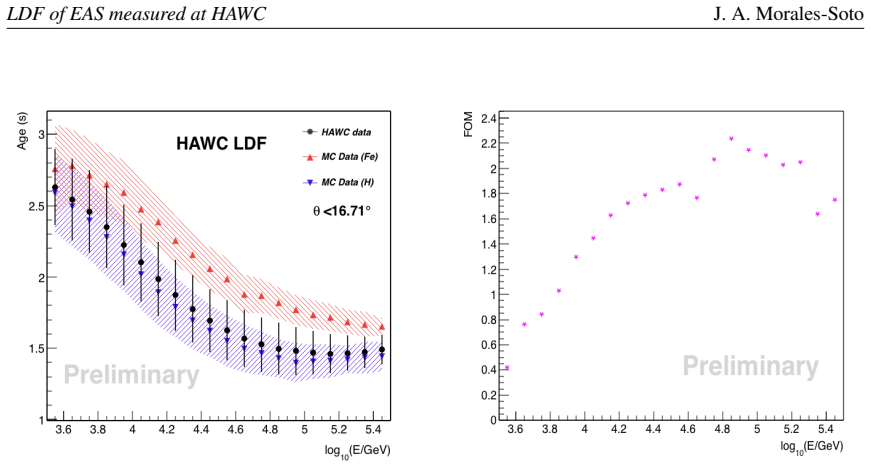
The central claim is that the NKG-style function previously used by HAWC for gamma-ray showers, $f(r) = A (r/r_M)^{s-3}(1+r/r_M)^{s-4.5}$ with $r_M = 124.21$ m, also gives a good description of cosmic-ray-induced showers, and in a $\chi^2/\mathrm{NDOF}$ comparison over $10^{3.5}$ to $10^{5.5}$ GeV it performs at least as well as three literature LDFs across the full energy range. The fitted lateral age parameter $s$ varies with primary mass: iron showers are older (larger $s$) and protons are younger, and the separation, quantified by the figure of merit $|s_{\mathrm{Fe}}-s_p|/\sqrt{\sigma_p^2+\sigma_{\mathrm{Fe}}^2}$, exceeds 1 for $E > 10^{3.8}$ GeV, peaks near $E = 10^{4.8}$ GeV, and remains about 1.75 at $E = 10^{5.5}$ GeV. The paper also reports that the average measured lateral distributions lie within the band predicted by the high-energy hadronic interaction model used in the simulations.
Load-bearing premise
The comparison that picks HAWC's LDF rests on the empirical charge-error function of Eq. (3.1), whose coefficients are asserted without calibration; if those errors do not represent the real PMT charge uncertainties, the $\chi^2$ values and the LDF ranking could change.
Editorial extensions
If this is right
- The lateral age parameter from a single HAWC LDF fit can serve as a mass-composition observable between $10^{3.8}$ and $10^{5.5}$ GeV, with proton-iron separation above one standard deviation.
- HAWC's existing gamma-ray LDF can be reused for cosmic-ray analyses without introducing a new parameterization.
- Average lateral distributions measured by HAWC are consistent with the predictions of the QGSJET-II-03 hadronic interaction model across $10^{3.5}$ to $10^{5.5}$ GeV.
- The proton-iron figure of merit peaks near $E = 10^{4.8}$ GeV and is still about 1.75 at $E = 10^{5.5}$ GeV.
Reading between the lines
- Beyond the paper: replacing the empirical charge-error function of Eq. (3.1) with PMT-level calibrated uncertainties could change the $\chi^2$ ranking of the four LDFs, although the age-based composition result depends mainly on the HAWC LDF itself.
- Beyond the paper: combining lateral age with other composition-sensitive observables, such as muon content or shower-front curvature, may extend the useful range beyond the energy where the FOM begins to decrease.
- Beyond the paper: repeating the four-function comparison on showers simulated with alternative hadronic interaction models would test whether the LDF ranking is model-dependent.
Signed reviews
Editorial analysis
A structured set of objections, weighed in public.
Referee Report
Summary. The paper studies the lateral distribution function (LDF) of cosmic-ray induced air showers recorded by the HAWC observatory, using 1.3 days of 2016 data with reconstructed energies between 10^3.5 and 10^5.5 GeV and zenith angles below about 16.7 degrees. Four LDF parameterizations are fitted to the mean effective charge in radial bins via chi-square minimization: the HAWC/NKG-like function of Eq. (3.2), the KASCADE function of Eq. (3.3), the ARGO function of Eq. (3.5), and a modified scaling formalism of Eq. (3.7). The authors compare the resulting chi-square per degree of freedom as a function of energy, conclude that HAWC's LDF provides the best description of the data among the tested forms, and use the lateral age parameter from that fit to assess proton/iron separation through a figure of merit. The paper also compares the measured average lateral distributions with CORSIKA/QGSJET-II-03 predictions for proton and iron primaries.
Significance. If the central claims were fully supported, the paper would establish a useful result: the lateral age parameter derived from a single LDF fit could serve as a mass-composition-sensitive observable at HAWC over a multi-TeV energy range, and HAWC's standard gamma-ray LDF would be validated for cosmic-ray showers. The work has clear strengths: it compares four LDFs on the same data set, presents the energy dependence of fit quality, evaluates composition sensitivity with a quantitative FOM, and checks the data against Monte Carlo predictions. However, the main conclusions rest on chi-square comparisons that use an unvalidated empirical charge-error model, and the text contains an internal tension between the statements that no LDF describes the data satisfactorily and that HAWC's LDF gives a good description. These issues are directly load-bearing for the paper's central claims and need to be resolved before the results can be accepted.
major comments (3)
- [Section 3, Eq. (3.1)] The empirical effective-charge error function log10(Qerror) = 0.3 - 0.06667*log10(Qeff) for log10(Qeff) <= 3 and 0.1 otherwise is introduced without any calibration or validation. This function provides the uncertainties that enter every chi-square fit, so it directly controls the LDF ranking in Fig. 2 (left) and the conclusion that HAWC's LDF is the best description. The authors need to demonstrate that this error model is a faithful representation of the PMT charge uncertainties, for example by comparing it with single-PMT charge resolution measurements, repeated-event studies, or the bin-by-bin scatter of the radial distributions, and to show that the ranking is robust to plausible variations of the error model. As it stands, the central comparison is not yet established.
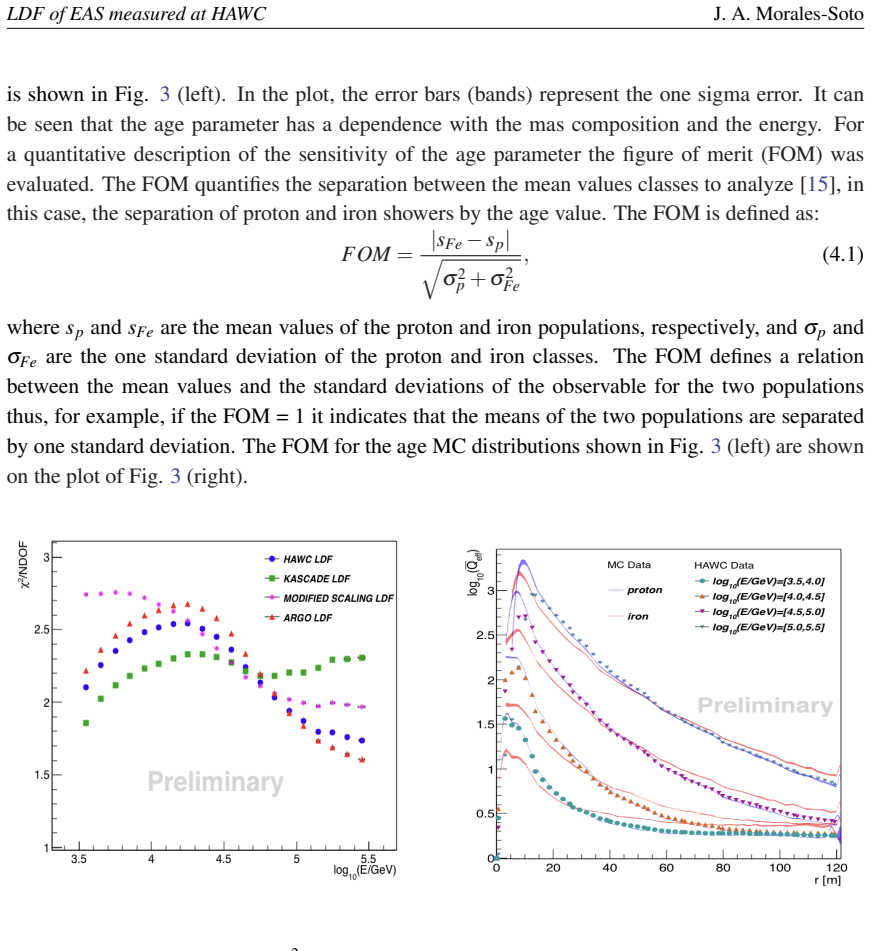
- [Sections 6 and 7] There is an internal inconsistency in the goodness-of-fit claim. Section 6 concludes that for E < 10^4.5 GeV Eqs. (3.3) and (3.2) give a better description and for E > 10^4.5 GeV Eqs. (3.5) and (3.2) fit better, while Section 7 states that none of the selected LDFs describes the measured data satisfactorily for all radial ranges and energies but that HAWC's LDF gives a good description in 10^3.5-10^5.5 GeV in comparison with the other LDFs. Since all example chi2/NDOF values in Fig. 1 exceed 1, 'best among the tested functions' and 'good description in an absolute sense' are different statements. The authors need to specify a pre-defined acceptance criterion for chi2/NDOF (or equivalent), discuss the statistical and systematic errors affecting the chi-square values, and reconcile the two statements with the same numbers.
- [Section 5 and Fig. 2 (right)] The comparison of the average lateral distributions with Monte Carlo predictions and the subsequent composition-sensitivity analysis are performed using only one high-energy hadronic interaction model, QGSJET-II-03, and only proton and iron primaries. The reconstructed energies also rely on the HAWC MC-based method described in [10], which introduces an additional model dependence into the comparison. Since the modified-scaling parameters beta, phi, and delta in Eq. (3.7) are stated to be derived from MC simulations, the comparison involving this LDF is partly circular. At minimum, the authors should state these caveats and quantify the effect of the interaction-model choice on the FOM values and on the energy dependence of the lateral age parameter.
minor comments (6)
- [Abstract and Section 2] The zenith-angle cuts are given as '< 16.7 degrees' in the abstract, 'θ < 16.71°' in Section 2, and 'θ < 16°' in the introduction; these should be made consistent.
- [Figure 1 caption] The caption states that the error bars represent both 'the error on the mean and the sigma error' without explaining which quantity is shown; please define both and indicate which is plotted.
- [Section 4] The fitting procedure does not specify the number of radial bins, the number of degrees of freedom, the treatment of bins with low occupancy, or how the mean effective charge and its variance are computed in each bin; these details are needed for the chi-square comparison to be reproducible.
- [Throughout] The name of the hadronic interaction model appears both as 'QGSJet-II-03' and 'QGSJET-II-03'; please use a single spelling consistently.
- [Introduction] The text contains a typo ('V olcano') and would benefit from a brief explanation of why the NKG lateral age parameter, originally derived for electromagnetic showers, is applicable to hadron-induced air showers in the TeV-PeV range.
- [Section 4, Eq. (4.1)] The FOM definition does not include systematic uncertainties from energy reconstruction, shower-core location, or PMT saturation; given that these potentially dominate at large radii and high energies, a sentence on the impact of these systematics on the FOM would be valuable.
Circularity Check
No significant circularity: the LDF comparison is an empirical fit to independent data, and the QGSJET-II-03 and FOM analyses are direct simulation-based tests rather than reductions to inputs.
full rationale
The paper's central derivation chain is data-driven and self-contained. The four LDFs are fitted directly to HAWC effective-charge distributions, and the ranking is based on the resulting chi-square per degree of freedom; the HAWC LDF is not assumed to be optimal but is tested against three literature forms. Equation (3.1) is an uncalibrated empirical error model that affects the fit-quality comparison, but this is an input systematic, not a circular step: the conclusion is not guaranteed by the error model, and the ranking could in principle change with a different model. The energy reconstruction is cited from the collaboration's own spectrum analysis [10], but that calibration does not contain or presuppose the paper's LDF result or its composition-sensitivity claim. The QGSJET-II-03 comparison in Fig. 2 (right) is a direct data-versus-simulation comparison; even though the same hadronic interaction model was used in the simulation and reconstruction calibration, the measured lateral distributions are not derived from the model's predictions. The FOM analysis is a simulation-based sensitivity estimate, not a claim that QGSJET-II-03 is uniquely correct, and the lateral age is obtained from fits rather than from the model as an input. No self-citation is load-bearing in a way that makes a prediction equivalent to its inputs. The internal tension in Section 7 between 'none of the selected LDFs describes satisfactorily' and 'HAWC's LDF gives a good description' is a possible logical or statistical inconsistency, but it is not circularity under the specified definitions.
Assumptions & free parameters
free parameters (4)
- Lateral age parameter s =
not quoted; obtained per energy bin
- Normalization factor A (or N, C) =
not quoted
- Modified scaling parameters beta, phi, delta =
beta=3.59, phi=0.19, delta=3.61
- Empirical charge error coefficients =
0.3, -0.06667, 0.1
assumptions (5)
- domain assumption The NKG function and the lateral age parameter, originally derived for electromagnetic cascades, can be applied to hadronic air showers.
- domain assumption The lateral age parameter is sensitive to the mass composition of primary cosmic rays.
- domain assumption QGSJET-II-03 and FLUKA describe hadronic interactions at HAWC energies, and the GEANT4-based detector simulation models HAWC response.
- domain assumption The HAWC event reconstruction and energy reconstruction from [5,10] are unbiased.
- ad hoc to paper The empirical error function (Eq. 3.1) gives correct uncertainties for Qeff.
Cite this review
Pith. "Pith review of The lateral distribution function of cosmic-ray induced air showers studied with the HAWC observatory." pith.science (2026). https://pith.science/paper/DYPPB7HV
@misc{pith2026190807930,
  author       = {Pith},
  title        = {Pith review of: The lateral distribution function of cosmic-ray induced air showers studied with the HAWC observatory},
  year         = {2026},
  howpublished = {\url{https://pith.science/paper/DYPPB7HV}},
  note         = {Machine review of arXiv:1908.07930}
}
abstract
The particle lateral distribution function (LDF) of air showers at a given altitude is sensitive to the mass composition and primary energy of cosmic rays. Studies of the LDF are difficult to perform due to experimental effects such as sampling bias, as well as shower-to-shower fluctuations in particle density. The High Altitude Water Cherenkov (HAWC) observatory, a dense air shower array located in central Mexico at 4100 m a.s.l., is well-suited to perform detailed event-by-event studies of the LDF of multi-TeV cosmic-ray showers. The detector is instrumented with 1,200 photomultipliers (PMTs) in close-packed water Cherenkov tanks containing a total of 60 ML of water. We present a study of the LDF of cosmic-ray air showers recorded by HAWC in 2016 with energies between 3 TeV and 300 TeV and zenith angle < 16.7$^{\circ}$. The data are used to determine the optimal parameterization of the LDF at the HAWC site. From here the lateral shower age is obtained and its sensitivity to the cosmic ray mass composition is analyzed.
Figures

Reference graph
Works this paper leans on
-
[10]
HAWC Collaboration, All-particle cosmic ray energy spectrum measured by the HAWC experiment from 10 to 500 TeV, Physical Review D, 96 (2017) [arXiv:1710.00890]
arXiv 2017
-
[1]
P. K. F. Grieder, Extensive Air Showers, Springer-Verlag, Berlin Heidelberg, 2010
work page 2010
-
[2]
Kamata and J
K. Kamata and J. Nishimura, Prog. of Theor. Phys. Supp. 6 (1958) 93
1958
-
[3]
Lecture notes on high energy cosmic rays
M. Kachelrieß, Lecture Notes on High Energy Cosmic Rays, 17.th Jyväsklyä Summer School (2017) [arXiv:0801.4376]
work page Pith review arXiv 2017
-
[4]
KASCADE Collaboration, Electron, Muon, and Hadron Lateral Distributions Measured in Air-Showers by the KASCADE Experiment, Astroparticle Physics 14 (2008) 1 [arXiv:astro-ph/0004233]
work page Pith review arXiv 2008
-
[5]
HAWC Collaboration, Observation of the Crab Nebula with the HAWC Gamma-Ray Observatory, The Astrophysical Journal, 843 (2017) 39 [arXiv:1701.01778]
arXiv 2017
-
[6]
Heck et al., Report No
D. Heck et al., Report No. FZKA 6019, Forschungszentrum Karlsruhe-Wissenhaltliche Berichte (1998)
1998
-
[7]
Ferrari, et al., CERN-2005-10 (2005), INFN/TC_05/11, SLAC-R-773; G
A. Ferrari, et al., CERN-2005-10 (2005), INFN/TC_05/11, SLAC-R-773; G. Battistoni et al., AIP Conference Proceedings 896 (2007) 31
work page 2005
Show all 15 references
-
[8]
Ostapchenko, Phys
S. Ostapchenko, Phys. Rev. D 83 (2011) 014018
2011
-
[9]
Agostinelli et al., NIMA 506 (2003) 250
S. Agostinelli et al., NIMA 506 (2003) 250
2003
-
[11]
Malone , The gamma-ray sky above 50 TeV with the HAWC Observatory, April Meeting of the American Physical Society, January 2017
K. Malone , The gamma-ray sky above 50 TeV with the HAWC Observatory, April Meeting of the American Physical Society, January 2017
2017
-
[12]
KASCADE Collaboration, Comparison of measured and simulated lateral distributions for electrons and muons with KASCADE, Astroparticle Physics 24 (2006) 467 [arXiv:astro-ph/0510810]
2006 arXiv
-
[13]
ARGO Collaboration, EAS age determination from the study of the lateral distribution of charged particles near the shower axis with the ARGO-YBJ experiment, Astroparticle Physics 93 (2017) 46 [arXiv:1707.01412]
2017 arXiv
-
[14]
R. I. Raikin et al., Raikin et al., Nucl. Phys. B (Proc. Suppl.) 175-176 (2008) 559-562
2008
-
[15]
E. M. Holt, F. K. Schröder and A. Haungs, Enhancing the cosmic-ray mass sensitivity of air-shower arrays by combining radio and muon detectors, The European Physical Journal C, 79 (2019) 371. 7
2019
Reviewed August 14, 2026 · model on record in the stance chip above.
Discussion (0). Continue with ORCID to comment.