REVIEW 4 major objections 5 minor 17 references
Design space exploration of Ferroelectric FET based Processing-in-Memory DNN Accelerator
T0 review · 4 major / 5 minor · reviewed 2026-08-14 · deepseek-v4-flash
Pith's one-line read FeFET nonlinearity cuts DNN accuracy by 7.5 points
desk verdict A useful FeFET-PIM design-space study with a genuine overparameterization insight, but the central HATI comparison is underspecified and the numbers conflict internally, so exact claims need a revision. read the letter →
The pith
A machine-rendered reading of the paper's core claim, the machinery that carries it, and where it could break.
The reading
What carries the argument
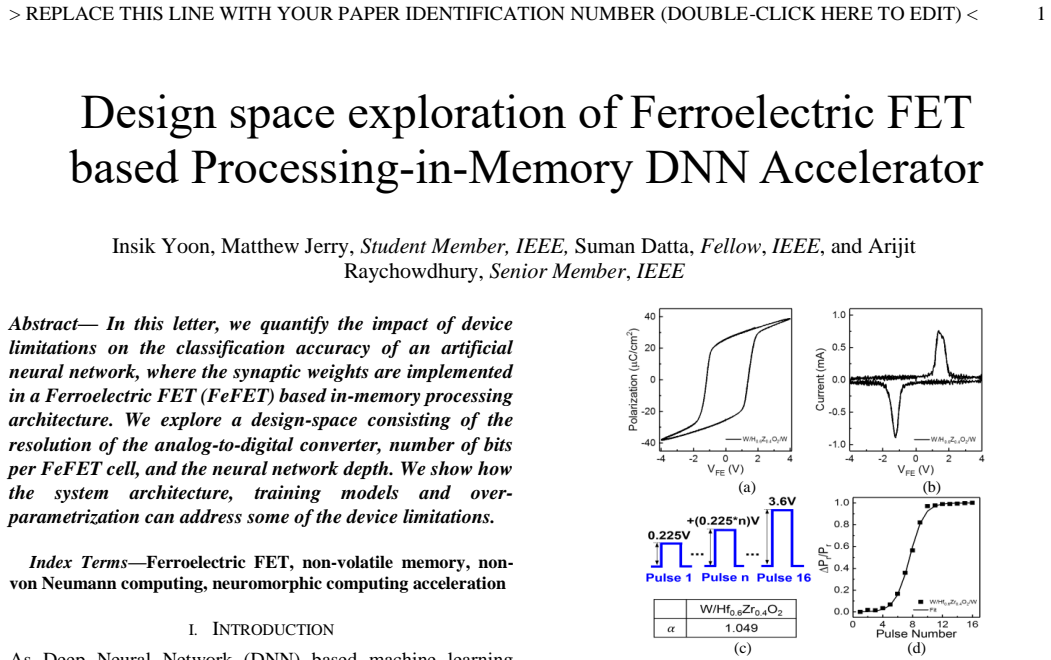
The central object is the sigmoidal conductance model of Eq. (1): $G(x) = G_{\min} + (G_{\max}-G_{\min})/(1+e^{-\alpha x})$, where $x$ is the pulse-amplitude-coded input and $\alpha$ quantifies the steepness and nonlinearity of the device's analog response. This model, validated against measured FeFET pulse data at $\alpha=0.4$, replaces the convex/concave curves used in earlier resistive-memory studies and is physically motivated by the Gaussian distribution of coercive fields in the HfZrO$_2$ ferroelectric. The other key mechanism is the differential FeFET cell, which stores positive and negative weights in two devices so that matrix-vector multiplication is computed in O(1) by summing column currents, enabling negative activations without a separate array.
What would settle it
Program the weights from a HATI-trained network (α=0.4) into an actual FeFET array and measure EMNIST accuracy; if the measured accuracy does not land near the simulated 67.38%, or if the fitted α values from devices processed at different anneal temperatures fall outside the swept 0.25–2.0 range, the sigmoidal model or the simulation's treatment of device behavior is wrong.
Extended reading notes
Core claim
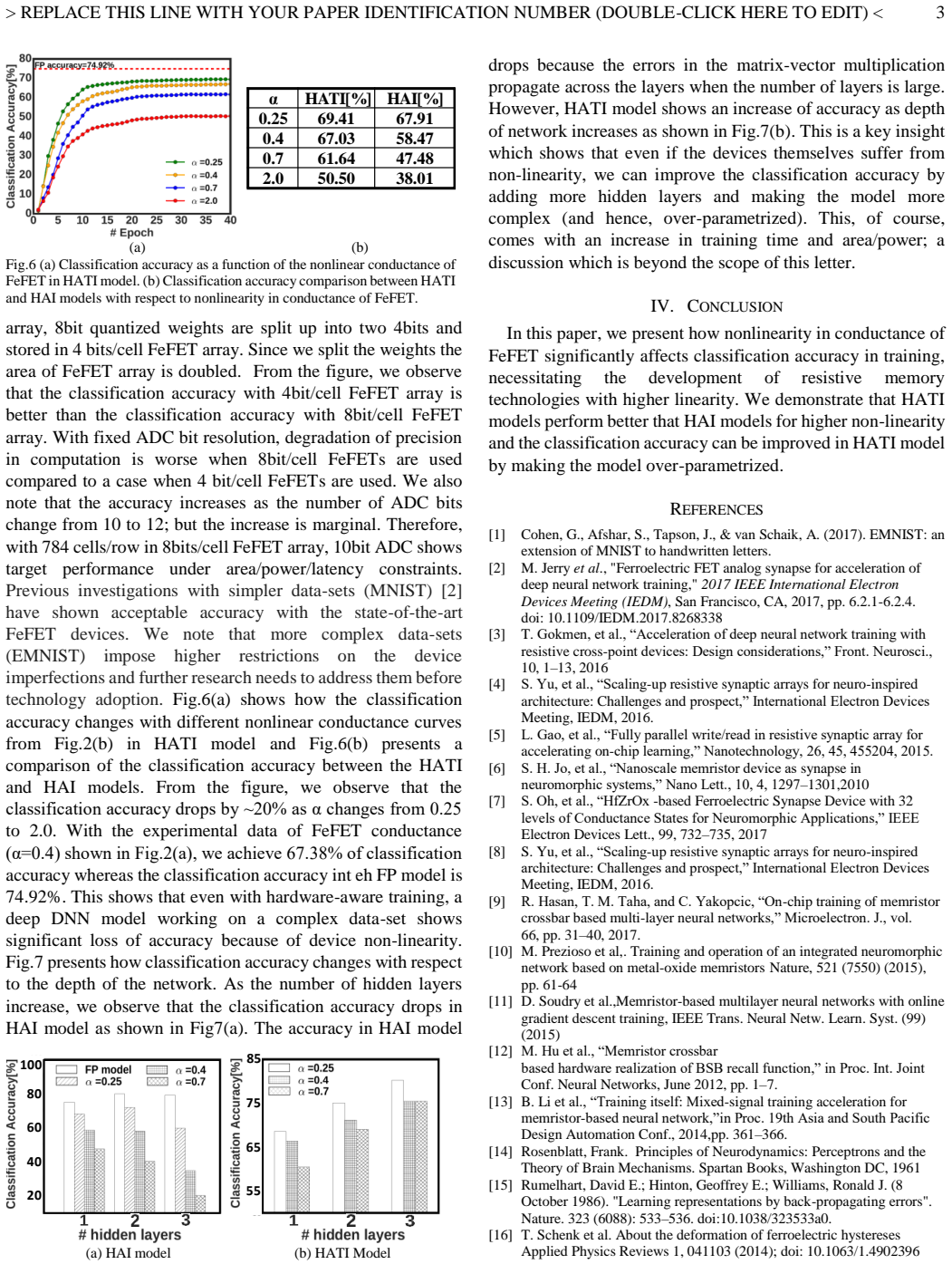
The paper claims that FeFET conductance as a function of write-pulse amplitude is sigmoidal rather than convex or concave, because it reflects the Gaussian distribution of coercive fields in the ferroelectric layer; this nonlinearity is captured by a parameter α that ranges from 0.25 to 2.0. With this model, the authors show that classifying EMNIST with a fully connected network stored in FeFET cells loses about 20% accuracy as α varies from 0.25 to 2.0, and that even the best hardware-aware-trained network (α=0.4) reaches 67.38% versus the 74.92% floating-point baseline. They further demonstrate that splitting an 8-bit weight across two 4-bit FeFET cells beats storing it in one 8-bit cell, that a 10-bit ADC captures nearly all available accuracy, and that increasing the number of hidden layers helps HATI but hurts HAI because errors accumulate in the hardware-agnostic case.
Load-bearing premise
The sigmoidal conductance curve with a single fitted parameter α, validated only at α=0.4, is assumed to capture real FeFET behavior over the whole α range and across all operating conditions; if the true device response is asymmetric, noisier, or differently shaped, the accuracy numbers and design conclusions shift.
Editorial extensions
If this is right
- With the measured FeFET nonlinearity (α=0.4), even hardware-aware training leaves a roughly 7.5-point accuracy gap to a floating-point network on EMNIST (67.38% vs 74.92%).
- Splitting an 8-bit weight into two 4-bit FeFET cells yields higher accuracy than a single 8-bit cell, at the cost of doubling the array area.
- A 10-bit ADC is sufficient; going to 12 bits gives only marginal accuracy gains.
- Deeper, over-parametrized networks improve HATI accuracy but degrade HAI accuracy, so design should pair deeper networks with hardware-aware training.
- Nonlinearity has a strong effect: changing α from 0.25 to 2.0 drops accuracy by about 20%, so more linear devices remain desirable.
Reading between the lines
- The same over-parametrization plus hardware-aware training recipe likely extends to convolutional and residual networks, where the error-propagation effect of device nonlinearity may differ across layers; the paper does not test those architectures.
- Because the sigmoidal model ties α to the coercive-field distribution, process-level engineering of that distribution or write-verify pulse schemes could linearize the effective conductance more cheaply than requiring intrinsically linear devices.
- The study ignores cycle-to-cycle variation, read noise, and endurance; if those correlate with α, the reported HATI accuracy numbers may be optimistic in hardware.
- The differential cell's support for negative activations suggests tanh or leaky-ReLU networks may interact differently with nonlinearity than the sigmoid-equipped networks studied, so the depth result may not directly transfer to such networks.
Signed reviews
Editorial analysis
A structured set of objections, weighed in public.
Referee Report
Summary. The paper presents a simulation-based design-space exploration of a Ferroelectric FET (FeFET) processing-in-memory DNN accelerator for the EMNIST Balanced dataset. The authors model FeFET conductance as a sigmoidal function of write-pulse count with a single nonlinearity parameter alpha, compare three schemes (floating-point baseline, hardware-aware inference HAI, and hardware-aware training and inference HATI), and vary the ADC resolution, number of bits per FeFET cell, and network depth. The main claims are that conductance nonlinearity degrades accuracy, that HATI partially recovers the loss relative to HAI, that 4-bit/cell split-cell arrays outperform 8-bit/cell arrays, and that over-parametrization via additional hidden layers helps HATI models.
Significance. If the results hold, the paper provides a useful first-order quantitative mapping between FeFET device nonlinearity and achievable DNN accuracy, and it makes concrete, falsifiable design suggestions (e.g., 10-bit ADC is sufficient, HATI is preferable at high nonlinearity, deeper HATI networks are more robust). The strengths are the use of a physically motivated sigmoidal conductance model calibrated to the authors' prior experimental device, the explicit comparison of HAI versus HATI, and the exploration of a multi-dimensional design space. However, the central HATI mechanism is not specified, the accuracy differences supporting the 4-bit/cell conclusion are small, and no statistical repeats are provided, so the quantitative claims should be treated as preliminary until the training procedure is fully described.
major comments (4)
- [Sec. II-C and Sec. III, Fig. 6] The HATI model is defined in a single sentence: "both training and inference are done on the FeFET PIM." No loss function, optimizer, gradient computation method, weight-programming rule, or quantization-aware training procedure is given. This matters because Eq. (1) describes conductance as a sigmoidal function of write-pulse count; HATI could mean continuous weight optimization with pulse mapping only at inference, or pulse-based updates whose nonlinearity enters the learning dynamics, and these choices yield different accuracy results. The paper's central claim that HATI outperforms HAI at alpha=0.4 cannot be verified or reproduced until this training algorithm is fully specified.
- [Sec. III, text and Fig. 6] The reported HATI accuracy for alpha=0.4 is inconsistent: the main text states 67.38%, while the table in Fig. 6(b) reports 67.03%. Since this specific configuration anchors the paper's headline comparison with the 74.92% floating-point baseline, the discrepancy must be resolved and all numerical values cross-checked.
- [Sec. III, Fig. 5] The conclusion that 4-bit/cell FeFET arrays outperform 8-bit/cell arrays relies on splitting 8-bit weights into two 4-bit cells, which doubles the array area. Some of the reported differences are small (e.g., 66.02% vs. 65.54% at alpha=0.25, ADC=8 bits), and no statistical repeats or error bars are reported. The claim needs either a significance analysis or an explicit statement of whether the comparison is for a fixed total area/energy budget rather than a per-cell precision comparison.
- [Sec. II-A, Eq. (1), Fig. 2] The sigmoidal conductance model is fitted to one measured device with alpha=0.4, and alpha is then varied from 0.25 to 2.0 without experimental validation or a physical mapping for those values. Because the design-space conclusions depend on the functional form of Eq. (1), the authors should either validate the model across the alpha range or provide a sensitivity analysis showing that the main conclusions are robust to alternative nonlinearity models (e.g., convex/concave power-law or exponential forms).
minor comments (5)
- [Equations] Equations (1) and (2) are garbled in the submitted text and should be typeset clearly with their symbols and bounds defined in the caption.
- [Sec. III] There is a typo on "int eh" that should read "in the", and the text contains other minor spelling issues such as "Kirchoff's" for "Kirchhoff's."
- [References] Reference [8] appears to duplicate reference [4]; the bibliography should be deduplicated and checked for completeness.
- [Sec. II-C] The HAI description states that weights are scaled to [-1,1] during training, but it is not stated how the trained weights are quantized to the number of cell states or how the ADC conversion and sigmoid activation are implemented in the simulation. These details should be added for reproducibility.
- [Sec. III, Fig. 7] Figure 7 lacks a legend or explicit caption labels for the curves; the figure should be annotated so the reader can identify the configurations being compared.
Circularity Check
No significant circularity; the design-space conclusions are forward simulation outputs, not constructed from their targets.
full rationale
The paper's central quantitative claims—accuracy degradation with FeFET nonlinearity alpha, ADC resolution, bits/cell, network depth, and the HAI versus HATI comparison—are outputs of a forward simulation over device and circuit non-idealities, not quantities fitted to those same claims. The conductance model in Eq. (1) is parameterized by alpha, but alpha is an input swept from 0.25 to 2.0, and no accuracy number is used to determine alpha; the alpha=0.4 value is anchored to measured FeFET data shown in Fig.1 and Fig.2(a). The self-citation [2] supplies experimental/fabrication details and is corroborated within the paper by displayed measured polarization, transient current, and model-data comparison, so the citation is not a self-referential chain that forces the result. The floating-point baseline is an external EMNIST training result and provides an independent benchmark. The HATI implementation is under-specified (Sec. II-C: 'both training and inference are done on the FeFET PIM'), and the text/table discrepancy (67.38% versus 67.03% at alpha=0.4) is an internal inconsistency; however, these are reproducibility and correctness risks, not circular reductions, because no equation, fitted parameter, or training procedure is defined in terms of the accuracy it is claimed to predict. Therefore no circular step is identified.
Assumptions & free parameters
free parameters (1)
- alpha (conductance nonlinearity) =
0.4 (experimental fit); varied 0.25 to 2.0
assumptions (4)
- domain assumption The sigmoidal conductance model (Eq. 1) accurately represents FeFET conductance response to write pulses.
- domain assumption The TensorFlow simulation with device/circuit/architecture models captures the non-idealities of the PIM implementation sufficiently for the stated accuracy comparisons.
- standard math The differential cell read operation implements an accurate analog matrix-vector product via Kirchoff's current summation.
- domain assumption EMNIST Balanced is a meaningful benchmark for real-world FeFET PIM design.
Cite this review
Pith. "Pith review of Design space exploration of Ferroelectric FET based Processing-in-Memory DNN Accelerator." pith.science (2026). https://pith.science/paper/7VSDB5II
@misc{pith2026190807942,
  author       = {Pith},
  title        = {Pith review of: Design space exploration of Ferroelectric FET based Processing-in-Memory DNN Accelerator},
  year         = {2026},
  howpublished = {\url{https://pith.science/paper/7VSDB5II}},
  note         = {Machine review of arXiv:1908.07942}
}
read the original abstract
In this letter, we quantify the impact of device limitations on the classification accuracy of an artificial neural network, where the synaptic weights are implemented in a Ferroelectric FET (FeFET) based in-memory processing architecture. We explore a design-space consisting of the resolution of the analog-to-digital converter, number of bits per FeFET cell, and the neural network depth. We show how the system architecture, training models and overparametrization can address some of the device limitations.
Figures

Reference graph
Works this paper leans on
-
[1]
Cohen, G., Afshar, S., Tapson, J., & van Schaik, A. (2017). EMNIST: an extension of MNIST to handwritten letters
work page 2017
-
[2]
Ferroelectric FET analog synapse for acceleration of deep neural network training,
M. Jerry et al., "Ferroelectric FET analog synapse for acceleration of deep neural network training," 2017 IEEE International Electron Devices Meeting (IEDM), San Francisco, CA, 2017, pp. 6.2.1-6.2.4. doi: 10.1109/IEDM.2017.8268338
arXiv 2017
-
[3]
T. Gokmen, et al., “Acceleration of deep neural network training with resistive cross-point devices: Design considerations,” Front. Neurosci., 10, 1–13, 2016
work page 2016
-
[5]
Fully parallel write/read in resistive synaptic array for accelerating on-chip learning,
L. Gao, et al., “Fully parallel write/read in resistive synaptic array for accelerating on-chip learning,” Nanotechnology, 26, 45, 455204, 2015
work page 2015
-
[6]
Nanoscale memristor device as synapse in neuromorphic systems,
S. H. Jo, et al., “Nanoscale memristor device as synapse in neuromorphic systems,” Nano Lett., 10, 4, 1297–1301,2010
work page 2010
-
[7]
S. Oh, et al., “HfZrOx -based Ferroelectric Synapse Device with 32 levels of Conductance States for Neuromorphic Applications,” IEEE Electron Devices Lett., 99, 732–735, 2017
work page 2017
-
[8]
Scaling-up resistive synaptic arrays for neuro-inspired architecture: Challenges and prospect,
S. Yu, et al., “Scaling-up resistive synaptic arrays for neuro-inspired architecture: Challenges and prospect,” International Electron Devices Meeting, IEDM, 2016
work page 2016
-
[9]
On-chip training of memristor crossbar based multi-layer neural networks,
R. Hasan, T. M. Taha, and C. Yakopcic, “On-chip training of memristor crossbar based multi-layer neural networks,” Microelectron. J., vol. 66, pp. 31–40, 2017
work page 2017
Show all 17 references
-
[10]
Prezioso et al,
M. Prezioso et al,. Training and operation of an integrated neuromorphic network based on metal-oxide memristors Nature, 521 (7550) (2015), pp. 61-64
2015
-
[11]
Soudry et al.,Memristor-based multilayer neural networks with online gradient descent training, IEEE Trans
D. Soudry et al.,Memristor-based multilayer neural networks with online gradient descent training, IEEE Trans. Neural Netw. Learn. Syst. (99) (2015)
2015
-
[12]
Memristor crossbar based hardware realization of BSB recall function,
M. Hu et al., “Memristor crossbar based hardware realization of BSB recall function,” in Proc. Int. Joint Conf. Neural Networks, June 2012, pp. 1–7
2012
-
[13]
Training itself: Mixed-signal training acceleration for memristor-based neural network,
B. Li et al., “Training itself: Mixed-signal training acceleration for memristor-based neural network,”in Proc. 19th Asia and South Pacific Design Automation Conf., 2014,pp. 361–366
2014
-
[14]
Principles of Neurodynamics: Perceptrons and the Theory of Brain Mechanisms
Rosenblatt, Frank. Principles of Neurodynamics: Perceptrons and the Theory of Brain Mechanisms. Spartan Books, Washington DC, 1961
1961
-
[15]
Learning representations by back-propagating errors
Rumelhart, David E.; Hinton, Geoffrey E.; Williams, Ronald J. (8 October 1986). "Learning representations by back-propagating errors". Nature. 323 (6088): 533–536. doi:10.1038/323533a0
1986 doi
-
[16]
Schenk et al
T. Schenk et al. About the deformation of ferroelectric hystereses Applied Physics Reviews 1, 041103 (2014); doi: 10.1063/1.4902396 (a) HAI model (b) HATI Model Fig. 7. Classification accuracy for FeFET array (8 bit/cell and 10bit ADC) as a function of the number of hidden lay...
2014 doi
-
[17]
Efficient BackProp
LeCun, Yann et al., “Efficient BackProp” Neural Networks: Tricks of the Trade, This Book is an Outgrowth of a 1996 NIPS Workshop, 1998, pages:9-50, isbn :3-540-65311-2
1996
-
[18]
Rectifier nonlinearities improve neural network acoustic models
Andrew L. Maas et al., “Rectifier nonlinearities improve neural network acoustic models” n ICML Workshop on Deep Learning for Audio, Speech and Language Processing, 2013
2013
Reviewed August 14, 2026 · model on record in the stance chip above.
Discussion (0). Continue with ORCID to comment.