REVIEW 3 major objections 4 minor 29 references
The effects of ecological selection on species diversity and trait distribution: predictions and an empirical test
T0 review · 3 major / 4 minor · reviewed 2026-08-14 · deepseek-v4-flash
Pith's one-line read Trait statistics plus diversity identify the type of selection.
desk verdict Useful framework with a clean simulation result; the empirical test is less clean than the title suggests, but the limitations are acknowledged. read the letter →
The pith
A machine-rendered reading of the paper's core claim, the machinery that carries it, and where it could break.
The reading
What carries the argument
The load-bearing piece is a pair of null comparisons plus a fitness model. In the model, the Lorentzian function $\omega_i = 1/(1+\theta(\delta_{\mathrm{best}}-\delta_i)^2)$ maps each species' trait value $\delta_i$ to its ecological fitness, where $\theta$ sets selection strength and $\delta_{\mathrm{best}}$ is the optimal trait value; the framework then reads CWM as a marker of the optimum's location (selection type), CWV as a marker of how steeply fitness declines with distance from the optimum (selection strength), and species diversity as the total filtering intensity. The empirical nulls are constructed by shuffling trait values across species within the observed abundance distribution (for CWM and CWV) and by a pure-drift simulation (for diversity).
What would settle it
Measure an additional trait correlated with seed mass in the productive habitat and build the same trait-shuffling null for it; if that trait's CWV also lies below its null while seed mass CWV does not, the case that seed mass itself was the selected trait would collapse.
Extended reading notes
Core claim
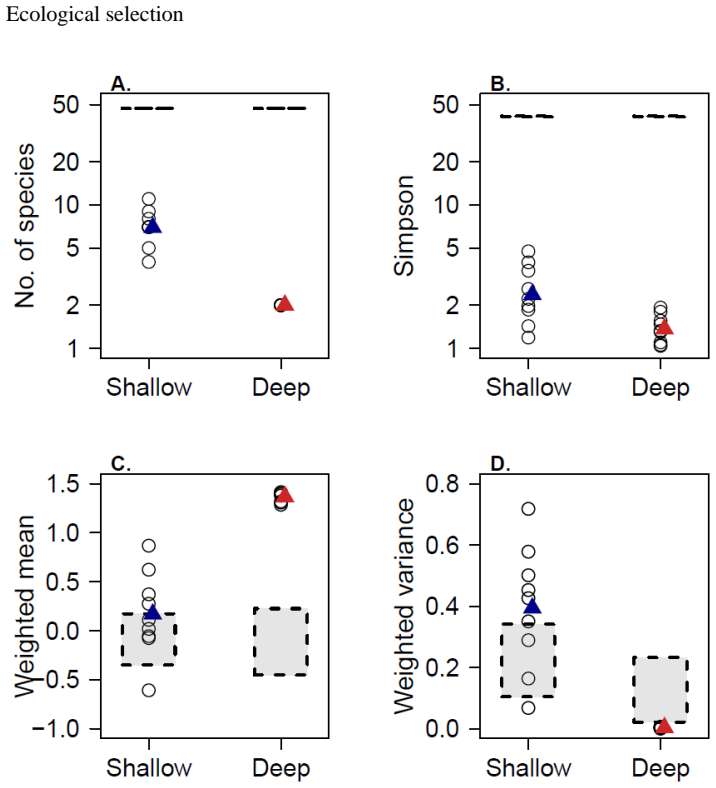
The central claim is that selection type and strength can be recovered by comparing three community statistics to null expectations built from the species pool: species diversity, which falls under any selection; the community-weighted mean trait value (CWM), which shifts away from the pool mean only under directional selection; and the community-weighted variance (CWV), which falls with selection strength under either type. The simulation shows that because a normal species pool contains more species near the intermediate optimum, stabilizing selection preserves more diversity at a given strength, whereas directional selection, favoring only species at one extreme, drives more species extinct. In the mesocosm data, both habitats have diversity below the drift null, but only the productive habitat shows elevated CWM and reduced CWV, supporting directional selection for large seeds; the less productive habitat's elevated CWV points to coexistence of different seed sizes rather than seed-mass filtering.
Load-bearing premise
The empirical attribution to seed mass assumes that shuffling seed masses among species within the observed community yields the right null, so it cannot distinguish selection on seed mass from selection on any unmeasured trait correlated with seed mass.
Editorial extensions
If this is right
- Whenever a community's diversity falls below the drift null, selection has acted; if CWV of a trait also falls below its null, that trait is implicated, and a CWM shift signs the direction of selection.
- At equal selection strength, directional selection should leave a community less diverse than stabilizing selection, so across-habitat diversity gaps become a rough gauge of selection directionality.
- Along environmental gradients, species diversity and CWV should track each other when selection strength varies, but decouple when the gradient mostly flips stabilizing to directional selection.
- A CWV above the trait-shuffling null can flag niche partitioning on the measured trait, as inferred for the less productive habitat.
- The framework is cleanest in closed experimental systems, since blocking dispersal removes the confounding between reproductive output and colonizing ability.
Reading between the lines
- The same logic could be applied to multiple traits at once: if CWM shifts only along one trait axis, the analysis localizes the trait under directional selection even when the true selective environment is unknown.
- The diversity gap between selection types suggests a testable experimental prediction for any system with a manipulable trait–fitness map: rotate trait values among species and the gap should shrink or disappear when pool trait geometry is destroyed.
- A CWV-above-null result in other empirical systems could be used as a distributional signal for competition–colonization trade-offs, since such trade-offs maintain high trait variance in low-stress habitats without invoking stabilizing selection on the trait itself.
Signed reviews
Editorial analysis
A structured set of objections, weighed in public.
Referee Report
Summary. The paper proposes a framework for inferring the type (stabilizing vs. directional) and strength of ecological selection by jointly comparing species diversity, community-weighted mean (CWM), and community-weighted variance (CWV) of a trait against null expectations. A spatially implicit metacommunity simulation shows that, at equal selection strength, directional selection reduces species diversity more than stabilizing selection while both reduce CWV, and that CWM deviation indicates directionality. The framework is applied to a mesocosm experiment of annual plants in two soil-depth habitats: species diversity was lower than the drift null in both habitats and lower in the productive habitat, CWM of seed mass was higher and CWV lower than the trait-shuffling null in the productive habitat (interpreted as directional selection for large seeds), while in the less productive habitat CWV was higher than the null (interpreted as niche partitioning). The authors conclude that simultaneous analysis of diversity and traits helps identify selection processes.
Significance. If the framework holds, it offers a practical way to infer ecological selection attributes from commonly measured community-level data. The simulation result that directional selection reduces diversity more than stabilizing selection at equal strength is a useful, nontrivial prediction that is robust to alternative trait distributions, fitness functions, and temporal scales, as shown by extensive supplementary analyses. The empirical case study demonstrates the framework's application to real data and highlights a potential link between productivity, seed mass selection, and diversity. However, the empirical attribution to seed mass is compromised by an identifiability problem that the authors acknowledge but do not resolve, and the less-productive-habitat result falls outside the proposed decision framework. The theoretical contribution is solid; the empirical inference needs substantial reframing or additional analysis to support the paper's central claim.
major comments (3)
- [Methods, 'Mesocosm experiment' paragraph; Appendix S1, Fig. S10] The empirical attribution of the observed CWM/CWV pattern to selection on seed mass is not identifiable from the trait-shuffling null used. The null randomizes seed mass among species within the observed abundance distribution, which controls for abundance and dominance but does not control for correlations between seed mass and unmeasured traits. If selection acts on an unmeasured trait correlated with seed mass, surviving species will be similar in that unmeasured trait and, because of the correlation, also similar in seed mass, generating exactly the observed decrease in CWV and shift in CWM. The authors acknowledge in the Methods that 'a decrease in CWV could be driven by a selection acting on a different uncorrelated trait,' and Appendix S1 Fig. S10 simulates a wrong-trait scenario, but that simulation permutes fitness to be uncorrelated with the measured trait and does not apply the trait-shuffling null; it neither addresses the correlated-trait case nor provides a way to rule it out empirically. Consequently, the claim that the productive habitat experienced directional selection specifically on seed mass is not uniquely supported by the data; it is equally compatible with selection on any trait sufficiently correlated with seed mass.
- [Results, 'Mesocosm experiment'; Discussion, 'Interpretation of the mesocosm experiment'; Fig. 2 decision scheme] The finding in the less productive habitat that CWV is higher than the null expectation lies outside the proposed decision framework. The framework in Fig. 2 only specifies interpretations for CWV lower than or not different from the null expectation; a higher-than-expected CWV is not part of the scheme. The authors interpret this result as evidence for niche partitioning and limiting similarity in seed mass, but this interpretation is post hoc and is not derived from the simulation model, which assumes frequency-independent selection only. No formal test or model is presented to distinguish niche partitioning from other processes that could inflate CWV relative to the trait-shuffling null (e.g., environmental heterogeneity within a treatment or sampling artifacts). This gap weakens the claim that the framework can jointly explain diversity and trait patterns across both habitats.
- [Fig. 2 and Methods, 'Mesocosm experiment'] The logical chain from observed patterns to selection type relies on a sequential decision rule (diversity lower than null → selection; CWV lower than null → trait-specific selection; CWM deviation → directional vs. stabilizing). However, the two null models are constructed differently: diversity is compared to a dynamic drift simulation with no trait-based selection, while CWM/CWV are compared to trait-shuffling nulls that condition on the observed abundances. Because the observed abundances are themselves a product of selection, the trait-shuffling null does not represent the 'no selection on this trait' expectation under the same community-level constraints. This mismatch means that the two steps of the decision rule are not testing the same null hypothesis, and the inference of selection type/strength is not as direct as Fig. 2 implies. The authors should clarify what biological question each null answers and address whether the sequential rule is valid when abundances are selected.
minor comments (4)
- [Discussion, first paragraph] The sentence 'In both habitats, selection has taken place, as indicated by species diversity being lower than the null expectation (Fig. 2)' cites Fig. 2, which is the conceptual scheme, but the relevant empirical results are in Fig. 4; the citation should be corrected.
- [Appendix S2, Table S1] The species list contains an apparent typo: 'Papaveraceaer umbonatum' should likely be 'Papaver umbonatum' or similar; the family abbreviation is also inconsistent.
- [Methods, 'Simulation model'] The description of the trait-shuffling null would benefit from explicitly stating whether the randomization is constrained to preserve the species pool's trait distribution and whether the observed abundances are held fixed; the current text is ambiguous about how the null accounts for the nine replicate communities.
- [Figure 3 and Appendix S1] Several supplementary figures (e.g., S4-S6, S9) are described as showing results 'qualitatively similar' to the main simulation, but no quantitative comparison or effect-size metric is provided; a brief statement of the range of deviations would strengthen the robustness claim.
Circularity Check
No significant circularity; simulation-derived predictions and empirical nulls are independent of each other.
full rationale
The central claim—directional selection reduces diversity more than stabilizing selection at equal strength—is produced by an explicit metacommunity simulation (Eqs. 1-2) with fixed parameters (Table 1), none of which are fitted to the mesocosm data. The empirical test uses two distinct nulls: a drift simulation with theta=0 for diversity, and trait shuffling for CWM/CWV. Neither null contains the quantity being predicted; the trait-shuffling null conditions on observed abundances but randomly reassigns seed mass, so the observed CWM/CWV deviations are not imposed by construction. The CWM/CWV-to-selection-type mapping is definitionally motivated but is verified in the simulation rather than assumed as an empirical result. Self-citations (DeMalach and Kadmon 2018; DeMalach et al. 2019) provide prior theoretical and empirical context for expecting seed-mass selection, but the current simulation and null tests do not reduce to those citations. The acknowledged wrong-trait scenario (Appendix S1) is an identifiability caveat—selection on an unmeasured trait can mimic the signal—not a circular reduction of the paper's predictions to its inputs. No equation in the paper is equivalent by construction to the claimed prediction, and no fitted parameter is renamed as a prediction.
Assumptions & free parameters
free parameters (5)
- theta (selection strength sweep) =
10^-3 to 10^3
- Dispersal proportion D =
10^-3
- Immigration proportion I =
5 x 10^-4
- Trait SD of species pool (delta_SD) =
0.5 (robustness: 0.1, 1, uniform)
- Species pool size in drift null model =
47
assumptions (5)
- domain assumption Trait differences among species reflect competitive hierarchy instead of niche partitioning (frequency-independent selection).
- domain assumption The species pool trait distribution is unimodal and normally distributed in the main simulation.
- domain assumption Fitness is a Lorentzian function of trait distance from an optimum, with strength theta.
- domain assumption The diversity null model for the mesocosm treats the system as closed drift with theta=0, D=0, I=0, and a 47-species pool.
- domain assumption Shuffling seed mass among species within the observed abundance distribution provides a valid null for trait-specific selection.
Cite this review
Pith. "Pith review of The effects of ecological selection on species diversity and trait distribution: predictions and an empirical test." pith.science (2026). https://pith.science/paper/7OTGYNOI
@misc{pith2026190807960,
  author       = {Pith},
  title        = {Pith review of: The effects of ecological selection on species diversity and trait distribution: predictions and an empirical test},
  year         = {2026},
  howpublished = {\url{https://pith.science/paper/7OTGYNOI}},
  note         = {Machine review of arXiv:1908.07960}
}
read the original abstract
Ecological selection is a major driver of community assembly. Selection is classified as stabilizing when species with intermediate trait values gain the highest reproductive success, whereas selection is considered directional when fitness is highest for species with extreme trait values. Previous studies have investigated the effects of different selection types on trait distribution, but the effects of selection on species diversity have remained unclear. Here, we propose a framework for inferring the type and strength of selection by studying species diversity and trait distribution together against null expectations. We use a simulation model to confirm our prediction that directional selection should lead to lower species diversity than stabilizing selection despite a similar effect on trait community-weighted variance. We apply the framework to a mesocosm system of annual plants to test whether differences in species diversity between two habitats that vary in productivity are related to differences in selection on seed mass. We show that, in both habitats, species diversity was lower than the null expectation, but that species diversity was lower in the more productive habitat. We attribute this difference to strong directional selection for large-seeded species in the productive habitat as indicated by trait community-weighted-mean being higher and community-weighted variance being lower than the null expectations. In the less productive habitat, we found that community-weighted variance was higher than expected by chance, suggesting that seed mass could be a driver of niche partitioning under such conditions. Altogether, our results suggest that viewing species diversity and trait distribution as interrelated patterns driven by the same process, ecological selection, is helpful in understanding community assembly.
Figures


Reference graph
Works this paper leans on
-
[1]
Botta-Dukát, Z. 2005. Rao’s quadratic entropy as a measure of functional diversity based on multiple traits. Journal of Vegetation Science 16:533–540
work page 2005
-
[2]
Cadotte, M. W., K. Carscadden, and N. Mirotchnick. 2011. Beyond species: functional diversity and the maintenance of ecological processes and services. Journal of Applied Ecology 48:1079–1087
work page 2011
- [3]
-
[4]
Chesson, P. 2000. Mechanisms of maintenance of species diversity. Annual Review of Ecology and Systematics 31:343–366
work page 2000
-
[5]
Coomes, D. A., and P. J. Grubb. 2003. Colonization, tolerance, competition and seed-size variation within functional groups. Trends in Ecology & Evolution 18:283–291. D’Andrea, R., and J. P. O’Dwyer. 2021. Competition for space in a structured landscape: The effect of seed limitation on coexistence under a tolerance‐fecundity trade‐off. Journal of Ecology...
work page 2003
-
[6]
DeMalach, N., and R. Kadmon. 2018. Seed mass diversity along resource gradients: the role of allometric growth rate and size-asymmetric competition. Ecology 99:2196–2206
work page 2018
-
[7]
DeMalach, N., R. Ron, and R. Kadmon. 2019. Mechanisms of seed mass variation along resource gradients. Ecology Letters 22:181–189
work page 2019
-
[8]
Joswig, A. Guenther, V. Falczuk, N. Rueger, M. D. Mahecha, and L. D. Gorne. 2016. The global spectrum of plant form and function. Nature 529:167-U73
work page 2016
Show all 29 references
-
[9]
Geritz, S. A. H., E. van der Meijden, and J. A. J. Metz. 1999. Evolutionary dynamics of seed size and seedling competitive ability. Theoretical Population Biology 55:324–343
1999
-
[10]
Grime, J. P. 1979. Plant Strategies and Vegetation Processes. J. Wiley and Sons, Chichester, UK
1979
-
[11]
HilleRisLambers, J., P. B. Adler, W. S. Harpole, J. M. Levine, and M. M. Mayfield. 2012. Rethinking Community Assembly through the Lens of Coexistence Theory. Annual Review of Ecology, Evolution, and Systematics, Vol 43 43:227–248
2012
-
[12]
Huston, M. A. 1994. Biological diversity: the coexistence of species. Cambridge University
1994
-
[13]
Laliberté, E., and P
Press, Cambridge UK. Laliberté, E., and P. Legendre. 2010. A distance-based framework for measuring functional diversity from multiple traits. Ecology 91:299–305
2010
-
[14]
Letten, A. D., S. Kathleen Lyons, and A. T. Moles. 2013. The mid-domain effect: it’s not just Ecological selection about space. Journal of Biogeography 40:2017–2019
2013
-
[15]
Munoz, B
Loranger, J., F. Munoz, B. Shipley, and C. Violle. 2018. What makes trait-abundance relationships when both environmental filtering and stochastic neutral dynamics are at play? Oikos 127:1735–1745
2018
-
[16]
H., and M
Lowe, W. H., and M. A. McPeek. 2014. Is dispersal neutral? Trends in Ecology & Evolution 29:444–450
2014
-
[17]
Macarthur, R., and R. Levins. 1967. The limiting similarity, convergence, and divergence of coexisting species. The American Naturalist 101:377–385
1967
-
[18]
Mayfield, M. M., S. P. Bonser, J. W. Morgan, I. Aubin, S. McNamara, and P. A. Vesk. 2010. What does species richness tell us about functional trait diversity? Predictions and evidence for responses of species and functional trait diversity to land-use change. Global Ecology An...
2010
-
[19]
Muller-Landau, H. C. 2010. The tolerance-fecundity trade-off and the maintenance of diversity in seed size. Proceedings of the National Academy of Sciences of the United States of America 107:4242–4247
2010
-
[20]
Muscarella, R., and M. Uriarte. 2016. Do community-weighted mean functional traits reflect optimal strategies? Proceedings of the Royal Society B: Biological Sciences 283
2016
-
[21]
Rapacciuolo, G., C. H. Graham, J. Marin, J. E. Behm, G. C. Costa, S. B. Hedges, M. R. Helmus, V. C. Radeloff, B. E. Young, and T. M. Brooks. 2019. Species diversity as a surrogate for conservation of phylogenetic and functional diversity in terrestrial vertebrates across the A...
2019
-
[22]
Rees, M., and M. Westoby. 1997. Game-theoretical evolution of seed mass in multi-species ecological models. Oikos 78:116–126
1997
-
[23]
G., and E
Rolhauser, A. G., and E. Pucheta. 2017. Directional, stabilizing, and disruptive trait selection as alternative mechanisms for plant community assembly. Ecology 98:668–677
2017
-
[24]
Fragman-Sapir, and R
Ron, R., O. Fragman-Sapir, and R. Kadmon. 2018. The role of species pools in determining species diversity in spatially heterogeneous communities. Journal of Ecology 106:1023– 1032
2018
-
[25]
Shipley, B. 2010. From plant traits to vegetation structure: chance and selection in the assembly of ecological communities. Cambridge University Press
2010
-
[26]
De Bello, J
Shipley, B., F. De Bello, J. H. C. Cornelissen, E. Laliberte, D. C. Laughlin, and P. B. Reich. 2016. Reinforcing loose foundation stones in trait-based plant ecology. Oecologia 180:923– 931
2016
-
[27]
Tilman, D. 1982. Resource competition and community structure. Monographs in population biology 17:1–296
1982
-
[28]
Vellend, M. 2010. Conceptual synthesis in community ecology. The Quarterly Review of Biology 85:183–206
2010
-
[29]
Vellend, M. 2016. The theory of ecological communities (MPB-57). Princeton University Press. Ecological selection FIGURES & TABLES Figure 1: Illustration of stabilizing and directional trait selection in ecological communities. The blue curves represent the ecological fitness ...
2016
Reviewed August 14, 2026 · model on record in the stance chip above.
Discussion (0). Continue with ORCID to comment.