REVIEW 3 major objections 3 minor 54 references
Bloch wave approach to almost periodic homogenization and approximations of effective coefficients
T0 review · 3 major / 3 minor · reviewed 2026-08-14 · deepseek-v4-flash
Pith's one-line read Periodizing an almost periodic medium on growing cubes lets Bloch-wave spectral analysis recover its effective tensor, with a power-law error rate when the deviation from periodicity decays algebraically.
desk verdict The rate theorem is a plausible new contribution, but the qualitative proof has a sign error that contradicts the paper's own Theorem 4.6(3); major revision needed before Theorem 5.1 is reliable. read the letter →
The pith
A machine-rendered reading of the paper's core claim, the machinery that carries it, and where it could break.
The reading
What carries the argument
The machinery has two parts. First, the "restrict and periodize" approximation: take $f\in AP(\mathbb{R}^d)$, set $f^R=f$ on $Y_R$, and extend $2\pi R$-periodically; the operator $A^R$ then has a genuine Bloch direct-integral decomposition with fiber operators on $L^2(Y_R)$. Second, the identity $\frac{1}{2}\frac{\partial^2\lambda^R_1}{\partial\eta_k\partial\eta_l}(0)=a^{R,*}_{kl}$, which expresses the homogenized tensor of the periodization as the curvature at zero of the lowest Bloch band; analyticity of the first Bloch eigenvalue and eigenvector near $\eta=0$, a consequence of the first spectral gap, makes this Hessian meaningful. The paper combines these with the almost periodic cell problem in the Besicovitch space $B^2(\mathbb{R}^d)$, whose solution $N_\xi$ has frequencies contained in those of $A$, and with a four-term splitting of the error $|A^*-A^{R,*}|$ into regularized-corrector errors, a mean-ergodic truncation error, a Green's-function boundary term, and a periodic-corrector decay term.
What would settle it
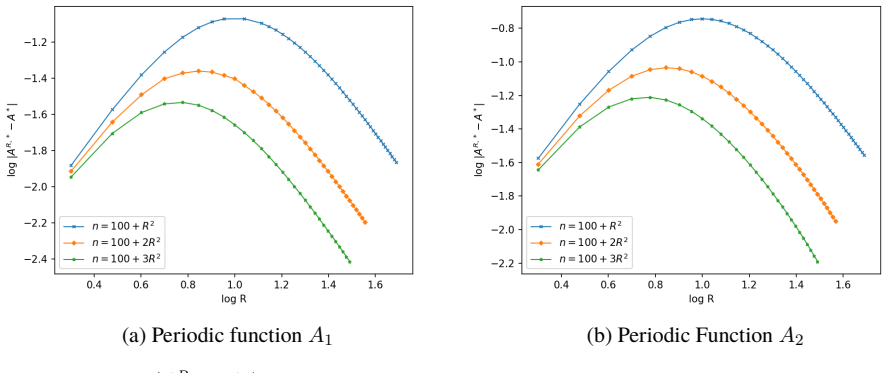
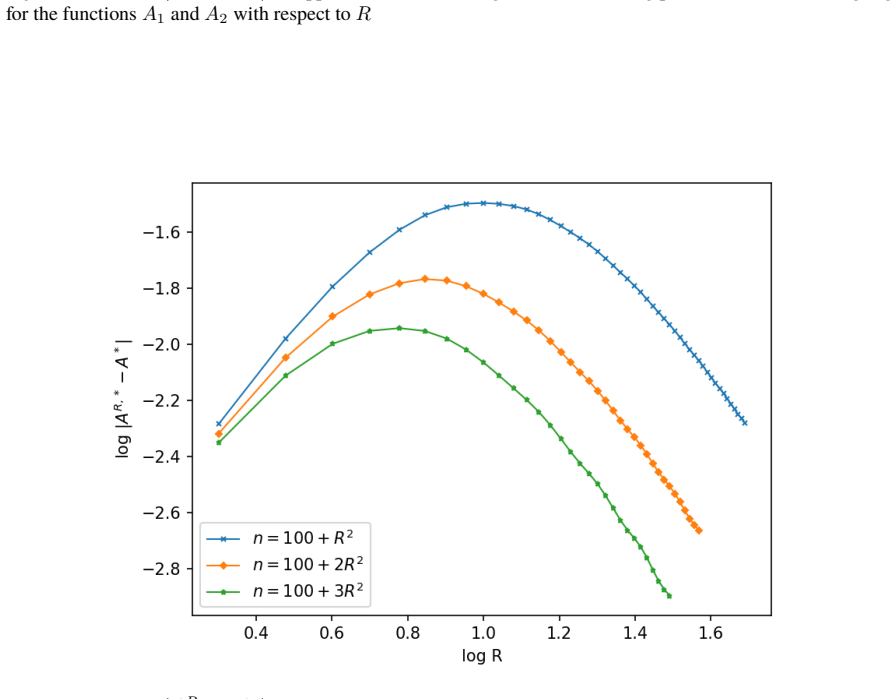
Solve the periodic cell problem for $A=4+\cos(2\pi x)+\cos(2\pi\sqrt{2}\,x)$ on $Y_R$ for $R$ from 10 to 400, form $A^{R,*}$ via (4.12), and regress $\log|A^{R,*}-A^*|$ on $\log R$ against a converged reference value; Theorem 8.1 predicts an eventual negative slope $-\beta$ for every $R$ beyond some threshold, so an asymptotic slope of zero, or error curves that flatten, would falsify the rate claim for that coefficient. The qualitative theorem is instead checked by testing weak flux convergence on a quasiperiodic coefficient with a spectrally solvable cell problem.
Extended reading notes
Core claim
The central discovery is that an almost periodic operator, which has no genuine direct-integral Bloch decomposition, can nonetheless be homogenized from Bloch data of its periodic truncations. For each $R$, let $A^R$ be the $Y_R$-periodic function obtained by restricting $A$ to the cube $Y_R=[-\pi R,\pi R)^d$ and periodizing. The paper proves that after sending $\epsilon\to 0$ and then $R\to\infty$, solutions of $A^\epsilon u^\epsilon=f$ converge weakly in $H^1(\Omega)$ to the solution of $A_hom u=f$, with flux convergence, where the homogenized tensor is $A^*_{kl}=\lim_{R\to\infty}\frac{1}{2}\frac{\partial^2\lambda^R_1}{\partial\eta_k\partial\eta_l}(0)$, the limit of half the Hessian of the first Bloch eigenvalue $\lambda^R_1$ of $A^R$. It then shows this tensor coincides with the abstract almost periodic homogenized tensor. Under the hypothesis that the modulus of almost periodicity $\rho(A,L)$ decays as $L^{-\tau}$, it proves $|A^*-A^{R,*}|\lesssim R^{-\beta}$ for some $\beta\in(0,1)$, and it provides numerical evidence for such rates.
Load-bearing premise
The load-bearing premise is that the periodic correction field on a cube of side $R$, rescaled to the unit cell, shrinks in $L^2$ norm at rate $R^{-\gamma}$ with $\gamma<\tau/(\tau+1)$; the proof invokes a cited result for this decay rather than deriving it, and the power-law rate $|A^*-A^{R,*}|\lesssim R^{-\beta}$ depends on that decay.
Editorial extensions
If this is right
- For any coefficient satisfying (A1)-(A3), the almost periodic oscillations force only a constant macroscopic tensor: the weak limit of $u^\epsilon$ solves $A_hom u=f$ and the oscillating fluxes converge weakly to $a^*\nabla u^*$.
- The homogenized tensor of an almost periodic medium can be computed by finite-cell periodic problems, with the cell side $R$ as the only numerical parameter; Theorem 8.1 guarantees power-law accuracy once $\rho(A,L)\lesssim L^{-\tau}$.
- Higher Bloch modes of the periodization are negligible: their contribution to the solution is bounded by $C R\epsilon$, so the lowest Bloch band alone determines homogenization.
- The tensor obtained by the Bloch route is not a new object: it coincides with the established almost periodic homogenized tensor, so the spectral construction is a valid alternative representation of $A^*$.
- Approximations by Dirichlet and Neumann cell problems can be handled by the same error splitting, replacing the periodic corrector decay estimate with the corresponding boundary-value estimates.
Reading between the lines
- A testable extension not pursued in the paper: for quasiperiodic coefficients with a finite frequency module, the modulus $\rho(A,L)$ is controlled by the Diophantine quality of the frequency vector, so one could compute the expected exponent $\beta$ explicitly and check it against finite-element error slopes.
- The same "periodize, read the lowest-band Hessian, let $R$ grow" construction should transfer to systems and to other operators with a spectral-gap structure, since only the analyticity of the first band and the Hessian identity are used; the missing ingredient in each case is the Section 8.7 periodic-corrector decay estimate.
- If the Section 8.7 estimate fails for some almost periodic coefficient with $\rho(A,L)\lesssim L^{-\tau}$, the qualitative theorem would survive but the power-law rate would not: rate and qualitative convergence are logically independent in this proof, so numerical rate experiments are the right discriminator between the two claims.
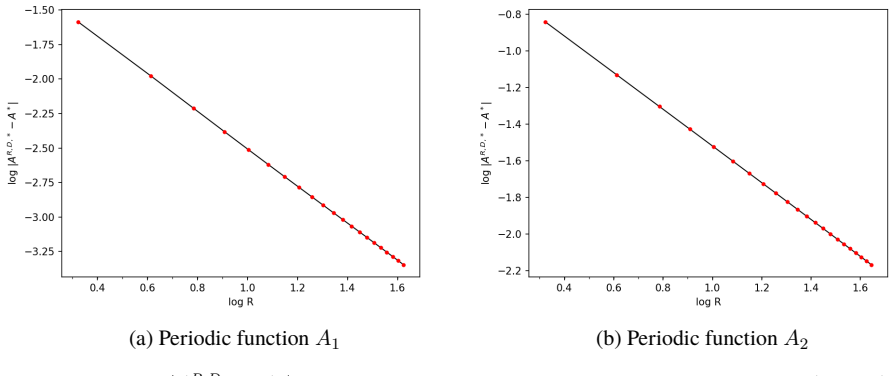
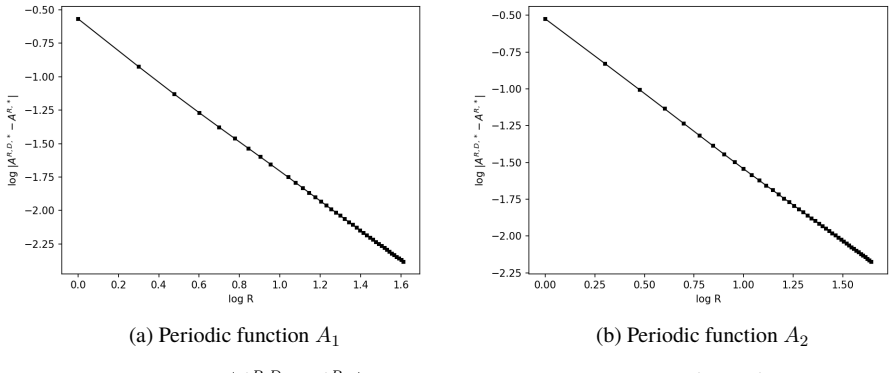
- The paper's log-log plots do not report fitted slopes, so a reader should treat the numerics as indicative rather than as a measurement of a specific $\beta$.
Signed reviews
Editorial analysis
A structured set of objections, weighed in public.
Referee Report
Summary. The paper proposes a Bloch-wave homogenization method for scalar elliptic operators with almost periodic coefficients. It replaces the almost periodic operator by periodic truncations on cubes of side length 2πR, studies the first Bloch eigenvalue of each truncation, and claims that the almost periodic effective tensor is the limit of half the Hessian of this eigenvalue at the origin (Theorem 5.1 and Eq. (4.17)). It further claims a quantitative rate for the approximation of the effective tensor under a power-law modulus of almost periodicity (Theorem 8.1). The last part of the paper contains numerical experiments for periodic and quasiperiodic examples. The central qualitative theorem is proved by passing to the limit in the first Bloch coefficient, and the quantitative theorem is proved by splitting the error into regularized, truncated, boundary, and periodic-cell terms.
Significance. If the main results were correct, the paper would give a spectral route to almost periodic homogenization and a quantitative justification for computing effective coefficients from Bloch eigenvalue data of periodic truncations. The paper has several strengths: it formulates a clear two-parameter limiting procedure, states a useful module-containment result for correctors (Lemma 6.3), and complements the analytic claims with numerical experiments. However, the manuscript as written does not establish its main theorem: the flux-identification step in the proof of Theorem 5.1 contains a sign inconsistency, and the rate estimate in Theorem 8.1 depends on an unproved decay estimate in Section 8.7. These are load-bearing issues, not presentation problems.
major comments (3)
- [§5.2.4, Eq. (5.21)] The identity (5.21) has the wrong sign. Theorem 4.6(3) states that ∂_{η_s}φ_R^1(y;0) − i φ_R^1(y;0) w_{R,s}(y) is constant in y, and by Remark 4.1 φ_R^1(·;0) is the constant (2π)^{-d/2}. Differentiating in y_k gives ∂_{y_k}∂_{η_s}φ_R^1(y;0) = i (2π)^{-d/2} ∂_{y_k} w_{R,s}(y). Hence the mean on the left of (5.21) equals + i(2π)^{-d/2} M(a_R,kl ∂_{y_k}w_{R,s}), not − i(2π)^{-d/2} M(a_R,kl ∂_{y_k}w_{R,s}). With the corrected sign, the second term in (5.12) contributes + i(2π)^{-d/2} ξ_s M(a_R,kl ∂_{y_k}w_{R,s}) times the common factor, so the combination in (5.22) becomes −i ξ_s [M(a_R,kl) − M(a_R,kl ∂_{y_k}w_{R,s})] instead of −i ξ_s a_R,∗_kl. Thus the Fourier-space limit (5.27) and the flux identification (5.33) do not follow as written; in the one-dimensional example a = 2 + sin x the resulting tensor would be approximately 2.27 rather than the correct 1.73. This sign inconsistency is a load-bearing defect in the proof of Theorem 5.1.
- [§8.7, Theorem 8.9] The estimate ‖~w_{R,ξ}‖_{L2(Y1)} ≤ C_γ R^{−γ} for 0 < γ < τ/(τ+1) is introduced with the phrase 'by a similar analysis to [45]', but no theorem or lemma in [45] is stated that gives this exact estimate, and no derivation is provided. This estimate controls the term R^{4−2γ} T^{−2} in (8.35), so the power-law rate |A* − A^{R,*}| ≲ R^{−β} in Theorem 8.1 is not established. In addition, the passage from (8.31)–(8.32) to the limiting zero solution is not justified as written: (8.33) is a boundary-value problem with a forcing h, whereas (8.31) is a Y1-periodic cell problem with h = 0, and the claimed limit equation −∇·(A*(ξ+∇~w_∞)) = 0 has no Y1-periodic solution for general ξ ≠ 0. A precise proof or a precise reference with all hypotheses is required.
- [§5.3, estimates before (5.27)] The displayed estimates for ‖v^R_k‖_{L2} and ‖z^R_s‖_{L2} are written with the norm ‖a_R − a‖_{L∞(ϵK)}; after the substitution y = x/ϵ, the quantity that appears is ‖a_R − a‖_{L∞(ϵ^{-1}K)}, and with either reading the displayed bound does not justify the claimed vanishing in the iterated limit ϵ→0 then R→∞. The conclusion that the terms involving v^R and z^R drop out of (5.26) is therefore unsupported. Since these terms are part of the proof of Theorem 5.1, a rigorous argument for their vanishing, or an explicit computation of their limits, is needed.
minor comments (3)
- [§7, proof of Proposition 7.1] In the displayed line after (7.2), 'λ^{R,ϵ}_m(ξ) = ϵ^{-2}λ^{R,ϵ}_m' should read 'λ^{R,ϵ}_m(ξ) = ϵ^{-2}λ^R_m(ϵξ)'.
- [§5.2.4, Eqs. (5.15)–(5.17)] The sentence 'As a consequence, ϵ^{-2}∂γ_R/∂y_k ∈ ...' appears inconsistent with the factor ϵ^{-1} in (5.15); the exponent should be checked and the convergence statement made precise.
- [§2.3 and §4.4] There are minor notational inconsistencies, for example a^ϵ_kl(ϵ) in (2.4) should presumably be a_kl(x/ϵ), and the cell correctors in (4.12) are written sometimes as w_{R,l} and sometimes as w_{R,p}; harmonizing these notations would improve readability.
Circularity Check
No significant circularity: the effective tensor is characterized via Bloch Hessians of periodic truncations and identified with the almost periodic homogenized tensor through external theorems; self-citations are peripheral.
full rationale
The paper's central derivation is not circular. The effective tensor a* is defined in (4.17) as the limit of half the Hessian of the first Bloch eigenvalue of the periodic truncations, and Theorem 4.6(4) identifies this Hessian with the standard periodic homogenized tensor a^{R,*}. The qualitative homogenization theorem (Theorem 5.1) then proves flux convergence using this identification, while the final identification a* = q* with the almost periodic homogenized tensor is imported from Bourgeat and Piatnitski [18] and the abstract theory of Jikov-Kozlov-Oleinik [33], not from the paper's own conclusions. The rate result in Theorem 8.1 is a triangle-inequality estimate whose four terms are controlled by external results of Shen [45], Shen and Zhuge [46], Gloria and Otto [31], and Bourgeat and Piatnitski [18]. The self-citations [49] and [50] appear only as contextual remarks and are not load-bearing. The most fragile passage is in Section 8.7, where the estimate ||tilde w_{R,xi}||_{L2(Y1)} <= C_gamma R^{-gamma} is asserted 'by a similar analysis to [45]' without a precise proof or statement; this is a missing-derivation/correctness risk, not a circular reduction, because [45] is an external quantitative homogenization result rather than the paper's own output. The paper also explicitly notes in Section 3 that the periodic approximations f_R may not converge to f in B^2(Rd), a limitation that does not create circularity. An internal sign inconsistency in the flux-identification step (5.21) would be a correctness defect, but it is not a circularity: the offending equality is derived from the standard Theorem 4.6(3), not from the theorem being proved. Overall, the derivation chain rests on independent external theorems and standard Bloch-wave identities, so the circularity score is 0.
Assumptions & free parameters
assumptions (5)
- domain assumption Coefficients A satisfy (A1)-(A3): measurable bounded real almost periodic, symmetric, coercive.
- standard math The first Bloch eigenvalue and eigenvector of the periodic approximation are analytic in a neighborhood U_R of eta = 0 (Theorem 4.4).
- standard math Bourgeat and Piatnitski Theorem 6.5: a^{R,*}_{kl} converges to q^*_{kl} for almost periodic media.
- standard math Shen's Theorem 8.3, Shen and Zhuge's Theorem 8.5, and Gloria and Otto's Green's function bounds are valid for this coefficient class.
- ad hoc to paper The rescaled periodic corrector decays as ||tilde w_{R,xi}||_{L2(Y1)} <= C_gamma R^{-gamma} for 0 < gamma < tau/(tau+1).
Cite this review
Pith. "Pith review of Bloch wave approach to almost periodic homogenization and approximations of effective coefficients." pith.science (2026). https://pith.science/paper/4XD4HE5A
@misc{pith2026190807977,
  author       = {Pith},
  title        = {Pith review of: Bloch wave approach to almost periodic homogenization and approximations of effective coefficients},
  year         = {2026},
  howpublished = {\url{https://pith.science/paper/4XD4HE5A}},
  note         = {Machine review of arXiv:1908.07977}
}
read the original abstract
Bloch wave homogenization is a spectral method for obtaining effective coefficients for periodically heterogeneous media. This method hinges on the direct integral decomposition of periodic operators, which is not available in a suitable form for almost periodic operators. In particular, the notion of Bloch eigenvalues and eigenvectors does not exist for almost periodic operators. However, we are able to recover the homogenization result in this case, by employing a sequence of periodic approximations to almost periodic operators. We also establish a rate of convergence for approximations of homogenized tensors for a class of almost periodic media. The results are supported by a numerical study.
Figures
Figures from the paper (5 more)



Reference graph
Works this paper leans on
-
[45]
Shen, Z. (2015). Convergence rates and H¨older estimates in almost-periodic homogenization of elliptic systems. Anal. PDE, 8(7):1565–1601
work page 2015
-
[1]
Abdulle, A., Arjmand, D., and Paganoni, E. (2019). Exponential decay of the resonance error in numerical homogenization via parabolic and elliptic cell problems. C. R. Math. Acad. Sci. Paris, 357(6):545–551
work page 2019
-
[2]
Allaire, G., Capdeboscq, Y., Piatnitski, A., Siess, V., and Vanninathan, M. (2004). Homogenization of periodic systems with large potentials. Arch. Ration. Mech. Anal., 174(2):179–220
work page 2004
-
[3]
Allaire, G., Palombaro, M., and Rauch, J. (2011). Diffractive geometric optics for Bloch wave packets. Arch. Ration. Mech. Anal., 202(2):373–426. 35 (a) Periodic function A1 (b) Periodic function A2 Figure 5: The averaged L2 norm of the difference of the gradients E(R) =( − ∫ YR |∇wR,D,e1 (y)−∇ wR,e1 (y)|2 dy )1/2 in log-log scale for the correctors corresp...
work page 2011
-
[4]
Allaire, G. and Piatnitski, A. (2005). Homogenization of the Schr ¨odinger equation and effective mass theorems. Comm. Math. Phys., 258(1):1–22
work page 2005
-
[5]
Allais, M. (1983). Sur la distribution normale des valeurs `a des instants r´eguli`erement espac´es d’une somme de sinuso¨ıdes.C. R. Acad. Sci. Paris S´er. I Math., 296(19):829–832
work page 1983
-
[6]
S., Blechta, J., Hake, J., Johansson, A., Kehlet, B., Logg, A., Richardson, C., Ring, J., Rognes, M
Alnæs, M. S., Blechta, J., Hake, J., Johansson, A., Kehlet, B., Logg, A., Richardson, C., Ring, J., Rognes, M. E., and Wells, G. N. (2015). The fenics project version 1.5.Archive of Numerical Software, 3(100)
work page 2015
-
[7]
Amerio, L. and Prouse, G. (1971). Almost-periodic functions and functional equations. Van Nostrand Reinhold Co., New York-Toronto, Ont.-Melbourne
work page 1971
Show all 54 references
-
[8]
Armstrong, S., Gloria, A., and Kuusi, T. (2016). Bounded correctors in almost periodic homogenization. Arch. Ration. Mech. Anal., 222(1):393–426
2016
-
[9]
N., Cardaliaguet, P., and Souganidis, P
Armstrong, S. N., Cardaliaguet, P., and Souganidis, P. E. (2014). Error estimates and convergence rates for the stochastic homogenization of Hamilton-Jacobi equations. J. Amer. Math. Soc., 27(2):479–540
2014
-
[10]
Armstrong, S. N. and Shen, Z. (2016). Lipschitz estimates in almost-periodic homogenization. Comm. Pure Appl. Math., 69(10):1882–1923
2016
-
[11]
and Lin, F.-H
Avellaneda, M. and Lin, F.-H. (1987). Compactness methods in the theory of homogenization. Comm. Pure Appl. Math., 40(6):803–847
1987
-
[12]
and Testard, D
Bellissard, J. and Testard, D. (1981). Almost periodic hamiltonians: an algebraic approach. Technical report, Centre National de la Recherche Scientifique
1981
-
[13]
and Gloria, A
Benoit, A. and Gloria, A. (2017). Long-time homogenization and asymptotic ballistic transport of classical waves. https://arXiv.org/abs/1701.08600
2017 arXiv
-
[14]
Bensoussan, A., Lions, J.-L., and Papanicolaou, G. (2011). Asymptotic analysis for periodic structures. AMS Chelsea Publishing, Providence, RI
2011
-
[15]
Besicovitch, A. S. (1955). Almost periodic functions. Dover Publications, Inc., New York
1955
-
[16]
and Le Bris, C
Blanc, X. and Le Bris, C. (2010). Improving on computation of homogenized coefficients in the periodic and quasi-periodic settings. Netw. Heterog. Media, 5(1):1–29
2010
-
[17]
Blanc, X., Le Bris, C., and Lions, P.-L. (2015). Local profiles for elliptic problems at different scales: defects in, and interfaces between periodic structures. Comm. Partial Differential Equations, 40(12):2173–2236
2015
-
[18]
and Piatnitski, A
Bourgeat, A. and Piatnitski, A. (2004). Approximations of effective coefficients in stochastic homogenization. Ann. Inst. H. Poincar´e Probab. Statist., 40(2):153–165
2004
-
[19]
Bourgeat, A., Quintard, M., and Whitaker, S. (1988). ´El´ements de comparaison entre la m ´ethode d’homog´en´eisation et la m´ethode de prise de moyenne avec fermeture. C. R. Acad. Sci. Paris S´er. II M´ec. Phys. Chim. Sci. Univers Sci. Terre, 306(7):463–466
1988
-
[20]
B ˘alilescu, L., Conca, C., Ghosh, T., San Mart´ın, J., and Vanninathan, M. (2018). The Dispersion Tensor and Its Unique Minimizer in Hashin–Shtrikman Micro-structures. Arch. Ration. Mech. Anal., 230(2):665–700
2018
-
[21]
Carvalho, T. O. and de Oliveira, C. R. (2002). Spectra and transport in almost periodic dimers. J. Statist. Phys., 107(5-6):1015–1030
2002
-
[22]
and Gayte, I
Casado-D ´ıaz, J. and Gayte, I. (2002). A derivation theory for generalized Besicovitch spaces and its application for partial differential equations. Proc. Roy. Soc. Edinburgh Sect. A, 132(2):283–315
2002
-
[23]
and Kohn, R., editors (1997)
Cherkaev, A. and Kohn, R., editors (1997). Topics in the mathematical modelling of composite materials, vol- ume 31. Birkh¨auser Boston, Inc., Boston, MA
1997
-
[24]
and Vanninathan, M
Conca, C. and Vanninathan, M. (1997). Homogenization of periodic structures via bloch decomposition. SIAM Journal on Applied Mathematics, 57(6):1639–1659
1997
-
[25]
Corduneanu, C. (2009). Almost periodic oscillations and waves. Springer, New York
2009
-
[26]
Damanik, D., Fillman, J., and Gorodetski, A. (2019). Multidimensional almost-periodic schr ¨odinger operators with cantor spectrum. Annales Henri Poincar´e, 20(4):1393–1402
2019
-
[27]
G., Byrne, H
Davit, Y., Bell, C. G., Byrne, H. M., Chapman, L. A., Kimpton, L. S., Lang, G. E., Leonard, K. H., Oliver, J. M., Pearson, N. C., Shipley, R. J., et al. (2013). Homogenization via formal multiscale asymptotics and volume averaging: How do the two techniques compare? Advances i...
2013
-
[28]
Fink, A. M. (1974). Almost periodic differential equations. Lecture Notes in Mathematics, Vol. 377. Springer- Verlag, Berlin-New York
1974
-
[29]
Gloria, A. (2011). Reduction of the resonance error—Part 1: Approximation of homogenized coefficients. Math. 38 Models Methods Appl. Sci., 21(8):1601–1630
2011
-
[30]
and Habibi, Z
Gloria, A. and Habibi, Z. (2016). Reduction in the resonance error in numerical homogenization II: Correctors and extrapolation. Found. Comput. Math., 16(1):217–296
2016
-
[31]
and Otto, F
Gloria, A. and Otto, F. (2017). Quantitative results on the corrector equation in stochastic homogenization. J. Eur. Math. Soc., 19(11):3489–3548
2017
-
[32]
Hofstadter, D. R. (1976). Energy levels and wave functions of Bloch electrons in rational and irrational magnetic fields. Phys. Rev. B, 14:2239–2249
1976
-
[33]
V., Kozlov, S
Jikov, V. V., Kozlov, S. M., and Ole˘inik, O. A. (1994). Homogenization of differential operators and integral functionals. Springer-Verlag, Berlin
1994
-
[34]
Kato, T. (1995). Perturbation theory for linear operators. Classics in Mathematics. Springer-Verlag, Berlin
1995
-
[35]
and Duneau, M
Katz, A. and Duneau, M. (1986). Quasiperiodic patterns and icosahedral symmetry.J. Physique, 47(2):181–196
1986
-
[36]
Kozlov, S. M. (1978). Averaging of differential operators with almost periodic rapidly oscillating coefficients. Mat. Sb. (N.S.), 107(149)(2):199–217, 317
1978
-
[37]
Kozlov, S. M. (1979). The averaging of random operators. Mat. Sb. (N.S.), 109(151)(2):188–202, 327
1979
-
[38]
Levitan, B. M. and Zhikov, V. V. (1982). Almost periodic functions and differential equations . Cambridge University Press
1982
-
[39]
Maurin, K. (1968). General eigenfunction expansions and unitary representations of topological groups. Mono- grafie Matematyczne, Tom 48. PWN-Polish Scientific Publishers, Warsaw
1968
-
[40]
Oleinik, O. A. and Zhikov, V. V. (1982). On the homogenization of elliptic operators with almost-periodic coefficients. Rendiconti del Seminario Matematico e Fisico di Milano, 52(1):149–166
1982
-
[41]
Payne, L. E. and Weinberger, H. F. (1960). An optimal Poincar´e inequality for convex domains. Arch. Rational Mech. Anal., 5:286–292 (1960)
1960
-
[42]
Pozhidaev, A. V. and Yurinski˘ı, V. V. (1989). On the error of averaging of symmetric elliptic systems.Izv. Akad. Nauk SSSR Ser. Mat., 53(4):851–867, 912
1989
-
[43]
and Simon, B
Reed, M. and Simon, B. (1978). Methods of modern mathematical physics. IV. Analysis of operators. Academic Press [Harcourt Brace Jovanovich, Publishers], New York-London
1978
-
[44]
Shechtman, D., Blech, I., Gratias, D., and Cahn, J. W. (1984). Metallic phase with long-range orientational order and no translational symmetry. Phys. Rev. Lett., 53:1951–1953
1984
-
[46]
and Zhuge, J
Shen, Z. and Zhuge, J. (2018). Approximate correctors and convergence rates in almost-periodic homogenization. J. Math. Pures Appl. (9), 110:187–238
2018
-
[47]
Shubin, M. A. (1978). Almost periodic functions and partial differential operators. Russian Mathematical Surveys, 33(2):1
1978
-
[48]
Simon, B. (1982). Almost periodic Schr ¨odinger operators: a review. Adv. in Appl. Math., 3(4):463–490
1982
-
[49]
and Tewary, V
Sivaji Ganesh, S. and Tewary, V. (2019). Bloch wave homogenization of quasiperiodic media.https://arxiv. org/abs/1910.12724. Accessed: 2019-10-29
2019 arXiv
-
[50]
and Tewary, V
Sivaji Ganesh, S. and Tewary, V. (2020). Generic simplicity of spectral edges and applications to homogenization. Asymptotic Analysis, 116(3–4):219–248
2020
-
[51]
and Vanninathan, M
Sivaji Ganesh, S. and Vanninathan, M. (2004). Bloch wave homogenization of scalar elliptic operators.Asymptot. Anal., 39(1):15–44
2004
-
[52]
and Vanninathan, M
Sivaji Ganesh, S. and Vanninathan, M. (2005). Bloch wave homogenization of linear elasticity system. ESAIM Control Optim. Calc. Var., 11(4):542–573
2005
-
[53]
Whitaker, S. (2013). The method of volume averaging, volume 13. Springer Science & Business Media
2013
-
[54]
Yurinski ˘ı, V. V. (1986). Averaging of symmetric diffusion in a random medium.Sibirsk. Mat. Zh., 27(4):167–180, 215. 39
1986
Reviewed August 14, 2026 · model on record in the stance chip above.
Discussion (0). Continue with ORCID to comment.