REVIEW 3 major objections 5 minor 91 references
A Fast and Efficient Stochastic Opposition-Based Learning for Differential Evolution in Numerical Optimization
T0 review · 3 major / 5 minor · reviewed 2026-08-14 · deepseek-v4-flash
Pith's one-line read The paper claims that a linear-time diversity measure and multiple exponential crossover turn BetaCOBL into a faster, more separable-problem-friendly opposition-based learning module that stays competitive with ten alternatives.
desk verdict Solid engineering extension with a real complexity win and heavy empirical support; the math around Eq. 22 is mislabeled but the main claim survives. read the letter →
The pith
A machine-rendered reading of the paper's core claim, the machinery that carries it, and where it could break.
The reading
What carries the argument
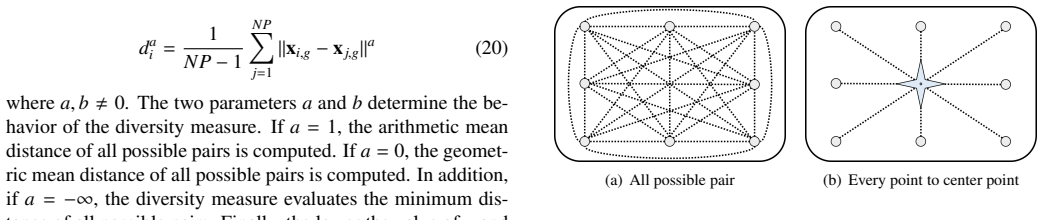
The load-bearing object is the linear-time diversity measure $D'_d(P_g)=\frac{1}{D}\sqrt{\sum_{k=1}^{D}\big((x^k_g)^2-(\overline{x^k_g})^2\big)}$, a root-mean-square of per-dimension variances that can be computed in one pass over the population; it replaces the power-mean pairwise-distance measure, which costs $O(NP^2 \cdot D)$, in the selection-switching scheme that decides whether to merge all original solutions or discard the worst half. The second mechanism is multiple exponential crossover, a semi-consecutive recombination that copies alternating blocks from the complete opposite solution and the original solution, with expected block lengths set by the crossover rate and a fixed component length $T=10$. The first mechanism supplies the speed-up, and the second addresses inseparability by preserving adjacent dependent variables.
What would settle it
Time iBetaCOBL and BetaCOBL on the same benchmark with population sizes 100, 200, and 400: if the runtime ratio does not track linear versus quadratic growth, the complexity claim is wrong; separately, on a population artificially collapsed to a tight cluster near the diversity threshold, record whether the two algorithms pick different selection operators.
Extended reading notes
Core claim
The central claim, stated as the authors would state it, is that the two perceived weaknesses of BetaCOBL can be fixed separately: diversity monitoring does not need pairwise distances, and partial opposition does not need to assume variables are independent. Replacing the power-mean diversity measure with a linear-time reformulation of mean pairwise distance keeps the selection-switching behavior intact while reducing the cost from quadratic to linear in population size, and replacing binomial crossover with multiple exponential crossover preserves blocks of strongly dependent adjacent variables. The supporting evidence is a comparison on the CEC 2013 and 2017 test suites at 30 and 50 dimensions using three differential evolution variants and ten OBL variants, with the paper reporting that iBetaCOBL is competitive with or better than all of them and clearly better than BetaCOBL at roughly one-third the runtime.
Load-bearing premise
The speed-up rests on the assumption that the fast diversity statistic sends the same 'still exploring or already converged' signal as the slow pairwise measure, so the algorithm switches selection operators at the right moments; if the two disagree on collapsed or clustered populations, accuracy could suffer even though the clock time drops.
Editorial extensions
If this is right
- Any differential evolution variant can embed iBetaCOBL as a module and inherit a linear-time diversity check instead of a pairwise one.
- On multimodal and composition functions, where exploration matters, the paper's results show iBetaCOBL tends to find more accurate solutions than the original DE and most OBL variants.
- Cost-sensitive and large-population optimization becomes more feasible because the per-jump overhead no longer grows quadratically with population size.
- Modern DE engines such as EDEV and LSHADE-RSP improve when iBetaCOBL is attached, with the largest gain appearing in the late stage where the algorithm must escape local optima.
Reading between the lines
- One extension the authors do not explore: the same linear-time diversity statistic could replace pairwise measures in the selection logic of other population-based optimizers, not only OBL variants of DE.
- A testable prediction follows from the crossover change: on hybrid or composition functions whose variable blocks are permuted, the advantage of iBetaCOBL over BetaCOBL should shrink, because multiple exponential crossover only preserves adjacency in the given coordinate order.
- The diversity threshold $D_T$ was tuned for the old measure; with the new statistic its scale differs, so the reported gains might be sensitive to $D_T$ and could be improved or degraded by re-calibrating it.
Signed reviews
Editorial analysis
A structured set of objections, weighed in public.
Referee Report
Summary. The paper proposes iBetaCOBL, a modified BetaCOBL for differential evolution, with two main changes: replacement of the O(NP^2 D) power-mean diversity measure in the selection-switching scheme with a claimed O(NP D) linear-time diversity measure (Eq. 22), and replacement of the binomial crossover in the partial-opposite-solution construction with multiple exponential crossover. The method is evaluated on the CEC 2013 and CEC 2017 suites at 30 and 50 dimensions, embedded in three DE variants (DE/rand/1/bin, EDEV, and LSHADE-RSP), and compared against ten OBL variants using 51 runs, Wilcoxon rank-sum tests, Friedman tests, and algorithm-complexity measurements. The authors claim that iBetaCOBL remains competitive with or outperforms the predecessor BetaCOBL while reducing computational cost.
Significance. If the claims are accepted, the paper offers a practical, low-cost drop-in OBL module for DE: the complexity reduction from O(NP^2 D) to O(NP D) is real and the experimental campaign is unusually thorough, spanning 58 benchmark functions, two dimensions, three DE base algorithms, 51 independent runs, and standard nonparametric statistical tests. The ablation study in Section 6.2, which compares BetaCOBL against BetaCOBL with each of the two linear-time diversity measures, is a commendable attempt to isolate the effect of the diversity-measure replacement. However, the paper's mathematical description of Eq. (22) as a reformulation of Eq. (21) is incorrect, and the conclusion that iBetaCOBL 'significantly outperformed its predecessor BetaCOBL' is not supported by the paper's own Friedman post-hoc results. The practical contribution remains useful, but the manuscript needs correction and more careful claims.
major comments (3)
- [4.2.2, Eq. (22)] Equation (22) is not a reformulation of Equation (21), as the text asserts. Equation (21) is the average pairwise Euclidean distance, whereas Eq. (22) is the square root of the average per-dimension variance. A simple counterexample shows the difference: for a two-point population in one dimension with coordinates a and b, Eq. (21) equals |a-b|, while Eq. (22) equals |a-b|/2. The two statistics have different scales and can rank different populations differently, so the subsequent use of the same threshold DT = 1e-6 cannot be justified by algebraic equivalence. The authors should either correct this statement to describe Eq. (22) as a different, approximating diversity measure, or provide a rigorous derivation of the claimed equivalence.
- [4.2.2, Algorithm 2, Section 6.2] Because Eq. (22) is a different statistic with a different scale and distribution from the original power-mean measure, the (mu+lambda) versus (mu,lambda) branch in the selection-switching scheme may fire at different generations or with different frequencies when DT is left unchanged. The ablation in Section 6.2 reports only final FEV means and Wilcoxon comparisons; it does not log which selection branch was taken, when the first switch occurred, or how many generation jumps used each branch. Without such trace-level evidence, the comparison against BetaCOBL conflates the intended complexity improvement with a potentially different switching schedule, and the claim that the cheaper measure 'maintains the performance' of BetaCOBL is not fully demonstrated.
- [Section 8; Section 6.1.1; Tables 2, 4, 6, 8, 16, 18, 22, 24] The conclusion that iBetaCOBL 'significantly outperformed its predecessor BetaCOBL' is not supported by the paper's own statistical analysis. In every Friedman test with Hochberg post-hoc comparison, BetaCOBL is not flagged as significantly different from iBetaCOBL; for example, Table 2 reports an adjusted p-value of 0.781 for the BetaCOBL comparison. The per-function Wilcoxon counts (e.g., 12 wins versus 6 losses on CEC 2013 at 30-D) show a favorable trend, but they are not a global test of significance. The authors should either temper the claim to 'competitive with lower computational cost' or conduct and report a proper paired statistical test across the benchmark suites.
minor comments (5)
- [4.2.2, Eq. (22)] The notation in Eq. (22) is ambiguous: the two overline expressions are typeset identically, but one should denote the mean of squares and the other the square of the mean. Please use distinct symbols, e.g., \overline{(x^k)^2} and (\overline{x^k})^2, and clarify the normalization described immediately after the equation.
- [2.2] There is an empty citation bracket after the sentence claiming that opposite values are more likely to be located near the optimal solution than random values; a reference is missing here.
- [7, Algorithm 2] The text states that LSHADE-RSP starts OBL only after three-fourths of the maximum number of function evaluations, but Algorithm 2 does not include this variant-specific delay and instead executes iBetaCOBL from the initialization phase. The pseudocode and the experimental description should be reconciled for reproducibility.
- [Throughout] There are several typographical inconsistencies, including 'LSAHDE-RSP' instead of 'LSHADE-RSP' and 'BetaCODE' instead of 'BetaCOBL' in Section 4.2.3. These should be corrected.
- [Experimental Setup] The paper reports aggregate mean and standard deviation values but does not provide per-run results, random seeds, or a code/data availability statement. Providing this material would improve reproducibility and allow independent verification of the Wilcoxon and Friedman results.
Circularity Check
No circularity: the performance claims are empirical comparisons on external CEC benchmarks, and the complexity reduction follows directly from replacing an O(NP^2*D) diversity computation with an O(NP*D) one.
full rationale
The paper's central claims are (1) iBetaCOBL is competitive with or better than ten OBL variants on CEC 2013 and CEC 2017 suites, and (2) it reduces the cost of BetaCOBL's diversity-based selection switching from O(NP^2*D) to O(NP*D). Both claims are supported by experiments and by a direct algebraic complexity comparison, not by a parameter fitted to the benchmark results and then renamed as a prediction. The two algorithmic modifications — the linear-time diversity measure D'_d in Eq. 22 and the multiple exponential crossover in Section 4.3.2 — are taken from external prior work (Wineberg and Oppacher; Qiu et al.) and are not justified by self-citation. Self-citations by the first author appear only in the related-work enumeration of DE variants and are not load-bearing for the proposed algorithm's design or evaluation. Even if Eq. 22 is not an exact algebraic reformulation of Eq. 21 — a point that could affect the fidelity of the switching behavior — the paper does not rely on that equivalence by construction: Section 6.2 empirically compares BetaCOBL with the linear-time diversity variants and reports no significant degradation, which is a legitimate external check rather than a circular reduction. The threshold DT and jumping rate Jr are reused from the prior BetaCOBL paper, not fitted to make the proposed algorithm win. Thus no derivation step reduces to its own inputs, and the appropriate circularity finding is no significant circularity.
Assumptions & free parameters
free parameters (4)
- Diversity threshold DT =
1e-6
- Jumping rate Jr =
0.05
- Exchanged component length T =
10
- Crossover rates for partial opposite solutions CR =
0.1 and 0.9
assumptions (4)
- domain assumption The linear-time diversity measure D'_d in Equation 22 preserves the selection-switching behavior of the power-mean-based measure in Equation 19 closely enough for BetaCOBL's convergence control.
- domain assumption Strongly dependent decision variables are adjacent in the coordinate ordering of the problem.
- domain assumption CEC 2013 and CEC 2017 benchmark suites are representative of the target class of cost-sensitive, inseparable numerical optimization problems.
- standard math Opposite solutions are, with higher probability, closer to the optimum than random solutions.
Cite this review
Pith. "Pith review of A Fast and Efficient Stochastic Opposition-Based Learning for Differential Evolution in Numerical Optimization." pith.science (2026). https://pith.science/paper/WO34QCNS
@misc{pith2026190808011,
  author       = {Pith},
  title        = {Pith review of: A Fast and Efficient Stochastic Opposition-Based Learning for Differential Evolution in Numerical Optimization},
  year         = {2026},
  howpublished = {\url{https://pith.science/paper/WO34QCNS}},
  note         = {Machine review of arXiv:1908.08011}
}
abstract
A fast and efficient stochastic opposition-based learning (OBL) variant is proposed in this paper. OBL is a machine learning concept to accelerate the convergence of soft computing algorithms, which consists of simultaneously calculating an original solution and its opposite. Recently, a stochastic OBL variant called BetaCOBL was proposed, which is capable of controlling the degree of opposite solutions, preserving useful information held by original solutions, and preventing the waste of fitness evaluations. While it has shown outstanding performance compared to several state-of-the-art OBL variants, the high computational cost of BetaCOBL may hinder it from cost-sensitive optimization problems. Also, as it assumes that the decision variables of a given problem are independent, BetaCOBL may be ineffective for optimizing inseparable problems. In this paper, we propose an improved BetaCOBL that mitigates all the limitations. The proposed algorithm called iBetaCOBL reduces the computational cost from $O(NP^{2} \cdot D)$ to $O(NP \cdot D)$ ($NP$ and $D$ stand for population size and a dimension, respectively) using a linear time diversity measure. Also, the proposed algorithm preserves strongly dependent variables that are adjacent to each other using multiple exponential crossover. We used differential evolution (DE) variants to evaluate the performance of the proposed algorithm. The results of the performance evaluations on a set of 58 test functions show the excellent performance of iBetaCOBL compared to ten state-of-the-art OBL variants, including BetaCOBL.
Figures

Figures from the paper (2 more)


Reference graph
Works this paper leans on
-
[1]
Storn, K
R. Storn, K. Price, Di fferential evolution–a simple and efficient heuristic for global optimization over continuous spaces, Journal of global opti- mization 11 (4) (1997) 341–359
1997
-
[2]
Price, R
K. Price, R. M. Storn, J. A. Lampinen, Di fferential evolution: a practi- cal approach to global optimization, Springer Science & Business Media, 2006
2006
-
[3]
S. Das, P. N. Suganthan, Di fferential evolution: A survey of the state- of-the-art, IEEE transactions on evolutionary computation 15 (1) (2011) 4–31
2011
-
[4]
Hansen, A
N. Hansen, A. Ostermeier, Completely derandomized self-adaptation in evolution strategies, Evolutionary computation 9 (2) (2001) 159–195
2001
-
[5]
F. Neri, V . Tirronen, Recent advances in di fferential evolution: a survey and experimental analysis, Artificial Intelligence Review 33 (1-2) (2010) 61–106
2010
-
[6]
S. Das, S. S. Mullick, P. N. Suganthan, Recent advances in di fferential evolution–an updated survey, Swarm and Evolutionary Computation 27 (2016) 1–30
2016
-
[7]
R. D. Al-Dabbagh, F. Neri, N. Idris, M. S. Baba, Algorithmic design is- sues in adaptive di fferential evolution schemes: Review and taxonomy, Swarm and Evolutionary Computation 43 (2018) 284–311
2018
-
[8]
H. R. Tizhoosh, Opposition-based learning: a new scheme for machine intelligence, in: International Conference on Computational Intelligence for Modelling, Control and Automation and International Conference on Intelligent Agents, Web Technologies and Internet Commerce (CIMCA- IAWTIC’06), V ol. 1, IEEE, 2005, pp. 695–701
2005
Show all 91 references
-
[9]
H. R. Tizhoosh, M. Ventresca, Oppositional concepts in computational intelligence, V ol. 155, Springer, 2008
2008
-
[10]
F. S. Al-Qunaieer, H. R. Tizhoosh, S. Rahnamayan, Opposition based computinga survey, in: The 2010 International Joint Conference on Neu- ral Networks (IJCNN), IEEE, 2010, pp. 1–7
2010
-
[11]
Q. Xu, L. Wang, N. Wang, X. Hei, L. Zhao, A review of opposition- based learning from 2005 to 2012, Engineering Applications of Artificial Intelligence 29 (2014) 1–12. 23
2014
-
[12]
Mahdavi, S
S. Mahdavi, S. Rahnamayan, K. Deb, Opposition based learning: A liter- ature review, Swarm and evolutionary computation 39 (2018) 1–23
2018
-
[13]
Rahnamayan, H
S. Rahnamayan, H. R. Tizhoosh, M. M. Salama, Opposition-based di ffer- ential evolution, IEEE Transactions on Evolutionary computation 12 (1) (2008) 64–79
2008
-
[14]
Park, J.-J
S.-Y . Park, J.-J. Lee, Stochastic opposition-based learning using a beta distribution in di fferential evolution, IEEE transactions on cybernetics 46 (10) (2016) 2184–2194
2016
-
[15]
Haimin, W
L. Haimin, W. Chengke, Genetic algorithm with adaptive mutation prob- ability and analysis of its property, Acta Electron. Sin.(China) 27 (5) (1999) 90–92
1999
-
[16]
Lozano, F
M. Lozano, F. Herrera, J. R. Cano, Replacement strategies to preserve useful diversity in steady-state genetic algorithms, Information Sciences 178 (23) (2008) 4421–4433
2008
-
[17]
Myers, E
R. Myers, E. R. Hancock, Genetic algorithms for ambiguous labelling problems, Pattern Recognition 33 (4) (2000) 685–704
2000
-
[18]
A. L. Barker, W. N. Martin, Population diversity and fitness measures based on genomic distances
-
[19]
A. L. Barker, W. N. Martin, Dynamics of a distance-based population diversity measure, in: Proceedings of the 2000 Congress on Evolution- ary Computation. CEC00 (Cat. No. 00TH8512), V ol. 2, IEEE, 2000, pp. 1002–1009
2000
-
[20]
Mattiussi, M
C. Mattiussi, M. Waibel, D. Floreano, Measures of diversity for pop- ulations and distances between individuals with highly reorganizable genomes, Evolutionary Computation 12 (4) (2004) 495–515
2004
-
[21]
Wineberg, F
M. Wineberg, F. Oppacher, Distance between populations, in: Genetic and Evolutionary Computation Conference, Springer, 2003, pp. 1481– 1492
2003
-
[22]
Y . Shi, R. C. Eberhart, Population diversity of particle swarms, in: 2008 IEEE Congress on Evolutionary Computation (IEEE World Congress on Computational Intelligence), IEEE, 2008, pp. 1063–1067
2008
-
[23]
Mallipeddi, P
R. Mallipeddi, P. N. Suganthan, B.-Y . Qu, Diversity enhanced adap- tive evolutionary programming for solving single objective constrained problems, in: 2009 IEEE Congress on Evolutionary Computation, IEEE, 2009, pp. 2106–2113
2009
-
[24]
Wineberg, F
M. Wineberg, F. Oppacher, The underlying similarity of diversity mea- sures used in evolutionary computation, in: Genetic and Evolutionary Computation Conference, Springer, 2003, pp. 1493–1504
2003
-
[25]
Wineberg, F
M. Wineberg, F. Oppacher, A linear time algorithm for determining population diversity in evolutionary computation, Proceedings of the IASTED International Confererence on Intelligent Systems and Control (ICS 2003)
2003
-
[26]
X. Qiu, K. C. Tan, J.-X. Xu, Multiple exponential recombination for dif- ferential evolution, IEEE transactions on cybernetics 47 (4) (2017) 995– 1006
2017
-
[27]
Liang, B
J. Liang, B. Qu, P. Suganthan, A. G. Hern´andez-D´ıaz, Problem definitions and evaluation criteria for the CEC 2013 special session on real-parameter optimization, Computational Intelligence Laboratory, Zhengzhou Univer- sity, Zhengzhou, China and Nanyang Technological Universi...
2013
-
[28]
N. Awad, M. Ali, J. Liang, B. Qu, P. Suganthan, Problem definitions and evaluation criteria for the CEC 2017 special session and competition on single objective bound constrained real-parameter numerical optimiza- tion, in: Technical Report, NTU, Singapore, 2016
2017
-
[29]
G. Wu, X. Shen, H. Li, H. Chen, A. Lin, P. N. Suganthan, Ensemble of differential evolution variants, Information Sciences 423 (2018) 172–186
2018
-
[30]
Stanovov, S
V . Stanovov, S. Akhmedova, E. Semenkin, LSHADE algorithm with rank-based selective pressure strategy for solving CEC 2017 benchmark problems, in: 2018 IEEE Congress on Evolutionary Computation (CEC), IEEE, 2018, pp. 1–8
2017
-
[31]
A. K. Qin, V . L. Huang, P. N. Suganthan, Differential evolution algorithm with strategy adaptation for global numerical optimization, IEEE transac- tions on Evolutionary Computation 13 (2) (2008) 398–417
2008
-
[32]
W. Gong, Z. Cai, C. X. Ling, H. Li, Enhanced di fferential evolution with adaptive strategies for numerical optimization, IEEE Transactions on Sys- tems, Man, and Cybernetics, Part B (Cybernetics) 41 (2) (2010) 397–413
2010
-
[33]
S.-Z. Zhao, P. N. Suganthan, S. Das, Self-adaptive di fferential evolution with multi-trajectory search for large-scale optimization, Soft Computing 15 (11) (2011) 2175–2185
2011
-
[34]
T. J. Choi, C. W. Ahn, An Adaptive Cauchy Di fferential Evolution Al- gorithm with Bias Strategy Adaptation Mechanism for Global Numerical Optimization., JCP 9 (9) (2014) 2139–2145
2014
-
[35]
T. J. Choi, C. W. Ahn, An adaptive cauchy differential evolution algorithm with population size reduction and modified multiple mutation strategies, in: Proceedings of the 18th Asia Pacific Symposium on Intelligent and Evolutionary Systems-V olume 2, Springer, 2015, pp. 13–26
2015
-
[36]
T. J. Choi, C. W. Ahn, Adaptive Cauchy Differential Evolution with Strat- egy Adaptation and Its Application to Training Large-Scale Artificial Neural Networks, in: International Conference on Bio-Inspired Comput- ing: Theories and Applications, Springer, 2017, pp. 502–510
2017
-
[37]
Brest, S
J. Brest, S. Greiner, B. Boskovic, M. Mernik, V . Zumer, Self-adapting control parameters in differential evolution: A comparative study on nu- merical benchmark problems, IEEE transactions on evolutionary compu- tation 10 (6) (2006) 646–657
2006
-
[38]
M. Leon, N. Xiong, Adapting di fferential evolution algorithms for con- tinuous optimization via greedy adjustment of control parameters, Jour- nal of Artificial Intelligence and Soft Computing Research 6 (2) (2016) 103–118
2016
-
[39]
S. M. Islam, S. Das, S. Ghosh, S. Roy, P. N. Suganthan, An adaptive dif- ferential evolution algorithm with novel mutation and crossover strategies for global numerical optimization, IEEE Transactions on Systems, Man, and Cybernetics, Part B (Cybernetics) 42 (2) (2011) 482–500
2011
-
[40]
T. J. Choi, C. W. Ahn, J. An, An adaptive cauchy di fferential evolution algorithm for global numerical optimization, The Scientific World Journal 2013
2013
-
[41]
T. J. Choi, C. W. Ahn, An adaptive di fferential evolution algorithm with automatic population resizing for global numerical optimization, in: Bio- Inspired Computing-Theories and Applications, Springer, 2014, pp. 68– 72
2014
-
[42]
T. J. Choi, C. W. Ahn, An adaptive population resizing scheme for differ- ential evolution in numerical optimization, Journal of Computational and Theoretical Nanoscience 12 (7) (2015) 1336–1350
2015
-
[43]
T. J. Choi, C. W. Ahn, Adaptive α-stable differential evolution in numeri- cal optimization, Natural Computing 16 (4) (2017) 637–657
2017
-
[44]
T. J. Choi, C. W. Ahn, An Improved Differential Evolution Algorithm and Its Application to Large-Scale Artificial Neural Networks, in: Journal of Physics: Conference Series, V ol. 806, IOP Publishing, 2017, p. 012010
2017
-
[45]
Mallipeddi, P
R. Mallipeddi, P. N. Suganthan, Q.-K. Pan, M. F. Tasgetiren, Di fferential evolution algorithm with ensemble of parameters and mutation strategies, Applied soft computing 11 (2) (2011) 1679–1696
2011
-
[46]
G. Wu, R. Mallipeddi, P. N. Suganthan, R. Wang, H. Chen, Di fferential evolution with multi-population based ensemble of mutation strategies, Information Sciences 329 (2016) 329–345
2016
-
[47]
M. Ali, M. Pant, Improving the performance of di fferential evolution al- gorithm using Cauchy mutation, Soft Computing 15 (5) (2011) 991–1007
2011
-
[48]
H. Qin, J. Zhou, Y . Lu, Y . Wang, Y . Zhang, Multi-objective differential evolution with adaptive Cauchy mutation for short-term multi-objective optimal hydro-thermal scheduling, Energy Conversion and Management 51 (4) (2010) 788–794
2010
-
[49]
T. J. Choi, C. W. Ahn, Accelerating di fferential evolution using multiple exponential cauchy mutation, in: Proceedings of the Genetic and Evolu- tionary Computation Conference Companion, ACM, 2018, pp. 207–208
2018
-
[50]
T. J. Choi, J. Togelius, Y .-G. Cheong, ACM-DE: Adaptive p-best Cauchy Mutation with linear failure threshold reduction for Differential Evolution in numerical optimization, arXiv preprint arXiv:1907.01095
1907 arXiv
-
[51]
T. J. Choi, J. Togelius, Y .-G. Cheong, Advanced cauchy mutation for differential evolution in numerical optimization, IEEE Access 8 (2020) 8720–8734
2020
-
[52]
S. Das, A. Abraham, U. K. Chakraborty, A. Konar, Di fferential evolu- tion using a neighborhood-based mutation operator, IEEE Transactions on Evolutionary Computation 13 (3) (2009) 526–553
2009
-
[53]
Basu, Quasi-oppositional di fferential evolution for optimal reactive power dispatch, International Journal of Electrical Power & Energy Sys- tems 78 (2016) 29–40
M. Basu, Quasi-oppositional di fferential evolution for optimal reactive power dispatch, International Journal of Electrical Power & Energy Sys- tems 78 (2016) 29–40
2016
-
[54]
T. R. Chelliah, R. Thangaraj, S. Allamsetty, M. Pant, Coordination of directional overcurrent relays using opposition based chaotic di fferential evolution algorithm, International Journal of Electrical Power & Energy Systems 55 (2014) 341–350
2014
-
[55]
H. V . H. Ayala, L. dos Santos Coelho, V . C. Mariani, A. Askarzadeh, An improved free search di fferential evolution algorithm: A case study on parameters identification of one diode equivalent circuit of a solar cell module, Energy 93 (2015) 1515–1522. 24
2015
-
[56]
Subudhi, D
B. Subudhi, D. Jena, A di fferential evolution based neural network ap- proach to nonlinear system identification, Applied Soft Computing 11 (1) (2011) 861–871
2011
-
[57]
Koohi-Moghadam, A
M. Koohi-Moghadam, A. T. Rahmani, Molecular docking with opposition-based differential evolution, in: Proceedings of the 27th An- nual ACM Symposium on Applied Computing, ACM, 2012, pp. 1387– 1392
2012
-
[58]
Dragoi, S
E.-N. Dragoi, S. Curteanu, A.-I. Galaction, D. Cascaval, Optimization methodology based on neural networks and self-adaptive differential evo- lution algorithm applied to an aerobic fermentation process, Applied Soft Computing 13 (1) (2013) 222–238
2013
-
[59]
Sidhu, J
D. Sidhu, J. Dhillon, D. Kaur, Hybrid heuristic search method for design of digital IIR filter with conflicting objectives, Soft Computing 21 (12) (2017) 3461–3476
2017
-
[60]
T. J. Choi, J.-H. Lee, H. Y . Youn, C. W. Ahn, Adaptive Differential Evolu- tion with Elite Opposition-Based Learning and its Application to Training Artificial Neural Networks, Fundamenta Informaticae 164 (2-3) (2019) 227–242
2019
-
[61]
Rahnamayan, H
S. Rahnamayan, H. R. Tizhoosh, M. M. Salama, Opposition-based dif- ferential evolution (ODE) with variable jumping rate, in: Foundations of Computational Intelligence, 2007. FOCI 2007. IEEE Symposium on, IEEE, 2007, pp. 81–88
2007
-
[62]
Esmailzadeh, S
A. Esmailzadeh, S. Rahnamayan, Opposition-based di fferential evolution with protective generation jumping, in: Di fferential Evolution (SDE), 2011 IEEE Symposium on, IEEE, 2011, pp. 1–8
2011
-
[63]
Rahnamayan, H
S. Rahnamayan, H. R. Tizhoosh, M. M. Salama, Quasi-oppositional dif- ferential evolution, in: Evolutionary Computation, 2007. CEC 2007. IEEE Congress on, IEEE, 2007, pp. 2229–2236
2007
-
[64]
Ergezer, D
M. Ergezer, D. Simon, D. Du, Oppositional biogeography-based opti- mization, in: Systems, Man and Cybernetics, 2009. SMC 2009. IEEE International Conference on, IEEE, 2009, pp. 1009–1014
2009
-
[65]
Q. Xu, L. Wang, B. He, N. Wang, Modified opposition-based di fferential evolution for function optimization, Journal of Computational Informa- tion Systems 7 (5) (2011) 1582–1591
2011
-
[66]
H. Wang, Z. Wu, S. Rahnamayan, Enhanced opposition-based di fferen- tial evolution for solving high-dimensional continuous optimization prob- lems, Soft Computing 15 (11) (2011) 2127–2140
2011
-
[67]
X. Zhou, Z. Wu, H. Wang, Elite opposition-based di fferential evolution for solving large-scale optimization problems and its implementation on GPU, in: Parallel and Distributed Computing, Applications and Tech- nologies (PDCAT), 2012 13th International Conference on, IEEE, 201...
2012
-
[68]
H. Liu, Z. Wu, H. Wang, S. Rahnamayan, C. Deng, Improved di fferential evolution with adaptive opposition strategy, in: 2014 IEEE Congress on Evolutionary Computation (CEC), IEEE, 2014, pp. 1776–1783
2014
-
[69]
Lacevic, E
B. Lacevic, E. Amaldi, Ectropy of diversity measures for populations in Euclidean space, Information Sciences 181 (11) (2011) 2316–2339
2011
-
[70]
R. K. Ursem, Diversity-guided evolutionary algorithms, in: International Conference on Parallel Problem Solving from Nature, Springer, 2002, pp. 462–471
2002
-
[71]
M. A. Bedau, M. Zwick, A. Bahm, Variance and uncertainty measures of population diversity dynamics, Advances in Systems Science and Appli- cations (1995) 7
1995
-
[72]
Riget, J
J. Riget, J. S. Vesterstrøm, A diversity-guided particle swarm optimizer- the ARPSO, Dept. Comput. Sci., Univ. of Aarhus, Aarhus, Denmark, Tech. Rep 2 (2002) 2002
2002
-
[73]
J. Jie, J. Zeng, Particle swarm optimization with diversity-controlled ac- celeration coe fficients, in: Third International Conference on Natural Computation (ICNC 2007), V ol. 4, IEEE, 2007, pp. 150–154
2007
-
[74]
C. Lin, A. Qing, Q. Feng, A comparative study of crossover in differential evolution, Journal of Heuristics 17 (6) (2011) 675–703
2011
-
[75]
Zaharie, Influence of crossover on the behavior of differential evolution algorithms, Applied soft computing 9 (3) (2009) 1126–1138
D. Zaharie, Influence of crossover on the behavior of differential evolution algorithms, Applied soft computing 9 (3) (2009) 1126–1138
2009
-
[76]
Dem ˇsar, Statistical comparisons of classifiers over multiple data sets, Journal of Machine learning research 7 (Jan) (2006) 1–30
J. Dem ˇsar, Statistical comparisons of classifiers over multiple data sets, Journal of Machine learning research 7 (Jan) (2006) 1–30
2006
-
[77]
Zhang, A
J. Zhang, A. C. Sanderson, JADE: adaptive differential evolution with op- tional external archive, IEEE Transactions on evolutionary computation 13 (5) (2009) 945–958
2009
-
[78]
Y . Wang, Z. Cai, Q. Zhang, Di fferential evolution with composite trial vector generation strategies and control parameters, IEEE Transactions on Evolutionary Computation 15 (1) (2011) 55–66
2011
-
[79]
M. Yang, C. Li, Z. Cai, J. Guan, Differential evolution with auto-enhanced population diversity, IEEE transactions on cybernetics 45 (2) (2014) 302– 315
2014
-
[80]
Kova ˇcevi´c, N
D. Kova ˇcevi´c, N. Mladenovi ´c, B. Petrovi ´c, P. Miloˇsevi´c, De-vns: Self- adaptive differential evolution with crossover neighborhood search for continuous global optimization, Computers & Operations Research 52 (2014) 157–169
2014
-
[81]
W. Gong, Z. Cai, Di fferential evolution with ranking-based mutation op- erators, IEEE Transactions on Cybernetics 43 (6) (2013) 2066–2081
2013
-
[82]
A. Draa, S. Bouzoubia, I. Boukhalfa, A sinusoidal di fferential evolution algorithm for numerical optimisation, Applied Soft Computing 27 (2015) 99–126
2015
-
[83]
N. H. Awad, M. Z. Ali, P. N. Suganthan, R. G. Reynolds, An ensemble sinusoidal parameter adaptation incorporated with L-SHADE for solving CEC2014 benchmark problems, in: 2016 IEEE congress on evolutionary computation (CEC), IEEE, 2016, pp. 2958–2965
2016
-
[84]
Brest, M
J. Brest, M. S. Mau ˇcec, B. Bo ˇskovi´c, il-shade: Improved l-shade algo- rithm for single objective real-parameter optimization, in: 2016 IEEE Congress on Evolutionary Computation (CEC), IEEE, 2016, pp. 1188– 1195
2016
-
[85]
Brest, M
J. Brest, M. S. Mau ˇcec, B. Boˇskovi´c, Single objective real-parameter op- timization: Algorithm jso, in: 2017 IEEE congress on evolutionary com- putation (CEC), IEEE, 2017, pp. 1311–1318
2017
-
[86]
N. H. Awad, M. Z. Ali, P. N. Suganthan, R. G. Reynolds, An ensem- ble sinusoidal parameter adaptation incorporated with l-shade for solving cec2014 benchmark problems, in: 2016 IEEE congress on evolutionary computation (CEC), IEEE, 2016, pp. 2958–2965
2016
-
[87]
N. H. Awad, M. Z. Ali, P. N. Suganthan, Ensemble sinusoidal di fferen- tial covariance matrix adaptation with euclidean neighborhood for solving cec2017 benchmark problems, in: 2017 IEEE Congress on Evolutionary Computation (CEC), IEEE, 2017, pp. 372–379
2017
-
[88]
N. H. Awad, M. Z. Ali, P. N. Suganthan, R. G. Reynolds, A. M. Shat- nawi, A novel differential crossover strategy based on covariance matrix learning with euclidean neighborhood for solving real-world problems, in: 2017 IEEE Congress on Evolutionary Computation (CEC), IEEE, 201...
2017
-
[89]
N. H. Awad, M. Z. Ali, P. N. Suganthan, Ensemble of parameters in a sinusoidal differential evolution with niching-based population reduction, Swarm and evolutionary computation 39 (2018) 141–156
2018
-
[90]
A. W. Mohamed, A. A. Hadi, A. M. Fattouh, K. M. Jambi, Lshade with semi-parameter adaptation hybrid with cma-es for solving cec 2017 benchmark problems, in: 2017 IEEE Congress on evolutionary computa- tion (CEC), IEEE, 2017, pp. 145–152
2017
-
[91]
Yeh, T.-Y
J.-F. Yeh, T.-Y . Chen, T.-C. Chiang, Modified l-shade for single objective real-parameter optimization, in: 2019 IEEE Congress on Evolutionary Computation (CEC), IEEE, 2019, pp. 381–386. 25
2019
Reviewed August 14, 2026 · model on record in the stance chip above.
Discussion (0). Continue with ORCID to comment.