REVIEW 6 minor 5 references
Good Fibrations through the Modal Prism
T0 review · 0 major / 6 minor · reviewed 2026-08-14 · deepseek-v4-flash
Pith's one-line read A map is a modal fibration exactly when its modalized fiber family factors through the modal unit; in Real Cohesion, maps with merely constant fibers are fibrations, giving loop-space and covering-space calculations.
desk verdict New modal-fibration notion and characterization theorem hold up; applications in Real Cohesive HoTT are real, with crispness caveats explicitly scoped. read the letter →
The pith
A machine-rendered reading of the paper's core claim, the machinery that carries it, and where it could break.
The reading
What carries the argument
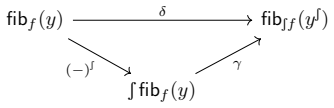
The load-bearing object is the modal prism: the commuting diagram comparing $\mathrm{fib}_f(y)$, the fiber of $!f$ at $y_!$, and $!\, \mathrm{fib}_f(y)$, with the connecting map $\gamma$. A map $f$ is a $!$-fibration when $\gamma$ is an equivalence. The proof of the main characterization combines two factorization systems for a modality, the $!$-connected/$!$-modal and $!$-equivalence/$!$-étale factorizations, and shows they agree exactly on fibrations. The Real Cohesion axioms enter through Theorem 5.8, which says the classifying type $\mathrm{BAut}_X(x)$ is discrete for crisp locally discrete $X$; that discreteness lets the family $!\, \mathrm{fib}_f$ factor through the modal unit, producing the concrete $S$-fibration criterion.
What would settle it
Find a model of Real Cohesive HoTT with a map $f : X \to Y$ and a crisp discrete type $F$ such that $\|F = S\, \mathrm{fib}_f(y)\|$ for every $y$, yet the modal-prism map $\gamma : S\, \mathrm{fib}_f(y) \to \mathrm{fib}_{Sf}(y_S)$ fails to be an equivalence for some $y$. Topologically, this would be a continuous map whose homotopy types of fibers are locally constant but which is not a quasi-fibration in the topological sense; Theorem 3.13 predicts no such map exists.
Extended reading notes
Core claim
The paper's central theorem is Theorem 3.13: for any modality $!$, a map $f : X \to Y$ is a $!$-fibration if and only if the family $! \, \mathrm{fib}_f : Y \to \mathrm{Type}_!$ factors through the modal unit $Y \to !Y$. Reading this through the modal prism, the comparison between the fiber of $f$ and the fiber of $!f$, the map $f$ is a fibration when the modality sees no new information in the fibers beyond what is recorded in the modalized base. For the shape modality $S$ of Real Cohesion, this says that $f$ is an $S$-fibration exactly when the homotopy type of the fiber over $y$ is locally constant in $y$. The paper then proves a practical sufficient condition: if all fibers are merely equivalent to a fixed crisply discrete type, the map is an $S$-fibration. This yields the fiber sequence $\mathbb{Z} \to S\mathbb{R} \to S S^1$ with $\Omega S S^1 \simeq \mathbb{Z}$, makes Hopf fibrations and homotopy quotients into $S$-fibrations, and supports a modal covering theory in which covers correspond to actions of the fundamental groupoid on discrete sets.
Load-bearing premise
The main results rest on the Real Cohesion axiom that, for types defined without free variables, internal topological discreteness coincides with the stricter crisp discreteness; if that axiom gives way, the classifying types $\mathrm{BAut}_X(x)$ may stop being discrete, and the criterion that maps with merely constant fibers are $S$-fibrations collapses.
Editorial extensions
If this is right
- If a map's fibers are merely equivalent to one fixed crisply discrete type $F$, the map is an $S$-fibration; knowing the fiber ahead of time is enough to certify fibrancy.
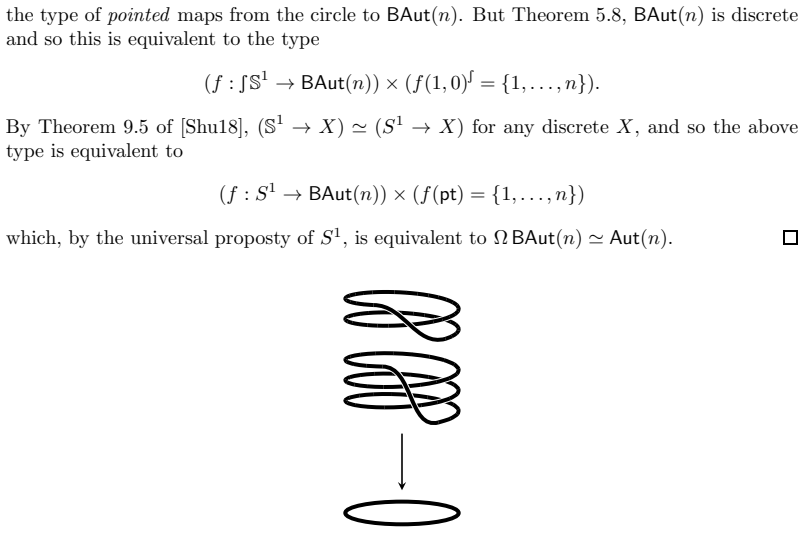
- $S$-fibrations transfer fiber sequences to homotopy types, so the long exact sequence associated to $(\cos, \sin) : \mathbb{R} \to S^1$ computes $\Omega S S^1 \simeq \mathbb{Z}$ without constructing the higher inductive circle.
- The generalized Hopf maps and the rotation maps $SO(n+1) \to S^n$ are $S$-fibrations, giving homotopy fiber sequences for real, complex, and quaternionic projective spaces.
- Quotients $X \to X/\kern-2pt/G$ by crisp higher group actions are $S$-fibrations, and covers of $X$ are equivalent to functors $S_1 X \to \mathrm{Type}_{S_0}$; every pointed homotopically connected space has an initial universal cover.
- The shape modality preserves $n$-connectedness of crisp types, so the shape of a higher group is a higher group; this yields characteristic-class maps such as the first Stiefel-Whitney and first Chern classes.
Reading between the lines
- Editorial inference: The local-constancy criterion suggests a synthetic definition of characteristic classes in cohesive homotopy type theory: any $S$-fibration with discrete fiber $F$ classifies by a map into $\mathrm{BAut}(F)$, so one can read off cohomology classes and likely develop obstruction theory along the same lines.
- Editorial inference: The paper proves that shape preserves connectedness only for crisp types and leaves the general case open; a natural test is whether a non-crisp counterexample exists, where an $n$-connected type has a shape that is not $n$-connected.
- Editorial inference: The same modal-fibration formalism should transfer to other modality/comodality pairs, such as a crystalline modality, where $!$-étale maps become formal étale maps or local diffeomorphisms; the paper notes the axioms needed, so one could test the theory in that setting to obtain differential-geometric covering statements.
- Editorial inference: Because $!$-fibrations are closed under pullback and composition, they behave like a class of universal quasi-fibrations; one might ask whether every map can be replaced, up to the appropriate equivalence, by a $!$-fibration with the same homotopy fibers, giving a factorization theorem the paper does not state.
Signed reviews
Editorial analysis
A structured set of objections, weighed in public.
Referee Report
Summary. The paper develops a theory of modal fibrations for an arbitrary higher modality ! in homotopy type theory. Around the 'modal prism' comparing a map's fibers with the fibers of its modal action, a !-fibration is defined by the requirement that the canonical comparison γ: ! fiber_f(y) -> fiber_{!f}(y!) is an equivalence. The central result is Theorem 3.13: the projection from a dependent sum is a !-fibration exactly when the family !E : Y -> Type factors through the modal unit Y -> !Y, yielding equivalent characterizations via pullback preservation and agreement of the two factorization systems. The paper then specializes to the shape modality S in Shulman's Real Cohesive HoTT and uses this criterion to show that maps with merely constant crisp discrete fibers are S-fibrations. Applications include the universal cover of the circle, Hopf fibrations, rotation maps SO(n+1) -> S^n, homotopy quotients by higher groups, and a covering-space theory with a classification theorem in terms of the fundamental groupoid.
Significance. If correct, this is a genuinely useful contribution to synthetic algebraic topology in HoTT. It gives a clean, general characterization of modal fibrations (Theorem 3.13) and a practical sufficient criterion (Theorem 6.1), and it demonstrates the payoff by deriving the loop space of the topological circle as Z without passing through the higher inductive circle. The paper is also honest about its scope: Theorem 5.8 depends on Shulman's Real Cohesion axioms, including crisp excluded middle and R-flat, and Theorem 8.6 is proved only for crisp types, with the general case left open. The dependencies on RSS17, Rij18, and Shu18 are external but non-circular, and the paper's central derivation is coherent. There is no machine-checked formalization, so I cannot certify every syntactic step, but I found no load-bearing gap.
minor comments (6)
- [§3 (Lemma 3.12)] The sentence 'the type of such factorizations is a proposition' is asserted rather than proved in detail; since Lemma 3.12 is the hinge for Theorem 3.13, I would spell out why any two factorizations agree using uniqueness of the !-unit for the relevant pullback square.
- [§6.2 (near Lemma 6.7)] The notation 'SK^{n+1}' for the unit sphere is easily confused with the shape modality S, which appears in the same paragraph; please use S^{2n+1} or an explicit sphere notation to distinguish the sphere from the shape operator.
- [§2 (examples of modalities)] There is a typo: 'crystaline modality' should be 'crystalline modality'.
- [§9 (Proposition 9.8)] Minor typo: 'futhermore' should be 'furthermore'.
- [§6.4] The examples in §6.4 and §6.5 invoke Theorem 7.7 before it is stated; a forward pointer or a reordering of the sections would improve readability.
- [§6.1 (Lemma 6.3)] In the proof that the fibers of (cos,sin) are merely equivalent to Z, the inverse maps depend on a choice of θ; this is fine because the conclusion is a mere proposition, but the dependence could be stated explicitly.
Circularity Check
No significant circularity found; the central characterization and examples are derived from external modality theory and Real Cohesion, not from their own conclusions.
full rationale
I walked the derivation chain from Definition 2.4 through Theorem 3.13, Theorem 5.8, Theorem 6.1, the examples, and the covering-space results. The main characterization in Theorem 3.13 is proved from the factorization-system results of RSS17 and Rij18 via Lemmas 3.2 and 3.12; it is not the definition of !-fibration, nor is the local-constant-family formulation assumed as an input. Theorem 6.1 does use the hypothesis that S fib_f(y) is merely equivalent to a crisp discrete F, which is a genuine sufficient condition: the proof factors S fib_f through BAut(F), uses Theorem 5.8 to show BAut(F) is discrete, and then applies Theorem 3.13. Theorem 5.8 itself is proved from the Real Cohesion axioms, in particular crisp discreteness and Axiom R♭, which are external to this paper and not derived from the fibration theorems. The examples, such as (cos,sin): R → S^1, establish the fiber equivalence to Z by elementary real analysis, and Theorem 6.4 then derives Ω S S^1 ≃ Z from the S-fibration property; no prior computation of that loop space is assumed. Similarly, the Hopf, SO(n+1), and homotopy-quotient examples use independently identified fibers and stabilizers. The covering-space results in Section 9 are corollaries of the same characterization, not renamings of a known result. The paper explicitly flags its scope limitations, such as Theorem 8.6 being restricted to crisp types and Remark 9.9 distinguishing cardinal finiteness from Kuratowski finiteness; these are genuine limitations rather than circular steps. The load-bearing background citations are to work by other authors, so there is no self-citation chain on which the central claim depends. I found no fitted parameter renamed as a prediction and no equation that reduces to its own input by construction.
Assumptions & free parameters
assumptions (5)
- standard math Standard HoTT with univalence, higher inductive types, and propositional resizing.
- domain assumption Axiom 1: crisp excluded middle, P ∨ ¬P for crisp propositions P.
- domain assumption Axiom 2 (R♭): a crisp type is crisply discrete iff it is discrete.
- domain assumption Crisp axiom of choice.
- domain assumption ♭ commutes with propositional truncation.
Cite this review
Pith. "Pith review of Good Fibrations through the Modal Prism." pith.science (2026). https://pith.science/paper/XA522B7F
@misc{pith2026190808034,
  author       = {Pith},
  title        = {Pith review of: Good Fibrations through the Modal Prism},
  year         = {2026},
  howpublished = {\url{https://pith.science/paper/XA522B7F}},
  note         = {Machine review of arXiv:1908.08034}
}
read the original abstract
Homotopy type theory is a formal language for doing abstract homotopy theory -- the study of identifications. But in unmodified homotopy type theory, there is no way to say that these identifications come from identifying the path-connected points of a space. In other words, we can do abstract homotopy theory, but not algebraic topology. Shulman's Real Cohesive HoTT remedies this issue by introducing a system of modalities that relate the spatial structure of types to their homotopical structure. In this paper, we develop a theory of modal fibrations for a general modality, and apply it in particular to the shape modality of Real Cohesion. We then give examples of modal fibrations in Real Cohesive HoTT, and develop the theory of covering spaces.
Figures
Reference graph
Works this paper leans on
-
[3]
Modalitie s in homotopy type theory
[RSS17] Egbert Rijke, Michael Shulman, and Bas Spitters. “Modalitie s in homotopy type theory”. In: arXiv e-prints (2017). arXiv: 1706.07526 [math.CT] . [Sch13] Urs Schreiber. “Differential cohomology in a cohesive infinity -topos”. In: (2013). arXiv: 1310.7930 [math-ph] . [Shu18] Michael Shulman. “Brouwer’s fixed-point theorem in real-co hesive homotopy typ...
arXiv 2017
-
[5]
[Wel18] Felix Wellen. “Cohesive Covering Theory”. In: Proceedings of HoTT/UF 2018 . Ed. by Huber Ahrens and M¨ ortberg. Aug. 2018.url: https://hott-uf.github.io/2018/abstracts/HoTTUF18_p aper_15.pdf. 40
work page 2018
-
[2017]
Goodwillie’s calculus of functors and higher to pos theory
arXiv: 1703.09050 [math.AT] . [Ane+18] M. Anel et al. “Goodwillie’s calculus of functors and higher to pos theory”. In: Journal of Topology 11.4 (2018), 1100–1132. issn: 1753-8416. doi: 10.1112/topo.12082. url: http://dx.doi.org/10.1112/topo.12082. 39 [BDR18] Ulrik Buchholtz, Floris van Doorn, and Egbert Rijke. Higher Groups in Homo- topy Type Theory
arXiv 2018
-
[2018]
Higher Groups in Homotopy Type Theory
arXiv: 1802.04315 [cs.LO] . [Chr+18] J. Daniel Christensen et al. “Localization in Homotopy Type Theory”. In: arXiv e-prints (2018). arXiv: 1807.04155 [math.AT] . [DT58] Albrecht Dold and Rene Thom. “Quasifaserungen und Unendlic he Symmetrische Produkte”. In: Annals of Mathematics 67.2 (1958), pp. 239–281. issn: 0003486X. url: http://www.jstor.org/stable/...
work page Pith review arXiv 2018
-
[2019]
[Uni13] The Univalent Foundations Program
arXiv: 1904.07004 [math.AT] . [Uni13] The Univalent Foundations Program. Homotopy Type Theory: Univalent Foun- dations of Mathematics. Institute for Advanced Study: https://homotopytypetheory.org/book,
arXiv 1904
Reviewed August 14, 2026 · model on record in the stance chip above.
Discussion (0). Continue with ORCID to comment.