REVIEW 3 major objections 3 minor 1 cited by
The Progenitors of Calcium-Strong Transients
T0 review · 3 major / 3 minor · reviewed 2026-08-14 · deepseek-v4-flash
Pith's one-line read This paper argues that calcium-strong transients come from rare binaries forged and then ejected by globular clusters.
desk verdict This paper makes a real contribution by constructing the local-universe globular cluster radial distribution and arguing that dynamical formation plus hardening/ejection in GCs can explain the CaST population, but the central formation-rate assumption is still unquantified and the scenario is a plausible framework, not a demonstrated solution. read the letter →
The pith
A machine-rendered reading of the paper's core claim, the machinery that carries it, and where it could break.
The reading
What carries the argument
The load-bearing object is the globular cluster itself, treated as a dynamical factory: its high stellar density creates rare hard binaries through captures and exchanges, and the same environment then hardens them. The quantitative machinery is the balance between the binary-hardening recoil and the cluster's gravitational pull. Repeated encounters shrink a hard binary's orbit and give the binary a growing recoil velocity; once that velocity exceeds the cluster escape speed, the binary is ejected while its orbit is still wide enough that gravitational-wave inspiral has not yet brought the components into contact. The paper estimates that the ejection separation and the gravitational-wave-dominated separation are comparable for its three candidate channels, so ejection before interaction is plausible for at least some systems. The other load-bearing component is the mass budget: combining the observed volumetric CaST rate with the local mass density of globular clusters requires roughly one CaST per 8.4 solar masses of cluster mass if production has been steady for a Hubble time, or one per 120 solar masses if it has been active for only the last gigayear.
What would settle it
A search capable of finding faint transients in the bright cores of galaxies that finds no nuclear-star-cluster CaST population at a rate comparable to the observed outskirt rate would falsify the dynamical-production scenario. A direct dynamical calculation showing that the three channels form in globular clusters far too slowly to meet the required mass budget would do the same.
Extended reading notes
Core claim
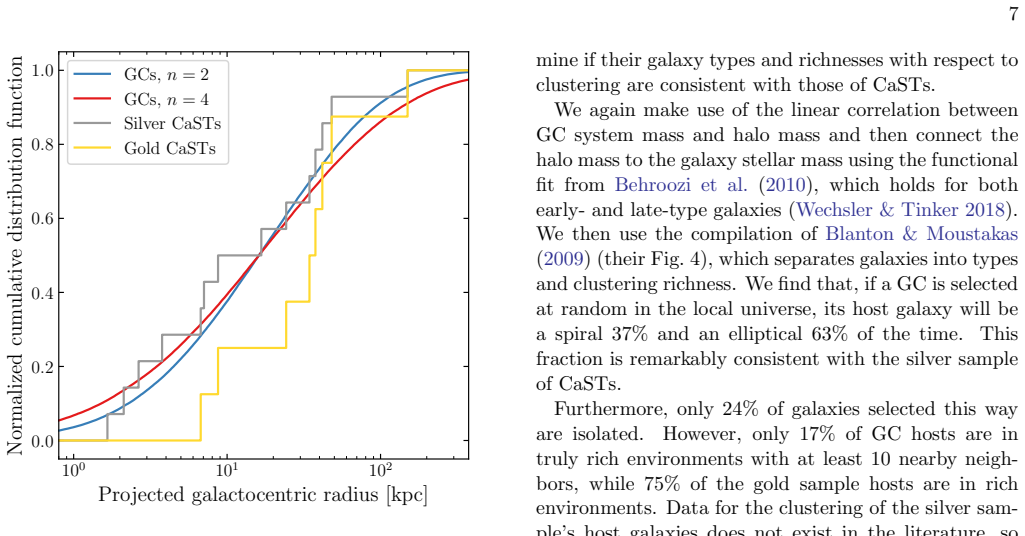
The central claim is that the observed population of calcium-strong transients is best understood as the product of dynamically formed binaries that are ejected from globular clusters before interacting. The paper matches the projected galactocentric radial distribution of the observed CaSTs to the theoretical radial distribution of globular clusters in the local universe, built from the halo mass function and a power-law relation between cluster system size and halo mass. It then identifies three binary channels whose field rates are too low but whose formation and interaction rates could be enhanced in dense cluster environments: He plus O/Ne white dwarf mergers, tidal disruption of He white dwarfs by neutron stars, and stable accretion from low-mass He-burning stars onto white dwarfs. Binary hardening simultaneously shrinks the orbits, raising the interaction rate, and eventually gives recoil kicks that exceed the cluster escape speed, ejecting the binary before mass transfer or merger. That is why no globular cluster is seen at a CaST site despite the cluster origin. The paper explicitly flags that the required production efficiency is high: if CaSTs have been produced at a constant rate for a Hubble time, nearly half of all white dwarfs in globular clusters must participate, and this budget appears to rule out the neutron-star channel because few neutron stars are retained in clusters.
Load-bearing premise
The assumption that the three candidate binaries are actually formed dynamically inside globular clusters at rates at least competitive with field formation is not quantified in the paper, and without it the radial-distribution match is only a coincidence.
Editorial extensions
If this is right
- CaSTs should continue to appear far from their hosts, tracing the globular cluster radial distribution; the observed sample should converge toward the broader silver-sample distribution rather than the gold-sample one as surveys improve.
- Deep imaging at CaST sites should usually reveal no host globular cluster, because the progenitors are ejected before exploding, though events born in clusters with unusually high escape velocities may still be found inside clusters.
- Nuclear star clusters should produce CaSTs at a rate comparable to the observed outskirt rate, and the current lack of such detections is a selection effect that core-sensitive searches can test.
- The helium-white-dwarf plus neutron-star channel is unlikely to be the main route, because the number of neutron stars retained in globular clusters is too small to provide the required event rate.
- Explosion models of the remaining two channels should produce low radioactive yields and ejecta dominated by intermediate-mass elements, matching the faint, calcium-dominated spectra of CaSTs.
Reading between the lines
- If the globular cluster origin is right, the CaST rate should scale with the total globular cluster mass of a galaxy or halo, so more massive clustered environments should contribute disproportionately; this could be tested by comparing host halo masses of future CaST samples.
- The tight mass budget hints that globular clusters may have been more massive in the past or that only a subpopulation of dense, core-collapsed clusters produces most CaSTs; identifying which clusters contribute could sharpen predictions for the nuclear-star-cluster rate.
- The same ejection mechanism may apply to other compact-object transients with anomalously extended radial distributions, so a systematic search for hostless explosions tracing globular-cluster halos could reveal whether CaSTs are one example of a broader dynamical channel.
- A direct N-body calculation of the three binary channels in realistic cluster models would turn the currently assumed formation-rate enhancement into a measured rate; if it comes out below field rates, the old-metal-poor-star alternative would need a concrete progenitor to remain viable.
Signed reviews
Editorial analysis
A structured set of objections, weighed in public.
Referee Report
Summary. The paper studies calcium-strong transients (CaSTs), a class of faint, spectroscopically peculiar explosions with high nebular Ca/O ratios, large galactocentric offsets, and a relatively high volumetric rate. The authors first show that the CaST radial distribution is qualitatively similar to the radial distribution of globular clusters (GCs) and of old, metal-poor stars. They then propose that CaSTs originate from one of three binary channels—He+O/Ne white dwarf mergers, He white dwarf disruptions by neutron stars, or accretion from low-mass He-burning stars onto white dwarfs—that are rare in the field but can be formed dynamically in GCs. Binary hardening both raises the interaction rate and ejects the binaries before explosion, explaining the absence of GCs at transient sites. The paper also quantifies the required CaST production efficiency from GC mass and derives a falsifiable prediction of a comparable CaST rate in nuclear star clusters. The central claim is conditional on an assumed, uncalculated dynamical formation rate, and the paper is transparent about this limitation.
Significance. If the GC-production scenario is correct, the paper would connect CaSTs to dynamical binary formation in dense stellar systems and provide a new, testable prediction for nuclear star clusters. The paper makes several useful contributions: it assembles the observational constraints on CaSTs, derives a theoretical GC radial distribution from independent empirical scaling relations, identifies three specific progenitor channels that warrant further study, and explicitly quantifies the rate-efficiency tension that any GC scenario must overcome. The falsifiable NSC prediction and the honesty about the missing dynamical calculation are strengths. The main significance is as a hypothesis-shaping paper rather than a demonstrated progenitor model; the central claim rests on an assumption that the authors themselves defer to future work.
major comments (3)
- [Section 3.3] The central assumption of the GC scenario is not quantified. The paper states that "we proceed under the assumption that CaST progenitors are formed dynamically in GCs as hard binaries at a rate larger than, or at least competitive with, that in the field" and defers the calculation to future N-body and population-synthesis work. This is load-bearing because §2.4 quotes field WD+NS merger rates of only 3e-16 to 3e-15 yr^-1 Msun^-1, so the required GC enhancement is not a small factor. As written, the paper demonstrates that the GC scenario is consistent with the radial distribution only if an uncalculated formation rate happens to be favorable; it does not demonstrate that the proposed channels supply the observed CaST rate. A quantitative requirement on the dynamical birth rate for each channel, or a reframing of the claim as a strictly conditional hypothesis, is needed.
- [Section 3.4, Eq. (6)] The rate-efficiency budget derived in §3.4 is severe and, as the authors acknowledge, not resolved by the paper. The constant-Hubble-time case requires η ≈ 1 CaST per 8.4 Msun of GC mass, which with 0.3 WDs per Msun implies roughly half of all GC white dwarfs participating; the 1-Gyr-delay case gives about 3% before applying the 2–7× mass-segregation boost and the restriction to the subset of GCs with densities near 10^7 pc^-3 needed for rapid hardening. Since the hardening timescale in Eq. (3) is evaluated at n = 10^7 pc^-3, typical GCs will be much less efficient, so the required per-cluster efficiency is even higher. This budget should be converted into a required dynamical formation rate for each candidate channel and compared with existing constraints from cataclysmic variables, X-ray binaries, and double-WD populations, rather than left as a caveat.
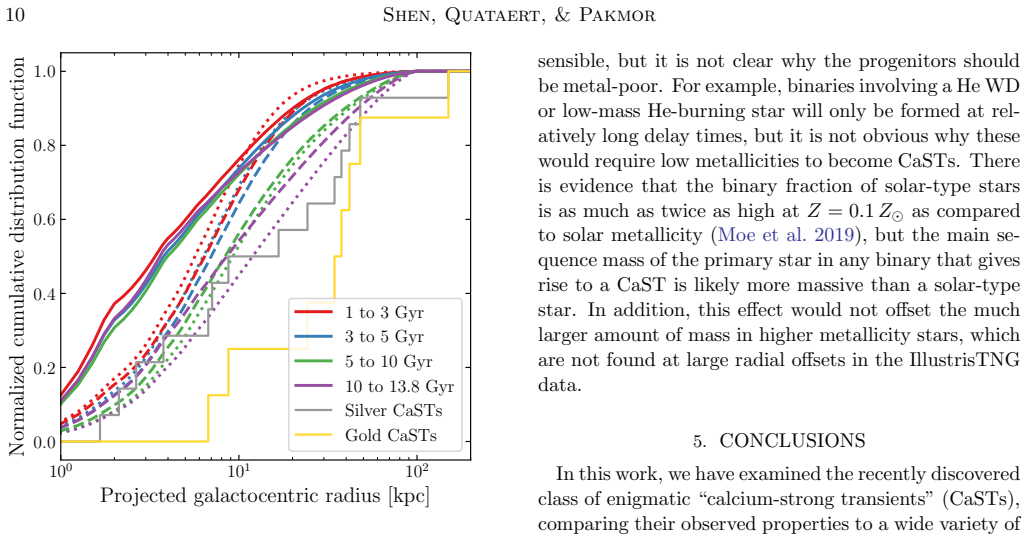
- [Section 3.1, Figure 1] The claimed consistency between the GC radial distribution and the CaST distribution is assessed only by visual comparison of cumulative distributions. No significance test (e.g., Kolmogorov–Smirnov) is given, the gold sample contains only eight objects, and the paper itself notes in §3.1 that the Palomar Transient Factory is biased against recovering CaSTs close to their hosts, making the gold distribution an upper limit. With these issues, the visual agreement is suggestive but not a quantitative empirical constraint. The paper should either provide a test statistic or explicitly label the match as qualitative for both Figure 1 and Figure 2.
minor comments (3)
- [Section 3.1] The uncertainty in the GC system effective radius–halo mass relation, including the alternative slope from Hudson & Robison (2018) noted in the footnote, is not propagated into the cumulative distributions in Figures 1 and 2; showing a range of Sérsic indices and scaling-relation parameters would make the robustness of the conclusion clearer.
- [Section 3.4] The quoted Frohmaier et al. rate is asymmetric (+1.13/-0.39), but the derived efficiency η is presented as a single value; reporting the corresponding range in η would help the reader see how sensitive the mass-budget argument is to the uncertain rate.
- [Section 4] The statement that overall TNG100 stellar density profiles match observed stacked galaxies is used to support the reliability of age and metallicity binning, but this is a weaker validation than a direct comparison of halo stellar populations; the sentence should be phrased as a modeling assumption.
Circularity Check
No significant circularity: the GC radial distribution and rate-efficiency constraints use independent empirical inputs, and the unquantified GC dynamical-formation rate is an openly stated assumption, not a fitted prediction.
full rationale
The paper's central comparison is not circular. In Section 3.1, the predicted GC radial distribution is built from independent inputs: the observed M_GCs/M_halo relation, the Tinker et al. (2008) halo mass function, and Forbes (2017)'s empirically calibrated Re-halo mass relation. This cumulative distribution is then compared with, not fitted to, the observed CaST offsets in Figure 1. Section 3.4 similarly treats the observed volumetric CaST rate (Frohmaier et al. 2018) and the independently integrated GC mass density (rho_GCs = 1.4e6 Msun/Mpc3) as inputs, and the resulting efficiency eta ~ 1 CaST per 8.4 Msun is explicitly an 'implied production efficiency' — a constraint used to test the scenario (e.g., ruling out He WD + NS progenitors), not a fitted parameter relabeled as a prediction. The load-bearing dynamical-formation rate in GCs is admittedly not quantified: Section 3.3 states, 'We do not conduct a quantitative estimate of the birth rates... Instead, we proceed under the assumption that CaST progenitors are formed dynamically in GCs as hard binaries at a rate larger than, or at least competitive with, that in the field.' That is an acknowledged unverified assumption and a correctness risk, but it is not circularity because the paper does not pretend to derive it. The Section 3.5 nuclear-star-cluster prediction is a conditional, falsifiable corollary ('if CaSTs are indeed dynamically formed in GCs, they should also explode in nuclear star clusters'), not an output forced by construction. The self-citations present (e.g., Shen & Bildsten 2014 for O/Ne WD core behavior, Shen 2015 for double-WD mass-transfer instability) support ancillary physics subclaims about candidate explosion channels; they are not the basis for the GC-production scenario, and the paper imports no 'uniqueness theorem' from the authors' prior work. Overall, the derivation chain is self-contained against external benchmarks; the central weakness is an unquantified rate assumption, which belongs to scientific plausibility, not circular reasoning.
Assumptions & free parameters
free parameters (5)
- Sersic index n for GC surface density profiles =
n = 2 and n = 4 (representative values)
- GC system mass fraction MGCs/Mhalo =
3e-5
- GC effective radius-halo mass relation Re = 22 kpc (Mhalo/1e13 Msun)^(1/3) =
Normalization 22 kpc, slope 1/3
- Duration of CaST production from GCs =
Constant over Hubble time vs. only last 1 Gyr
- Binary hardening fiducial parameters (xi=0.3, n=1e7 pc^-3, sigma=10 km/s, vesc=50 km/s) =
Fiducial values for core-collapsed GC
assumptions (7)
- domain assumption GC total mass is linearly proportional to host halo mass (MGCs/Mhalo ~ 3e-5) across five orders of magnitude
- standard math The Tinker et al. (2008) halo mass function at z=0 describes local universe halos and HMFcalc implements it correctly
- domain assumption GC systems are described by Sersic surface density profiles with index n=2 to 4
- standard math Hardening of a binary in a GC follows the Heggie-Hills law with timescale Eq. (3), and ejection occurs when recoil velocity reaches the GC escape velocity Eq. (4)
- ad hoc to paper CaST progenitors (He+O/Ne WD, He WD+NS, or He-burning star+WD binaries) are formed dynamically in GCs at a rate at least competitive with the field
- domain assumption IllustrisTNG100 stellar populations binned by age and metallicity accurately represent the true radial distributions of old, metal-poor stars in the local universe
- domain assumption The retained neutron star fraction in globular clusters is about 1 per 800-900 Msun (Ivanova et al. 2008)
Cite this review
Pith. "Pith review of The Progenitors of Calcium-Strong Transients." pith.science (2026). https://pith.science/paper/5WCKSNPL
@misc{pith2026190808056,
  author       = {Pith},
  title        = {Pith review of: The Progenitors of Calcium-Strong Transients},
  year         = {2026},
  howpublished = {\url{https://pith.science/paper/5WCKSNPL}},
  note         = {Machine review of arXiv:1908.08056}
}
read the original abstract
A new class of faint, spectroscopically peculiar transients has emerged in the last decade. We term these events "calcium-strong transients" (CaSTs) because of their atypically high calcium-to-oxygen nebular line ratios. Previous studies have struggled to deduce the identity of their progenitors due to a combination of their extremely extended radial distributions with respect to their host galaxies and their relatively high rate of occurrence. In this work, we find that the CaST radial distribution is consistent with the radial distribution of two populations of stars: old (ages > 5 Gyr), low-metallicity (Z/Zsol < 0.3) stars and globular clusters. While no obvious progenitor scenario arises from considering old, metal-poor stars, the alternative production site of globular clusters leads us to narrow down the list of possible candidates to three binary scenarios: mergers of helium and oxygen/neon white dwarfs; tidal disruptions of helium white dwarfs by neutron stars; and stable accretion from low-mass helium-burning stars onto white dwarfs. While rare in the field, these binary systems can be formed dynamically at much higher rates in globular clusters. Subsequent binary hardening both increases their interaction rate and ejects them from their parent globular clusters prior to mass transfer contact. Their production in, and ejection from, globular clusters may explain their radial distribution and the absence of globular clusters at their explosion site. This model predicts a currently undiscovered high rate of CaSTs in nuclear star clusters. Alternatively, an undetermined progenitor scenario involving old, low-metallicity stars may instead hold the key to understanding CaSTs.
Figures
Forward citations
Cited by 1 Pith paper
-
Compact Objects in Globular Clusters
Globular clusters host many stellar remnants, and their dense environments produce X-ray sources, radio pulsars, and gravitational-wave black hole mergers.
Reference graph
Works this paper leans on
-
[1]
Andrews, J. J., & Mandel, I. 2019, ApJL, 880, L8, doi: 10.3847/2041-8213/ab2ed1
-
[2]
Anninos, P., Fragile, P. C., Olivier, S. S., et al. 2018, ApJ, 865, 3, doi: 10.3847/1538-4357/aadad9
-
[3]
Antonini, F., & Rasio, F. A. 2016, ApJ, 831, 187, doi: 10.3847/0004-637X/831/2/187
-
[4]
2003, MNRAS, 340, 227, doi: 10.1046/j.1365-8711.2003.06286.x
Baumgardt, H., & Makino, J. 2003, MNRAS, 340, 227, doi: 10.1046/j.1365-8711.2003.06286.x
arXiv 2003
-
[5]
Behroozi, P. S., Conroy, C., & Wechsler, R. H. 2010, ApJ, 717, 379, doi: 10.1088/0004-637X/717/1/379
-
[6]
Benacquista, M. J., & Downing, J. M. B. 2013, Living Reviews in Relativity, 16, 4, doi: 10.12942/lrr-2013-4
-
[7]
Bildsten, L., Shen, K. J., Weinberg, N. N., & Nelemans, G. 2007, ApJL, 662, L95, doi: 10.1086/519489
doi:10.1086/519489 2007
-
[8]
Blakeslee, J. P., Tonry, J. L., & Metzger, M. R. 1997, AJ, 114, 482, doi: 10.1086/118488
doi:10.1086/118488 1997
Show all 112 references
-
[9]
R., & Moustakas, J
Blanton, M. R., & Moustakas, J. 2009, ARA&A, 47, 159, doi: 10.1146/annurev-astro-082708-101734
2009 doi
-
[10]
B., & Church, R
Bobrick, A., Davies, M. B., & Church, R. P. 2017, MNRAS, 467, 3556, doi: 10.1093/mnras/stx312
2017 doi
-
[11]
C., et al
Branch, D., Baron, E., Thomas, R. C., et al. 2004, PASP, 116, 903, doi: 10.1086/425081
2004 doi
-
[12]
D., & Kocsis, B
Brandt, T. D., & Kocsis, B. 2015, ApJ, 812, 15, doi: 10.1088/0004-637X/812/1/15
2015 doi
-
[13]
R., Kilic, M., Kenyon, S
Brown, W. R., Kilic, M., Kenyon, S. J., & Gianninas, A. 2016, ApJ, 824, 46, doi: 10.3847/0004-637X/824/1/46
2016 doi
-
[14]
J., Marsh, T
Carter, P. J., Marsh, T. R., Steeghs, D., et al. 2013, MNRAS, 429, 2143, doi: 10.1093/mnras/sts485
2013 doi
-
[15]
D., et al
Chen, P., Dong, S., Stritzinger, M. D., et al. 2019, ApJL, submitted (arXiv:1905.02205)
2019 arXiv
-
[16]
Choksi, N., & Gnedin, O. Y. 2019, MNRAS, 488, 5409, doi: 10.1093/mnras/stz2097
2019 doi
-
[17]
2007, CBET, 1084, 1
Chu, J., & Li, W. 2007, CBET, 1084, 1
2007
-
[18]
Clayton, G. C. 1996, PASP, 108, 225, doi: 10.1086/133715
1996 doi
-
[19]
R., Darbha, S., Kasen, D., & Quataert, E
Coughlin, E. R., Darbha, S., Kasen, D., & Quataert, E. 2018, ApJL, 863, L24, doi: 10.3847/2041-8213/aad7bd
2018 doi
-
[20]
M., Cantwell, T., et al
De, K., Kasliwal, M. M., Cantwell, T., et al. 2018a, ApJ, 866, 72, doi: 10.3847/1538-4357/aadf8e
-
[21]
M., Ofek, E
De, K., Kasliwal, M. M., Ofek, E. O., et al. 2018b, Science, 362, 201, doi: 10.1126/science.aas8693 de Plaa, J., Werner, N., Bleeker, J. A. M., et al. 2007, A&A, 465, 345, doi: 10.1051/0004-6361:20066382
2007 doi
-
[22]
Dessart, L., & Hillier, D. J. 2015, MNRAS, 447, 1370, doi: 10.1093/mnras/stu2520 D’Souza, R., Kauffman, G., Wang, J., & Vegetti, S. 2014, MNRAS, 443, 1433, doi: 10.1093/mnras/stu1194
2015 doi
-
[23]
V., & Fedorova, A
Ergma, E. V., & Fedorova, A. V. 1990, Ap&SS, 163, 143, doi: 10.1007/BF00639983 Fern´ andez, R., Margalit, B., & Metzger, B. D. 2019, MNRAS, 488, 259, doi: 10.1093/mnras/stz1701 Fern´ andez, R., & Metzger, B. D. 2013, ApJ, 763, 108, doi: 10.1088/0004-637X/763/2/108
1990 doi
-
[24]
Filippenko, A. V. 1997, ARA&A, 35, 309, doi: 10.1146/annurev.astro.35.1.309
1997 doi
-
[25]
V., Chornock, R., Swift, B., et al
Filippenko, A. V., Chornock, R., Swift, B., et al. 2003, IAUC, 8159, 2
2003
-
[26]
Fink, M., Hillebrandt, W., & R¨ opke, F. K. 2007, A&A, 476, 1133, doi: 10.1051/0004-6361:20078438
2007 doi
-
[27]
K., Hillebrandt, W., et al
Fink, M., R¨ opke, F. K., Hillebrandt, W., et al. 2010, A&A, 514, A53, doi: 10.1051/0004-6361/200913892 12 Shen, Quataert, & Pakmor
2010 doi
-
[28]
R., et al
Fink, M., Kromer, M., Seitenzahl, I. R., et al. 2014, MNRAS, 438, 1762, doi: 10.1093/mnras/stt2315
2014 doi
-
[29]
Foley, R. J. 2015, MNRAS, 452, 2463, doi: 10.1093/mnras/stv789
2015 doi
-
[30]
Forbes, D. A. 2017, MNRAS, 472, L104, doi: 10.1093/mnrasl/slx148
2017 doi
-
[31]
A., Read, J
Forbes, D. A., Read, J. I., Gieles, M., & Collins, M. L. M. 2018, MNRAS, 481, 5592, doi: 10.1093/mnras/sty2584
2018 doi
-
[32]
Fragione, G., Antonini, F., & Gnedin, O. Y. 2018, MNRAS, 475, 5313, doi: 10.1093/mnras/sty183
2018 doi
-
[33]
2018, ApJ, 858, 50, doi: 10.3847/1538-4357/aabc0b
Frohmaier, C., Sullivan, M., Maguire, K., & Nugent, P. 2018, ApJ, 858, 50, doi: 10.3847/1538-4357/aabc0b
2018 doi
-
[34]
R., Wang, B., et al
Geier, S., Marsh, T. R., Wang, B., et al. 2013, A&A, 554, A54, doi: 10.1051/0004-6361/201321395
2013 doi
-
[35]
Y., Ostriker, J
Gnedin, O. Y., Ostriker, J. P., & Tremaine, S. 2014, ApJ, 785, 71, doi: 10.1088/0004-637X/785/1/71
2014 doi
-
[36]
G., Carretta, E., & Bragaglia, A
Gratton, R. G., Carretta, E., & Bragaglia, A. 2012, A&A Rv, 20, 50, doi: 10.1007/s00159-012-0050-3
2012 doi
-
[37]
2010, ApJL, 709, L64, doi: 10.1088/2041-8205/709/1/L64
Guillochon, J., Dan, M., Ramirez-Ruiz, E., & Rosswog, S. 2010, ApJL, 709, L64, doi: 10.1088/2041-8205/709/1/L64
2010 doi
-
[38]
E., Harris, G
Harris, W. E., Harris, G. L., & Hudson, M. J. 2015, ApJ, 806, 36, doi: 10.1088/0004-637X/806/1/36
2015 doi
-
[39]
Heggie, D. C. 1975, MNRAS, 173, 729, doi: 10.1093/mnras/173.3.729
1975 doi
-
[40]
Hills, J. G. 1983, AJ, 88, 1269, doi: 10.1086/113418
1983 doi
-
[41]
J., & Robison, B
Hudson, M. J., & Robison, B. 2018, MNRAS, 477, 3869, doi: 10.1093/mnras/sty844
2018 doi
-
[42]
Fregeau, J. M. 2008, MNRAS, 386, 553, doi: 10.1111/j.1365-2966.2008.13064.x
2008
-
[43]
O., Rasio, F
Ivanova, N., Heinke, C. O., Rasio, F. A., et al. 2006, MNRAS, 372, 1043, doi: 10.1111/j.1365-2966.2006.10876.x
2006
-
[44]
M., Kulkarni, S
Kasliwal, M. M., Kulkarni, S. R., Gal-Yam, A., et al. 2012, ApJ, 755, 161, doi: 10.1088/0004-637X/755/2/161
2012 doi
-
[45]
S., Maeda, K., Nomoto, K., et al
Kawabata, K. S., Maeda, K., Nomoto, K., et al. 2010, Nature, 465, 326, doi: 10.1038/nature09055
2010 doi
-
[46]
2018, MNRAS, 477, 3449, doi: 10.1093/mnras/sty842
Kawana, K., Tanikawa, A., & Yoshida, N. 2018, MNRAS, 477, 3449, doi: 10.1093/mnras/sty842
2018 doi
-
[47]
Khokhlov, A. M. 1991, A&A, 245, 114
1991
-
[48]
Kravtsov, A. V. 2013, ApJL, 764, L31, doi: 10.1088/2041-8205/764/2/L31
2013 doi
-
[49]
C., van Rossum, D
Long, M., Jordan, IV, G. C., van Rossum, D. R., et al. 2014, ApJ, 789, 103, doi: 10.1088/0004-637X/789/2/103
2014 doi
-
[50]
M., Cao, Y., et al
Lunnan, R., Kasliwal, M. M., Cao, Y., et al. 2017, ApJ, 836, 60, doi: 10.3847/1538-4357/836/1/60
2017 doi
-
[51]
D., Bersier, D., James, P
Lyman, J. D., Bersier, D., James, P. A., et al. 2016a, MNRAS, 457, 328, doi: 10.1093/mnras/stv2983
-
[52]
D., James, P
Lyman, J. D., James, P. A., Perets, H. B., et al. 2013, MNRAS, 434, 527, doi: 10.1093/mnras/stt1038
2013 doi
-
[53]
Tanvir, N. R. 2014, MNRAS, 444, 2157, doi: 10.1093/mnras/stu1574
2014 doi
-
[54]
D., Levan, A
Lyman, J. D., Levan, A. J., James, P. A., et al. 2016b, MNRAS, 458, 1768, doi: 10.1093/mnras/stw477
-
[55]
2016, ApJ, 819, 3, doi: 10.3847/0004-637X/819/1/3
MacLeod, M., Guillochon, J., Ramirez-Ruiz, E., Kasen, D., & Rosswog, S. 2016, ApJ, 819, 3, doi: 10.3847/0004-637X/819/1/3
2016 doi
-
[56]
2018, MNRAS, 476, 2584, doi: 10.1093/mnras/sty339
Maoz, D., Hallakoun, N., & Badenes, C. 2018, MNRAS, 476, 2584, doi: 10.1093/mnras/sty339
2018 doi
-
[57]
Margalit, B., & Metzger, B. D. 2016, MNRAS, 461, 1154, doi: 10.1093/mnras/stw1410
2016 doi
-
[58]
2018, MNRAS, 480, 5113, doi: 10.1093/mnras/sty2206
Marinacci, F., Vogelsberger, M., Pakmor, R., et al. 2018, MNRAS, 480, 5113, doi: 10.1093/mnras/sty2206
2018 doi
-
[59]
2015, A&A, 573, A57, doi: 10.1051/0004-6361/201424562
Meng, X., & Han, Z. 2015, A&A, 573, A57, doi: 10.1051/0004-6361/201424562
2015 doi
-
[60]
2016, A&A, 595, A126, doi: 10.1051/0004-6361/201628765
Mernier, F., de Plaa, J., Pinto, C., et al. 2016, A&A, 595, A126, doi: 10.1051/0004-6361/201628765
2016 doi
-
[62]
J., Raymond, J
Milisavljevic, D., Patnaude, D. J., Raymond, J. C., et al. 2017, ApJ, 846, 50, doi: 10.3847/1538-4357/aa7d9f
2017 doi
-
[63]
M., & Badenes, C
Moe, M., Kratter, K. M., & Badenes, C. 2019, ApJ, 875, 61, doi: 10.3847/1538-4357/ab0d88
2019 doi
-
[64]
J., Mazzali, P
Moriya, T. J., Mazzali, P. A., Tominaga, N., et al. 2017, MNRAS, 466, 2085, doi: 10.1093/mnras/stw3225
2017 doi
-
[65]
S., Kasliwal, M
Mulchaey, J. S., Kasliwal, M. M., & Kollmeier, J. A. 2014, ApJL, 780, L34, doi: 10.1088/2041-8205/780/2/L34
2014 doi
-
[66]
G., Power, C., & Robotham, A
Murray, S. G., Power, C., & Robotham, A. S. G. 2013, Astronomy and Computing, 3, 23, doi: 10.1016/j.ascom.2013.11.001
2013 doi
-
[67]
P., Pillepich, A., Springel, V., et al
Naiman, J. P., Pillepich, A., Springel, V., et al. 2018, MNRAS, 477, 1206, doi: 10.1093/mnras/sty618
2018 doi
-
[68]
Yungelson, L. R. 2001, A&A, 368, 939, doi: 10.1051/0004-6361:20010049
2001 doi
-
[69]
2018, MNRAS, 475, 624, doi: 10.1093/mnras/stx3040
Nelson, D., Pillepich, A., Springel, V., et al. 2018, MNRAS, 475, 624, doi: 10.1093/mnras/stx3040
2018 doi
-
[70]
2019, Computational Astrophysics and Cosmology, 6, 2, doi: 10.1186/s40668-019-0028-x
Nelson, D., Springel, V., Pillepich, A., et al. 2019, Computational Astrophysics and Cosmology, 6, 2, doi: 10.1186/s40668-019-0028-x
2019 doi
-
[71]
1982, ApJ, 257, 780, doi: 10.1086/160031
Nomoto, K. 1982, ApJ, 257, 780, doi: 10.1086/160031
1982 doi
-
[72]
2013, ApJL, 770, L8, doi: 10.1088/2041-8205/770/1/L8
Pakmor, R., Kromer, M., Taubenberger, S., & Springel, V. 2013, ApJL, 770, L8, doi: 10.1088/2041-8205/770/1/L8
2013 doi
-
[73]
T., Etienne, Z., & Shapiro, S
Paschalidis, V., Liu, Y. T., Etienne, Z., & Shapiro, S. L. 2011, PhRvD, 84, 104032, doi: 10.1103/PhysRevD.84.104032
2011 doi
-
[74]
Shapiro, S. L. 2009, PhRvD, 80, 024006, doi: 10.1103/PhysRevD.80.024006 13
2009 doi
-
[75]
Perets, H. B. 2014, arXiv e-prints, arXiv:1407.2254. https://arxiv.org/abs/1407.2254
2014 arXiv
-
[76]
B., Gal-yam, A., Crockett, R
Perets, H. B., Gal-yam, A., Crockett, R. M., et al. 2011, ApJL, 728, L36+, doi: 10.1088/2041-8205/728/2/L36
2011 doi
-
[77]
B., Gal-Yam, A., Mazzali, P
Perets, H. B., Gal-Yam, A., Mazzali, P. A., et al. 2010, Nature, 465, 322, doi: 10.1038/nature09056
2010 doi
-
[78]
2018, MNRAS, 475, 648, doi: 10.1093/mnras/stx3112
Pillepich, A., Nelson, D., Hernquist, L., et al. 2018, MNRAS, 475, 648, doi: 10.1093/mnras/stx3112
2018 doi
-
[79]
2019, ApJ, 873, 84, doi: 10.3847/1538-4357/aafb6a
Polin, A., Nugent, P., & Kasen, D. 2019, ApJ, 873, 84, doi: 10.3847/1538-4357/aafb6a
2019 doi
-
[80]
J., Maguire, K., Fl¨ ors, A., et al
Prentice, S. J., Maguire, K., Fl¨ ors, A., et al. 2019, A&A, submitted (arXiv:1909.05567)
2019 arXiv
-
[81]
2000, IAUC, 7507, 2
Puckett, T., & Dowdle, G. 2000, IAUC, 7507, 2
2000
-
[82]
L., Chatterjee, S., & Rasio, F
Rodriguez, C. L., Chatterjee, S., & Rasio, F. A. 2016, PhRvD, 93, 084029, doi: 10.1103/PhysRevD.93.084029
2016 doi
-
[83]
Rosswog, S., Ramirez-Ruiz, E., & Hix, W. R. 2008, ApJ, 679, 1385, doi: 10.1086/528738 —. 2009, ApJ, 695, 404, doi: 10.1088/0004-637X/695/1/404
2008 doi
-
[84]
2017, ApJ, 846, 36, doi: 10.3847/1538-4357/aa7e32 S´ anchez-Janssen, R., Cˆ ot´ e, P., Ferrarese, L., et al
Samsing, J., MacLeod, M., & Ramirez-Ruiz, E. 2017, ApJ, 846, 36, doi: 10.3847/1538-4357/aa7e32 S´ anchez-Janssen, R., Cˆ ot´ e, P., Ferrarese, L., et al. 2019, ApJ, 878, 18, doi: 10.3847/1538-4357/aaf4fd
2017 doi
-
[85]
H., Arur, K., Maccarone, T
Sell, P. H., Arur, K., Maccarone, T. J., et al. 2018, MNRAS, 475, L111, doi: 10.1093/mnrasl/sly011
2018 doi
-
[86]
Sand, D. J. 2015, MNRAS, 450, 4198, doi: 10.1093/mnras/stv902
2015 doi
-
[87]
Shen, K. J. 2015, ApJL, 805, L6, doi: 10.1088/2041-8205/805/1/L6
2015 doi
-
[88]
J., & Bildsten, L
Shen, K. J., & Bildsten, L. 2009, ApJ, 699, 1365, doi: 10.1088/0004-637X/699/2/1365 —. 2014, ApJ, 785, 61, doi: 10.1088/0004-637X/785/1/61
2009 doi
-
[89]
J., Kasen, D., Miles, B
Shen, K. J., Kasen, D., Miles, B. J., & Townsley, D. M. 2018a, ApJ, 854, 52, doi: 10.3847/1538-4357/aaa8de
-
[90]
2010, ApJ, 715, 767, doi: 10.1088/0004-637X/715/2/767
Scannapieco, E. 2010, ApJ, 715, 767, doi: 10.1088/0004-637X/715/2/767
2010 doi
-
[91]
J., Boubert, D., G¨ ansicke, B
Shen, K. J., Boubert, D., G¨ ansicke, B. T., et al. 2018b, ApJ, 865, 15, doi: 10.3847/1538-4357/aad55b
-
[92]
Sigurdsson, S., & Phinney, E. S. 1993, ApJ, 415, 631, doi: 10.1086/173190
1993 doi
-
[93]
A., Fink, M., Kromer, M., et al
Sim, S. A., Fink, M., Kromer, M., et al. 2012, MNRAS, 420, 3003, doi: 10.1111/j.1365-2966.2011.20162.x
2012
-
[94]
1987, Dynamical evolution of globular clusters (Princeton: Princeton University Press)
Spitzer, L. 1987, Dynamical evolution of globular clusters (Princeton: Princeton University Press)
1987
-
[95]
2018, MNRAS, 475, 676, doi: 10.1093/mnras/stx3304
Springel, V., Pakmor, R., Pillepich, A., et al. 2018, MNRAS, 475, 676, doi: 10.1093/mnras/stx3304
2018 doi
-
[96]
M., Nugent, P
Sullivan, M., Kasliwal, M. M., Nugent, P. E., et al. 2011, ApJ, 732, 118, doi: 10.1088/0004-637X/732/2/118
2011 doi
-
[97]
2018, ApJ, 858, 26, doi: 10.3847/1538-4357/aaba79
Tanikawa, A. 2018, ApJ, 858, 26, doi: 10.3847/1538-4357/aaba79
2018 doi
-
[98]
2017, in Handbook of Supernovae, ed
Taubenberger, S. 2017, in Handbook of Supernovae, ed. A. W. Alsabti & P. Murdin (New York: Springer), 317, doi: 10.1007/978-3-319-21846-5 37
2017 doi
-
[99]
M., Langer, N., Moriya, T
Tauris, T. M., Langer, N., Moriya, T. J., et al. 2013, ApJL, 778, L23, doi: 10.1088/2041-8205/778/2/L23
2013 doi
-
[100]
V., Klypin, A., et al
Tinker, J., Kravtsov, A. V., Klypin, A., et al. 2008, ApJ, 688, 709, doi: 10.1086/591439
2008 doi
-
[101]
2016, ATel, 9685, 1
Tonry, J., Denneau, L., Stalder, B., et al. 2016, ATel, 9685, 1
2016
-
[102]
2018, A&A, 619, A53, doi: 10.1051/0004-6361/201833164
Zenati, Y. 2018, A&A, 619, A53, doi: 10.1051/0004-6361/201833164
2018 doi
-
[103]
M., Miles, B
Townsley, D. M., Miles, B. J., Shen, K. J., & Kasen, D. 2019, ApJL, 878, L38, doi: 10.3847/2041-8213/ab27cd
2019 doi
-
[104]
2014, MNRAS, 437, 1519, doi: 10.1093/mnras/stt1983
Valenti, S., Yuan, F., Taubenberger, S., et al. 2014, MNRAS, 437, 1519, doi: 10.1093/mnras/stt1983
2014 doi
-
[105]
Vesperini, E., & Heggie, D. C. 1997, MNRAS, 289, 898, doi: 10.1093/mnras/289.4.898
1997 doi
-
[106]
2011, ApJ, 738, 21, doi: 10.1088/0004-637X/738/1/21
Waldman, R., Sauer, D., Livne, E., et al. 2011, ApJ, 738, 21, doi: 10.1088/0004-637X/738/1/21
2011 doi
-
[107]
2019, MNRAS, 482, 3206, doi: 10.1093/mnras/sty2866
Wang, Y.-H., Leigh, N., Sesana, A., & Perna, R. 2019, MNRAS, 482, 3206, doi: 10.1093/mnras/sty2866
2019 doi
-
[108]
H., & Tinker, J
Wechsler, R. H., & Tinker, J. L. 2018, ARA&A, 56, 435, doi: 10.1146/annurev-astro-081817-051756
2018 doi
-
[109]
E., & Kasen, D
Woosley, S. E., & Kasen, D. 2011, ApJ, 734, 38, doi: 10.1088/0004-637X/734/1/38
2011 doi
-
[110]
P., et al
Yuan, F., Kobayashi, C., Schmidt, B. P., et al. 2013, MNRAS, 432, 1680, doi: 10.1093/mnras/stt591
2013 doi
-
[111]
Yungelson, L. R. 2008, Astronomy Letters, 34, 620, doi: 10.1134/S1063773708090053
2008 doi
-
[112]
Zenati, Y., Bobrick, A., & Perets, H. B. 2019a, MNRAS, submitted (arXiv:1908.10866)
1908 arXiv
-
[113]
B., & Toonen, S
Zenati, Y., Perets, H. B., & Toonen, S. 2019b, MNRAS, 486, 1805, doi: 10.1093/mnras/stz316
Reviewed August 14, 2026 · model on record in the stance chip above.
Discussion (0). Continue with ORCID to comment.