REVIEW 2 major objections 5 minor 2 cited by
X-ray properties of z>4 blazars
T0 review · 2 major / 5 minor · reviewed 2026-08-14 · deepseek-v4-flash
Pith's one-line read Blazars at z>4 have X-ray-to-radio luminosity ratios 2.4±0.5 times larger than blazars at z~1, consistent with CMB photons boosting jet X-ray emission.
desk verdict A careful, near-complete X-ray study of z>4 CLASS blazars whose central 2.4x X/R enhancement is plausible but rests on an unmatched radio-luminosity comparison with the z~1 control sample. read the letter →
The pith
A machine-rendered reading of the paper's core claim, the machinery that carries it, and where it could break.
The reading
What carries the argument
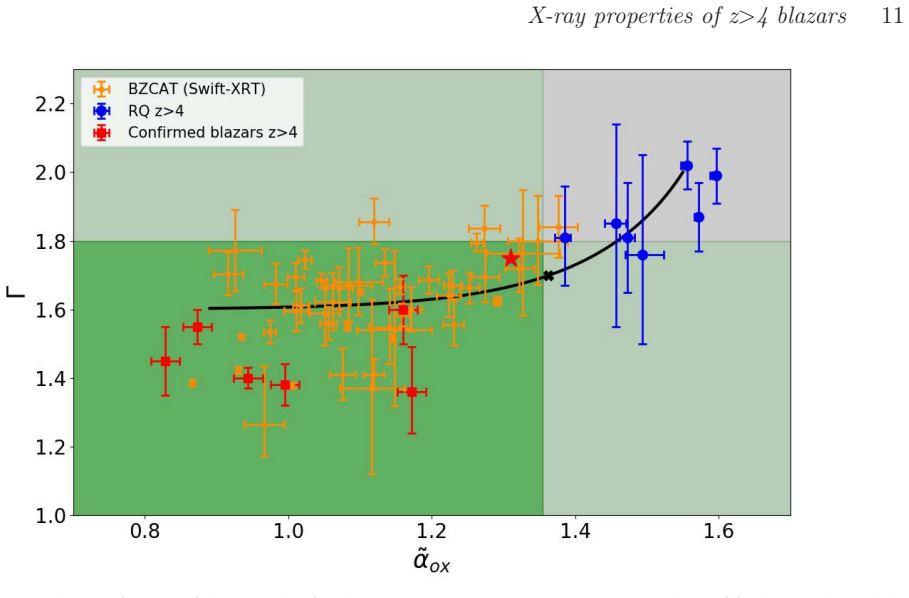
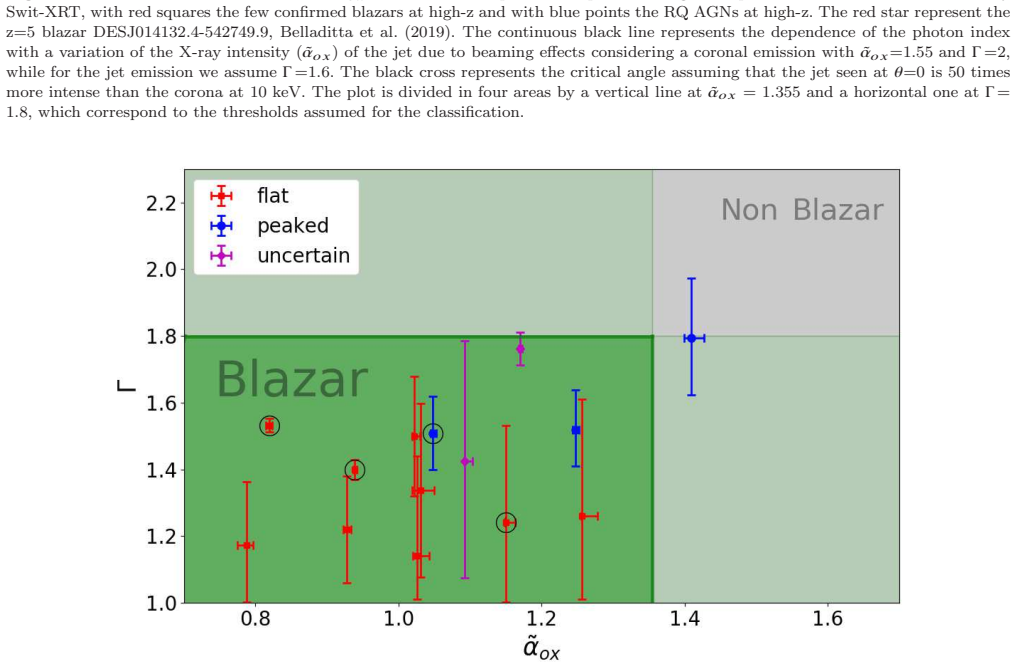
The load-bearing object is the rest-frame two-point spectral index $\tilde{\alpha}_{ox}$, computed between 2500 Å and 10 keV instead of the more usual 2 keV, so that the X-ray flux of sources at z>4 is evaluated where the telescopes actually detect it. Paired with the photon index $\Gamma$, it separates blazar-like X-ray emission from coronal emission through the thresholds $\tilde{\alpha}_{ox}<1.355$ and $\Gamma<1.8$. The paper's quantitative result rests on the ratio $L_X/L_R$ (2–10 keV over 1.4 GHz rest frame) and on the model formula $L_X/L_R(z)=L_X/L_R(0)[1+A(1+z)^4]$, with $A\approx 1.6\times10^{-3}$; this formula converts the observed factor 2.4 into a statement that CMB scattering contributes about 4% of the X-ray emission at z~1.3 and grows rapidly toward higher redshifts.
What would settle it
Compute the X-ray-to-radio luminosity ratio for the z~1 comparison blazars binned in 1.4 GHz radio luminosity to match the CLASS sources; if the 2.4-fold offset disappears or drops below the quoted uncertainty, the claimed redshift evolution is a selection artifact rather than an intrinsic CMB effect. Alternatively, measure the same ratios for a complete sample of blazars at z>5.5: if the enhancement does not continue to grow as $(1+z)^4$, the IC/CMB interpretation is wrong.
Extended reading notes
Core claim
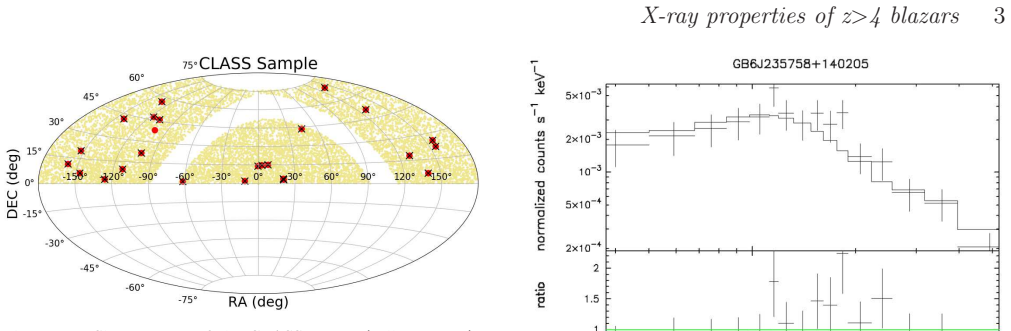
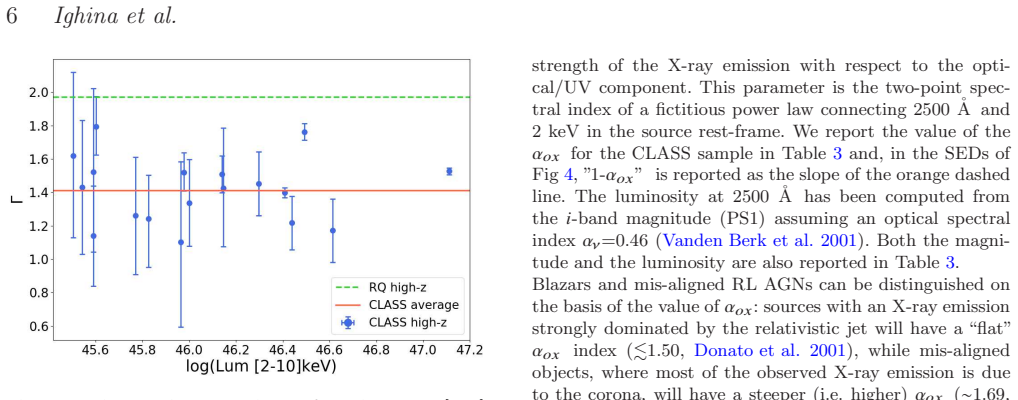
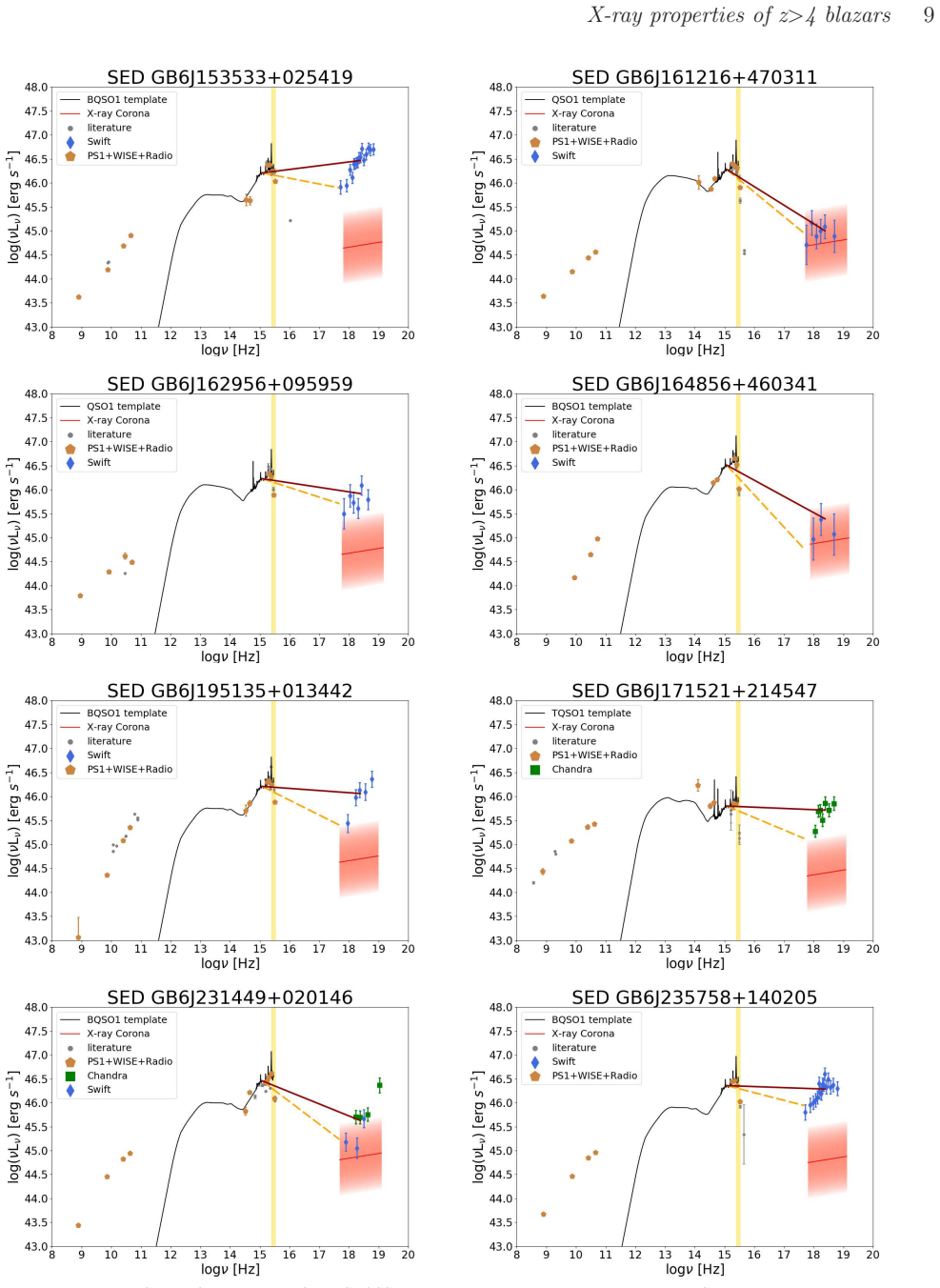
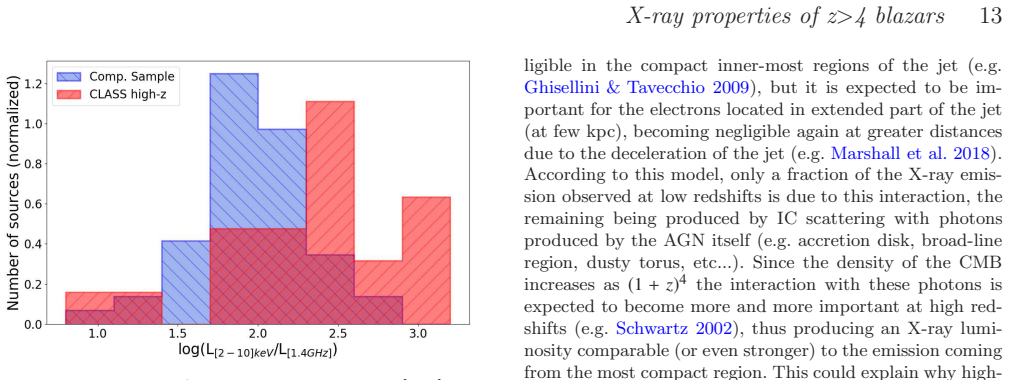
The paper's central claim is that the X-ray-to-radio luminosity ratio of blazar jets increases with redshift. From Chandra, XMM-Newton, and Swift-XRT data on 24 of 25 sources in the z>4 CLASS sample, it classifies 21 as likely blazars and 3 as non-blazars (with one uncertain) on the basis of flat, X-ray-bright spectra. Comparing the 2–10 keV to 1.4 GHz luminosity ratios of these sources with those of a z~1 BZCAT sample, it finds the high-z blazars are 2.4±0.5 times brighter in X-rays per unit radio luminosity, a difference that survives even when all 24 CLASS sources, not just the classified blazars, are included. The paper attributes the excess to inverse-Compton scattering of CMB photons by electrons in the extended jet, which adds a $(1+z)^4$-growing component to the X-ray emission. It closes by noting that this mechanism, with a single common value of the model parameter $A$, cannot reproduce the even larger X-ray-to-radio ratios found in the $2<z<3$ X-ray-selected blazars.
Load-bearing premise
The comparison treats the z>4 CLASS sample (5 GHz > 30 mJy) and the z~1 BZCAT sample (1.4 GHz > 1.5 Jy) as drawing from the same blazar population with overlapping radio luminosities, so that the 2.4-fold difference in X-ray-to-radio ratio is a redshift effect rather than a selection effect.
Editorial extensions
If this is right
- At z>4, X-ray classification marks roughly 21 of 24 observed CLASS sources as blazars and proves more reliable than radio spectral shape alone: five sources with peaked radio spectra are classified as blazars in the X-rays.
- The X-ray-to-radio luminosity ratio of blazars evolves with redshift, so demographic studies that assume a constant ratio will mispredict the X-ray output of high-redshift jets.
- The z>4 space density of blazars remains consistent with a density peak at z~2 even when the X-ray-based classification is adopted, preserving the earlier radio-based conclusion.
- A uniform IC/CMB model cannot remove the discrepancy with X-ray-selected samples, whose z~2–3 members show even larger X-ray-to-radio ratios; some additional spread in the model parameter $A$ would be required.
- Observations of blazars at z>5.5 are the stated test of the $(1+z)^4$ growth in the CMB-scattered component.
Reading between the lines
- A matched comparison that bins the z~1 BZCAT sample by the same radio luminosities as the CLASS sample would isolate the factor 2.4 from flux-limit selection; if the offset weakens in matched bins, part of the claimed evolution is a sample-composition effect.
- If CMB boosting is real, X-ray-brightness classifications of high-z radio sources will increasingly catch misaligned jets as blazars; the five sources the paper flags with '?' after correcting for CMB emission are the natural first place to look for such contamination.
- The 10 keV version of $\tilde{\alpha}_{ox}$ could be applied to other high-z quasar samples, lowering the energy-dependent bias that makes the standard $\alpha_{ox}$ classification unreliable above z~4.
Signed reviews
Editorial analysis
A structured set of objections, weighed in public.
Referee Report
Summary. The paper presents the X-ray spectral analysis of 24/25 z>4 blazar candidates from the CLASS radio survey. Using Swift-XRT, XMM-Newton, and Chandra data, the authors fit absorbed power-law models, compute photon indices and X-ray luminosities, build rest-frame SEDs, and classify 21 sources as blazars using a redefined X-ray-to-optical spectral index (tilde alpha_ox) together with the photon index. The central empirical result is a comparison of the X-ray-to-radio luminosity ratio (X/R) between these z>4 CLASS blazars and a z~1 BZCAT blazar sample with S1.4GHz>1.5Jy; the CLASS blazars show a mean X/R ratio larger by a factor 2.4+/-0.5, with a KS test probability below 0.001%. The authors tentatively interpret this as IC/CMB enhancement, parameterized in Eq. (2), and then test this simple model against the Ajello et al. (2009) X-ray-selected blazar sample, finding that the simple model cannot resolve the tension between the radio-selected and X-ray-selected evolutionary results.
Significance. If the reported 2.4x offset in X/R between z>4 and z~1 blazars is a genuine redshift evolution, it is an important result: it would support the idea that the CMB contributes to high-redshift blazar X-ray emission and would have direct bearing on the discrepancy between radio-selected and X-ray-selected blazar evolution. The paper has clear strengths: the X-ray follow-up is nearly complete (24/25), the spectroscopic analysis uses public data and standard tools with C-statistics for low-count sources, the KS separation is visually strong, the result is robust to replacing the X-ray classification with the full CLASS sample, and the authors honestly report that the simple IC/CMB model fails against the external Ajello et al. sample. The main weakness is that the central comparison is not matched in radio luminosity or beaming indicators, and the quoted errors on the X/R ratios are purely statistical and ignore blazar variability and the non-simultaneity of radio and X-ray observations; these issues directly affect the significance and physical interpretation of the central claim.
major comments (2)
- [§6, Fig. 7; §5, p. 6] The central comparison between the CLASS z>4 blazars and the BZCAT z~1 blazars is not matched in radio luminosity or beaming. The text in §5 states that the S1.4GHz>1.5Jy flux limit selects objects in a similar range of radio power as the CLASS sources, but no radio-luminosity binning, matched subsample, or quantitative demonstration of overlap is presented. Because the CLASS sample is selected at S5GHz>30mJy while the BZCAT sample is selected at S1.4GHz>1.5Jy, the z~1 sample may preferentially include more radio-luminous or more strongly beamed jets; either effect can shift the X/R ratio without any redshift dependence. A matched L1.4 comparison, or an explicit demonstration of overlapping radio luminosity and beaming distributions, is required before the 2.4+/-0.5 ratio offset can be attributed to redshift evolution.
- [Table 3, column 11] The formal errors on log(Lx/LR) are as small as 0.001-0.003 dex (e.g., GB6J001115+144608 with 1.170 (+0.003/-0.002) and GB6J143023+420450 with 0.819 (+0.004/-0.004)). These errors are statistical only and assume that the radio and X-ray measurements refer to the same state of the source, whereas the observations in Tables 1 and 3 are non-simultaneous and blazars are known to vary by factors of several in both bands. The reported KS probability of <0.001% and the 2.4+/-0.5 offset therefore do not include variability-induced scatter. The authors should add a conservative systematic term or perform a Monte Carlo variability test to demonstrate that the offset remains significant when this variance is included.
minor comments (5)
- [§5, Fig. 5] The thresholds Gamma=1.8 and tilde alpha_ox=1.355 are calibrated so that all confirmed high-z blazars are included, but the text should state explicitly that the classification efficiency is not measured and that the choice of thresholds is not optimized; the robustness of the X/R comparison to the exact threshold values is not shown.
- [Fig. 4 caption] The SED panels are dense, and the caption does not identify which SWIRE template (QSO1, BSQO1, or TQSO1) was adopted for each source; a supplementary table listing the adopted template per source would improve reproducibility.
- [Table 2, note *] The caption says the last column reports the chi2 with the degrees of freedom, but for C-stat fits the reported value is the Cash statistic; this should be stated explicitly in the caption to avoid misinterpretation.
- [Eq. 1] The definition of tilde alpha_ox should state explicitly in the equation or its immediate caption that nu_10keV and nu_2500A are rest-frame frequencies; the text mentions this only in the surrounding sentence.
- [Abstract] The phrase 'largest flux-limited complete sample' could be misread as an X-ray flux-limited sample; the sample is a complete radio flux-limited CLASS sample with nearly complete X-ray follow-up, and the wording should make this distinction clear.
Circularity Check
No significant circularity: the X/R comparison is an empirical measurement, and the IC/CMB model parameter is fitted then honestly tested against an external sample.
full rationale
The central claim (the 2.4+/-0.5 X-ray-to-radio luminosity ratio enhancement of z>4 CLASS blazars relative to z~1 BZCAT blazars) is a direct measurement of observed luminosities, not a derived quantity that reduces to its inputs. The only fitted parameter, A in Eq. 2, is explicitly adjusted to match the observed enhancement ("In order to obtain an enhancement similar to the one observed in our sample we need A ~ 1.6e-3"), and the paper then tests the resulting simple IC/CMB model against the external Ajello et al. (2009) sample and reports that it fails, so it is not a fitted quantity disguised as a prediction. The classification thresholds (Gamma=1.8, tilde_alpha_ox=1.355) are calibrated on external reference samples and on confirmed high-z blazars from the literature, and the authors explicitly check that the X/R contrast is not a selection artefact of their classification: the difference remains significant even when all CLASS sources, blazar or not, are included. Reliance on C19 for the parent sample and spectroscopic redshifts is normal use of prior work by the same group, not a load-bearing self-citation chain; no uniqueness theorem or ansatz is smuggled in through citation. Concerns about unmatched radio-luminosity selection or non-simultaneous photometry are correctness risks, not circularity, and therefore do not raise the circularity score.
Assumptions & free parameters
free parameters (2)
- A (IC/CMB normalization) =
~1.6e-3
- Blazar classification thresholds (Gamma, ~alpha_ox) =
Gamma=1.8, ~alpha_ox=1.355
assumptions (5)
- domain assumption Blazar X-ray spectra are power laws absorbed only by the Galactic column density NH, with no intrinsic absorption at the source redshift.
- domain assumption Flat Lambda CDM cosmology with H0=70, Omega_Lambda=0.7, Omega_M=0.3.
- domain assumption The Steffen et al. (2006) 2500 Angstrom to 2 keV relation predicts the coronal X-ray luminosity of a non-blazar AGN of given optical luminosity.
- domain assumption The IC/CMB model of Wu et al. (2013), Eq. 2, with a single global parameter A, describes the redshift evolution of the X-ray-to-radio ratio in blazars.
- domain assumption Photon index constrained within [1,2.5] as the limits observed in flat-spectrum radio quasars.
Cite this review
Pith. "Pith review of X-ray properties of z>4 blazars." pith.science (2026). https://pith.science/paper/KELDDQGB
@misc{pith2026190808084,
  author       = {Pith},
  title        = {Pith review of: X-ray properties of z>4 blazars},
  year         = {2026},
  howpublished = {\url{https://pith.science/paper/KELDDQGB}},
  note         = {Machine review of arXiv:1908.08084}
}
read the original abstract
We present the X-ray analysis of the largest flux-limited complete sample of blazar candidates at z>4 selected from the Cosmic Lens All Sky Survey (CLASS). After obtaining a nearly complete (24/25) X-ray coverage of the sample (from Swift-XRT, XMM-Newton and Chandra), we analysed the spectra in order to identify the bona-fide blazars. We classified the sources based on the shape of their Spectral Energy Distributions (SEDs) and, in particular, on the flatness of the X-ray emission and its intensity compared to the optical one. We then compared these high-z blazars with a blazar sample selected at lower redshifts (z~1). We found a significant difference in the X-ray-to-radio luminosity ratios, with the CLASS blazars having a mean ratio 2.4+/-0.5 times larger than low-z blazars. We tentatively interpret this evolution as due to the interaction of the electrons of the jet with the Cosmic Microwave Background (CMB) photons, which is expected to boost the observed X-ray emission at high redshifts. Such a dependence has been already observed in highly radio-loud AGNs in the recent literature. This is the first time it is observed using a statistically complete radio flux limited sample of blazars. We have then evaluated whether this effect could explain the differences in the cosmological evolution recently found between radio and X-ray selected samples of blazars. We found that the simple version of this model is not able to solve the tension between the two evolutionary results.
Figures
Figures from the paper (3 more)
Forward citations
Cited by 2 Pith papers
-
The most extreme high-z radio quasars in the eRASS:1 X-ray survey
The team confirmed 39 new high-redshift radio quasars and found that the number of X-ray-selected blazars at z>4 grows with redshift faster than a constant X-ray/radio ratio model, in broad agreement with the IC/CMB model.
-
From compact jets to extended lobes: radio morphologies of distant quasars at z > 4
Three z>4 quasars are resolved into kiloparsec-scale radio structures: two bent, FR II-like double-lobed sources and one compact one-sided jet.
Reference graph
Works this paper leans on
-
[1]
write newline
" write newline "" before.all 'output.state := FUNCTION fin.entry write newline FUNCTION new.block output.state before.all = 'skip after.block 'output.state := if FUNCTION new.sentence output.state after.block = 'skip output.state before.all = 'skip after.sentence 'output.state := if if FUNCTION not #0 #1 if FUNCTION and 'skip pop #0 if FUNCTION or pop #1...
-
[2]
Ajello M., et al., 2009, @doi [ ] 10.1088/0004-637X/699/1/603 , 699, 603
-
[3]
Bassett L. C., Brandt W. N., Schneider D. P., Vignali C., Chartas G., Garmire G. P., 2004, @doi [ ] 10.1086/422019 , 128, 523
-
[4]
Belladitta S., Moretti A., Caccianiga A., Ghisellini G., Cicone C., Sbarrato T., Ighina L., Pedani M., 2019, , in press
work page 2019
-
[6]
N., et al., 2005, @doi [ ] 10.1007/s11214-005-5097-2 , 120, 165
Burrows D. N., et al., 2005, @doi [ ] 10.1007/s11214-005-5097-2 , 120, 165
-
[7]
Caccianiga A., et al., 2019, @doi [ ] 10.1093/mnras/sty3526 , 484, 204
-
[8]
Cash W., 1979, @doi [ ] 10.1086/156922 , 228, 939
doi:10.1086/156922 1979
-
[9]
C., et al., 2016, eprint arXiv:1612.05560
Chambers K. C., et al., 2016, eprint arXiv:1612.05560
arXiv 2016
Show all 57 references
-
[10]
C., Stawarz L., Siemiginowska A., Gobeille D., Wardle J
Cheung C. C., Stawarz L., Siemiginowska A., Gobeille D., Wardle J. F. C., Harris D. E., Schwartz D. A., 2012, @doi [ ] 10.1088/2041-8205/756/1/L20 , 756
2012 doi
-
[11]
J., Cotton W
Condon J. J., Cotton W. D., Greisen E. W., Yin Q. F., Perley R. A., Taylor G. B., Broderick J. J., 1998, @doi [ ] 10.1086/300337 , 115, 1693
1998 doi
-
[12]
Coppejans R., et al., 2017, @doi [ ] 10.1093/mnras/stx215 , 467, 2039
2017 doi
-
[13]
Donato D., Ghisellini G., Tagliaferri G., Fossati G., 2001, @doi [ ] 10.1051/0004-6361:20010675 , 375, 739
2001 doi
-
[14]
Eitan A., Behar E., 2013, @doi [ ] 10.1088/0004-637X/774/1/29 , 774
2013 doi
-
[16]
Galbiati E., et al., 2005, @doi [ ] 10.1051/0004-6361:20041716 , 430, 927
2005 doi
-
[17]
P., Bautz M
Garmire G. P., Bautz M. W., Ford P. G., Nousek J. A., Ricker, Jr. G. R., 2003, , 4851, 28
2003
-
[19]
Ghisellini G., Tavecchio F., Foschini L., Ghirlanda G., Maraschi L., Celotti A., 2010, @doi [ ] 10.1111/j.1365-2966.2009.15898.x , 402, 497
2010
-
[20]
Ghisellini G., Sbarrato T., Tagliaferri G., Foschini L., Tavecchio F., Ghirlanda G., Braito V., Gehrels N., 2014, @doi [ ] 10.1093/mnrasl/slu032 , 440, L111
2014 doi
-
[21]
Giommi P., et al., 2019, arXiv:1904.06043
2019 arXiv
-
[22]
C., Scott W
Gregory P. C., Scott W. K., Douglas K., Condon J. J., 1996, @doi [ ] 10.1086/192282 , 103, 427
1996 doi
-
[23]
Grupe D., Mathur S., Wilkes B., Osmer P., 2005, @doi [ ] 10.1086/498260 , 131, 55
2005 doi
-
[24]
E., Grindlay J
Harris D. E., Grindlay J. E., 1979, @doi [ ] 10.1093/mnras/188.1.25 , 188, 25
1979 doi
-
[25]
E., et al., 2008, @doi [ ] 10.1086/523302 , 175, 97
Healey S. E., et al., 2008, @doi [ ] 10.1086/523302 , 175, 97
2008 doi
-
[26]
http://doi.org/10.5281/zenodo.1475236
Ighina L., et al., 2018, contribution to the 13th Italian meeting on AGN, Milan Oct 2018, Zenodo. http://doi.org/10.5281/zenodo.1475236
2018 doi
-
[27]
T., Jagannathan P., Mooley K
Intema H. T., Jagannathan P., Mooley K. P., Frail D. A., 2017, @doi [ ] 10.1051/0004-6361/201628536 , 598
2017 doi
-
[28]
I., Sramek R., Schmidt M., Shaffer D
Kellermann K. I., Sramek R., Schmidt M., Shaffer D. B., Green R., 1989, @doi [ ] 10.1086/115207 , 98, 1195
1989 doi
-
[29]
M., Cotton W
Lane W. M., Cotton W. D., van Velzen S., Clarke T. E., Kassim N. E., Helmboldt J. F., Lazio T. J. W., Cohen A. S., 2014, @doi [ ] 10.1093/mnras/stu256 , 440, 327
2014 doi
-
[30]
M., Marchesini E., Landoni M., Massaro F., Ajello M., 2017, @doi [ ] 10.3847/1538-4357/aa74b8 , 842, 87
Mao P., Urry C. M., Marchesini E., Landoni M., Massaro F., Ajello M., 2017, @doi [ ] 10.3847/1538-4357/aa74b8 , 842, 87
2017 doi
-
[31]
L., et al., 2018, @doi [ ] 10.3847/1538-4357/aaaf66 , 856, 66
Marshall H. L., et al., 2018, @doi [ ] 10.3847/1538-4357/aaaf66 , 856, 66
2018 doi
-
[32]
Massaro E., Maselli A., Leto C., Marchegiani P., Perri M., Giommi P., Piranomonte S., 2015, @doi [ ] 10.1007/s10509-015-2254-2 , 357
2015 doi
-
[33]
T., et al., 2003, @doi [ ] 10.1046/j.1365-8711.2003.06256.x , 341, 1
Myers S. T., et al., 2003, @doi [ ] 10.1046/j.1365-8711.2003.06256.x , 341, 1
2003
-
[34]
Orienti M., Dallacasa D., Stanghellini C., 2007, @doi [ ] 10.1051/0004-6361:20078105 , 475, 813
2007 doi
-
[35]
Orienti M., Dallacasa D., Stanghellini C., 2010, @doi [ ] 10.1111/j.1365-2966.2010.17179.x , 408, 1075
2010
-
[36]
L., Reeves J
Page K. L., Reeves J. N., O'Brien P. T., Turner M. J. L., 2005, @doi [ ] 10.1111/j.1365-2966.2005.09550.x , 364, 195
2005
-
[37]
Pietsch W., et al., 2003, @doi [ ] 10.1051/0004-6361:20000066 , 365, L18
2003 doi
-
[38]
W., Sowards-Emmerd D., Greenhill L., Michelson P., 2004, @doi [ ] 10.1086/423201 , 610, L9
Romani R. W., Sowards-Emmerd D., Greenhill L., Michelson P., 2004, @doi [ ] 10.1086/423201 , 610, L9
2004 doi
-
[39]
N., Shemmer O., Chomiuk L., Lopez L
Saez C., Brandt W. N., Shemmer O., Chomiuk L., Lopez L. A., Marshall H. L., Miller B. P., Vignali C., 2011, @doi [ ] 10.1088/0004-637X/738/1/53 , 738, 53
2011 doi
-
[40]
Sbarrato T., et al., 2012, @doi [ ] 10.1111/j.1745-3933.2012.01332.x , 426, L91
2012
-
[41]
Sbarrato T., Ghisellini G., Nardini M., Tagliaferri G., Greiner J., Rau A., Schady P., 2013, @doi [ ] 10.1093/mnras/stt882 , 433, 2182
2013 doi
-
[42]
Sbarrato T., Ghisellini G., Tagliaferri G., Foschini L., Nardini M., Tavecchio F., Gehrels N., 2015, @doi [ ] 10.1093/mnras/stu2269 , 446, 2483
2015 doi
-
[43]
A., 2002, @doi [ ] 10.1086/341359 , 571, L71
Schwartz D. A., 2002, @doi [ ] 10.1086/341359 , 571, L71
2002 doi
-
[44]
N., Vignali C., Schneider D
Shemmer O., Brandt W. N., Vignali C., Schneider D. P., Fan X., Richards G. T., Strauss M. A., 2005, @doi [ ] 10.1086/432050 , 630, 729
2005 doi
-
[45]
Shemmer O., et al., 2006, @doi [ ] 10.1086/503543 , 644, 86
2006 doi
-
[46]
K., Aldcroft T
Siemiginowska A., Smith R. K., Aldcroft T. L., Schwartz D. A., Paerels F., Petric A. O., 2003, @doi [ ] 10.1086/380497 , 598, L15
2003 doi
-
[47]
T., Strateva I., Brandt W
Steffen A. T., Strateva I., Brandt W. N., Alexander D. M., Koekemoer A. M., Lehmer B. D., Schneider D. P., Vignali C., 2006, @doi [ ] 10.1086/503627 , 131, 2826
2006 doi
-
[48]
Tananbaum H., et al., 1979, @doi [ ] 10.1086/183100 , 234, L9
1979 doi
-
[49]
E., et al., 2001, @doi [ ] 10.1086/321167 , 122, 549
Vanden Berk D. E., et al., 2001, @doi [ ] 10.1086/321167 , 122, 549
2001 doi
-
[50]
N., Schneider D
Vignali C., Brandt W. N., Schneider D. P., Garmire G. P., Kaspi S., 2003, @doi [ ] 10.1086/345728 , 125, 418
2003 doi
-
[51]
Volonteri M., 2010, @doi [ ] 10.1007/s00159-010-0029-x , 18, 279
2010 doi
-
[52]
Volonteri M., Haardt F., Ghisellini G., Della Ceca R., 2011, @doi [ ] 10.1111/j.1365-2966.2011.19024.x , 416, 216
2011
-
[53]
A., Fabian A
Worsley M. A., Fabian A. C., Celotti A., Iwasawa K., 2004, @doi [ ] 10.1111/j.1365-2966.2004.07887.x , 350, L67
2004
-
[54]
L., et al., 2010, @doi [ ] 10.1088/0004-6256/140/6/1868 , 140, 1868
Wright E. L., et al., 2010, @doi [ ] 10.1088/0004-6256/140/6/1868 , 140, 1868
2010 doi
-
[55]
N., Miller B
Wu J., Brandt W. N., Miller B. P., Garmire G. P., Schneider D. P., Vignali C., 2013, @doi [ ] 10.1088/0004-637X/763/2/109 , 763, 109
2013 doi
-
[56]
G., et al., 2000, @doi [ ] 10.1086/301513 , 120, 1579
York D. G., et al., 2000, @doi [ ] 10.1086/301513 , 120, 1579
2000 doi
-
[57]
C., Celotti A., Jonker P
Yuan W., Fabian A. C., Celotti A., Jonker P. G., 2003, @doi [ ] 10.1046/j.1365-2966.2003.07234.x , 346, L7
2003
-
[58]
C., Worsley M
Yuan W., Fabian A. C., Worsley M. A., McMahon R. G., 2006, @doi [ ] 10.1111/j.1365-2966.2006.10175.x , 368, 985
2006
-
[59]
R., White R
Zeimann G. R., White R. L., Becker R. H., Hodge J. A., Stanford S. A., Richards G. T., 2011, @doi [ ] 10.1088/0004-637X/736/1/57 , 736
2011 doi
-
[60]
F., Brandt W
Zhu S. F., Brandt W. N., Wu J., Garmire G. P., Miller B. P., 2019, @doi [ ] 10.1093/mnras/sty2832 , 482, 2016
2019 doi
Reviewed August 14, 2026 · model on record in the stance chip above.
Discussion (0). Continue with ORCID to comment.