REVIEW 3 major objections 5 minor 38 references
Emergence of moderate opinions as a consequence of group pressure
T0 review · 3 major / 5 minor · reviewed 2026-08-14 · deepseek-v4-flash
Pith's one-line read The paper derives a critical conviction line $\lambda_c(p)=(2-p)/[4(1-p)]$ for a three-agent opinion model with group pressure, and shows the ordering transition disappears for $p\ge 2/3$.
desk verdict A clean, modest extension of the LCCC model with group pressure, whose analytic λ_c(p) is actually exact in the thermodynamic limit, but whose numerical support at intermediate p is too thin. read the letter →
The pith
A machine-rendered reading of the paper's core claim, the machinery that carries it, and where it could break.
The reading
What carries the argument
The central object is the single-agent update equation, Eq. (1), which combines a conviction-weighted three-agent exchange term with a group-pressure term pulling the focal agent toward the current average opinion of the three interacting agents. The argument rides on a mean-field fixed-point calculation: replacing the stochastic $\epsilon$'s by their expectation $1/2$ and setting every opinion to a common $o^*$ turns Eq. (1) into a self-consistency condition whose nontrivial solution exists only for $\lambda>\lambda_c(p)=(2-p)/[4(1-p)]$. Setting $\lambda_c=1$ then gives the suppression threshold $p^*=2/3$. The order parameter $O$ is the diagnostic that distinguishes the symmetric, absorbing phase ($O=0$) from the symmetry-broken phase ($O>0$).
What would settle it
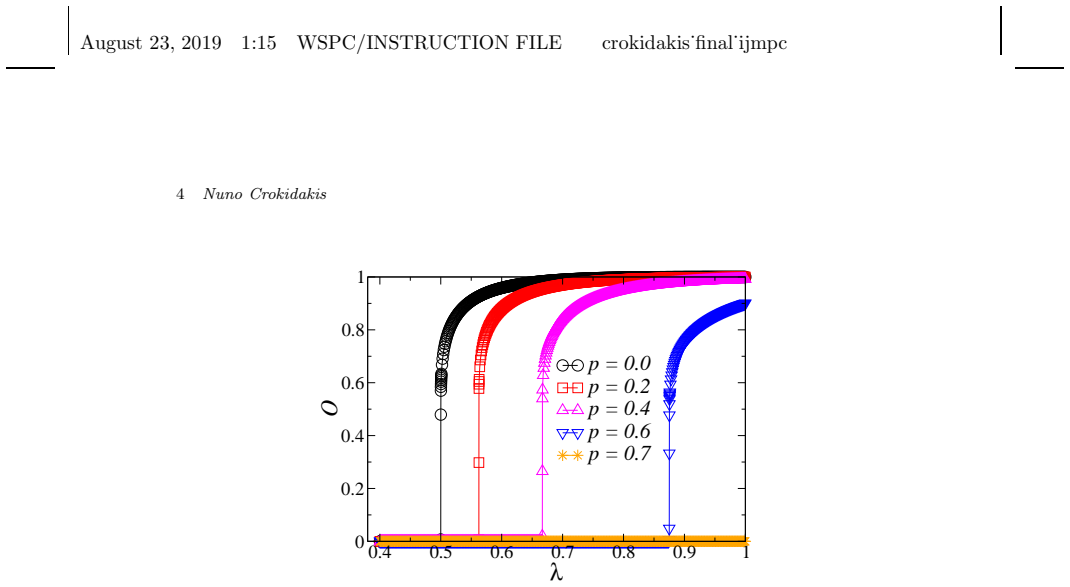
Run long simulations at $p=0.7$ with $\lambda=1$ for growing $N$: the formula predicts $O=0$, so a stationary $O$ that does not decay with $N$ would falsify the suppression claim. A second check is locating the transition at $p=0.2$, where $\lambda_c=0.5625$, by finite-size scaling; agreement within statistical error would support the mean-field line, while systematic deviation would show where the annealed approximation fails.
Extended reading notes
Core claim
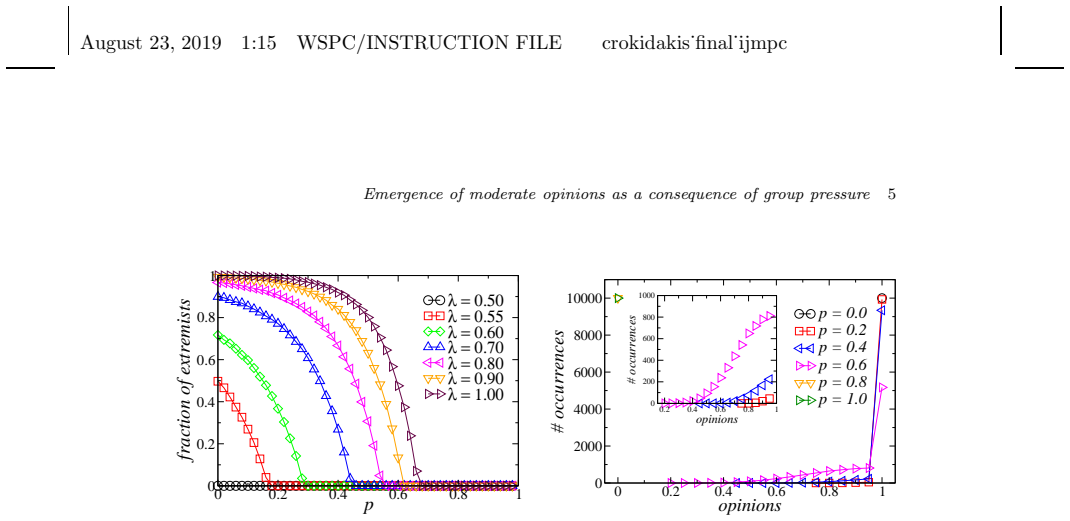
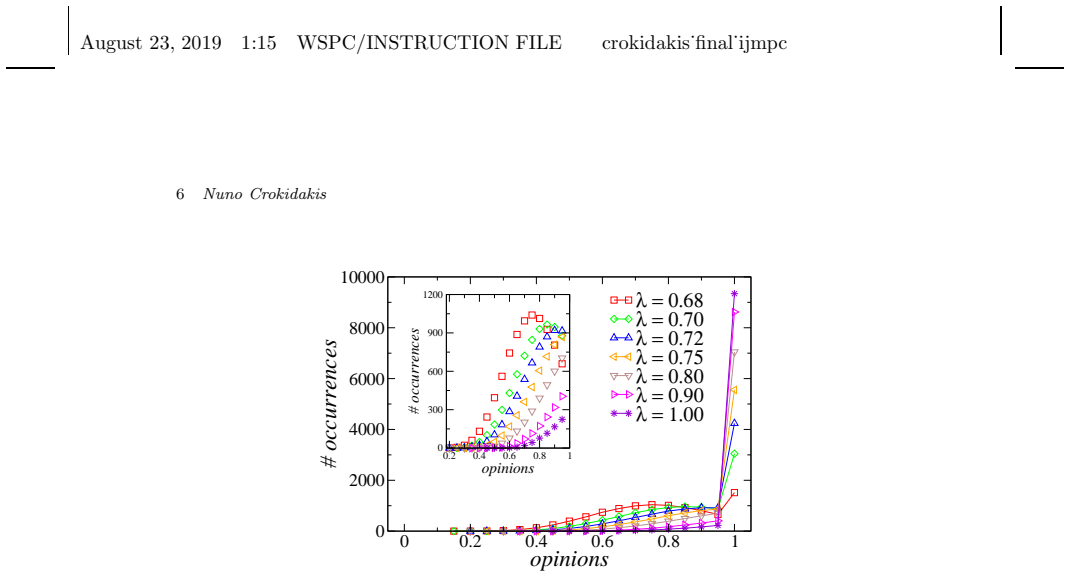
For the fully-connected three-agent kinetic-exchange model with update rule $o_i(t+1)=(1-p)[\lambda o_i(t)+\lambda\epsilon_t o_j(t)+\lambda\epsilon'_t o_k(t)]+p\epsilon''_t(o_i+o_j+o_k)/3$ and annealed noises uniform in $[0,1]$, the order parameter $O=|\sum_i o_i|/N$ is zero in the long-time limit for $\lambda\le\lambda_c(p)$ and positive for $\lambda>\lambda_c(p)$, with $\lambda_c(p)=(2-p)/[4(1-p)]$. Since $\lambda\le1$, the critical line merges with the upper bound at $p^*=2/3$, meaning the symmetry-breaking transition is suppressed for all $p>2/3$. Simulations with $N=10^4$ support the phase picture and show that increasing $p$ broadens the opinion histogram and reduces the fraction of agents stuck at $o=\pm1$, even when conviction is maximal.
Load-bearing premise
The whole critical line rests on replacing the random variables by their average $1/2$ and assuming a single common opinion value at the fixed point; if fluctuations or the hard bounds $-1\le o_i\le1$ matter, the boundary $\lambda_c(p)$ and the threshold $p^*=2/3$ could move.
Editorial extensions
If this is right
- For any $p<2/3$, increasing conviction $\lambda$ through $\lambda_c(p)$ flips the population from a neutral, absorbing state with $O=0$ to a symmetry-broken state in which one opinion sign dominates.
- For $p\ge2/3$, the model predicts that no majority opinion can form regardless of conviction; the collective state remains neutral.
- Raising group pressure at fixed conviction broadens the stationary opinion distribution and reduces the fraction of extremists at $o=\pm1$, including at $\lambda=1$.
- The pure three-agent case $p=0$ has $\lambda_c=1/2$, so adding any group pressure raises the conviction needed for consensus.
Reading between the lines
- Editorial inference: the pressure term acts like a restoring force toward the group mean, so the suppression threshold $p^*=2/3$ can be read as the point where that restoring force overwhelms the aligning effect of conviction; a similar competition should appear in models with external media or common noise.
- Editorial inference: on networks where interactions are local rather than global, $p^*$ may shift because the average opinion exerting pressure is computed over a neighborhood; testing the rule on degree-heterogeneous graphs could separate group-size effects from pressure strength.
- Editorial inference: the annealed-noise mean-field treatment likely gives only a first approximation; finite-size scaling of the transition at, say, $p=0.2$ could reveal whether the true critical behavior matches the mean-field line or shows fluctuation-driven shifts in $\lambda_c$.
Signed reviews
Editorial analysis
A structured set of objections, weighed in public.
Referee Report
Summary. The paper introduces a continuous opinion dynamics model with three-agent kinetic exchange interactions and a group-pressure term. Each agent's opinion evolves by Eq. (1) under the influence of the agent's own conviction λ, two randomly selected partners, and the group average, with annealed stochastic coefficients. A mean-field fixed-point calculation gives the critical line λc(p) = (2−p)/[4(1−p)] and the suppression threshold p* = 2/3, above which no symmetry-breaking ordering occurs for λ ≤ 1. Simulations for N = 10^4 and 100 independent runs show order-parameter curves for selected p, histograms of opinion distributions, and the fraction of extremist agents as a function of p. The central claims are that the model displays a symmetry-breaking transition for p < 2/3, that the transition is suppressed for p ≥ 2/3, and that increasing group pressure reduces extremism.
Significance. If the central claims hold, the paper contributes a clean exactly-solvable limiting case to the kinetic-exchange opinion dynamics literature: a three-agent interaction with group pressure yields a critical line with no fitted parameters, and the prediction p* = 2/3 is a crisp falsifiable statement. The model is simple and the analytic result is presented in closed form. The p = 0 limit correctly reproduces the known LCCC-type threshold λc = 1/2, which lends credibility to the model. The main strengths are the absence of fitted parameters and the explicit, testable prediction for the location of the transition. The paper is, however, short on numerical validation of the intermediate-p portion of the critical line and on finite-size control of the claimed absorbing phase.
major comments (3)
- [§3, Eq. (4)] The derivation of Eq. (5) is not justified as written: it replaces the annealed random variables εt, ε′t, ε′′t by their mean 1/2 and assumes a common fixed point o*, which is a strong step for a nonlinear, bounded, stochastic map. The result can be placed on firmer ground: taking the conditional expectation of Eq. (1) over the random choices and the annealed noises gives E[m(t+1)|Ft] = [1 + (2λ(1−p) + p/2 − 1)/N] m(t), so the instability condition 2λ(1−p) + p/2 = 1 is exact for the first moment in the N → ∞ limit of the unbounded process. I recommend adding this argument (or an equivalent explicit statement of the mean-field approximation) so that Eq. (5) is not presented as a bare replacement of stochastic variables by their averages.
- [§3, Fig. 1] The numerical test of the predicted critical line is incomplete. Figure 1 shows O(λ) for p = 0, 0.2, 0.4, 0.6, and 0.7, but no critical points are estimated for the intermediate values, no error bars are given, and no finite-size analysis is reported. Because λc(p) = (2−p)/[4(1−p)] ranges from 0.5 to 0.875 over the plotted p values, a finite-size drift of even 5–10% would be invisible in the plotted curves. I ask for a quantitative comparison: for each p, estimate λc(N) from, e.g., Binder cumulants or the crossing of the magnetization, and show that it extrapolates to Eq. (5) as N → ∞.
- [Abstract and §3] The statement that O is 'identically null' for λ ≤ λc is not correct for a finite system. In the symmetric phase the per-run order parameter defined by Eq. (3) fluctuates with a typical magnitude O(N^{-1/2}), so O = 0 holds only in the thermodynamic limit or after an ensemble average over many realizations. The text should qualify this (e.g., 'O → 0 as N → ∞' or '⟨O⟩ = 0 in the thermodynamic limit') and, if the phase is called absorbing, should specify which observable actually converges to the all-zero state in finite time.
minor comments (5)
- [Throughout] The paper contains several typographical and grammatical errors ('pre ssure' in the title, 'beahvior', 'definied', 'stationay', 'pannel', 'convition', 'interactios'); a careful proofread is needed.
- [§2, after Eq. (1)] The bound −1 ≤ o_i ≤ 1 is stated, but the text never says how the algorithm treats updates that would fall outside this interval. If a clipping or projection step is used, it should be described, since the fraction of extremists in Fig. 2 counts agents at exactly o = ±1.
- [§3, Figs. 2 and 3] The histogram construction should specify the bin width and the number of samples per bin; the selection of only positive-magnetization runs should also be stated explicitly in the captions, not only in the text.
- [Abstract and §4] The phrase 'wider distribution of opinions' is misleading for p close to 1, where the distribution collapses toward o = 0; 'less extremist' or 'concentrated near moderate opinions' would be more accurate.
- [§3, Eq. (4)] The notation ⟨ε⟩, ⟨ε′⟩, ⟨ε′′⟩ is used in Eq. (4) before the uniform distribution of the noises is fully specified; please define the distribution explicitly before taking averages.
Circularity Check
No significant circularity: the critical line λ_c(p) is derived algebraically from the model's own update rule and tested by simulation, not fitted.
full rationale
The paper's central quantitative claim, Eq. (5), follows directly from the fixed-point condition applied to the model's own update rule Eq. (1): replacing the annealed random variables by their expectation ⟨ε⟩=1/2 and setting all opinions to a common value o* gives o* = [2λ(1−p) + p/2]o*, so a nontrivial solution requires 2λ(1−p)+p/2=1, i.e. λ_c(p)=(2−p)/[4(1−p)]. No parameter is fitted to the simulation data; λ and p are control parameters, and the simulations in Fig. 1 are used to test the predicted threshold, not to set its constants. The suppression threshold p*=2/3 follows algebraically from λ_c(p*)=1, again without data fitting. The self-citations in the reference list (e.g., Refs. 15, 17, 18, 20, 26, 33) are contextual background and do not carry the load-bearing derivation; no uniqueness theorem or ansatz is imported from the author's prior work. The qualitative observation that increasing group pressure p reduces extremism is visibly encoded in the pressure term p ε'' o_avg of Eq. (1), but this is a model consequence tested numerically rather than a fitted or renamed prediction, and it is not used to derive the critical line. The mean-field replacement of annealed variables by their expectation is an approximation whose rigor could be questioned, but that is a correctness or robustness concern, not circularity. The derivation chain is therefore self-contained and not circular.
Assumptions & free parameters
assumptions (3)
- domain assumption The annealed random variables ε_t, ε'_t, ε''_t are independent and uniformly distributed on [0,1], so their expectation is 1/2.
- ad hoc to paper The dynamics can be analyzed by a mean-field fixed point with a common opinion o* and stochastic coefficients replaced by their averages.
- domain assumption All agents share the same conviction λ and interact in a fully-connected population.
Cite this review
Pith. "Pith review of Emergence of moderate opinions as a consequence of group pressure." pith.science (2026). https://pith.science/paper/FAXT2WZH
@misc{pith2026190808088,
  author       = {Pith},
  title        = {Pith review of: Emergence of moderate opinions as a consequence of group pressure},
  year         = {2026},
  howpublished = {\url{https://pith.science/paper/FAXT2WZH}},
  note         = {Machine review of arXiv:1908.08088}
}
abstract
In this work we study a continuous opinion dynamics model considering 3-agent interactions and group pressure. Agents interact in a fully-connected population, and two parameters govern the dynamics: the agents' convictions $\lambda$, that are homogeneous in the population, and the group pressure $p$. Stochastic parameters also drive the interactions. Our analytical and numerical results indicate that the model undergoes symmetry-breaking transitions at distinct critical points $\lambda_{c}$ for any value of $p<p^{*}=2/3$, i.e., the transition can be suppressed for sufficiently high group pressure. Such transition separates two phases: for any $\lambda \leq \lambda_{c}$, the order parameter $O$ is identically null ($O=0$, a symmetric, absorbing phase), while for $\lambda>\lambda_{c}$, we have $O>0$, i.e., a symmetry-broken phase (ferromagnetic). The numerical simulations also reveal that the increase of group pressure leads to a wider distribution of opinions, decreasing the extremism in the population.
Figures
Reference graph
Works this paper leans on
-
[1]
Galam, Sociophysics: A Physicist’s Modeling of Psycho-political Phenomena (Springer, Berlin, 2012)
S. Galam, Sociophysics: A Physicist’s Modeling of Psycho-political Phenomena (Springer, Berlin, 2012)
work page 2012
-
[2]
P. Sen, B. K. Chakrabarti, Sociophysics: an introduction (Oxford University Press, Oxford, 2013)
work page 2013
-
[3]
D. Stauffer, S. Moss de Oliveira, P. M. C. de Oliveira, J. S. S ´ a Martins,Biology, Sociology, Geology by Computational Physicists (Elsevier, Amsterdam, 2006). August 23, 2019 1:15 WSPC/INSTRUCTION FILE crokidakis˙final˙ijmpc Emergence of moderate opinions as a consequence of group pre ssure 7
work page 2006
-
[4]
C. Castellano, S. Fortunato, V. Loreto, Statistical phys ics of social dynamics, Rev. Mod. Phys. 81, 591 (2009)
work page 2009
-
[5]
M. T. Gastner, K. Tak´ acs, M. Guly´ as, Z. Szvetelszky, B. O borny, PLoS ONE 14(6):e0218729 (2019)
work page 2019
-
[6]
W. Han, C. Huang, J. Yang, Physica A 531, 121791 (2019)
work page 2019
-
[7]
X. Wang, Y. Lan, J. Xiao, Physica A 531, 121721 (2019)
work page 2019
-
[8]
J. Fern´ andez-Gracia, K. Suchecki, J. J. Ramasco, M. San M iguel, V. M. Eguluz, Phys. Rev. Lett. 112, 158701 (2014)
work page 2014
Show all 38 references
-
[9]
Abramiuk, J
A. Abramiuk, J. Pawlowski, K. Sznajd-Weron, Entropy 21(5 ), 521 (2019)
2019
-
[10]
Weber, R
D. Weber, R. Theisen, S. Motsch, J. Stat. Phys. 176, 40 (20 19)
-
[11]
S. Mori, M. Hisakado, K. Nakayama, Phys. Rev. E 99, 052307 (2019)
2019
-
[12]
O. Abid, S. Jamoussi, Y. B. Ayed, Online Social Networks a nd Media 6, 1-17 (2018)
2018
-
[13]
Galam, Int
S. Galam, Int. J. Mod. Phys. B 31, 1742015 (2017)
2017
-
[14]
Galam, M
S. Galam, M. A. Javarone, PLoS ONE 11(5): e0155407 (2016)
2016
-
[15]
A. R. Vieira, N. Crokidakis, Physica A 450, 30 (2016)
2016
-
[16]
A. R. Vieira, C. Anteneodo, Phys. Rev. E 97, 052106 (2018)
2018
-
[17]
Crokidakis, P
N. Crokidakis, P. M. C. de Oliveira, Phys. Rev. E 85, 04114 7 (2012)
2012
-
[18]
Crokidakis, F
N. Crokidakis, F. L. Forgerini, B. J. Phys. 42, 125 (2012)
2012
-
[19]
Sznajd-Weron, Sznajd model and its applications, Act a Physica Polonica B, vol.36, no
K. Sznajd-Weron, Sznajd model and its applications, Act a Physica Polonica B, vol.36, no. 8 (2005)
2005
-
[20]
Crokidakis, J
N. Crokidakis, J. S. S´ a Martins, Int. J. Mod. Phys. C 29, 1 850094 (2018)
2018
-
[21]
Cheng, C
C. Cheng, C. Yu, Physica A 532, 121900 (2019)
2019
-
[22]
M. A. Javarone, S. Galam, Social Informatics. SocInfo 20 14. Lecture Notes in Com- puter Science, vol 8852. Springer, Cham, edited by L. Aiello , D. McFarland
-
[23]
Bottcher, H
L. Bottcher, H. J. Herrmann, H. Gersbach, PLoS ONE 13(3): e0193199 (2018)
2018
-
[24]
Nagler, H
˙Bottcher, J. Nagler, H. J. Herrmann, Phys. Rev. Lett. 118, 08 8301 (2017)
2017
-
[25]
Deffuant, D
G. Deffuant, D. Neau, F. Amblard, G. Weisbuch, Adv. Comple x Syst. 3, 87 (2000)
2000
-
[26]
Anteneodo, N
C. Anteneodo, N. Crokidakis, Phys. Rev. E 95, 042308 (201 7)
-
[27]
Ramos, J
M. Ramos, J. Shao, S. D. S. Reis, C. Anteneodo, J. S. Andrad e, S. Havlin, H. A. Makse, Scientific Reports 5, 10032 (2015)
2015
-
[28]
K. Fan, W. Pedrycz, Physica A 436, 87 (2015)
2015
-
[29]
Hegselmann, U
R. Hegselmann, U. Krause, J. Artif. Soc. Soc. Simul. 5(3) , (2002)
2002
-
[30]
Deffuant, F
G. Deffuant, F. Amblard, G. Weisbuch, T. Faure, J. Artif. S oc. Soc. Simul. 5(4):1 (2002)
2002
-
[31]
Lorenz, Int
J. Lorenz, Int. J. Mod. Phys. C 18, 1819 (2007)
2007
-
[32]
A. C. R. Martins, Int. J. Mod. Phys. C 19, 617 (2008)
2008
-
[33]
A. R. Vieira, C. Anteneodo, N. Crokidakis, J. Stat. Mech. 023204 (2016)
2016
-
[34]
Lallouache, A
M. Lallouache, A. S. Chakrabarti, A. Chakraborti, B. K. C hakrabarti, Phys. Rev. E 82, 056112 (2010)
2010
-
[35]
Biswas, A
S. Biswas, A. K. Chandra, A. Chatterjee, B. K. Chakrabart i, J. Phys.: Conf. Ser. 297, 012004 (2011)
2011
-
[36]
Brugna, G
C. Brugna, G. Toscani, Phys. Rev. E 92, 052818 (2015)
2015
-
[37]
J. P. Pinasco, V. Semeshenko, P. Balenzuela, Chaos, Soli tons and Fractals 98, 210 (2017)
2017
-
[38]
Galam, Physica A 333, 453 (2004)
S. Galam, Physica A 333, 453 (2004)
2004
Reviewed August 14, 2026 · model on record in the stance chip above.
Discussion (0). Continue with ORCID to comment.