REVIEW 2 major objections 3 minor 9 references
Schr\"oder Coloring and Applications
T0 review · 2 major / 3 minor · reviewed 2026-08-14 · deepseek-v4-flash
Pith's one-line read Schröder numbers, placed inside partial Bell polynomials, satisfy closed binomial identities that yield explicit enumeration formulas for three families of combinatorial objects.
desk verdict New Bell polynomial evaluation and explicit bijections for Schröder-colored objects; correct in spirit, but proofs lean on unstated earlier results that a referee should ask to be included. read the letter →
The pith
A machine-rendered reading of the paper's core claim, the machinery that carries it, and where it could break.
The reading
What carries the argument
The central object is the exponential partial Bell polynomial $B_{n,k}(z_1,\ldots,z_{n-k+1})$, the generating object for partitions of an $n$-set into $k$ blocks. Its role here is to package the Schröder numbers: evaluating at $z_j=j!s_{j-1}$ converts the count of colored compositions into products of Schröder numbers. The load-bearing identity is Theorem 2.5's double binomial sum, obtained from a bijection between colored compositions of $n+k$ and Schröder paths with $k-1$ diagonal steps on the diagonal. In the applications, the same polynomials appear as peak-counting weights for colored Dyck paths via the cited enumeration theorem.
What would settle it
Compute both sides of (2.6) directly for a small pair such as $n=4$, $k=2$ using $s_0=1$, $s_1=1$, $s_2=3$, $s_3=11$; any mismatch falsifies the identity. Alternatively, enumerate $D_n^{\sigma}(\alpha-1,1)$ by peak count for small $n$ and $\alpha$ and compare the results with Corollary 3.4.
Extended reading notes
Core claim
The central discovery is that the partial Bell polynomial $B_{n,k}(1!s_0,2!s_1,\ldots)$ has the closed form $\frac{n!}{(k-1)!}\sum_{j=1}^{n-k}\frac{1}{j}\binom{n-k-1}{j-1}\binom{n+j-1}{j-1}$ for $1\le k<n$, obtained by identifying colored compositions with Schröder paths split at their diagonal steps. The analogous statement for large Schröder numbers follows by a finite alternating sum over the little-Schröder formula. The authors then use this identity to turn three bijections—one for rational Schröder paths, one for ordered rooted trees, one for outerplanar maps—into explicit formulas, each expressed as a sum over a number of peaks or blocks.
Load-bearing premise
The derivation depends on a convolution formula from the authors' earlier paper, quoted without proof here, remaining valid when applied to the little and large Schröder sequences; if that formula has restrictions that exclude these sequences, Theorem 2.5 and the formulas built on it do not follow.
Editorial extensions
If this is right
- For every integer slope $\alpha$ and size $n$, the number of rational Schröder paths in $S_n(\alpha)$ built from exactly $k$ Schröder building blocks has an explicit binomial-sum formula, and the maximal-block case reduces to $\frac{2n}{(\alpha-1)n+1}\binom{\alpha n}{n}$, reproducing several OEIS sequences.
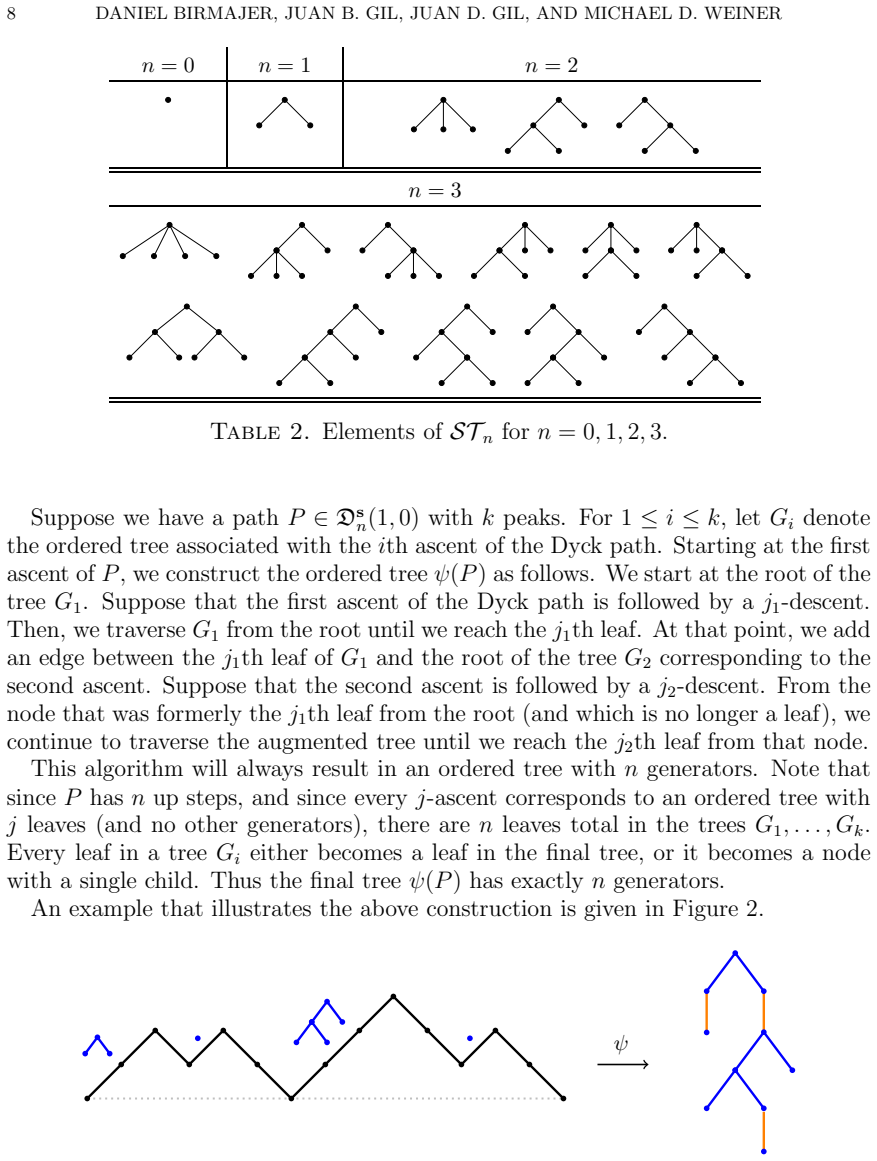
- The number of ordered rooted trees with $n$ generators and a prescribed number of nodes of outdegree $1$ is given by a closed binomial sum, with total counts 1, 2, 7, 32, 166, 926, 5419, 32816, ... for small $n$.
- The number of simple rooted outerplanar maps with $n+1$ vertices and exactly $k$ biconnected components is given by an explicit formula, and the case $k=n$ recovers the Catalan numbers for planted trees.
- Bell transforms of the little Schröder sequence of the form $Y_{a,b,-1,1}(s)$ can be written out as finite binomial sums, so an entire family of sequence transformations acquires a closed form.
Reading between the lines
- The same convolution-plus-Bell-polynomial route could be applied to other integer sequences satisfying a parallel convolution identity, yielding closed enumeration formulas for whatever combinatorial families those sequences count.
- The bijective encoding of Schröder paths as colored Dyck paths suggests analogous colored-path bijections for other Schröder-counted structures, such as indecomposable permutations avoiding 2413 and 3142 or increasing tableaux of shape $(n,n)$.
- The explicit formulas for rational Schröder paths may support asymptotic analysis as $n$ grows, since the double binomial sums are amenable to standard estimates even though the paper does not pursue that direction.
- Because the maximum-block formula in Corollary 3.2 is so compact, it could serve as a fast test for whether a newly discovered sequence counts rational Schröder paths with all blocks of minimal size.
Signed reviews
Editorial analysis
A structured set of objections, weighed in public.
Referee Report
Summary. The paper studies the little Schröder numbers s_n and the large Schröder numbers r_n. Its main computational result, Theorem 2.5, gives an explicit closed form for the partial Bell polynomial B_{n,k}(1!s_0,2!s_1,...) for 1≤k<n. The proof combines a bijection between colored compositions and Schröder paths (Lemma 2.3) with a previously published convolution formula. The paper also presents three bijections: rational Schröder paths with slope α are mapped to colored Dyck paths (Theorem 3.1); ordered rooted trees with n generators are mapped to colored Dyck paths (Theorem 4.1); and simple outerplanar maps are mapped to colored Dyck paths (Theorem 5.1). Using a peak-counting theorem from a companion paper, the authors derive explicit enumeration formulas for these objects.
Significance. The partial Bell polynomial evaluation is a genuinely useful closed formula: it gives an efficient tool for Bell transforms of the Schröder sequences, and the paper demonstrates this by producing several explicit enumeration formulas that match OEIS entries. The bijections are natural and the coloring framework is elegant. The paper is clearly written and the main identities pass small-case checks. Its value would be enhanced if the proof of Theorem 2.5 were self-contained, since the current version relies on an unstated external formula.
major comments (2)
- [Section 2, proof of Theorem 2.5 (Eq. 2.6)] The proof invokes "a convolution formula given in [2, Section 4]" to pass from the expression for s_n as a sum of Bell polynomials to the convolution identity for the sum over m_1+...+m_k=n of s_{m_1}...s_{m_k}. This is the central step of the paper: Theorem 2.5 and all later counting formulas depend on it. The formula is not stated in the manuscript, so the reader cannot verify its hypotheses or the parameter range. Please state the convolution formula explicitly and verify that it applies to the little Schröder sequence for all n and 1≤k<n. If this formula requires conditions that fail, the identity (2.6) is unsupported.
- [Sections 3–5, counting corollaries] The enumeration formulas (e.g., Corollaries 3.4, 4.2, 5.2, and 5.4) are derived by combining Theorem 2.5 with [1, Theorem 2], which counts colored Dyck paths by peaks. The statement of [1, Theorem 2] is not given, making the derivation of these corollaries impossible to check from the manuscript alone. Please include the statement of [1, Theorem 2] (or a proof of the needed case) so that the applications are self-contained.
minor comments (3)
- [Corollary 3.2 and Table 1] The formula in Corollary 3.2 is typeset ambiguously: the displayed "2n/n" should be 2^n/n, and the same superscript issue affects the formula in Table 1's caption. Please correct the notation.
- [Theorem 5.1, inverse construction] The inverse map in Theorem 5.1 uses the index "(j_1 - i_1 + 1)th vertex on M_1"; the meaning of this index is not immediately clear. A short clarifying sentence or a small example would help the reader follow the construction.
- [End of Section 3] The formula for #S_n(α) is cited from [8, Theorem 2.9] without stating the theorem. Since this is a known result, citing is acceptable, but providing the precise statement would improve the manuscript's self-containedness.
Circularity Check
No circularity: Theorem 2.5 uses a new bijection plus an external convolution identity from [2]; the later applications invoke an independent peak-count theorem from [1].
full rationale
Walking the derivation chain, Theorem 2.5 is obtained from the Hoggatt–Lind formula (2.2), the new bijection in Lemma 2.3 giving identity (2.4), and a convolution identity quoted from [2, Section 4]. The convolution identity is applied to the factorial/Stirling data B_{n,j}(1!,2!,...) and is not the target formula B_{n,k}(1!s0,...); the target Bell polynomial at the Schröder numbers is reached only after substituting (2.4) and shifting the index. Sections 3–5 call on [1, Theorem 2] as an external enumeration statement for colored Dyck paths; that theorem is parameter-free and does not assume the present Bell-polynomial evaluation. No parameter is fitted to a subset of data and then renamed a prediction, and no object is defined in terms of the quantity being derived. The preprint is not fully self-contained because the formula from [2, Section 4] is quoted rather than stated, but that is a proof-completeness or correctness gap, not a circular reduction. Since no equation reduces to its own input by construction, the appropriate circularity finding is no significant circularity.
Assumptions & free parameters
assumptions (6)
- domain assumption The little Schröder numbers s_n count Schröder paths with no D-steps on y=x, ordered trees with no outdegree-1 vertices and n+1 leaves, and dissections of a convex (n+2)-gon.
- standard math Hoggatt-Lind formula: #CS_{n,k} = k!/n! B_{n,k}(1!s0, 2!s1, ...) for colored compositions.
- domain assumption Convolution formula from [2, Section 4]: sum over m1+...+mk=n of s_{m1}...s_{mk} = k times sum over j of C(n+j+k-1, j-1) (j-1)!/n! B_{n,j}(1!, 2!, ...).
- domain assumption Peak-count theorem [1, Theorem 2]: the number of colored Dyck paths D^c_n(a,1) with k peaks is C((a-1)n+k, k-1) (k-1)!/n! B_{n,k}(1!c1, 2!c2, ...).
- domain assumption Formula for #S_n(alpha) from [8, Theorem 2.9].
- domain assumption Dissections of a convex (n+2)-gon correspond to biconnected rooted outerplanar maps with n+2 vertices.
Cite this review
Pith. "Pith review of Schr\"oder Coloring and Applications." pith.science (2026). https://pith.science/paper/B7N4SJLB
@misc{pith2026190808103,
  author       = {Pith},
  title        = {Pith review of: Schr\"oder Coloring and Applications},
  year         = {2026},
  howpublished = {\url{https://pith.science/paper/B7N4SJLB}},
  note         = {Machine review of arXiv:1908.08103}
}
read the original abstract
We present several bijections, in terms of combinatorial objects counted by the Schr\"oder numbers, that are then used (via coloring) for the construction and enumeration of rational Schr\"oder paths with integer slope, ordered rooted trees, and simple rooted outerplanar maps. On the other hand, we derive partial Bell polynomial identities for the little and large Schr\"oder numbers, which allow us to obtain explicit enumeration formulas.
Figures


Reference graph
Works this paper leans on
-
[1]
D. Birmajer, J. B. Gil, P. R. W. McNamara, and M. D. Weiner, Enume ration of colored Dyck paths via partial Bell polynomials, Lattice path combinatorics and applications , 155–165, Dev. Math. 58, Springer, Cham, 2019
work page 2019
-
[2]
D. Birmajer, J. B. Gil, and M. D. Weiner, A family of Bell transforma tions, Discrete Math. 342 (2019), no. 1, 38–54
work page 2019
-
[3]
N. Bonichon, C. Gavoille, and N. Hanusse, Canonical decompositio n of outerplanar maps and application to enumeration, coding and generation, J. Graph Algorithms Appl. 9 (2005), no. 2, 185–204
work page 2005
-
[4]
I. Geffner and M. Noy, Counting outerplanar maps, Electron. J. Combin. 24 (2) (2017), #P2.3
work page 2017
-
[5]
V. E. Hoggatt and D. A. Lind, Fibonacci and binomial properties o f weighted compositions, J. Combin. Theory 4 (1968), 121–124
work page 1968
-
[6]
The On-Line Encyclopedia of Integer Sequences , published electronically at https://oeis.org, 2019
work page 2019
-
[7]
Schr¨ oder, Vier kombinatorische Probleme, Z
E. Schr¨ oder, Vier kombinatorische Probleme, Z. Math. Phys. 15 (1870), 361–376
-
[8]
Schr¨ oder, Generalized Schrder numbers and the rotation p rinciple, J
J. Schr¨ oder, Generalized Schrder numbers and the rotation p rinciple, J. Integer Seq. 10 (2007), Article 07.7.7
work page 2007
Show all 9 references
-
[9]
R. P. Stanley, Hipparchus, Plutarch, Schr¨ oder, and Hough, Amer. Math. Monthly 104 (1997), no. 4, 344–350. 12 DANIEL BIRMAJER, JUAN B. GIL, JUAN D. GIL, AND MICHAEL D. WE INER Nazareth College, 4245 East A ve., Rochester, NY 14618 Penn State Altoona, 3000 Ivyside Park, Altoon...
1997
Reviewed August 14, 2026 · model on record in the stance chip above.
Discussion (0). Continue with ORCID to comment.