REVIEW 2 major objections 5 minor 38 references
HII versus HI in the `green valley' galaxies: direct comparison
T0 review · 2 major / 5 minor · reviewed 2026-08-14 · deepseek-v4-flash
Pith's one-line read The paper establishes that in the green-valley galaxy J1237+39, all detected gas—neutral and ionized—is in global counter-rotation with the stellar disc, so the gas was captured from the environment rather than being a remnant of the…
desk verdict New HII-HI comparison finds a likely counter-rotating gas disc in J1237+39, but the result hangs on a single low-resolution stellar velocity measurement that needs verification. read the letter →
The pith
A machine-rendered reading of the paper's core claim, the machinery that carries it, and where it could break.
The reading
What carries the argument
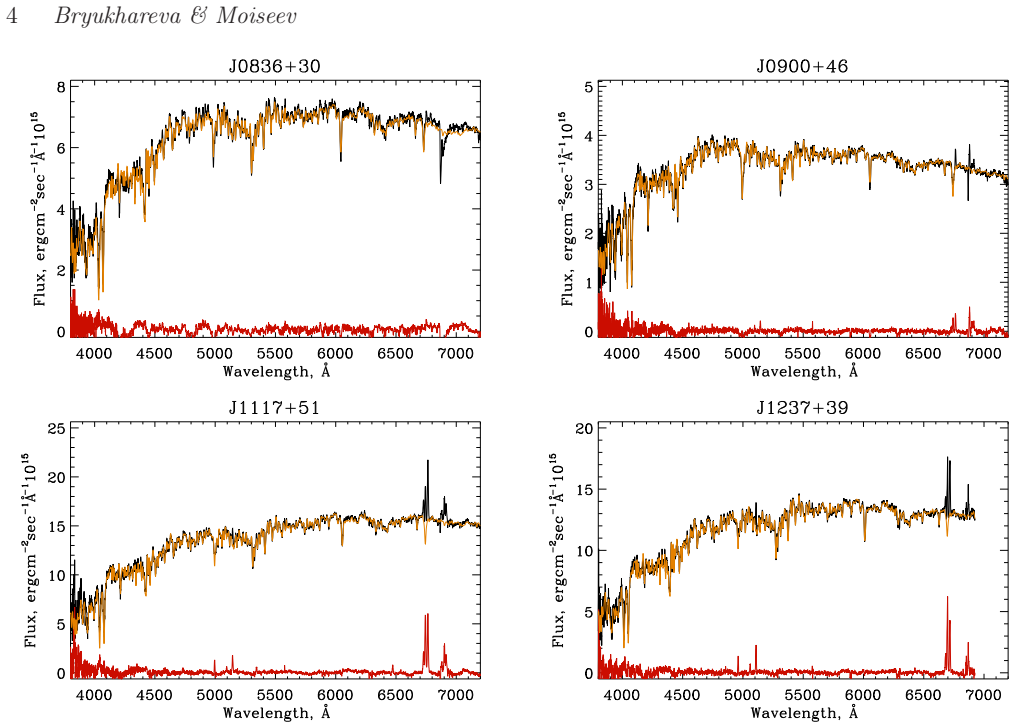
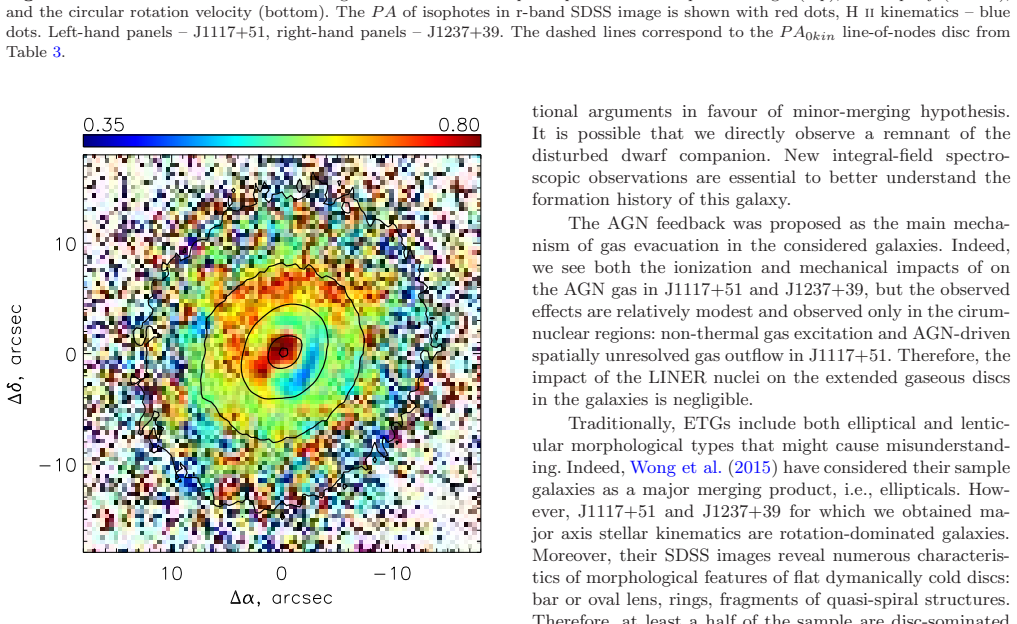
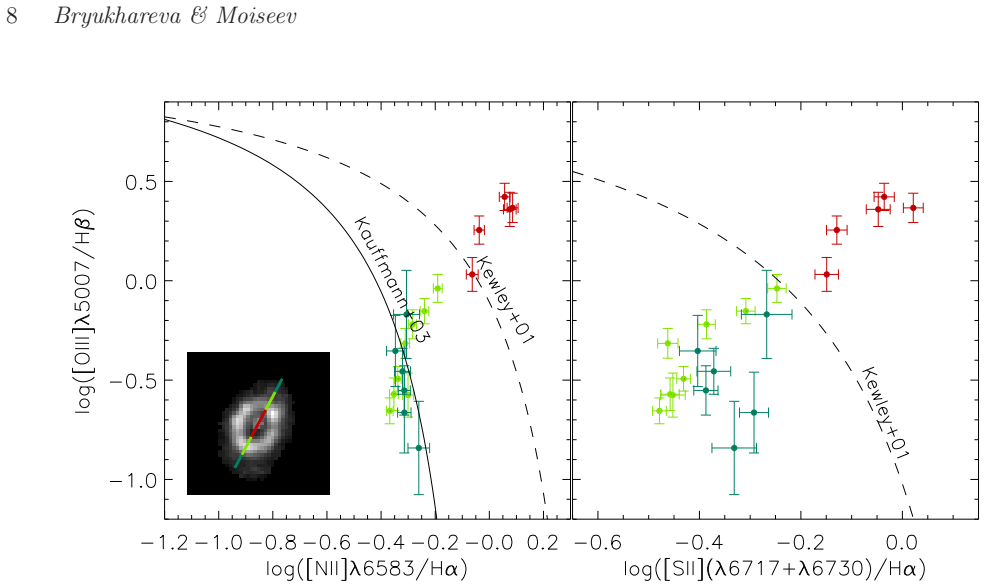
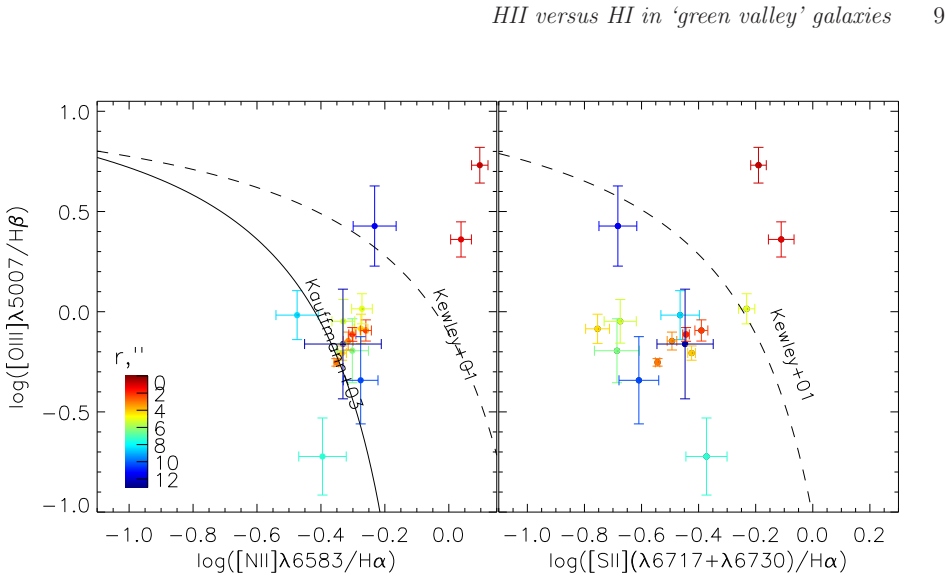
The load-bearing comparison is between three velocity fields: neutral gas from H I radio mapping, ionized gas from scanning Fabry-Perot observations of Hα, and stars from absorption-line template fitting. The scanning Fabry-Perot data provide roughly an order of magnitude better angular resolution than the 21-cm maps, which is what allows the paper to see the nuclear outflow in J1117+51, the inner non-circular streaming in J1237+39, and the sign of the global rotation. A tilted-ring model extracts rotation curves and residual velocity maps from the Hα fields, and BPT diagnostic diagrams classify the excitation mechanism as star-forming, composite, or LINER/AGN.
What would settle it
Obtain a full integral-field stellar-velocity map of J1237+39 with high signal-to-noise absorption-line fits: if the stellar rotation along the major axis has the same sign as the H I and H II velocities, the global counter-rotation claim is refuted. Alternatively, map the gas metallicity across the disc, since the cold-accretion scenario predicts a sharp metallicity boundary and a smooth gradient would undermine it.
Extended reading notes
Core claim
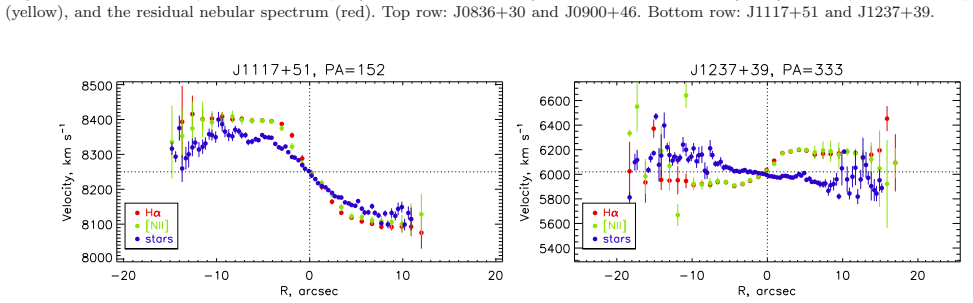
The paper's central discovery is the global gas-star counter-rotation in J1237+39. The Hα velocity field from the scanning Fabry-Perot observations and the earlier WSRT H I maps agree in detail, and both show the gas rotating in the opposite direction from the stellar disc along the major axis, over a gaseous disc larger than the stellar disc. The authors therefore conclude that all observed gas in this system was captured from the environment, through accretion or minor merging, and that the galaxy may be on its way to a new starburst rather than further quenching. In the rest of the sample, the ionized gas mirrors the H I status: it is absent outside the circumnuclear regions in the two galaxies whose H I reservoirs were classified as ejected, and it co-rotates with the stars in J1117+51, where the only AGN signature is a central outflow and LINER-type excitation.
Load-bearing premise
The counter-rotation conclusion rests on the sign of the stellar rotation, which comes from fitting stellar-population templates to absorption spectra along a single major-axis slit; a systematic template bias or a slit not exactly on the major axis could flip the stellar rotation sign and invalidate the result.
Editorial extensions
If this is right
- In J0836+30 and J0900+46, the absence of ionized gas outside the nuclei is consistent with the H I picture in which the reservoirs were ejected or heated beyond detectability.
- In J1117+51, the AGN affects only the central region, so large-scale AGN feedback is not the cause of the gas distribution in this source.
- J1237+39 would have been classified as an early quenching stage from H I alone, but the counter-rotating gas shows it is actually accreting, so H I morphology by itself cannot clock the green-valley transition.
- Gas acquired by accretion or minor merging can form a large, regularly rotating, counter-rotating disc that may trigger a new episode of star formation.
Reading between the lines
- The same gas-star rotation test could be applied systematically to integral-field surveys; if counter-rotating gas is common in green-valley early-type galaxies, the 'green valley' is an overlay of quenching and accretion paths, not a single transition.
- Deep imaging or stellar-population mapping of the red knot and one-armed red spiral in J1237+39 would directly test the minor-merger interpretation proposed here.
- A gas-phase metallicity map of the counter-rotating disc would distinguish minor merging from filamentary accretion: the accretion scenario predicts a sharp metallicity boundary between the counter-rotating gas and the galaxy's own gas.
Signed reviews
Editorial analysis
A structured set of objections, weighed in public.
Referee Report
Summary. The paper presents long-slit and scanning Fabry-Perot observations of four green-valley early-type galaxies from Wong et al. (2015), comparing the ionized-gas morphology and kinematics with the existing WSRT HI maps and with stellar kinematics derived from ULySS full-spectrum fitting. In J0836+30 and J0900+46, no extended ionized gas is detected, consistent with the previously reported expelled HI reservoirs. In J1117+51 and J1237+39, rotating HII discs are detected; J1117+51 shows co-rotating gas and a nuclear blueshifted outflow, whereas J1237+39 is claimed to host a global HI+HII disc counter-rotating relative to the stellar disc, which the authors interpret as evidence that all of its gas was captured from the environment. The paper concludes that HI morphology alone is not a sufficient quenching-stage indicator and that higher-resolution IFU data are needed.
Significance. If the counter-rotation result for J1237+39 holds, it is a valuable and relatively rare case linking the green-valley quenching sequence to external gas acquisition, and it demonstrates the advantage of order-of-magnitude higher angular resolution in HII velocity fields compared with the 12-30 arcsec WSRT HI data. The paper is a direct observational comparison rather than a model-derived argument: the gas kinematics come from independent H-alpha FPI mapping, the tilted-ring analysis is standard, and the authors are explicit about the degeneracy between minor merging and filamentary accretion. However, the headline claim depends on a single low-resolution long-slit stellar absorption measurement whose sign is not documented with error bars or template-systematics tests, and the morphological supporting evidence is admittedly preliminary. The paper would be a solid contribution after that load-bearing point is quantitatively supported.
major comments (2)
- [Sec. 2.1, Fig. 3] The counter-rotation claim for J1237+39 is the paper's headline result, but it rests on the sign of the stellar line-of-sight velocity gradient measured from ULySS fits to δλ ≈ 5 Å (FWHM ≈ 230 km/s) long-slit spectra. Fig. 3 shows no error bars for the stellar velocities, and the text reports no systematic tests of the ULySS fits, such as comparisons of the Elodie and Vaz Miles libraries, sensitivity to continuum/emission-line masking, or an independent cross-correlation check. At this spectral resolution a template mismatch can plausibly bias a small stellar gradient, and the H-alpha velocity field alone cannot determine the stellar rotation direction. I request that the authors display error bars on all stellar velocity points, compare stellar velocities derived with both libraries and with an independent method, and state the minimum stellar velocity gradient that would be robustly detected. Without such checks, the global HI+HII counter-rotation conclusion is not fully supported.
- [Abstract vs Sec. 4] The abstract states as a firm conclusion that all of the observed gas in J1237+39 was captured from the environment via accretion or minor merging, whereas Sec. 4 explicitly says the available data are not enough to make a confident choice between minor merging and filamentary accretion, and Sec. 3.1 labels the supporting color-index structures as very preliminary. The wording of the abstract and Conclusion (iv) should be aligned with the body's more hedged interpretation unless additional evidence, such as metallicity maps or an independent stellar kinematic map, is provided.
minor comments (5)
- [Sec. 3.2] The text contains the unrendered string '???maximum starburst line???'; this should read 'maximum starburst line' with the Kewley et al. (2001) reference.
- [Sec. 5 and Sec. 4] Conclusion (ii) contains the typo 'rotats' ('rotates'), and Sec. 4 contains 'dymanically cold discs' ('dynamically cold discs').
- [Table 3 and Fig. 5] No uncertainties are given for the circular rotation velocities Vrot; adding them, or at least stating their typical scatter, would allow the reader to judge the radial stability of the fitted rotation curves.
- [Sec. 3.1] The photometric inclination is fixed by adopting an intrinsic axial ratio q0=0.2; the sensitivity of PAkin and Vrot to this assumption is not discussed, even though the sign of the rotation is not affected.
- [Sec. 2.1] The stellar library name 'Vaz Miles' should be checked and cited properly (likely Vazdekis/MILES), and the exact ULySS configuration used for the fits should be described so the kinematic measurements are reproducible.
Circularity Check
No significant circularity: the counter-rotation claim is a direct comparison of independently measured stellar and gas velocities; the quoted conclusion is an interpretation, not a fitted prediction.
full rationale
The paper's derivation chain is observational rather than model-derived. Stellar line-of-sight velocities are obtained from ULySS fits to absorption spectra (Sec. 2.1), while ionized-gas velocities come from Gaussian/Voigt fits to emission lines (Sec. 2.1 and 2.2). These measurements are independent, and the counter-rotation in J1237+39 is read directly from the velocity curves in Fig. 3. The tilted-ring model described in Sec. 3.1 is fitted to the gas velocity fields to derive kinematic position angles, inclinations, and rotation curves; it does not assume or inject the gas-star counter-rotation, and the conclusion does not feed back into the fit. The H-alpha velocity fields are also independently compared with the external WSRT HI data of Wong et al. (2015), providing agreement on the gas rotation sense. The paper's self-citations (Afanasiev & Moiseev 2011; Moiseev & Egorov 2008; Moiseev 2014, 2015; Finkelman et al. 2011) concern data-reduction and tilted-ring software and are methodological, not load-bearing for the scientific claim. The possible sensitivity of the stellar rotation sign to template mismatch is a measurement systematic, not a circularity: nothing in the paper's stated assumptions or equations makes the stellar velocity equal to the gas velocity by construction. Therefore the paper is self-contained with respect to the counter-rotation inference, and no circular step can be exhibited.
Assumptions & free parameters
free parameters (4)
- Photometric inclination i0 =
J1117+51: 43 deg, J1237+39: 34 deg
- Kinematic position angle PA0_kin =
J1117+51: 151 deg, J1237+39: 337 deg
- Systemic velocity Vsys =
J1117+51: 8240 km/s, J1237+39: 6095 km/s
- Circular rotation velocity Vrot(r) =
Flat rotation curves (Fig. 5, bottom)
assumptions (4)
- domain assumption The gas in the discs moves on circular orbits in a thin inclined plane (tilted-ring model)
- domain assumption The ULySS stellar template fits provide unbiased stellar line-of-sight velocities
- domain assumption Distances, stellar masses, and HI properties are taken from Wong et al. (2015)
- standard math BPT diagnostics classify gas excitation using Kewley et al. (2001) and Kauffmann et al. (2003) curves
Cite this review
Pith. "Pith review of HII versus HI in the `green valley' galaxies: direct comparison." pith.science (2026). https://pith.science/paper/WVR4NEK5
@misc{pith2026190808115,
  author       = {Pith},
  title        = {Pith review of: HII versus HI in the `green valley' galaxies: direct comparison},
  year         = {2026},
  howpublished = {\url{https://pith.science/paper/WVR4NEK5}},
  note         = {Machine review of arXiv:1908.08115}
}
read the original abstract
We study the morphology and kinematics of the ionization state of the gas in four 'green valley' early-type galaxies at different stages of their transition from a 'blue cloud' of star-forming galaxies to the sequence of passive evolution. The previous HI mapping of the considered sample reveals a spatial offset between the cold gas reservoirs and stellar discs depending on the post-starburst age. Consideration of the ionized-gas properties is essential to understand the role of various feedback processes in star formation quenching. We performed long-slit and 3D optical spectroscopic observations at the 6-m Russian telescope and compared the gas and stellar kinematics. Spatial distribution of the ionized gas is in agreement with HI maps; however, the one-order higher angular resolution in the HII velocity fields allows us to study non-circular gas motions in detail, like the AGN-driven outflow in the nucleus of J1117+51. The most intriguing result is the global HI+HII gas counter-rotation relative to the stellar disc in J1237+39. Therefore, in this case all the observed gas in the 'green valley' galaxy was captured from the environment via accretion or minor merging.
Figures

Figures from the paper (5 more)


Reference graph
Works this paper leans on
-
[1]
write newline
" write newline "" before.all 'output.state := FUNCTION fin.entry write newline FUNCTION new.block output.state before.all = 'skip after.block 'output.state := if FUNCTION new.sentence output.state after.block = 'skip output.state before.all = 'skip after.sentence 'output.state := if if FUNCTION not #0 #1 if FUNCTION and 'skip pop #0 if FUNCTION or pop #1...
-
[2]
L., Moiseev A
Afanasiev V. L., Moiseev A. V., 2011, Baltic Astronomy, http://adsabs.harvard.edu/abs/2011BaltA..20..363A 20, 363
2011
-
[3]
K., Glazebrook K., Brinkmann J., Ivezi \'c Z ., Lupton R
Baldry I. K., Glazebrook K., Brinkmann J., Ivezi \'c Z ., Lupton R. H., Nichol R. C., Szalay A. S., 2004, @doi [ ] 10.1086/380092 , http://adsabs.harvard.edu/abs/2004ApJ...600..681B 600, 681
doi:10.1086/380092 2004
-
[5]
Baldwin J. A., Phillips M. M., Terlevich R., 1981, @doi [ ] 10.1086/130766 , http://adsabs.harvard.edu/abs/1981PASP...93....5B 93, 5
doi:10.1086/130766 1981
-
[6]
G., 1989, , http://adsabs.harvard.edu/abs/1989A
Begeman K. G., 1989, , http://adsabs.harvard.edu/abs/1989A
work page 1989
-
[7]
Blanton M. R., Moustakas J., 2009, @doi [ ] 10.1146/annurev-astro-082708-101734 , http://adsabs.harvard.edu/abs/2009ARA
-
[8]
Dickey C., Geha M., Wetzel A., El-Badry K., 2019, arXiv e-prints, http://ads.inasan.ru/abs/2019arXiv190201401D
work page 2019
-
[9]
Egorov O. V., Lozinskaya T. A., Moiseev A. V., Smirnov-Pinchukov G. V., 2018, @doi [ ] 10.1093/mnras/sty1158 , http://adsabs.harvard.edu/abs/2018MNRAS.478.3386E 478, 3386
Show all 38 references
-
[10]
S., 1999, @doi [ ] 10.1086/312169 , https://ui.adsabs.harvard.edu/abs/1999ApJ...521L..37E 521, L37
Erwin P., Sparke L. S., 1999, @doi [ ] 10.1086/312169 , https://ui.adsabs.harvard.edu/abs/1999ApJ...521L..37E 521, L37
1999 doi
-
[11]
M., Couch W
Fasano G., Poggianti B. M., Couch W. J., Bettoni D., Kj rgaard P., Moles M., 2000, @doi [ ] 10.1086/317047 , https://ui.adsabs.harvard.edu/abs/2000ApJ...542..673F 542, 673
2000 doi
-
[12]
Finkelman I., Moiseev A., Brosch N., Katkov I., 2011, @doi [ ] 10.1111/j.1365-2966.2011.19601.x , http://adsabs.harvard.edu/abs/2011MNRAS.418.1834F 418, 1834
2011
-
[13]
J., 2008, @doi [ ] 10.1111/j.1365-2966.2008.13071.x , https://ui.adsabs.harvard.edu/abs/2008MNRAS.386..935F 386, 935
Fraternali F., Binney J. J., 2008, @doi [ ] 10.1111/j.1365-2966.2008.13071.x , https://ui.adsabs.harvard.edu/abs/2008MNRAS.386..935F 386, 935
2008
-
[14]
P., 1926, @doi [ ] 10.1086/143018 , https://ui.adsabs.harvard.edu/abs/1926ApJ....64..321H 64, 321
Hubble E. P., 1926, @doi [ ] 10.1086/143018 , https://ui.adsabs.harvard.edu/abs/1926ApJ....64..321H 64, 321
1926 doi
-
[15]
Jin Y., et al., 2016, @doi [ ] 10.1093/mnras/stw2055 , http://ads.inasan.ru/abs/2016MNRAS.463..913J 463, 913
2016 doi
-
[16]
Y., Kniazev A
Katkov I. Y., Kniazev A. Y., Sil'chenko O. K., 2015, @doi [ ] 10.1088/0004-6256/150/1/24 , https://ui.adsabs.harvard.edu/abs/2015AJ....150...24K 150, 24
2015 doi
-
[17]
Kauffmann G., et al., 2003, @doi [ ] 10.1111/j.1365-2966.2003.07154.x , http://adsabs.harvard.edu/abs/2003MNRAS.346.1055K 346, 1055
2003
-
[18]
J., Dopita M
Kewley L. J., Dopita M. A., Sutherland R. S., Heisler C. A., Trevena J., 2001, @doi [ ] 10.1086/321545 , http://adsabs.harvard.edu/abs/2001ApJ...556..121K 556, 121
2001 doi
-
[19]
J., Groves B., Kauffmann G., Heckman T., 2006, @doi [ ] 10.1111/j.1365-2966.2006.10859.x , http://adsabs.harvard.edu/abs/2006MNRAS.372..961K 372, 961
Kewley L. J., Groves B., Kauffmann G., Heckman T., 2006, @doi [ ] 10.1111/j.1365-2966.2006.10859.x , http://adsabs.harvard.edu/abs/2006MNRAS.372..961K 372, 961
2006
-
[20]
Koleva M., Prugniel P., Bouchard A., Wu Y., 2009, @doi [ ] 10.1051/0004-6361/200811467 , http://adsabs.harvard.edu/abs/2009A
2009 doi
-
[21]
C., et al., 2007, @doi [ ] 10.1086/516639 , http://adsabs.harvard.edu/abs/2007ApJS..173..342M 173, 342
Martin D. C., et al., 2007, @doi [ ] 10.1086/516639 , http://adsabs.harvard.edu/abs/2007ApJS..173..342M 173, 342
2007 doi
-
[22]
L., et al., 2019, arXiv e-prints, https://ui.adsabs.harvard.edu/abs/2019arXiv190105579M p
Masters K. L., et al., 2019, arXiv e-prints, https://ui.adsabs.harvard.edu/abs/2019arXiv190105579M p. arXiv:1901.05579
2019 arXiv
-
[23]
V., 2014, @doi [Astrophysical Bulletin] 10.1134/S1990341314010015 , http://adsabs.harvard.edu/abs/2014AstBu..69....1M 69, 1
Moiseev A. V., 2014, @doi [Astrophysical Bulletin] 10.1134/S1990341314010015 , http://adsabs.harvard.edu/abs/2014AstBu..69....1M 69, 1
2014 doi
-
[24]
V., 2015, @doi [Astrophysical Bulletin] 10.1134/S1990341315040112 , http://adsabs.harvard.edu/abs/2015AstBu..70..494M 70, 494
Moiseev A. V., 2015, @doi [Astrophysical Bulletin] 10.1134/S1990341315040112 , http://adsabs.harvard.edu/abs/2015AstBu..70..494M 70, 494
2015 doi
-
[25]
V., Egorov O
Moiseev A. V., Egorov O. V., 2008, @doi [Astrophysical Bulletin] 10.1134/S1990341308020089 , http://adsabs.harvard.edu/abs/2008AstBu..63..181M 63, 181
2008 doi
-
[26]
V., Vald \'e s J
Moiseev A. V., Vald \'e s J. R., Chavushyan V. H., 2004, @doi [ ] 10.1051/0004-6361:20040045 , http://adsabs.harvard.edu/abs/2004A
2004 doi
-
[27]
Naab T., et al., 2014, @doi [ ] 10.1093/mnras/stt1919 , https://ui.adsabs.harvard.edu/abs/2014MNRAS.444.3357N 444, 3357
2014 doi
-
[28]
M., Dalla Bont \`a E., Fabricius M., Saglia R
Pizzella A., Morelli L., Coccato L., Corsini E. M., Dalla Bont \`a E., Fabricius M., Saglia R. P., 2018, @doi [ ] 10.1051/0004-6361/201731712 , http://adsabs.harvard.edu/abs/2018A
2018 doi
-
[29]
Querejeta M., et al., 2015, @doi [ ] 10.1051/0004-6361/201526354 , https://ui.adsabs.harvard.edu/abs/2015A&A...579L...2Q 579, L2
2015 doi
-
[31]
K., Moiseev A
Sil'chenko O. K., Moiseev A. V., Afanasiev V. L., 2009, @doi [ ] 10.1088/0004-637X/694/2/1550 , http://ads.inasan.ru/abs/2009ApJ...694.1550S 694, 1550
2009 doi
-
[32]
K., Proshina I
Sil'chenko O. K., Proshina I. S., Shulga A. P., Koposov S. E., 2012, @doi [ ] 10.1111/j.1365-2966.2012.21990.x , https://ui.adsabs.harvard.edu/abs/2012MNRAS.427..790S 427, 790
2012
-
[33]
K., Moiseev A
Sil'chenko O. K., Moiseev A. V., Egorov O. V., 2019, , in press, https://ui.adsabs.harvard.edu/abs/2019arXiv190707261S p. arXiv:1907.07261
2019 arXiv
-
[34]
Strateva I., et al., 2001, @doi [ ] 10.1086/323301 , http://adsabs.harvard.edu/abs/2001AJ....122.1861S 122, 1861
2001 doi
-
[35]
C., Aceves H., Rodr \' guez-P \'e rez C., Borlaff A., Querejeta M., 2017, @doi [ ] 10.1051/0004-6361/201628821 , https://ui.adsabs.harvard.edu/abs/2017A&A...604A.105T 604, A105
Tapia T., Eliche-Moral M. C., Aceves H., Rodr \' guez-P \'e rez C., Borlaff A., Querejeta M., 2017, @doi [ ] 10.1051/0004-6361/201628821 , https://ui.adsabs.harvard.edu/abs/2017A&A...604A.105T 604, A105
2017 doi
-
[36]
Taylor P., Federrath C., Kobayashi C., 2018, @doi [ ] 10.1093/mnras/sty1439 , https://ui.adsabs.harvard.edu/abs/2018MNRAS.479..141T 479, 141
2018 doi
-
[37]
Taylor P., Kobayashi C., Federrath C., 2019, @doi [ ] 10.1093/mnras/stz630 , https://ui.adsabs.harvard.edu/abs/2019MNRAS.485.3215T 485, 3215
2019 doi
-
[38]
V., van de Ven G., Moster B
Tsatsi A., Macci \`o A. V., van de Ven G., Moster B. P., 2015, @doi [ ] 10.1088/2041-8205/802/1/L3 , https://ui.adsabs.harvard.edu/abs/2015ApJ...802L...3T 802, L3
2015 doi
-
[39]
J., Oemler A
Wilman D. J., Oemler A. J., Mulchaey J. S., McGee S. L., Balogh M. L., Bower R. G., 2009, @doi [ ] 10.1088/0004-637X/692/1/298 , https://ui.adsabs.harvard.edu/abs/2009ApJ...692..298W 692, 298
2009 doi
-
[40]
I., Schawinski K., J \'o zsa G
Wong O. I., Schawinski K., J \'o zsa G. I. G., Urry C. M., Lintott C. J., Simmons B. D., Kaviraj S., Masters K. L., 2015, @doi [ ] 10.1093/mnras/stu2724 , http://adsabs.harvard.edu/abs/2015MNRAS.447.3311W 447, 3311
2015 doi
Reviewed August 14, 2026 · model on record in the stance chip above.
Discussion (0). Continue with ORCID to comment.