REVIEW 4 major objections 6 minor 31 references
Measuring the Faraday effect in olive oil using permanent magnets and Malus' law
T0 review · 4 major / 6 minor · reviewed 2026-08-14 · deepseek-v4-flash
Pith's one-line read Full Malus-law fitting extracts Faraday rotations as small as ±50 µrads.
desk verdict A careful Malus-fitting Faraday method and new olive oil Verdet data, but the ±50 µrad sensitivity claim needs validation against drift and a known rotation. read the letter →
The pith
A machine-rendered reading of the paper's core claim, the machinery that carries it, and where it could break.
The reading
What carries the argument
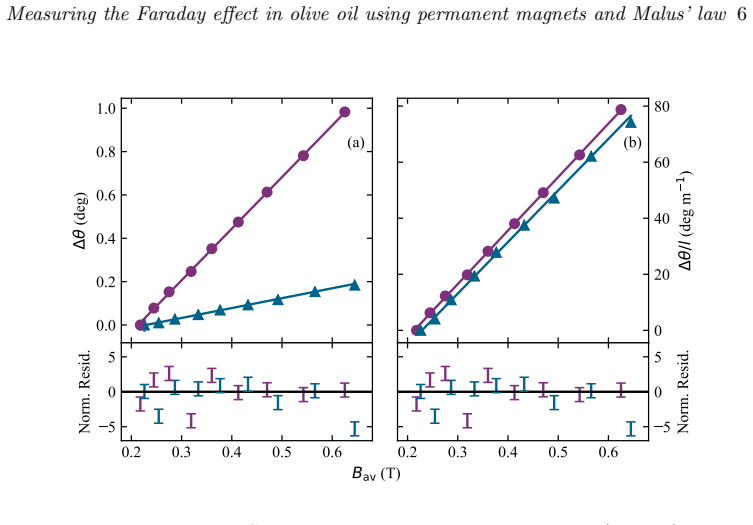
The working object is the Malus-law model $I = I_0 \cos^2(\varphi+\theta)+c$ fitted to the full analyzer rotation curve, which decouples the polarization rotation $\theta$ from intensity drift and background offset. The field is supplied by a pair of neodymium permanent magnets whose axial field is calibrated with a Hall probe and modelled from the on-axis field of a cylindrical magnet, $B_z = \frac{B_0}{2}\left[\frac{z+z_0+t}{\sqrt{(z+z_0+t)^2+R^2}} - \frac{z+z_0-t}{\sqrt{(z+z_0-t)^2+R^2}}\right]$; the oil Verdet coefficient is extracted from the slope of $\Delta\theta_{\mathrm{oil}}$ versus $B_{\mathrm{oil}}l_{\mathrm{oil}}$, after subtracting the empty-cuvette rotation.
What would settle it
Measure the same oil in cuvettes with substantially different wall thicknesses, or compare with an independently calibrated liquid sample; if the extracted Verdet coefficient changes, the empty-cuvette subtraction is biasing the result.
Extended reading notes
Core claim
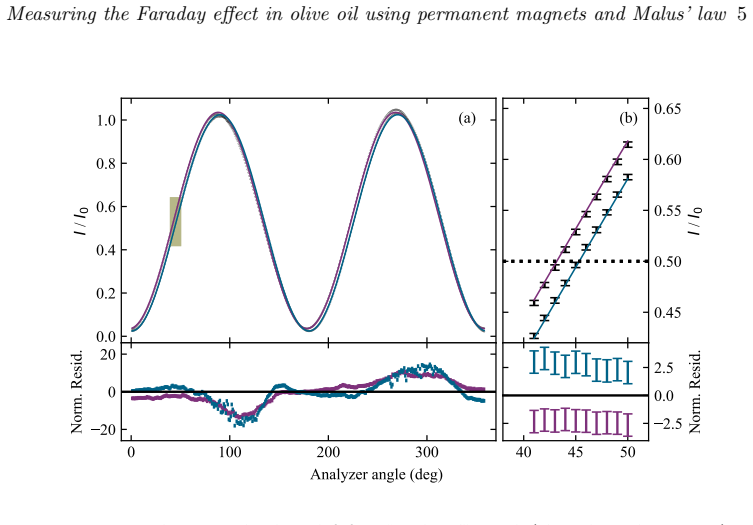
The central claim is methodological: by collecting intensity over a full 360° analyzer rotation and fitting $I = I_0 \cos^2(\varphi+\theta)+c$ with weighted least squares, the amplitude $I_0$ and offset $c$ are parameterized, so slow laser power drift and background light no longer masquerade as rotation. This yields phase-shift errors on the order of tens of microradians without modulating the magnetic field. Applied to olive oil, the method gives Verdet coefficients that agree with recent literature and do not reproduce the earlier report of a high value at 650 nm; the wavelength dependence fits a Drude-like dispersion with an inferred $\lambda_0$ near the ultraviolet.
Load-bearing premise
The empty-cuvette rotation is measured separately and subtracted from the filled-cuvette rotation, assuming the glass's Faraday rotation is unchanged by filling and that the two rotations add linearly.
Editorial extensions
If this is right
- Faraday rotation measurements at the tens-of-microradian level no longer require field modulation or a lock-in amplifier; a motorized analyzer and photodiode suffice.
- The same full-curve fitting should transfer to other polarimetric measurements—sugar optical rotation, stress birefringence, and magneto-optics in gases and solids—wherever intensity fluctuations are the limiting noise.
- Olive oil's Verdet coefficient is similar to water's and not anomalously large near 650 nm, so the earlier report of a strong peak is not supported.
- The Drude-type fit with $\lambda_0 = 142 \pm 13$ nm places the dominant dispersion resonance in the ultraviolet, consistent with olive oil's transparency in the visible.
- A full 360° scan takes about 10 minutes, so a Verdet coefficient can be determined in a short laboratory session, making high-precision polarimetry accessible as a teaching experiment.
Reading between the lines
- The quoted $\pm 1\,\mathrm{deg\,T^{-1}\,m^{-1}}$ uncertainty on the 659.2 nm Verdet coefficient is the statistical fit error; the paper does not give a systematic error budget for the empty-cuvette subtraction, so the absolute accuracy may be worse than the stated precision.
- A direct test of the cuvette-subtraction assumption would be to measure the same oil in cells with different wall thicknesses; if the extracted Verdet coefficient shifts, the empty-cuvette correction is biasing the result.
- The same fitting idea could be combined with AC field modulation to push sensitivity further, since the full-curve fit would also average over modulation-cycle intensity fluctuations.
Signed reviews
Editorial analysis
A structured set of objections, weighed in public.
Referee Report
Summary. The paper describes a permanent-magnet apparatus for measuring the Faraday effect in liquids and solids. A polarization analyzer is stepped over 360 degrees while a photodiode records intensity; the resulting Malus-law curve is fitted to I = I0 cos^2(phi + theta) + c to extract the rotation. The authors claim that this fitting procedure averages over laser intensity fluctuations and yields phase sensitivity down to +/- 50 microradians. They apply the method to olive oil at seven wavelengths, subtract the measured empty-cuvette rotation, and report Verdet coefficients, including V = 192 +/- 1 deg T^-1 m^-1 at 659.2 nm. They also fit the wavelength dependence with Cauchy and Drude dispersion models and report Verdet coefficients for the fused-quartz cuvette. The intended contribution is a simple, inexpensive teaching-laboratory experiment that can resolve a previously reported anomalous value.
Significance. If the methodological claims survive scrutiny, the apparatus offers a low-cost, lock-in-free route to DC Faraday rotation measurements with tens-of-microradian precision, which would be valuable for teaching laboratories and for settling the disputed olive-oil Verdet coefficient. The paper has real strengths: the field calibration is explicit, the data fitting uses orthogonal distance regression with covariance-matrix uncertainties, the cuvette subtraction is a sensible first-order correction, and the reported olive-oil values agree with recent literature rather than with the earlier anomalous claim. The dispersion fits are a useful consistency check, and the glass Verdet data are a useful by-product. However, the headline sensitivity claim is not yet demonstrated against a controlled rotation, and the systematic uncertainties from laser drift, glass subtraction, and temperature are unquantified.
major comments (4)
- [Section 3, Section 5, Eq. (2)] The abstract and Section 5 claim that fitting the full Malus transmission curve averages over laser intensity fluctuations and allows phase shifts as small as +/- 50 microradians to be extracted. However, Eq. (2) treats I0 and c as constants over the entire scan, whereas the analyzer is stepped sequentially and a full 360-degree scan takes about 10 minutes (Section 3). A slow laser-power drift over the scan duration is therefore not constant and is not removed by 'fully parameterizing the amplitude and offset': a linear fractional drift of amplitude epsilon maps onto the fitted phase as a bias of order epsilon radians, so even a 0.1% drift gives a roughly 100-microradian bias, comparable to or exceeding the claimed sensitivity. The paper reports no power monitor, normalization, interleaved control scan, or calibration against a known rotation that would validate the 50-microradian claim. Please either demonstrate the insensitivity experimentally or revise the claim and the uncertainty analysis accordingly.
- [Section 4, Eq. (6)] The oil rotation is obtained by subtracting the empty-cuvette rotation, Delta_theta_oil = Delta_theta_combined - Delta_theta_cuvette. This assumes that the glass walls contribute identically when the cuvette is empty and when it is filled with oil, and that the two rotations add linearly. Filling the cuvette can change the mechanical stress on the glass, the beam path through the cell, and the field geometry, any of which would bias Delta_theta_oil. Since the glass and oil rotations are of comparable magnitude (Fig. 3), even a few percent change in the glass contribution would shift the derived Verdet coefficient outside the quoted statistical errors, e.g., V = 192 +/- 1 deg T^-1 m^-1 at 659.2 nm. The manuscript does not quantify this systematic error; please add a control measurement or an estimate of its magnitude.
- [Section 5, Table 1] The quoted uncertainties on the Verdet coefficients are propagated from the fit statistics and the path-length error, but no systematic uncertainty from temperature is included. The results are stated as being at approximately 20 degrees Celsius, yet no thermometer reading or temperature control is described, and the Faraday rotation of liquids is temperature-dependent. The +/- 1 deg T^-1 m^-1 error on V at 659.2 nm is therefore a statement of statistical precision only; the accuracy relative to literature values remains unquantified. Please either measure and report the temperature during each scan or explicitly state this as a limitation.
- [Abstract, Section 5] The central claim of 50-microradian sensitivity is inferred from the scatter of repeated fits, not from a controlled rotation of known magnitude. Without a calibration (e.g., a known Verdet material or a calibrated waveplate rotation), the reported sensitivity conflates repeatability with accuracy and cannot support the headline claim. Please add a validation measurement using a known rotation or a reference material.
minor comments (6)
- [Introduction, Section 5] There are minor typographical errors: 'birefrigence' in the Introduction and 'paramaterized' in Section 5 should be corrected.
- [Eq. (7)] The notation 'Boilloil' in Eq. (7) is ambiguous; it should be written as B_oil * l_oil or with an explicit multiplication sign.
- [Figure 4] Only 4 of the 7 wavelengths are shown in Figure 4; please specify in the caption which wavelengths are omitted and why, or show all data in a supplementary plot.
- [Section 5, Figure 5] The reported chi-squared values (4.45 and 7.28) are not accompanied by the number of degrees of freedom; please report these so readers can judge the goodness of fit.
- [Appendix B, Table B1] The 796.2 nm glass Verdet value (370 +/- 50 deg T^-1 m^-1) is far from the dispersion models and is acknowledged as anomalous; consider excluding it from the dispersion fits or presenting the fits with and without this point.
- [Appendix A, Ref. [30]] The magnetic field formula in Eq. (A.1) is cited to a PhD thesis; a standard electromagnetism textbook reference would be more accessible to the intended teaching-laboratory audience.
Circularity Check
No circularity: every claimed result is a direct fit to measured optical rotations, not a re-statement of the inputs.
full rationale
The paper's derivation chain is a sequence of fits to measured data: the transmitted intensity is modeled by Malus' law with an offset, I = I0 cos^2(phi + theta) + c (Eq. 2); the rotation theta is obtained by fitting full analyzer scans at each magnetic field; the oil-only rotation is isolated by subtracting the empty-cuvette rotation (Eq. 6); the Verdet coefficient is extracted as the slope of Delta-theta_oil versus B_oil divided by path length (Eq. 7); and the Verdet values at different wavelengths are then fit to Cauchy and Drude dispersion forms. No step defines its target in terms of the target itself: V is not assumed in the Malus fit, theta is not assumed in the cuvette subtraction, and the dispersion parameters A and lambda_0 are explicitly fitted to the measured Verdet coefficients, with the abstract saying the data 'can be fit' rather than claiming a prediction. The only same-group citation, Ref. [30] for the axial field formula (A.1), is not load-bearing: the field profiles are fitted to independent hall-probe measurements, so the cited formula is anchored to external calibration rather than being an unverified premise. Potential experimental biases, such as slow laser drift during the ~10-minute scan or changes in glass birefringence when the cuvette is filled, are correctness risks rather than circular reductions, because the paper does not derive those effects from the quantities it claims to measure. No uniqueness theorem, renaming of a known result, or ansatz-smuggling through self-citation is present. The central claim is a measurement with fitted parameters, so the derivation is self-contained and not circular.
Assumptions & free parameters
free parameters (4)
- Cauchy dispersion coefficient A =
-26 ± 4 deg T^-1 m^-1
- Cauchy dispersion coefficient B =
9.42 ± 0.12 x 10^7 deg T^-1 m^-1 nm^2
- Drude dispersion coefficient A =
7.9 ± 0.2 x 10^7 deg T^-1 m^-1 nm^2
- Drude resonance wavelength lambda0 =
142 ± 13 nm
assumptions (6)
- domain assumption Malus' law with an additive offset, I = I0 cos^2(phi + theta) + c, describes the transmitted intensity (Eq. 2).
- domain assumption Total Faraday rotation is the sum of the glass and oil rotations, so delta_theta_oil = delta_theta_combined - delta_theta_cuvette (Eq. 6).
- domain assumption The axial field of each permanent magnet is described by Eq. (A.1) with piecewise superposition; the average Boil can be computed from this model.
- standard math The Verdet coefficient is linear in field and path length, theta = V integral B dl (Eq. 3).
- domain assumption The wavelength dependence can be represented by Cauchy or Drude dispersion laws, Eqs (4) and (5).
- domain assumption The sample temperature is effectively constant near 20 degrees Celsius.
Cite this review
Pith. "Pith review of Measuring the Faraday effect in olive oil using permanent magnets and Malus' law." pith.science (2026). https://pith.science/paper/ESPY2YZC
@misc{pith2026190808120,
  author       = {Pith},
  title        = {Pith review of: Measuring the Faraday effect in olive oil using permanent magnets and Malus' law},
  year         = {2026},
  howpublished = {\url{https://pith.science/paper/ESPY2YZC}},
  note         = {Machine review of arXiv:1908.08120}
}
abstract
We present a simple permanent magnet set-up that can be used to measure the Faraday effect in gases, liquids and solids. By fitting the transmission curve as a function of polarizer angle (Malus' law) we average over fluctuations in the laser intensity and can extract phase shifts as small as $\pm$ 50 $\mu$rads. We have focused on measuring the Faraday effect in olive oil and find a Verdet coefficient of $V$ = 192 $\pm$ 1 deg T$^{-1}$ m$^{-1}$ at approximately 20 $^{\circ}$C for a wavelength of 659.2 nm. We show that the Verdet coefficient can be fit with a Drude-like dispersion law $A/(\lambda^2 - \lambda_0^2)$ with coefficients $A$ = 7.9 $\pm$ 0.2 $\times$ 10$^{7}$ deg T$^{-1}$ m$^{-1}$ nm$^2$ and $\lambda_0$ = 142 $\pm$ 13 nm.
Figures

Figures from the paper (2 more)


Reference graph
Works this paper leans on
-
[1]
Adams C S and Hughes I G 2019 Optics f2f (Oxford: Oxford University Press) ch 4
work page 2019
-
[2]
¨Ohman Y 1956 Stockholm Obs. Ann. 19 (11) 3
work page 1956
-
[3]
Dick D J and Shay T M 1991 Optics Letters 16 867
work page 1991
-
[4]
Weller L, Kleinbach K S, Zentile M A, Knappe S, Hughes I G and Adams C S 2012 Optics Letters 37 (16) 3405
work page 2012
-
[5]
Gardner F F and Whiteoak J B 1963 Nature 197 1162
work page 1963
-
[6]
mit.edu/8.13/www/JLExperiments/JLExp08.pdf} [Accessed 31st July 2019]
Massachusetts Institute of Technology Physics Department The Faraday Effect {http://web. mit.edu/8.13/www/JLExperiments/JLExp08.pdf} [Accessed 31st July 2019]
work page 2019
-
[7]
Rutgers University Physics Department The Faraday Effect {http://www.physics.rutgers.edu/ ∼eandrei/389/faraday.pdf} [Accessed 31st July 2019]
work page 2019
-
[8]
Compton R N and Duncan M A 2016 Laser Experiments for Chemistry and Physics (Oxford: Oxford University Press) ch 20
work page 2016
Show all 31 references
-
[9]
Mahurin S M, Compton R N and Zare R N 1999 J. Chem. Edu. 76 1234
1999
-
[10]
Nixon M and Hughes I G 2017 Eur. J. Phys. 38 045302
2017
-
[11]
Loeffler F J 1983 Am. J. Phys. 51 661
1983
-
[12]
Pedrotti F L and Bandettini P 1990 Am. J. Phys. 58 542
1990
-
[13]
Hunte C 2018 Eur. J. Phys. 39 025301
2018
-
[14]
Jacob D, Vallet M, Bretenaker F, Le Floch A and Le Naour R 1995 Appl. Phys. Lett. 66 3546
1995
-
[15]
Van Baak D A 1996 Am. J. Phys. 64 724
1996
-
[16]
Jain A, Kumar J, Zhou F, Li L and Tripathy S 1999 Am. J. Phys. 67 714
1999
-
[17]
Valev V K, Wouters J and Verbiest T 2008 Eur. J. Phys. 29 1099
2008
-
[18]
Valev V K, Wouters J and Verbiest T 2008 Am. J. Phys. 76 626
2008
-
[19]
and Korsch W
Phelps G, Abney J., Broering M. and Korsch W. 2015 Rev. Sci. Instrum. 86 073107
2015
-
[20]
Chang C, Wang L, Shy J, Lin C and Chou C 2011 Rev. Sci. Instrum. 82 063112
2011
-
[21]
Brandon W, Mandjiny S, McDonald K and Lee D 2017 European Scientific Journal October 2017 Special Edition 111
2017
-
[22]
Duffy R M and Netterfield R P 1983 Applied Optics 22 (9) 1272
1983
-
[23]
Shakir A A, AL-Mudhafa R D and Anwaar A A 2013 J. Adv. EEE 2 (3) 362 Measuring the Faraday effect in olive oil using permanent magnets and Malus’ law 10
2013
-
[24]
Cauchy A L 1830 Bull. Sci. Math. 14 6
-
[25]
Cauchy A L 1836 M´ emoire sur la Dispersion de la Lumi` ere(Prague: Calve)
-
[26]
(Leipzig: S
Drude P 1900 Lehrbuch der Optik 1st Ed. (Leipzig: S. Hirzel)
1900
-
[27]
So C, Spong N L R, M¨ ohl C, Jiao Y and Adams C S Zeeman-tunable Modulation Transfer Spectroscopy arXiv:1906.04154
1906 arXiv
-
[28]
Hughes I G and Hase T P A 2010 Measurements and their Uncertainties (Oxford: Oxford University Press) ch 9
2010
-
[29]
Abu-Taha M I, Halasa M A and Abu-Samreh M M 2012 Journal of Modern Physics 4 230
2012
-
[30]
Available at Durham E-Theses Online:{http://etheses.dur.ac.uk/7747/}
Weller L 2013 PhD Thesis Durham University Appendix F. Available at Durham E-Theses Online:{http://etheses.dur.ac.uk/7747/}
2013
-
[31]
Indian Acad
Ramaseshan S 1946 Proc. Indian Acad. Sci. A24 426 Appendix A. Magnetic field modelling The magnetic field was calibrated to determine the spatial homogeneity and average field strength at each magnet separation distance. Each full rotation of the magnets in their mount increased ...
1946
Reviewed August 14, 2026 · model on record in the stance chip above.
Discussion (0). Continue with ORCID to comment.