REVIEW 2 major objections 5 minor 71 references
Delensing Degree-Scale $B$-Mode Polarization with High-Redshift Line Intensity Mapping
T0 review · 2 major / 5 minor · reviewed 2026-08-14 · deepseek-v4-flash
Pith's one-line read Adding high-redshift line intensity mapping to CMB delensing improves tensor-to-scalar constraints by about 11 percent, if line-of-sight density modes survive foreground removal.
desk verdict Solid forecast: IM could add ~11% to CMB-S4 delensing, but only if k_parallel≈0 survives foreground cleaning—a binary condition the paper honestly flags. read the letter →
The pith
A machine-rendered reading of the paper's core claim, the machinery that carries it, and where it could break.
The reading
What carries the argument
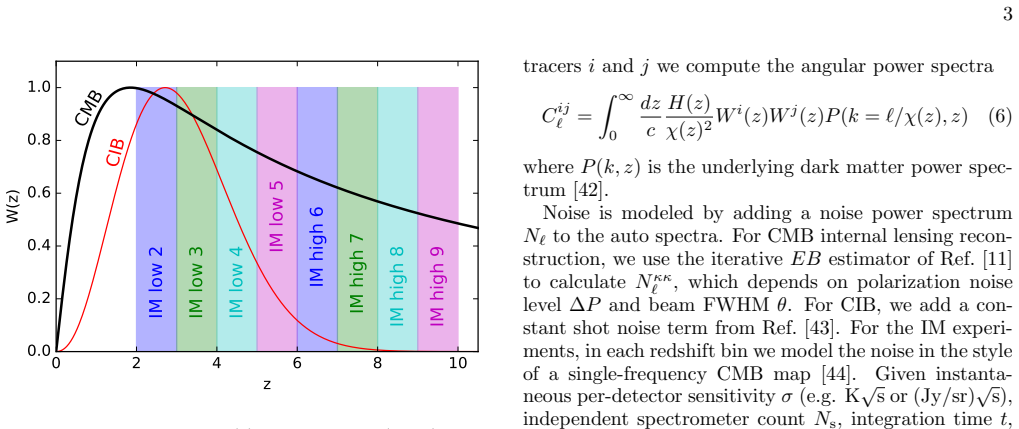
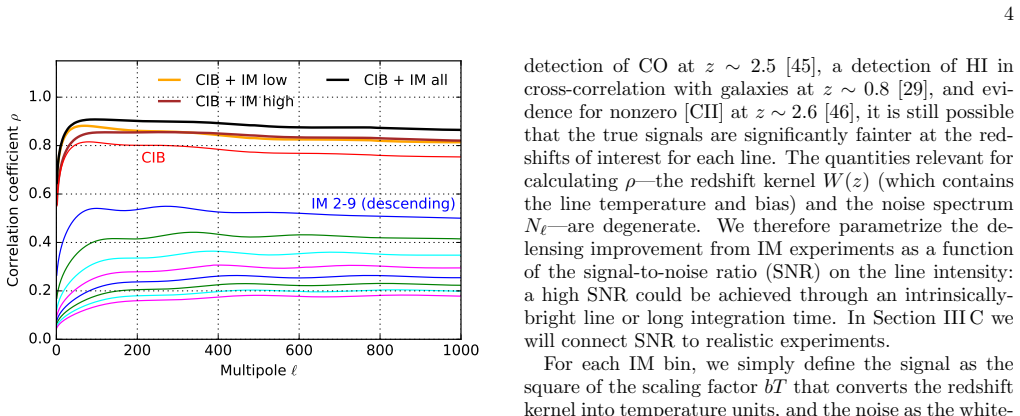
The engine is the effective correlation coefficient $\rho_\ell$ between the CMB lensing kernel and an optimally weighted combination of all available tracers, built from each tracer's redshift kernel and noise power spectrum. For IM maps the redshift kernel is $W(z)=b(z)\,T(z)\,dN/dz$, with redshift fixed by the observed line, and the noise follows a single-frequency CMB map model. The correlation is converted into a delensing improvement factor $\alpha=\sigma_0(r)/\sigma_d(r)$ via the residual lensing B-mode power, so the paper's central number is the ratio of projected $\sigma(r)$ with and without IM data. A critical feature is that delensing uses only the line-of-sight mean density, $k_\parallel \approx 0$, which is exactly the component that smooth-spectrum foregrounds dominate.
What would settle it
Measure the cross-correlation between foreground-cleaned line intensity maps and a CMB lensing reconstruction at $\ell<100$, comparing runs that keep and exclude modes with $k_\parallel \lesssim 0.02\,h\,\mathrm{Mpc}^{-1}$; if the recovered line-of-sight modes show no significant correlation with lensing after foreground subtraction, the predicted 11% delensing improvement is not realized.
Extended reading notes
Core claim
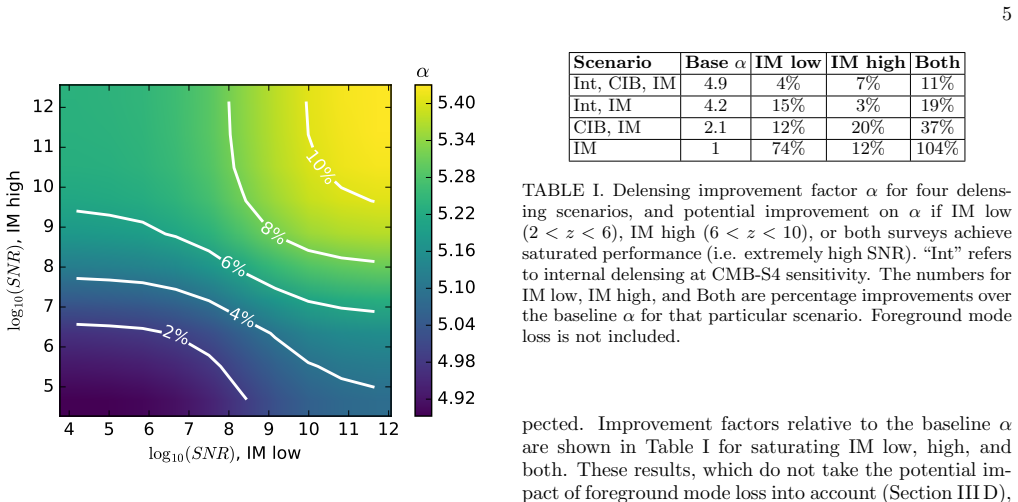
The paper claims that at CMB-S4 sensitivity, the combination of internal CMB delensing and CIB delensing reaches an improvement factor $\alpha=4.9$, removing about 88% of the lensing B-mode power; adding saturated tomographic line intensity maps spanning $2<z<10$ raises this to $\alpha=5.43$, an 11% improvement, corresponding to a reduction in projected $\sigma(r)$ from roughly $5\times10^{-4}$ to $4.5\times10^{-4}$. Saturation requires very high signal-to-noise in the maps, but the required depths are feasible for planned next-generation instruments if the emission lines are near their predicted strengths. The gain is contingent on recovering the line-of-sight density modes at $k_\parallel\approx 0$; without those modes the IM maps cannot correlate with the lensing kernel and provide no delensing benefit.
Load-bearing premise
The central claim depends on removing smooth-spectrum foregrounds from the intensity maps without discarding the line-of-sight density modes at $k_\parallel \approx 0$; if those modes are cut or marginalized away, the maps no longer correlate with the CMB lensing kernel and the 11% improvement vanishes.
Editorial extensions
If this is right
- At saturated signal-to-noise, IM low ($2<z<6$) alone improves $\alpha$ by 4%, IM high ($6<z<10$) by 7%, and both together by 11%, reaching $\alpha=5.43$.
- If smooth-spectrum foregrounds force exclusion of the $k_\parallel\approx 0$ modes, the IM maps do not correlate with the lensing kernel and add nothing to delensing.
- IM delensing becomes more valuable if the baseline underperforms: without CIB the gain from both IM surveys is 19%, without internal delensing it is 37%, and with neither it is 104%.
- Achieving saturation requires long integrations on the deep CMB patch, with estimates of thousands of hours for a Stage-2 HI survey and a few years for a large [CII] spectrometer array, assuming line strengths near current models.
- Because the IM maps are byproducts of surveys built for other cosmology goals, the delensing gain comes at little extra cost, and additional tracers hedge against systematics in any single delensing map.
Reading between the lines
- The $k_\parallel=0$ requirement implies that IM experiments whose analysis pipelines avoid the foreground wedge, as is standard for power-spectrum measurements, will not automatically deliver delensing products; survey planning must include foreground subtraction and map-making that preserve line-of-sight density.
- The paper cites mode-coupling techniques for reconstructing the lost $k_\parallel\approx 0$ modes, suggesting a testable extension: run foreground-cleaned IM simulations and check whether the reconstructed line-of-sight modes recover the expected correlation with a known lensing field.
- Because the CIB redshift kernel is uncertain, the exact baseline $\alpha=4.9$ is not fixed; precise IM measurements could help pin down the CIB kernel, which would shift the quoted percentage improvement.
- A roughly 10% sharper $\sigma(r)$ matters most in the pessimistic regime where $r$ is small and the only route to improved inflation constraints is more efficient delensing.
Signed reviews
Editorial analysis
A structured set of objections, weighed in public.
Referee Report
Summary. This paper asks whether tomographic line intensity mapping (IM) surveys covering 2<z<10 can improve the delensing of degree-scale CMB B-modes beyond a baseline of CMB-S4 internal delensing plus CIB delensing. The author constructs a standard projected-tracer framework: Limber angular power spectra are computed from lensing kernels for the CMB, CIB, and top-hat IM redshift bins; instrumental noise is added; correlation coefficients are combined; and the residual BB power is converted to an improvement factor α for σ(r). The baseline α=4.9 improves to α=5.43 (about 11%) if the IM maps reach sufficiently high SNR, corresponding to σ(r) roughly 5e-4 to 4.5e-4. Integration-time estimates for CO/HI and [CII] surveys are given, and foreground effects are discussed, with interloper masking costing about 10% for [CII] and smooth-spectrum foregrounds identified as the dominant concern.
Significance. If the numerical result is taken at face value, the paper provides a useful planning result: high-redshift IM is unlikely to be a transformative delensing tool at CMB-S4 sensitivity, but it may be worth including as a byproduct tracer, and it becomes more valuable if internal or CIB delensing underperform. The calculation is transparent and reproducible from the stated equations; it is a forward model with no parameters fitted to the target result, and the saturation improvement is robust to the unknown line brightness because the bT amplitude cancels in the correlation coefficient at high SNR. The paper also deserves credit for clearly identifying the requirement to preserve k_parallel roughly equal to 0 modes, which is the actual obstacle rather than raw sensitivity.
major comments (2)
- [III D 1 / Figure 3] The central 11% result (alpha=4.9 to 5.43) is computed in Section III B from IM maps with statistical noise only, i.e., it assumes the k_parallel roughly equal to 0 line-of-sight modes survive foreground cleaning. Section III D 1 states that smooth-spectrum foregrounds preferentially populate low-k_parallel modes, that excluding them removes any correlation with CMB lensing, and that if [CII] experiments cannot recover the line-of-sight density their maps will not aid in delensing. The paper therefore identifies a binary failure mode, but it does not quantify it or label Figure 3 and Table I as idealized upper bounds in the main text; the abstract's hedge is not repeated in Section III B or the Conclusions. I request a quantitative treatment of a k_parallel cutoff (e.g., recomputing rho and alpha after removing modes below a series of thresholds) or, at minimum, a prominent statement that the quoted improvements are ceilings contingent on an unproven foreground-removal capability.
- [II A / IV, Eq. (3)] The baseline alpha=4.9 against which the 11% improvement is measured depends on the Hall et al. CIB kernel, Eq. (3), yet the paper acknowledges in Section IV that the CIB kernel is a large source of error in CIB delensing. Because the marginal value of the IM tracers is defined relative to this baseline, the headline percentage is sensitive to CIB kernel assumptions; the paper's bracketing scenarios remove CIB entirely, but do not vary the kernel shape. A simple scan over zc, sigma_z, and beta (or a comparison with an alternative CIB model) would show whether the 11% number is stable, and would make the forecast more robust.
minor comments (5)
- [Abstract] The phrase 'unable to to correlate' contains a duplicated 'to'; please fix.
- [III A, footnote [47]] The justification for assuming constant bT is relegated to a footnote; since this assumption directly affects the relative sensitivity of the IM bins, the test should be described in the main text or an appendix.
- [III D 2] The statement that masked interloper voxels are 'uncorrelated with the structure that lenses the CMB' is too strong because lower-redshift matter also lenses the CMB; the correct point is that interlopers trace a different, largely disjoint lensing kernel, so the correlation with the target high-redshift signal is reduced rather than absent.
- [III B / Figures 3 and 4] The caveat 'Foreground mode loss is not included' appears only in figure captions; an explicit sentence in Section III B stating that the quoted improvements are upper bounds would make the status of the headline result unambiguous before the foreground discussion.
- [III C] The integration-time forecasts are quoted for single model line strengths from Refs. [28] and [54] without a range; a brief scaling of the required time with (bT)^-2 over the range of published model predictions would make the feasibility claims more transparent.
Circularity Check
No significant circularity: the delensing improvement is a forward-model forecast against external benchmarks, and the foreground caveat is an explicitly stated contingency rather than a derived result.
full rationale
The paper's central result—an ~11% improvement in the delensing factor α when high-redshift line intensity mapping is added to a CMB-S4 internal + CIB baseline—is obtained by computing correlation coefficients from specified lensing kernels, the Limber power spectrum, and instrument noise models. No parameter is fitted to the target percentage; the unknown line brightness and noise enter through an SNR parameter that is varied, and at saturation the brightness factor cancels in the correlation coefficient, so the headline is not an artifact of assuming a particular line strength. The only self-reference, [67], concerns ancillary science motivations for IM surveys and does not carry the delensing calculation. The paper's own caveat that the result requires measuring the line-of-sight density modes (k_parallel ≈ 0) is a limitation and an explicitly stated contingency, not a circular step: the formalism does not define the predicted improvement in terms of an unvalidated fitted quantity, and the discussion clearly marks the foreground-removal requirement as unproven. At most this is a self-citation that is not load-bearing, hence a score of 1.
Assumptions & free parameters
assumptions (4)
- standard math Limber approximation, Eq. (6)
- domain assumption Adopted CIB kernel parameters (zc=2, sigma_z=2, T=34 K) from Hall et al., Eqs. (3-4)
- domain assumption Line emission is a linearly biased tracer of matter with top-hat redshift bins and constant bT within each redshift range, Eq. (5) and Section III A
- ad hoc to paper Foreground removal can preserve k_parallel approximately 0 modes, Section III D 1
Cite this review
Pith. "Pith review of Delensing Degree-Scale $B$-Mode Polarization with High-Redshift Line Intensity Mapping." pith.science (2026). https://pith.science/paper/TCJCI7XB
@misc{pith2026190808128,
  author       = {Pith},
  title        = {Pith review of: Delensing Degree-Scale $B$-Mode Polarization with High-Redshift Line Intensity Mapping},
  year         = {2026},
  howpublished = {\url{https://pith.science/paper/TCJCI7XB}},
  note         = {Machine review of arXiv:1908.08128}
}
abstract
Cosmic microwave background (CMB) experiments that constrain the tensor-to-scalar ratio $r$ are now approaching the sensitivity at which delensing---removing the $B$ modes induced by the gravitational lensing of large-scale structure---is necessary. We consider the improvement in delensing that maps of large-scale structure from tomographic line intensity mapping (IM) experiments targeting $2 < z < 10$ could provide. Compared to a nominal baseline of cosmic infrared background and internal delensing at CMB-S4 sensitivity, we find that the addition of high-redshift IM data could improve delensing performance by ~11%. Achieving the requisite sensitivity in the IM data is feasible with next-generation experiments that are now being planned. However, these results are contingent on the ability to measure low-$k$ modes along the line of sight. Without these modes, IM datasets are unable to to correlate with the lensing kernel and do not aid in delensing.
Figures
Figures from the paper (1 more)

Reference graph
Works this paper leans on
-
[1]
Galactic syn- chrotron and dust, CMB, and CIB), unlike much of the cosmological IM signal
Smooth-Spectrum All IM measurements will contain foregrounds that vary slowly in the frequency direction (e.g. Galactic syn- chrotron and dust, CMB, and CIB), unlike much of the cosmological IM signal. These components preferentially populate low-k‖ modes in the IM data cube. At the same time, since CMB lensing is a 2D projection of a 3D field, the relevan...
-
[2]
Interloper Lines The second major foreground contaminant, relevant for [CII] from 6 <z < 10, is “interloper lines”—emission from lower-redshift galaxies (primarily in CO) that is redshifted into the observing band. Several mitigation strategies have been proposed, including masking the in- terlopers and using the anisotropy of the power spectrum when the ...
- [3]
-
[4]
M. Kamionkowski and E. D. Kovetz, Annual Review of Astronomy and Astrophysics 54, 227 (2016)
work page 2016
-
[5]
BICEP2/Keck Array Collaboration, Physical Review Letters 121, 221301 (2018), arXiv:1810.05216
arXiv 2018
-
[6]
CMB-S4 Science Book, ArXiv e-prints , arXiv:1610.02743 (2016)
arXiv 2016
-
[7]
M. Zaldarriaga and U. Seljak, Phys. Rev. D 58, 023003 (1998), arXiv:astro-ph/9803150
arXiv 1998
-
[8]
A limit on the detectability of the energy scale of inflation
L. Knox and Y.-S. Song, Phys. Rev. Lett. 89, 011303 (2002), arXiv:astro-ph/0202286
work page Pith review arXiv 2002
Show all 71 references
-
[9]
Simard, D
G. Simard, D. Hanson, and G. Holder, Astrophys. J. 807, 166 (2015), arXiv:1410.0691
2015 arXiv
-
[10]
Seljak and C
U. Seljak and C. M. Hirata, Phys. Rev. D 69, 043005 (2004), astro-ph/0310163
2004 arXiv
-
[11]
Kesden, A
M. Kesden, A. Cooray, and M. Kamionkowski, Phys. Rev. D 67, 123507 (2003), arXiv:astro-ph/0302536
2003 arXiv
-
[13]
Carron, A
J. Carron, A. Lewis, and A. Challinor, Journal of Cos- mology and Astro-Particle Physics 2017, 035 (2017)
2017
-
[14]
K. M. Smith et al., J. Cosmology Astropart. Phys. 6, 014 (2012), arXiv:1010.0048
2012 arXiv
-
[15]
B. Yu, J. C. Hill, and B. D. Sherwin, Phys. Rev. D 96, 123511 (2017)
2017
-
[16]
G. P. Holder et al., Astrophys. J. 771, L16 (2013), arXiv:1303.5048
2013 arXiv
-
[17]
B. D. Sherwin and M. Schmittfull, Phys. Rev. D 92, 043005 (2015), arXiv:1502.05356
2015 arXiv
- [18]
-
[19]
Larsen et al., Physical Review Letters 117, 151102 (2016), arXiv:1607.05733
P. Larsen et al., Physical Review Letters 117, 151102 (2016), arXiv:1607.05733
2016 arXiv
-
[20]
Manzotti et al., Astrophys
A. Manzotti et al., Astrophys. J. 846, 45 (2017), arXiv:1701.04396
2017 arXiv
-
[21]
Namikawa et al., Phys
T. Namikawa et al., Phys. Rev. D 93, 043527 (2016), arXiv:1511.04653
2016 arXiv
-
[22]
LSST Science Collaboration, arXiv e-prints , arXiv:0912.0201 (2009), arXiv:0912.0201
2009 arXiv
- [23]
-
[24]
A. P. Beardsley et al., Astrophys. J. 833, 102 (2016), arXiv:1608.06281. 9
2016 arXiv
-
[25]
E. D. Kovetz et al., ArXiv e-prints (2017), arXiv:1709.09066
2017 arXiv
-
[26]
Z. S. Ali et al., Astrophys. J. 809, 61 (2015), arXiv:1502.06016
2015 arXiv
-
[27]
L. B. Newburgh et al., in Ground-based and Airborne Telescopes VI , Proc. SPIE, Vol. 9906 (2016) p. 99065X, arXiv:1607.02059
2016 arXiv
-
[28]
D. R. DeBoer et al., PASP 129, 045001 (2017), arXiv:1606.07473
2017 arXiv
-
[29]
Bandura et al., in Ground-based and Airborne Tele- scopes V , Proc
K. Bandura et al., in Ground-based and Airborne Tele- scopes V , Proc. SPIE, Vol. 9145 (2014) p. 914522, arXiv:1406.2288
2014 arXiv
-
[30]
Righi, C
M. Righi, C. Hern´ andez-Monteagudo, and R. A. Sun- yaev, A&A 489, 489 (2008), arXiv:0805.2174
2008 arXiv
-
[31]
Cosmic Visions 21 cm Collaboration, ArXiv e-prints (2018), arXiv:1810.09572
2018 arXiv
-
[32]
K. W. Masui et al., Astrophys. J. 763, L20 (2013), arXiv:1208.0331
2013 arXiv
- [33]
- [34]
-
[35]
C. L. Carilli, Astrophys. J. 730, L30 (2011), arXiv:1102.0745
2011 arXiv
-
[36]
A. T. Crites et al., in Millimeter, Submillimeter, and Far- Infrared Detectors and Instrumentation for Astronomy VII , Proc. SPIE, Vol. 9153 (2014) p. 91531W
2014
-
[37]
T. Y. Li et al., Astrophys. J. 817, 169 (2016), arXiv:1503.08833
2016 arXiv
-
[38]
P. T. P. Ho et al., Astrophys. J. 694, 1610 (2009), arXiv:0810.1871
2009 arXiv
-
[39]
Sigurdson and A
K. Sigurdson and A. Cooray, Phys. Rev. Lett. 95, 211303 (2005), arXiv:astro-ph/0502549
2005 arXiv
-
[40]
Serra, O
P. Serra, O. Dor´ e, and G. Lagache, Astrophys. J. 833, 153 (2016), arXiv:1608.00585
2016 arXiv
-
[41]
low” and “high
and are divided between a “low” and “high” exper- iment. “IM low” (2 < z <6) roughly reflects a survey such as COMAP targeting CO or HI Stage 2, while “IM high” (6 <z < 10) is an EoR survey such as TIME tar- geting [CII]. The lensing kernels for CMB, CIB, and eight IM bands are...
-
[42]
G. J. Stacey et al., ArXiv e-prints (2018), arXiv:1807.04354
2018 arXiv
-
[43]
N. R. Hall et al., Astrophys. J. 718, 632 (2010), arXiv:0912.4315
2010 arXiv
-
[44]
This is because the CMB lensing kernel varies slowly at z >2
While in principle finer binning improves delensing per- formance, in practice little benefit is seen by going to smaller bins. This is because the CMB lensing kernel varies slowly at z >2
-
[45]
D. N. Limber, Astrophys. J. 117, 134 (1953)
1953
-
[46]
Planck Collaboration, A&A 571, A30 (2014), arXiv:1309.0382
2014 arXiv
-
[47]
Tegmark, Phys
M. Tegmark, Phys. Rev. D 56, 4514 (1997), astro- ph/9705188
1997
-
[48]
G. K. Keating et al., Astrophys. J. 830, 34 (2016), arXiv:1605.03971
2016 arXiv
-
[49]
A. R. Pullen et al., MNRAS 478, 1911 (2018), arXiv:1707.06172
2018 arXiv
-
[50]
How- ever, currently there is little data regarding these line strengths, and models vary significantly
In reality we expect bT to increase with time. How- ever, currently there is little data regarding these line strengths, and models vary significantly. To test whether assuming a single line strength for a redshift range is a reasonable approximation, we recalculate ρ for IM lo...
-
[51]
While HI experiments targeting “IM high” redshifts are already taking data, we focus on [CII] here: foregrounds are expected to be significantly worse for HI at high z, and the signal traces different phases as reionization pro- gresses which complicates the correlation with CMB
-
[52]
Padmanabhan, MNRAS 475, 1477 (2018), arXiv:1706.01471
H. Padmanabhan, MNRAS 475, 1477 (2018), arXiv:1706.01471
2018 arXiv
-
[53]
Delensing requires deep measurements over the full r survey area, which is much larger than the planned CO surveys
We note that this long integration time does not mean that detecting the CO signal in the first place would take years. Delensing requires deep measurements over the full r survey area, which is much larger than the planned CO surveys
-
[54]
E. Shirokoff et al., in Millimeter, Submillimeter, and Far- Infrared Detectors and Instrumentation for Astronomy VI , Society of Photo-Optical Instrumentation Engineers (SPIE) Conference Series, Vol. 8452 (2012) p. 84520R, arXiv:1211.1652
2012 arXiv
-
[55]
J. Redford et al., in Millimeter, Submillimeter, and Far- Infrared Detectors and Instrumentation for Astronomy IX , Society of Photo-Optical Instrumentation Engineers (SPIE) Conference Series, Vol. 10708 (2018) p. 107081O
2018
-
[56]
The am atmospheric model,
S. Paine, “The am atmospheric model,” (2018)
2018
- [57]
-
[58]
Font-Ribera et al., J
A. Font-Ribera et al., J. Cosmology Astropart. Phys. 2014, 023 (2014), arXiv:1308.4164
2014 arXiv
-
[59]
A. Liu, A. R. Parsons, and C. M. Trott, Phys. Rev. D 90, 023019 (2014), arXiv:1404.4372
2014 arXiv
-
[60]
J. C. Pober et al., Astrophys. J. 819, 8 (2016)
2016
- [61]
-
[62]
E. R. Switzer, Astrophys. J. 838, 82 (2017), arXiv:1703.07832
2017 arXiv
-
[63]
E. R. Switzer et al., Astrophys. J. 872, 82 (2019), arXiv:1812.06223
2019 arXiv
- [64]
-
[65]
Schaan, S
E. Schaan, S. Ferraro, and D. N. Spergel, Phys. Rev. D 97, 123539 (2018), arXiv:1802.05706
2018 arXiv
-
[66]
Schaan and S
E. Schaan and S. Ferraro, Phys. Rev. Lett. 122, 181301 (2019), arXiv:1804.06403
2019 arXiv
- [67]
-
[68]
Cheng et al., Astrophys
Y.-T. Cheng et al., Astrophys. J. 832, 165 (2016), arXiv:1604.07833
2016 arXiv
- [69]
-
[70]
K. S. Karkare and S. Bird, Phys. Rev. D 98, 043529 (2018), arXiv:1806.09625
2018 arXiv
-
[71]
It is possible that cross-correlating with IM, in which the redshift is well-known, could aid in precisely constraining the CIB kernel [14, 69]
- [72]
Reviewed August 14, 2026 · model on record in the stance chip above.
Discussion (0). Continue with ORCID to comment.