REVIEW 3 major objections 6 minor 48 references
cSeiz: An Edge-Device for Accurate Seizure Detection and Control for Smart Healthcare
T0 review · 3 major / 6 minor · reviewed 2026-08-14 · deepseek-v4-flash
Pith's one-line read A proposed edge device detects seizures from EEG and automatically injects a fast-acting anti-convulsant drug, reporting 96.9% sensitivity and 97.5% specificity.
desk verdict A genuine integration of detector and micropump, but the 96.9%/97.5% numbers are in-sample fits, not validated performance. read the letter →
The pith
A machine-rendered reading of the paper's core claim, the machinery that carries it, and where it could break.
The reading
What carries the argument
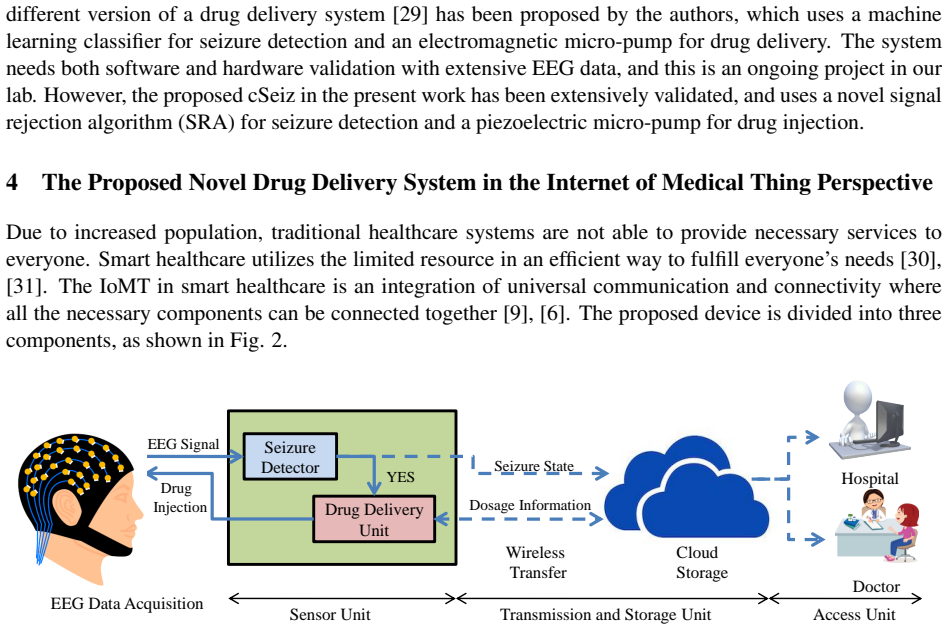
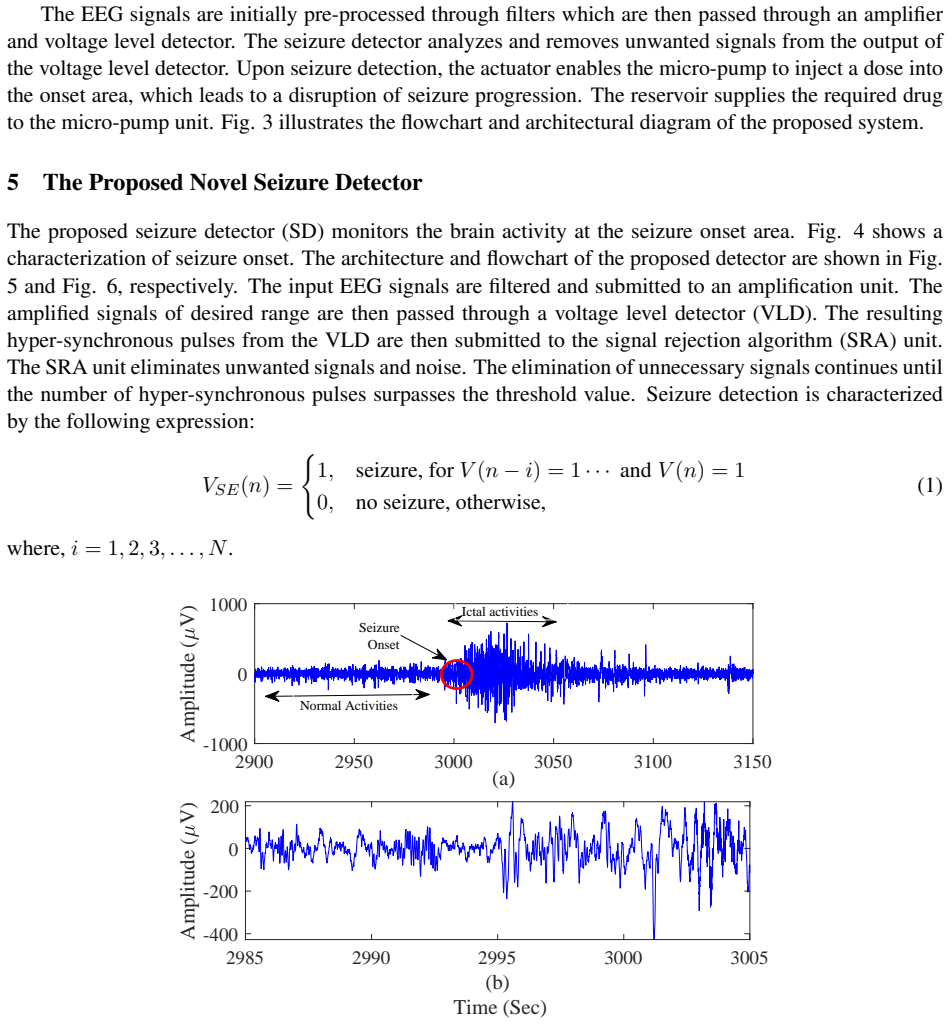
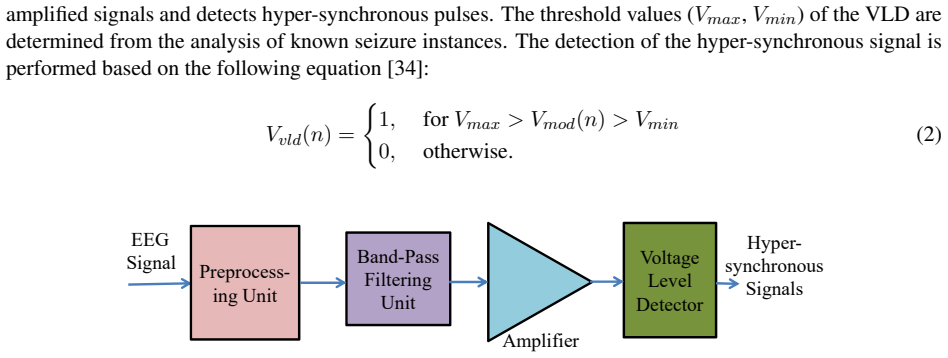
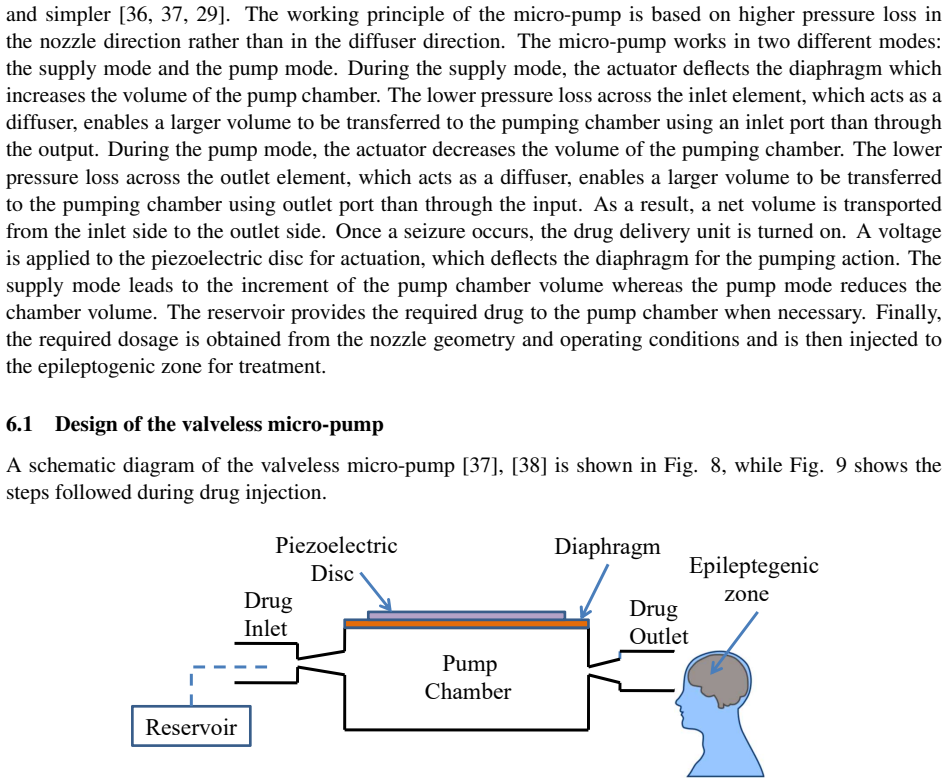
The load-bearing object is the pairing of a hyper-synchronous signal detection circuit with a signal rejection algorithm (SRA) for detection, and a valveless piezoelectric micro-pump for delivery. The detection circuit (band-pass filter, adjustable-gain amplifier, voltage level detector with thresholds $V_{\max}$ and $V_{\min}$) turns EEG into a binary pulse train; the SRA then removes isolated '1' pulses over successive iterations and declares a seizure only when persistent hyper-synchronous pulses exceed a threshold. The pump uses a PZT disc to deflect a PDMS diaphragm, and its net volume flow $Q = 2 V_{\text{str}} f (\sqrt{\eta}-1)/(\sqrt{\eta}+1)$ depends on stroke volume $V_{\text{str}}$, actuation frequency $f$, and the nozzle-to-diffuser loss ratio $\eta$. This machinery is what lets the authors claim accurate detection plus active drug delivery at milliwatt power.
What would settle it
Re-run the same detector with the thresholds and SRA parameters frozen, on EEG from patients or recording sessions not used during tuning; if sensitivity or specificity falls far below 96.9% and 97.5%, the published numbers are tuning artifacts rather than general detection performance. Alternatively, bench-test the micro-pump against a physiological backpressure to check whether output flow remains near 3.08 ml/min.
Extended reading notes
Core claim
On its own terms, the paper claims that a closed-loop seizure-control system can be built from two simple hardware ideas rather than heavy machine learning. First, seizure onset is detected by thresholding amplified EEG into hyper-synchronous pulses, then iteratively discarding spurious pulses with the SRA until the remaining pulses exceed a threshold; the detector alone consumes about 3.2 mW. Second, upon detection, a piezoelectric disc deflects a diaphragm in a valveless micro-pump, and the pump's net flow per stroke is governed by the diffuser/nozzle pressure-loss ratio so that 29.08 mW drives a maximum flow of 3.08 ml/min. The paper reports sensitivity 96.9%, specificity 97.5%, and average latency 3.6 s on seven subjects' EEG, and frames the result as an accurate, energy-efficient IoMT edge device for wearable or implantable seizure control.
Load-bearing premise
The load-bearing premise is that the detector's thresholds and rejection parameters, chosen by trial and error on known seizure samples from the same patients whose EEG is later scored, still give 96.9% sensitivity and 97.5% specificity on unseen seizures and on new patients.
Editorial extensions
If this is right
- Seizure control becomes a closed loop: the device detects onset and infuses drug without waiting for a clinician, which matters for the roughly one-third of epilepsy patients whose seizures resist medication.
- Ultra-low power budgets (3.2 mW detector, 29.08 mW drug delivery) make the design plausible as an implantable or wearable device rather than a desktop system.
- The IoMT integration implies continuous recording, cloud storage, and automatic physician notification, so the device doubles as a remote-monitoring system.
- Because detection is analog thresholding plus a simple algorithm rather than a trained classifier, the approach may transfer to other sensor modalities such as heart-rate or galvanic-skin-response signals.
Reading between the lines
- A direct extension the authors do not fully pursue is a patient-independent evaluation: fixing the hand-tuned thresholds and SRA parameters and testing on entirely unseen subjects would show whether the reported accuracy reflects a general mechanism or tuning to the dataset.
- The 3.6 s latency is short enough that an implanted pump might interrupt a seizure before it generalizes; an animal model with induced seizures could test whether drug delivery at this latency actually truncates seizure duration.
- The flow model assumes constant pressure-loss coefficients and a rigid diaphragm; a benchtop microfluidic test with variable backpressure would tell whether the 3.08 ml/min figure survives real physiological conditions.
- One could combine the analog detection front end with a machine-learning verifier to reduce false alarms, since the SRA's threshold-energy step already suggests a two-stage cascade.
Signed reviews
Editorial analysis
A structured set of objections, weighed in public.
Referee Report
Summary. The manuscript proposes cSeiz, an Internet-of-Medical-Things edge device that combines an analog/mixed-signal seizure detector with a valveless piezoelectric micropump for closed-loop drug delivery. The detector uses a band-pass filter, amplifier, voltage level detector (VLD), and a signal rejection algorithm (SRA); the drug delivery unit is based on a diaphragm-driven valveless micropump modeled by Eqs. (6)-(8). The authors report a sensitivity of 96.9%, specificity of 97.5%, average latency of 3.6 s, a detector power of 3.2 mW, and a drug delivery power of 29.08 mW with a maximum flow of 3.08 ml/min, based on system-level simulations in Simulink and a hardware-in-the-loop consumer-electronics proof of concept using CHB-MIT EEG recordings.
Significance. If the detection and power figures were obtained under a valid evaluation protocol, the work would be a useful contribution to low-power IoMT seizure management: the SRA is simple, the analog-front-end approach is energy-efficient, and the integration of cloud connectivity and drug delivery in a single concept is timely. The paper also deserves credit for presenting a hardware-in-the-loop prototype rather than only offline signal-processing results. However, the reported accuracy is not yet a reliable estimate of real-world performance, because the detection thresholds and SRA parameters were tuned on the same CHB-MIT data used for scoring, and the drug delivery characteristics come from an analytical simulation rather than a fabricated device. These issues limit the current significance of the headline claims.
major comments (3)
- [Section 7 and Section 8, Table 3] The sensitivity and specificity of 96.9% and 97.5% are computed on the same CHB-MIT subjects from which the VLD thresholds and SRA parameters were derived: Section 7 states that Vmax/Vmin and the SRA parameters are 'adjusted by trial and error' and 'achieved by heuristic analysis of the known seizure and non-seizure instances,' while Section 8 scores the detector on EEG from the same subject list (chb01, chb03, chb05, chb08, chb11, chb17, chb19). No train/test split, cross-validation, or per-subject breakdown is reported. The headline numbers are therefore in-sample fits, and the conclusion that the system generalizes to unseen seizures or new patients is not supported. Please provide a held-out evaluation (e.g., leave-one-subject-out cross-validation or a separate test set) and report per-subject sensitivity/specificity with error bars.
- [Section 6.2, Tables 4-5, Section 9] The drug-delivery performance numbers (29.08 mW, 3.08 ml/min) are obtained from the analytical model of Eqs. (6)-(8) and system-level simulation, as stated in Sections 7 and 8, and the manuscript itself defers animal testing to future work. In the abstract and conclusion, however, the system is described as one that 'will detect seizures and inject a fast acting anti-convulsant drug at the onset' and 'delivers drug into the onset area.' Please reframe these statements as simulated performance of a proposed micropump, and clearly label all Table 4-5 values as model predictions rather than measured quantities. The closed-loop control claim also needs specification of how detection output is electrically connected to pump actuation in the prototype.
- [Section 8, Equations (9)-(10)] The reported sensitivity/specificity percentages are based on an undisclosed number of seizure and non-seizure events; the text says the detector 'misses one seizure instance' without giving denominators or confidence intervals. With a single missed event, small changes in the event count can move the sensitivity by several percentage points, and the absence of per-subject numbers makes it impossible to assess variability across the seven subjects. Please report the confusion matrix, event counts per subject, and confidence intervals.
minor comments (6)
- [Section 8] The subject 'chob08' is likely a typo for 'chb08'.
- [Table 4] 'Possions ratio' should be 'Poisson's ratio'.
- [Figure 10] The label 'Seisure Detection' should read 'Seizure Detection'.
- [Equations (3)-(5)] The notation V(n) is used for both the VLD output and the SRA input; define V(n) explicitly and state how it relates to Vvld(n) in Eq. (2).
- [Section 8] The time frame Tf is only described as 'in the range of milliseconds to seconds'; specify the value used for each subject or explain how it is selected.
- [Table 6] The comparison table mixes units (uW, mW, uJ/class) and has many 'NA' entries; a consistent metric and full rows would make the comparison easier to evaluate.
Circularity Check
The headline 96.9% sensitivity / 97.5% specificity is an in-sample estimate: VLD thresholds and SRA parameters are tuned by trial and error on the same CHB-MIT recordings used for scoring.
-
fitted input called prediction
[Sec. 7 (CE Proof of Concept) and Sec. 8 (Experimental Results), Eqs. (9)-(10)]
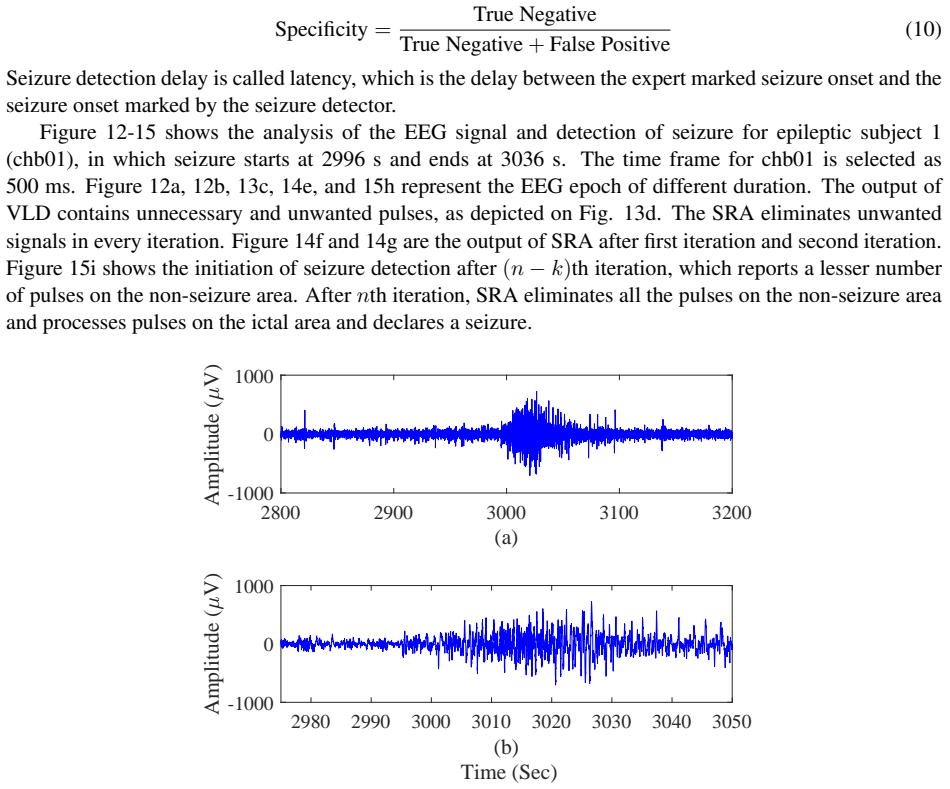
"The maximum and minimum voltage of the VLD is determined by heuristic analysis of the amplified signal... The average optimal values have been adjusted by trial and error method, which are then applied to unknown seizure and non-seizure instances... statistical energy in each time frame is calculated for the known seizure and non-seizure instances and optimal value is determined by heuristic approach as discussed earlier... Overall, the detector misses one seizure instance for the chosen EEG dataset."
The reported sensitivity and specificity are computed from detector outputs that depend on VLD thresholds (Vmax, Vmin), SRA parameters (n, k, Tf), and an energy threshold. The paper states these are 'determined by heuristic analysis' / 'adjusted by trial and error' on 'known seizure and non-seizure instances' from the same CHB-MIT subjects later used for evaluation, with no explicit train/test split, cross-validation, or held-out protocol. Thus the 'prediction' (96.9% sensitivity, 97.5% specificity) is an in-sample characterization of a hand-tuned configuration, not an estimate of performance on unseen data.
full rationale
The central detection claim is not derived from an independent test. The VLD thresholds and SRA parameters are explicitly tuned by 'heuristic analysis' and 'trial and error' on known seizure/non-seizure instances, and the same CHB-MIT recordings used for tuning are then used to compute the 96.9%/97.5% figures. Because no train/test split or cross-validation is described, the reported accuracy is an in-sample fit rather than a prediction. This is the one concrete circular step. The paper's self-citations (eSeiz, Neuro-Detect, etc.) are not load-bearing for the detection result and do not import a uniqueness theorem, so no additional self-citation circularity is present. The drug-delivery subsystem is modeled with standard analytical equations from the micropump literature (Eqs. (6)-(8)); its 3.08 ml/min and 29.08 mW figures are simulation outputs tied to chosen geometry and material inputs, not circular renamings. Overall score reflects partial circularity in the headline detection accuracy.
Assumptions & free parameters
free parameters (8)
- VLD thresholds Vmax and Vmin =
Average lower 210 mV, upper 380 mV (Table 3)
- SRA parameters n, k, and pulse threshold =
Not specified numerically
- Time frame Tf =
500 ms for chb01; variable per patient
- Statistical energy threshold =
Not specified
- Diffuser divergence angle =
10 degrees
- Pump chamber diameter =
10 mm
- Actuation frequency =
130 Hz
- Fluidic diodicity eta =
2
assumptions (5)
- domain assumption Seizure-relevant EEG activity lies within the 3-29 Hz band and can be isolated by a band-pass filter.
- domain assumption Seizure onset is characterized by hyper-synchronous activity detectable as amplitude threshold crossings.
- domain assumption The signal rejection algorithm removes noise and the remaining persistent pulses indicate seizure.
- domain assumption The valveless micropump can be modeled with constant pressure-loss coefficients and published diaphragm equations.
- domain assumption The CHB-MIT subjects used (chb01, chb03, chb05, chb08, chb11, chb17, chb19) are representative of the target epilepsy population.
Cite this review
Pith. "Pith review of cSeiz: An Edge-Device for Accurate Seizure Detection and Control for Smart Healthcare." pith.science (2026). https://pith.science/paper/5R7E7VPO
@misc{pith2026190808130,
  author       = {Pith},
  title        = {Pith review of: cSeiz: An Edge-Device for Accurate Seizure Detection and Control for Smart Healthcare},
  year         = {2026},
  howpublished = {\url{https://pith.science/paper/5R7E7VPO}},
  note         = {Machine review of arXiv:1908.08130}
}
read the original abstract
Epilepsy is one of the most common neurological disorders affecting up to 1% of the world's population and approximately 2.5 million people in the United States. Seizures in more than 30% of epilepsy patients are refractory to anti-epileptic drugs. An important biomedical research effort is focused on the development of an energy efficient implantable device for the real-time control of seizures. In this paper we propose an Internet of Medical Things (IoMT) based automated seizure detection and drug delivery system (DDS) for the control of seizures. The proposed system will detect seizures and inject a fast acting anti-convulsant drug at the onset to suppress seizure progression. The drug injection is performed in two stages. Initially, the seizure detector detects the seizure from the electroencephalography (EEG) signal using a hyper-synchronous signal detection circuit and a signal rejection algorithm (SRA). In the second stage, the drug is released in the seizure onset area upon seizure detection. The design was validated using a system-level simulation and consumer electronics proof of concept. The proposed seizure detector reports a sensitivity of 96.9% and specificity of 97.5%. The use of minimal circuitry leads to a considerable reduction of power consumption compared to previous approaches. The proposed approach can be generalized to other sensor modalities and the use of both wearable and implantable solutions, or a combination of the two.
Figures


Figures from the paper (13 more)






Reference graph
Works this paper leans on
-
[1]
Seizure Prediction: The Long and Winding road,
F. Mormann, R. G. Andrzejak, C. E. Elger, and K. Lehnertz, “ Seizure Prediction: The Long and Winding road,”Brain, vol. 130, no. 2, pp. 314–333, Feb. 2007
work page 2007
-
[2]
Outcomes of Epilepsy Surgery in Adults and Children,
S. Spencer and L. Huh, “Outcomes of Epilepsy Surgery in Adults and Children,”Lancet Neurol., vol. 7, no. 6, pp. 525–537, 2008. Page – 18-of-24 Table 5: CHARACTERIZATION OF THE DRUG DELIVERY SYSTEM Parameter Value Input voltage 5 V Divergence angle (Diffuser) 10 ◦ Frequency 130 Hz Power Consumption 29.08 mW V olume flow 3.08 ml/min
work page 2008
- [3]
-
[4]
Seizure Prediction 6: From Mechanisms to Engineered Interventions for Epilepsy,
B. J. Gluckman and C. Schevon, “ Seizure Prediction 6: From Mechanisms to Engineered Interventions for Epilepsy,” J. clin. Neurophysiol., vol. 32, no. 3, pp. 181–187, Feb. 2015
work page 2015
-
[5]
Trustworthiness of Medical Devices and Body Area Networks,
M. Zhang, A. Raghunathan, and N. K. Jha, “Trustworthiness of Medical Devices and Body Area Networks,” Proceedings of the IEEE, vol. 102, no. 8, pp. 1174–1188, Aug 2014
work page 2014
-
[6]
Everything You Wanted to Know About Smart Healthcare,
P. Sundaravadivel, E. Kougianos, S. P. Mohanty, and M. Ganapathiraju, “Everything You Wanted to Know About Smart Healthcare,” IEEE Consumer Electronics Magazine , vol. 8, no. 1, pp. 18–28, Jan. 2018
work page 2018
-
[7]
V . P. Yanambaka, S. P. Mohanty, E. Kougianos, and D. Puthal, “PMsec: Physical Unclonable Function- Based Robust and Lightweight Authentication in the Internet of Medical Things,” IEEE Transactions on Consumer Electronics, vol. 65, no. 3, pp. 388–397, Aug 2019
work page 2019
-
[8]
Consumer Technologies for Smart Cities,
S. P. Mohanty, “Consumer Technologies for Smart Cities,” Keynote, 23rd IEEE International Symposium on Consumer Technologies (ISCT), 2019, Ancona, Italy, 19th June 2019. [Online]. Available: http://www.smohanty.org/Presentations/2019/Mohanty_ISCT-2019_ Keynote-Talk_CT-Smart-City.pdf
work page 2019
Show all 48 references
-
[9]
Effective Ways to Use Internet of Things in the Field of Medical and Smart Health Care,
K. Ullah, M. A. Shah, and S. Zhang, “Effective Ways to Use Internet of Things in the Field of Medical and Smart Health Care,” in Proc. Int. Conf. Intell. Syst. Eng. (ICISE) , Islamabad, 2016, pp. 372–379
2016
-
[10]
Developing Residential Wireless Sensor Networks for ECG Healthcare Monitoring,
N. Dey, A. S. Ashour, and F. Shi, “Developing Residential Wireless Sensor Networks for ECG Healthcare Monitoring,” IEEE Transactions on Consumer Electronics (TCE) , vol. 63, no. 4, pp. 442– 449, Nov. 2017
2017
-
[11]
Cooperative Wireless Sensor Environments Supporting Body Area Networks,
S. Ivanov, D. Botvich, and S. Balasubramaniam, “Cooperative Wireless Sensor Environments Supporting Body Area Networks,” IEEE Transactions on Consumer Electronics (TCE) , vol. 58, no. 2, pp. 284–292, May 2012
2012
-
[12]
Remote Health Monitoring by OSGi Technology and Digital TV Integration,
S. Spinsante and E. Gambi, “Remote Health Monitoring by OSGi Technology and Digital TV Integration,” IEEE Transactions on Consumer Electronics (TCE) , vol. 58, no. 4, pp. 1434–1441, Nov. 2012
2012
-
[13]
A Personalized Point-of-Care Platform for Real-Time ECG Monitoring,
S. Raj and K. C. Ray, “A Personalized Point-of-Care Platform for Real-Time ECG Monitoring,”IEEE Tran. Consum. Electron., vol. 64, no. 4, pp. 452–460, Nov 2018
2018
-
[14]
This Seizure-Detecting Smartwatch Could Save Your Life,
E. Dolgin, “This Seizure-Detecting Smartwatch Could Save Your Life,” spectrum.ieee.org, Feb. 2018. [Online]. Available: https://spectrum.ieee.org/the-human-os/biomedical/diagnostics/ this-seizuredetecting-smartwatch-could-save-your-life
2018
-
[15]
Development of an arrhythmia monitoring system and human study,
S. Lee, P. Huang, M. Liang, J. Hong, and J. Chen, “Development of an arrhythmia monitoring system and human study,”IEEE Tran. Consum. Electron., vol. 64, no. 4, pp. 442–451, Nov 2018
2018
-
[16]
Patient-specific Seizure Onset Detection,
A. Shoeb, H. Edwards, J. Connolly, B. Bourgeois, T. Treves, and J. Guttag, “Patient-specific Seizure Onset Detection,” Epilepsy Behav., vol. 5, no. 4, pp. 483–498, Aug. 2004
2004
-
[17]
Mormann, K
F. Mormann, K. Lehnertz, P. David, and C. Elger, “Mean Phase Coherence As a Measure for Phase Page – 19-of-24 Table 6: COMPARISON WITH EXISTING SYSTEMS Existing Works Seizure Detection Method Sensitivity Specificity Latency Power Consump- tion on SDa Drug Delivery Unit Power Co...
2010
-
[18]
The Design and Hardware Implementation of Low Power Realtime Seizure Detection Algorithm,
S. Raghunathan, S. K. Gupta, M. P. Ward, R. M. Worth, K. Roy, and P. Irazoqui, “The Design and Hardware Implementation of Low Power Realtime Seizure Detection Algorithm,” J. Neural Eng. , vol. 6, no. 5, pp. 056 005(13)–056 005(13), Oct. 2009
2009
-
[19]
Analog Seizure Detection and Performance Evaluation,
N. C. Bhavaraju, M. G. Frei, and I. Osorio, “Analog Seizure Detection and Performance Evaluation,” IEEE Trans. Biomed. Eng., vol. 53, no. 2, pp. 238–245, Feb. 2006
2006
-
[20]
A Novel Low-Power-Implantable Epileptic Seizure-Onset Detector,
M. T. Salam, M. Sawan, and D. K. Nguyen, “A Novel Low-Power-Implantable Epileptic Seizure-Onset Detector,” IEEE Trans. Biomed. Circuits Syst., vol. 5, no. 6, pp. 568–578, Dec. 2011
2011
-
[21]
A Micro-Power EEG Acquisition SoC With Integrated Feature Extraction Processor for a Chronic Seizure Detection System,
N. Verma, A. Shoeb, J. Bohorquez, J. Dawson, J. Guttag, and A. P. Chandrakasan, “A Micro-Power EEG Acquisition SoC With Integrated Feature Extraction Processor for a Chronic Seizure Detection System,” IEEE J. Solid-State Circuits, vol. 45, no. 4, pp. 804–816, Apr. 2010
2010
-
[22]
Low Power Real Time Seizure Detection for Ambulatory EEG,
K. Patel, C. P. Chua, S. Faul, and C. J. Bleakley, “ Low Power Real Time Seizure Detection for Ambulatory EEG,” in Proc. Int. Conf. PCTHealth—Pervasive Health , London, UK, Apr. 2009
2009
-
[23]
An Implantable Closedloop Asynchronous Drug Delivery System for the Treatment of Refractory Epilepsy,
M. T. Salam, M. Mirzaei, M. S. Ly, D. K. Nguyen, and M. Sawan, “An Implantable Closedloop Asynchronous Drug Delivery System for the Treatment of Refractory Epilepsy,” IEEE Trans. Neural Syst. Rehabil. Eng., vol. 20, no. 4, pp. 432–442, July 2012
2012
-
[24]
An Energy Efficient ASIC for Wireless Body Sensor Networks in Medical Applications,
X. Zhang, H. Jiang, L. Zhang, C. Zhang, Z. Wang, and X. Chen, “An Energy Efficient ASIC for Wireless Body Sensor Networks in Medical Applications,”IEEE Trans. Biomed. Circuits Syst., vol. 4, no. 1, pp. 11–18, Nov. 2009
2009
-
[25]
Brain Stimulation for Epilepsy,
W. H. Theodore and R. S. Fisher, “Brain Stimulation for Epilepsy,”Neurology, vol. 3, no. 8, pp. 111–8, 2004
2004
-
[26]
Electrical Stimulation for the Treatment of Epilepsy,
P. Boon, “Electrical Stimulation for the Treatment of Epilepsy,” Neurotherapeutics, vol. 6, no. 2, pp. 218–27, 2009
2009
-
[27]
An Automated Drug Delivery System for Focal Epilepsy,
A. G. Stein, “An Automated Drug Delivery System for Focal Epilepsy,” Epilepsy Res., vol. 39, no. 2, pp. 103–14, 2000
2000
-
[28]
An Energy Efficient Epileptic Seizure Detector,
M. A. Sayeed, S. P. Mohanty, E. Kougianos, and H. Zaveri, “ An Energy Efficient Epileptic Seizure Detector,” in Proc. IEEE Int. Conf. Consum. Electron. (ICCE) , Las Vegas, NV , 2018, pp. 1–4
2018
-
[29]
An IoT-based Drug Delivery System for Refractory Epilepsy,
M. A. Sayeed, S. P. Mohanty, E. Kougianos, and H. Zaveri, “An IoT-based Drug Delivery System for Refractory Epilepsy,” in Proc. IEEE Int. Conf. Consum. Electron. (ICCE) , Las Vegas, NV , 2019, p. in Press
2019
-
[30]
A Robust and Fast Seizure Detection in IoT Edge ,
M. A. Sayeed, S. P. Mohanty, E. Kougianos, V . P. Yanambakha, and H. Zaveri, “ A Robust and Fast Seizure Detection in IoT Edge ,” in Proc. IEEE Int. Conf. Smart Electron. Syst. (iSES) , Hyderabad, India, 2018, p. in Press
2018
-
[31]
Everything You Wanted to Know About Smart Cities,
S. P. Mohanty, U. Choppali, and E. Kougianos, “Everything You Wanted to Know About Smart Cities,” IEEE Consumer Electronics Magazine (MCE) , vol. 6, no. 3, pp. 60–70, July 2016
2016
-
[32]
A Fast and Accurate Approach for Real- Time Seizure Detection in the IoMT,
M. A. Sayeed, S. P. Mohanty, E. Kougianos, and H. Zaveri, “A Fast and Accurate Approach for Real- Time Seizure Detection in the IoMT,” inProc. IEEE Int. Conf. Smart Cities (ISC2) , Kansas City, MO, 2018, p. in Press
2018
-
[33]
Neuro-Detect: A Machine Learning- Based Fast and Accurate Seizure Detection System in the IoMT,
M. A. Sayeed, S. P. Mohanty, E. Kougianos, and H. P. Zaveri, “Neuro-Detect: A Machine Learning- Based Fast and Accurate Seizure Detection System in the IoMT,” IEEE Transactions on Consumer Electronics, vol. 65, no. 3, pp. 359–368, Aug 2019
2019
-
[34]
A Low Power Implantable Device for Epileptic Seizure Detection and Neurostimulation,
M. T. Salam, D. K. Nguyen, and M. Sawan, “A Low Power Implantable Device for Epileptic Seizure Detection and Neurostimulation,” in Proc. Biomed. Circuits and Syst. Conf. (BioCAS) , Paphos, 2010, pp. 154–157
2010
-
[35]
Analytical Modeling, Simulations and Experimental Studies of a PZT Actuated Planar Valveless PDMS Micropump,
S. Singh, N. Kumar, D. George, and A. Sen, “Analytical Modeling, Simulations and Experimental Studies of a PZT Actuated Planar Valveless PDMS Micropump,”Sens. Actuator A-Phys., vol. 225, pp. Page – 21-of-24 81 – 94, 2015
2015
-
[36]
Dynamics Modeling and Vibration Analysis of a Piezoelectric Diaphragm Applied in Valveless Micropump,
X. He, W. Xu, N. Lin, B. Uzoejinwa, and Z. Deng, “Dynamics Modeling and Vibration Analysis of a Piezoelectric Diaphragm Applied in Valveless Micropump,” J. Sound Vib., vol. 405, pp. 133 – 143, 2017
2017
-
[37]
A Thin PDMS Nozzle/diffuser Micropump for Biomedical Applications,
P. Kawun, S. Leahy, and Y . Lai, “A Thin PDMS Nozzle/diffuser Micropump for Biomedical Applications,” Sens. Actuator A-Phys., vol. 249, pp. 149 – 154, 2016
2016
-
[38]
Modeling of micropump performance and optimization of diaphragm geometry,
N. Ramaswamy, N. Karanth, S. Kulkarni, and V . Desai, “Modeling of micropump performance and optimization of diaphragm geometry,” IJCA Proc. Int. Symp. Devices MEMS, Intell. Syst. Commun. (ISDMISC), no. 5, pp. 14–19, 2011
2011
-
[39]
A Valveless Diffuser/nozzle Based Fluid Pump ,
E. Stemme and G. Stemme, “A Valveless Diffuser/nozzle Based Fluid Pump ,”Sens. Actuator A-Phys., vol. 39, no. 2, pp. 159–167, 1993
1993
-
[40]
A Valve-less Planar Fluid Pump With Two Pump Chambers,
A. Olsson, G. Stemme, and E. Stemme, “A Valve-less Planar Fluid Pump With Two Pump Chambers,” Sens. Actuator A-Phys., vol. 47, no. 1-3, pp. 549–556, 1995
1995
-
[41]
Energy-Efficient Design of the Secure Better Portable Graphics Compression Architecture for Trusted Image Communication in the IoT ,
U. Albalawi, S. P. Mohanty, and E. Kougianos, “Energy-Efficient Design of the Secure Better Portable Graphics Compression Architecture for Trusted Image Communication in the IoT ,” in Proc. IEEE Comput. Soc. Annu. Symp. VLSI (ISVLSI) , Pittsburgh, PA, 2016, pp. 302–307
2016
-
[42]
PhysioBank, PhysioToolkit, and PhysioNet: Components of a new research resource for complex physiologic signals,
A. L. Goldberger, “PhysioBank, PhysioToolkit, and PhysioNet: Components of a new research resource for complex physiologic signals,” Circulation, vol. 101, no. 23, pp. e215–e220, Jun. 2000
2000
-
[43]
Application of Machine Learning to Epileptic Seizure Onset Detection and Treatment,
A. Shoeb, “Application of Machine Learning to Epileptic Seizure Onset Detection and Treatment,” Ph.D. dissertation, Massachusetts Institute of Technology, Sep. 2009
2009
-
[44]
An Implantable Micropump Prototype For Focal Drug Delivery,
A. Hamie, E. Ghafar-Zadeh, and M. Sawan, “An Implantable Micropump Prototype For Focal Drug Delivery,” inProc. IEEE Int. Symp. Med. Measure. Applicat. (MeMeA) , Gatineau, QC, May 2013, pp. 278–281
2013
-
[45]
An 8-Channel Scalable EEG Acquisition SoC With Patient-Specific Seizure Classification and Recording Processor,
J. Yoo, L. Yan, D. El-Damak, M. A. B. Altaf, A. H. Shoeb, and A. P. Chandrakasan, “An 8-Channel Scalable EEG Acquisition SoC With Patient-Specific Seizure Classification and Recording Processor,” IEEE J. Solid-State Circuits, vol. 48, no. 1, pp. 214–228, Jan. 2013
2013
-
[46]
A 16-Channel Patient-Specific Seizure Onset and Termination Detection SoC With Impedance-Adaptive Transcranial Electrical Stimulator,
M. A. B. Altaf, C. Zhang, and J. Yoo, “A 16-Channel Patient-Specific Seizure Onset and Termination Detection SoC With Impedance-Adaptive Transcranial Electrical Stimulator,” IEEE J. Solid-State Circuits, vol. 50, no. 11, pp. 2728–2740, Nov. 2015
2015
-
[47]
eSeiz: An Edge-Device for Accurate Seizure Detection for Smart Healthcare,
M. A. Sayeed, S. P. Mohanty, E. Kougianos, and H. P. Zaveri, “eSeiz: An Edge-Device for Accurate Seizure Detection for Smart Healthcare,” IEEE Transactions on Consumer Electronics , vol. 65, no. 3, pp. 379–387, Aug 2019. Page – 22-of-24 Authors’ Biographies Md Abu Sayeed is cu...
2019
-
[2018]
He has mentored 2 post-doctoral researchers, and supervised 10 Ph.D
He is the founding steering committee chair for the IEEE International Symposium on Smart Electronic Systems (iSES), steering committee vice-chair of the IEEE-CS Symposium on VLSI (ISVLSI), and steering committee vice-chair of the OITS International Conference on Information T...
1985
Reviewed August 14, 2026 · model on record in the stance chip above.
Discussion (0). Continue with ORCID to comment.