REVIEW 3 major objections 5 minor 29 references
Creation of Synthetic Networked PMU Data: A Generative Adversarial Network Approach
T0 review · 3 major / 5 minor · reviewed 2026-08-14 · deepseek-v4-flash
Pith's one-line read A single GAN trained on generator-bus voltages can be extended algebraically to produce network-wide synthetic PMU data that satisfy Kirchhoff's laws by construction.
desk verdict Useful networked-PMU GAN with a clever model-reduction trick, but the Kirchhoff-recovery claim is validated only on generator buses and rests on an unstated load-model assumption. read the letter →
The pith
A machine-rendered reading of the paper's core claim, the machinery that carries it, and where it could break.
The reading
What carries the argument
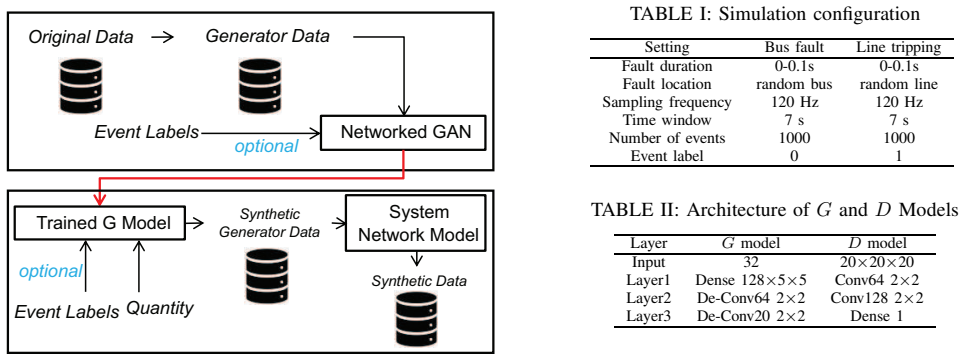
The load-bearing object is the network equation with constant-impedance loads folded into the bus admittance matrix, $[Y]$, together with model reduction to the generator internal buses. This lets the method generate only $n_g$ voltage profiles with one GAN and then reconstruct all $n$ bus voltages and $2m$ branch currents algebraically via Eq. (10). The GAN itself is a conditional convolutional model with gradient-penalty and mode-seeking regularizations that learns the joint distribution of generator-bus voltage profiles.
What would settle it
Take a real power system with PMUs at both generator and non-generator buses, train the GAN on the generator-bus voltages, use Eq. (10) to reconstruct the non-generator voltages, and compare against the actual PMU measurements at those buses; systematic errors larger than measurement noise would show that the constant-impedance recovery does not hold on real data.
Extended reading notes
Core claim
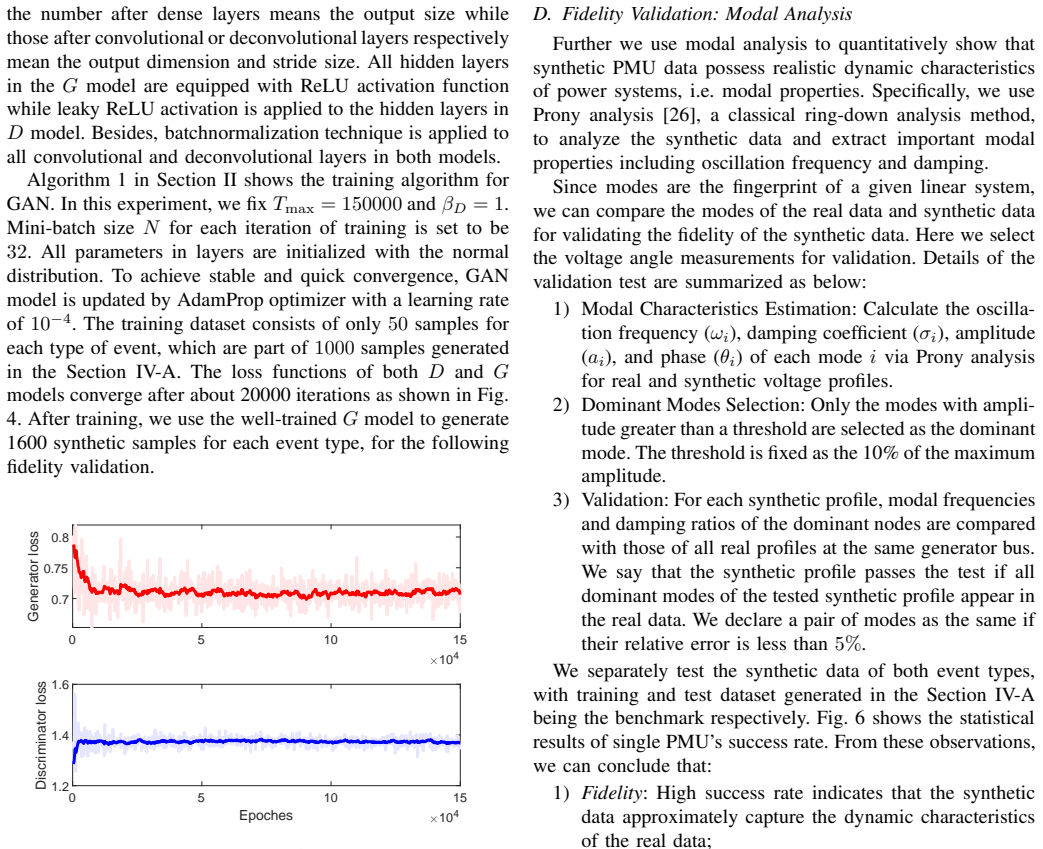
The central discovery is that networked PMU data can be generated in two stages: a conditional GAN learns the joint temporal behavior of generator-bus voltage magnitudes and angles from labeled historical transients, and then a model-based recovery step uses the network equation $I^{inj}=YV$ with a model-reduced admittance matrix to compute every non-generator bus voltage and branch current. Because loads are modeled as constant impedance, load-bus current injections vanish, making the reduced network equation exact and letting the generator-bus voltages determine the whole grid state. The authors claim the resulting synthetic streams preserve the dominant electromechanical modes of the training data, with frequencies and damping ratios within a 5% relative-error tolerance, and that mixed real-plus-synthetic training sets improve binary event classification over real data alone.
Load-bearing premise
The method's real-world value rests on the assumption that simulation data from a 39-bus test system can stand in for real PMU measurements, and that loads behave as constant impedances so that the algebraic recovery in Eq. (10) is exact.
Editorial extensions
If this is right
- Synthetic data produced this way satisfy Kirchhoff's current and voltage laws at every time step by construction, because the recovery step is algebraic.
- The amount of data the GAN must learn is cut from all PMU channels to the number of generator buses, shrinking model size and training cost.
- With only tens of labeled samples per event type, the trained GAN produces hundreds of additional synthetic transients that carry the same dominant oscillation modes.
- Validation via ring-down modal analysis shows that the dominant modes of synthetic transients match those in the real training and test data within a 5% relative-error tolerance.
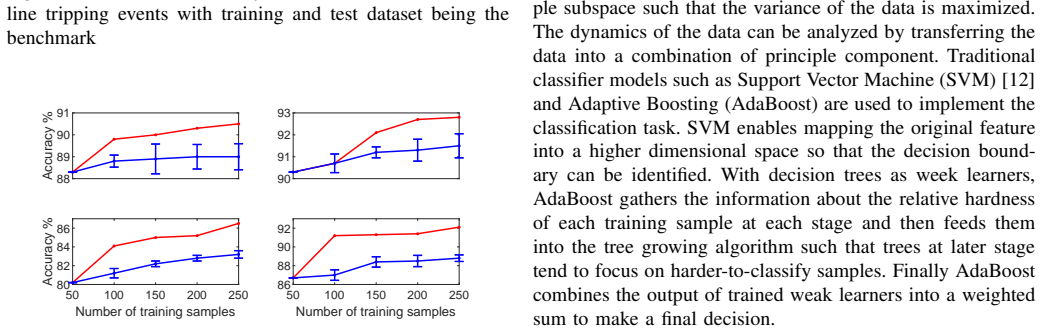
- Augmenting a small real training set with synthetic samples improves event classification accuracy in the paper's SVM and AdaBoost experiments with DWT and PCA features.
Reading between the lines
- If the same two-stage scheme transfers to real PMU recordings, it could let utilities share transient datasets publicly in a form that hides the detailed dynamic model while preserving network-wide consistency.
- The constant-impedance load assumption is the point most likely to break in practice; a natural extension is to replace the fixed admittance matrix with a time-varying one or to learn a correction term for non-constant-impedance loads.
- The same algebraic-recovery trick could apply to other physics-constrained generative tasks, such as synthetic state-estimation or protection-relay datasets, wherever a linear network model links a small set of driving variables to the full state.
- A sharper test than autocorrelation would be to feed synthetic and real transients into an online event diagnosis or a dynamic state estimator and compare downstream decisions, since downstream utility is what the paper ultimately promises.
Signed reviews
Editorial analysis
A structured set of objections, weighed in public.
Referee Report
Summary. The paper proposes a conditional GAN that learns to generate post-fault voltage profiles at generator buses from a limited set of labeled transient PMU records, then uses a known bus admittance matrix and a constant-impedance-load assumption, Eq. (10), to algebraically recover voltages at all non-generator buses and all branch currents, thereby producing a complete network-wide synthetic PMU event. The method is demonstrated on simulated IEEE 39-bus data for bus-fault and line-tripping events. Validation consists of visual and autocorrelation comparisons of generator-bus voltage profiles, Prony-based modal analysis on those profiles, and an event-classification experiment where synthetic samples are added to a small real training set.
Significance. If the central claim holds, the approach addresses a real bottleneck in power-system research: transient PMU data are scarce and confidential, and synthetic data that are both realistic and network-consistent would be broadly useful. The domain-informed reduction from all PMU channels to generator-bus voltage trajectories is a sensible way to reduce the GAN's output dimension, and the Prony-based modal check is a stronger fidelity criterion than pixel-level or purely statistical comparisons. The data-enrichment application is a useful proof-of-concept. However, the paper's headline claim that the reconstructed network-wide data satisfy Kirchhoff's laws is not actually validated on the reconstructed non-generator voltages and currents, and the recovery step rests on an unstated load-model assumption for the simulation data used as ground truth. The method is promising, but the physical-fidelity claim needs substantially more support.
major comments (3)
- [III-B, III-C, IV-A] The Kirchhoff recovery in Eq. (10) is load-bearing for the paper's central claim, but it is never validated against the training data on non-generator buses or branch currents. Equation (10) defines the recovery under the assumption that all loads are constant impedance, so load-bus current injections are zero; however, Section IV-A does not state the load model used in the IEEE 39-bus simulation data that are treated as real data. If the simulator uses constant-power or ZIP loads, the recovered voltages and currents are not the ones produced by the simulator, and the generated "complete synthetic event" would not carry the true system dynamics at those locations. The conclusion in Section V lists non-constant-impedance loads as future work, confirming that this assumption is active rather than incidental. Please state the load model, and if it is not constant impedance, either re-run the training-data generation under that assumption or extend Eq. (10) with nonzero load injections.
- [IV-C, IV-D] The fidelity validations (autocorrelation and Prony analysis) are performed only on the GAN-generated generator-bus voltage profiles; the recovered non-generator voltages and branch currents are never compared with the simulator's ground truth or analyzed by the same metrics. The abstract's claim that the synthetic data reflect "first principles such as Kirchhoff's laws" therefore remains unverified for exactly the quantities that the recovery step is supposed to create. Add at least a comparison of recovered load-bus voltages and branch currents versus simulated ones, and a statistical or modal check on those channels.
- [IV-E, Fig. 7] The event-classification experiment does not include error bars or significance tests, and the reported accuracy differences between real-only and hybrid training sets are small, typically 1-2%. Without an ablation that compares the proposed Kirchhoff-recovered augmentation against generic augmentation (for example, adding noise or GAN output without the recovery step), the improvement cannot be attributed to the physical fidelity of the network-wide data; it may simply reflect an increased training set size. Report variance over repeated runs and include such an ablation.
minor comments (5)
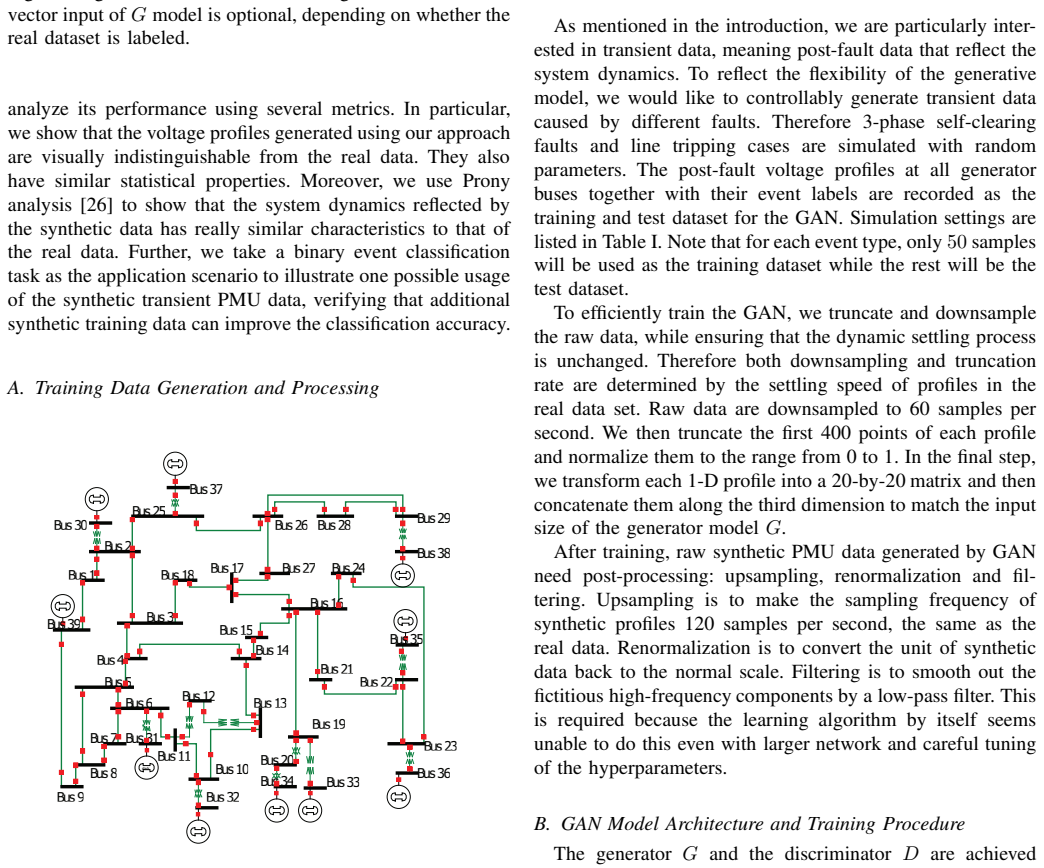
- [IV-A] Section IV-A states that low-pass filtering is required because the GAN cannot suppress high-frequency noise; please quantify the filter's effect on the Prony modes and clarify why the filtered output is still considered a learned representation rather than a partially hand-post-processed one.
- [II-C, Eq. (5)] Equation (5) defines the mode-seeking penalty as a reciprocal discriminator-gradient norm; this does not match the standard mode-seeking regularizer and is not derived in the text. Please provide the correct expression or a reference for this form, and check the sign in Algorithm 1 where it is added to the generator objective.
- [III-C] The statement that "the bus admittance matrix Y is invertible for any operable system" is too strong; a bus admittance matrix can be singular without a solid reference to ground. Recommend replacing this with an explicit invertibility assumption for the systems considered.
- [Fig. 6] Figure 6 does not define the reported success-rate statistic: it is unclear whether the bars are means over generator buses, over synthetic samples, or over both. Define the statistic and add error bars.
- [I-A, Ref. [25]] There are minor typographical issues, including "spario-temporal" in Section I-A and "Wilet" in reference [25]; these should be corrected.
Circularity Check
No circularity: the GAN learns generator-bus voltage profiles from held-out simulated data, and the network-wide recovery uses a known admittance matrix as an input rather than a fitted parameter.
full rationale
The paper's central derivation is not circular. The GAN is trained on historical generator-bus voltage profiles, and the remaining voltages and currents are recovered by solving the known bus admittance matrix equation (10) under the explicitly stated constant-impedance-load assumption. The admittance matrix Y is an input to the generation pipeline, not a parameter fitted to the synthetic data or to the target PMU streams. Kirchhoff's laws are therefore enforced by construction, which is a design feature rather than a circular reduction. The validation is also performed against external benchmarks: the GAN is tested on held-out simulated samples, and modal properties are compared between synthetic and real (simulated) profiles to assess fidelity. The paper's self-citations, such as [8] for single-PMU GAN generation and [28] for PCA-based feature extraction, are background references and are not load-bearing for the main claim. The paper does state a limitation relevant to external validity: 'we take the simulation data as the real data, due to the unavailability of real-world PMU data,' and the conclusion lists 'a more general case with non-constant-impedance loads' as future work. These are modeling and validation concerns, not circularity: they do not make any prediction equivalent to its own input by definition. No fitted parameter is renamed as a prediction, and no uniqueness theorem or ansatz is imported from the authors' prior work to force the result. Therefore the appropriate finding is no significant circularity.
Assumptions & free parameters
free parameters (5)
- Regularization weights beta_G, beta_DD, beta_DG
- Preprocessing downsample rate and truncation length =
60 samples/s; first 400 points
- Low-pass filter cutoff and order
- Prony dominant-mode thresholds =
amplitude threshold 10% of max; mode match within 5% relative error
- GAN minibatch size and learning rate =
32 and 1e-4
assumptions (5)
- domain assumption The bus admittance matrix Y is known, constant, and invertible.
- domain assumption All loads are constant impedance, so load-bus current injections are zero and Kron reduction applies.
- domain assumption Simulated IEEE 39-bus data are a valid proxy for real PMU transient data.
- ad hoc to paper GAN-generated generator-bus voltage profiles correspond to physically realizable generator trajectories.
- standard math The GAN training procedure converges to a distribution close to the training distribution.
Cite this review
Pith. "Pith review of Creation of Synthetic Networked PMU Data: A Generative Adversarial Network Approach." pith.science (2026). https://pith.science/paper/VETYZB4H
@misc{pith2026190808180,
  author       = {Pith},
  title        = {Pith review of: Creation of Synthetic Networked PMU Data: A Generative Adversarial Network Approach},
  year         = {2026},
  howpublished = {\url{https://pith.science/paper/VETYZB4H}},
  note         = {Machine review of arXiv:1908.08180}
}
read the original abstract
This paper introduces a machine learning-based approach to synthetically creating realistic phasor measurement unit (PMU) data streams of multiple transient types. In contrast to the existing literature of transient simulation-based data generation methods, we propose a generative adversarial network (GAN) based approach to learning directly from the historical data and simultaneously reproduce multiple PMU data streams. The synthetic PMU data streams reflect meaningful dynamic characteristics which observe first principles such as Kirchhoff's laws. The efficacy of this approach is demonstrated by numerical studies on the IEEE 39-bus system. We validate the fidelity and flexibility of the synthetic data via statistical resemblance and modal analysis approaches. Finally we illustrate a practical application scenario for the usage of the synthetic PMU data, i.e. leverage the synthetic data to improve the performance of the event classification algorithms.
Figures

Figures from the paper (4 more)


Reference graph
Works this paper leans on
- [8]
-
[1]
K. M. Gegner, A. B. Birchfield, T. Xu, K. S. Shetye, and T. J. Overbye, ”A methodology for the creation of geographically realisti c synthetic power flow models,” in Proc. IEEE Power Energy Conf. Illinois , 2016, pp. 16
work page 2016
-
[2]
A. B. Birchfield, T. Xu and T. J. Overbye, ”Power Flow Conve rgence and Reactive Power Planning in the Creation of Large Synthet ic Grids,” in IEEE Transactions on Power Systems, vol. 33, no. 6, pp. 666 7-6674, Nov. 2018
work page 2018
-
[3]
T. Xu, A. B. Birchfield and T. J. Overbye, ”Modeling, Tunin g, and V alidating System Dynamics in Synthetic Electric Grids,” i n IEEE Transactions on Power Systems, vol. 33, no. 6, pp. 6501-6509 , Nov. 2018
work page 2018
-
[4]
D. J. Watts and S. H. Strogatz, ”Collective dynamics of ’S mall-World’ networks,” Nature, vol. 393, no.6684, pp. 393440, 1998
work page 1998
-
[5]
Z. Wang, R. J. Thomas and A. Scaglione, ”Generating Rando m Topology Power Grids,” Proceedings of the 41st Annual Hawaii Interna tional Conference on System Sciences (HICSS 2008), Waikoloa, HI, 2 008, pp. 183-183
work page 2008
- [6]
-
[7]
Y . Chen, Y . Wang, D. Kirschen and B. Zhang, ”Model-Free Re newable Scenario Generation Using Generative Adversarial Network s,” in IEEE Trans. on Power Systems, vol. 33, no. 3, pp. 3265-3275, May 20 18
Show all 29 references
-
[9]
Ren and Y
C. Ren and Y . Xu, ”A Fully Data-Driven Method based on Gene rative Adversarial Networks for Power System Dynamic Security Ass essment with Missing Data,” in IEEE Trans. on Power Systems, 2019
2019
-
[10]
X. Cao, G. Raman, G. Raman, and J. Peng. ”Generative Adve rsarial Networks for Real-time Stability of Inverter-based System s.” arXiv preprint arXiv:1901.05114 (2019)
2019 arXiv
-
[11]
Zhang and M
Z. Zhang and M. Wu. ”Predicting Real-Time Locational Ma rginal Prices: A GAN-Based Video Prediction Approach.” arXiv prep rint arXiv:2003.09527 (2020)
2020 arXiv
-
[12]
S. Ekici. ”Classification of power system disturbances using support vector machines.” Expert Systems with Applications. vol. 3 6. pp. 9859- 9868, 2009
2009
-
[13]
Goodfellow, J
I. Goodfellow, J. Pouget-Abadie, M. Mirza, B. Xu, D. War de-Farley, S. Ozair, A. Courville, and Y . Bengio, ”Generative adversaria l nets,” Ad- vances in Neural Information Processing Systems, 2014, pp. 26722680
2014
-
[14]
Arjovsky, S
M. Arjovsky, S. Chintala, and L. Bottou. ”Wasserstein g an.” arXiv preprint arXiv:1701.07875 (2017)
2017 arXiv
-
[15]
Arjovsky, S
M. Arjovsky, S. Chintala, and L. Bottou. ”Wasserstein g enerative adver- sarial networks.” In International conference on machine l earning, pp. 214-223. 2017
2017
-
[16]
Gulrajani, F
I. Gulrajani, F. Ahmed, M. Arjovsky, V . Dumoulin, and A. Courville. ”Improved training of wasserstein gans.” In Advances in neu ral infor- mation processing systems, pp. 5767-5777. 2017
2017
-
[17]
Mescheder, G
L. Mescheder, G. Andreas, and N. Sebastian. ”Which trai ning methods for GANs do actually converge?.” arXiv preprint arXiv:1801 .04406 (2018)
2018
-
[18]
Q. Mao, H. Lee, H. Tseng, S. Ma, and M. Y ang. ”Mode seeking gener- ative adversarial networks for diverse image synthesis.” I n Proceedings of the IEEE Conference on Computer Vision and Pattern Recogn ition, pp. 1429-1437. 2019
2019
-
[19]
J. Zhu, T. Park, P . Isola, and A. Efros. ”Unpaired image- to-image translation using cycle-consistent adversarial networks .” In Proceedings of the IEEE international conference on computer vision, pp . 2223-2232. 2017
2017
-
[20]
Y ang, S
L. Y ang, S. Chou, Y . Y ang, ”MidiNet: A Convolutional Gen erative Adversarial Network for Symbolic-domain Music Generation ,” arXiv preprint arXiv:1703.10847, 2017
2017 arXiv
-
[21]
L. Y u, W. Zhang, J. Wang, and Y . Y u. ”Seqgan: Sequence gen erative adversarial nets with policy gradient.” In Thirty-First AA AI Conference on Artificial Intelligence. 2017
2017
-
[22]
R. Fu, J. Chen, S. Zeng, Y . Zhuang, and A. Sudjianto. ”Tim e Series Simulation by Conditional Generative Adversarial Net.” ar Xiv preprint arXiv:1904.11419 (2019)
2019 arXiv
-
[23]
Z. Lin, A. Jain, C. Wang, G. Fanti, and V . Sekar. ”Generat ing High- fidelity, Synthetic Time Series Datasets with DoppelGANger .” arXiv preprint arXiv:1909.13403 (2019)
2019 arXiv
-
[24]
Radford, L
A. Radford, L. Metz, and S. Chintala, ”Unsupervised rep resentation learning with deep convolutional generative adversarial n etworks,” arXiv preprint arXiv:1511.06434, 2015
2015 arXiv
-
[25]
Pai and J
P .Sauer, M. Pai and J. Chow, ”Power System and Dynamic St ability”, Wilet IEEE Press, New Jersey, 2017. pp. 140-170
2017
-
[26]
”Identification of electromechanical modes in power systems.” IEEE Task Force Report, 2012
Formerly TP462. ”Identification of electromechanical modes in power systems.” IEEE Task Force Report, 2012
2012
-
[27]
Kundur, N
P . Kundur, N. Balu, and M. Lauby. Power system stability and control. V ol. 7. New Y ork: McGraw-hill, 1994
1994
-
[28]
L. Xie, Y . Chen and P . R. Kumar, ”Dimensionality Reducti on of Synchrophasor Data for Early Event Detection Linearized An alysis,” IEEE Trans. Power Syst., vol29, no.26, pp. 2784-2794, Nov 20 14
-
[29]
Cai and Y
L. Cai and Y . Zhu. ”The challenges of data quality and dat a quality assessment in the big data era.” Data science journal 14 (201 5)
Reviewed August 14, 2026 · model on record in the stance chip above.
Discussion (0). Continue with ORCID to comment.