REVIEW 4 major objections 3 minor 18 references
Discovery of an Outbursting 12.8 Minute Ultracompact X-Ray Binary
T0 review · 4 major / 3 minor · reviewed 2026-08-14 · deepseek-v4-flash
Pith's one-line read The paper reports that OGLE-UCXB-01, a 12.79-minute variable star in the globular cluster Djorg 2, is an ultracompact X-ray binary in which a neutron star or black hole accretes from a very low-mass companion, with the orbital period…
desk verdict A real and well-observed candidate ultracompact X-ray binary, but the orbital-period claim rests on an unquantified absence of longer periods. read the letter →
The pith
A machine-rendered reading of the paper's core claim, the machinery that carries it, and where it could break.
The reading
What carries the argument
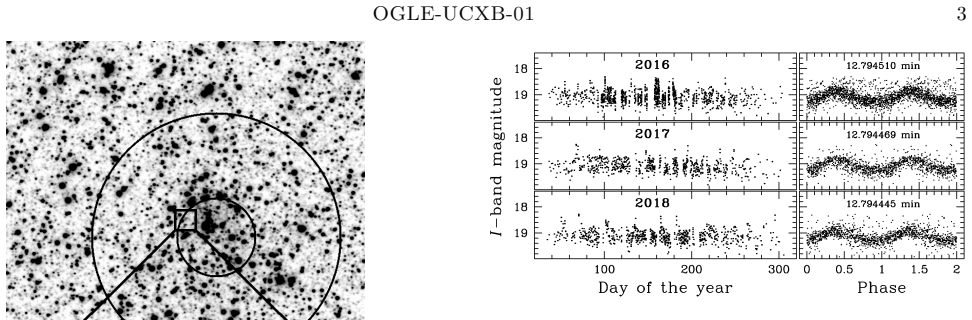
The load-bearing machinery is the 12.79-minute periodic modulation itself, measured across 15 years of OGLE photometry and converted to Barycentric Julian Date to remove Earth-motion aliases. The Fourier/ANOVA analysis (FNPEAKS and TATRY codes) identifies the true period by resolving the 25.59-minute alias. The steady period decrease, $\dot{P} = -9.16(16)\times10^{-11}$ s s$^{-1}$, is the mechanism that ties the object to gravitational-wave emission: an ultracompact binary shrinks as it loses angular momentum to gravitational radiation, and the observed $\dot{P}$ is consistent with that picture. The outbursts and hard X-ray spectrum provide the accretion diagnostics that distinguish a UCXB from a pulsating star or AM CVn system.
What would settle it
A radial-velocity curve of the optical source that shows no Doppler shift at the 12.79-minute period would falsify the orbital interpretation, as would the detection of a second periodicity at a longer period in higher-cadence, higher-resolution photometry that could represent the true orbit.
Extended reading notes
Core claim
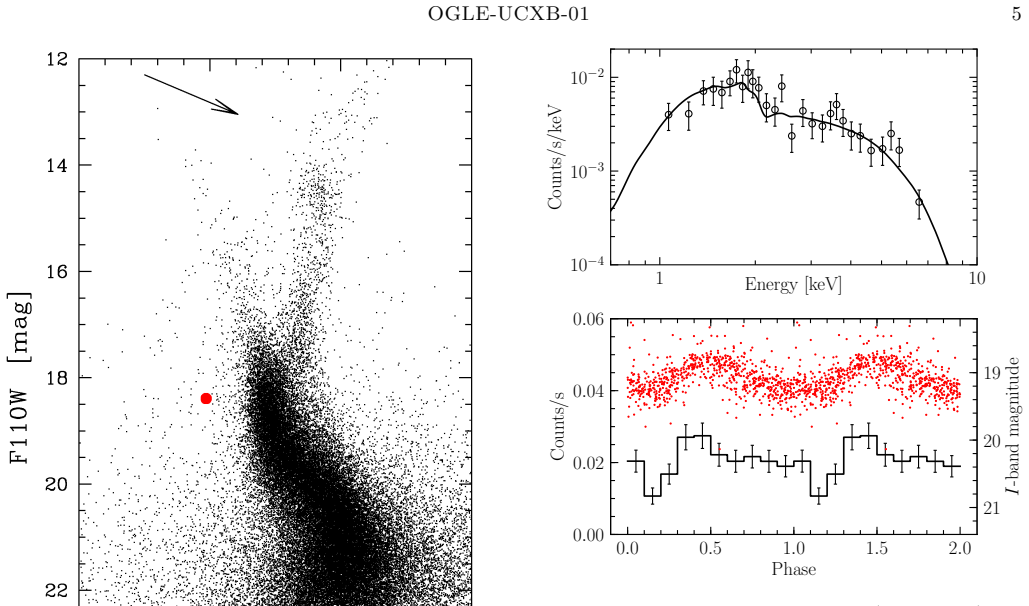
OGLE-UCXB-01 is an ultracompact X-ray binary (UCXB) with an orbital period of $P = 12.79$ minutes, the shortest-period variable ever found in OGLE data. The 12.79-minute optical modulation is accompanied by short outbursts reaching about 1 mag in the I band (likely more than 2 mag once blending is corrected), a blue position in the HST color-magnitude diagram about 0.25 mag blueward of the main-sequence turnoff, and a single Chandra source with an absorbed power-law spectrum of photon index $\Gamma = 1.22 \pm 0.23$ and luminosity $4.4\pm0.5\times10^{33}$ erg s$^{-1}$ at the cluster distance. The period decreases steadily at $\dot{P} = -9.16(16)\times10^{-11}$ s s$^{-1}$ over 2004-2018, and the X-ray and optical signals are phase-correlated with a correlation coefficient of 0.72. The authors conclude that the object cannot be an AM CVn-type cataclysmic variable because its period is below the roughly 20-minute limit for outbursts in those systems and its X-ray spectrum is too hard.
Load-bearing premise
The central assumption is that the 12.79-minute periodicity is the binary orbital period and not the spin period of an accreting neutron star; the paper excludes the spin interpretation only on the grounds that no longer orbital period is seen, which presumes that such a period would have been detected in heavily blended ground-based data.
Editorial extensions
If this is right
- OGLE-UCXB-01 joins a short list of ultracompact X-ray binaries found in globular clusters and is the shortest-period one known from OGLE.
- The measured $\dot{P}$ implies strong gravitational-wave emission in the millihertz band, making the system a verification source for LISA if its distance and cluster membership are confirmed.
- The period below 20 minutes rules out an AM CVn-type white-dwarf accretor, so the primary is most likely a neutron star or black hole.
- If the system belongs to Djorg 2, its luminosity and color are consistent with typical UCXBs, supporting the cluster as a formation site for these binaries.
- The strong X-ray-optical correlation suggests that the accreting region and the optical-emitting region vary together, giving a direct probe of the accretion flow.
Reading between the lines
- If the 12.79-minute signal is the spin of a neutron star rather than the orbit, the absence of any longer periodicity in 15 years of OGLE data would require the orbit to be unusually long or unfavorably inclined; a radial-velocity campaign could separate these cases.
- Continued monitoring should show the period continuing to shrink at a rate consistent with gravitational radiation; any deviation would indicate additional angular-momentum loss mechanisms such as mass loss or magnetic braking.
- The object may probe the AM CVn period gap: if outbursts truly do not occur below 20 minutes in degenerate helium-rich systems, this hard-X-ray source defines a separate population and could revise formation rates of UCXBs in globular clusters.
- A dedicated high-cadence X-ray observation could search for type I X-ray bursts, which, if found, would identify the accretor as a neutron star and measure its spin.
Signed reviews
Editorial analysis
A structured set of objections, weighed in public.
Referee Report
Summary. The paper reports the discovery of a periodic optical variable with a period of about 12.79 minutes, OGLE-UCXB-01, located in the field of the Galactic bulge globular cluster Djorg 2. The variability is identified in long-term OGLE I-band photometry, supported by HST WFC3/IR imaging that resolves the source and shows a blue color, and by a faint Chandra X-ray source with an absorbed power-law spectrum (photon index 1.22). The authors measure a constant period decrease of -9.16(16) x 10^-11 s/s and observe repeated short brightenings lasting hours. They conclude that the object is an ultracompact X-ray binary (UCXB) and a potential strong gravitational-wave source for LISA. The central claim is that the 12.79-minute modulation is the orbital period of the binary, an interpretation the paper attempts to justify by the absence of other periodicities in the OGLE data and by the difficulty of explaining the absence of a longer orbital modulation in a neutron-star spin scenario.
Significance. If the orbital interpretation is correct, OGLE-UCXB-01 would be a valuable addition to the small sample of ultracompact X-ray binaries with a well-measured period derivative, providing constraints on mass transfer and gravitational-wave driven evolution and a candidate verification source for LISA. The paper also demonstrates a productive use of OGLE archival data for discovering sub-hour periodic variables. The analysis includes measured periods with uncertainties, a detected period derivative, and an X-ray spectral fit. The principal weakness is that the paper does not quantitatively exclude the alternative that the 12.79-minute period is the spin period of an accreting neutron star; the arguments given rest on assumed detectability of any longer orbital period in heavily blended, sparsely sampled OGLE data. The X-ray/optical association and phase correlation are also not statistically quantified. The result is significant but the classification is not yet secure.
major comments (4)
- [Section 2 and Section 4] The statement in Section 4 that 'Lack of other periodicities in the long-term OGLE photometry means that the 12.79 minute signal represents the orbital period' is an unsupported inference. The absence of a detected longer period in heavily blended ground-based photometry with 20-min cadence and 100-s exposures does not rule out orbital periods whose modulation is low-amplitude or smeared by the long exposures. The paper should quantify the sensitivity of the OGLE data to longer-period signals (for example, by injection-recovery tests) or explicitly present the orbital interpretation as one of two plausible options rather than the only one.
- [Section 4, spin-period paragraph] The spin interpretation is dismissed too quickly. The claim that a slowly rotating accreting neutron star scenario is 'difficult' because of the absence of a longer orbital modulation is not quantitatively founded. Intermediate polars and many accreting X-ray pulsars show only spin modulation in optical photometry, particularly at low inclination or in crowded fields. The authors should estimate the expected orbital modulation amplitude for a plausible binary configuration and compare it with the detection limits of the OGLE data, or they should explicitly state that the spin-orbit ambiguity remains unresolved.
- [Section 3, X-ray association] The X-ray source is located 0.64 arcsec from the optical position, but the paper does not give the positional uncertainty of the Chandra source nor the probability of chance coincidence within the cluster core. Because the X-ray detection is a key piece of evidence for accretion and for associating the optical variable with the X-ray emitter, this offset should be quantified in terms of the Chandra absolute astrometry and the local density of X-ray sources.
- [Section 3, X-ray/optical correlation] The correlation coefficient of 0.72 between the phased X-ray and optical light curves is reported without an uncertainty or a significance level, and it is derived from only 10 bins. The authors should assess the statistical significance of this correlation and state explicitly whether it can discriminate between an orbital-phase and a spin-phase alignment of the X-ray and optical modulations.
minor comments (3)
- [Section 2, Figure 1 caption] The caption says 'The presented data come from 2017,' but the text and Figure 3 show that the long-term light curves span multiple seasons; please clarify whether the phase-folded light curves in Figure 1 use only 2017 data or the full baseline.
- [Section 3, HST variability paragraph] The sentence 'The observations cover over four variability cycles' is followed by a description of five single images; please specify the number of cycles covered by the F110W and F160W observations separately, and clarify how the exposure times (24-599 s) affect the measured amplitudes.
- [Section 4, last paragraph] The phrase 'the newly detected object requires an optical spectrum' could be interpreted as mandatory follow-up; consider rephrasing to 'would benefit from' to retain the tentative nature of the classification.
Circularity Check
No circularity: the period, period decrease, X-ray flux, and color are independently measured and the UCXB classification rests on external literature benchmarks.
full rationale
The paper's derivation is self-contained. The 12.79-minute period is measured from OGLE photometry with a Fourier search and refined with the TATRY code; the reported period and its uncertainty come from the data, not from the classification. The period decrease rate of -9.16(16) x 10^-11 s/s is fit from phased light curves over 2004-2018 and is an independent observable, not a quantity forced by assuming the object is an ultracompact binary. The hard X-ray detection with photon index 1.22 is obtained from Chandra data and compared with known UCXBs from external references. The blue HST color and the location in a color-magnitude diagram are direct measurements. The classification as a UCXB uses external benchmarks: AM CVn systems do not outburst at periods below about 20 minutes (Solheim 2010; Ramsay et al. 2018) and have softer X-ray spectra (Strohmayer 2004; Ramsay et al. 2006); none of those cited constraints are supplied by the present authors' prior work in a way that would make the conclusion circular. The principal interpretive step, identifying the 12.79-minute modulation as the orbital period rather than a neutron-star spin period, is explicitly discussed and argued from the absence of other periodicities in long-term OGLE data; this is an astrophysical assumption about detectability, not a reduction of the conclusion to its own input. The self-citations in the paper are to the OGLE survey infrastructure and prior variable-star discoveries, and they do not carry the central claim. Therefore the paper exhibits no significant circularity.
Assumptions & free parameters
free parameters (3)
- orbital period derivative dP/dt =
-9.16 +/- 0.16 x 10^-11 s/s
- X-ray photon index Gamma =
1.22 +/- 0.23
- equivalent hydrogen column N_H =
(0.53 +/- 0.20) x 10^22 cm^-2
assumptions (4)
- domain assumption The 12.79-minute optical modulation is the binary orbital period and not the spin period of the accretor.
- domain assumption The Chandra X-ray source 0.64 arcsec from the optical variable is the same object, not a background source.
- domain assumption Distance to Djorg 2 is 8.75 kpc and foreground extinction is AV ~ 2.4 mag, as adopted from Ortolani et al. (2019) and Nataf et al. (2013).
- standard math The Fourier/ANOVA period search and alias identification correctly recover 112.549 c/d as the true frequency.
Cite this review
Pith. "Pith review of Discovery of an Outbursting 12.8 Minute Ultracompact X-Ray Binary." pith.science (2026). https://pith.science/paper/SQ4GVKY6
@misc{pith2026190808186,
  author       = {Pith},
  title        = {Pith review of: Discovery of an Outbursting 12.8 Minute Ultracompact X-Ray Binary},
  year         = {2026},
  howpublished = {\url{https://pith.science/paper/SQ4GVKY6}},
  note         = {Machine review of arXiv:1908.08186}
}
read the original abstract
We report the discovery of OGLE-UCXB-01, a 12.8 minute variable object located in the central field of Galactic bulge globular cluster Djorg 2. The presence of frequent, short-duration brightenings at such an ultrashort period in long-term OGLE photometry together with the blue color of the object in Hubble Space Telescope images and the detection of moderately hard X-rays by Chandra observatory point to an ultracompact X-ray binary system. The observed fast period decrease makes the system a particularly interesting target for gravitational-wave detectors such as the planned Laser Interferometer Space Antenna.
Figures


Figures from the paper (3 more)


Reference graph
Works this paper leans on
-
[1]
Alard, C., & Lupton, R. H. 1998, ApJ, 503, 325
1998
-
[2]
Dolphin, A. E. 2000, PASP, 112, 1383
2000
- [3]
-
[4]
Fruscione, A., McDowell, J. C., Allen, G. E., et al. 2006 Proc. SPIE, 6270, 1V
work page 2006
-
[5]
Harris, W. E. 1996, AJ, 112, 1487 Mr´ oz, P., Udalski, A., Poleski, R., et al. 2015, AcA, 65, 313
work page 1996
-
[6]
M., Gould, A., Fouqu´ e, P., et al
Nataf, D. M., Gould, A., Fouqu´ e, P., et al. 2013, ApJ, 769, 88
2013
-
[7]
Nataf, D. M. 2015, MNRAS, 449, 1171
work page 2015
-
[8]
Nelemans, G., & Jonker, P. G. 2010, New Astronomy Reviews, 54, 87
work page 2010
Show all 18 references
-
[9]
V., Nardiello, D., et al
Ortolani, S., Held, E. V., Nardiello, D., et al. 2019, A&A, 627, A145
2019
-
[10]
A., Latour, M., et al
Pietrukowicz, P., Dziembowski, W. A., Latour, M., et al. 2017, NatAs, 1, 166
2017
-
[11]
J., Marsh, T., et al
Ramsay, G., Groot, P. J., Marsh, T., et al. 2006, A&A, 457, 623
2006
-
[12]
J., Marsh, T
Ramsay, G., Green, M. J., Marsh, T. R., et al. 2018, A&A, 620, A141
2018
-
[13]
1996, ApJL, 460, 107
Schwarzenberg-Czerny, A. 1996, ApJL, 460, 107
1996
-
[14]
2010, PASP, 122, 1133 Soszy´ nski, I., Udalski, A., Szyma´ nski, M
Solheim, J.-E. 2010, PASP, 122, 1133 Soszy´ nski, I., Udalski, A., Szyma´ nski, M. K., et al. 2014, AcA, 64, 177 Soszy´ nski, I., Udalski, A., Szyma´ nski, M. K., et al. 2015, AcA, 65, 297
2010
-
[15]
E., & Priedhorsky, W
Stella, L., White, N. E., & Priedhorsky, W. 1987, ApJL, 315, 49
1987
-
[16]
Strohmayer, T. E. 2004, ApJ, 614, 358
2004
-
[17]
K., Soszy´ nski, I., & Poleski, R
Udalski, A., Szyma´ nski, M. K., Soszy´ nski, I., & Poleski, R. 2008, AcA, 58, 69
2008
-
[18]
K., & Szyma´ nski, G
Udalski, A., Szyma´ nski, M. K., & Szyma´ nski, G. 2015, AcA, 65, 1 Wo´ zniak, P. R. 2000, AcA, 50, 421
2015
Reviewed August 14, 2026 · model on record in the stance chip above.
Discussion (0). Continue with ORCID to comment.