REVIEW 3 major objections 5 minor 38 references
Outgroup Homogeneity Bias Causes Ingroup Favoritism
T0 review · 3 major / 5 minor · reviewed 2026-08-14 · deepseek-v4-flash
Pith's one-line read The paper claims that outgroup homogeneity bias alone is sufficient to produce ingroup favoritism between arbitrary groups in a prisoner's dilemma, without intergroup conflict or meaningful group tags.
desk verdict A clean sufficiency result showing outgroup homogeneity can cause ingroup favoritism via direct reciprocity, but the extreme operationalization needs a robustness check. read the letter →
The pith
A machine-rendered reading of the paper's core claim, the machinery that carries it, and where it could break.
The reading
What carries the argument
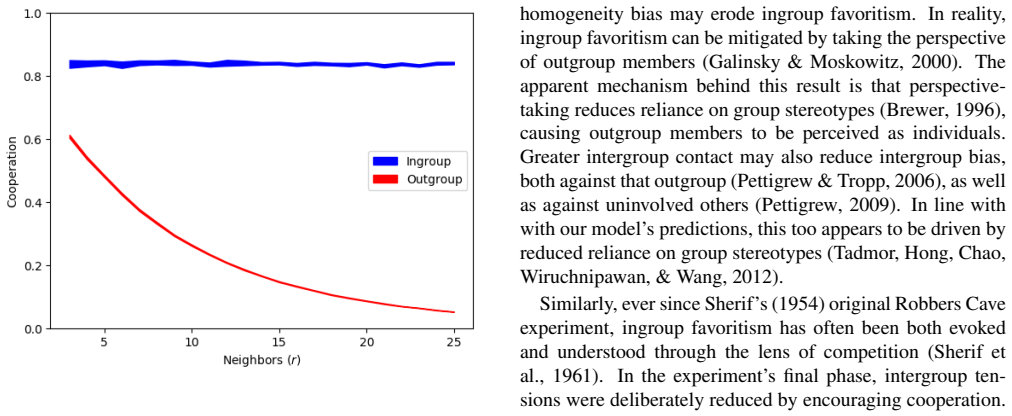
The engine is the pair of Bayesian estimates $p_i$ and $q_i$ for each partner $i$—the probability partner $i$ cooperates conditional on the learner cooperating versus defecting—updated by counts of past outcomes through the posterior-mean rule in Equation 1. Outgroup homogeneity is implemented by replacing the individual $p_i$ and $q_i$ with a single pair $p_j$ and $q_j$ for each outgroup $j$, so all outgroup members share one reputation. The action rule is the rational inequality $pb - c > qb$: cooperate when expected utility of cooperating exceeds that of defecting. These estimates operate on a random $r$-regular graph, where every individual has exactly $r$ neighbors, producing repeated interactions that make cooperation possible. The active mechanism is the cascade: one outgroup defection lowers the shared outgroup estimate, the learner retaliates against the whole group, and the recipients, who did not defect, retaliate back, spreading defection through the network.
What would settle it
Run the same simulation with partial pooling: give each outgroup member an individual estimate that is combined with the group estimate via a weight $w$ from 0 to 1, where $w=0$ is the paper's full homogeneity and $w=1$ is individual tracking. If the ingroup–outgroup cooperation gap falls smoothly to zero as $w$ approaches 1, compare the value of $w$ at which the gap drops below, say, 5 percentage points; a high threshold would falsify the strong causal claim, while a low threshold would support it.
Extended reading notes
Core claim
The central discovery is that ingroup favoritism is not a separate preference but an emergent consequence of rational Bayesian learning under a perceptual constraint. When a learner treats an outgroup as a single entity, a defection by one outgroup member lowers the estimated cooperativeness of every member of that group. The learner then defects against the whole group, and those partners defect back, so a single broken interaction escalates into a cascade of mutual defection that makes outgroup cooperation unsustainable. Ingroup cooperation, by contrast, is attributed to individuals, so a defection only lowers that one partner's estimate and can be repaired by future cooperation. The model's decision rule is simple: cooperate if $pb - c > qb$, where $p$ and $q$ are the estimated probabilities of the partner cooperating given cooperation or defection by the learner.
Load-bearing premise
Everything depends on outgroup homogeneity being absolute: an interaction with one outgroup member updates a single group-wide estimate, so one defection tarnishes the whole group.
Editorial extensions
If this is right
- Ingroup favoritism needs no evolved preference or intergroup competition; a minimal cognitive bias plus reinforcement learning can generate it in any arbitrary grouping.
- Reducing reliance on group stereotypes—for example by making people see outgroup members as individuals—should reduce favoritism, consistent with perspective-taking findings.
- Raising the payoff for mutual cooperation relative to exploiting a cooperator should shrink the ingroup–outgroup cooperation gap.
- Increasing diversity (more groups) and limiting the number of outgroup neighbors each person interacts with should dampen the defect-cascade and reduce bias.
- Because the model has no selection over genotypes, the bias is a phenotype of learning, meaning it can appear and disappear quickly with context.
Reading between the lines
- The paper's binary treatment of homogeneity suggests a testable continuum: one could parameterize partial homogeneity, where each outgroup member keeps an individual estimate partly pooled with the group estimate, and look for a threshold below which favoritism vanishes.
- The cascade mechanism predicts a novel signature: punishment spillover. In a lab minimal-group setting, a participant who experiences defection by one outgroup member should retaliate against an innocent outgroup member if and only if they perceive outgroup members as interchangeable.
- If homogeneity is the cause, interventions that individuate outgroup members—unique names, faces, or histories—should reduce favoritism as effectively as changing payoff structures; the model gives a precise reason to expect such an effect.
- The model's diversity result might generalize to real-world contact effects: diversity reduces bias not by changing attitudes but by making group-level reputations less informative.
Signed reviews
Editorial analysis
A structured set of objections, weighed in public.
Referee Report
Summary. The paper proposes an agent-based model in which individuals play a repeated prisoner's dilemma on a random regular graph, learn each partner's probability of cooperating via Bayesian inference, and choose actions to maximize conditional expected utility. When individuals exhibit outgroup homogeneity bias, they track a single pair of estimated cooperation parameters for each outgroup rather than for individual outgroup members. Simulations show that this group-level tracking causes outgroup cooperation rates to collapse while ingroup cooperation persists, producing ingroup favoritism between arbitrary groups. The authors then examine how the benefit-to-cost ratio, the number of groups, and the neighborhood size mitigate this outcome. The central claim is that outgroup homogeneity bias alone is sufficient to generate ingroup favoritism through direct reciprocity, without selection, intergroup conflict, or information-sharing rules.
Significance. If the result is robust, the paper offers a minimal and elegant cognitive mechanism for ingroup favoritism: a well-documented perceptual bias, implemented as a simple information-processing constraint, produces a behavioral asymmetry between groups that are arbitrary and functionally irrelevant. The model's strengths are its simplicity, its use of standard Bayesian learning, and the intuitive connection of the mitigation results to established empirical findings on perspective-taking, intergroup contact, and cooperation incentives. The simulations are clearly described and the results are visually transparent. However, the significance is bounded by the paper's dependence on an extreme operationalization of outgroup homogeneity and by the absence of any formal or sensitivity analysis establishing that the effect is not an artifact of that operationalization.
major comments (3)
- [Model, Rational Bayesian Learning] The paper equates outgroup homogeneity bias with complete group-level aggregation: individuals tracking a single pair (p_j, q_j) for each outgroup. This is the strongest possible form of the bias, and the cascade mechanism described in Results (Figure 2) depends entirely on one defection lowering the entire group's estimated cooperativeness. The authors never test whether a partial or graded form of the bias, such as agents who use individual-level estimates with probability lambda and group-level estimates with probability 1-lambda, or who shrink individual estimates toward the group mean, still produces ingroup favoritism. Since the title and abstract make a causal claim about outgroup homogeneity in general, and the Discussion itself treats stereotype reduction as a matter of degree, the absence of any sensitivity analysis over the strength of the bias is load-bearing. The authors should add simulations with a continuum of bias intensities and report whether the effect persists at moderate levels.
- [Results, Figures 2-5] The central claim that 'outgroup homogeneity causes ingroup favoritism' rests entirely on simulation for a single default parameter set (b=3, c=1, r=10, m=2, epsilon=0.01) and on a verbal narrative about cascades of retributive defections. No stability analysis, mean-field approximation, or formal characterization of equilibrium behavior is provided, so the reader cannot assess whether the observed outcome is a generic property of the learning dynamics or a fragile outcome dependent on the particular parameters and initial conditions. The paper should either provide an analytical argument for the cascade mechanism or, at minimum, a phase diagram over the key parameters (b/c, m, r, epsilon) showing the regions in which ingroup favoritism emerges. Without this, the strength of the causal wording in the title exceeds the evidence presented.
- [Results, Figures 1-2] The paper reports only averaged cooperation rates and 95% confidence intervals across 20 runs. It does not report the distribution of outcomes across runs, so it is possible that the reported averages conceal multimodality, such as some runs reaching global cooperation, some reaching global defection, and only a fraction exhibiting ingroup favoritism. Because the proposed mechanism relies on cascades, which are inherently nonlinear and path-dependent, the fraction of runs that actually exhibit ingroup favoritism is directly relevant to the robustness of the claim. The authors should report, for each condition, the proportion of simulation runs in which ingroup cooperation exceeds outgroup cooperation by a meaningful margin, rather than only the mean rates.
minor comments (5)
- [Model, Eq. (1)] Equation (1) contains an internal inconsistency: the text states that pseudocounts take the value alpha=beta=0, representing a uniform prior, but the formula includes +1 in the numerator and +2 in the denominator. In a standard Beta-Binomial posterior mean, a uniform prior corresponds to Beta(1,1), which would make the +1/+2 terms necessary, but then alpha and beta are not the Beta concentration parameters. Please clarify whether alpha and beta are offsets from a Beta(1,1) prior or redefine the notation so that the stated values match the formula.
- [Model, Simulation] The paper states that 'Removing this parameter (setting epsilon=0) does not qualitatively alter our results' but provides no supporting figure or analysis. Since the trembling-hand parameter is central to the exploration of both actions, this claim should be substantiated or removed.
- [Discussion] There is a typo in the Discussion: 'In line with with our model's predictions' should read 'In line with our model's predictions'.
- [General] The paper does not mention whether the simulation code is publicly available. Given the emphasis on computational results, providing the code would improve reproducibility and allow readers to test alternative operationalizations of outgroup homogeneity.
- [References] The reference to Bollobás (2001) contains a DOI that appears to belong to a different article; please verify the citation details.
Circularity Check
No significant circularity: the ingroup-favoritism result is not stated in the model assumptions and emerges from simulation.
full rationale
The paper's central claim is that Bayes-rational agents with outgroup homogeneity bias develop ingroup favoritism under direct reciprocity. The key assumption is that biased agents track one (p_j, q_j) pair per outgroup instead of per individual (Model, Rational Bayesian Learning, Eq. 1). This is a formalization of the psychological bias, not a restatement of the target result. The decision rule (Eq. 2) is the standard expected-utility threshold; it contains no ingroup-favoritism term. The differential cooperation rates in Figures 2-5 are not specified in advance but arise from the repeated-interaction dynamics: a group-level estimate spreads blame from one defector to the whole outgroup, and the resulting retaliation cascades are emergent. There is no equation in which the ingroup/outgroup cooperation gap is set equal to the tracking rule, no fitted parameter is later presented as a prediction, and no self-citation is used to justify the core mechanism. The concern that a softer, partial form of the bias was not tested is a robustness/external-validity limitation, not a circularity of the derivation. Therefore the paper's derivation chain is self-contained relative to its stated assumptions.
Assumptions & free parameters
free parameters (7)
- b/c ratio =
3 (default; swept)
- number of groups m =
2 (default; swept)
- neighborhood degree r =
10 (default; swept)
- trembling-hand probability epsilon =
0.01
- population size N =
1000
- replacement probability =
0.01
- pseudocounts alpha, beta =
0
assumptions (6)
- domain assumption Agents are expected utility maximizers with Bayesian posterior-mean estimates (Eq. 1 and Inequality 2)
- ad hoc to paper Outgroup homogeneity bias is equivalent to tracking a single pair of Bayesian parameters per outgroup (Model, Rational Bayesian Learning)
- domain assumption Group tags are arbitrary and uncorrelated with behavior
- domain assumption Uniform prior over cooperation probabilities
- standard math Random regular graph interaction structure
- domain assumption Replacement assigns new tags uniformly at random and resets learning
Cite this review
Pith. "Pith review of Outgroup Homogeneity Bias Causes Ingroup Favoritism." pith.science (2026). https://pith.science/paper/NCNRSYQ3
@misc{pith2026190808203,
  author       = {Pith},
  title        = {Pith review of: Outgroup Homogeneity Bias Causes Ingroup Favoritism},
  year         = {2026},
  howpublished = {\url{https://pith.science/paper/NCNRSYQ3}},
  note         = {Machine review of arXiv:1908.08203}
}
read the original abstract
Ingroup favoritism, the tendency to favor ingroup over outgroup, is often explained as a product of intergroup conflict, or correlations between group tags and behavior. Such accounts assume that group membership is meaningful, whereas human data show that ingroup favoritism occurs even when it confers no advantage and groups are transparently arbitrary. Another possibility is that ingroup favoritism arises due to perceptual biases like outgroup homogeneity, the tendency for humans to have greater difficulty distinguishing outgroup members than ingroup ones. We present a prisoner's dilemma model, where individuals use Bayesian inference to learn how likely others are to cooperate, and then act rationally to maximize expected utility. We show that, when such individuals exhibit outgroup homogeneity bias, ingroup favoritism between arbitrary groups arises through direct reciprocity. However, this outcome may be mitigated by: (1) raising the benefits of cooperation, (2) increasing population diversity, and (3) imposing a more restrictive social structure.
Figures


Reference graph
Works this paper leans on
-
[1]
Balliet2014 APACrefauthors Balliet, D. , Wu, J. \ De Dreu , C K W. APACrefauthors \ 2014 . Ingroup favoritism in cooperation: A meta-analysis. Ingroup favoritism in cooperation: A meta-analysis. Psychological Bulletin 140 6 1556--1581 . APACrefDOI doi:10.1037/a0037737 APACrefDOI
-
[2]
Berger2007 APACrefauthors Berger, U. APACrefauthors \ 2007 . Brown's original fictitious play Brown's original fictitious play . Journal of Economic Theory . APACrefDOI doi:10.1016/j.jet.2005.12.010 APACrefDOI
-
[3]
Bernhard2006 APACrefauthors Bernhard, H. , Fischbacher, U. \ Fehr, E. APACrefauthors \ 2006 . Parochial altruism in humans Parochial altruism in humans . Nature 442 7105 912--915 . APACrefDOI doi:10.1038/nature04981 APACrefDOI
-
[4]
Billig1973 APACrefauthors Billig, M. \ Tajfel, H. APACrefauthors \ 1973 . Social categorization and similarity in intergroup behaviour Social categorization and similarity in intergroup behaviour . European Journal of Social Psychology 3 1 27--52 . APACrefDOI doi:10.1002/ejsp.2420030103 APACrefDOI
-
[5]
Bollobas2001 APACrefauthors Bollob \' a s, B. APACrefauthors \ 2001 . Random Graphs Random Graphs . October 30 4 1--3 . APACrefDOI doi:10.1214/aoms/1177706098 APACrefDOI
arXiv 2001
-
[6]
Brewer1979 APACrefauthors Brewer, M B. APACrefauthors \ 1979 . In-group bias in the minimal intergroup situation: A cognitive-motivational analysis In-group bias in the minimal intergroup situation: A cognitive-motivational analysis . Psychological Bulletin 86 2 307--324 . APACrefDOI doi:10.1037/0033-2909.86.2.307 APACrefDOI
-
[7]
Brewer1996 APACrefauthors Brewer, M B. APACrefauthors \ 1996 . When stereotypes lead to stereotyping: The use of stereotypes in person perception When stereotypes lead to stereotyping: The use of stereotypes in person perception . Stereotypes and stereotyping 162 254--275
work page 1996
-
[8]
Brewer2008 APACrefauthors Brewer, M B. APACrefauthors \ 2008 . Depersonalized trust and ingroup cooperation Depersonalized trust and ingroup cooperation . Rationality and Social Responsibility: Essays in Honor of Robyn Mason Dawes Rationality and social responsibility: Essays in honor of robyn mason dawes \ ( \ 215--232). APACrefDOI doi:10.4324/9780203889...
Show all 38 references
-
[9]
\ Bowles, S
Choi2007 APACrefauthors Choi, J K. \ Bowles, S. APACrefauthors \ 2007 . The coevolution of parochial altruism and war The coevolution of parochial altruism and war . Science 318 5850 636--640 . APACrefDOI doi:10.1126/science.1144237 APACrefDOI
2007 doi
-
[10]
, Gl \" o ckner, A
Dorrough2015 APACrefauthors Dorrough, A R. , Gl \" o ckner, A. , Hellmann, D M. \ Ebert, I. APACrefauthors \ 2015 . The development of ingroup favoritism in repeated social dilemmas The development of ingroup favoritism in repeated social dilemmas . Frontiers in Psychology 6 A...
2015
-
[11]
, Lalive, R
EffersonLalive2008 APACrefauthors Efferson, C. , Lalive, R. \ Fehr, E. APACrefauthors \ 2008 . The Coevolution of Cultural Groups and Ingroup Favoritism The Coevolution of Cultural Groups and Ingroup Favoritism . Science 321 5897 1844--1849 . APACrefDOI doi:10.1126/science.115...
2008 doi
-
[12]
, Faber, N S
Everett2015 APACrefauthors Everett, J A C. , Faber, N S. \ Crockett, M. APACrefauthors \ 2015 . Preferences and beliefs in ingroup favoritism Preferences and beliefs in ingroup favoritism . Frontiers in Behavioral Neuroscience 9 . APACrefDOI doi:10.3389/fnbeh.2015.00015 APACrefDOI
2015
-
[13]
, Tarnita, C E
Fu2012 APACrefauthors Fu, F. , Tarnita, C E. , Christakis, N A. , Wang, L. , Rand, D G. \ Nowak, M A. APACrefauthors \ 2012 . Evolution of in-group favoritism Evolution of in-group favoritism . Scientific Reports 2 . APACrefDOI doi:10.1038/srep00460 APACrefDOI
2012 doi
-
[14]
\ Moskowitz, G B
Galinsky2000 APACrefauthors Galinsky, A D. \ Moskowitz, G B. APACrefauthors \ 2000 . Perspective-taking: Decreasing stereotype expression, stereotype accessibility, and in-group favoritism. Perspective-taking: Decreasing stereotype expression, stereotype accessibility, and in-...
2000 doi
-
[15]
\ van den Bergh, J C
Garcia2011 APACrefauthors Garc \' i a, J. \ van den Bergh, J C. APACrefauthors \ 2011 . Evolution of parochial altruism by multilevel selection Evolution of parochial altruism by multilevel selection . Evolution and Human Behavior 32 4 277--287 . APACrefDOI doi:10.1016/j.evolh...
2011 doi
-
[16]
Us and Them
Gray2014 APACrefauthors Gray, K. , Rand, D G. , Ert, E. , Lewis, K. , Hershman, S. \ Norton, M I. APACrefauthors \ 2014 . The Emergence of "Us and Them" in 80 Lines of Code: Modeling Group Genesis in Homogeneous Populations The Emergence of "Us and Them" in 80 Lines of Code: M...
2014 doi
-
[17]
, Kalish, M L
Griffiths2008 APACrefauthors Griffiths, T L. , Kalish, M L. \ Lewandowsky, S. APACrefauthors \ 2008 nov . Review. Theoretical and empirical evidence for the impact of inductive biases on cultural evolution. Review. Theoretical and empirical evidence for the impact of inductive...
2008
-
[18]
, Lolliot, S
Hewstone2014 APACrefauthors Hewstone, M. , Lolliot, S. , Swart, H. , Myers, E. , Voci, A. , Ramiah, A A. \ Cairns, E. APACrefauthors \ 2014 . Intergroup contact and intergroup conflict Intergroup contact and intergroup conflict . Peace and Conflict . APACrefDOI doi:10.1037/a00...
2014 doi
-
[19]
\ van Baalen, M
Jansen2006 APACrefauthors Jansen, V A A. \ van Baalen, M. APACrefauthors \ 2006 mar . Altruism through beard chromodynamics Altruism through beard chromodynamics . Nature 440 7084 663--666 . APACrefDOI doi:10.1038/nature04387 APACrefDOI
2006 doi
-
[20]
APACrefauthors \ 1990
Jeffrey1990 APACrefauthors Jeffrey, R C. APACrefauthors \ 1990 . The logic of decision The logic of decision . University of Chicago Press
1990
-
[21]
\ Park, B
Judd1988 APACrefauthors Judd, C M. \ Park, B. APACrefauthors \ 1988 . Out-Group Homogeneity: Judgments of Variability at the Individual and Group Levels Out-Group Homogeneity: Judgments of Variability at the Individual and Group Levels . Journal of Personality and Social Psych...
1988 doi
-
[22]
\ Morath, F
Konrad2012 APACrefauthors Konrad, K A. \ Morath, F. APACrefauthors \ 2012 . Evolutionarily stable in-group favoritism and out-group spite in intergroup conflict Evolutionarily stable in-group favoritism and out-group spite in intergroup conflict . Journal of Theoretical Biolog...
2012 doi
-
[23]
, Ortiz, V
Locksley1980 APACrefauthors Locksley, A. , Ortiz, V. \ Hepburn, C. APACrefauthors \ 1980 . Social categorization and discriminatory behavior: Extinguishing the minimal intergroup discrimination effect. Social categorization and discriminatory behavior: Extinguishing the minima...
1980 doi
-
[24]
APACrefauthors \ 2012
Masuda2012 APACrefauthors Masuda, N. APACrefauthors \ 2012 . Ingroup favoritism and intergroup cooperation under indirect reciprocity based on group reputation Ingroup favoritism and intergroup cooperation under indirect reciprocity based on group reputation . Journal of Theor...
2012 doi
-
[25]
\ Ohtsuki, H
Masuda2007 APACrefauthors Masuda, N. \ Ohtsuki, H. APACrefauthors \ 2007 . Tag-based indirect reciprocity by incomplete social information Tag-based indirect reciprocity by incomplete social information . Proceedings of the Royal Society B: Biological Sciences 274 1610 689--69...
2007
-
[26]
\ Masuda, N
Nakamura2012 APACrefauthors Nakamura, M. \ Masuda, N. APACrefauthors \ 2012 . Groupwise information sharing promotes ingroup favoritism in indirect reciprocity Groupwise information sharing promotes ingroup favoritism in indirect reciprocity . BMC Evolutionary Biology 12 1 213...
2012 doi
-
[27]
APACrefauthors \ 2009
Pettigrew2009 APACrefauthors Pettigrew, T F. APACrefauthors \ 2009 . Secondary transfer effect of contact: Do intergroup contact effects spread to noncontacted outgroups? Secondary transfer effect of contact: Do intergroup contact effects spread to noncontacted outgroups? Soci...
2009 doi
-
[28]
\ Tropp, L R
Pettigrew2006 APACrefauthors Pettigrew, T F. \ Tropp, L R. APACrefauthors \ 2006 . A meta-analytic test of intergroup contact theory A meta-analytic test of intergroup contact theory . Journal of Personality and Social Psychology . APACrefDOI doi:10.1037/0022-3514.90.5.751 APACrefDOI
2006 doi
-
[29]
, Pfeiffer, T
Rand2009 APACrefauthors Rand, D G. , Pfeiffer, T. , Dreber, A. , Sheketoff, R W. , Wernerfelt, N C. \ Benkler, Y. APACrefauthors \ 2009 . Dynamic remodeling of in-group bias during the 2008 presidential election Dynamic remodeling of in-group bias during the 2008 presidential ...
2009 doi
-
[30]
APACrefauthors \ 1975 mar
Selten1975 APACrefauthors Selten, R. APACrefauthors \ 1975 mar . Reexamination of the perfectness concept for equilibrium points in extensive games Reexamination of the perfectness concept for equilibrium points in extensive games . International Journal of Game Theory 4 1 25-...
1975 doi
-
[31]
, Harvey, O
Sherif1961 APACrefauthors Sherif, M. , Harvey, O. , White, B J. , Hood, W R. , Sherif, C W. \ Muzafer Sherif, O. J. Harvey, B. Jack White, William R. Hood , C W S. APACrefauthors \ 1961 . Intergroup Conflict and Cooperation: The Robbers Cave Experiment . Intergroup Conflict an...
1961 doi
-
[32]
, Harvey, O J
Sherif1954 APACrefauthors Sherif, M. , Harvey, O J. \ Hood, W R. APACrefauthors \ 1954 . The Robbers Cave Experiment . The Robbers Cave Experiment . APACrefDOI doi:10.4135/9781412963879.n482 APACrefDOI
1954 doi
-
[33]
\ Wormald, N C
Steger1999 APACrefauthors Steger, A. \ Wormald, N C. APACrefauthors \ 1999 . Generating Random Regular Graphs Quickly Generating Random Regular Graphs Quickly . Combinatorics Probability and Computing . APACrefDOI doi:10.1017/S0963548399003867 APACrefDOI
1999 doi
-
[34]
\ F \' a th, G
Szabo2007 APACrefauthors Szab \' o , G. \ F \' a th, G. APACrefauthors \ 2007 . Evolutionary games on graphs Evolutionary games on graphs . Physics Reports 446 4-6 97--216 . APACrefDOI doi:10.1016/j.physrep.2007.04.004 APACrefDOI
2007 doi
-
[35]
, Hong, Y Y
Tadmor2012 APACrefauthors Tadmor, C T. , Hong, Y Y. , Chao, M M. , Wiruchnipawan, F. \ Wang, W. APACrefauthors \ 2012 . Multicultural experiences reduce intergroup bias through epistemic unfreezing Multicultural experiences reduce intergroup bias through epistemic unfreezing ....
2012 doi
-
[36]
, Billig, M G
Tajfel1971 APACrefauthors Tajfel, H. , Billig, M G. , Bundy, R P. \ Flament, C. APACrefauthors \ 1971 . Social categorization and intergroup behaviour Social categorization and intergroup behaviour . European Journal of Social Psychology 1 2 149--178 . APACrefDOI doi:10.1002/e...
1971 doi
-
[37]
APACrefauthors \ 2008
Traulsen2008 APACrefauthors Traulsen, A. APACrefauthors \ 2008 . Mechanisms for similarity based cooperation Mechanisms for similarity based cooperation . European Physical Journal B 63 3 363--371 . APACrefDOI doi:10.1140/epjb/e2008-00031-3 APACrefDOI
2008 doi
-
[38]
, Jin, N
Yamagishi1999 APACrefauthors Yamagishi, T. , Jin, N. \ Kiyonari, T. APACrefauthors \ 1999 . Bounded generalized reciprocity: Ingroup boasting and ingroup favoritism Bounded generalized reciprocity: Ingroup boasting and ingroup favoritism \ ( 16)\ ( 16)
1999
Reviewed August 14, 2026 · model on record in the stance chip above.
Discussion (0). Continue with ORCID to comment.