REVIEW 3 major objections 5 minor 1 cited by
Operation of ILC250 at the Z-pole
T0 review · 3 major / 5 minor · reviewed 2026-08-14 · deepseek-v4-flash
Pith's one-line read The ILC250 can run at the Z-pole at 2.1×10$^{33}$ cm$^{-2}$ s$^{-1}$, beating the old scaling estimate despite a lower repetition rate.
desk verdict A credible, honestly-caveated parameter set for ILC at Z-pole, with one genuinely untested assumption about undulator wakefields that should be addressed before the luminosity is quoted as a prediction. read the letter →
The pith
A machine-rendered reading of the paper's core claim, the machinery that carries it, and where it could break.
The reading
What carries the argument
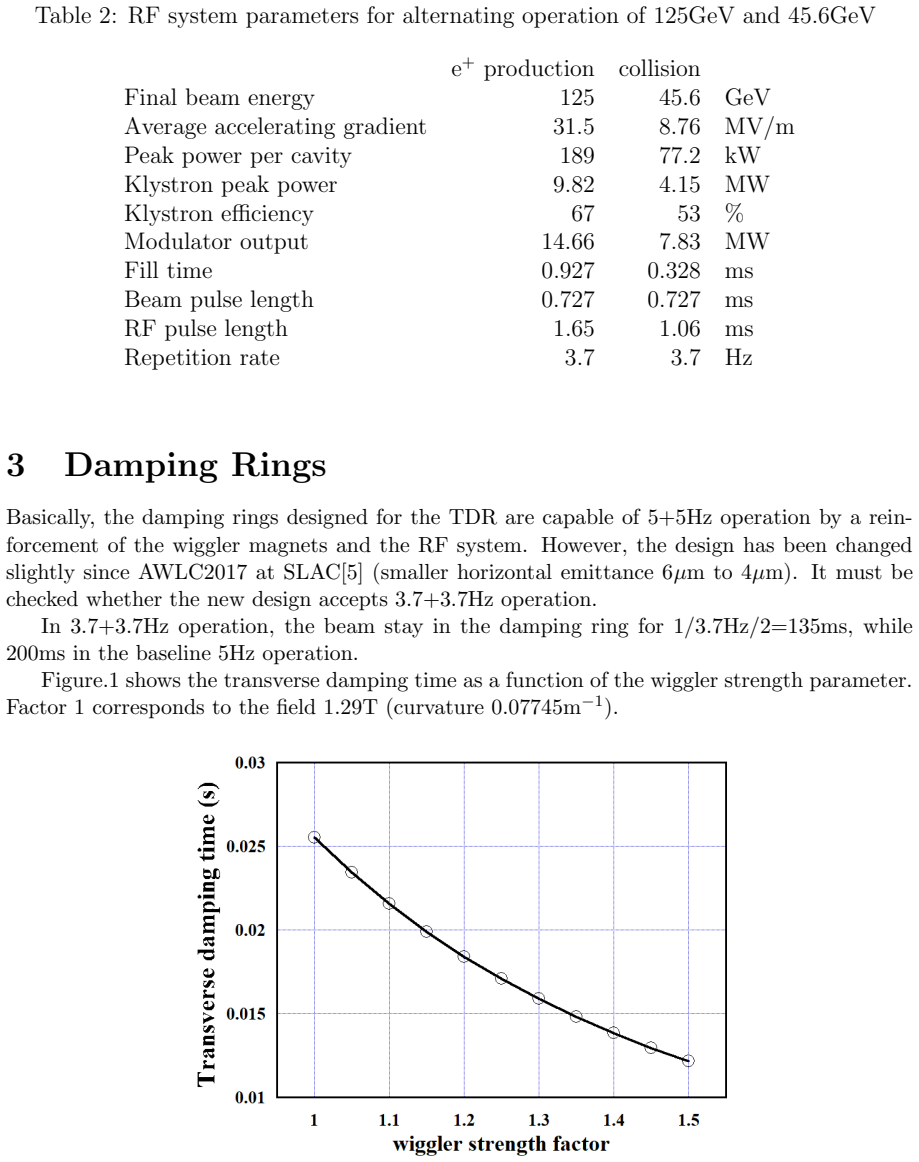
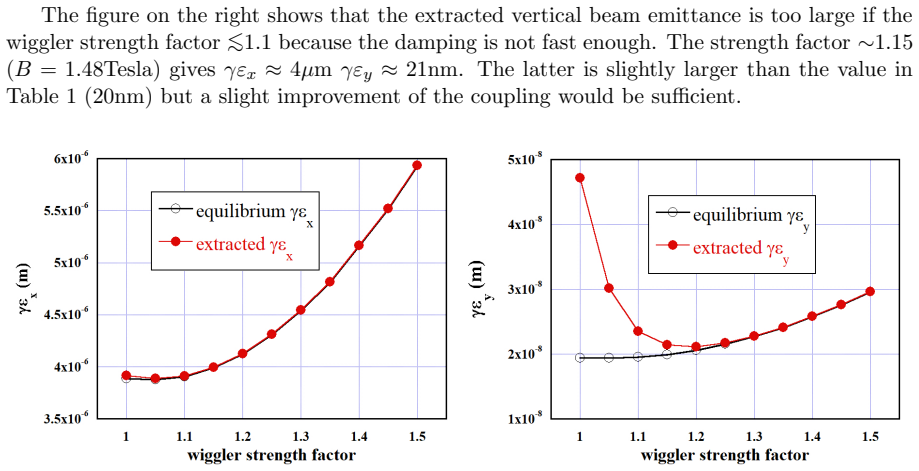
The organizing relation is the luminosity formula $L = f_{\mathrm{rep}} n_b N^2/(4\pi\sigma_x^*\sigma_y^*) H_D$, with $H_D$ the enhancement from the beam-beam force. The paper adjusts each factor under the constraints imposed by a 250 GeV machine: the repetition rate is set by RF power limits to 3.7+3.7 Hz; the beam sizes are set by the damping-ring emittance and by BDS simulations that include magnet errors and wake-field corrections; and $H_D$ is computed from the beam-beam interaction. The two nontrivial moves are lengthening the bunch to 0.41 mm to reduce the relative energy spread from about 0.41% to 0.3%, which keeps the final-focus beam size under control, and raising the damping-ring wiggler strength to a factor 1.15 so the vertical emittance damps within the shorter 135 ms store time.
What would settle it
Measure or simulate the resistive-wall wakefield-driven vertical emittance growth for a 45.6 GeV beam over the 231 m undulator section with realistic misalignments; if the growth exceeds the roughly 10 nm vertical emittance budget used here, the proposed 2.1 × 10$^{33}$ cm$^{-2}$ s$^{-1}$ luminosity is not reachable without a bypass beam line.
Extended reading notes
Core claim
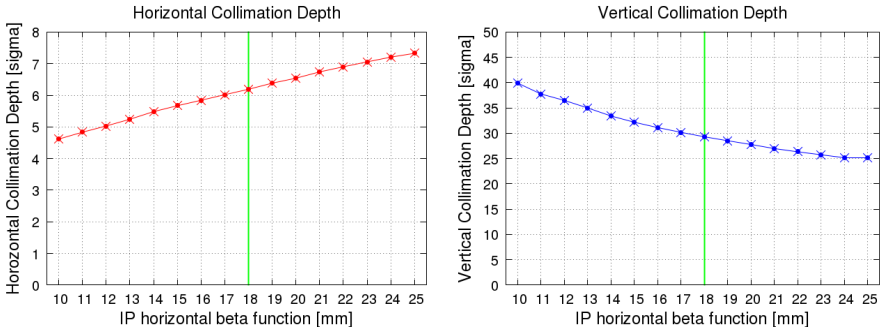
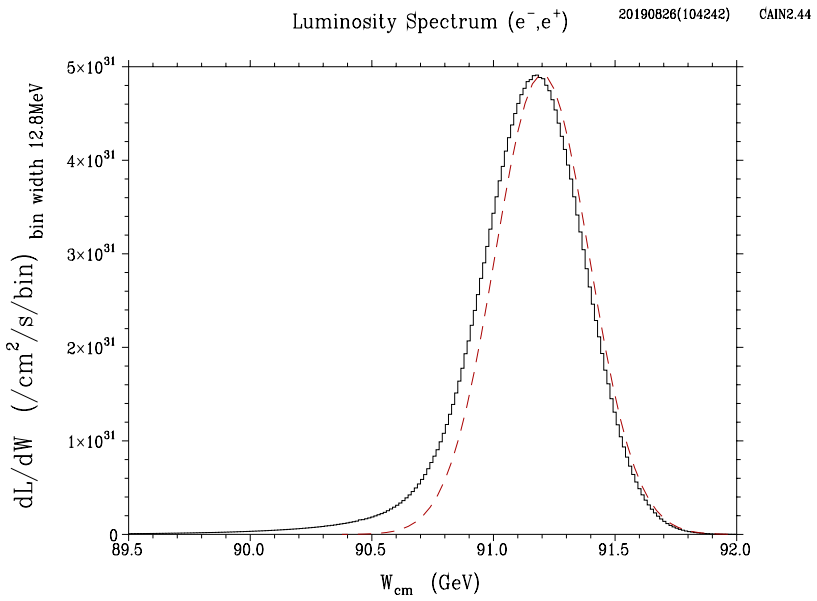
The central claim is that the ILC250, as designed for 250 GeV collisions, can be operated at the Z-pole with a credible luminosity of about 2.1 × 10$^{33}$ cm$^{-2}$ s$^{-1}$ rather than the 1–1.5 × 10$^{33}$ from simple scaling. The paper derives this from simulations of the damping rings, the electron main linac, the beam delivery system, and the beam-beam interaction, with the key changes being a bunch length of 0.41 mm instead of 0.3 mm, a horizontal $\beta$ function at the IP of 18 mm instead of 13 mm, a normalized horizontal emittance of 5 µm from the damping-ring redesign, and a vertical emittance after BDS tuning of about 14.6 nm. Beamstrahlung at the Z-pole is small, so the limitations are the final-focus momentum bandwidth and the vertical disruption parameter, both of which the chosen parameters keep within acceptable ranges.
Load-bearing premise
The load-bearing premise is that wakefield effects in the undulator section do not seriously degrade the 45.6 GeV colliding beam; the paper itself says this effect has not been studied in detail and may force a bypass.
Editorial extensions
If this is right
- Z-pole running becomes a realistic operating mode for the ILC250 without the 5+5 Hz scheme or a major RF-power upgrade.
- The longer bunch and relaxed $\beta_x^*$ keep collimation depth and momentum-bandwidth constraints at acceptable levels, so the luminosity estimate is not just a scaling extrapolation.
- Doubling the bunch train to 2625 bunches would raise the Z-pole luminosity to roughly 4.2 × 10$^{33}$ cm$^{-2}$ s$^{-1}$.
- Since beamstrahlung is negligible at 91.2 GeV, further luminosity gains would have to come from bunch number or disruption-parameter tolerance, not from stronger focusing alone.
Reading between the lines
- If the undulator wakefield check passes, the same parameter-shaping logic is likely to transfer to W-pair threshold running around 161 GeV, where many of the same low-energy constraints appear.
- A one-year Z-pole run at this luminosity would produce a Z sample large enough to sharpen electroweak precision measurements, a payoff the paper does not emphasize.
- The paper's suggested undulator bypass is a concrete fallback: testing resistive-wall wakefields early could decide whether the baseline 2.1 × 10$^{33}$ or the bypass variant is the real Z-pole luminosity.
Signed reviews
Editorial analysis
A structured set of objections, weighed in public.
Referee Report
Summary. This paper proposes a parameter set for operating the ILC250 accelerator at the Z-pole, with center-of-mass energy 91.2 GeV. It analyzes the main subsystems in sequence: the RF power budget for alternating 125 GeV and 45.6 GeV beam pulses, the damping rings with increased wiggler strength, the electron main linac with curved-orbit and misalignment effects, the beam delivery system with collimation, momentum bandwidth, and wake fields, and the beam-beam interaction. The proposed parameter set includes a 3.7+3.7 Hz collision rate, a 0.41 mm bunch length, a horizontal IP beta function of 18 mm, vertical IP beam size 14.6 nm, and a resulting luminosity of 2.05 × 10^33 cm^-2 s^-1, which exceeds the earlier scaling estimate of about 1.5 × 10^33 cm^-2 s^-1.
Significance. If the proposed parameter set can be realized, this result would be valuable for the ILC physics program by quantifying a viable Z-pole running scenario and identifying the required upgrades and operational constraints. The paper's strengths include a transparent presentation of parameters, explicit simulations with 100 random seeds for the main subsystems, and honest statements of remaining open items. The luminosity estimate is an output of the chosen parameters rather than a fitted quantity, so the central numerical claim is not circular. However, the central claim currently rests on at least one explicitly unstudied effect — the resistive-wall wakefield of the 45.6 GeV colliding beam in the 231 m undulator section — and on several optimistic assumptions in the beam delivery system simulation. These issues mean that the paper is more a feasibility study with open validation items than a fully established luminosity prediction.
major comments (3)
- [Section 4 (Electron Main Linac)] The operation of the 45.6 GeV colliding beam through the 231 m undulator section is a load-bearing unvalidated premise. The paper explicitly states that 'the wakefield effects (mainly resistive wall) for the colliding beam in the undulator section should be studied in more detail because the beam energy is low' and that a bypass beamline may be needed. Since any vertical emittance growth in this section directly increases the 14.6 nm σ*_y value used in Eq. (1), the quoted luminosity is not yet supported. The proposed bypass is not specified (length, optics, or effect on the 3.7+3.7 Hz timing and RF power budget), so it cannot be counted as a validated remedy. A quantitative estimate or simulation of the resistive-wall wake growth for E=45.6 GeV, σ_z=0.41 mm, and the undulator aperture is needed before the final luminosity number can be accepted.
- [Section 5 (Beam Delivery System), Table 4] The final vertical beam size of 14.6 nm relies on several assumptions that are stated but not quantified by sensitivity studies: a BPM-to-magnet alignment of 5 µm instead of the 10 µm used in previous ILC simulations, a 300 µm offset of wake sources, RF contacts for bellows and flange gaps, and the assumption that the feedback system can suppress the beam angle jitter to 10%. Because σ*_y enters the luminosity approximately linearly, an error in these assumptions translates directly into an error in L. The paper should provide a sensitivity scan over these parameters, or at least justify the 10% jitter-suppression figure with a reference or simulation, in order to establish how robust the 14.6 nm value is.
- [Section 2 (Repetition Rate), Table 2] The 3.7+3.7 Hz repetition rate is derived from the modulator energy integral, but the feasibility of rapidly alternating the accelerating gradient between 31.5 MV/m and 8.76 MV/m within the installed power and RF system constraints is not demonstrated. The paper states 'There seems to be no other RF-technical problem' without analyzing transient beam loading, cavity detuning requirements, klystron performance at short alternating pulses, or the available dynamic range of the piezo tuners. Since frep appears directly in Eq. (1), this assumption is load-bearing for the luminosity claim; a quantitative RF-system study should be added or referenced.
minor comments (5)
- [Abstract] The abstract contains a typo: 'has not been studies intensively' should read 'has not been studied intensively'.
- [Section 4, Eq. (2)] The expression 'β*_x >~ 13mm/2.74 × (10/5) =~ 18mm' is dimensionally and notationally confusing; the factor (10/5) should be labeled as the emittance ratio from the damping-ring improvement.
- [Section 5, Table 4] In Table 4, the horizontal beam sizes for rows (3) and (4) are omitted; the authors should state explicitly whether σ*_x is unchanged from row (2) or give the simulated values.
- [Section 8 (Summary)] The summary contains a typo: 'repitition' should be 'repetition', and the sentence '∝E1.5 from 250GeV in TDR' is incomplete.
- [Section 7 (Luminosity Upgrade)] The mention of 'traveling focusing' is made without a reference; a citation for this scheme should be added for completeness.
Circularity Check
No significant circularity: the luminosity is an output of independently simulated parameters; the deferred undulator-wakefield study is a stated limitation, not a circular step.
full rationale
The paper derives L from Eq. (1) using beam sizes that are outputs of separate simulations (damping rings in Sec. 3, main linac in Sec. 4, BDS in Sec. 5, beam-beam in Sec. 6), not by fitting to a luminosity target. The main design choices are driven by independent constraints: repetition rate from RF power (Sec. 2), beta*_x from collimation depth (Eq. 2), and bunch length from momentum bandwidth (Sec. 5). The BDS simulation produces sigma*_y = 14.6 nm, which is then adopted in Table 1 and used to compute L = 2.05e33 cm^-2 s^-1; no fitted quantity is renamed as a prediction. Self-citations [3] and [5] are prior design reports that set input parameters (e.g., the 5 um horizontal emittance), but the central Z-pole claim does not reduce to those citations; the paper contains independent numerical simulations. The one explicit caveat, that 'the wakefield effects (mainly resistive wall) for the colliding beam in the undulator section should be studied in more detail because the beam energy is low,' is a stated missing study rather than a hidden circular definition; it affects the confidence of the parameter set but not the logical independence of the derivation.
Assumptions & free parameters
free parameters (6)
- Horizontal beta at IP (β*_x) =
18 mm
- RMS bunch length (σ_z) =
0.41 mm
- Damping ring wiggler strength factor =
1.15
- Wake source transverse offset =
300 µm
- BPM-to-magnet field center alignment =
5 µm
- Beam angle jitter suppression =
10%
assumptions (3)
- domain assumption ILC TDR baseline parameters (e.g., bunch population 2e10, emittances, DR design) are valid starting points.
- domain assumption Simulation codes SAD and the unspecified beam-beam code correctly model wakefields, dynamic aperture, and luminosity enhancement.
- ad hoc to paper The RF system can rapidly alternate gradients 31.5 and 8.76 MV/m at 3.7+3.7 Hz within the installed power budget.
Cite this review
Pith. "Pith review of Operation of ILC250 at the Z-pole." pith.science (2026). https://pith.science/paper/SYK6DTU5
@misc{pith2026190808212,
  author       = {Pith},
  title        = {Pith review of: Operation of ILC250 at the Z-pole},
  year         = {2026},
  howpublished = {\url{https://pith.science/paper/SYK6DTU5}},
  note         = {Machine review of arXiv:1908.08212}
}
read the original abstract
ILC (International Linear Collider) is under consideration as the next global project of particle physics. Its Technical Design Report, published in 2013, describes the accelerator for the center-of-mass energies above 200GeV. The operation of ILC at lower center-of-mass energies has not been studies intensively. This report discusses the operation of the ILC at a center-of-mass 91.2GeV and presents a possible parameter set.
Figures

Figures from the paper (7 more)




Forward citations
Cited by 1 Pith paper
-
Tests of the Standard Model at the International Linear Collider
The paper projects that a polarized e+e- collider at 250 GeV to 1 TeV would measure most Higgs couplings to sub-percent precision and improve many electroweak observables by an order of magnitude.
Reference graph
Works this paper leans on
-
[1]
The International Linear Collider, Technical Design Report volume 3.II: Accelerator Base- line Design. 2013. https://www.linearcollider.org/ILC/Publications/Technical-Design-Report
work page 2013
-
[2]
“ILC possibilities at Z and W”, N. Walker, http://ilcdoc.linearcollider.org/record/63004?ln=ja
-
[3]
“Z-pole Operation”, LCWS2016 at Morioka, https://agenda.linearcollider.org/event/7371/contributions/38173/
- [4]
-
[5]
Overview of ILC optimization at the center of mass energy of 250GeV
“Overview of ILC optimization at the center of mass energy of 250GeV”, K. Yokoya, AWLC2017, June 28, 2017. https://agenda.linearcollider.org/event/7507/timetable/#20170628.detailed, “Preliminary study for lower horizontal emittance”, K. Kubo, AWLC2017, June 29, 2017. https://agenda.linearcollider.org/event/7507/timetable/#20170629.detailed
work page 2017
-
[6]
SAD is a computer program for accelerator design; http://acc-physics.kek.jp/SAD/index.html 15
Reviewed August 14, 2026 · model on record in the stance chip above.
Discussion (0). Continue with ORCID to comment.