REVIEW 3 major objections 6 minor 25 references
A Sparkler in the Fireworks Galaxy: Discovery of an Ultraluminous X-ray Transient with a Strong Oxygen Line in NGC 6946
T0 review · 3 major / 6 minor · reviewed 2026-08-14 · deepseek-v4-flash
Pith's one-line read A new X-ray source in NGC 6946 turned on between 2008 and 2012, has stayed ultraluminous since, and shows a strong O VIII line at 0.66 keV attributed to a massive outflow.
desk verdict A careful discovery paper for a new transient ULX with a striking oxygen line; the line's combined-spectrum significance deserves a check, but the paper is solid and warrants peer review. read the letter →
The pith
A machine-rendered reading of the paper's core claim, the machinery that carries it, and where it could break.
The reading
What carries the argument
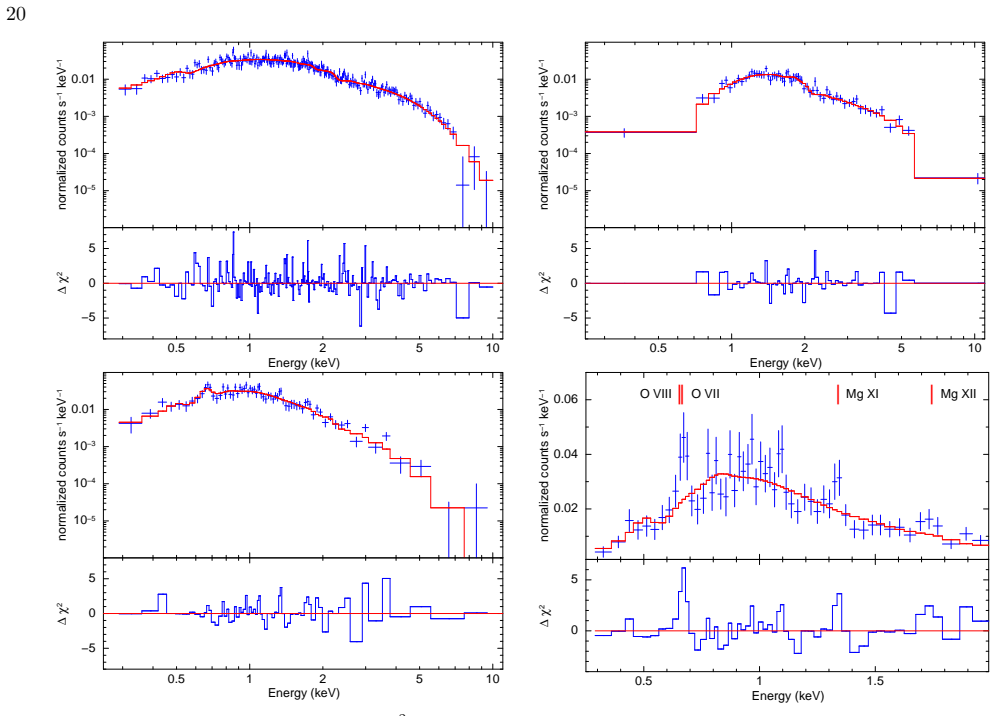
The argument is carried by multi-epoch X-ray spectroscopy of archival Chandra, XMM-Newton, and Swift observations, interpreted through the empirical ULX spectral classification (broadened disk, classical soft ultraluminous, transitional-to-super-soft regimes) and through Comptonization fits in which a low electron temperature ($kT_e \approx 0.65$ keV) and high optical depth ($\tau \approx 13$) signal down-scattering in a wind. The central diagnostic object is the Gaussian emission-line residual at $0.66$ keV whose strength, narrow width, and presence only in the softest state identify it as an O VIII Ly$\alpha$ wind line rather than a continuum artifact; the assumed $7.7$ Mpc distance to NGC 6946 converts every count rate into the luminosities that define the ULX and the $\approx 2\times10^{38}$ erg s$^{-1}$ line output.
What would settle it
Take a high-resolution soft X-ray spectrum of CXOU J203451.1+601043 during a soft state: if the 0.66 keV feature is O VIII Ly$\alpha$ from an outflow it should resolve into a line with a blueshift or P Cygni profile, whereas a finding that it is O VII He$\beta$ or stationary thermal plasma would undercut the wind and oxygen-rich-donor interpretation.
Extended reading notes
Core claim
CXOU J203451.1+601043 is a previously unrecognized transient ULX in NGC 6946 that turned on between 2008 February and 2012 May, remained at $\approx2$–$4\times10^{39}$ erg s$^{-1}$ in all later observations, and varied between spectral regimes: a broadened-disk state in 2012, a transitional state approaching the super-soft regime in 2016, and a harder state in 2018–2019 with no significant luminosity change. In its softest 2017 XMM-Newton spectrum the source shows an unresolved emission line at $E=(0.66\pm0.01)$ keV, equivalent width $\approx100$ eV, intrinsic FWHM $\lesssim30$ eV, and de-absorbed luminosity $\approx2\times10^{38}$ erg s$^{-1}$ (about 10% of the total), significant at $>99.8\%$ regardless of continuum model. The authors identify the line as O VIII Ly$\alpha$ (rest energy 0.654 keV), argue that it comes from the ULX rather than diffuse gas, and interpret it as a massive outflow; the line is an order of magnitude more luminous than analogous lines in other soft ULXs. They present this as support for the view that the soft ultraluminous regime is produced by a thick, down-scattering wind whose optical depth along our line of sight sets the apparent spectral hardness. They further speculate, on the basis of the strong oxygen line and the oxygen-rich (O, Ne, Mg, Si) abundance pattern required by a plasma fit, that the donor is an oxygen-rich white dwarf in an ultracompact binary, which would make it the first ultracompact ULX candidate outside a globular cluster.
Load-bearing premise
Every luminosity in the paper, including the ULX classification and the oxygen-line luminosity, is computed from the assumed 7.7 Mpc distance to NGC 6946; if the older $\approx5.5$ Mpc distance were right, the 2012 source would fall below the ultraluminous threshold.
Editorial extensions
If this is right
- A long-lived transient ULX can stay at or above $10^{39}$ erg s$^{-1}$ for at least seven years, so the census of transient ULXs must count systems that do not decay after a short outburst.
- The 2017 spectrum places CXOU J203451.1+601043 in the transitional regime between ordinary ULXs and ultraluminous supersoft sources, supporting the idea that those classes differ mainly by the scattering optical depth of a wind along our line of sight.
- A wind line from a ULX can be strong enough ($EW\approx100$ eV) to be detected and modelled at CCD resolution, so soft-state monitoring of nearby galaxies can find more such systems without high-resolution gratings.
- If the oxygen-rich donor scenario holds, this is the first ultracompact ULX candidate outside a globular cluster, and its transient behaviour is a puzzle because a fully ionized disk in such a system should be stable against thermal-viscous outbursts.
- When the source eventually declines, its decay track will discriminate between a stellar-mass black hole following the standard hardness-luminosity pattern and a neutron star switching between accretor and propeller states.
Reading between the lines
- Line luminosity at about 10% of the total X-ray luminosity implies a genuinely massive wind; if the wind is the same medium that down-scatters the continuum, the line flux and the spectral downturn energy should track each other as the source changes state, a correlation that future monitoring of this source could test.
- The faint optical counterpart at $M\approx-4$ mag is compatible with an early B star but also with an irradiated disk; if the white-dwarf donor scenario is right, the optical light should vary on the $\sim10$ minute orbital period the authors predict, which would separate the donor interpretation from the B-star interpretation.
- An oxygen-rich C/O or O-Ne-Mg white-dwarf donor would make this system a scaled-up analogue of Galactic ultracompact X-ray binaries; comparing the X-ray line ratios (O VIII/O VII) with those systems could reveal whether the line forms in an outflow or on the disk surface.
- The authors' wind interpretation predicts that the line should disappear or weaken when the continuum hardens; the 2018–2019 Swift data already show hardening, so a pointed soft X-ray observation in that state would provide a direct test.
Signed reviews
Editorial analysis
A structured set of objections, weighed in public.
Referee Report
Summary. The paper reports the discovery of a new X-ray transient, CXOU J203451.1+601043, in NGC 6946, which was undetected before 2008 and has been detected from 2012 onward in Chandra, XMM-Newton, and Swift data. The authors model the 2012, 2016, and 2017 spectra with several continuum models plus a Gaussian emission line and find a strong line at 0.66 +/- 0.01 keV in the 2017 combined EPIC spectrum, with an equivalent width of roughly 100 eV and a de-absorbed luminosity of about 2 x 10^38 erg/s. They identify the line as O VIII Ly-alpha and interpret it as evidence of a massive outflow, connecting the soft Comptonized continuum with wind emission lines. They also document spectral variability, a candidate optical counterpart, and speculate that the donor star may be an oxygen-rich white dwarf in an ultracompact binary.
Significance. If the line detection holds, the source is a valuable addition to the small sample of ULXs with clearly detected soft X-ray wind lines, and it strengthens the empirical connection between the soft ultraluminous spectral state and line diagnostics. The analysis is careful in several respects: it tests multiple continuum models, uses likelihood-ratio simulations with 10,000 runs, verifies that the source is point-like with PSF checks, and uses narrow-band images to exclude diffuse gas or a pre-existing supernova remnant. The paper is also appropriately cautious in labeling the white-dwarf donor scenario as speculative. The main concerns are that the central line significance is established on the summed pn+MOS spectrum without per-detector spectral verification, and that the statistical procedure behind the quoted significance is not fully specified.
major comments (3)
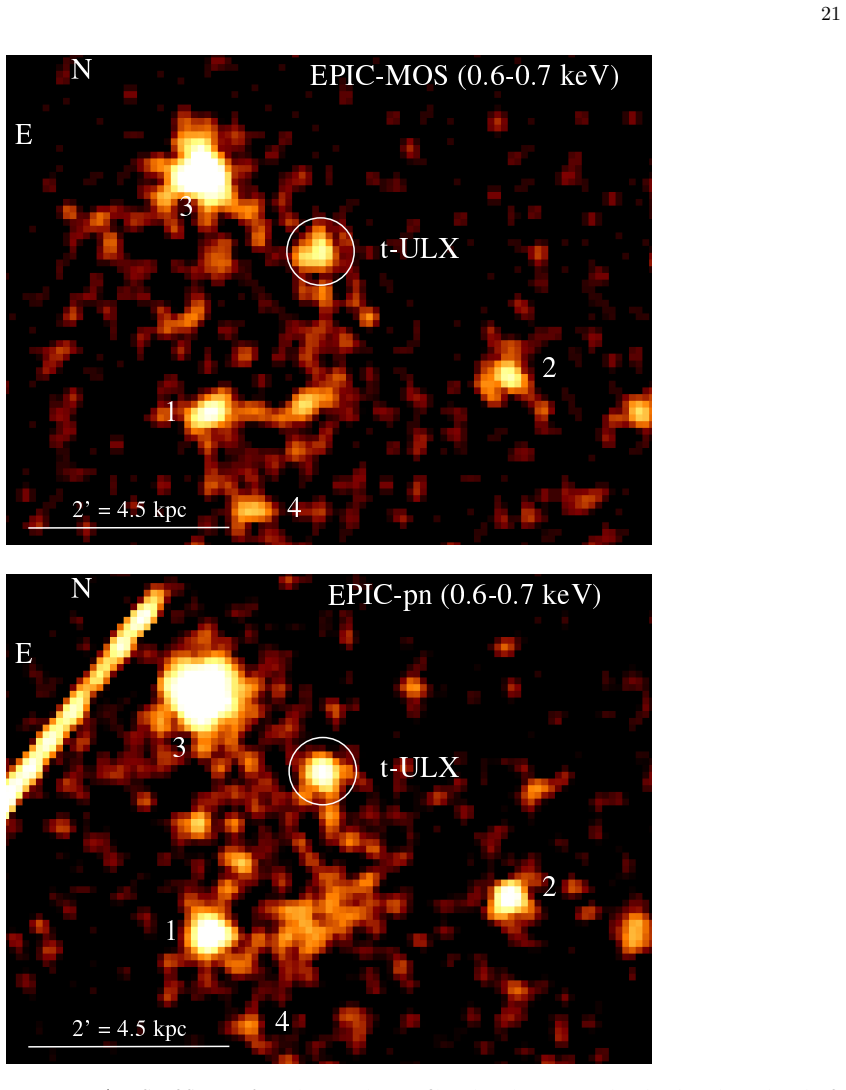
- [Section 3.3, Table 2] The significance of the 0.66 keV line (>99.8% from the likelihood-ratio test and Delta-chi-squared > 11.4) is computed on the summed EPIC-pn+MOS spectrum, but the paper does not present independent spectral fits or residual spectra for the pn and MOS detectors. The two instruments have different effective areas, gain scales, and calibration residuals near 0.5-0.7 keV, so a cross-calibration mismatch can in principle produce or enhance a narrow feature in the combined spectrum. Figure 8 shows narrow-band 0.60-0.70 keV images from pn and MOS separately, which is a useful check that the emission is point-like in both detectors, but it does not quantify the line significance per detector. Because the 0.66 keV line is the most outstanding property of the source and is the foundation for the outflow and oxygen-rich donor interpretations, I request per-detector spectral fits of the 2017 data, or at least pn-only and MOS-only residual plots with the line significance, and any necessary qualification of the detection claim if the per-detector signal is not significant.
- [Section 3.3, likelihood-ratio test] The paper states that 10,000 simulations were run for the likelihood-ratio test, but it does not state whether the Gaussian line energy and width were free parameters in the alternative model used for each simulated spectrum. If the line centroid was fixed at the best-fit value (0.66 keV), the quoted >99.8% significance does not account for the search over energy in the soft band and would be an overestimate. If the line parameters were free in the simulations, this should be stated explicitly. The same information is needed for the 2012 fit, where the significance is reported as only approximately 70%.
- [Section 1, Table 1] All luminosities in the paper scale with the assumed distance of 7.7 +/- 0.3 Mpc (Anand et al. 2018; Eldridge & Xiao 2019). At the older 5.5 Mpc distance, the 2012 XMM-Newton luminosity in Table 2 (L0.3-10 about 1.6 x 10^39 erg/s for the comptt model) would be about 0.8 x 10^39 erg/s, below the canonical 10^39 erg/s ULX threshold, and the 2012 Chandra luminosity in Table 1 would be about 0.6 x 10^39 erg/s. The statement in the abstract and in Section 1 that the source has remained at luminosities about 2-4 x 10^39 erg/s since 2012 therefore depends on the new distance. The later-epoch detections (2016, 2017) remain above 10^39 erg/s even at the old distance, so the transient ULX identification is not overturned, but the luminosity history and the absolute magnitudes in Table 4 should be presented with the distance sensitivity explicitly stated, or with a table of values at both distances.
minor comments (6)
- [Section 2.1] The sentence 'We searched for point sources in each epoch with with wavdetect' contains a duplicated 'with'.
- [Abstract] The phrase 'at an energy of of' contains a duplicated 'of'.
- [Section 3.2] The sentence 'Count rates were extracted from the 0.3-10 keV band' appears twice in consecutive paragraphs.
- [Section 3.1] The text refers to 'SN 20017eaw' in one place; this should be 'SN 2017eaw'.
- [Figure 9 caption] The caption identifies the lower panel as a '2016 HST/WFC3 image in the F814W band', but the text and Table 4 identify that image as ACS/WFC; please correct the caption.
- [Table 2] Table 2 contains typographic artifacts such as '/greaterorsimilar' and '*' in the parameter entries; the final typeset version should be checked carefully for these symbols.
Circularity Check
No circularity: the source properties are measured, not derived from themselves.
full rationale
This is an observational discovery paper. The central claims are measurements: the transient appearance and luminosity of CXOU J203451.1+601043, its spectral evolution, and the detection of a 0.66 keV emission line. These are obtained from standard Chandra, XMM-Newton, and Swift data reduction and spectral fitting. No quantity is fitted to a subset of data and then renamed as a prediction; no continuum model is used to define the line in a way that forces its detection; the line significance is computed from the combined EPIC spectrum but is also inspected in separate pn and MOS narrow-band images, and the cross-calibration concern is a possible systematic effect, not circular reasoning. The spectral-state classification uses external empirical categories from the literature, and the proposed oxygen-rich donor scenario is explicitly speculation, not a derived result. The assumed distance to NGC 6946 scales luminosities but is an external, stated assumption, and the line energy, equivalent width, and line flux are distance-independent. Self-citations (e.g., Pinto et al. 2017, on which Soria is a coauthor) provide context for interpreting wind lines rather than the load-bearing justification for the line detection. The paper does not derive any quantity from a model that already contains that quantity, so no circular step can be exhibited.
Assumptions & free parameters
free parameters (4)
- Line energy (Gaussian centroid) =
0.66 +/- 0.01 keV (2017)
- Line normalization (photon flux) =
2.7 (+2.3/-1.4) x 10^-5 ph cm^-2 s^-1 (2017, power-law continuum)
- Comptonization electron temperature kTe =
0.65 (+0.89) keV (2017, comptt model)
- Comptonization optical depth tau =
13.6 (+7.3/-0.8) (2017)
assumptions (4)
- domain assumption NGC 6946 is at a distance of 7.7 +/- 0.3 Mpc
- domain assumption The 0.66 keV line is O VIII Ly-alpha
- domain assumption Spectral softening in ULXs is caused by down-scattering in a thick wind
- domain assumption Empirical ULX spectral states (broadened disk, soft ultraluminous, super-soft) are physically meaningful
invented entities (1)
-
O-Ne-Mg or CO white dwarf donor in an ultracompact binary
Cite this review
Pith. "Pith review of A Sparkler in the Fireworks Galaxy: Discovery of an Ultraluminous X-ray Transient with a Strong Oxygen Line in NGC 6946." pith.science (2026). https://pith.science/paper/OOXTYB3S
@misc{pith2026190808293,
  author       = {Pith},
  title        = {Pith review of: A Sparkler in the Fireworks Galaxy: Discovery of an Ultraluminous X-ray Transient with a Strong Oxygen Line in NGC 6946},
  year         = {2026},
  howpublished = {\url{https://pith.science/paper/OOXTYB3S}},
  note         = {Machine review of arXiv:1908.08293}
}
abstract
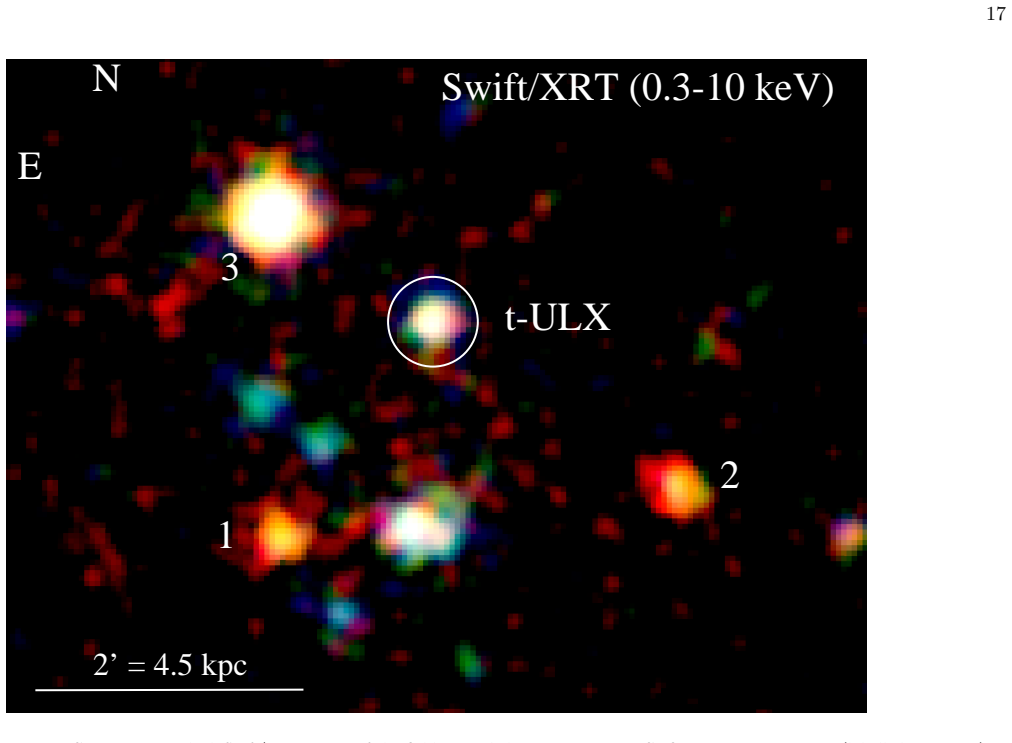
We discovered and studied an ultraluminous X-ray source (CXOU J203451.1+601043) that appeared in the spiral galaxy NGC 6946 at some point between 2008 February and 2012 May, and has remained at luminosities $\approx$2-4 $\times 10^{39}$ erg s$^{-1}$ in all observations since then. Our spectral modelling shows that the source is generally soft, but with spectral variability from epoch to epoch. Using standard empirical categories of the ultraluminous regimes, we find that CXOU J203451.1+601043 was consistent with a broadened disk state in 2012, but was in a transitional state approaching the super-soft regime in 2016, with substantial down-scattering of the hard photons (similar, for example, to the ultraluminous X-ray source in NGC 55). It has since hardened again in 2018-2019 without any significant luminosity change. The most outstanding property of CXOU J203451.1+601043 is a strong emission line at an energy of of $(0.66 \pm 0.01)$ keV, with equivalent width of $\approx$100 eV, and de-absorbed line luminosity of $\approx$2 $\times 10^{38}$ erg s$^{-1}$, seen when the continuum spectrum was softest. We identify the line as OVIII Ly$\alpha$ (rest frame energy of 0.654 keV); we interpret it as a strong indicator of a massive outflow. Our finding supports the connection between two independent observational signatures of the wind in super-Eddington sources: a lower temperature of the Comptonized component, and the presence of emission lines in the soft X-ray band. We speculate that the donor star is oxygen-rich: a CO or O-Ne-Mg white dwarf in an ultracompact binary. If that is the case, the transient behaviour of CXOU J203451.1+601043 raises intriguing theoretical questions.
Figures


Figures from the paper (6 more)



Reference graph
Works this paper leans on
-
[1]
High Mass X-ray Binaries: illuminating the passage fr om massive binaries to merging compact objects
Abramowicz, M. A., Czerny, B., Lasota, J. P., & Szuszkiewicz , E. 1988, ApJ, 332, 646 Anand, G. S., Rizzi, L., & Tully, R. B. 2018, AJ, 156, 105 Arnaud, K. A. 1996, ASPC, 101, 17 Astropy Collaboration, Price-Whelan, A. M., Sip˝ ocz, B. M. , et al. 2018, AJ, 156, 123 Bachetti, M., Harrison, F. A., W alton, D. J., et al. 2014, Nat ure, 514, 202 Barmby, P., ...
arXiv 1988
-
[2]
1 × 1037 4404 28.7 2002-11-25 <
work page 2002
-
[3]
5 × 1037 4631 28.4 2004-10-22 <
work page 2004
-
[4]
0 × 1037 4632 25.2 2004-11-06 4633 26.6 2004-12-03 13435 20.4 2012-05-21 4 . 0+0.6 −0.6 × 10⁻¹⁴
work page 2004
-
[5]
1+0.2 −0.2 × 1039 17878 40.0 2016-09-28
work page 2016
-
[6]
8+0.4 −0.4 × 1039 19887 18.5 2016-09-28 19040 9.8 2017-06-11 0 . 6+0.1 −0.1 × 10⁻¹⁴
work page 2016
-
[7]
7+0.3 −0.3 × 1039 XMM-Newton/EPIC 0093641501 0.6 2003-04-18 < 1 × 10⁻¹⁴ < 2 × 1038 0093641601 2.2 2003-05-17 0093641701 1.2 2003-06-18 0200670101 3.9 2004-06-09 <
work page 2003
-
[8]
1 × 10⁻¹⁵ < 3 × 10370200670201 12.7 2004-06-11 0200670301 11.3 2004-06-13 0200670401 8.8 2004-06-25 0401360101 18.7 2006-05-23 < 2 × 10⁻¹⁵ <
work page 2004
Show all 25 references
-
[9]
5 × 1037 0401360201 4.7 2006-06-02 0401360301 4.9 2006-06-18 0500730101 26.0 2007-11-08 <
2006
-
[10]
6+0.1 −0.1 × 10⁻¹³
2 × 10⁻¹⁵ < 2 × 1037 0500730201 31.7 2007-11-02 0691570101 109.3 2012-10-21 1 . 6+0.1 −0.1 × 10⁻¹³
2007
-
[11]
6+0.1 −0.1 × 10⁻¹³
6+0.1 −0.1 × 1039 0794581201 43.1 2017-06-01 0 . 6+0.1 −0.1 × 10⁻¹³
2017
-
[12]
4+0.4 −0.4 × 10⁻¹³
8+2.0 −0.1 × 1039 Swift/XRT 31113001 to 31113004 10 2008-02-04 to 2008-02-14 < 2 × 10⁻¹⁴ < 4 × 1038 49820001 to 49820003 7 2013-05-31 to 2013-06-04 1 . 4+0.4 −0.4 × 10⁻¹³
2008
-
[13]
1+0.2 −0.2 × 10⁻¹³
4+0.5 −0.5 × 1039 10130001 to 10130029 44 2017-05-13 to 2017-09-17 1 . 1+0.2 −0.2 × 10⁻¹³
2017
-
[14]
2+0.3 −0.3 × 10⁻¹³
6+0.4 −0.4 × 1039 94059001 to 94059044 43 2018-04-01 to 2018-12-27 2 . 2+0.3 −0.3 × 10⁻¹³
2018
-
[15]
7+0.3 −0.3 × 10⁻¹³
8+0.4 −0.4 × 1039 94059045 to 94059072 17 2019-01-06 to 2019-04-06 1 . 7+0.3 −0.3 × 10⁻¹³
2019
-
[16]
5 and total column density NH = 4 × 1021 cm−2 (twice the Galactic line-of-sight value)
2+0.4 −0.4 × 1039 a: for the Chandra observations, we estimated observed fluxes and intrinsic lu minosities (or their respective upper limits) in the 0.3–10 keV band with the ciao task srcflux, assuming a power-law model with photon index Γ = 2 . 5 and total column density NH = ...
2016
-
[17]
See Table 2 for a comparison of flux and luminosity conversi ons using power-laws versus more complex spectral models. 13 TABLE 2 Best-fitting parameters of the EPIC spectra from 2012 and 20 17, and the ACIS spectrum from 2016 Model Parameters Values 2012 2016 2017 tbabs × tbab...
2012
-
[18]
06 a: observed fluxes in the 0.3–10 keV bandb: for all spectral models, the de-absorbed luminosities L0. 3− 10 (0.3–10 keV band) were defined as 4 πd 2 times the de-absorbed fluxes c: Nbb = ( Rbb/D 10 )2 where Rbb is the source radius in km and D10 is the distance to the sourc...
2017
-
[19]
20 a: Nbb = ( Rbb /D 10)2 where Rbb is the source radius in km and D10 is the distance to the source in units of 10 kpc (here, D10 = 770). b: Ndbb = ( Rin /D 10 )2 cos θ , where Rin is the apparent inner disk radius in km, D10 the distance to the source in units of 10 kpc, and...
2004
-
[20]
15 2016-10-26 ACS-WFC F814W 2570 26 . 05 ±
2016
-
[21]
1.— Left panel: adaptively smoothed Chandra/ACIS image of NGC 6946, based on the stacked data from 2001 to
15 2018-01-05 WFC3-UVIS F555W 710 – – 2018-01-05 WFC3-UVIS F814W 780 – – 16 10.0 05.020:35:00.055.0 50.0 45.0 34:40.0 35.0 12:00.011:00.060:10:00.009:00.008:00.007:00.0 N E 60 arcsec 10.0 05.020:35:00.055.0 50.0 45.0 34:40.0 35.0 12:00.011:00.060:10:00.009:00.008:00.007:00.0 F...
2018
-
[24]
1”, “2”, “3
1 100.5 2 5 10−8 10−7 10−6 10−5 10−4 keV2 (Photons cm−2 s−1 keV−1) Energy (keV) Fig. 6.— Unfolded X-ray spectra of CXOU J203451.1+601043 at three di fferent epochs, based on the best-fitting Comptonization mod els listed in Table 2 ( tbabs × tbabs × (bbodyrad + comptt + gaussian...
2019
-
[25]
Bottom panel: 2016 HST/WFC3 image in the F814W band
0 mag. Bottom panel: 2016 HST/WFC3 image in the F814W band
2016
-
[28]
Bottom right panel: as in the bottom left panel, for th e EPIC-pn observation of 2017 June
Bottom left panel: background-subtra cted XMM-Newton/EPIC-pn light curve from 2012 October 21, binned to 1000 s. Bottom right panel: as in the bottom left panel, for th e EPIC-pn observation of 2017 June
2012
-
[2004]
1”, “2” and “3
Red represents the 0.3–1 keV band, green is for 1–2 keV, and blue f or 2–8 keV. Right panel: adaptively smoothed Chandra/ACIS image, based on the stacked data from 2012 to 2017, showing the appearance of the transient ULX investigated in this paper. 17 E N Swift/XRT (0.3-10 ke...
2019
Reviewed August 14, 2026 · model on record in the stance chip above.
Discussion (0). Continue with ORCID to comment.