REVIEW 4 major objections 6 minor 5 references
Robustly segmenting quadriceps muscles of ultra-endurance athletes with weakly supervised U-Net
T0 review · 4 major / 6 minor · reviewed 2026-08-14 · deepseek-v4-flash
Pith's one-line read Replacing atlas-based joint-label fusion with a weakly supervised U-Net improves DICE on an atypical female quadriceps volume from 0.829 to 0.918 while cutting the reported 20-hour step to about 2 hours.
desk verdict Honest incremental engineering result; the robustness claim rests on a single female volume and needs more data, but the speedup and candor make it worth a proper review. read the letter →
The pith
A machine-rendered reading of the paper's core claim, the machinery that carries it, and where it could break.
The reading
What carries the argument
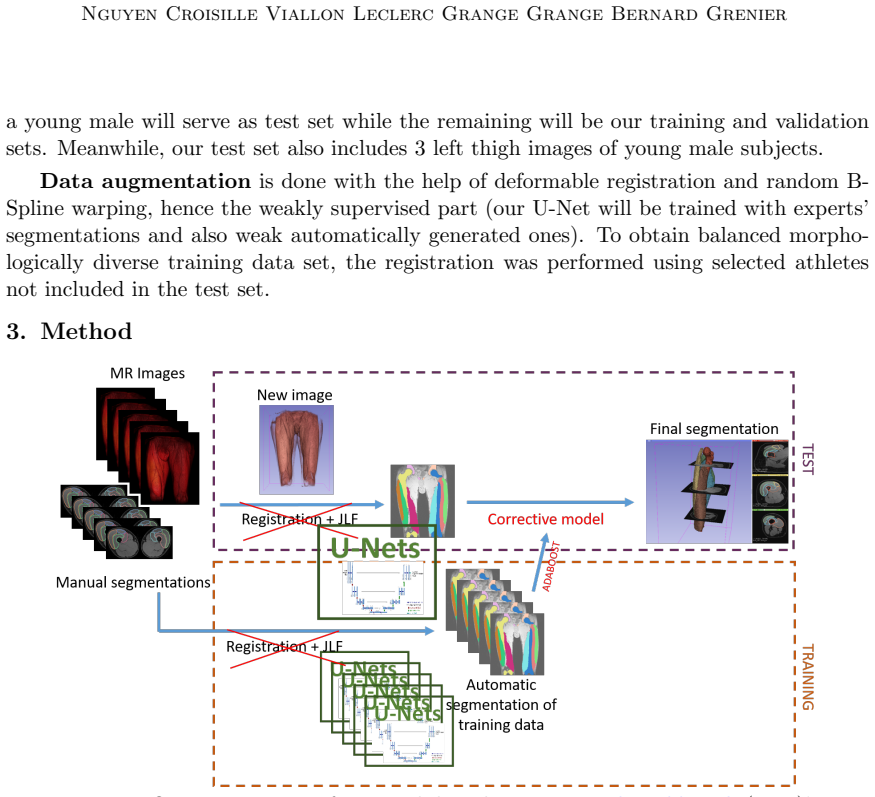
The central object is the weakly supervised U-Net used as a drop-in replacement for the multi-atlas joint-label-fusion (JLF) step, a voting scheme that combines atlas labels after deformable registration. U-Net is a convolutional encoder-decoder that maps an axial MR slice to a per-pixel label map of the four quadriceps heads. The corrective-learning (CL) stage is retained: it trains a separate network on the errors of the initial automatic segmentations and applies that learned correction to the final output. Weak supervision is provided by augmenting the expert-labeled training volumes with segmentations generated through deformable registration and random B-spline warping of selected athletes, which balances morphology in the training set. The load-bearing identity is therefore the replacement itself: a fast learned segmenter that is less sensitive to large anatomical deformations, followed by the existing error-correction mechanism.
What would settle it
Segment ten or more atypical right-thigh MRI volumes with both JLF+CL and U-Net+CL, using expert segmentations as ground truth; if the U-Net pipeline does not beat JLF+CL on the majority of those volumes in DICE, the paper's central robustness claim fails.
Extended reading notes
Core claim
The paper's claim is that a U-Net trained with expert and weakly labeled slice data can stand in for the registration-based joint-label-fusion step of a corrective-learning segmentation framework, and that for quadriceps MRI this substitution improves accuracy precisely on the case where atlas matching struggled: a subject with markedly different thigh morphology. On the female right-leg test volume, U-Net plus corrective learning gives DICE 0.918 versus 0.829 for JLF plus corrective learning, and mean absolute distance 1.638 mm versus 5.600 mm. On the typical male right and left test volumes the methods are comparable, with a slight DICE decline for U-Net on the male right leg (0.925 versus 0.937) and slight gains on the left leg. The authors also claim a practical computational advantage: the expensive step drops from about 20 hours per volume for JLF to about 2 hours of U-Net training on a GPU.
Load-bearing premise
The robustness claim rests on a single female test volume, and if that manual segmentation is unrepresentative or noisy, the reported DICE improvement could disappear.
Editorial extensions
If this is right
- The reported time for the expensive segmentation step drops by roughly an order of magnitude, from about 20 hours per volume with JLF on 16 CPUs to about 2 hours of U-Net training, making large athlete cohorts more feasible.
- For the atypical female thigh, DICE improves from 0.829 with JLF+CL to 0.918 with U-Net+CL, and mean absolute distance improves from 5.600 mm to 1.638 mm, while typical male legs stay within a few hundredths of DICE.
- Because corrective learning is retained, the method still has a mechanism for repairing boundary errors that the first-pass U-Net makes, which the authors see as the main remaining error type.
- The automatic segmentation is intended to enable longitudinal monitoring of local changes in each quadriceps head along an ultra-marathon, rather than only a whole-muscle analysis.
Reading between the lines
- The decisive atypical-morphology comparison consists of one female volume; a multi-subject atypical test set would be needed to tell whether the improvement is a property of the method or of that particular thigh.
- The reported time comparison is not end-to-end: JLF's 20 hours is a per-volume inference cost, while the U-Net figure is training time, so the true per-volume runtime of the new pipeline remains unmeasured.
- The weak labels come from warping a chosen set of athletes not in the test set; the choice of those source athletes is likely to affect how well the U-Net generalizes, and a more homogeneous training set might erase the advantage.
Signed reviews
Editorial analysis
A structured set of objections, weighed in public.
Referee Report
Summary. The paper describes a segmentation framework for the four quadriceps muscle heads in 3D T1-weighted MR images of ultra-endurance athletes, in which the computationally expensive multi-atlas segmentation with joint label fusion (JLF) inside Wang and Yushkevich's corrective learning (CL) framework is replaced by a weakly supervised U-Net. Weak labels are generated via deformable registration and random B-spline warping from seven manually segmented atlases. The test set consists of one female right thigh, one young male right thigh, and three left thigh volumes. On the female right leg, U-Net with CL achieves DICE 0.918 versus 0.829 for JLF with CL, while on the male right leg DICE declines slightly (0.925 vs 0.937) and Hausdorff distance worsens substantially (30.794 mm vs 17.694 mm). The authors report that JLF takes about 20 hours per volume on 16 CPUs, whereas each U-Net requires about 2 hours of training on a Tesla V100, and conclude that the proposed method provides similar or improved accuracy with significantly reduced computation time, especially for atypical morphologies.
Significance. If the accuracy claims were confirmed on a broader test set, the contribution would be practically valuable: a trainable segmentation method that avoids the per-volume cost of multi-atlas registration while maintaining or improving accuracy on morphologically unusual quadriceps would enable large-scale longitudinal studies of ultra-endurance athletes. The architectural idea of embedding a U-Net in the corrective-learning loop is reasonable and the paper makes an honest statement of the trade-offs on the male right-leg cell in Table 1. However, the evidence supporting the headline robustness claim is confined to a single female test volume, and the computation-time comparison mixes training time with per-volume inference time. The significance is therefore conditional on additional validation.
major comments (4)
- [§4, Table 1] The central claim of improved robustness for 'remarkably different morphology' is supported by exactly one test volume: the female right leg, where U-Net+CL achieves DICE 0.918 versus 0.829 for JLF+CL. With n=1, no error bars, and no inter-rater variability assessment for the manual ground truth, the observed 0.089 DICE difference cannot be separated from label noise or random variation. Please report per-volume scores for all test subjects, add a repeatability analysis of the manual segmentations, or explicitly restrict the conclusion to a case study rather than a general robustness claim.
- [§4, runtime comparison] The runtime comparison is not apples-to-apples: 20 hours is reported as the JLF inference time for one volume on 16 CPUs, while 2 hours is the training time of each U-Net on a Tesla V100. No per-volume inference time is given for U-Net or U-Net+CL, so the statement that the approach 'reduced significantly the computation time' is not directly supported. Please report the wall-clock time to produce one test segmentation with U-Net and U-Net+CL on comparable hardware.
- [§3, Corrective learning step] The manuscript does not specify how the five corrective-learning U-Nets, each trained with a different validation subject, are used to compute the U-Net+CL results in Table 1. It is unclear which network is applied to each test volume, whether the five outputs are averaged, or how the learned correction is combined with the base U-Net prediction. This omission prevents reproduction and makes the U-Net+CL results ambiguous.
- [§5, Conclusion] The conclusion states that the method provided 'similar or even improved accuracy', but this does not hold for all reported cells: for the male right leg, U-Net+CL DICE is lower than JLF+CL (0.925 vs 0.937) and HD is markedly worse (30.794 mm vs 17.694 mm). Please qualify the conclusion to reflect the mixed results across the male and left-leg test cases.
minor comments (6)
- [Abstract] There is a typo in the abstract: 'corrective leaning' should read 'corrective learning'.
- [§4, text before Table 1] The text says 'the Table 4 quantifies results on test set' but the table is numbered Table 1; please correct the cross-reference.
- [§3, U-Net architecture] Please provide the essential architectural details of the U-Net (depth, number of channels per level, input slice size, loss function, optimizer, number of training epochs) so that the experiments are reproducible.
- [§2, Data] The description of weak label generation is brief: please clarify whether the random B-spline warping is applied to the label maps only or to both image and labels, and how the amount of warping was chosen to avoid anatomically implausible labels.
- [§4, Table 1] For the left-thigh rows, the paper reports averages over 2D slices but not over the three subjects; please indicate the number of volumes and slices and report the spread (e.g., standard deviation or range) to allow the reader to judge variability.
- [General] The manuscript does not mention ethics approval or data availability; if the data cannot be shared, a statement to that effect would be useful for readers.
Circularity Check
No significant circularity: the U-Net+CL segmentation is evaluated on held-out test volumes against independently computed JLF baselines, and the only self-citation is contextual, not load-bearing.
full rationale
The paper's central comparison is between U-Net-based segmentation and the JLF-based pipeline of Wang and Yushkevich, with both baselines computed on the same held-out test volumes in Table 1. The U-Net is trained on training subjects plus automatically generated weak labels derived from training-subject deformations; the test volumes (female right leg, young male right leg, and three left thighs) are explicitly excluded from training and validation. Corrective learning is implemented through a standard leave-one-training-subject-out procedure, where each of the five correction networks validates on one training volume and excludes it from its own training set. No reported test metric is fitted from that test volume, and no parameter is tuned against the female subject whose morphological atypicality is the paper's motivating case. The only self-citation, Nguyen et al. (2018), is used to explain that the authors had previously adapted Wang and Yushkevich's JLF+CL method to their dataset; it is not invoked as the source of any numerical claim or as a uniqueness or correctness argument. The small test size and single atypical female subject raise statistical and generalizability concerns, but those are correctness risks, not circularity. Accordingly, no circular step can be exhibited, and the score is 0.
Assumptions & free parameters
free parameters (3)
- U-Net training hyperparameters =
Not reported
- Deformable registration parameters for weak label generation =
Not reported
- Corrective learning configuration =
5 networks, dropout 0.2
assumptions (3)
- domain assumption Manual expert segmentations are treated as ground truth.
- ad hoc to paper Weak labels generated by deformable registration and random B-Spline warping are accurate enough to train the U-Net without systemic bias.
- domain assumption 2D slice-wise U-Net predictions can be re-stacked to form valid 3D volumes.
Cite this review
Pith. "Pith review of Robustly segmenting quadriceps muscles of ultra-endurance athletes with weakly supervised U-Net." pith.science (2026). https://pith.science/paper/7DDIINQK
@misc{pith2026190808294,
  author       = {Pith},
  title        = {Pith review of: Robustly segmenting quadriceps muscles of ultra-endurance athletes with weakly supervised U-Net},
  year         = {2026},
  howpublished = {\url{https://pith.science/paper/7DDIINQK}},
  note         = {Machine review of arXiv:1908.08294}
}
read the original abstract
In this study, segmentation of quadriceps muscle heads of ultra-endurance athletes was done using a multi-atlas segmentation and corrective leaning framework where the registration based multi-atlas segmentation step was replaced with weakly supervised U-Net. For the case with remarkably different morphology, our method produced improved accuracy, while reduced significantly the computation time.
Figures

Reference graph
Works this paper leans on
-
[1]
Understanding the disharmony between dropout and batch normalization by variance shift
Xiang Li, Shuo Chen, Xiaolin Hu, and Jian Yang. Understanding the disharmony between dropout and batch normalization by variance shift. CoRR, abs/1801.05134, 2018
arXiv 2018
-
[2]
Hoai-Thu Nguyen, Thomas Grenier, Benjamin Leporq, Caroline Le Goff, Charles de Bourguignon, Guido Giardini, Gr \' e goire Millet, and Olivier Beuf. Longitudinal study of quadriceps muscle head inflammation of athletes enrolled in extreme mountain ultra-marathon using radiomic features extracted from automatic segmentation based on atlas registration and m...
work page 2018
-
[3]
Jeffrey W Prescott, Thomas M Best, Mark S Swanson, Furqan Haq, Rebecca D Jackson, and Metin N Gurcan. Anatomically Anchored Template-Based Level Set Segmentation: Application to Quadriceps Muscles in MR Images from the Osteoarthritis Initiative . Journal of Digital Imaging, 24 0 (1): 0 28--43, 2011. ISSN 1618-727X. doi:10.1007/s10278-009-9260-2. URL http:...
-
[4]
U-net: Convolutional networks for biomedical image segmentation
Olaf Ronneberger, Philipp Fischer, and Thomas Brox. U-net: Convolutional networks for biomedical image segmentation. In MICCAI, 2015
2015
-
[5]
Hongzhi Wang and Paul Yushkevich. Multi-atlas segmentation with joint label fusion and corrective learning - an open source implementation . Frontiers in Neuroinformatics, 7: 0 27, 2013. ISSN 1662-5196. doi:10.3389/fninf.2013.00027. URL http://journal.frontiersin.org/article/10.3389/fninf.2013.00027
Reviewed August 14, 2026 · model on record in the stance chip above.
Discussion (0). Continue with ORCID to comment.