REVIEW 3 major objections 6 minor 21 references
Probing neutrino emission at GeV energies from compact binary mergers with IceCube
T0 review · 3 major / 6 minor · reviewed 2026-08-14 · deepseek-v4-flash
Pith's one-line read The first GeV neutrino search for compact binary mergers finds no signal and sets low-energy upper limits.
desk verdict First IceCube search for GeV neutrinos from compact binary mergers, with a plausible new selection but limits that rest entirely on simulation and at least one printed number that looks like a typo. read the letter →
The pith
A machine-rendered reading of the paper's core claim, the machinery that carries it, and where it could break.
The reading
What carries the argument
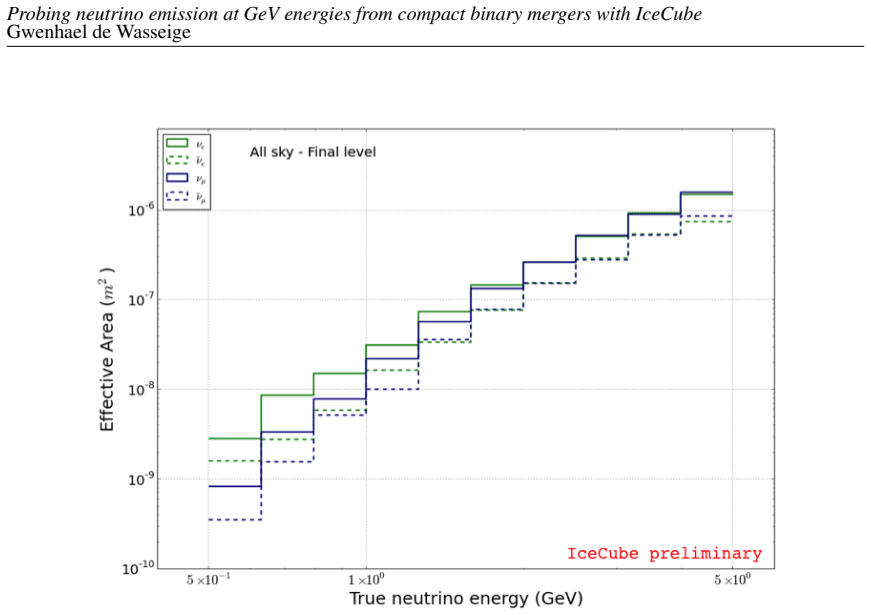
The central mechanism is a low-energy neutrino event selection for IceCube/DeepCore, defined by a sequence of cuts: standard high-energy filters (1400 Hz to 15 Hz), an upper bound on the number of triggered optical modules, a causality requirement on hit pairs consistent with the speed of light in ice with scattering, and topology variables (interaction depth, local charge, total charge). This selection is what carries the argument; its simulated efficiency (Fig. 2) and effective area (Fig. 3) convert a null event count into a fluence upper limit via the assumed $E^{-2}$ spectrum.
What would settle it
Run the GeV event selection on a year of IceCube data and count events in the 1–5 GeV atmospheric neutrino band; the observed rate should match the roughly mHz prediction made from the simulation. A discrepancy beyond statistical uncertainty would show the effective area in Fig. 3 is not correct and would invalidate the quoted upper limits.
Extended reading notes
Core claim
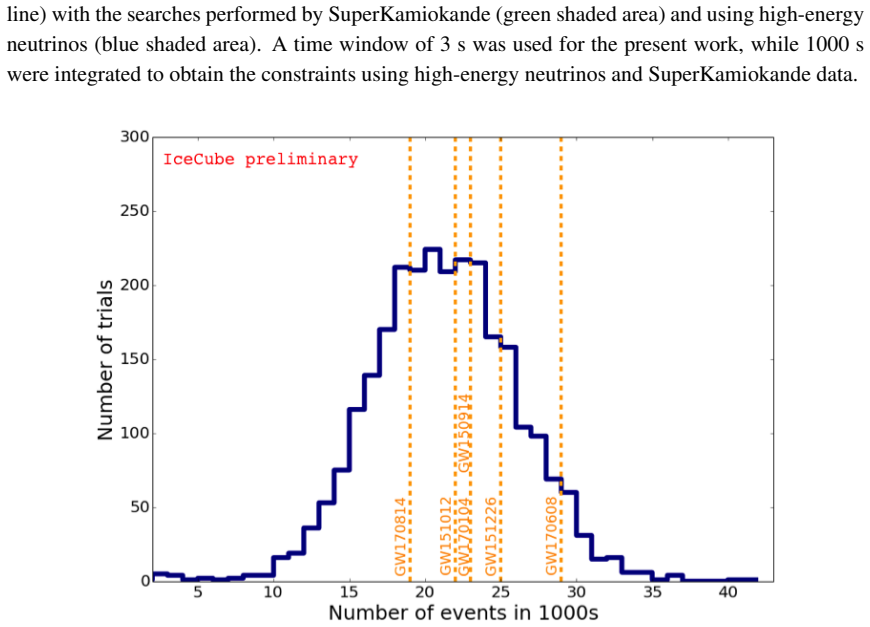
The central claim is that IceCube can be made sensitive to GeV neutrinos by a new selection of events in DeepCore. The selection first uses standard IceCube filters to reduce the atmospheric muon background from 1400 Hz to 15 Hz while retaining 98% of GeV neutrino events, then imposes a small number of causally connected optical modules and a causality condition between pairs of hits, cutting noise from 6 Hz to 0.2 Hz, and finally applies depth, charge, and event-topology cuts to reach a rate of 0.02 Hz. The resulting effective area is reported in Fig. 3, and the passing fraction exceeds 40% for neutrinos below 5 GeV, optimized between 1 and 2.5 GeV. The paper then applies this selection to the LVC catalog: for BNS and NSBH mergers, zero events are found in the [t, t+3s] window, which is interpreted as an upper limit of $1.84 \times 10^{7}$ MeV$^{-1}$ cm$^{-2}$ integrated over 3 s in the 500 MeV–5 GeV range; for BBH mergers in a $\pm 500$ s window, all events are consistent with background, with GW170608 in the 5% tail, leading to an upper limit of $5.0 \times 10^{4}$ MeV$^{-1}$ cm$^{-2}$. The paper presents this as the first validation of a GeV neutrino search in IceCube.
Load-bearing premise
The selection's efficiency and effective area come entirely from computer simulations of neutrino interactions and detector noise, and the paper shows no comparison of the selected GeV sample against real data; if those simulations misrepresent how IceCube responds at GeV energies, every fluence limit derived from the null observations would be wrong.
Editorial extensions
If this is right
- IceCube's energy reach for astrophysical neutrino searches now extends below 1 GeV, making coincident low-energy neutrino searches possible for gravitational-wave and gamma-ray transient events.
- The null prompt search places the first upper limits on GeV neutrino fluence from BNS/NSBH mergers, constraining hadronic acceleration and the matter environment around the merger site.
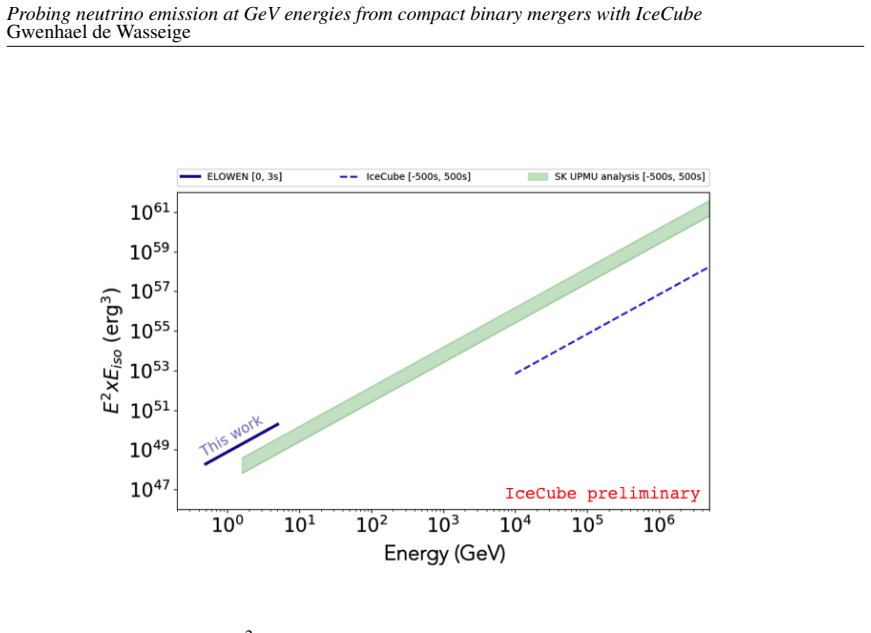
- The upper limits complement, rather than compete with, Super-Kamiokande and high-energy neutrino telescope limits by probing a different energy band and thus different production mechanisms.
- The same selection can be applied to future gravitational-wave events; as LIGO/Virgo sensitivity grows, the accumulated exposure will tighten these limits.
- With KM3NeT and IceCube-Upgrade, the paper expects lower triggers and better reconstruction, straightforwardly improving GeV-regime sensitivity.
Reading between the lines
- Beyond the paper: because the event selection's efficiency comes entirely from simulation, a calibration sample of atmospheric neutrinos in the 1–5 GeV band would provide a direct check of the reported effective area; the paper does not present such a data/MC comparison.
- Beyond the paper: the 3 s prompt window is tied to the 1.7 s delay of the GRB in GW170817; a source with delayed accretion or a longer-lived cocoon could emit GeV neutrinos over minutes, so the null result does not constrain those scenarios.
- Beyond the paper: if the assumed $E^{-2}$ spectrum is wrong, the quoted fluence limits do not directly apply; for a softer spectrum, the sensitivity at the lower edge of the 500 MeV–5 GeV band would degrade, so the limit is spectrum-dependent.
- Beyond the paper: applying this selection to a known gamma-ray burst with observed GeV photons would offer a test of the neutrino production mechanism: a correlation of neutrino count with GeV gamma fluence would support hadronic models.
Signed reviews
Editorial analysis
A structured set of objections, weighed in public.
Referee Report
Summary. This ICRC2019 proceedings paper presents a search for GeV-scale astrophysical neutrinos from compact binary mergers detected by LIGO/Virgo, using a new low-energy event selection in IceCube/DeepCore. The selection is built from GENIE 2.8.6 neutrino simulations and a detector-noise simulation, yielding the reported effective areas and passing fractions for electron and muon neutrinos. For the three BNS/NSBH mergers in the sample, zero events are found in the [t, t+3 s] prompt window, and the paper quotes an upper limit on the neutrino fluence in the 0.5-5 GeV range. An extended ±500 s search over BBH mergers yields another limit. The results are compared with Super-Kamiokande and high-energy neutrino constraints.
Significance. If the quantitative results are correct, this is an interesting proof of principle that IceCube can be sensitive to sub-GeV/GeV neutrinos, opening a new multi-messenger window. The paper has clear strengths: the null observation is robust, the assumed E^-2 source spectrum is stated, public LIGO/Virgo merger times are used, and the comparison with existing constraints is useful. However, the numerical limits are not reproducible from the text as printed, and the effective area and event-selection efficiency rest entirely on simulation with no data/MC closure or systematic uncertainties. The significance of the headline numbers is therefore not yet established, even though the new direction itself is valuable.
major comments (3)
- [Section 2.1] The GeV event selection and its efficiency rest entirely on GENIE 2.8.6 neutrino simulations and a detector-noise simulation; no data/MC closure or systematic uncertainty is shown. The final sample is noise-dominated before the final cuts (6 Hz of noise survives after the first stage, 0.2 Hz after applying causality, and 0.02 Hz final), so even a modest mismodeling of the noise correlations or of the low-energy light yield would scale the effective area in Figure 3. Because the search is a null count, every quoted fluence limit scales inversely with that effective area. Please add a data/MC comparison of the final event rate and of the distributions of the discriminating variables, or state explicitly that the quoted limits are preliminary and do not include this uncertainty.
- [Section 3.1] The headline limit, '1.84 x 10^7 neutrinos MeV^-1 cm^-2', cannot be reproduced from the information in the text, and the units are nonstandard. For a zero-count search over a 3 s window with an effective area of the magnitude implied by Figure 3, a 90% confidence upper limit on a differential fluence in the 500 MeV-5 GeV band should be orders of magnitude smaller; the printed value appears to have an exponent/sign error. Please provide the explicit limit formula (including the Poisson upper quantile, the assumed background rate, and the energy integral over the assumed E^-2 spectrum) and the numerical result of that calculation.
- [Section 3.2] The extended-window result is presented as an upper limit, but the procedure is not defined. The text states that the data recorded during GW170608 lie in the 5% tail of the background distribution and then quotes a limit of '50 x 10^3 neutrinos MeV^-1 cm^-2'; however, a single event in the 5% tail is not by itself an upper limit, and the same units/exponent problem as in Section 3.1 reappears. Please specify the counting or likelihood method, the confidence level, whether the observed event is included in the limit, and the numerical exposure used.
minor comments (6)
- [Abstract / Section 1] The claim to present the 'first search for GeV astrophysical neutrinos emitted from Compact Binary Mergers' should be qualified, because the Super-Kamiokande limit on GW170817 cited as [4] already covers part of the GeV range; suggest 'first search in IceCube' or 'first search below 1 GeV'.
- [Sections 3.1 and 3.2] The units 'neutrinos MeV^-1 cm^-2' are ambiguous for a fluence limit; please state whether this is a differential fluence per energy bin and, if so, specify the binning and whether the quoted number is a 90% confidence limit.
- [Figure 4] The caption says the present work is shown as a 'blue line' and the high-energy neutrino constraints as a 'blue shaded area'; using two blue entries in the same figure is confusing and should be fixed with distinct colors and/or labels.
- [Table 1] The word 'subthreshold' is misspelled as 'subtreshold', and the table should indicate whether the Fermi-LAT candidate for GW170608 was confirmed as a counterpart or remains a sub-threshold candidate.
- [References] Reference [14] should be 'Glück' rather than 'Glck', and the text should use the standard notation for the GRV98 parton distribution functions.
- [Figure 3 / Section 3.1] The effective area is shown for ν_e and ν_μ, but the prompt limit is said to be 'integrated over the three neutrino flavors'; please state the flavor assumption explicitly and note whether an effective area for ν_τ is included or neglected.
Circularity Check
No circularity: the GeV search is an experimental upper limit from zero coincident events divided by a simulated acceptance, with no parameter fitted to the search data.
full rationale
The derivation chain is not circular. The paper reports a counting search: no neutrino candidates were found in the [t, t+3 s] window for BNS/NSBH mergers, and this null count is converted into a fluence upper limit by dividing by the simulated IceCube effective area. The effective area is a detector-response input, not a quantity derived from the same events that are then 'predicted.' The quoted limits therefore follow from Poisson statistics and simulated acceptance, not from any fit to the search data. The assumed E^-2 spectrum is a stated benchmark assumption used both for the simulation of the passing fraction and for the limit calculation; it is not fitted to the data and is disclosed explicitly. Self-citations to IceCube detector papers and to the noise-simulation thesis are internal references, but they do not define the target claim: the paper does not invoke a self-citation to forbid alternatives or to force its result. The main robustness concern, namely that the simulated effective area is not validated with data/MC closure or systematics, is a correctness risk rather than circularity, because the measurement is still an independent empirical upper limit conditional on that simulated acceptance. No load-bearing step reduces by definition to its own input.
Assumptions & free parameters
free parameters (1)
- Assumed source spectral index =
-2 (assumed, not fitted)
assumptions (4)
- domain assumption GENIE 2.8.6 accurately simulates GeV neutrino interactions, including cross sections, hadronization, and nuclear model, in the IceCube deep ice.
- domain assumption The detector noise simulation, including thermal, radioactive, and correlated scintillation noise, accurately models the accidental-trigger background that dominates the final sample.
- domain assumption A power-law neutrino spectrum with index -2 describes the source emission for the purpose of converting limits to Eiso.
- domain assumption The prompt emission window [t, t+3s] derived from the GW170817 GRB delay is a valid search window for all BNS/NSBH mergers.
Cite this review
Pith. "Pith review of Probing neutrino emission at GeV energies from compact binary mergers with IceCube." pith.science (2026). https://pith.science/paper/ETDHBEOD
@misc{pith2026190808299,
  author       = {Pith},
  title        = {Pith review of: Probing neutrino emission at GeV energies from compact binary mergers with IceCube},
  year         = {2026},
  howpublished = {\url{https://pith.science/paper/ETDHBEOD}},
  note         = {Machine review of arXiv:1908.08299}
}
read the original abstract
The advent of Multi-Messenger Astronomy has allowed for new types of source searches within the neutrino community. We present the results of the first search for GeV astrophysical neutrinos emitted from Compact Binary Mergers, i.e. binary black hole or binary neutron star mergers, detected by the LIGO and Virgo interferometers. We introduce a new approach that lowers the energy threshold of IceCube from roughly 10 GeV to <1 GeV. This method uses an innovative event selection of GeV neutrino events in IceCube and searches for a statistically significant increase in the amount of GeV-like events detected around the Compact Binary Merger time. We compare our results with constraints set by high-energy neutrino searches, and describe the complementarity of these low and high-energy searches.
Figures


Figures from the paper (2 more)
Reference graph
Works this paper leans on
-
[1]
LIGO Scientific Collaboration and Virgo Collaboration, Phys. Rev. Lett. 116, 061102 (2016)
work page 2016
- [2]
- [3]
-
[4]
SuperKamiokande Collaboration, Astrophys. J. 857 (2018) no.1, L4
work page 2018
-
[5]
IceCube Collaboration, M. G. Aartsen et al. JINST 12 (2017), P03012
2017
-
[6]
IceCube Collaboration, R. Abbasi et al., Astropart. Phys. 35 (2012) 615
work page 2012
-
[7]
M. W. E. Smith et al., Astropart. Phys. 45 (2013) 56
work page 2013
-
[8]
IceCube Collaboration, M. G. Aartsen et al., Astropart. Phys. 92 (2017) 30
work page 2017
Show all 21 references
-
[9]
The IceCube, Fermi-LAT, MAGIC, AGILE, ASAS-SN, HA WC, H.E.S.S, INTEGRAL, Kanata, Kiso, Kapteyn, Liverpool telescope, Subaru, Swift/NuSTAR, VERITAS, VLA/17B-403 teams, Science 361, eaat1378 (2018)
2018
-
[10]
Andreopoulos et al., Nucl
C. Andreopoulos et al., Nucl. Instrum. Meth. A614 (2010) 87
2010
-
[11]
T. Yang, C. Andreopoulos, H. Gallagher, and P. Kehayias, AIP Conf. Proc. 967 (2007) 269
2007
-
[12]
Z. Koba, H. B. Nielsen, and P. Olesen, Nucl. Phys. B40 (1972) 317
1972
-
[13]
Sjostrand, S
T. Sjostrand, S. Mrenna, and P. Z. Skands, JHEP 05 (2006) 026
2006
-
[14]
M. Glck, E. Reya, and A. V ogt, Eur. Phys. J.C5 (1998) 461
1998
-
[15]
Larson, Ph.D thesis, University of Alabama, Tuscaloosa (2013)
M. Larson, Ph.D thesis, University of Alabama, Tuscaloosa (2013)
2013
-
[16]
GCN 21227 - LIGO/Virgo G288732: Fermi-LAT detection of a weak candidate, https://gcn.gsfc.nasa.gov/other/G288732.gcn3
-
[17]
LIGO Scientific Collaboration and Virgo Collaboration, Phys. Rev. Lett. 119, 161101 (2017)
2017
-
[18]
ANTARES and IceCube and Pierre Auger and LIGO Scientific and VirgoCollaborations, Astrophys. J. 850 (2017) 2
2017
-
[19]
Baret et al., Phys
B. Baret et al., Phys. Rev. D 85, 103004 (2012)
2012
-
[20]
Adriàn-Martinez et al., Journal of Physics G: Nuclear and Particle Physics, 43 (2016), 8
KM3NeT Collaboration, S. Adriàn-Martinez et al., Journal of Physics G: Nuclear and Particle Physics, 43 (2016), 8
2016
-
[21]
IceCube Collaboration, PoS(ICRC2019)1031 (these proceedings). 8
Reviewed August 14, 2026 · model on record in the stance chip above.
Discussion (0). Continue with ORCID to comment.