REVIEW 3 major objections 3 minor 14 references
Torus orbit closures in flag varieties and retractions on Weyl groups
T0 review · 3 major / 3 minor · reviewed 2026-08-14 · deepseek-v4-flash
Pith's one-line read Geometric limits of torus actions on flag varieties and the closest-point retraction of a Coxeter matroid define the same map on the Weyl group.
desk verdict The geometric retraction result is worth keeping; the algebraic retraction theorem is false for B/C/D because Lemma 5.4 fails. read the letter →
The pith
A machine-rendered reading of the paper's core claim, the machinery that carries it, and where it could break.
The reading
What carries the argument
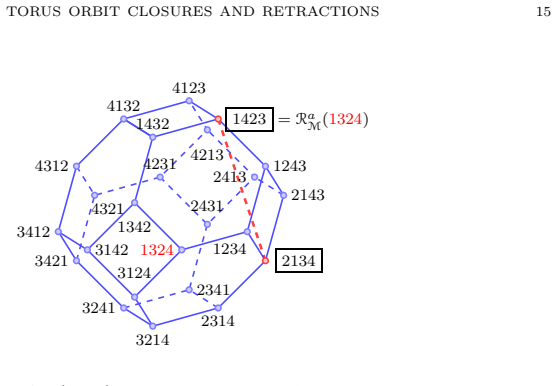
The load-bearing object is the Coxeter matroid retraction R^m_M, defined by the Minimality Property: for each u, exactly one element of M is minimal in the u-twisted Bruhat order ≤_u. The proof that R^g_Y=R^m_{Y^T} is carried by the Bruhat decomposition into cells A^u_w = uB^-$u^{{-1}}$wB/B: if x lies in A^u_w then the limit defining R^g_Y(u) is w, and the T-fixed points of the closure of A^u_w form the interval {v : w ≤_u v ≤_u u w_0}, so w is the unique ≤_u-minimal fixed point. The algebraic retraction R^a_M is carried by the u-lexicographic order ≺_u on one-line notation, which is compatible with Bruhat order in classical types; that compatibility plus left-invariance yields Lemma 5.5 and Theorem 5.7. All three constructions land in the same map because each picks the unique 'first' element of M when M is a Coxeter matroid.
What would settle it
Compute the T-fixed points of the closure of A^u_w for a non-type-A group such as B_2 or G_2 and compare with the Bruhat interval from w to u w_0; finding any fixed point outside that interval is a concrete counterexample to the equality.
Extended reading notes
Core claim
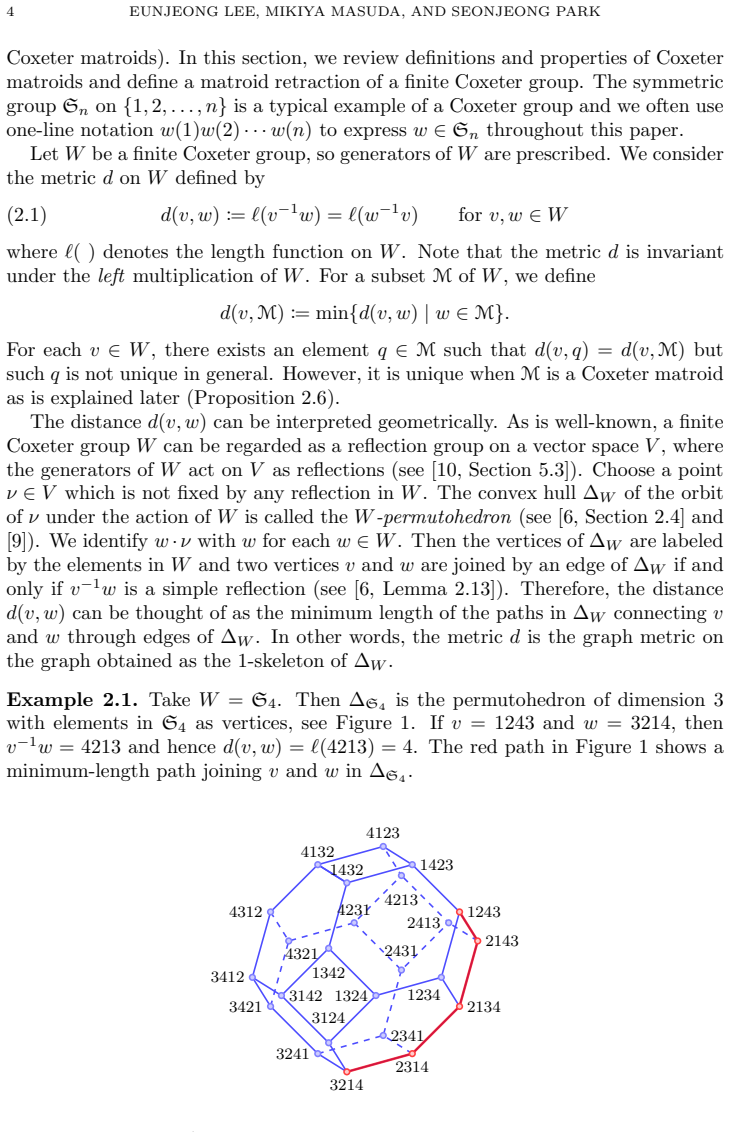
The central claim is that the abstract unique-closest-point retraction on a finite Coxeter group has two concrete incarnations. The paper defines the length metric d(v,w)=ℓ($v^{{-1}}$w), and for a Coxeter matroid M (a subset with a unique u-minimal element for each u) defines the matroid retraction R^m_M(u) as that unique minimal element. Theorem 3.7 states that for any T-orbit closure Y in G/B, the geometric retraction R^g_Y—defined by taking lim_{t→0} λ_u(t)·x for a generic λ_u in the chamber C(u)—equals R^m_{Y^T}. Theorem 5.7 states that for any Coxeter matroid M in a product of classical Weyl groups, the algebraic retraction R^a_M, given by the ≺_u-lexicographic minimum, equals R^m_M. Along the way the paper reformulates the geometric retraction through Bruhat cells A^u_w, uses the Gelfand–Serganova polytope criterion, shows every Bruhat interval is representable, and exhibits a non-representable Coxeter matroid in S_7 built from the Fano plane.
Load-bearing premise
The proof of the geometric–matroid equality assumes that the closure of each Bruhat cell A^u_w contains exactly the T-fixed points in the interval from w to u w_0; an extra fixed point anywhere would break the equality.
Editorial extensions
If this is right
- For any torus orbit closure Y, the limit that defines R^g_Y(u) is the unique T-fixed point of Y closest to u in the Coxeter length metric.
- The maximal cone of the fan of Y attached to y∈Y^T is the union of the chambers C(u) over all u with R^g_Y(u)=y; equivalently, the geometric retraction encodes the fan.
- In a product of classical Weyl groups, the algebraic retraction computes the closest-point retraction for every Coxeter matroid without comparing full Bruhat intervals.
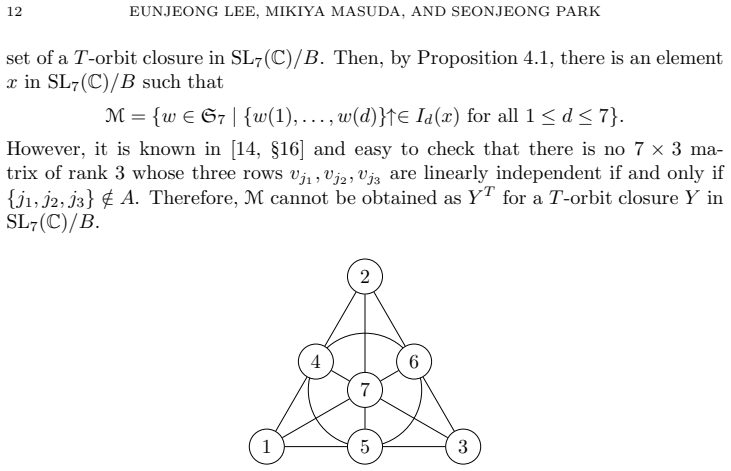
- Every Bruhat interval [v,w] in S_n occurs as the fixed-point set of a torus orbit closure, so Bruhat intervals are representable Coxeter matroids; however, the Fano-plane example gives a Coxeter matroid of S_7 that is not representable.
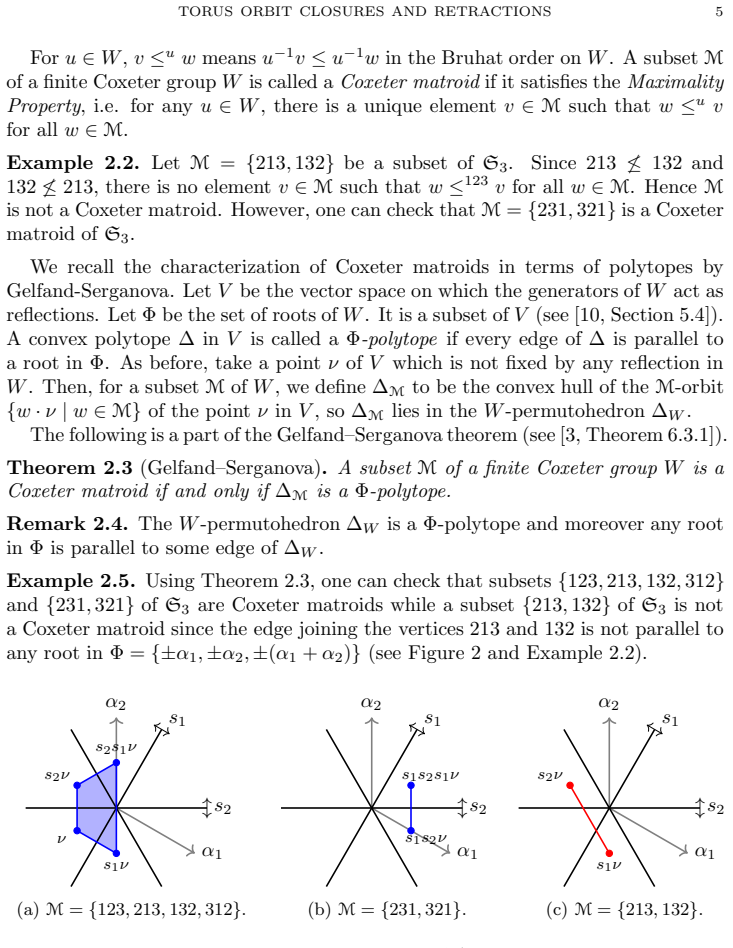
- For two-element subsets of S_n, the two conditions (unique closest point for every u, and that closest point given by R^a_M) characterize Coxeter matroids; the same characterization is open for larger subsets.
Reading between the lines
- Since R^a_M is computed by a lexicographic scan, it gives a practical nearest-point oracle for Coxeter matroids that avoids explicit Bruhat comparisons; the paper does not draw this algorithmic consequence.
- The S_7 example suggests the obstruction to representability is exactly the non-realizability of the underlying ordinary matroid; checking all small-rank Coxeter matroids against this condition would test that identification.
- The equality R^g=R^m implies the fan of a torus orbit closure can be reconstructed purely combinatorially from the fixed-point matroid; one could try to compute toric invariants of Y from R^m without coordinates.
Signed reviews
Editorial analysis
A structured set of objections, weighed in public.
Referee Report
Summary. The paper studies retractions of a finite Coxeter group W onto a Coxeter matroid M. It defines a matroid retraction R^m_M via the Bruhat-order Minimality Property, a geometric retraction R^g_Y for torus orbit closures Y in G/B, and an algebraic retraction R^a_M for Weyl groups of classical Lie type defined by a lexicographic order. The main claims are Theorem A (R^g_Y = R^m_{Y^T}) and Theorem B (R^a_M = R^m_M for every Coxeter matroid M in a product of classical Weyl groups). The paper also discusses representability of Coxeter matroids and gives a partial characterization of two-element Coxeter matroids in S_n.
Significance. The geometric result, if correct, gives a clean toric-geometric realization of the matroid retraction and would be a useful bridge between Coxeter matroid theory and torus orbit closures. The algebraic retraction is an appealing combinatorial construction, and its equality with the matroid retraction would provide an explicit algorithm for closest-point retractions in classical types. However, the central algebraic claim is false as stated: the lexicographic order in Lemma 5.4 does not refine Bruhat order outside type A, and the paper's Theorem B fails already in type B_2. The manuscript therefore cannot fulfill its main advertised contribution, although Theorem A appears salvageable after correcting a notational gap in equation (3.8).
major comments (3)
- [§5, Lemma 5.4] Lemma 5.4 is false for W of type B_2, so its conclusion v <_u w implies v ≺_u w does not hold for signed classical types. Let s_0 be the sign change of coordinate 1 and s_1 the transposition swapping coordinates, and set v = s_1 s_0 = \bar{2}1 and w = s_1 s_0 s_1 = 1\bar{2}. Then v^{-1}w = s_1, so {v,w} is an edge of the W-permutohedron and hence a Coxeter matroid by the Gelfand–Serganova criterion. Since v is a subword of w, v < w in Bruhat order. However, for u = e the order (5.1) is 1 ≺ 2 ≺ \bar{2} ≺ \bar{1}, and comparing one-line words gives w = 1\bar{2} ≺ v = \bar{2}1. Thus v < w does not imply v ≺_e w. The proof of Lemma 5.4 relies on the type-A criterion 'v ≤ w iff sorted d-subsets are coordinatewise ≤', which is not valid for types B, C, and D.
- [§5, Theorem 5.7 and Lemma 5.5] Theorem 5.7 is false as stated. Using the same elements v = \bar{2}1 and w = 1\bar{2} in B_2, take M = {v,w}. This M is a Coxeter matroid because its two vertices are joined by an edge parallel to a root. For u = e, the unique Bruoth-minimal element of M is v, so R^m_M(e) = v. But with the lexicographic order (5.1), w is smaller than v, so R^a_M(e) = w. Hence R^a_M(e) ≠ R^m_M(e), contradicting Theorem 5.7. The proof of Theorem 5.7 goes through Lemma 5.5, whose proof depends on Lemma 5.4; the failure of Lemma 5.4 therefore invalidates the algebraic-retraction theorem outside type A. The same construction embeds into B_n and D_n by including extra coordinates, so the problem is not a rank-2 artifact.
- [§3, equation (3.8) and proof of Theorem 3.7] Equation (3.8) is written as A^u_w = ⨆_{w ≤_u v ≤_u u w_0} A^u_v, and the following sentence asserts (A^u_w)^T = {v | w ≤_u v ≤_u u w_0}. As written this is false: the open Bruhat cell A^u_w is not equal to the union of cells in its closure, and its T-fixed points are not the entire interval. The correct statement is that \overline{A^u_w} is the disjoint union of the A^u_v over that interval, and hence (\overline{A^u_w})^T is the interval. The proof of Theorem 3.7 uses exactly the closure interpretation: from T·x ⊆ A^u_w the closure Y satisfies Y ⊆ \overline{A^u_w}, so Y^T is contained in the interval. This is a load-bearing notational gap, but it is readily fixed by placing overlines in (3.8) and in the proof.
minor comments (3)
- [Remark 1.2] There is a typo: 'identitity' should be 'identity'.
- [§5, before Definition 5.1] In the sentence 'it tunrs out that R^a_M = R^m_M', 'tunrs' should be 'turns'.
- [References] Reference [1] is corrupted in the typeset text ('Bia/suppress lynicki Birula'); it should read A. Białynicki-Birula.
Circularity Check
No significant circularity: the three retractions are defined independently and the equality theorems are derived from separate geometric and combinatorial input.
full rationale
The central equality R^g_Y = R^m_{Y^T} is not assumed: R^g is defined by torus limits in Proposition 3.1 and (3.4), while R^m is defined independently by Coxeter-matroid minimality in (2.2). Theorem 3.7 proves the equality using the Bruhat-decomposition interval formula (3.8), not by importing it into the definition. Similarly, the algebraic retraction is defined by an explicit lexicographic order (5.1), and Theorem 5.7 derives R^a_M = R^m_M from Lemma 5.4 and Lemma 5.5; the matroid retraction is not built into Definition 5.1. The self-citations to [11] and [12] appear as contextual motivation in Remark 5.2 and in the side discussion of representable Bruhat intervals in Remark 4.3; they are not load-bearing premises of either main theorem. Concerns raised in review, such as equation (3.8) arguably needing the closure of the cell rather than the open cell, or Lemma 5.4's Bruhat criterion failing for signed types B/C/D, are mathematical-correctness issues rather than circularity: a false lemma would refute or invalidate Theorem 5.7, but it would not make the derivation equivalent to its input by construction.
Assumptions & free parameters
assumptions (5)
- domain assumption The T-fixed point set Y^T of a T-orbit closure in G/B is a Coxeter matroid of the Weyl group W (Gelfand-Serganova).
- standard math The characterization of Bruhat order in classical types: v ≤ w iff {v(1),...,v(d)}↑ ≤ {w(1),...,w(d)}↑ for all d < n.
- standard math The Gelfand-Serganova polytope criterion: M is a Coxeter matroid iff the convex hull Δ_M is a Φ-polytope.
- domain assumption If M is a Coxeter matroid of W = ∏W_j, then M = ∏M_j with each M_j a Coxeter matroid of W_j.
- domain assumption The closure of the B_u-cell A^u_w is the union of B_u-cells indexed by the interval [w, u w0] in the ≤_u order.
Cite this review
Pith. "Pith review of Torus orbit closures in flag varieties and retractions on Weyl groups." pith.science (2026). https://pith.science/paper/CQWO7YZC
@misc{pith2026190808310,
  author       = {Pith},
  title        = {Pith review of: Torus orbit closures in flag varieties and retractions on Weyl groups},
  year         = {2026},
  howpublished = {\url{https://pith.science/paper/CQWO7YZC}},
  note         = {Machine review of arXiv:1908.08310}
}
abstract
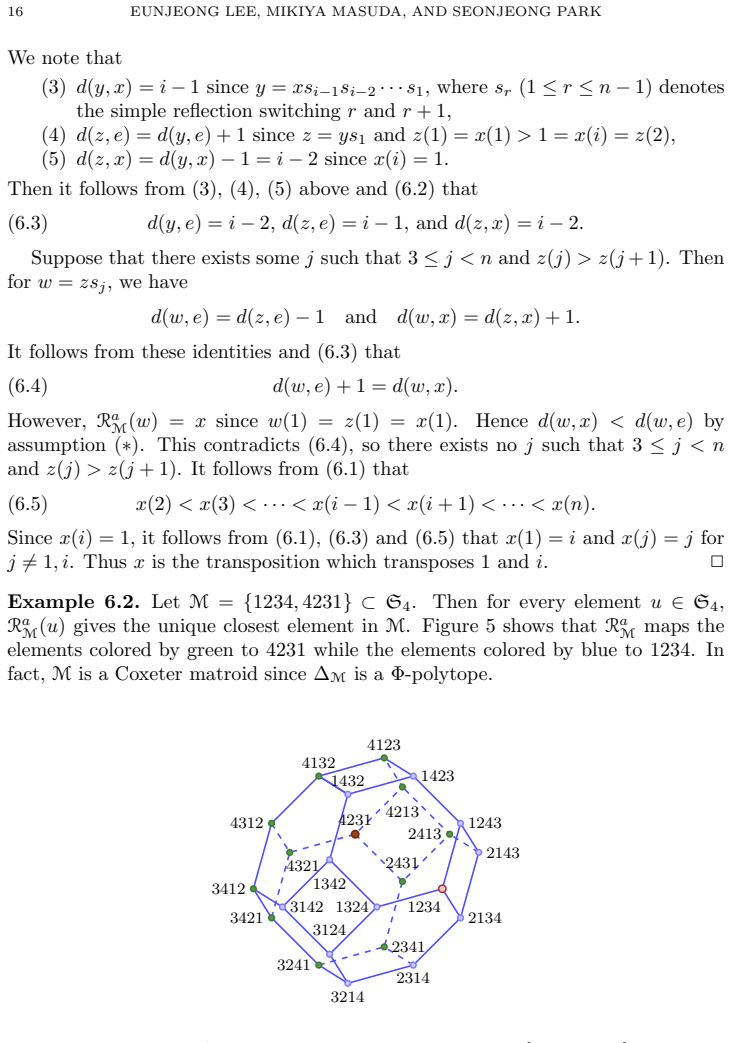
A finite Coxeter group $W$ has a natural metric $d$ and if $\mathcal{M}$ is a subset of $W$, then for each $u\in W$, there is $q\in \mathcal{M}$ such that $d(u,q)=d(u,\mathcal{M})$. Such $q$ is not unique in general but if $\mathcal{M}$ is a Coxeter matroid, then it is unique, and we define a retraction $\mathcal{R}^m_{\mathcal{M}}\colon W\to \mathcal{M}\subset W$ so that $\mathcal{R}^m_{\mathcal{M}}(u)=q$. The $T$-fixed point set $Y^T$ of a $T$-orbit closure $Y$ in a flag variety $G/B$ is a Coxeter matroid, where $G$ is a semisimple algebraic group, $B$ is a Borel subgroup, and $T$ is a maximal torus of $G$ contained in $B$. We define a retraction $\mathcal{R}^g_{Y}\colon W\to Y^T\subset W$ geometrically, where $W$ is the Weyl group of $G$, and show that $\mathcal{R}^g_{Y}=\mathcal{R}^m_{Y^T}$. We introduce another retraction $\mathcal{R}^a_{\mathcal{M}}\colon W\to \mathcal{M}\subset W$ algebraically for an arbitrary subset $\mathcal{M}$ of $W$ when $W$ is a Weyl group of classical Lie type, and show that $\mathcal{R}^a_{\mathcal{M}}=\mathcal{R}^m_{\mathcal{M}}$ when $\mathcal{M}$ is a Coxeter matroid.
Figures
Figures from the paper (2 more)
Reference graph
Works this paper leans on
-
[1]
A. Bia/suppress lynicki Birula. Some theorems on actions of algebraic groups. Ann. of Math. (2) , 98:480–497, 1973
work page 1973
-
[2]
S. Billey and V. Lakshmibai. Singular loci of Schubert varieties . volume 182 of Progress in Mathematics. Birkh¨ auser Verlag, Basel, 2000
work page 2000
-
[3]
A. V. Borovik, I. M. Gelfand, and N. White. Coxeter matroids , volume 216 of Progress in Mathematics. Birkh¨ auser Boston, Inc., Boston, MA, 2003
work page 2003
-
[4]
J. B. Carrell and A. Kurth. Normality of torus orbit closu res in G/P . J. Algebra, 233(1):122– 134, 2000
work page 2000
-
[5]
D. A. Cox, J. B. Little, and H. K. Schenck. Toric varieties, volume 124 of Graduate Studies in Mathematics . American Mathematical Society, Providence, RI, 2011
work page 2011
-
[6]
S. Fomin and N. Reading. Root systems and generalized associahedra. In Geometric combina- torics, volume 13 of IAS/Park City Math. Ser. , pages 63–131. Amer. Math. Soc., Providence, RI, 2007
work page 2007
-
[7]
I. M. Gel’fand and V. V. Serganova. Combinatorial geomet ries and the strata of a torus on homogeneous compact manifolds. Uspekhi Mat. Nauk , 42(2(254)):107–134, 287, 1987
work page 1987
-
[8]
V. Guillemin, T. Holm, and C. Zara. A GKM description of th e equivariant cohomology ring of a homogeneous space. J. Algebraic Combin. , 23(1):21–41, 2006
work page 2006
Show all 14 references
-
[9]
Hohlweg, C
C. Hohlweg, C. E. M. C. Lange, and H. Thomas. Permutahedra and generalized associahedra. Adv. Math., 226(1):608–640, 2011
2011
-
[10]
J. E. Humphreys. Reflection groups and Coxeter groups . Cambridge studies in advanced mathematics 29, 1990
1990
-
[11]
Lee and M
E. Lee and M. Masuda. Generic torus orbit closures in Sch ubert varieties. J. Combin. Theory Ser. A , 170:105143, 44pp, 2020
2020
-
[12]
E. Lee, M. Masuda, and S. Park. Toric Bruhat interval pol ytopes. arXiv preprint arXiv:1904.10187
1904 arXiv
-
[13]
White, editor
N. White, editor. Theory of matroids , volume 26 of Encyclopedia of Mathematics and its Applications. Cambridge University Press, Cambridge, 1986
1986
-
[14]
H. Whitney. On the abstract properties of linear dependence. Amer. J. Math. , 57(3):509–533, 1935. (E. Lee) Center for Geometry and Physics, Institute for Basic Scienc e (IBS), Pohang 37673, Republic of Korea Email address : eunjeong.lee@ibs.re.kr (M. Masuda) Osaka City Univer...
1935
Reviewed August 14, 2026 · model on record in the stance chip above.
Discussion (0). Continue with ORCID to comment.