REVIEW 2 major objections 5 minor 243 references
Deconstructing Blockchains: A Comprehensive Survey on Consensus, Membership and Structure
T0 review · 2 major / 5 minor · reviewed 2026-08-14 · deepseek-v4-flash
Pith's one-line read The paper claims that any blockchain can be understood as a combination of three components: membership selection, consensus mechanism, and structure.
desk verdict A useful and mostly accurate blockchain survey whose three-component framework is genuinely helpful, but the completeness claim should be softened to 'most systems' given the paper's own ancillary-components section. read the letter →
The pith
A machine-rendered reading of the paper's core claim, the machinery that carries it, and where it could break.
The reading
What carries the argument
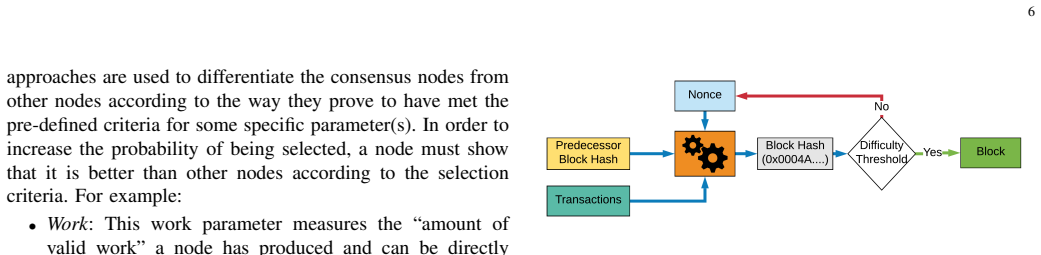
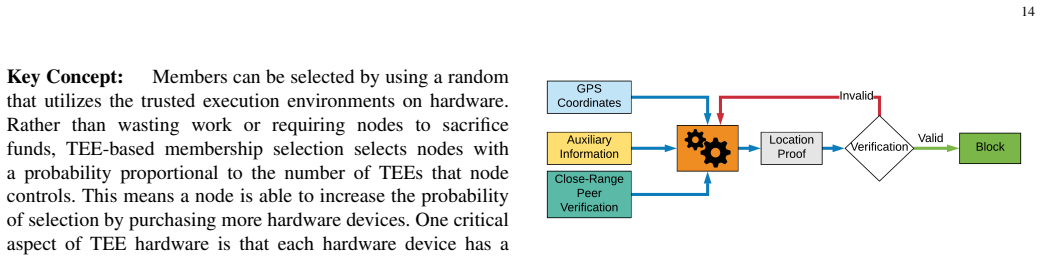
The central object is the decomposition itself: membership selection determines the committee of nodes that runs the consensus, consensus mechanism decides the block to append, and structure represents how the ledger data is organized. The evaluation framework supplies the criteria that make the decomposition operational: network synchrony, online presence, adversary threshold measured in computational power, stake, space, or traditional Byzantine faults, and trust assumptions, together with desired properties such as agreement, termination, validity, and total-order prefix. The classification tables and generic chart for membership selection categories carry the argument by converting a sprawling design space into a small set of dimensions on which systems can be compared.
What would settle it
Find one deployed or formally specified blockchain that cannot be placed in the survey's classification without a forced choice that obscures a security-relevant property, for example a system whose liveness depends on transaction-level mempool ordering inside a block, and show that two systems in the same three-way cell have different safety or liveness guarantees.
Extended reading notes
Core claim
The central claim is that the diverse field of blockchains can be usefully characterized by three decoupled components, and that these three components are the right parameters for evaluation and comparison. The paper classifies membership selection into work-, stake-, capacity-, authority-, hardware-, and location-based variants; consensus into Nakamoto-style probabilistic protocols and BFT-style deterministic protocols; and structure into single chains, parallel chains, directed acyclic graphs, and block lattices. It claims to be the first to classify blockchains by this three-way decomposition, and it provides tables and charts that map leading systems onto these categories together with their system models, properties, and achieved guarantees.
Load-bearing premise
The load-bearing premise is that membership selection, consensus mechanism, and structure are the three critical components whose decomposition is sufficient to compare and classify all known blockchain systems; the paper itself concedes that other components such as cryptography, internal storage, and virtual machines also heavily shape design.
Editorial extensions
If this is right
- New blockchain proposals can be classified and compared along the three axes of membership selection, consensus mechanism, and structure, making their design choices explicit.
- System designers can deliberately combine components from different categories, revealing novel coherent combinations rather than starting from a single template.
- Attacks can be organized by which component they exploit, such as mining-power attacks targeting membership selection or long-range attacks targeting consensus assumptions, giving a structured way to reason about defenses.
- The framework provides a checklist for reading whitepapers that lack formal detail, since each system can be described by its choices on the three axes and the assumptions those choices entail.
- Scalability and security trade-offs become visible as interactions between components, for example the pairing of PoW-based membership selection with BFT consensus and parallel-chain structures in systems like ByzCoin and RepuCoin.
Reading between the lines
- Editorial inference: the same three-axis decomposition could be extended to sharding and cross-chain systems, where membership selection per shard and structure between shards become natural parameters, a direction the paper only sketches in its future outlook.
- Editorial inference: the classification implies a design space of membership-consensus-structure triples, so unexplored combinations may yield protocols with properties not yet seen; testing such combinations would be a direct extension of the survey.
- Editorial inference: the attack taxonomy suggests a unified threat model where each attack is tied to the violation of one component's assumption, which could be tested by checking whether every known blockchain attack fits at least one of the paper's three attack categories.
- Editorial inference: if a counterexample arises in which two systems classified identically on all three axes have materially different safety or liveness behavior, the framework would likely need a fourth axis such as transaction semantics or execution environment, as the paper's own discussion of ancillary components anticipates.
Signed reviews
Editorial analysis
A structured set of objections, weighed in public.
Referee Report
Summary. This paper presents a survey of blockchain systems organized around a three-component decomposition: membership selection, consensus mechanism, and structure. It proposes an evaluation framework based on system models, desired properties, and analysis criteria, applies it to classify membership and consensus mechanisms, reviews blockchain structures, and catalogs attacks on these components. The paper claims to be the first to classify blockchains along these three axes and argues that the framework helps tame the complexity of the current blockchain ecosystem.
Significance. Should the three-component decomposition be accepted as an organizing framework, the survey would be a useful entry point: it covers a wide range of PoW/PoS/TEE-based membership mechanisms, BFT and Nakamoto-style consensus, structural variants, and attacks, with convenient summary tables. The paper's self-described novelty is plausible in its combination of the three axes, even though layered decompositions exist, e.g., the blockchain consensus layer of Abraham and Malkhi. However, the advertised completeness of the decomposition is not established and is contradicted by the paper's own discussion, so the significance depends on re-scoping the claim to a useful partial decomposition rather than a complete deconstruction.
major comments (2)
- [Abstract, §I, §IX, §VIII-E] The completeness claim that anchors the paper's novelty is internally inconsistent. The abstract says the three components are common to all known systems, while §I says common to most known systems, and §IX calls the decomposition a set of 'simple but complete critical components.' Yet §VIII-E explicitly identifies cryptography, internal structures/storage, and virtual machines/platforms as components that 'heavily contribute and influence the design and operation' of blockchains. For systems such as Zcash and Monero the primary differentiators are transaction-privacy cryptography, and for Ethereum the EVM execution model; the three-component taxonomy does not represent these. Since the stated novelty of the paper is precisely this decomposition, the overstatement is load-bearing. The authors should either argue that the ancillary components are subordinate to or derivable from the three named ones, or rephrase the claims as an important but partial organizing framework.
- [§VI and §VIII-B/C] The evaluation framework is applied unevenly across the three components. Membership selection and consensus receive comparative tables (Tables I and III) using the criteria of §III, whereas the structure component is covered only by short narrative descriptions in §VI and by qualitative remarks in §VIII-B and §VIII-C. Given that the paper's contribution is explicitly a tripartite decomposition with 'an evaluation framework ... using the decoupled components as parameters,' the absence of an equally systematic treatment of structure makes the framework incomplete as presented. At minimum, the paper should state why structure is handled only qualitatively, or add a summary table for structure along the same dimensions.
minor comments (5)
- [§IV-A.1.1] The description of Bitcoin mining says the input is 'the combination of the nonce and the new block hash'; the block hash is the output of the hash, not an input, so this should be phrased as hashing the block header (which includes the nonce, the previous block hash, and the Merkle root).
- [Figure 1] Figure 1 is not legible in the provided version; a higher-resolution or vector version with readable labels is needed if it is meant to give the promised 'clear and unique landscape of blockchains.'
- [Tables IV–VI] The attack tables would be easier to use if each row explicitly cited the paper or source that introduced the attack, rather than relying on citations only in the prose sections.
- [§V-C.1] The description of PBFT would be more self-contained if it explained why 3f+1 replicas are needed and what role the view-change timers play, since these points are used later in the discussion of leader-based BFT blockchains.
- [§VIII-G] The statement that 'currently, all mainstream blockchains are PoW-based' should be qualified with a date or a phrase such as 'at the time of writing,' since the claim was already becoming less accurate during the period covered by the survey.
Circularity Check
No significant circularity: the survey's three-component taxonomy is a stated organizing assumption, not a result derived from its own inputs.
full rationale
This paper is a survey and taxonomy, not a derivation chain. Its central contribution is a decomposition of blockchains into membership selection, consensus mechanism, and structure, followed by a comparative analysis of known systems under that framework. The decomposition is introduced as a definitional framing in Section I ('the deconstruction of the blockchain into three simple, critical components common to most known systems: membership selection, consensus mechanism, and structure') and then applied uniformly to external and self-authored systems. There is no fitted parameter, no predicted quantity, and no formal theorem whose conclusion is equivalent to its premises. The paper does cite several works by its own authors (e.g., RepuCoin [221], RedBelly/DBFT [59,60], and Attack of the Clones [75]), but these citations are descriptive uses for particular systems or attacks and are not load-bearing for the framework itself; removing them would not change the decomposition or the evaluation criteria. The abstract and introduction also claim the three components are 'common to all known systems' while Section VIII-E lists other components, such as cryptography and virtual machines, as also heavily influencing blockchain design. That is a potential scope or consistency concern, but it is a correctness issue about the completeness of the taxonomy, not a circularity: the survey does not define membership selection, consensus, or structure in terms of the conclusions it draws, nor does it present a fitted input as a prediction. No specific equation, construction, or cited uniqueness theorem makes the paper's central claim reduce to its own inputs. Therefore, the honest finding is no significant circularity.
Assumptions & free parameters
assumptions (1)
- domain assumption Blockchains can be fully characterized by three components: membership selection, consensus mechanism, and structure.
Cite this review
Pith. "Pith review of Deconstructing Blockchains: A Comprehensive Survey on Consensus, Membership and Structure." pith.science (2026). https://pith.science/paper/7LCPMKKD
@misc{pith2026190808316,
  author       = {Pith},
  title        = {Pith review of: Deconstructing Blockchains: A Comprehensive Survey on Consensus, Membership and Structure},
  year         = {2026},
  howpublished = {\url{https://pith.science/paper/7LCPMKKD}},
  note         = {Machine review of arXiv:1908.08316}
}
read the original abstract
It is no exaggeration to say that since the introduction of Bitcoin, blockchains have become a disruptive technology that has shaken the world. However, the rising popularity of the paradigm has led to a flurry of proposals addressing variations and/or trying to solve problems stemming from the initial specification. This added considerable complexity to the current blockchain ecosystems, amplified by the absence of detail in many accompanying blockchain whitepapers. Through this paper, we set out to explain blockchains in a simple way, taming that complexity through the deconstruction of the blockchain into three simple, critical components common to all known systems: membership selection, consensus mechanism and structure. We propose an evaluation framework with insight into system models, desired properties and analysis criteria, using the decoupled components as criteria. We use this framework to provide clear and intuitive overviews of the design principles behind the analyzed systems and the properties achieved. We hope our effort will help clarifying the current state of blockchain proposals and provide directions to the analysis of future proposals.
Figures


Figures from the paper (12 more)




Reference graph
Works this paper leans on
-
[1]
AntMiner R4
“AntMiner R4.” [Online]. Available: https:// asicminermarket.com/product/antminer-r4-mute-8ths/
-
[2]
Bitshares
“Bitshares.” [Online]. Available: https://bitshares.org
-
[3]
Cardano
“Cardano.” [Online]. Available: https://www.cardano. org/en/home/
-
[4]
Available: https://www.dash.org/
“Dash.” [Online]. Available: https://www.dash.org/
-
[5]
Dogecoin
“Dogecoin.” [Online]. Available: https://dogecoin.com/
-
[6]
Available: https://eos.io
“EOS.” [Online]. Available: https://eos.io
-
[7]
Ledger Wallet
“Ledger Wallet.” [Online]. Available: https://www. ledger.com
-
[8]
Available: https://lisk.io/
“Lisk.” [Online]. Available: https://lisk.io/
Show all 243 references
-
[9]
Available: https://neo.org/
“Neo.” [Online]. Available: https://neo.org/
-
[10]
Available: https://ripple.com/
“Ripple.” [Online]. Available: https://ripple.com/
-
[11]
Available: https://steem.io/
“Steem.” [Online]. Available: https://steem.io/
-
[12]
Trezor hardware wallet
“Trezor hardware wallet.” [Online]. Available: https: //trezor.io
-
[13]
Verge currency
“Verge currency.” [Online]. Available: https: //vergecurrency.com/
-
[14]
Waves platform
“Waves platform.” [Online]. Available: https: //wavesplatform.com/
-
[15]
Web Assembly
“Web Assembly.” [Online]. Available: https: //webassembly.org
-
[16]
Raiden Network Overview,
“Raiden Network Overview,” 2015. [Online]. Available: https://raiden.network/faq.html
2015
-
[17]
Moderately hard, memory-bound functions,
M. Abadi, M. Burrows, and T. Wobber, “Moderately hard, memory-bound functions,” in Proceedings of the Network and Distributed System Security Symposium, NDSS 2003, San Diego, California, USA , 2003
2003
-
[18]
The blockchain consensus layer and BFT,
I. Abraham and D. Malkhi, “The blockchain consensus layer and BFT,” Bulletin of the EATCS , vol. 123,
-
[19]
Solida: A blockchain protocol based on reconfigurable byzantine consensus,
I. Abraham, D. Malkhi, K. Nayak, L. Ren, and A. Spiegelman, “Solida: A blockchain protocol based on reconfigurable byzantine consensus,” in 21st In- ternational Conference on Principles of Distributed Systems, OPODIS 2017, Lisbon, Portugal, December 18-20, 2017, 2017, pp. 25:1–25:19
2017
-
[20]
PBFT vs proof-of- authority: Applying the CAP theorem to permissioned blockchain,
S. D. Angelis, L. Aniello, R. Baldoni, F. Lombardi, A. Margheri, and V . Sassone, “PBFT vs proof-of- authority: Applying the CAP theorem to permissioned blockchain,” in Proceedings of the Second Italian Conference on Cyber Security, Milan, Italy, February 6th - to - 9th, 2018....
2018
-
[21]
Hijack- ing Bitcoin: Routing attacks on cryptocurrencies,
M. Apostolaki, A. Zohar, and L. Vanbever, “Hijack- ing Bitcoin: Routing attacks on cryptocurrencies,” in 2017 IEEE Symposium on Security and Privacy (S&P) . IEEE, 2017, pp. 375–392
2017
-
[22]
Ripple: Overview and outlook,
F. Armknecht, G. O. Karame, A. Mandal, F. Youssef, and E. Zenner, “Ripple: Overview and outlook,” in International Conference on Trust and Trustworthy Computing. Springer, 2015, pp. 163–180
2015
-
[23]
Enabling blockchain innovations with pegged sidechains,
A. Back, M. Corallo, L. Dashjr, M. Friedenbach, G. Maxwell, A. Miller, A. Poelstra, J. Tim ´on, and P. Wuille, “Enabling blockchain innovations with pegged sidechains,” http://www.opensciencereview. com/papers/123/enablingblockchain-innovations-with- pegged-sidechains, 2014
2014
-
[24]
Bitcoin block withhold- ing attack: Analysis and mitigation,
S. Bag, S. Ruj, and K. Sakurai, “Bitcoin block withhold- ing attack: Analysis and mitigation,” IEEE Transactions 37 on Information Forensics and Security , vol. 12, no. 8, pp. 1967–1978, 2017
1967
-
[25]
The swirlds hashgraph consensus algorithm: Fair, fast, Byzantine fault tolerance,
L. Baird, “The swirlds hashgraph consensus algorithm: Fair, fast, Byzantine fault tolerance,”
-
[26]
Consensus in the age of blockchains,
S. Bano, A. Sonnino, M. Al-Bassam, S. Azouvi, P. McCorry, S. Meiklejohn, and G. Danezis, “Consensus in the age of blockchains,” CoRR, vol. abs/1711.03936,
-
[27]
State machine replication in the libra blockchain,
M. Baudet, A. Ching, A. Chursin, G. Danezis, F. Garillot, Z. Li, D. Malkhi, O. Naor, D. Perelman, and A. Sonnino, “State machine replication in the libra blockchain,” 2019. [On- line]. Available: https://developers.libra.org/docs/state- machine-replication-paper
2019
-
[28]
Proof of Activity: Extending Bitcoin’s Proof of Work via Proof of Stake [Extended Abstract],
I. Bentov, C. Lee, A. Mizrahi, and M. Rosenfeld, “Proof of Activity: Extending Bitcoin’s Proof of Work via Proof of Stake [Extended Abstract],” SIGMETRICS Performance Evaluation Review, vol. 42, no. 3, pp. 34–37, 2014. [Online]. Available: https: //doi.org/10.1145/2695533.2695545
2014
-
[29]
Available: http://arxiv.org/abs/1711
[Online]. Available: http://arxiv.org/abs/1711. 03936
-
[30]
Snow white: Provably secure proofs of stake,
——, “Snow white: Provably secure proofs of stake,” IACR Cryptology ePrint Archive , vol. 2016, p. 919,
2016
-
[31]
Equihash: Asym- metric Proof-of-Work Based on the Generalized Birth- day Problem,
A. Biryukov and D. Khovratovich, “Equihash: Asym- metric Proof-of-Work Based on the Generalized Birth- day Problem,” in 23nd Annual Network and Distributed System Security Symposium, NDSS 2016, San Diego, California, USA, February 21-24, 2016 , 2016
2016
-
[32]
The sleepy model of consensus,
I. Bentov, R. Pass, and E. Shi, “The sleepy model of consensus,” IACR Cryptology ePrint Archive , vol. 2016, p. 918, 2016. [Online]. Available: http: //eprint.iacr.org/2016/918
2016
-
[33]
Bitcoin Wiki: Difficulty,
“Bitcoin Wiki: Difficulty,” 2018, https://en.bitcoin.it/ wiki/Difficulty
2018
-
[34]
Available: http://eprint.iacr.org/2016/ 919
[Online]. Available: http://eprint.iacr.org/2016/ 919
2016
-
[35]
Delegated proof of stake,
——, “Delegated proof of stake,” 2013-2017. [Online]. Available: http://docs.bitshares.org/bitshares/dpos.html
2013
-
[36]
Bitcoin Core 0.11 Data Storage,
Bitcoin, “Bitcoin Core 0.11 Data Storage,” 2016, updated January 2016. [Online]. Available: https: //en.bitcoin.it/wiki/Bitcoin Core 0.11 (ch 2): Data Storage#The UTXO set .28chainstate leveldb.29
2016
-
[37]
Hashrate distribution,
blockchain.com, “Hashrate distribution,” 2019. [Online]. Available: https://www.blockchain.com/pools
2019
-
[38]
[Online]
Bitshares, 2013-2017. [Online]. Avail- able: https://bitshares.org/technology/delegated-proof- of-stake-consensus/
2013
-
[39]
Using block chain for peer-to-peer proof-of-location,
G. Brambilla, M. Amoretti, and F. Zanichelli, “Using block chain for peer-to-peer proof-of-location,” CoRR, vol. abs/1607.00174, 2016. [Online]. Available: http: //arxiv.org/abs/1607.00174
2016 arXiv
-
[40]
Hashcash - A denial of service counter-measure,
A. Black, “Hashcash - A denial of service counter-measure,” Cypherspace, Tech. Rep., 2002. [Online]. Available: http://www.hashcash.org/papers/ hashcash.pdf
2002
-
[41]
Validator Ordering and Randomness in PoS
V . Buterin, “Validator Ordering and Randomness in PoS.” [Online]. Available: https://vitalik.ca/files/ randomness.html
-
[42]
Why Buy When You Can Rent? - Bribery Attacks on Bitcoin-Style Consensus,
J. Bonneau, “Why Buy When You Can Rent? - Bribery Attacks on Bitcoin-Style Consensus,” in 2016 Interna- tional Workshops on Financial Cryptography and Data Security (FC), BITCOIN, VOTING, and WAHC, Christ Church, Barbados, February 26, 2016, Revised Selected Papers, 2016, pp. 19–26
2016
-
[43]
Light Clients and Proof of Stake,
——, “Light Clients and Proof of Stake,” 2015. [Online]. Available: https://blog.ethereum.org/2015/01/ 10/light-clients-proof-stake/
2015
-
[44]
Tendermint: Byzantine Fault Tolerance in the Age of Blockchains,
E. Buchman, “Tendermint: Byzantine Fault Tolerance in the Age of Blockchains,” Master’s thesis, The Uni- versity of Guelph, 2016
2016
-
[45]
State Tree Pruning,
——, “State Tree Pruning,” 2015. [Online]. Available: https://blog.ethereum.org/2015/06/26/state- tree-pruning/
2015
-
[46]
Long Range Attacks: The Serious Problem with Adaptive Proof-of-Work,
——, “Long Range Attacks: The Serious Problem with Adaptive Proof-of-Work,” 2014. [Online]. Available: https://blog.ethereum.org/2014/05/15/long- range-attacks-the-serious-problem-with-adaptive- proof-of-work/
2014
-
[47]
On public and private blockchains,
——, “On public and private blockchains,” 2015. [Online]. Available: https://blog.ethereum.org/2015/08/ 07/on-public-and-private-blockchains/
2015
-
[48]
The problem of censorship,
——, “The problem of censorship,” 2015. [Online]. Available: https://blog.ethereum.org/2015/06/ 06/the-problem-of-censorship/
2015
-
[49]
Blockchain Con- sensus Protocols in the Wild,
C. Cachin and M. Vukoli ´c, “Blockchain Con- sensus Protocols in the Wild,” CoRR arXiv , vol. abs/1707.01873, 2017. [Online]. Available: http://arxiv.org/abs/1707.01873
2017 arXiv
-
[50]
Casper FFG with one message type, and simpler fork choice rule,
——, “Casper FFG with one message type, and simpler fork choice rule,” 2017. [On- line]. Available: https://ethresear.ch/t/casper-ffg-with- one-message-type-and-simpler-fork-choice-rule/103
2017
-
[51]
Bitcoin Cash,
B. Cash, “Bitcoin Cash,” 2017. [Online]. Available: https://www.bitcoincash.org/#faq-section
2017
-
[52]
Transactions as proof-of-stake & the end of mining,
bytemaster and bitsharestalk.org, “Transactions as proof-of-stake & the end of mining,” 2013. [Online]. Available: https://bitsharestalk.org/index.php? topic=1138.msg13602#msg13602A
2013
-
[53]
Analysis of the XRP ledger consensus protocol,
B. Chase and E. MacBrough, “Analysis of the XRP ledger consensus protocol,” 2018. [Online]. Available: http://arxiv.org/abs/1802.07242
2018 arXiv
-
[54]
Exploring the Monero Peer-to-Peer Network,
T. Cao, J. Yu, J. Decouchant, X. Luo, and P. Ver ´ıssimo, “Exploring the Monero Peer-to-Peer Network,” IACR Cryptology ePrint Archive , vol. 2019, p. 411, 2019. [Online]. Available: https://eprint.iacr.org/2019/411
2019
-
[55]
Traveling the silk road: A measurement 38 analysis of a large anonymous online marketplace,
N. Christin, “Traveling the silk road: A measurement 38 analysis of a large anonymous online marketplace,” in Proceedings of the 22nd International Conference on World Wide Web , ser. WWW ’13. New York, NY , USA: ACM, 2013, pp. 213–224. [Online]. Available: http://doi.acm.org/...
2013
-
[56]
Practical Byzantine Fault Tolerance and Proactive Recovery,
M. Castro and B. Liskov, “Practical Byzantine Fault Tolerance and Proactive Recovery,” ACM Trans. Com- put. Syst., vol. 20, no. 4, pp. 398–461, 2002
2002
-
[57]
Coinbase: Ethereum Classic Double Spending Involved More Than $1.1 Million in Crypto,
CoinTelegraph, “Coinbase: Ethereum Classic Double Spending Involved More Than $1.1 Million in Crypto,” 2019. [Online]. Available: https://cointelegraph.com/news/coinbase-ethereum- classic-double-spending-involved-more-than-11- million-in-crypto
2019
-
[58]
On Security Analysis of Proof-of-Elapsed- Time (PoET),
L. Chen, L. Xu, N. Shah, Z. Gao, Y . Lu, and W. Shi, “On Security Analysis of Proof-of-Elapsed- Time (PoET),” in International Symposium on Stabi- lization, Safety, and Security of Distributed Systems . Springer, 2017, pp. 282–297
2017
-
[59]
DBFT: efficient leaderless byzantine consensus and its application to blockchains,
T. Crain, V . Gramoli, M. Larrea, and M. Raynal, “DBFT: efficient leaderless byzantine consensus and its application to blockchains,” in 17th IEEE International Symposium on Network Computing and Applications, NCA 2018, Cambridge, MA, USA, November 1-3, 2018, 2018, pp. 1–8
2018
-
[60]
Arcade city,
A. City, “Arcade city,” 2018. [Online]. Available: https://arcade.city/
2018
-
[61]
B-money,
W. Dai, “B-money,” 1998. [Online]. Available: http: //www.weidai.com/bmoney.txt
1998
-
[62]
A survey on security and privacy issues of bitcoin,
M. Conti, S. K. E, C. Lal, and S. Ruj, “A survey on security and privacy issues of bitcoin,” IEEE Communications Surveys and Tutorials , vol. 20, no. 4, pp. 3416–3452, 2018. [Online]. Available: https://doi.org/10.1109/COMST.2018.2842460
2018
-
[63]
Ouroboros Praos: An Adaptively-Secure, Semi- synchronous Proof-of-Stake Blockchain,
B. David, P. Ga ˇzi, A. Kiayias, and A. Rus- sell, “Ouroboros Praos: An Adaptively-Secure, Semi- synchronous Proof-of-Stake Blockchain,” in Advances in Cryptology – EUROCRYPT 2018 , J. B. Nielsen and V . Rijmen, Eds. Cham: Springer International Publishing, 2018, pp. 66–98
2018
-
[64]
Evaluating the red belly blockchain,
T. Crain, C. Natoli, and V . Gramoli, “Evaluating the red belly blockchain,” CoRR, vol. abs/1812.11747, 2018. [Online]. Available: http://arxiv.org/abs/1812.11747
2018 arXiv
-
[65]
Information Propaga- tion in the Bitcoin Network,
C. Decker and R. Wattenhofer, “Information Propaga- tion in the Bitcoin Network,” in 2013 IEEE Thirteenth International Conference on Peer-to-Peer Computing (P2P). IEEE, 2013, pp. 1–10
2013
-
[66]
Snow White: Robustly Reconfigurable Consensus and Applications to Provably Secure Proofs of Stake,
P. Daian, R. Pass, and E. Shi, “Snow White: Robustly Reconfigurable Consensus and Applications to Provably Secure Proofs of Stake,” in 23rd International Con- ference on Financial Cryptography and Data Security FC’19 February 1822, 2019 St. Kitts Marriott Resort St. Kitts, 2019
2019
-
[67]
Towards an optimized blockchain for iot,
A. Dorri, S. S. Kanhere, and R. Jurdak, “Towards an optimized blockchain for iot,” in Proceedings of the Second International Conference on Internet-of-Things Design and Implementation. ACM, 2017, pp. 173–178
2017
-
[68]
Bitcoin meets strong consistency,
C. Decker, J. Seidel, and R. Wattenhofer, “Bitcoin meets strong consistency,” in Proceedings of the 17th International Conference on Distributed Computing and Networking. ACM, 2016, p. 13
2016
-
[69]
The sybil attack,
J. R. Douceur, “The sybil attack,” in Peer-to-Peer Sys- tems, P. Druschel, F. Kaashoek, and A. Rowstron, Eds. Berlin, Heidelberg: Springer Berlin Heidelberg, 2002, pp. 251–260
2002
-
[70]
Dhinsa and T
N. Dhinsa and T. Marquez, “Chasyr,” 2017. [Online]. Available: https://www.chasyr.com/
2017
-
[71]
Consensus in the presence of partial synchrony,
C. Dwork, N. A. Lynch, and L. J. Stockmeyer, “Consensus in the presence of partial synchrony,” J. ACM, vol. 35, no. 2, pp. 288–323, 1988. [Online]. Available: http://doi.acm.org/10.1145/42282.42283
1988
-
[72]
Blockchain for iot security and privacy: The case study of a smart home,
A. Dorri, S. S. Kanhere, R. Jurdak, and P. Gauravaram, “Blockchain for iot security and privacy: The case study of a smart home,” in 2017 IEEE International Con- ference on Pervasive Computing and Communications workshops (PerCom workshops). IEEE, 2017, pp. 618– 623
2017
-
[73]
Proofs of space,
S. Dziembowski, S. Faust, V . Kolmogorov, and K. Pietrzak, “Proofs of space,” in 35th Annual Cryptol- ogy Conference (CRYPTO) 2015, Santa Barbara, CA, USA, August 16-20, 2015, Proceedings, Part II , 2015, pp. 585–605
2015
-
[74]
On Memory- Bound Functions for Fighting Spam,
C. Dwork, A. V . Goldberg, and M. Naor, “On Memory- Bound Functions for Fighting Spam,” in 23rd Annual International Cryptology Conference CRYPTO 2003, Santa Barbara, California, USA, August 17-21, 2003, Proceedings, 2003, pp. 426–444
2003
-
[75]
The attack of the clones against proof-of- authority,
——, “The attack of the clones against proof-of- authority,”CoRR, vol. abs/1902.10244, 2019, Presented at EDCON Sydney 2019. [Online]. Available: http: //arxiv.org/abs/1902.10244
1902 arXiv
-
[76]
Pricing via processing or com- batting junk mail,
C. Dwork and M. Naor, “Pricing via processing or com- batting junk mail,” in Annual International Cryptology Conference. Springer, 1992, pp. 139–147
1992
-
[77]
Solidity,
——, “Solidity,” 2014. [Online]. Available: https: //solidity.readthedocs.io/en/latest/
2014
-
[78]
Impact of man-in-the-middle attacks on ethereum,
P. Ekparinya, V . Gramoli, and G. Jourjon, “Impact of man-in-the-middle attacks on ethereum,” in 2018 IEEE 37th Symposium on Reliable Distributed Systems (SRDS). IEEE, 2018, pp. 11–20
2018
-
[79]
Proof-of-stake faq - ethereum,
Ethereum, “Proof-of-stake faq - ethereum,” 2017. [Online]. Available: https://github.com/ethereum/wiki/ wiki/Proof-of-Stake-FAQ
2017
-
[80]
Patricia Tree,
Ethereum, “Patricia Tree,” 2014, updated June 2018. [Online]. Available: https://github.com/ethereum/wiki/ wiki/Patricia-Tree
2014
-
[81]
Light Client Protocol,
Ethereum, J. Ray, V . Buterin, J. McKinney, and Heiko, “Light Client Protocol,” 2014-2018. [Online]. Available: https://github.com/ethereum/wiki/wiki/Light- client-protocol
2014
-
[82]
Ethereum,
“Ethereum,” https://www.ethereum.org/, 2017
2017
-
[83]
Problems,
Ethereum Wiki, “Problems,” 2017. [Online]. Available: https://github.com/ethereum/wiki/wiki/Problems
2017
-
[84]
Sharding FAQs - On Sharding Blockchains,
Ethereum, V . Buterin, J. Ray, T. Ishizaki, and V . Griffith, “Sharding FAQs - On Sharding Blockchains,” 2016-
2016
-
[85]
Majority Is Not Enough: Bitcoin Mining Is Vulnerable,
I. Eyal and E. G. Sirer, “Majority Is Not Enough: Bitcoin Mining Is Vulnerable,” in 18th International Conference on Financial Cryptography and Data Se- curity, FC 2014, Christ Church, Barbados, March 3-7, 2014, Revised Selected Papers , 2014, pp. 436–454
2014
-
[86]
Finney’s attack,
H. Finney, “Finney’s attack,” February 2011. [Online]. Available: https://bitcointalk.org/index.php?topic=3441. msg48384#msg48384
2011
-
[87]
Ethereum 2.0 specs,
Ethereum Foundation. Ethereum, “Ethereum 2.0 specs,”
-
[88]
Available: https://github.com/ethereum/ eth2.0-specs
[Online]. Available: https://github.com/ethereum/ eth2.0-specs
-
[89]
The Bit- coin backbone protocol: Analysis and applications,
J. Garay, A. Kiayias, and N. Leonardos, “The Bit- coin backbone protocol: Analysis and applications,” in Annual International Conference on the Theory and Applications of Cryptographic Techniques . Springer, 2015, pp. 281–310
2015
-
[90]
Bitcoin-NG: A scalable blockchain protocol,
I. Eyal, A. E. Gencer, E. G. Sirer, and R. V . Renesse, “Bitcoin-NG: A scalable blockchain protocol,” in 13th USENIX Symposium on Networked Systems Design and Implementation (NSDI 16). Santa Clara, CA: USENIX 39 Association, Mar. 2016, pp. 45–59
2016
-
[91]
The burst dymaxion,
S. Gauld, F. von Acoina, and R. Stadler, “The burst dymaxion,” 2017. [Online]. Avail- able: https://www.burst-coin.org/wp-content/uploads/ 2017/07/The-Burst-Dymaxion-1.00.pdf
2017
-
[92]
Stake-bleeding attacks on proof-of-stake blockchains,
P. Ga ˇzi, A. Kiayias, and A. Russell, “Stake-bleeding attacks on proof-of-stake blockchains,” in 2018 Crypto Valley Conference on Blockchain Technology (CVCBT). IEEE, 2018, pp. 85–92
2018
-
[93]
Im- possibility of Distributed Consensus with One Faulty Process,
M. J. Fischer, N. A. Lynch, and M. Paterson, “Im- possibility of Distributed Consensus with One Faulty Process,” J. ACM, vol. 32, no. 2, pp. 374–382, 1985
1985
-
[94]
Traceable ring signature,
E. Fujisaki and K. Suzuki, “Traceable ring signature,” in Proceedings of the 10th International Conference on Practice and Theory in Public-key Cryptography , ser. PKC’07. Berlin, Heidelberg: Springer-Verlag, 2007, pp. 181–200. [Online]. Available: http://dl.acm.org/ citation....
2007
-
[95]
Bit- coin blockchain dynamics: The selfish-mine strategy in the presence of propagation delay,
J. G ¨obel, H. Keeler, A. Krzesinski, and P. Taylor, “Bit- coin blockchain dynamics: The selfish-mine strategy in the presence of propagation delay,” Performance Evaluation, July 2016
2016
-
[96]
The Bitcoin backbone protocol with chains of variable difficulty,
J. A. Garay, A. Kiayias, and N. Leonardos, “The Bitcoin backbone protocol with chains of variable difficulty,” in 37th Annual International Cryptology Conference CRYPTO 2017, Santa Barbara, CA, USA, August 20-24, 2017, Proceedings, Part I , 2017, pp. 291–323. [Online]. Availabl...
2017 doi
-
[97]
From blockchain consensus back to Byzantine consensus,
V . Gramoli, “From blockchain consensus back to Byzantine consensus,” Future Generation Computer Systems , 2017. [Online]. Avail- able: http://www.sciencedirect.com/science/article/pii/ S0167739X17320095
2017
-
[98]
How to time-stamp a digital document,
S. Haber and W. S. Stornetta, “How to time-stamp a digital document,” Journal of Cryptology , vol. 3, no. 2, pp. 99–111, Jan 1991. [Online]. Available: https://doi.org/10.1007/BF00196791
1991 doi
-
[99]
On the security and per- formance of proof of work blockchains,
A. Gervais, G. O. Karame, K. W ¨ust, V . Glykantzis, H. Ritzdorf, and S. Capkun, “On the security and per- formance of proof of work blockchains,” inProceedings of the 2016 ACM SIGSAC Conference on Computer and Communications Security, Vienna, Austria, October 24- 28, 2016, 20...
2016
-
[100]
ALGORAND: Scaling Byzantine agreements for cryptocurrencies,
Y . Gilad, R. Hemo, S. Micali, G. Vlachos, and N. Zel- dovich, “ALGORAND: Scaling Byzantine agreements for cryptocurrencies,” in Proceedings of the 26th Sym- posium on Operating Systems Principles . ACM, 2017, pp. 51–68
2017
-
[101]
Eclipse Attacks on Bitcoin’s Peer-to-Peer Network,
E. Heilman, A. Kendler, A. Zohar, and S. Goldberg, “Eclipse Attacks on Bitcoin’s Peer-to-Peer Network,” in 24th USENIX Security Symposium, USENIX Security 15, Washington, D.C., USA, August 12-14, 2015. , 2015, pp. 129–144
2015
-
[102]
Cache Attacks on Intel SGX,
J. G ¨otzfried, M. Eckert, S. Schinzel, and T. M ¨uller, “Cache Attacks on Intel SGX,” in Proceedings of the 10th European Workshop on Systems Security , ser. EuroSec’17. New York, NY , USA: ACM, 2017, pp. 2:1–2:6. [Online]. Available: http://doi.acm.org/10. 1145/3065913.3065915
2017
-
[103]
Managing iot devices us- ing blockchain platform,
S. Huh, S. Cho, and S. Kim, “Managing iot devices us- ing blockchain platform,” in 19th international confer- ence on advanced communication technology (ICACT)
-
[104]
Hyperledger sawtooth journal,
Hyperledger, “Hyperledger sawtooth journal,” 2015-
2015
-
[105]
Evaluat- ing cryptonote-style blockchains,
R. Han, J. Yu, J. K. Liu, and P. Zhang, “Evaluat- ing cryptonote-style blockchains,” in 14th International Conference on Information Security and Cryptology, Inscrypt 2018, Fuzhou, China, December 14-17, 2018, Revised Selected Papers, 2018, pp. 29–48
2018
-
[106]
DFINITY technology overview series, consensus system,
T. Hanke, M. Movahedi, and D. Williams, “DFINITY technology overview series, consensus system,” CoRR, vol. abs/1805.04548, 2018. [Online]. Available: http: //arxiv.org/abs/1805.04548
2018 arXiv
-
[107]
Bank of Montreal, CaixaBank, Commerzbank, Erste Group, IBM and UBS Collaborate to Advance an Open, Blockchain-based Trade Finance Platform,
IBM, “Bank of Montreal, CaixaBank, Commerzbank, Erste Group, IBM and UBS Collaborate to Advance an Open, Blockchain-based Trade Finance Platform,”
-
[108]
Cryptanalysis of curl-p and other attacks on the IOTA cryptocurrency,
E. Heilman, N. Narula, G. Tanzer, J. Lovejoy, M. Colavita, M. Virza, and T. Dryja, “Cryptanalysis of curl-p and other attacks on the IOTA cryptocurrency,” IACR Cryptology ePrint Archive , vol. 2019, p. 344,
2019
-
[109]
Ethereum Development Tutorial,
H. Ibrahim, J. Ray, liuxiopai, kakousis, A. Xiong, F. V ogelsteller, L. Zeug, K. Chia, H. C. Stockhausen, B. Joseff, jn pn, ghasshee, V . buterin, J. Kwon, and G. Wood, “Ethereum Development Tutorial,” 2014-
2014
-
[110]
Intel software guard extensions,
Intel, “Intel software guard extensions,” 2014. [Online]. Available: https://software.intel.com/en-us/sgx
2014
-
[111]
IEEE, 2017, pp. 464–467
2017
-
[112]
Proof of elapsed time,
Intelledger, “Proof of elapsed time,” 2016. [Online]. Available: https://intelledger.github.io/introduction.html
2016
-
[113]
Available: https://sawtooth.hyperledger
[Online]. Available: https://sawtooth.hyperledger. org/docs/core/releases/1.0/architecture/journal.html
-
[114]
Hyperledger,
“Hyperledger,” https://www.hyperledger.org/, 2017
2017
-
[115]
IBM Blockchain: Hyperledger Fabric,
“IBM Blockchain: Hyperledger Fabric,” https://www. ibm.com/blockchain/hyperledger.html, 2017
2017
-
[116]
Clique poa protocol & rinkeby poa testnet,
karalabe and Ethereum, “Clique poa protocol & rinkeby poa testnet,” 2017. [Online]. Available: https: //eips.ethereum.org/EIPS/eip-225
2017
-
[117]
Available: https://www-03.ibm.com/ press/us/en/pressrelease/53208.wss
[Online]. Available: https://www-03.ibm.com/ press/us/en/pressrelease/53208.wss
-
[118]
Abu Dhabi National Oil Company (ADNOC),
——, “Abu Dhabi National Oil Company (ADNOC),”
-
[119]
Available: https://www.ibm.com/case- studies/abu-dhabi-national-oil-company-adnoc
[Online]. Available: https://www.ibm.com/case- studies/abu-dhabi-national-oil-company-adnoc
-
[120]
Enhancing Bitcoin Security and Performance with Strong Consistency via Collec- tive Signing,
E. Kokoris-Kogias, P. Jovanovic, N. Gailly, I. Khoffi, L. Gasser, and B. Ford, “Enhancing Bitcoin Security and Performance with Strong Consistency via Collec- tive Signing,” in 25th USENIX Security Symposium, USENIX Security 16, Austin, TX, USA, August 10-12, 2016., 2016, pp. 279–296
2016
-
[121]
Available: https://github.com/ethereum/ wiki/wiki/Ethereum-Development-Tutorial
[Online]. Available: https://github.com/ethereum/ wiki/wiki/Ethereum-Development-Tutorial
-
[122]
A traceability analysis of monero’s blockchain,
A. Kumar, C. Fischer, S. Tople, and P. Saxena, “A traceability analysis of monero’s blockchain,” in 22nd European Symposium on Research in Computer Secu- rity (ESORICS) 2017 , Oslo, Norway, September 11-15, 2017, Proceedings, Part II , 2017, pp. 153–173
2017
-
[123]
Hyperledger Saw- tooth PoET Documentation,
Intel and HyperLedger, “Hyperledger Saw- tooth PoET Documentation,” 2017. [Online]. 40 Available: https://sawtooth.hyperledger.org/docs/core/ releases/latest/architecture/poet.html
2017
-
[124]
Cosmos: A network of distributed ledgers,
J. Kwon and E. Buchman, “Cosmos: A network of distributed ledgers,” 2017. [Online]. Available: https://cosmos.network/cosmos-whitepaper.pdf
2017
-
[125]
SGX-Bomb: Locking down the processor via Rowhammer attack,
Y . Jang, J. Lee, S. Lee, and T. Kim, “SGX-Bomb: Locking down the processor via Rowhammer attack,” in Proceedings of the 2nd Workshop on System Software for Trusted Execution . ACM, 2017, p. 5
2017
-
[126]
Pors: Proofs of retriev- ability for large files,
A. Juels and B. S. Kaliski Jr, “Pors: Proofs of retriev- ability for large files,” in Proceedings of the 14th ACM conference on Computer and communications security . Acm, 2007, pp. 584–597
2007
-
[127]
An empirical analysis of anonymity in zcash,
G. Kappos, H. Yousaf, M. Maller, and S. Meiklejohn, “An empirical analysis of anonymity in zcash,” in 27th USENIX Security Symposium, USENIX Security 2018, Baltimore, MD, USA, August 15-17, 2018. , 2018, pp. 463–477
2018
-
[128]
Raiblocks: A feeless distributed cryptcurrency network,
C. LeMahieu, “Raiblocks: A feeless distributed cryptcurrency network,” 2017 (original 2014). [On- line]. Available: https://raiblocks.net/media/RaiBlocks Whitepaper English.pdf
2017
-
[129]
Double- spending fast payments in Bitcoin,
G. O. Karame, E. Androulaki, and S. Capkun, “Double- spending fast payments in Bitcoin,” in Proceedings of the 2012 ACM conference on Computer and communi- cations security. ACM, 2012, pp. 906–917
2012
-
[130]
Ouroboros: A provably secure proof-of-stake blockchain protocol,
A. Kiayias, A. Russell, B. David, and R. Oliynykov, “Ouroboros: A provably secure proof-of-stake blockchain protocol,” in Annual International Cryptology Conference. Springer, 2017, pp. 357–388
2017
-
[131]
Ppcoin: Peer-to-peer crypto- currency with proof-of-stake,
S. King and S. Nadal, “Ppcoin: Peer-to-peer crypto- currency with proof-of-stake,” self-published paper, Au- gust, vol. 19, 2012
2012
-
[132]
XFT: Practical Fault Tolerance beyond Crashes,
S. Liu, P. Viotti, C. Cachin, V . Qu´ema, and M. Vukoli´c, “XFT: Practical Fault Tolerance beyond Crashes,” in 12th USENIX Symposium on Operating Systems Design and Implementation (OSDI 16) , 2016, pp. 485–500
2016
-
[133]
Can blockchain strengthen the internet of things?
N. Kshetri, “Can blockchain strengthen the internet of things?” IT professional, vol. 19, no. 4, pp. 68–72, 2017
2017
-
[134]
Byzantine Quorum Sys- tems,
D. Malkhi and M. K. Reiter, “Byzantine Quorum Sys- tems,” in Proceedings of the Twenty-Ninth Annual ACM Symposium on the Theory of Computing, El Paso, Texas, USA, May 4-6, 1997 , 1997, pp. 569–578
1997
-
[135]
Tendermint: Consensus without mining,
J. Kwon, “Tendermint: Consensus without mining,” http://tendermint.com/docs/tendermint v04.pdf, 2014
2014
-
[136]
Fast Byzantine consensus,
J.-P. Martin and L. Alvisi, “Fast Byzantine consensus,” IEEE Transactions on Dependable and Secure Comput- ing, vol. 3, no. 3, pp. 202–215, 2006
2006
-
[137]
Password authentication with insecure communication,
L. Lamport, “Password authentication with insecure communication,” Communications of the ACM , vol. 24, no. 11, pp. 770–772, 1981
1981
-
[138]
The Byzantine Generals Problem,
L. Lamport, R. E. Shostak, and M. C. Pease, “The Byzantine Generals Problem,” ACM Trans. Program. Lang. Syst., vol. 4, no. 3, pp. 382–401, 1982
1982
-
[139]
Transactions as proof-of-stake,
D. Larimer, “Transactions as proof-of-stake,” 2013. [Online]. Available: https://bravenewcoin.com/assets/ Uploads/TransactionsAsProofOfStake10.pdf
2013
-
[140]
ALGORAND: the efficient and democratic ledger,
S. Micali, “ALGORAND: the efficient and democratic ledger,” CoRR, vol. abs/1607.01341, 2016. [Online]. Available: http://arxiv.org/abs/1607.01341
2016 arXiv
-
[141]
Delegated proof of stake,
Lisk.io, “Delegated proof of stake,” 2018. [Online]. Available: https://lisk.io/academy/blockchain-basics/ how-does-blockchain-work/delegated-proof-of-stake
2018
-
[142]
Litecoin,
Litecoin, “Litecoin,” 2011. [Online]. Available: https: //litecoin.info/index.php/Litecoin
2011
-
[143]
Linkable spontaneous anonymous group signature for ad hoc groups (extended abstract),
J. K. Liu, V . K. Wei, and D. S. Wong, “Linkable spontaneous anonymous group signature for ad hoc groups (extended abstract),” in Information Security and Privacy: 9th Australasian Conference, ACISP 2004, Sydney, Australia, July 13-15, 2004. Proceedings, 2004, pp. 325–335
2004
-
[144]
Walmart is betting on the blockchain to improve food safety,
R. Miller, “Walmart is betting on the blockchain to improve food safety,” 2018. [Online]. Available: https://techcrunch.com/2018/09/24/walmart- is-betting-on-the-blockchain-to-improve-food-safety/
2018
-
[145]
Namecoin,
A. Loibl, “Namecoin,” namecoin. info, 2014
2014
-
[146]
CacheZoom: How SGX amplifies the power of cache attacks,
A. Moghimi, G. Irazoqui, and T. Eisenbarth, “CacheZoom: How SGX amplifies the power of cache attacks,” in International Conference on Cryptographic Hardware and Embedded Systems . Springer, 2017, pp. 69–90
2017
-
[147]
35 Amazing Real World Examples Of How Blockchain Is Changing Our World,
B. Marr, “35 Amazing Real World Examples Of How Blockchain Is Changing Our World,” 2018. [Online]. Available: https://www.forbes.com/sites/bernardmarr/ 2018/01/22/35-amazing-real-world-examples-of-how- blockchain-is-changing-our-world/#351e61a543b5
2018
-
[148]
Bitcoin Core version 0.10.1 released,
A. Morcos, C. Fields, dexX7, fsb4000, G. Andresen, G. Maxwell, I. Pustogarov, J. Nick, J. Schnelli, M. Corallo, mrbandrews, P. Wuille, R. de Vries, S. Daftuar, and W. J. van der Laan, “Bitcoin Core version 0.10.1 released,” 2015. [Online]. Available: https://bitcoin.org/en/rel...
-
[149]
Stellar
D. Mazieres, “Stellar.” [Online]. Available: https: //www.stellar.org/
-
[150]
A digital signature based on a con- ventional encryption function,
R. C. Merkle, “A digital signature based on a con- ventional encryption function,” in Conference on the Theory and Application of Cryptographic Techniques . Springer, 1987, pp. 369–378
1987
-
[151]
Blockchain technology in healthcare: The revolution starts here,
M. Mettler, “Blockchain technology in healthcare: The revolution starts here,” in e-Health Networking, Ap- plications and Services (Healthcom), 2016 IEEE 18th International Conference on . IEEE, 2016, pp. 1–3
2016
-
[152]
The Balance Attack or Why Forkable Blockchains Are Ill-Suited for Consortium,
——, “The Balance Attack or Why Forkable Blockchains Are Ill-Suited for Consortium,” in 2017 47th Annual IEEE/IFIP International Conference on Dependable Systems and Networks (DSN) . IEEE, 2017, pp. 579–590
2017
-
[153]
Ze- rocoin: Anonymous distributed e-cash from Bitcoin,
I. Miers, C. Garman, M. Green, and A. D. Rubin, “Ze- rocoin: Anonymous distributed e-cash from Bitcoin,” in IEEE Symposium on Security and Privacy (SP) . IEEE, 2013, pp. 397–411
2013
-
[154]
Permacoin: Repurposing Bitcoin Work for Data Preser- vation,
A. Miller, A. Juels, E. Shi, B. Parno, and J. Katz, “Permacoin: Repurposing Bitcoin Work for Data Preser- vation,” in 2014 IEEE Symposium on Security and Privacy, SP 2014, Berkeley, CA, USA, May 18-21, 2014, 2014, pp. 475–490
2014
-
[155]
The Honey Badger of BFT Protocols,
A. Miller, Y . Xia, K. Croman, E. Shi, and D. Song, “The Honey Badger of BFT Protocols,” in Proceedings of the 2016 ACM SIGSAC Conference on Computer and Communications Security, Vienna, Austria, October 24- 41 28, 2016, 2016, pp. 31–42
2016
-
[156]
Proof of authority chains,
Parity, “Proof of authority chains,” 2017. [On- line]. Available: https://github.com/paritytech/parity/ wiki/Proof-of-Authority-Chains
2017
-
[157]
Proof of luck: an efficient blockchain consensus protocol,
M. Milutinovic, W. He, H. Wu, and M. Kanwal, “Proof of luck: an efficient blockchain consensus protocol,” in Proceedings of the 1st Workshop on System Software for Trusted Execution, SysTEX@Middleware 2016, Trento, Italy, December 12, 2016 , 2016, pp. 21–26
2016
-
[158]
Polkadot lightpaper,
Parity Technologies and Web3 Foundation, “Polkadot lightpaper,” 2017. [Online]. Available: https://polkadot. network/Polkadot-lightpaper.pdf
2017
-
[159]
[Online]
Monero, “Monero,” 2014. [Online]. Available: https: //getmonero.org/resources/research-lab/
2014
-
[160]
Analysis of the blockchain protocol in asynchronous networks,
R. Pass, L. Seeman, and A. Shelat, “Analysis of the blockchain protocol in asynchronous networks,” in 36th Annual International Conference on the Theory and Ap- plications of Cryptographic Techniques (EUROCRYPT) 2017, Paris, France, April 30 - May 4, 2017, Proceed- ings, Part ...
2017
-
[161]
An Empirical Analysis of Traceability in the Monero Blockchain,
M. M ¨oser, K. Soska, E. Heilman, K. Lee, H. Hef- fan, S. Srivastava, K. Hogan, J. Hennessey, A. Miller, A. Narayanan, and N. Christin, “An Empirical Analysis of Traceability in the Monero Blockchain,” Proceedings of Privacy Enhancing Technologies Symposium (PETs), vol. 2018, ...
2018
-
[162]
Bitcoin: A Peer-to-Peer Electronic Cash System,
S. Nakamoto, “Bitcoin: A Peer-to-Peer Electronic Cash System,” 2009. [Online]. Available: https://bitcoin.org/ bitcoin.pdf
2009
-
[163]
The Blockchain Anomaly,
C. Natoli and V . Gramoli, “The Blockchain Anomaly,” in 2016 IEEE 15th International Symposium on Net- work Computing and Applications (NCA). IEEE, 2016, pp. 310–317
2016
-
[164]
Thunderella: Blockchains with optimistic instant confirmation,
——, “Thunderella: Blockchains with optimistic instant confirmation,” in 37th Annual International Conference on the Theory and Applications of Cryptographic Tech- niques (EUROCRYPT) 2018, Tel Aviv, Israel, April 29 - May 3, 2018 Proceedings, Part II , 2018, pp. 3–33
2018
-
[165]
Stubborn mining: Generalizing selfish mining and combining with an eclipse attack,
K. Nayak, S. Kumar, A. Miller, and E. Shi, “Stubborn mining: Generalizing selfish mining and combining with an eclipse attack,” in IEEE European Symposium on Security and Privacy, EuroS&P 2016, Saarbr ¨ucken, Germany, March 21-24, 2016 , 2016, pp. 305–320
2016
-
[166]
Ring signature confidential transactions for monero,
S. Noether, “Ring signature confidential transactions for monero,” Cryptology ePrint Archive, Report 2015/1098, 2015, https://eprint.iacr.org/2015/1098
2015
-
[167]
NXT Whitepaper,
NXT, “NXT Whitepaper,” 2016. [Online]. Available: http://nxtwiki.org/wiki/Whitepaper:Nxt
2016
-
[168]
The Tangle,
S. Popov, “The Tangle,” 2017. [Online]. Available: https://iota.org/IOTA Whitepaper.pdf
2017
-
[169]
Light Ethereum SubProtocol (LES) - Wiki,
Parity Technologies, “Light Ethereum SubProtocol (LES) - Wiki,” 2015. [Online]. Available: https: //wiki.parity.io/Light-Ethereum-Subprotocol-(LES)
2015
-
[170]
R3, “Corda,” Available from https://www.corda.net/, 2016
2016
-
[171]
Spacemint: A cryptocurrency based on proofs of space,
S. Park, K. Pietrzak, A. Kwon, J. Alwen, G. Fuchsbauer, and P. Gazi, “Spacemint: A cryptocurrency based on proofs of space,” IACR Cryptology ePrint Archive , vol. 2015, p. 528, 2015
2015
-
[172]
A Secure Group Membership Protocol,
M. K. Reiter, “A Secure Group Membership Protocol,” IEEE Transactions on Software Engineering , vol. 22, no. 1, pp. 31–42, 1996
1996
-
[173]
Fruitchains: A fair blockchain,
R. Pass and E. Shi, “Fruitchains: A fair blockchain,” in Proceedings of the ACM Symposium on Principles of Distributed Computing. ACM, 2017, pp. 315–324
2017
-
[174]
Hybrid Consensus: Efficient Consensus in the Permissionless Model,
——, “Hybrid Consensus: Efficient Consensus in the Permissionless Model,” in 31st International Sympo- sium on Distributed Computing, DISC 2017, October 16-20, 2017, Vienna, Austria , 2017, pp. 39:1–39:16
2017
-
[175]
The sleepy model of consensus,
——, “The sleepy model of consensus,” in Advances in Cryptology – ASIACRYPT 2017 , T. Takagi and T. Peyrin, Eds. Cham: Springer International Publish- ing, 2017, pp. 380–409
2017
-
[176]
It’s here: The second bitcoin whitepaper,
dacoinminster, “It’s here: The second bitcoin whitepaper,” 2012. [Online]. Available: https: //bitcointalk.org/index.php?topic=56901.0
2012
-
[177]
A blockchain-based approach to health information ex- change networks,
K. Peterson, R. Deeduvanu, P. Kanjamala, and K. Boles, “A blockchain-based approach to health information ex- change networks,” in Proc. NIST Workshop Blockchain Healthcare, vol. 1, 2016, pp. 1–10
2016
-
[178]
Plasma: Scalable autonomous smart contracts,
J. Poon and V . Buterin, “Plasma: Scalable autonomous smart contracts,” 2017. [Online]. Available: https: //plasma.io/plasma.pdf
2017
-
[179]
The Bitcoin Lightning Network: Scalable Off-Chain Instant Payments,
J. Poon and T. Dryja, “The Bitcoin Lightning Network: Scalable Off-Chain Instant Payments,” 2015. [Online]. Available: https://lightning.network
2015
-
[180]
[Online]
Parity, “Aura,” 2018. [Online]. Available: https: //wiki.parity.io/Aura
2018
-
[181]
Bitcoin Forum - Proof of Stake instead of Proof of Work,
QuantumMechanic, “Bitcoin Forum - Proof of Stake instead of Proof of Work,” 2011. [Online]. Available: https://bitcointalk.org/index.php?topic=27787.0
2011
-
[182]
Platin Whitepaper,
Platin, “Platin Whitepaper,” 2019. [Online]. Available: https://platin.io/assets/whitepaper/Platin Whitepaper v3.03.pdf
2019
-
[183]
eW ASM Compendium,
J. Ray, “eW ASM Compendium,” 2018. [Online]. Avail- able: https://github.com/ethereum/wiki/wiki/EWasm- compendium
2018
-
[184]
On blockchain and its integration with iot. challenges and opportunities,
A. Reyna, C. Mart ´ın, J. Chen, E. Soler, and M. D ´ıaz, “On blockchain and its integration with iot. challenges and opportunities,” Future Generation Computer Sys- tems, vol. 88, pp. 173–190, 2018
2018
-
[185]
zkSNARKs in a Nutshell,
C. Reitwiessner, “zkSNARKs in a Nutshell,” 2016. [Online]. Available: https://blog.ethereum.org/2016/12/ 05/zksnarks-in-a-nutshell/
2016
-
[186]
Amd secure technology,
AMD, “Amd secure technology,” 2013. [Online]. Avail- able: https://www.amd.com/en/technologies/security
2013
-
[187]
Building a secure system using trustzone technology,
ARM, “Building a secure system using trustzone technology,” 2009. [Online]. 42 Available: http://infocenter.arm.com/help/topic/ com.arm.doc.prd29-genc-009492c/PRD29-GENC- 009492C trustzone security whitepaper.pdf
2009
-
[188]
CBC Casper Resource List,
N. Rush, D. Ryan, V . Zamfir, and Ethereum, “CBC Casper Resource List,” 2018. [Online]. Available: https: //github.com/ethereum/cbc-casper/wiki/Resource-List
2018
-
[189]
The Second Bitcoin Whitepaper,
——, “The Second Bitcoin Whitepaper,” 2012. [Online]. Available: https://sites.google.com/site/ 2ndbtcwpaper/2ndBitcoinWhitepaper.pdf
2012
-
[190]
[Online]
Ethereum, 2013. [Online]. Available: https://github. com/ethereum/go-ethereum
2013
-
[191]
Libra white paper,
Libra, “Libra white paper,” 2019. [Online]. Available: https://libra.org/en-US/white-paper/
2019
-
[192]
Implementing Fault-tolerant Services Using the State Machine Approach: A Tutorial,
F. B. Schneider, “Implementing Fault-tolerant Services Using the State Machine Approach: A Tutorial,” ACM Comput. Surv., vol. 22, no. 4, pp. 299–319, Dec. 1990. [Online]. Available: http://doi.acm.org/10.1145/98163. 98167
1990 doi
-
[193]
[Online]
Parity Technologies, 2016. [Online]. Available: https: //github.com/paritytech/parity-ethereum
2016
-
[194]
Malware guard extension: Using SGX to conceal cache attacks,
M. Schwarz, S. Weiser, D. Gruss, C. Maurice, and S. Mangard, “Malware guard extension: Using SGX to conceal cache attacks,” in International Conference on Detection of Intrusions and Malware, and Vulnerability Assessment. Springer, 2017, pp. 3–24
2017
-
[195]
Poa-network-whitepaper,
POA Network, “Poa-network-whitepaper,” 2018. [Online]. Available: https://github.com/poanetwork/ wiki/wiki/POA-Network-Whitepaper
2018
-
[196]
Slimcoin whitepaper,
Slimcoin and P4Titan, “Slimcoin whitepaper,” 2014. [Online]. Available: www.slimcoin.club/whitepaper.pdf
2014
-
[197]
How to leak a secret,
R. L. Rivest, A. Shamir, and Y . Tauman, “How to leak a secret,” in Advances in Cryptology — ASIACRYPT 2001, C. Boyd, Ed. Berlin, Heidelberg: Springer Berlin Heidelberg, 2001, pp. 552–565
2001
-
[198]
Analysis of bitcoin pooled mining reward systems,
M. Rosenfeld, “Analysis of bitcoin pooled mining reward systems,” CoRR, vol. abs/1112.4980, 2011. [Online]. Available: http://arxiv.org/abs/1112.4980
2011 arXiv
-
[199]
Analysis of hashrate-based double spending,
——, “Analysis of hashrate-based double spending,” CoRR, vol. abs/1402.2009, 2014. [Online]. Available: http://arxiv.org/abs/1402.2009
2009 arXiv
-
[200]
Keeping authorities “honest or bust
E. Syta, I. Tamas, D. Visher, D. I. Wolinsky, P. Jo- vanovic, L. Gasser, N. Gailly, I. Khoffi, and B. Ford, “Keeping authorities “honest or bust” with decentralized witness cosigning,” inIEEE Symposium on Security and Privacy, SP 2016, San Jose, CA, USA, May 22-26, 2016, 2016, ...
2016
-
[201]
Opti- mal selfish mining strategies in Bitcoin,
A. Sapirshtein, Y . Sompolinsky, and A. Zohar, “Opti- mal selfish mining strategies in Bitcoin,” in Financial Cryptography and Data Security - FC 2016 , 2016
2016
-
[202]
Zerocash: Decentralized Anonymous Payments from Bitcoin,
E. B. Sasson, A. Chiesa, C. Garman, M. Green, I. Miers, E. Tromer, and M. Virza, “Zerocash: Decentralized Anonymous Payments from Bitcoin,” in IEEE Sympo- sium on Security and Privacy (SP) . IEEE, 2014, pp. 459–474
2014
-
[203]
HEAP: Reliable assessment of BGP hijacking attacks,
J. Schlamp, R. Holz, Q. Jacquemart, G. Carle, and E. W. Biersack, “HEAP: Reliable assessment of BGP hijacking attacks,” IEEE Journal on Selected Areas in Communications, vol. 34, no. 6, pp. 1849–1861, 2016
2016
-
[204]
CryptoNote v1.0,
N. van Saberhagen, “CryptoNote v1.0,” 2012. [Online]. Available: https://cryptonote.org/whitepaper v1.pdf
2012
-
[205]
The ripple protocol consensus algorithm,
D. Schwartz, N. Youngs, A. Britto et al. , “The ripple protocol consensus algorithm,” 2014. [Online]. Available: https://ripple.com/files/ripple consensus whitepaper.pdf
2014
-
[206]
The vector76 attack,
vector76, “The vector76 attack,” August 2011. [Online]. Available: https://bitcointalk.org/index.php? topic=36788.msg463391#msg463391
2011
-
[207]
A Livelock Bug in the Presence of Byzantine Validator,
sifmelcara, “A Livelock Bug in the Presence of Byzantine Validator,” 2018. [Online]. Available: https: //github.com/tendermint/tendermint/issues/1047
2018
-
[208]
Convenience link to Casper+Sharding chain v2.1 spec,
Ethereum Foundation. Vitalik Buterin, “Convenience link to Casper+Sharding chain v2.1 spec,” 2018. [Online]. Available: https://ethresear.ch/t/convenience- link-to-casper-sharding-chain-v2-1-spec/2332
2018
-
[209]
Secure High-rate Trans- action Processing in Bitcoin,
Y . Sompolinsky and A. Zohar, “Secure High-rate Trans- action Processing in Bitcoin,” in International Confer- ence on Financial Cryptography and Data Security . Springer, 2015, pp. 507–527
2015
-
[210]
Proof of burn. Bitcoin. it,
I. Stewart, “Proof of burn. Bitcoin. it,” 2012. [Online]. Available: https://en.bitcoin.it/wiki/Proof of burn
2012
-
[211]
Proof of Burn - a potential alternative to proof of work and proof of stake,
——, “Proof of Burn - a potential alternative to proof of work and proof of stake,” 2012. [Online]. Available: https://bitcointalk.org/index.php? topic=131139.msg1404195
2012
-
[212]
The Quest for Scalable Blockchain Fabric: Proof-of-Work vs. BFT Replication,
——, “The Quest for Scalable Blockchain Fabric: Proof-of-Work vs. BFT Replication,” in Open Problems in Network Security - IFIP WG 11.4 International Workshop, iNetSec 2015, Zurich, Switzerland, October 29, 2015, Revised Selected Papers , 2015, pp. 112–125
2015
-
[213]
Snowflake to Avalanche: A Novel Metastable Consensus Protocol Family for Cryptocurrencies,
Team Rocket, “Snowflake to Avalanche: A Novel Metastable Consensus Protocol Family for Cryptocurrencies,” 2018. [Online]. Avail- able: https://ipfs.io/ipfs/QmUy4jh5mGNZvLkjies1RW- M4YuvJh5o2FYopNPVYwrRVGV
2018
-
[214]
Ethereum Classic (ETC) Hit by Double-Spend Attack Worth $1.1 Million,
TheHackerNews, “Ethereum Classic (ETC) Hit by Double-Spend Attack Worth $1.1 Million,” 2019. [Online]. Available: https://thehackernews.com/2019/ 01/ethereum-double-spend-attack.html
2019
-
[215]
A Protocol for Interledger Payments,
S. Thomas and E. Schwartz, “A Protocol for Interledger Payments,” 2017. [Online]. Available: https://interledger.org/interledger.pdf
2017
-
[216]
Ethereum: A secure decentralised gener- alised transaction ledger,
G. Wood, “Ethereum: A secure decentralised gener- alised transaction ledger,” Ethereum Project Yellow Pa- per, vol. 151, 2014
2014
-
[217]
BlackCoin’s Proof-of-Stake Protocol v2,
P. Vasin, “BlackCoin’s Proof-of-Stake Protocol v2,” 2014. [Online]. Available: http://blackcoin.co/ blackcoin-pos-protocol-v2-whitepaper.pdf
2014
-
[218]
BGPmon: A real-time, scalable, exten- sible monitoring system,
H. Yan, R. Oliveira, K. Burnett, D. Matthews, L. Zhang, and D. Massey, “BGPmon: A real-time, scalable, exten- sible monitoring system,” in Conference For Homeland Security, 2009. CATCH’09. Cybersecurity Applications & Technology. IEEE, 2009, pp. 212–223
2009
-
[219]
Discouragement attacks,
E. Vitalik Buterin, “Discouragement attacks,” 2017. [Online]. Available: https://github.com/ethereum/research/blob/master/ papers/other casper/discouragement.tex
2017
-
[220]
Re-thinking untraceability in the CryptoNote-style blockchain,
J. Yu, M. H. A. Au, and P. J. E. Ver ´ıssimo, “Re-thinking untraceability in the CryptoNote-style blockchain,” IACR Cryptology ePrint Archive , vol. 2019, p. 186, 2019. [Online]. Available: https: //eprint.iacr.org/2019/186
2019
-
[221]
Comchain: Bridging the 43 gap between public and consortium blockchains,
G. Vizier and V . Gramoli, “Comchain: Bridging the 43 gap between public and consortium blockchains,” in IEEE International Conference on Internet of Things (iThings) and IEEE Green Computing and Communica- tions (GreenCom) and IEEE Cyber, Physical and Social Computing (CPSCom...
2018
-
[222]
Eventually consistent,
W. V ogels, “Eventually consistent,”Communications of the ACM, vol. 52, no. 1, pp. 40–44, 2009
2009
-
[223]
Vukoli ´c, Quorum systems with applications to stor- age and consensus
M. Vukoli ´c, Quorum systems with applications to stor- age and consensus . San Rafael, Calif: Morgan & Claypool, 2012
2012
-
[224]
What are zk-SNARKs?
Z-Cash, “What are zk-SNARKs?” 2016. [Online]. Available: https://z.cash/technology/zksnarks.html
2016
-
[225]
A survey on consensus mechanisms and mining management in blockchain networks,
W. Wang, D. T. Hoang, Z. Xiong, D. Niyato, P. Wang, P. Hu, and Y . Wen, “A survey on consensus mechanisms and mining management in blockchain networks,” CoRR, vol. abs/1805.02707, 2018. [Online]. Available: http://arxiv.org/abs/1805.02707
2018 arXiv
-
[226]
Leaky cauldron on the dark land: Understanding memory side-channel hazards in SGX,
W. Wang, G. Chen, X. Pan, Y . Zhang, X. Wang, V . Bind- schaedler, H. Tang, and C. A. Gunter, “Leaky cauldron on the dark land: Understanding memory side-channel hazards in SGX,” in Proceedings of the 2017 ACM SIGSAC Conference on Computer and Communications Security. ACM, 201...
2017
-
[227]
On The Unforkability of Monero,
D. A. Wijaya, J. K. Liu, R. Steinfeld, D. Liu, and J. Yu, “On The Unforkability of Monero,” in Proceedings of the 2019 ACM Asia Conference on Computer and Communications Security, AsiaCCS 2019, Auckland, New Zealand, July 09-12, 2019 , 2019, pp. 621–632
2019
-
[228]
Toward privacy preserving and col- lusion resistance in a location proof updating system,
Z. Zhu and G. Cao, “Toward privacy preserving and col- lusion resistance in a location proof updating system,” IEEE Transactions on Mobile Computing, vol. 12, no. 1, pp. 51–64, 2011
2011
-
[229]
Silk road sentencing: Why governments can’t win war on darknet drugs,
N. Woolf, “Silk road sentencing: Why governments can’t win war on darknet drugs,” 2015. [Online]. Avail- able: https://www.theguardian.com/technology/2015/ may/31/silk-road-sentencing-darknet-drugs
2015
-
[231]
Hotstuff: Bft consensus in the lens of blockchain,
M. Yin, D. Malkhi, M. K. Reiter, G. G. Gueta, and I. Abraham, “Hotstuff: Bft consensus in the lens of blockchain,” 2018. [Online]. Available: http: //arxiv.org/abs/1803.05069
2018 arXiv
-
[233]
Repucoin: Your reputation is your power,
J. Yu, D. Kozhaya, J. Decouchant, and P. Esteves- Verissimo, “Repucoin: Your reputation is your power,” IEEE Transactions on Computers (ToC) , 2019
2019
-
[234]
New empirical traceability analysis of CryptoNote- style blockchains,
Z. Yu, M. H. Au, J. Yu, R. Yang, Q. Xu, and W. F. Lau, “New empirical traceability analysis of CryptoNote- style blockchains,” in 23rd International Conference on Financial Cryptography and Data Security (FC) , 2019
2019
-
[235]
Health- care data gateways: found healthcare intelligence on blockchain with novel privacy risk control,
X. Yue, H. Wang, D. Jin, M. Li, and W. Jiang, “Health- care data gateways: found healthcare intelligence on blockchain with novel privacy risk control,” Journal of medical systems, vol. 40, no. 10, p. 218, 2016
2016
-
[237]
Introducing Casper “the friendly GHOST
V . Zamfir, “Introducing Casper “the friendly GHOST”,”
-
[239]
Practical defenses against BGP prefix hijacking,
Z. Zhang, Y . Zhang, Y . C. Hu, and Z. M. Mao, “Practical defenses against BGP prefix hijacking,” in Proceedings of the 2007 ACM CoNEXT conference . ACM, 2007, p. 3
2007
-
[240]
Evaluation DAG-based Blockchains for IoT,
L. Zhao and J. Yu, “Evaluation DAG-based Blockchains for IoT,” in Proceedings of the 18th IEEE International Conference on Trust, Security and Privacy in Comput- ing Communications (TrustCom) , 2019
2019
-
[242]
Light Ethereum SubProtocol (LES),
F. Zsolt, “Light Ethereum SubProtocol (LES),” 2016-
2016
-
[243]
Available: https://github.com/zsfelfoldi/ go-ethereum/wiki/Light-Ethereum-Subprotocol-(LES)
[Online]. Available: https://github.com/zsfelfoldi/ go-ethereum/wiki/Light-Ethereum-Subprotocol-(LES)
-
[2015]
Available: https://blog.ethereum.org/ 2015/08/01/introducing-casper-friendly-ghost/
[Online]. Available: https://blog.ethereum.org/ 2015/08/01/introducing-casper-friendly-ghost/
2015
-
[2016]
Available: https://www.swirlds.com/ downloads/SWIRLDS-TR-2016-01.pdf
[Online]. Available: https://www.swirlds.com/ downloads/SWIRLDS-TR-2016-01.pdf
2016
-
[2017]
Available: http://eatcs.org/beatcs/index
[Online]. Available: http://eatcs.org/beatcs/index. php/beatcs/article/view/506
-
[2018]
Available: https://github.com/ethereum/ wiki/wiki/Sharding-FAQs
[Online]. Available: https://github.com/ethereum/ wiki/wiki/Sharding-FAQs
-
[2019]
Available: https://eprint.iacr.org/2019/ 344
[Online]. Available: https://eprint.iacr.org/2019/ 344
2019
Reviewed August 14, 2026 · model on record in the stance chip above.
Discussion (0). Continue with ORCID to comment.