REVIEW 2 major objections 5 minor 43 references
Atomic Vibrations in Glasses
T0 review · 2 major / 5 minor · reviewed 2026-08-14 · deepseek-v4-flash
Pith's one-line read The paper argues that the boson peak in glasses consists of quasi-localized acoustic modes created when disorder destroys plane waves at nanometre wavelengths, possibly hybridized with low-lying optic modes.
desk verdict An honest review chapter, not a research contribution; its value is in the synthesis and pedagogy, and its central boson-peak/Ioffe-Regel identification is explicitly labelled as a belief, not a demonstrated result. read the letter →
The pith
A machine-rendered reading of the paper's core claim, the machinery that carries it, and where it could break.
The reading
What carries the argument
The argument is carried by the disordered one-dimensional diatomic chain, in which random spring constants leave the vibrational density of states nearly unchanged while the eigenmodes' wave-vector spectral density broadens: low-frequency modes remain plane-wave-like, but higher-frequency modes become quasi-localized vibrations spread over a few atomic distances. This picture is extended to three-dimensional glasses through the Ioffe-Regel crossover, the frequency at which the acoustic mean free path shrinks to the wavelength, marking the end of propagating sound. The paper uses this machinery to connect the quasi-localized modes to the boson peak and to the thermal-conductivity plateau.
What would settle it
Measure the transverse acoustic mean free path in a glass such as vitreous silica up to and beyond the Ioffe-Regel crossover and compare that frequency with the maximum of the reduced density of states g(ω)/ω²; a systematic mismatch between the two frequencies would falsify the central identification.
Extended reading notes
Core claim
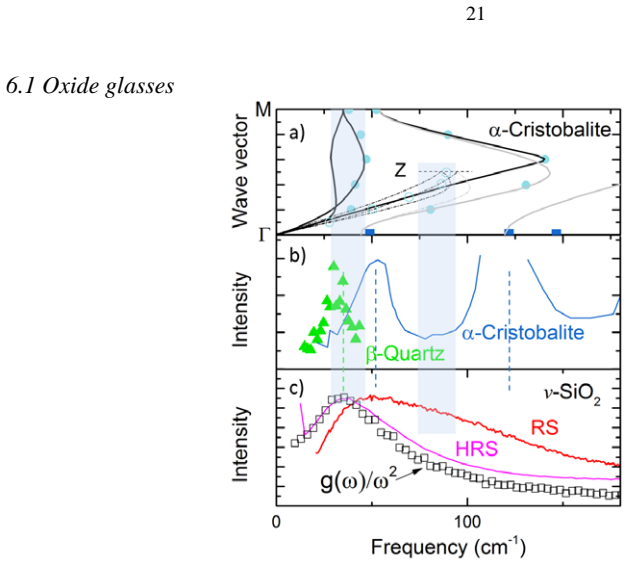
The paper's central claim is that the boson peak in glasses originates from a renormalization and redistribution of the acoustic branches caused by the destruction of plane waves of nanometre wavelength, with optional hybridization with low-lying optic vibrations such as the librations of rigid SiO4 tetrahedra. In the authors' picture, the boson peak is not the sum of all scattering channels but a specific set of quasi-localized modes that account for solid-state properties unique to glasses, including the plateau in thermal conductivity and the Ioffe-Regel crossover where sound waves stop propagating. The claim is supported by comparing the boson-peak frequency with the Ioffe-Regel crossover frequency for transverse acoustic excitations, a correspondence the authors state is believed but not yet demonstrated experimentally.
Load-bearing premise
The argument assumes, without direct experimental proof, that the boson-peak frequency coincides with the Ioffe-Regel crossover for transverse acoustic waves in every glass.
Editorial extensions
If this is right
- The boson peak is a universal glass-specific vibrational feature, not a spectroscopic artifact.
- The thermal-conductivity plateau follows from the same disorder-induced collapse of the acoustic mean free path that ends plane-wave sound.
- The boson-peak frequency should match the transverse Ioffe-Regel crossover frequency in every glass, a prediction the authors note is still untested.
- Because quasi-localized modes have ill-defined wavevectors, vibrational selection rules are relaxed, so Raman, infrared, hyper-Raman and neutron spectra each weight the boson peak differently.
- Amorphous silicon, which lacks low-lying optic modes, provides a case where the purely acoustic mechanism can be isolated.
Reading between the lines
- If the transverse Ioffe-Regel identification holds, a direct measurement of the transverse mean free path across the crossover in one glass would give a parameter-free check of the boson-peak frequency.
- The same quasi-localization mechanism predicts a characteristic nanometre length scale (roughly 1-3 nm) that should be visible in simulations of eigenmode spatial profiles and in hypersound attenuation data.
- A systematic comparison of boson-peak frequencies with transverse Ioffe-Regel frequencies across network, metallic and molecular glasses would reveal whether the correspondence is universal or limited to network glasses.
- The authors' distinction between boson-peak modes and other scattering processes implies that reported boson-peak intensities in Raman and neutron data may need to be decomposed before being compared with microscopic theories.
Signed reviews
Editorial analysis
A structured set of objections, weighed in public.
Referee Report
Summary. This manuscript is a review chapter on atomic vibrations in glasses, centered on the nature of the boson peak. It introduces a disordered diatomic linear chain to show how disorder converts plane-wave acoustic modes into quasi-localized modes, then reviews the connection between vibrational anomalies (heat capacity, thermal conductivity plateau) and the Ioffe-Regel crossover, and surveys spectroscopic evidence in v-SiO2, v-B2O3, and amorphous silicon. The central claim, stated in Sec. 7, is that boson-peak modes mostly originate from the destruction of acoustic plane waves at nanometer wavelengths, with possible hybridization with low-lying optic/rigid-unit modes, and that this mechanism is causally linked to the thermal conductivity plateau.
Significance. If established, the thesis would provide a unified explanation of several glass-specific anomalies. The chapter is a useful scholarly review: it is honest about open questions, documents the Ioffe-Regel crossover evidence for longitudinal acoustic modes, and explicitly acknowledges that the transverse correspondence is not experimentally demonstrated. However, the central thesis is presented more confidently in the abstract and Sec. 7 than the evidence warrants, and that gap is load-bearing for the chapter's main conclusion.
major comments (2)
- [Sec. 5.2 / Sec. 7] The statement in Sec. 7 that boson-peak modes 'mostly originate from a renormalization and a redistribution of the modes of the acoustic branches due to the destruction of plane waves of nanometer wavelengths' is presented as the conclusion of the chapter, but the evidence reviewed in Sec. 5.2 concerns longitudinal acoustic excitations only (lithium diborate, densified silica, glycerol), and the text explicitly says that no experimental data have demonstrated the transverse Ioffe-Regel/boson-peak correspondence. In Sec. 6.2, the transverse crossover in amorphous silicon is reported to 'raise some doubts about its physical meaning.' The chapter therefore does not provide direct support for the central causal link. I recommend that the abstract and Sec. 7 be revised to present this as a working hypothesis, and that the longitudinal/transverse discrepancy be discussed explicitly.
- [Sec. 2.1 / Sec. 2.2] The 1D chain calculation with δK/K0 = 0.25 and M/m = 2 illustrates the qualitative change in mode character with frequency, but Sec. 2.2 concedes that the extension to 3D network glasses 'has been much debated.' Since the chain result is invoked in Sec. 7 as the foundation for the acoustic-plane-wave-destruction mechanism, the manuscript should either cite quantitative 3D evidence that the same mechanism produces the excess modes at the boson-peak frequency, or further qualify the status of the argument. As written, the leap from the 1D toy model to 3D network glasses is an unsupported extrapolation.
minor comments (5)
- [Section numbering] Section 2.2 is labeled '1.2 Real amorphous solids'; the section number should be corrected to 2.2.
- [Eq. (4)] Equation (4) appears to be missing its right-hand side; the displayed equation is blank, so the thermal conductivity expression cannot be read.
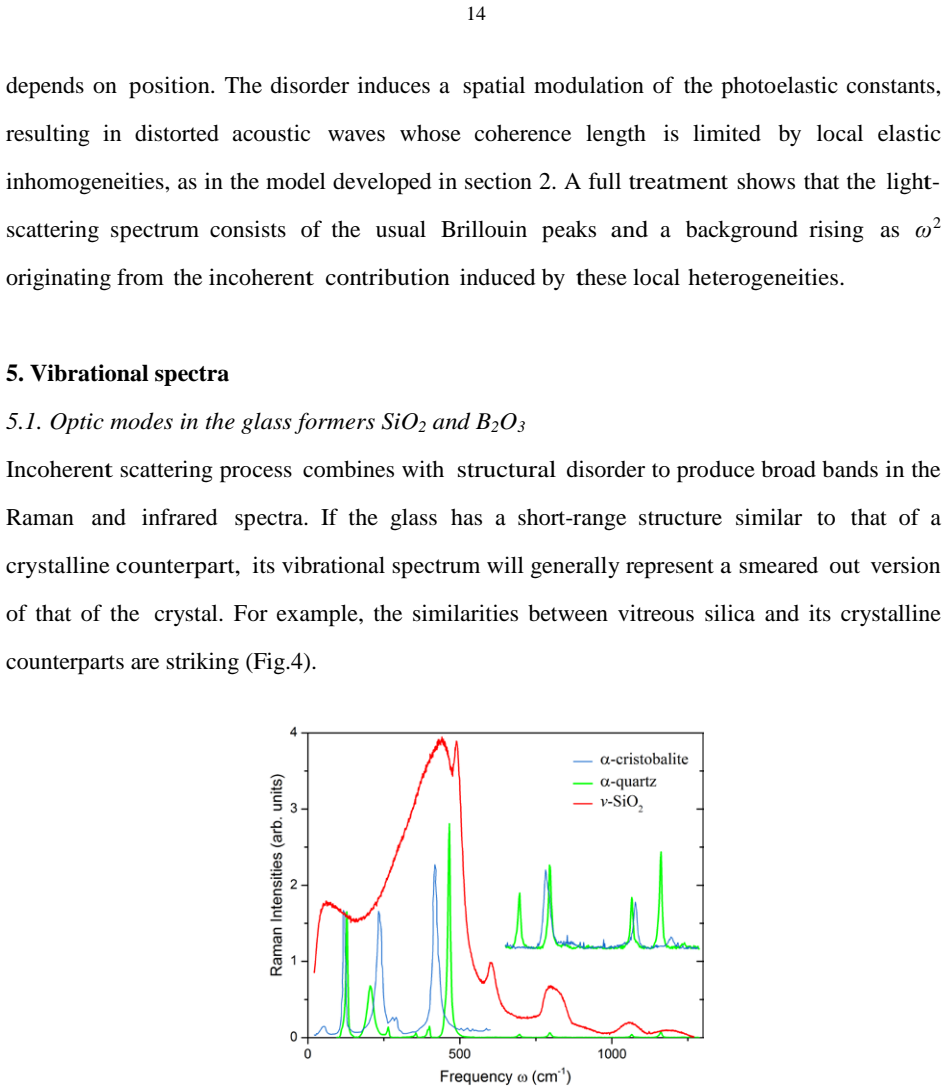
- [Fig. 6 caption] The caption of Fig. 6 is identical to that of Fig. 5 and refers to v-SiO2, while the text in Sec. 5.1 explicitly describes Fig. 6 as the spectrum of v-B2O3; the caption should be corrected.
- [Acknowledgments] The Acknowledgments contain a typo: 'gratefully tanked' should be 'gratefully thanked.'
- [References] Reference [14] misspells the first author's name as 'Greabner'; the correct spelling is 'Graebner.'
Circularity Check
No significant circularity: the chapter's interpretive synthesis is supported by independent experimental data; its explicitly unverified Ioffe-Regel premise is an empirical hypothesis, not a constructional identity.
full rationale
The chapter presents a review and interpretive synthesis, not a derivation in which an output is forced by its own inputs. The 1D chain model in Section 2.1 uses openly illustrative parameters (δK/K0 = 0.25, M/m = 2) to show how disorder produces quasi-localized modes; these parameters are not fitted to boson-peak data, and the model does not generate a quantitative prediction that is then compared with the boson peak. The load-bearing physical premise, that the boson-peak frequency equals the transverse Ioffe-Regel crossover frequency in all glasses, is explicitly stated in Section 5.2 as an unverified belief: 'It is believed that the boson peak frequency actually corresponds to the Ioffe-Regel crossover frequency for the transverse acoustic excitations in all glasses, but no experimental data have demonstrated the validity of this statement yet.' An unverified hypothesis is a correctness risk, not circularity; the paper does not redefine the boson peak in terms of the Ioffe-Regel frequency, nor does any equation make the two quantities equal by construction. The self-citations in the reference list (Rufflé et al. 2003, 2006; Hehlen et al. 2000; Hehlen and Neuville 2015) are to published, externally falsifiable experimental measurements of acoustic damping, hyper-Raman spectra, and Raman responses; they are used as empirical evidence, not as an authority that forbids alternatives. The paper also candidly notes that generalization of the 1D chain picture to real 3D glasses 'has been much debated' (Section 2.2), and that the transverse Ioffe-Regel measurement in amorphous silicon 'raises some doubts about its physical meaning' (Section 6.2). These admissions confirm that the central claim is an interpretation resting on identifiable, independently checkable evidence rather than a step that reduces to its own definition or to a fitted parameter. No circular step can be quoted from the manuscript.
Assumptions & free parameters
free parameters (2)
- delta-K/K0 = 0.25 =
0.25
- M/m = 2 =
2
assumptions (4)
- domain assumption Harmonic approximation for low-frequency glass vibrations
- domain assumption 1D disordered-chain results carry over to 3D network glasses
- domain assumption Boson peak frequency equals transverse Ioffe-Regel crossover frequency
- domain assumption Rayleigh scattering l^-1 proportional to omega^4 dominates near the Ioffe-Regel crossover
Cite this review
Pith. "Pith review of Atomic Vibrations in Glasses." pith.science (2026). https://pith.science/paper/GLXCWIBI
@misc{pith2026190808321,
  author       = {Pith},
  title        = {Pith review of: Atomic Vibrations in Glasses},
  year         = {2026},
  howpublished = {\url{https://pith.science/paper/GLXCWIBI}},
  note         = {Machine review of arXiv:1908.08321}
}
abstract
In glasses, atomic disorder combined with atomic connectivity makes understanding of the nature of the vibrations much more complex than in crystals or molecules. With a simple model, however, it is possible to show how disorder generates quasi-local modes on optic branches as well as on acoustic branches at low-frequency. The latter modes, possibly hybridizing with low-lying optic modes in real glasses, lead to the excess, low-frequency excitations known as {\it boson-peak modes}, which are lacking in crystals. The spatially quasi-localized vibrations also explain anomalies in thermal conductivity and the end of the acoustic branches, two other specific features of glasses. Together with the quasi-localization of the modes at the nanometric scale, structural disorder lifts the crystalline or molecular spectroscopic selection rules and makes interpretation of experiments difficult. Nevertheless, vibrations in simple glasses such as vitreous silica or vitreous boron oxide are nowadays rather well described. But a comprehensive understanding of the boson peak modes remains a highly debated issue as illustrated by three archetypal glass systems, vitreous SiO$_2$ and B$_2$O$_3$ and amorphous silicon.
Figures
Reference graph
Works this paper leans on
-
[1]
N. Taraskin and S.R. Elliott, Propagation of plane-wave vibrational excitations in disordered systems, Phys. Rev. B, 61 (2000) 12017-30
work page 2000
-
[2]
Dean, Vibrations of glass-like disordered chains, Proc
P. Dean, Vibrations of glass-like disordered chains, Proc. Phys. Soc., 84 (1964) 727-44
work page 1964
-
[3]
M. Rothenfusser, W. Dietsche and H. Kinder, Linear dispersion of transverse high- frequency phonons in vitreous silica, Phys. Rev. B, 27 (1983) 5196-98
work page 1983
-
[4]
N. Bilir and W.A. Phillips, Phonons in SiO2: low-temperature heat capacity of cristobalite, Phil. Mag., 32 (1975) 113-22
work page 1975
- [5]
-
[6]
V.N. Sigaev, E.N. Smelyanskaya, V.G. Plotnichenko, V.V. Koltashev, A.A. Volkov and P. Pernice, Low-frequency band at 50 cm-1 in the Raman spectrum of cristobalite : identification of similar motifs in glasses and crystals of similar composition, J. Non-Cryst. Solids, 248 (1999) 141-45
work page 1999
-
[7]
M.A. Ramos and U. Buchenau, Low-temperature thermal conductivity of glasses within the soft-potential model, Phys. Rev. B, 55 (1997) 5749-54
work page 1997
-
[8]
Phillips, Tunneling states in amorphous solids, J
W .A. Phillips, Tunneling states in amorphous solids, J. Low Temp. Phys., 7 (1972) 351-60
work page 1972
Show all 43 references
-
[9]
Anderson, B.I
P.W. Anderson, B.I. Halperin and C.M. Varma, Properties of glasses and spin glasses, Phil. Mag, 25 (1972) 1-12
1972
-
[10]
Safarik, R.B
D.J. Safarik, R.B. Scwartz and M.F. Hundley, Similarities in the Cp/T3 peaks in amorphous and crystalline metals, Phys. Rev. Lett., 96 (2006) 195902
2006
-
[11]
Chumakov et al., Role of disorder in the thermodynamics and atomic dynamics of glasses, Phys
A.I. Chumakov et al., Role of disorder in the thermodynamics and atomic dynamics of glasses, Phys. Rev. Lett., 112 (2014) 025502
2014
-
[12]
Gurarie and J.T
V. Gurarie and J.T. Chalker, Some generic aspects of bosonic excitations in disordered systems, Phys. Rev. Lett., 89 (2002) 136801. 28
2002
-
[13]
Debye, Zustandsgleichung und Quantenhypothese mit einem Anhang über Wärmeleitung, in Vorträge über die kinetische Theorie der Materie und der Elektrizität, vol
P. Debye, Zustandsgleichung und Quantenhypothese mit einem Anhang über Wärmeleitung, in Vorträge über die kinetische Theorie der Materie und der Elektrizität, vol. VI (Leipzig: G. Teubner, 1914)
1914
-
[14]
Greabner, B
J.E. Greabner, B. Golding and L.C. Allen, Phonons localization in glasses, Phys. Rev. B, 34 (1986) 5696 -5701
1986
-
[15]
boson peak
W. Schirmacher, Thermal conductivity of glassy materials and the “boson peak”, Europhys. Lett., 73 (2006) 892-98
2006
-
[16]
Beltukov, C
Y.M. Beltukov, C. Fusco, D.A. Parshin and A. Tanguy, Boson peak and Ioffe-Regel criterion in amorphous silicon-like materials: effect of bond directionality, Phys. Rev. E, 93, (2016) 023006
2016
-
[17]
Hayes and R
W. Hayes and R. Loudon, Scattering of Light by Crystals (New York, Wiley, 1978)
1978
-
[18]
Martin and W
A.J. Martin and W. Brenig, Model for Brillouin scattering in amorphous solids, Phys. Stat. Sol., 64 (1974) 163-72
1974
-
[19]
Kirk, Quantitative analysis of the effect of disorder -induced mode coupling on infrared absorption in silica, P hys.Rev
C.T. Kirk, Quantitative analysis of the effect of disorder -induced mode coupling on infrared absorption in silica, P hys.Rev. B, 38 (1988) 1255-73
1988
-
[20]
Taraskin and S
S.N. Taraskin and S. R. Elliott, Nature of vibrational excitations in vitreous silica, Phys. Rev. B, 56 (1997) 8605
1997
-
[21]
Hehlen and G
B. Hehlen and G. Simon, The vibrations of vitreous silica observed in hyper-Raman scattering, J. Raman Spectrosc., 43 (2012) 1941-50
2012
-
[22]
Galeener, A.J
F.L. Galeener, A.J. Leadbetter and M.W. Stringfellow, Comparison of the neutron, Raman, and infrared spectra of vitreous SiO2, GeO2, and BeF2, Phys. Rev., B27, (1983) 1052- 78
1983
-
[23]
Wilson, P
M. Wilson, P. A. Madden, M. Hemmati and C. A. Angell, Polarization effects, network dynamics, and the infrared spectrum of amorphous SiO2, Phys. Rev. Lett., 77 (1996) 4023-26
1996
-
[24]
Umari, X
P. Umari, X. Gonze and A. Pasquarello, Concentration of small ring structures in vitreous silica from a first-principles analysis of the Raman spectrum, Phys. Rev. Lett., 90 (2003) 027401. 29
2003
-
[25]
Hehlen, Inter-tetrahedra bond angle of permanently densified silicas extracted from their Raman spectra, J
B. Hehlen, Inter-tetrahedra bond angle of permanently densified silicas extracted from their Raman spectra, J. Phys.: Condens. Matter, 22 (2010) 025401
2010
-
[26]
Maris, Interactions of sound waves with thermal phonons in dielectric crystals, p
H.J. Maris, Interactions of sound waves with thermal phonons in dielectric crystals, p. 279- 345 in W.P. Mason and R.N. Thurston (eds), Physical Acoustics: Principles and Methods (New York: Academic Press, 1971)
1971
-
[27]
Anderson and H.E
O.L. Anderson and H.E. Bommel, Ultrasonic absorption in fused silica at low-temperature and high frequencies, J. Amer. Ceram. Soc., 38 ( 1955) 125-131
1955
-
[28]
Hunklinger and W
S. Hunklinger and W. Arnold, pp. 155-215 in W.P. Mason and R.N. Thurston (eds) Physical Acoustics Vol. XII, (New York: Academic Press, 1976)
1976
-
[29]
Rufflé, M
B. Rufflé, M. Foret, E. Courtens, R. Vacher and G. Monaco, Observation of the onset of strong scattering on high frequency acoustic phonons in densified silica glass, Phys. Rev. Lett., 90 (2003) 095502
2003
-
[30]
Rufflé, G
B. Rufflé, G. Guimbreti`ere, E. Courtens, R. Vacher and G. Monaco, Glass specific behavior in the damping of acousticlike vibrations, Phys. Rev. Lett., 96 (2006) 045502
2006
-
[31]
Malinovsky and A.P
V.K. Malinovsky and A.P. Sokolv, The nature of the boson peak in Raman scattering in glasses, Solid State Commun., 57 (1986) 757-61
1986
-
[32]
Novikov and A.P
V.N. Novikov and A.P. Sokolov, Poisson’s ratio and the fragility of glass forming liquids, Nature, 431 (2004) 161-63, and Ref. therein
2004
-
[33]
Swainson, M.T
I.P. Swainson, M.T. Dove and D.C. Palmer, Infrared and Raman spectroscopy studies of the α-β phase transition in cristobalite, Phys. Chem. Minerals, 30 (2003) 353-65, and Ref. therein
2003
-
[34]
Buchenau, M
U. Buchenau, M. Prager, N.Nu¨cker, A.J. Dianoux, N. Hamad and W.A. Philips, Low- frequency modes in vitreous silica, Phys. Rev. B, 34 (1986) 5665
1986
-
[35]
Hehlen, E
B. Hehlen, E. Courtens, R. Vacher, A. Yamanaka, M. Jataoka and K. Inoue, Hyper- Raman scattering observation of the boson peak in vitreous silica, Phys. Rev. Lett., 84 (2000) 5355-58. 30
2000
-
[36]
Weigel et al., Polarized Raman spectroscopy of v-SiO2 under rare-gas compression, Phys
C. Weigel et al., Polarized Raman spectroscopy of v-SiO2 under rare-gas compression, Phys. Rev. B, 93 (2016) 224303
2016
-
[37]
Hehlen and D
B. Hehlen and D. Neuville, Raman response of network modifier cations in alumino silicate glasses, J. Phys. Chem. B, 119 (2015) 4093
2015
-
[38]
Temple and C.E
P.A. Temple and C.E. Hathaway, Multiphonon Raman spectrum of silicon, Phys. Rev. B, 7 (1973) 3685-97
1973
-
[39]
Zwick and R
A. Zwick and R. Carles, Multiple-order Raman scattering in crystalline and amorphous silicon, Phys. Rev. B, 48 (1993) 6024-32
1993
-
[40]
Christie, S.N
J.K. Christie, S.N. Taraskin and S.R. Elliott, Vibrational behavior of a realistic amorphous- silicon model, J. Non-Cryst. Solids, 253 (2007) 2272-79
2007
-
[41]
Kamitakahara, C.M
W.A. Kamitakahara, C.M. Soukoulis, H.R. Shanks, U. Buchenau and G.S. Grest, Vibrational spectrum of amorphous silicon: experiment and computer simulation, Phys. Rev. B, 36 (1987) 6539-42
1987
-
[42]
B.L. Zink, R. Pietri and F. Hellman, Thermal conductivity and specific heat of thin-film amorphous silicon, Phys. Rev. Lett., 96 (2006) 055902
2006
-
[43]
Mizuno, H
H. Mizuno, H. Shiba and A. Ikeda, Continuum limit of the vibrational properties of amorphous solids, Proc. Natl. Acad. Sci., 114 (2017) E9767. Appendix : supplementary information for figure captions Fig. 2. Data from F. Birch and H. Clark, Amer. Jour. Sci., 238 (1940) 529-58....
2017
Reviewed August 14, 2026 · model on record in the stance chip above.
Discussion (0). Continue with ORCID to comment.