REVIEW 3 major objections 4 minor 50 references
An Embedded Boundary Approach for Resolving the Contribution of Cable Subsystems to Fully Coupled Fluid-Structure Interaction
T0 review · 3 major / 4 minor · reviewed 2026-08-14 · deepseek-v4-flash
Pith's one-line read A cable's flow can be captured by slaving its embedded surface to a beam centerline, with exact energy transfer.
desk verdict A genuine method contribution for cable-driven FSI with a clean conservation proof and a meaningful flight-data validation, though the rigid-section kinematics and single-case validation keep it from being definitive. read the letter →
The pith
A machine-rendered reading of the paper's core claim, the machinery that carries it, and where it could break.
The reading
What carries the argument
At the heart is the master-slave kinematic relation between the beam centerline C and the embedded surface Sigma_h. Each surface node S_j^i is paired with a master point M_i on the beam, and its motion is computed from the beam's displacement and rotation via u_{S_j^i} = u_{M_i} + R(theta_{M_i}) d_j^i - d_j^i and dot u_{S_j^i} = dot u_{M_i} + omega_{M_i} x R(theta_{M_i}) d_j^i. Loads are transferred back through Eq. (3), which accumulates surface forces and moments at the master point, and Eq. (4), which distributes them to beam nodes with the beam's shape functions. The identity that carries the argument is the virtual-work equality -delta W_F = delta W_S, which proves the transfer conserves energy globally. Supporting machinery includes a shifted Gauss-point quadrature for wall loads that avoids spurious oscillations on slender embedded surfaces, and a doubly-intersected edge criterion for adaptive refinement around cables.
What would settle it
A body-fitted simulation of a short, flexible cable segment in cross-flow that resolves the cable with 3D solid elements would settle this: if the resolved cross-section measurably ovalizes, the master-slave reconstruction of the surface from centerline kinematics fails. A water-tunnel experiment measuring cross-sectional deformation of a flexible cable would test Eq. (1) directly.
Extended reading notes
Core claim
The central claim is that a cable can be represented by two coupled objects of different dimensions: a topologically 1D finite-element beam for its dynamics, and an embedded discrete surface for its fluid boundary. The surface nodes are slaved to the beam through Eq. (1), using the beam's interpolated displacement and rotation to update surface positions and velocities, with the initial distance vector assumed constant. Flow loads computed on the surface are accumulated at master points and then distributed to beam nodes through Eqs. (3)-(4). The paper proves that this transfer is globally conservative, because the virtual work of fluid tractions on the surface equals the virtual work of the generalized forces on the beam nodes. Numerical tests show that the approach matches the dressing method on a refueling hose and, for the parachute inflation, accounts for the suspension lines' disturbance of the bow shock so that the predicted total drag agrees with flight data to within 10 percent.
Load-bearing premise
The load-bearing premise is that each cable cross-section stays rigid and attached to the beam centerline, so the surface can be reconstructed from centerline kinematics alone; if the physical cross-section deforms or ovalizes, the slave surface motion and the transferred moment are wrong.
Editorial extensions
If this is right
- Cable-driven FSI can be computed on a non-body-fitted fluid mesh, so the cost of resolving the flow around a slender cable is controlled by adaptive refinement rather than by maintaining a body-fitted boundary-layer mesh.
- The method removes the need for massless rigid and phantom elements, so structural time integration does not have to handle singular mass matrices or differential-algebraic constraints.
- For the supersonic parachute test case, including the suspension lines in the FSI changes the predicted total drag enough to bring it into the measured range; omitting them overpredicts drag.
- The virtual-work identity shows that the load transfer cannot add or remove energy between the fluid and structure despite the reduced 1D structural idealization.
- The mesh-adaptation criterion deliberately does not fully resolve the cable boundary layer; it resolves the cable's effect on the flow, which is what the flight-data comparison validates.
Reading between the lines
- Because the conservation proof is algebraic, the same master-slave transfer could be dropped into other embedded-boundary solvers and should remain conserving as long as surface loads are evaluated consistently on the embedded surface.
- The rigid-cross-section assumption suggests a natural extension: for cables whose cross-sections ovalize, such as very flexible hoses or braided cords, a curvature- or pressure-based correction could be added while keeping the master-slave structure of the method.
- The doubly-intersected edge refinement criterion is stated for cables but is really a generic rule for any slender body whose diameter is smaller than the local mesh size; it could apply to tethers, towed arrays, or guidewires in biomedical flows.
Signed reviews
Editorial analysis
A structured set of objections, weighed in public.
Referee Report
Summary. This paper proposes an embedded boundary (master-slave kinematic) method for fluid-structure interaction with cable subsystems. The structural dynamics of a cable are modeled by 1D beam/cable elements along its centerline C, while the physical cable surface Sigma_h is embedded in a non-body-fitted CFD mesh. Each surface node is slaved to a master point on the centerline by assuming that the initial distance vector d_j^i is time-independent (rigid cross-section kinematics), and its motion is computed from the interpolated translation and rotation of the beam. Flow loads are computed on Sigma_h using a shifted Gauss-point quadrature and transferred to the beam nodes with a conservative load/moment transfer. The authors prove a global energy-conservation identity for this transfer and integrate the approach into the FIVER Eulerian framework, including a new local ghost-node population strategy for slender surfaces and a doubly-intersected edge AMR criterion. The method is verified against the dressing approach on an aerial refueling hose model and validated against Curiosity Mars parachute flight drag data, with an ablation showing that suspension-line FSI significantly reduces total drag despite the small direct drag of the lines.
Significance. Subject to the issues below, the method addresses a real and under-served problem: two-way coupling between 1D structural cable models and 3D fluids. The global conservation result (Eq. (5)) is cleanly proved and is an algebraic consequence of the chosen kinematics and load-transfer shape functions, which is a useful design property. The validation against independent flight data for the Mars DGB parachute is a strong point and gives credibility to the overall framework; the ablation of suspension-line FSI is informative. The paper also contributes a concrete algorithmic component (local ghost-node population and double-intersection AMR criterion) that is relevant beyond cable FSI. However, the physical fidelity of the rigid-cross-section kinematics is not tested independently, the accuracy order of the shear-load quadrature is not established, and the validation evidence is a single drag time-history without mesh-convergence or sensitivity studies. These gaps are fixable and do not invalidate the central algorithmic idea.
major comments (3)
- [Section 3, Eq. (1); Sections 5.1-5.2] The time-independence of d_j^i imposes a rigid-cross-section kinematics: each cable section translates and rotates as a plane, so the embedded surface cannot ovalize or warp. The energy-conservation proof following Eq. (5) is correct for this kinematics but does not validate it. The comparison with the dressing approach in Section 5.1 cannot validate it either, because the dressing superelement uses rigid massless beams to connect centerline nodes to phantom surface nodes, i.e., it embodies the same rigid-section assumption. The flight-data validation in Section 5.2 concerns Technora suspension lines (E = 29.5 GPa) for which the assumption is reasonable, but the soft-hose regime (E = 17 MPa, Table 1) that motivates the cable-FSI capability remains unvalidated. Please add a test that exercises cross-section deformation (e.g., an ovalization-prone soft cylinder) or provide an asymptotic argument for when the rigid-section assumption is valid, and otherwise explicitly scope the accuracy claims to cables whose sections remain rigid.
- [Section 4.2, Eq. (12) and following Taylor expansion] The paper claims that the shear-stress contribution to the shifted-Gauss-point quadrature (12) is a second-order approximation of its counterpart in (11). The Taylor argument is given for pressure using partial p / partial n approximately 0, but no analogous boundary condition is stated for the viscous stress tensor. For a generic smooth shear-stress field, tau(G'_k) = tau(G_k) + O(h), so the shear contribution to (12) is only first-order accurate with respect to (11) unless an additional assumption such as partial tau / partial n approximately 0 is justified, which does not follow from the no-slip wall condition. Please either prove the second-order claim with the appropriate boundary condition or revise the accuracy statement; this is the load-computation step on which the master-slave transfer and the reported results depend.
- [Section 5.2, Figure 11] The validation of the parachute simulation rests on a single comparison of total drag time-history with Curiosity flight data, with a claimed relative error of less than 10%. The paper does not define the error metric (time interval, norm, inclusion of the inflation transient), does not report a mesh-convergence study for the parachute mesh, and does not test sensitivity to the new doubly-intersected edge AMR criterion or to the stated mesh sizes (3 mm near suspension lines, 5 cm near the canopy). Since the central claim is that the proposed approach accurately resolves cable-driven FSI, this evidence is thinner than the claim requires. Please add at least one coarser/finer resolution comparison or a sensitivity study, and give a precise definition of the reported relative error.
minor comments (4)
- [Section 5.2] The phrase 'in the the case' should be corrected to 'in the case'.
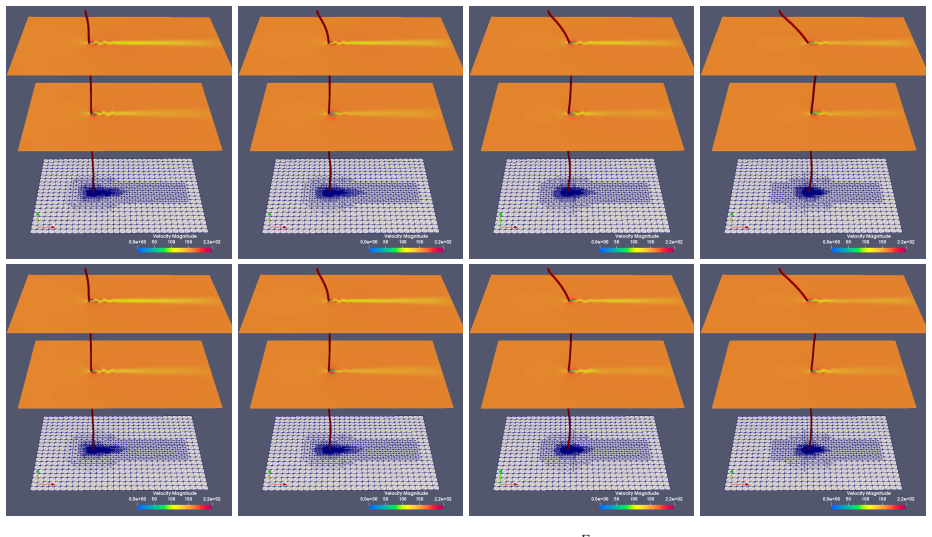
- [Figure 7] The caption labels the top panel as the pinned end while the text describes the cross-section at the free end; please reconcile this inconsistency.
- [Section 4.3] The doubly-intersected edge criterion is described only heuristically; please specify the geometric tolerance for 'intersected twice' and how the criterion is combined with the existing distance/Hessian AMR criteria in the implementation.
- [Section 5.1] The statement that the proposed approach is 'more comprehensive and user-friendly' than the dressing approach could be supported by quantitative measures (e.g., wall-clock time, condition number, DOF counts) in addition to the shown matching time histories.
Circularity Check
No significant circularity: the conservation proof is an algebraic consequence of the stated transfer definitions, and the key validation uses independent NASA flight data.
full rationale
The paper's central technical claims are the master-slave kinematics and the energy-conserving load transfer. The time-independence of d_j^i is an explicit modeling assumption (Section 3, before Eq. (1)), not a hidden fit or a renamed prediction. The global-conservation result in Eq. (5) is derived algebraically from the definitions in Eqs. (1), (3), and (4); it does not import a fitted constant or assume the conclusion. The load-transfer shape functions are stated in the paper, and the reference to [31] supplies an established transfer framework rather than a circularly defined result. The refueling comparison against the dressing approach is an implementation-level verification; because the goal there is to show that the two approaches agree, sharing the same beam/section model does not make the comparison circular. The parachute validation compares the computed total drag with measured NASA Curiosity flight data from reference [45], which is external to this paper's fitted values or assumptions. The numerous self-citations to FIVER and related prior work support the underlying computational framework, but the load-bearing claim of the paper, the master-slave kinematic coupling and its conservative load transfer, is presented with its own derivation and is validated against independent data. Accordingly, no circular step can be exhibited from the paper's equations or argument chain.
Assumptions & free parameters
assumptions (4)
- domain assumption The distance vector d_j^i between a surface node and its master point is time-independent (rigid cable cross-section kinematics).
- domain assumption No-slip displacement transmission holds at the fluid-structure interface, so delta u_F = delta u_S in Eq. (5).
- domain assumption The FE beam interpolation of displacement and rotational DOFs adequately represents cable centerline dynamics at master points M_i.
- domain assumption The pressure normal derivative at the interface satisfies approximately dp/dn = 0, making the shifted Gauss point evaluation second-order accurate.
Cite this review
Pith. "Pith review of An Embedded Boundary Approach for Resolving the Contribution of Cable Subsystems to Fully Coupled Fluid-Structure Interaction." pith.science (2026). https://pith.science/paper/6VR7B6CM
@misc{pith2026190808382,
  author       = {Pith},
  title        = {Pith review of: An Embedded Boundary Approach for Resolving the Contribution of Cable Subsystems to Fully Coupled Fluid-Structure Interaction},
  year         = {2026},
  howpublished = {\url{https://pith.science/paper/6VR7B6CM}},
  note         = {Machine review of arXiv:1908.08382}
}
abstract
Cable subsystems characterized by long, slender, and flexible structural elements are featured in numerous engineering systems. In each of them, interaction between an individual cable and the surrounding fluid is inevitable. Such a Fluid-Structure Interaction (FSI) has received little attention in the literature, possibly due to the inherent complexity associated with fluid and structural semi-discretizations of disparate spatial dimensions. This paper proposes an embedded boundary approach for filling this gap, where the dynamics of the cable are captured by a standard finite element representation $\mathcal C$ of its centerline, while its geometry is represented by a discrete surface $\Sigma_h$ that is embedded in the fluid mesh. The proposed approach is built on master-slave kinematics between $\mathcal C$ and $\Sigma_h$, a simple algorithm for computing the motion/deformation of $\Sigma_h$ based on the dynamic state of $\mathcal C$, and an energy-conserving method for transferring to $\mathcal C$ the loads computed on $\Sigma_h$. Its effectiveness is demonstrated for two highly nonlinear applications featuring large deformations and/or motions of a cable subsystem and turbulent flows: an aerial refueling model problem, and a challenging supersonic parachute inflation problem. The proposed approach is verified using numerical data, and validated using real flight data.
Figures


Figures from the paper (8 more)




Reference graph
Works this paper leans on
-
[1]
Fan Y, Xia J. Simulation of 3D parachute fluid–structure interaction based on nonlinear finite element method and preconditioning finite volume method. Chinese Journal of Aeronautics 2014; 27(6): 1373– 1383
work page 2014
-
[2]
Space–time finite element computation of complex fluid–structure interactions
Tezduyar TE, Takizawa K, Moorman C, Wright S, Christopher J. Space–time finite element computation of complex fluid–structure interactions. International Journal for Numerical Methods in Fluids 2010; 64(10-12): 1201–1218
work page 2010
-
[3]
Huang Z, Avery P, Farhat C, Rabinovitch J, Derkevorkian A, Peterson LD. Simulation of parachute inflation dynamics using an Eulerian computational framework for fluid-structure interfaces evolving in high-speed turbulent flows. In: AIAA. ; 2018: 1540
work page 2018
-
[4]
Sengupta A, Kelsch R, Roeder J, Wernet M, Witkowski A, Kandis M. Supersonic performance of disk- gap-band parachutes constrained to a 0-degree trim angle.Journal of Spacecraft and Rockets2009; 46(6): 1155–1163
-
[5]
Numerical modelling of Mars supersonic disk-gap-band parachute inflation
Gao X, Zhang Q, Tang Q. Numerical modelling of Mars supersonic disk-gap-band parachute inflation. Advances in Space Research 2016; 57(11): 2259–2272
work page 2016
-
[6]
3-D parachute simulation by the immersed boundary method
Kim Y, Peskin CS. 3-D parachute simulation by the immersed boundary method. Computers & Fluids 2009; 38(6): 1080–1090
work page 2009
-
[7]
Fully coupled fluid-structure interaction for offshore applications
Jaiman RK, Shakib F, Oakley OH, Constantinides Y. Fully coupled fluid-structure interaction for offshore applications. In: American Society of Mechanical Engineers. ; 2009: 757–765
work page 2009
-
[8]
Simulation of riser VIV using fully three dimensional CFD simulations
Holmes S, Oakley OH, Constantinides Y. Simulation of riser VIV using fully three dimensional CFD simulations. In: American Society of Mechanical Engineers. ; 2006: 563–570
work page 2006
Show all 50 references
-
[9]
Assessment of vortex-induced vibrations on deepwater risers by considering fluid-structure interaction
Herfjord K, Drange S, Kvamsdal T. Assessment of vortex-induced vibrations on deepwater risers by considering fluid-structure interaction. Journal of Offshore Mechanics and Arctic Engineering 1999; 121(4): 207–212
1999
-
[10]
CFD Modeling of B-52 and KC-135 in air refueling formation
Lofthouse AJ, Nathan B. CFD Modeling of B-52 and KC-135 in air refueling formation. In: AIAA. ; 2017: 4236
2017
-
[11]
Modeling and simulation of hose-paradrogue aerial refueling systems
Ro K, Kamman JW. Modeling and simulation of hose-paradrogue aerial refueling systems. Journal of Guidance, Control, and Dynamics 2010; 33(1): 53–63
2010
-
[12]
Modeling and simulation of aerial refueling by finite element method
Zhu Z, Meguid S. Modeling and simulation of aerial refueling by finite element method. International Journal of Solids and Structures 2007; 44(24): 8057–8073
2007
-
[13]
Numerical simulation of hose whip phenomenon in aerial refueling
Styuart A, Gaston R, Yamashiro H, Stirling R, Mor M. Numerical simulation of hose whip phenomenon in aerial refueling. In: AIAA. ; 2011: 6211
2011
-
[14]
2–D parachute simulation by the immersed boundary method
Kim Y, Peskin CS. 2–D parachute simulation by the immersed boundary method. SIAM Journal on Scientific Computing 2006; 28(6): 2294–2312
2006
-
[15]
Large-scale nonlinear aeroelastic computations: flutter, LCO and buffet investigations
Farhat C. Large-scale nonlinear aeroelastic computations: flutter, LCO and buffet investigations. In: WCCM V. ; 2002
2002
-
[16]
Aeroelastic dynamic analysis of a full F-16 configuration for various flight conditions
Geuzaine P, Brown G, Harris C, Farhat C. Aeroelastic dynamic analysis of a full F-16 configuration for various flight conditions. AIAA Journal 2003; 41(3): 363–371
2003
-
[17]
Algorithms for interface treatment and load computation in embedded boundary methods for fluid and fluid–structure interaction problems
Wang K, Rallu A, Gerbeau JF, Farhat C. Algorithms for interface treatment and load computation in embedded boundary methods for fluid and fluid–structure interaction problems. International Journal for Numerical Methods in Fluids 2011; 67(9): 1175–1206. 21
2011
-
[18]
FIVER: A finite volume method based on exact two-phase Riemann problems and sparse grids for multi-material flows with large density jumps
Farhat C, Gerbeau JF, Rallu A. FIVER: A finite volume method based on exact two-phase Riemann problems and sparse grids for multi-material flows with large density jumps. Journal of Computational Physics 2012; 231(19): 6360–6379
2012
-
[19]
Numerical analysis of blood flow in the heart
Peskin CS. Numerical analysis of blood flow in the heart. Journal of Computational Physics 1977; 25(3): 220–252
1977
-
[20]
An immersed boundary method for complex incompressible flows
Choi JI, Oberoi RC, Edwards JR, Rosati JA. An immersed boundary method for complex incompressible flows. Journal of Computational Physics 2007; 224(2): 757–784
2007
-
[21]
A ghost-cell immersed boundary method for flow in complex geometry
Tseng YH, Ferziger JH. A ghost-cell immersed boundary method for flow in complex geometry. Journal of Computational Physics 2003; 192(2): 593–623
2003
-
[22]
The modified ghost fluid method as applied to extreme fluid-structure interaction in the presence of cavitation
Liu T, Khoo B, Xie W. The modified ghost fluid method as applied to extreme fluid-structure interaction in the presence of cavitation. Commun. Comput. Phys. 2006; 1(5): 898–919
2006
-
[23]
An embedded boundary framework for compressible turbulent flow and fluid–structure computations on structured and unstructured grids
Lakshminarayan V, Farhat C, Main A. An embedded boundary framework for compressible turbulent flow and fluid–structure computations on structured and unstructured grids. International Journal for Numerical Methods in Fluids 2014; 76(6): 366–395
2014
-
[24]
A computational framework for the simulation of high-speed multi-material fluid–structure interaction problems with dynamic fracture
Wang K, Lea P, Farhat C. A computational framework for the simulation of high-speed multi-material fluid–structure interaction problems with dynamic fracture. International Journal for Numerical Meth- ods in Engineering 2015; 104(7): 585–623
2015
-
[25]
An enhanced FIVER method for multi-material flow problems with second-order convergence rate
Main A, Zeng X, Avery P, Farhat C. An enhanced FIVER method for multi-material flow problems with second-order convergence rate. Journal of Computational Physics 2017; 329: 141–172
2017
-
[26]
A family of position-and orientation-independent embedded boundary methods for viscous flow and fluid–structure interaction problems
Huang DZ, De Santis D, Farhat C. A family of position-and orientation-independent embedded boundary methods for viscous flow and fluid–structure interaction problems. Journal of Computational Physics 2018; 365: 74–104
2018
-
[27]
Mesh adaptation framework for embedded boundary methods for computational fluid dynamics and fluid-structure interaction
Borker R, Huang D, Grimberg S, Farhat C, Avery P, Rabinovitch J. Mesh adaptation framework for embedded boundary methods for computational fluid dynamics and fluid-structure interaction. Inter- national Journal for Numerical Methods in Fluids 2019
2019
-
[28]
An arbitrary Lagrangian-Eulerian computing method for all flow speeds
Hirt CW, Amsden AA, Cook J. An arbitrary Lagrangian-Eulerian computing method for all flow speeds. Journal of Computational Physics 1974; 14(3): 227–253
1974
-
[29]
An arbitrary Lagrangian-Eulerian finite element method for transient dynamic fluid-structure interactions
Donea J, Giuliani S, Halleux JP. An arbitrary Lagrangian-Eulerian finite element method for transient dynamic fluid-structure interactions. Computer Methods in Applied Mechanics and Engineering 1982; 33(1-3): 689–723
1982
-
[30]
The discrete geometric conservation law and the nonlinear stability of ALE schemes for the solution of flow problems on moving grids
Farhat C, Geuzaine P, Grandmont C. The discrete geometric conservation law and the nonlinear stability of ALE schemes for the solution of flow problems on moving grids. Journal of Computational Physics 2001; 174(2): 669–694
2001
-
[31]
Farhat C, Lesoinne M, Le Tallec P. Load and motion transfer algorithms for fluid/structure interaction problems with non-matching discrete interfaces: momentum and energy conservation, optimal discretiza- tion and application to aeroelasticity. Computer Methods in Applied Mecha...
1998
-
[32]
MATCHER Version 2.0
CMSoft, Inc. MATCHER Version 2.0. User’s Reference Manual, 2007
2007
-
[33]
Implicit time integration of a class of constrained hybrid formulations part I: spectral stability theory
Farhat C, Crivelli L, G´ eradin M. Implicit time integration of a class of constrained hybrid formulations part I: spectral stability theory. Computer Methods in Applied Mechanics and Engineering 1995; 125(1- 4): 71–107. 22
1995
-
[34]
Approximate Riemann solvers, parameter vectors, and difference schemes
Roe PL. Approximate Riemann solvers, parameter vectors, and difference schemes. Journal of Compu- tational Physics 1981; 43(2): 357–372
1981
-
[35]
Towards the ultimate conservative difference scheme
Van Leer B. Towards the ultimate conservative difference scheme. V. A second-order sequel to Godunov’s method. Journal of Computational Physics 1979; 32(1): 101–136
1979
-
[36]
Computational gasdynamics
Laney CB. Computational gasdynamics. Cambridge university press . 1998
1998
-
[37]
A non-oscillatory Eulerian approach to interfaces in mul- timaterial flows (the ghost fluid method)
Fedkiw RP, Aslam T, Merriman B, Osher S. A non-oscillatory Eulerian approach to interfaces in mul- timaterial flows (the ghost fluid method). Journal of Computational Physics 1999; 152(2): 457–492
1999
-
[38]
Local adaptive mesh refinement for shock hydrodynamics
Berger MJ, Colella P. Local adaptive mesh refinement for shock hydrodynamics. Journal of Computa- tional Physics 1989; 82(1): 64–84
1989
-
[39]
Local bisection refinement for n-simplicial grids generated by reflection
Maubach JM. Local bisection refinement for n-simplicial grids generated by reflection. SIAM Journal on Scientific Computing 1995; 16(1): 210–227
1995
-
[40]
The completion of locally refined simplicial partitions created by bisection
Stevenson R. The completion of locally refined simplicial partitions created by bisection. Mathematics of Computation 2008; 77(261): 227–241
2008
-
[41]
Adaptive mesh refinement for immersed boundary methods
Vanella M, Posa A, Balaras E. Adaptive mesh refinement for immersed boundary methods. Journal of Fluids Engineering 2014; 136(4): 040909
2014
-
[42]
An adaptive version of the immersed boundary method
Roma AM, Peskin CS, Berger MJ. An adaptive version of the immersed boundary method. Journal of Computational Physics 1999; 153(2): 509–534
1999
-
[43]
A one-equation turbulence model for aerodynamic flows
Spalart P, Allmaras S. A one-equation turbulence model for aerodynamic flows. In: AIAA. ; 1992: 439
1992
-
[44]
Robust and provably second-order explicit–explicit and implicit–explicit staggered time-integrators for highly non-linear compressible fluid–structure interaction problems
Farhat C, Rallu A, Wang K, Belytschko T. Robust and provably second-order explicit–explicit and implicit–explicit staggered time-integrators for highly non-linear compressible fluid–structure interaction problems. International Journal for Numerical Methods in Engineering 2010;...
2010
-
[45]
Reconstruction of the Mars science laboratory parachute performance
Cruz JR, Way DW, Shidner JD, Davis JL, Adams DS, Kipp DM. Reconstruction of the Mars science laboratory parachute performance. Journal of Spacecraft and Rockets 2014; 51(4): 1185–1196
2014
-
[46]
Flexible material systems testing
Lin JK, Shook LS, Ware JS, Welch JV. Flexible material systems testing. NASA Report CR-2010- 216854; 2010
2010
-
[47]
An eddy-viscosity subgrid-scale model for turbulent shear flow: algebraic theory and appli- cations
Vreman A. An eddy-viscosity subgrid-scale model for turbulent shear flow: algebraic theory and appli- cations. Physics of Fluids 2004; 16(10): 3670–3681
2004
-
[48]
The first ANDES elements: 9-dof plate bending triangles
Militello C, Felippa CA. The first ANDES elements: 9-dof plate bending triangles. Computer Methods in Applied Mechanics and Engineering 1991; 93(2): 217–246
1991
-
[49]
Unified multilevel adaptive finite element methods for elliptic problems
Mitchell WF. Unified multilevel adaptive finite element methods for elliptic problems . PhD thesis. Uni- versity of Illinois at Urbana-Champaign, ; 1988
1988
-
[50]
A homogenized flux-body force approach for modeling porous wall boundary conditions in compressible viscous flows
Huang DZ, Wong ML, Lele SK, Farhat C. A homogenized flux-body force approach for modeling porous wall boundary conditions in compressible viscous flows. arXiv preprint arXiv:1907.09632 2019. 23
1907 arXiv
Reviewed August 14, 2026 · model on record in the stance chip above.
Discussion (0). Continue with ORCID to comment.