REVIEW 2 major objections 4 minor 21 references
A tale of two shuffle algebras
T0 review · 2 major / 4 minor · reviewed 2026-08-14 · deepseek-v4-flash
Pith's one-line read Top and bottom shuffle algebras decompose quantum toroidal gl_n
desk verdict Strong new shuffle realization of the quantum toroidal algebra, but the key pairing in Prop 6.6 is not fully proved as written. read the letter →
The pith
A machine-rendered reading of the paper's core claim, the machinery that carries it, and where it could break.
The reading
What carries the argument
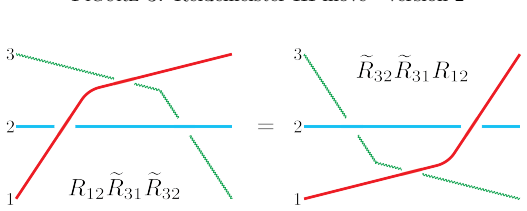
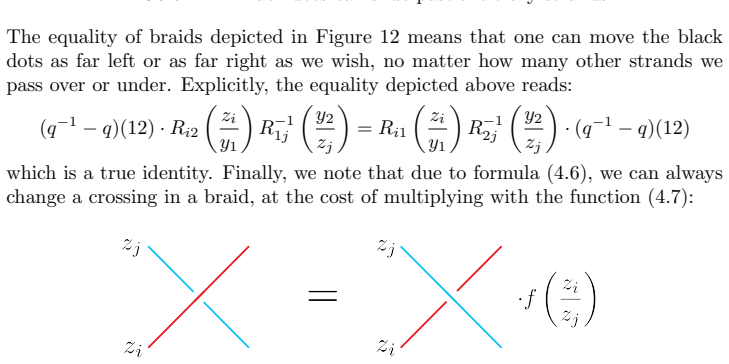
The central object is a matrix-valued shuffle algebra $A^+$ with spectral parameter. Its elements are $\mathrm{End}(V^{\otimes k})$-valued rational functions in variables $z_1,\dots,z_k$, symmetric in a braided sense, with only simple poles at $z_a = z_b q^2$ and with iterated residues constrained by the wheel conditions. The product is assembled from the R-matrix $R(x)$ and its mate $\tilde{R}(x)$, and associativity follows from Reidemeister-type moves; the extended algebra $\tilde{A}^+$ adds generating series $S(x)$ and $T(x)$, a topological coproduct, and a bialgebra pairing defined by iterated residues. The slope subalgebras $B^+_\mu$, with PBW generators $F^\mu_{[i;j)}$ and $\bar{F}^\mu_{[i;j)}$, organize the comparison with the explicit algebra $D$ that is already known to be isomorphic to $U_{q,q}(\ddot{gl}_n)$.
What would settle it
Compute the trace identity behind Proposition 6.6 for $k=4$ and a permutation $\sigma$ that is not the longest element, take the iterated residue of the integrand at $z_i q^2 = z_j$ for an inversion pair $(i,j)$ of $\sigma$, and check whether the residue vanishes. A single nonzero residue for any such $\sigma$ would show that the claimed bialgebra pairing is not well-defined, and with it the realization of the algebra as a Drinfeld double.
Extended reading notes
Core claim
The paper's central claim is Theorem 1.5: there exist injective algebra homomorphisms $A^+ \hookrightarrow U_{q,q}(\ddot{gl}_n)$ and $A^{-,\mathrm{op}} \hookrightarrow U_{q,q}(\ddot{gl}_n)$, whose images $U^{\mathrm{up}}$ and $U^{\mathrm{down}}$ satisfy $U_{q,q}(\ddot{gl}_n) \cong U^{\mathrm{up}} \otimes U^{\mathrm{down}}$. The extended shuffle algebras $\tilde{A}^+ = A^+ \otimes U^{\geq}_q(\dot{gl}_n)$ and $\tilde{A}^{-,\mathrm{op}} = (A^- \otimes U^{\leq}_q(\dot{gl}_n))^{\mathrm{op}}$ carry topological coproducts, and $U_{q,q}(\ddot{gl}_n)$ is their Drinfeld double. This new coproduct extends the Drinfeld-Jimbo coproduct on the horizontal subalgebra $U_q(\dot{gl}_n)\subset U_{q,q}(\ddot{gl}_n)$.
Load-bearing premise
The load-bearing premise is that a certain contour-reordering step in the bialgebra pairing never picks up leftover residues; the paper verifies this vanishing only for the longest permutation and leaves the general case to the reader. If any such residue is nonzero, the pairing is not well-defined and the Drinfeld-double realization of the quantum toroidal algebra collapses.
Editorial extensions
If this is right
- The quantum toroidal algebra gains a top-bottom triangular decomposition alongside the usual left-right one; unlike the left-right halves, the top half in degree $\mathbb{Z}^n \times \{1\}$ is generated by elements indexed by all roots of $U_q(\dot{sl}_n)$, not just positive roots.
- The new topological coproduct makes $U_{q,q}(\ddot{gl}_n)$ into a Drinfeld double of two extended shuffle algebras, so the pairing between the halves is encoded in explicit commutation relations among the generators.
- The shuffle presentation yields a PBW basis: ordered products of slope-$\mu$ generators over increasing $\mu$ form a linear basis, with dimension controlled by the number of unordered interval collections.
- For any quantum group with a representation $V$ and a unitary R-matrix, the Section 2 machinery produces a double shuffle algebra; specializing to $V = \mathbb{C}^n(z)$ with the standard R-matrix recovers the quantum toroidal algebra.
Reading between the lines
- Editorial inference: the general R-matrix shuffle construction opens a concrete testbed for other affine types: feed in a unitary R-matrix of a representation, form the double shuffle algebra, and check whether it is isomorphic to the corresponding quantum affinization; the paper itself floats a connection to q-deformed extended Yangians outside type A.
- Editorial inference: the success of the whole argument is concentrated in the contour-reordering step of the pairing; a natural stress test is to compute the residue for a small non-longest permutation, such as $k=4$, before relying on the Drinfeld-double statement.
- Editorial inference: in the $n=1$ limit the top-bottom decomposition is the left-right decomposition conjugated by the $SL_2(\mathbb{Z})$ rotation, whereas for $n>1$ the two decompositions are genuinely non-isomorphic; this suggests the new coproduct is a new structure rather than a reindexing of the old one.
Signed reviews
Editorial analysis
A structured set of objections, weighed in public.
Referee Report
Summary. The paper introduces a new family of matrix-valued shuffle algebras A^+ and A^- built from the R-matrix with spectral parameter of U_q(gl_n), and claims that these algebras are isomorphic to the 'up' and 'down' halves D^+ and D^- of the quantum toroidal algebra U_{q,q}(gl_n double dot) that appear in a new triangular decomposition. The author constructs extended algebras ~A^+ and ~A^- with topological coproducts, defines a bialgebra pairing between them, forms the Drinfeld double, and asserts that this double is isomorphic to the full quantum toroidal algebra. The main theorem, Theorem 1.5, also states that the resulting topological coproduct extends the Drinfeld-Jimbo coproduct on the horizontal subalgebra U_q(gl_n). The proof is largely a comparison with the author's earlier PBW presentation of U_{q,q}(gl_n double dot) from [17].
Significance. If the main theorem is correct, the paper gives a genuinely new shuffle-algebra description of the 'top' and 'bottom' halves of the quantum toroidal algebra, complementary to the known left/right shuffle presentations. The new topological coproduct extending the Drinfeld-Jimbo coproduct is a concrete and falsifiable structural claim. The construction itself is explicit and parameter-free: the shuffle algebras are defined directly from the universal R-matrix, and the claimed isomorphisms are reduced to a finite set of algebraic checks. The paper is well organized and the overall architecture is coherent. Its main weakness is that a load-bearing contour-reordering step in the construction of the bialgebra pairing is not proved in general, and the proof of the Drinfeld double realization inherits this gap.
major comments (2)
- [§6.6, Eqs. (6.14)–(6.15)] The pairing (6.13) is not proved to be well-defined. To show that the two defining formulas (6.14) and (6.15) agree on elements of the form (6.12), the proof must justify changing the integration contour from |z1|≪...≪|zk| to |zσ(1)|≪...≪|zσ(k)| in (6.20)–(6.21). The only poles that can be met are at zi q_+^2 = zj and the analogous q_- poles. The paper explicitly shows the vanishing of the residue only for the longest permutation σ=ω_k, using identity (6.23). For general σ, the text says: 'We leave the visual depiction of this fact to the interested reader' and asserts that the relevant blue and green strands do not cross except at two points. This is not a cosmetic omission: if for some σ and some i<j with σ^{-1}(i)>σ^{-1}(j) the residue at zi q_+^2 = zj is nonzero, then formulas (6.14) and (6.15) define different functionals, the pairing (6.13) is not single-valued, and the Drinfeld double construction in (6.30) collapses. Proposition 6.7, the double (6.30), and the realization of U_{q,q}(gl_n double dot) in Theorem 1.5 all depend on this pairing. A complete proof of the residue vanishing for all σ, or an alternative contour-independent definition of the pairing, is required.
- [§6.7–6.9] The construction of the Drinfeld double relies on several substantial checks that are delegated rather than proved. The proof of Proposition 6.7 says it 'follows that of Proposition 2.11 very closely' and leaves the verification of (2.29) and several cases to the reader; the displayed verification of (6.27) itself ends with the sentence 'We may move R_{ω_k} to the very right of the expression above', which hides exactly the kind of braid manipulation that is problematic in Proposition 6.6. Likewise, relations (6.31)–(6.33) are asserted with proofs left as exercises. Since these relations are what match the commutation relations of D and thereby produce the algebra isomorphism in the final proof of Theorem 1.5, the double realization is only as solid as the unproved pairwise checks. They should be written out or given precise references to where they are proved.
minor comments (4)
- [§6.6, proof of Proposition 6.6] The proof refers to 'Braid 1' through 'Braid 6' on the previous page, but these braid diagrams are not present in the text under review; without them, the displayed braid moves cannot be checked by the reader. If the diagrams exist in the published version, this is not an issue, but they should be included.
- [Throughout] Several statements are justified with 'left as an exercise to the interested reader', including Proposition 2.11, formulas (3.115)–(3.117), Proposition 3.39, and parts of Propositions 5.17 and 6.11. While many of these are routine, some are non-trivial and are used later in load-bearing positions; the author should indicate which of these exercises are genuinely routine and which are needed for the main theorem.
- [§4.3] The nonstandard residue convention, by which (α−x)^{-1} has residue 1 at x=α, is stated only in passing. Since all later contour computations depend on it, this convention should be prominently displayed and used consistently.
- [§5.22] The author notes that no closed formula is known for the imaginary generators P^μ_{lδ,r} in (5.56). This is acceptable, but it should be stated more prominently, since the isomorphism Υ_μ : E^+_μ → B^+_μ is only defined through the existence of these generators.
Circularity Check
No circular reduction: the shuffle algebras are defined from the R-matrix and independently matched to the known presentation D, with the only notable gap being an omitted contour-reordering verification in Proposition 6.6, which is a correctness risk rather than a circularity.
full rationale
The paper's construction is definition-theorem, not fit. A+ and A− are new shuffle algebras built from the fixed R-matrix (3.87) by the shuffle product (4.9) and the wheel conditions (4.13); no parameter is fitted to the desired conclusion. Theorem 5.25 is proved by explicit maps F^μ_{[i;j)} ↦ p^μ, by computing α-functionals, and by dimension bounds obtained inside the paper (Lemmas 5.10, 5.15, Claim 5.29), while the identification of the abstract algebra D with U_{q,q}(gln) is imported from [16,17]. That import is a self-citation, but it is an independent prior structure theorem: its assumptions are about the standard shuffle algebra S and the PBW presentation D, not about the new A±, so it does not make the target result true by definition. The same applies to the use of the D± PBW basis from [17] in the surjectivity part of Theorem 5.25. The genuinely fragile point is Proposition 6.6: the equality of (6.14) and (6.15) is reduced to contour reordering, and for general σ the paper states 'We leave the visual depiction of this fact to the interested reader' after proving the residue vanishing only for the longest permutation. If a residue survived, the pairing (6.13) would be ill-defined and the Drinfeld double realization would collapse. This is a load-bearing rigor gap, but it is not circularity: the gap is in verifying a well-definedness property of a newly constructed integral, not in defining the answer to match the input. No step in the claimed derivation chain equates the conclusion with its inputs by construction.
Assumptions & free parameters
assumptions (4)
- standard math Yang-Baxter equation for the R-matrix R(x) of (3.87), and the unitarity identity R_{12}(x)R_{21}(1/x) = f(x) Id
- domain assumption The quantum toroidal algebra U_{q,q}(gl_n) is isomorphic to the double shuffle algebra S (theorem of [16]) and to the algebra D of [17] with its PBW basis
- standard math The subalgebra E of U_q(gl_n) is the Drinfeld double of its positive and negative halves with the pairing (3.25)
- domain assumption The evaluation representation V = C^n(z) of U_q(gl_n) has the R-matrix (3.87) with the stated analytic properties
invented entities (1)
-
Matrix-valued shuffle algebra A+ with spectral parameters
independent evidence
Cite this review
Pith. "Pith review of A tale of two shuffle algebras." pith.science (2026). https://pith.science/paper/THE3475J
@misc{pith2026190808395,
  author       = {Pith},
  title        = {Pith review of: A tale of two shuffle algebras},
  year         = {2026},
  howpublished = {\url{https://pith.science/paper/THE3475J}},
  note         = {Machine review of arXiv:1908.08395}
}
read the original abstract
As a quantum affinization, the quantum toroidal algebra is defined in terms of its "left" and "right" halves, which both admit shuffle algebra presentations. In the present paper, we take an orthogonal viewpoint, and give shuffle algebra presentations for the "top" and "bottom" halves instead, starting from the evaluation representation of the quantum affine group and its usual R-matrix. An upshot of this construction is a new topological coproduct on the quantum toroidal algebra which extends the Drinfeld-Jimbo coproduct on the horizontal quantum affine subalgebra.
Figures


Figures from the paper (17 more)




Reference graph
Works this paper leans on
-
[17]
Negut, A., PBW basis for Uq,q(¨gln), arχiv:1905.06277
work page Pith review arXiv 1905
-
[1]
Beck J., Braid group action and quantum affine algebras , Commun. Math. Physics vol. 165 (1994), 555568
work page 1994
-
[2]
Burban I., Schiffmann O., On the Hall algebra of an elliptic curve, I , Duke Math. J. 161 (2012), no. 7, 1171–1231
work page 2012
-
[3]
Ding J., Frenkel I., Isomorphism of two realizations of quantum affine algebra Uq(ˆgln), Comm. Math. Phys. 156 (1993), no. 2, 277–300
work page 1993
-
[4]
Ding J., Iohara K., Generalization of Drinfeld quantum affine algebras , Lett. Math. Phys., 41 (1997), no. 2, 181–193
work page 1997
-
[5]
G., A new realization of Yangians and quantized affine algebras , Soviet Math
Drinfeld V. G., A new realization of Yangians and quantized affine algebras , Soviet Math. Dokl. 36 (1988), 212–216
work page 1988
-
[6]
Enriquez B., On correlation functions of Drinfeld currents and shuffle algebras, Transform. Groups 5 (2000), no. 2, 111 - 120
work page 2000
-
[7]
Faddeev L., Reshetikhin N., Takhtajan L., Quantization of Lie groups and Liealgebras , Leningrad Math. J.1(1990) 193–226
work page 1990
Show all 21 references
-
[8]
Feigin B., Hashizume K., Hoshino A., Shiraishi J., Yanagida S., A commutative algebra on degenerate CP1 and MacDonald polynomials , J. Math. Phys. 50 (2009), no. 9
2009
-
[9]
380 (2013), 78–108 80 ANDREI NEGUT ,
Feigin B., Jimbo M., Miwa T., Mukhin E., Representations of quantum toroidal gln, Journal of Algebra vol. 380 (2013), 78–108 80 ANDREI NEGUT ,
2013
-
[10]
Feigin B., Odesskii A., Vector bundles on elliptic curve and Sklyanin algebras , Topics in Quantum Groups and Finite-Type Invariants, Amer. Math. Soc. Transl. Ser. 2, 185 (1998), Amer. Math. Soc., 65–84
1998
-
[11]
Jing N., Zhang H., Hopf algebraic structures of quantum toroidal algebras , arχiv:1604.05416
-
[12]
Maulik D., Okounkov A., Quantum groups and quantum cohomology , Ast´ erisque, Volume 408 (2019) 212 pp
2019
-
[13]
Miki K., A (q,γ ) analog of the W1+∞ algebra, J. Math. Phys., 48 (2007), no. 12
2007
-
[14]
I., Reflection equation and twisted Yangians , Journal of Mathematical Physics 48, 093501 (2007)
Mudrov A. I., Reflection equation and twisted Yangians , Journal of Mathematical Physics 48, 093501 (2007)
2007
-
[15]
Negut, A., Shuffle algebra revisited , Int. Math. Res. Not., Volume 2014, Issue 22, 2014, 6242–6275
2014
-
[16]
Math., Volume 372 (2020), 107288
Negut, A., Quantum toroidal and shuffle algebras , Adv. Math., Volume 372 (2020), 107288
2020
-
[18]
Negut, A., DeformedW –algebras in type A for rectangular nilpotent, arχiv:2004.02737
2004 arXiv
-
[19]
Okounkov A., Smirnov A., Quantum difference equation for Nakajima varieties , arχiv:1602.09007
-
[20]
Schiffmann O., Drinfeld realization of the elliptic Hall algebra , Journal of Algebraic Com- binatorics, vol 35 (2012), no 2, 237–262
2012
-
[21]
Wendlandt C., The R-Matrix Presentation for the Yangian of a Simple Lie Algebra , Comm. Math. Phys., October 2018, Volume 363, Issue 1, 289–332 MIT, Department of Mathematics, Cambridge, MA, USA Simion Stoilow Institute of Mathematics, Bucharest, Romania E-mail address: andrei...
2018
Reviewed August 14, 2026 · model on record in the stance chip above.
Discussion (0). Continue with ORCID to comment.