REVIEW 3 major objections 8 minor 34 references
Optimal unions of scaled copies of domains and P\'olya's conjecture
T0 review · 3 major / 8 minor · reviewed 2026-08-14 · deepseek-v4-flash
Pith's one-line read Scaled copies of a domain decide Pólya's conjecture.
desk verdict Genuinely new structural results on Pólya's conjecture, but the main theorems rest on one underproved variational lemma that a referee should pin down before publication. read the letter →
The pith
A machine-rendered reading of the paper's core claim, the machinery that carries it, and where it could break.
The reading
What carries the argument
The load-bearing object is the Wolf-Keller decomposition (Lemma 2.6): every optimiser $\Omega^*_k$ in $R(\Omega)$ splits into scaled copies of optimisers for smaller ranks, $\Omega^*_k = \bigsqcup_q \alpha_q \Omega^*_{j_q}$, with $\lambda^*_k(R)^{d/2} = \sum_q \lambda^*_{j_q}(R)^{d/2}$. This additive identity is what makes the sequence $\lambda^*_k^{d/2}$ subadditive, justifies the recursive dynamic-programming search over partitions used in the numerical section, and underlies the propagation arguments that connect recurrence of the generator to the infimum $L$. The second mechanism is the packing-density estimate of Section 4, which turns the fact that an optimal union can be geometrically embedded into another domain into a lower bound on $L$ in terms of the asymptotic packing density $\rho_\Omega$.
What would settle it
For a bounded domain $\Omega$ whose generator is optimal infinitely often, check the $k$-th Dirichlet eigenvalue of a volume-one union of its scaled copies: if any such eigenvalue is smaller than $(2\pi)^2(\omega_d|\Omega|)^{-2/d}k^{2/d}$, then Pólya's conjecture fails in $R(\Omega)$ despite the generator recursing infinitely often, which contradicts Theorem 1.3.
Extended reading notes
Core claim
The central discovery is that the geometric behaviour of the optimisers encodes the validity of Pólya's conjecture. For a fixed generator $\Omega$, let $\lambda^*_k(R)$ be the best possible $k$-th Dirichlet eigenvalue among volume-one unions of scaled copies of $\Omega$. The sequence $\lambda^*_k(R)^{d/2}$ is subadditive, so by Fekete's lemma it converges to an infimum $L$; Pólya's conjecture in $R(\Omega)$ holds exactly when $L$ equals the Weyl constant $(2\pi)^d/\omega_d$. The trichotomy sharpens this: if the generator itself recurs as an optimiser infinitely often, the conjecture holds; if it recurs only finitely often, the conjecture holds precisely when the optimal value equals the Weyl constant infinitely often, and fails precisely when the optimal value attains its infimum infinitely often. In the presence of the two-term Weyl law, the strong Pólya conjecture is equivalent to the largest scale factor $r_{1,k}$ of the optimiser tending to $1$ as $k$ grows, so the geometry of the optimal union at high frequency is a complete proxy for the conjecture.
Load-bearing premise
The whole structure leans on the claim that in an optimal union every component must carry an eigenvalue exactly equal to the union's optimal value, a variational step the paper states briefly rather than proves in full.
Editorial extensions
If this is right
- If $\Omega$ tiles $\mathbb{R}^d$, Pólya's conjecture holds for every union of its scaled copies (Corollary 1.9).
- If $\Omega$ simply tiles $\mathbb{R}^d$ and its fundamental domain obeys the two-term Weyl law, then $\Omega$ satisfies the strong Pólya conjecture and is itself an optimiser infinitely often (Theorem 1.11).
- The universal lower bound $\inf_k \lambda^*_k(R)^{d/2}/k \geq \rho_\Omega (2\pi)^d/\omega_d$ holds for every domain, strengthening Urakawa's lattice-packing bound in terms of a more flexible packing density (Theorem 1.8).
- Under the two-term Weyl law, the strong Pólya conjecture in $R(\Omega)$ is equivalent to the largest scaled-copy coefficient $r_{1,k}$ converging to $1$ along every subsequence (Theorem 1.4).
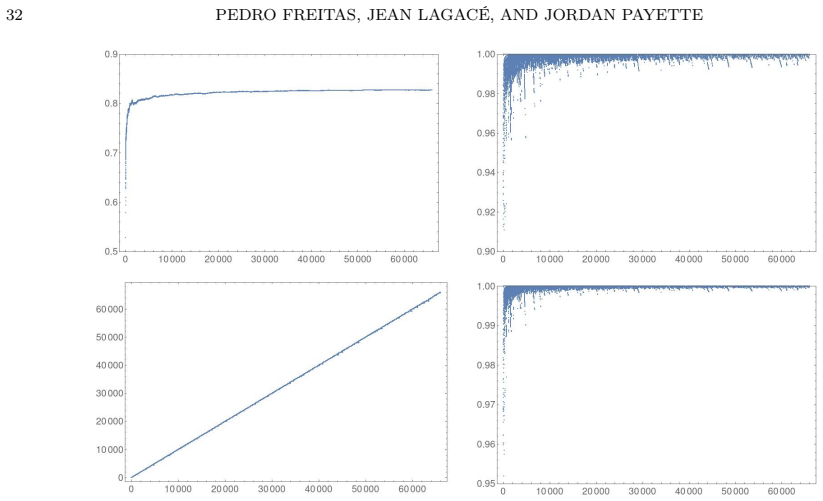
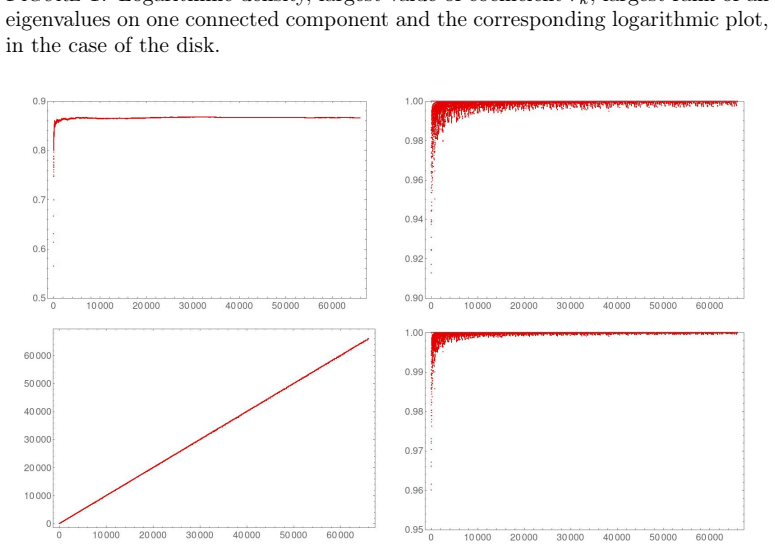
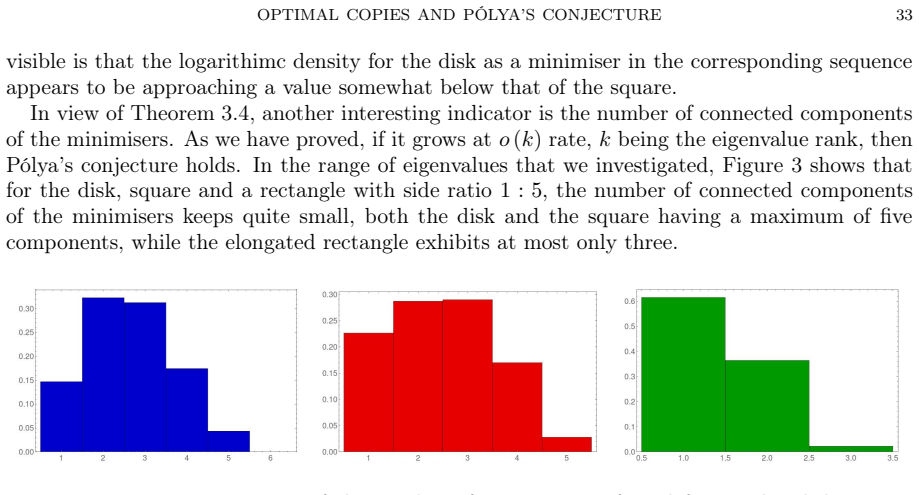
- For the disk, square, and $1:5$ rectangle, numerical optimisers up to rank $66{,}000$ have at most five connected components, consistent with the conjecture (Section 5).
Reading between the lines
- If the observed log-density of ranks where the generator is an optimiser converges to a constant greater than $0.8$ for all tested domains, the trichotomy suggests this constant is a new spectral invariant of $\Omega$ that may distinguish domains for which Pólya's conjecture is open (like the disk) from tiling domains (like the square), and this can be tested on other shapes such as ellipses or tr
- The equivalence of strong Pólya with $r_{1,k} \to 1$ turns a spectral inequality into a computable geometric condition; checking whether $r_{1,k}$ approaches $1$ for a candidate domain at very high $k$ provides a numerical test that could flag a counterexample long before a proof is found.
- The packing density $\rho_\Omega$ could be refined to a spectral packing density that measures how efficiently copies of $\Omega$ can be embedded while preserving eigenvalue ordering, which might connect to questions in discrete geometry about densest packings of non-convex tiles.
Signed reviews
Editorial analysis
A structured set of objections, weighed in public.
Referee Report
Summary. The paper studies, for a fixed bounded domain Omega, the family R(Omega) of all disjoint unions of scaled and isometric copies of Omega with total volume at most 1 (for Dirichlet) or at least 1 (for Neumann). For each k it analyzes the extremal values lambda_k^*(R) = inf lambda_k and mu_k^*(R) = sup mu_k over this family. The main results are: existence of extremizers and sub/superadditivity of the extremal eigenvalue sequences (Section 2); a Wolf-Keller type decomposition of every extremizer into scaled extremizers of smaller rank (Lemmas 2.6 and 2.7); a trichotomy (Theorem 1.3) relating whether the generator Omega is an extremizer infinitely often to the validity of Polya's conjecture in R(Omega); an equivalence, under two-term Weyl asymptotics, between the strong Polya conjecture and convergence of the largest scaling coefficient to 1 (Theorem 1.4); a lower bound for the Dirichlet limit in terms of a newly defined asymptotic packing density (Theorem 1.8); and numerical experiments for the disk, the square, and a 1:5 rectangle (Section 5).
Significance. The paper offers a genuinely new structural framework for Polya's conjecture: rather than seeking universal bounds over all domains, it shows that the validity of the conjecture for a fixed generator is encoded in the asymptotic behavior of optimizers in R(Omega). If the technical decomposition lemmas are made fully rigorous, the trichotomy and the packing-density bounds form a valuable contribution that recovers and strengthens results of Polya and Urakawa. The paper is also honest that the numerical experiments do not prove the conjecture, and the recursive algorithm based on Lemma 2.6 is a useful byproduct. A notable strength is that the results contain no fitted parameters; the constants come from Weyl's law, Kroger's bound, and the geometric definition of packing density.
major comments (3)
- [Section 2, Lemma 2.6 (pp. 13-15)] The proof hinges on the unproved variational assertion that the largest eigenvalue smaller or equal to lambda_k^*(R) of each connected component must equal lambda_k^*(R). The one-sentence perturbation argument is not a complete proof: a quantitative check is needed to show that shrinking a component whose relevant eigenvalue is strictly below lambda_k^*(R) and expanding the others strictly lowers the k-th eigenvalue, including when eigenvalues coincide or when components have different ranks. This lemma is subsequently used in Theorem 1.3, Theorem 3.4, Proposition 3.5, Theorem 1.4, and Algorithm 5.2, so the gap is load-bearing and should be closed with a fully expanded argument.
- [Section 3, Theorem 1.4 (pp. 20-22) and Lemma 3.8 (p. 24)] The proofs require a stronger decomposition property than Lemma 2.6 states: not only is each connected component of an optimizer an optimizer for its own rank, but any subcollection of components is an optimizer for the sum of the ranks. For instance, the equality lambda_{j'}(Xi_k)^{d/2} = lambda_{j'}^*(R)^{d/2} in the proof of Theorem 1.4 (1) implies (2), and the statement in Lemma 3.8 that Omega_k^{*(n_j)} realises lambda_{n_j k}^*(R), both use exactly this stronger property. Please state and prove the stronger decomposition property or give a separate argument for it.
- [Section 3, Theorem 1.4, proof of (3) implies (1) (p. 22)] In the decomposition j_k = n_k j + r with 0 <= r < j, the case r = 0 is allowed, but the construction (17) then involves lambda_r(Omega), which is undefined for the Dirichlet Laplacian because the numbering starts at k = 1. When j divides j_k, the first term in (17) should be omitted or handled separately. As written, the proof is incomplete along any subsequence for which r = 0.
minor comments (8)
- [Section 4, Proposition 4.2 (p. 27)] The proof has inconsistent notation: the cardinality bound should be n^d rather than n (since |nV| = n^d for |V| = 1), and the scaling map should be n_i^{-1/d} R^i V rather than n_i^{-1/d} n V, with density rho_i = n_i / R^{id}. As written, the construction of the asymptotic packing is not clear.
- [Section 4, Theorem 1.11 proof (p. 29)] The sentence "Since Omega satisfies the two-term Weyl law (1)" should refer to the fundamental domain V, consistent with the theorem statement; as written it is a typo.
- [Section 3, Lemma 3.2 proof (p. 17)] The justification of the last inequality in display (8) is confusingly worded: the point is that a_p >= b_{k-p}, so both terms are bounded by a_p; the phrase involving 'max{a_p, b_{k-p}}' is not the needed argument.
- [Section 5, Algorithm 5.2 (p. 31)] The pseudocode never sets ranks[k] to {k} when no improvement is found, because the branch 'if minrank == k' is inside the 'then' block where minrank has just been set to j. The initialisation of ranks[k] should be moved before the loop or the no-improvement case handled after the loop.
- [Section 1.5 (pp. 7-8)] The text says 'In all four cases' although three generators are studied (disk, square, and 1:5 rectangle); also 'logarithimc' and 'converhing' are typos.
- [Section 2, Lemma 2.6 proof (p. 14)] The sentence 'Summing up these identities for j from 1 to p-1' uses the wrong index (it should be q), and there is a stray comma in 'Omega_{n,q}'.
- [Section 2, Lemma 2.7 proof (p. 16)] The statement that 'f_0,...,f_{k-1}, phi in H^1(V) generates a k-dimensional subspace' counts k+1 functions; the dimension should be k+1, or the variational argument should be phrased directly via the orthogonal complement of the first k eigenfunctions.
- [Throughout] The manuscript contains numerous typographical errors ('satisy', 'adressed', 'reunion', 'strenghtening', 'a forth bullet point') that should be corrected in a final version.
Circularity Check
No significant circularity: the central theorems are derived from independent spectral inequalities, Weyl asymptotics, and an independently defined packing density; self-citations are not load-bearing.
full rationale
The paper's main results are not circular. The existence and sub/superadditivity results (Lemmas 2.1–2.4) are proved from the definition of the family R and standard spectral inequalities. Lemma 2.6 is the structural heart of the paper; its proof is terse and may contain a rigor gap in the one-line perturbation argument, but it does not assume the theorem it proves. The trichotomy in Theorem 1.3 follows from Fekete's lemma and the fact that if the generator Ω is an optimizer infinitely often, Weyl's law forces the optimal constant to equal Pólya's constant; the finite case is handled via Proposition 3.5 using the decomposition from Lemma 2.6. Theorem 1.4 derives its equivalence from the two-term Weyl law and Lemma 2.6, and the packing-density bound in Theorem 1.8 uses monotonicity of Dirichlet eigenvalues under inclusion together with Weyl's law; the quantity ρ_Ω is a geometrically defined packing density, not a fitted parameter. The paper's self-citations, such as [18] in the introduction, are contextual background and are not used as load-bearing inputs to any proof. A possible lack of full justification in a variational step is a rigor concern, not circularity: no equation in the paper is defined in terms of the result it supports, and no fitted value is renamed as a prediction.
Assumptions & free parameters
assumptions (6)
- standard math Weyl's asymptotic law for Dirichlet and Neumann eigenvalues
- domain assumption Two-term Weyl law (1) and (2), requiring zero measure of periodic billiard trajectories
- standard math Kröger's upper bound for Neumann eigenvalues
- standard math Berezin-Li-Yau bound for Dirichlet eigenvalues
- domain assumption Lipschitz boundary for the Neumann problem
- domain assumption Upper Minkowski dimension of the boundary of V strictly less than d
invented entities (1)
-
asymptotic packing density ρ_Ω
Cite this review
Pith. "Pith review of Optimal unions of scaled copies of domains and P\'olya's conjecture." pith.science (2026). https://pith.science/paper/3EJRBVU7
@misc{pith2026190808441,
  author       = {Pith},
  title        = {Pith review of: Optimal unions of scaled copies of domains and P\'olya's conjecture},
  year         = {2026},
  howpublished = {\url{https://pith.science/paper/3EJRBVU7}},
  note         = {Machine review of arXiv:1908.08441}
}
abstract
Given a bounded Euclidean domain $\Omega$, we consider the sequence of optimisers of the $k^{\rm th}$ Laplacian eigenvalue within the family consisting of all possible disjoint unions of scaled copies of $\Omega$ with fixed total volume. We show that this sequence encodes information yielding conditions for $\Omega$ to satisfy P\'{o}lya's conjecture with either Dirichlet or Neumann boundary conditions. This is an extension of a result by Colbois and El Soufi which applies only to the case where the family of domains consists of all bounded domains. Furthermore, we fully classify the different possible behaviours for such sequences, depending on whether P\'{o}lya's conjecture holds for a given specific domain or not. This approach allows us to recover a stronger version of P\'{o}lya's original results for tiling domains satisfying some dynamical billiard conditions, and a strenghtening of Urakawa's bound in terms of packing density.
Figures
Reference graph
Works this paper leans on
-
[1]
P. R. S. Antunes and P. Freitas, Numerical optimisation of low eigenvalues of the Dirichlet and Neumann Laplacians, J. Optim. Theory Appl.154 (2012), 235–257
work page 2012
- [2]
-
[3]
P. R. S. Antunes and P. Freitas, Optimisation of eigenvalues of the Dirichlet Laplacian with a surface area restriction,Appl. Math. Optim.73 (2016) 313–328
work page 2016
-
[4]
P. R. S. Antunes, P. Freitas, and J. B. Kennedy, Asymptotic behaviour and numerical approximation of optimal eigenvalues of the Robin Laplacian,ESAIM Control Optim. Calc. Var.19 (2013), 438–459
work page 2013
-
[5]
Berezin, Covariant and contravariant symbols of operators,Izv
F.A. Berezin, Covariant and contravariant symbols of operators,Izv. Akad. Nauk SSSR Ser. Mat.(1972) 36, 1134–1167
work page 1972
-
[6]
M. van den Berg, D. Bucur and K. Gittins, Maximizing Neumann eigenvalues on rectangles,Bull. London Math. Soc. 48 (2016), 877–894
work page 2016
-
[7]
M. van den Berg and K. Gittins, Minimising Dirichlet eigenvalues on cuboids of unit measure,Mathe- matika 63 (2017), 469–482
work page 2017
-
[8]
M. van den Berg and M. Iversen, On the minimisation of Dirichlet eigenvalues of the Laplace operator, J. Geom. Anal.(2013) 23, 660–676
work page 2013
Show all 34 references
-
[9]
Berger, The eigenvalues of the Laplacian with Dirichlet boundary condition inR2 are almost never minimized by disks,Ann
A. Berger, The eigenvalues of the Laplacian with Dirichlet boundary condition inR2 are almost never minimized by disks,Ann. Global Anal. Geom.47 (2015), 285–304. 34 PEDRO FREITAS, JEAN LAGACÉ, AND JORDAN PAYETTE
2015
-
[10]
Bogosel and E
B. Bogosel and E. Oudet, Qualitative and numerical analysis of a spectral problem with perimeter constraint SIAM J. Control Optim.54 (2016), 317–340. 0
2016
-
[11]
Bucur and P
D. Bucur and P. Freitas, Asymptotic behaviour of optimal spectral planar domains with fixed perimeter, J. Math. Phys.54 (2013), 053504. http://dx.doi.org/10.1063/1.4803140
2013 doi
-
[12]
Bucur and A
D. Bucur and A. Henrot, Maximization of the second non-trivial Neumann eigenvalue,Acta Math. 222 (2019), 337–361
2019
-
[13]
Canzani,Analysis on Manifolds via the Laplacian, Lecture notes, Harvard University (2013), 114 pp
Y. Canzani,Analysis on Manifolds via the Laplacian, Lecture notes, Harvard University (2013), 114 pp
2013
-
[14]
Colbois and A
B. Colbois and A. El Soufi, Extremal eigenvalues of the Laplacian on Euclidean domains and closed surfaces, Math. Z. 278 (2014), 529–549
2014
-
[15]
T. A. Driscoll, N. Hale, and L. N. Trefethen, editors,Chebfun Guide, Pafnuty Publications, Oxford, 2014
2014
-
[16]
Faber, Beweis, dass unter allen homogenen membranen von gleicher flüche und gleicher spannung die kreisfürmige den tiefsten grundton gibt, Sitz
G. Faber, Beweis, dass unter allen homogenen membranen von gleicher flüche und gleicher spannung die kreisfürmige den tiefsten grundton gibt, Sitz. ber. bayer. Akad. Wiss. (1923), 169–172
1923
-
[17]
Freitas, Asymptotic behaviour of extremal averages of Laplacian eigenvalues.J
P. Freitas, Asymptotic behaviour of extremal averages of Laplacian eigenvalues.J. Stat. Phys. 167 (2017), 1511–1518
2017
-
[18]
Freitas, A remark on Pólya’s conjecture at low frequencies,Arch
P. Freitas, A remark on Pólya’s conjecture at low frequencies,Arch. Math. (Basel)112 (2019), 305–311
2019
-
[19]
Freitas and J.B
P. Freitas and J.B. Kennedy, Extremal domains and Pólya-type inequalities for the Robin Laplacian on rectangles and unions of rectangles,Int. Math. Res. Not. IMRN, to appear
-
[20]
Gittins and S
K. Gittins and S. Larson, Asymptotic behaviour of cuboids optimising Laplacian eigenvalues,Integral Equations Operator Theory89 (2017), 607–629
2017
-
[21]
Kellner, On a theorem of Pólya,Amer
R. Kellner, On a theorem of Pólya,Amer. Math. Monthly73 (1966), 856–858
1966
-
[22]
Krahn, Über eine von Rayleigh formulierte minimaleigenschaft des kreises,Math
E. Krahn, Über eine von Rayleigh formulierte minimaleigenschaft des kreises,Math. Annalen 94 (1924), 97–100
1924
-
[23]
Krahn, Über Minimaleigenshaften der Kugel in drei und mehr Dimensionen, Acta Comm
E. Krahn, Über Minimaleigenshaften der Kugel in drei und mehr Dimensionen, Acta Comm. Univ. Dorpat. A9 (1926), 1–44. [English translation: Minimal properties of the sphere in three and more dimensions, Edgar Krahn 1894-1961: A Centenary Volume, Ü. Lumiste and J. Peetre, editor...
1926
-
[24]
Kröger, Upper bounds for the Neumann eigenvalues on a bounded domain in Euclidean space,J
P. Kröger, Upper bounds for the Neumann eigenvalues on a bounded domain in Euclidean space,J. Funct. Anal(1992) 106(2): pp. 353–357
1992
-
[25]
Larson, Asymptotic shape optimization for Riesz means of the Dirichlet Laplacian over convex do- mains, preprint arXiv:1611.0568 [math.SP] (2016)
S. Larson, Asymptotic shape optimization for Riesz means of the Dirichlet Laplacian over convex do- mains, preprint arXiv:1611.0568 [math.SP] (2016)
2016
-
[26]
Li and S.-T
P. Li and S.-T. Yau. On the Schrödinger equation and the eigenvalue problem,Comm. Math. Phys. 88(1983), 309–318
1983
-
[27]
Marshall, Stretching convex domains to capture many lattice points, preprint arXiv:1707.00682v3 (2017)
N. Marshall, Stretching convex domains to capture many lattice points, preprint arXiv:1707.00682v3 (2017)
2017 arXiv
-
[28]
Oudet, Numerical minimization of eigenmodes of a membrane with respect to the domain,ESAIM Control Optim
E. Oudet, Numerical minimization of eigenmodes of a membrane with respect to the domain,ESAIM Control Optim. Calc. Var.10 (2004), 315–330
2004
-
[29]
Poliquin and G
G. Poliquin and G. Roy-Fortin. Wolf-Keller theorem for Neumann eigenvalues,Ann. Sci. Math. Québec 36 (2010), 169–178
2010
-
[30]
1961 On the eigenvalues of vibrating membranes,Proc
Pólya, G. 1961 On the eigenvalues of vibrating membranes,Proc. London Math. Soc.11, 419–433
1961
-
[31]
Safarov & D
Yu. Safarov & D. Vassiliev,The asymptotic distribution of eigenvalues of partial differential operators, American Mathematical Society 1997, series Translations of Mathematical Monographs, vol. 155
1997
-
[32]
Urakawa, Lower bounds for the eigenvalues of the fixed vibrating membrane problems,Tôhoku Math
H. Urakawa, Lower bounds for the eigenvalues of the fixed vibrating membrane problems,Tôhoku Math. J. 36 (1984), 85–89
1984
-
[33]
H. F. Weinberger, An isoperimetric inequality for theN-dimensional free membrane problem.J. Rational Mech. Anal. 5 (1956), 633–636
1956
-
[34]
S. A. Wolf and J. B. Keller, Range of the first two eigenvalues of the Laplacian,Proc. R. Soc. Lond. A., (1994), 447:pp. 397–412. OPTIMAL COPIES AND PÓLYA’S CONJECTURE 35 Departamento de Matemática, Instituto Superior Técnico, Universidade de Lisboa, A v. Ro- visco Pais, 1049-0...
1994
Reviewed August 14, 2026 · model on record in the stance chip above.
Discussion (0). Continue with ORCID to comment.