REVIEW 3 major objections 4 minor 1 cited by
On the recent parametric determination of an asteroseismological model for the DBV star KIC 08626021
T0 review · 3 major / 4 minor · reviewed 2026-08-14 · deepseek-v4-flash
Pith's one-line read This paper argues that the chemical structure inferred for the pulsating white dwarf KIC 08626021 from a very precise asteroseismic fit cannot be produced by any standard single-star white dwarf formation channel, even with extreme…
desk verdict Strong cautionary analysis with a real scope limit: the impossibility claim holds for single-star evolution but is untested for the merger channel the authors themselves cite. read the letter →
The pith
A machine-rendered reading of the paper's core claim, the machinery that carries it, and where it could break.
The reading
What carries the argument
The load-bearing device is the complete evolutionary sequence: starting from a zero-age main-sequence star and following it through core helium burning, the thermally pulsing asymptotic giant branch, and the cooling white dwarf stage, so that every chemical feature in the final model can be traced to a specific physical process. The paper perturbs that machinery piece by piece - the overshooting parameter at the convective core boundary, the diffusion efficiency, the $^{12}\mathrm{C}(\alpha,\gamma)^{16}\mathrm{O}$ reaction rate, and the treatment of thermal pulses - and compares each resulting profile with the asteroseismic one. A second mechanism is the fossil-record argument: because diffusion only reshapes the outer layers on white dwarf timescales, deep features such as the carbon buffer must have been imprinted during the progenitor's nuclear burning phases, which is what makes the reaction-rate test decisive.
What would settle it
Compute a single-star evolutionary sequence from the main sequence to the white dwarf stage, using standard physics and reaction rates within current published uncertainties, that yields a homogeneous carbon-oxygen core of $0.45\,M_\odot$, a nearly pure carbon buffer, and a helium envelope near $10^{-4}\,M_\odot$ for a $0.57\,M_\odot$ white dwarf; finding such a model would refute the paper's central claim, while a merger simulation producing the same structure would show the claim's scope is limited to single-star evolution.
Extended reading notes
Core claim
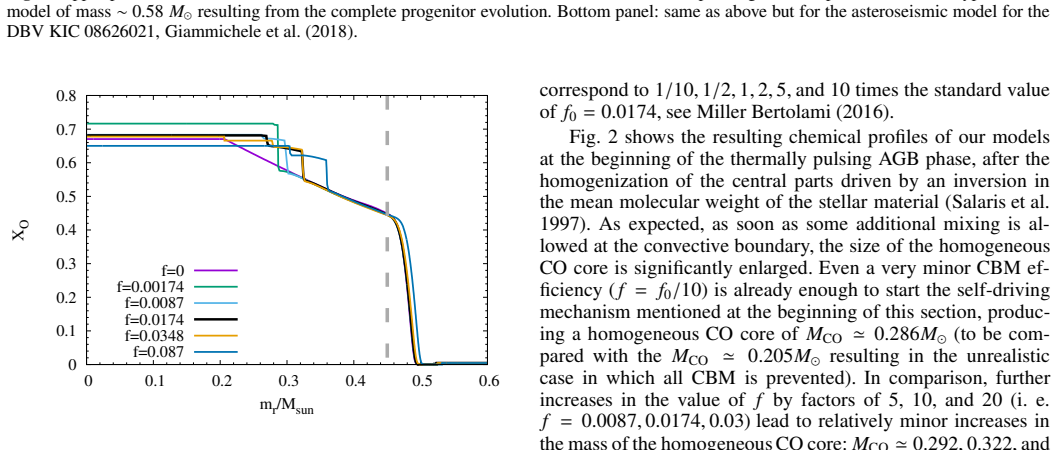
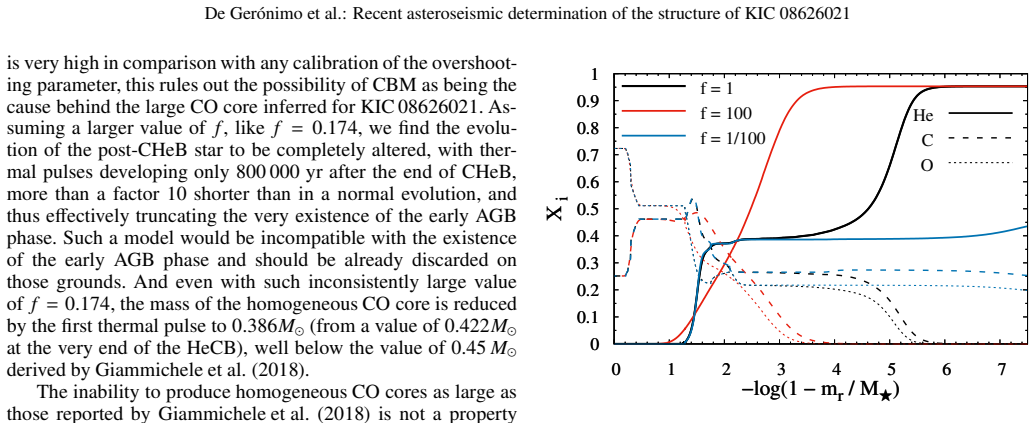
The paper's central claim is that the chemical stratification of the asteroseismic model for KIC 08626021 is a fossil record of earlier evolution, and every plausible route to that record fails. During core helium burning, convective overshooting up to five times the standard value still produces a homogeneous CO core of at most about $0.35\,M_\odot$, well short of the $0.45\,M_\odot$ inferred. During white dwarf cooling, diffusion varied in efficiency from $1/100$ to 100 times normal cannot create the nearly pure carbon buffer at the top of the core, and the inferred helium envelope would be thickened by gravitational settling within roughly $10^5$ to $2\times10^5$ years, while the star takes about ten million years to cool to its observed temperature. The only way the authors found to reproduce both the oxygen-rich core and the carbon buffer is to alter the $^{12}\mathrm{C}(\alpha,\gamma)^{16}\mathrm{O}$ reaction rate by factors of roughly 10 and $1/100$ to $1/1000$ in different temperature regimes, which they judge incompatible with laboratory determinations. Their conclusion is that the main chemical structures derived for KIC 08626021 cannot be reconciled with current knowledge of white dwarf formation.
Load-bearing premise
The conclusion assumes KIC 08626021 formed from a single star following the standard evolutionary path; if its history involved a merger of two white dwarfs, the paper's impossibility claim does not cover that route.
Editorial extensions
If this is right
- If the paper is right, parametric asteroseismic fits can reach very high period precision while implying chemical structures that full evolutionary models cannot produce, so precision alone does not guarantee a physically meaningful interior.
- For a white dwarf of about $0.6\,M_\odot$, the homogeneous carbon-oxygen core cannot be pushed beyond roughly $0.35\,M_\odot$ by any studied convective boundary mixing prescription; larger inferred cores signal missing physics or a wrong model.
- Deep carbon-rich buffers in white dwarfs, if real, are nucleosynthetic fossils, not products of diffusion during cooling.
- Within the single-star assumption, explaining KIC 08626021 would require either a revision of nuclear reaction rates far beyond current bounds or a non-standard formation channel such as a white dwarf merger.
- The inferred thin helium envelope would demand a cooling timescale 50 to 100 times shorter than standard models predict, an independent tension for the asteroseismic solution.
Reading between the lines
- A natural next step is to apply the same evolutionary-realism check to other parametric asteroseismic fits; if several show similar impossibilities, the flexible chemical profiles of those models may be overfitting period spectra.
- The paper does not model merger formation, so a merger origin for KIC 08626021 remains an open route around the impossibility conclusion; computing post-merger chemical structures is the most direct way to test it.
- The apparent upper limit on homogeneous core size could serve as a calibration target for convective boundary mixing prescriptions, independent of this particular star.
- The extreme reaction-rate split needed to mimic the inferred profile effectively rules out nuclear physics as the resolution, which shifts suspicion onto the asteroseismic model itself.
Signed reviews
Editorial analysis
A structured set of objections, weighed in public.
Referee Report
Summary. The paper tests whether the chemical structure inferred for the pulsating DB white dwarf KIC 08626021 by Giammichele et al. (2018) can be produced by standard white-dwarf formation physics. Using the LPCODE stellar evolution code, the authors compute full evolution sequences from the ZAMS to the DB domain for final masses near 0.58 solar masses and explore four ingredients: convective boundary mixing during core helium burning, diffusion efficiency during the white-dwarf cooling phase, modifications of the 12C(alpha,gamma)16O reaction rate and screening, and TP-AGB intershell abundances and helium content. They report that the 0.45-solar-mass homogeneous CO core is not reachable with any reasonable CBM prescription, that diffusion cannot create the C-rich buffer or preserve the thin helium envelope, that reproducing the high central oxygen abundance and C buffer requires an ad hoc 12C+alpha rate about 10 times higher during CHeB and 100-1000 times lower during helium-shell burning, and that the TP-AGB cannot simultaneously supply the asteroseismically inferred C-rich intershell and very low helium content. The paper concludes that the asteroseismic model of KIC 08626021 is difficult to reconcile with current understanding of white-dwarf formation.
Significance. If the conclusion holds, the paper is significant: it turns a striking asteroseismic result into a quantitative challenge to white-dwarf formation theory and identifies which microphysical and macrophysical uncertainties are and are not able to bridge the gap. The authors carefully anchor their CBM discussion in earlier independent work by Straniero, Constantino, Bossini, and collaborators, and the negative result for the single-star channel is well supported by a consistent set of ZAMS-to-WD sequences. The paper is also honest in stating that the required reaction-rate changes are extreme and outside current uncertainties. The main limitations are that the impossibility claim is broader than the models actually computed, and that the one 'successful' modified-rate model is not demonstrated to reproduce the full asteroseismic profile or the observed periods.
major comments (3)
- [Abstract and Section 4] The conclusion that the KIC 08626021 structure 'cannot be reconciled with our present knowledge of white dwarf formation' is broader than the evidence presented. Section 1 explicitly lists white-dwarf mergers as an accepted alternative DB formation channel, citing Saio & Jeffery (2000, 2002), but all quantitative experiments in Sections 3.1-3.4 use single-star LPCODE sequences starting from the ZAMS. No merger calculation or even a scaling estimate for merger remnants is given. The authors should either restrict the abstract and conclusion to the single-star evolutionary channel, or add a quantitative discussion of whether double-He or He+CO merger remnants could plausibly produce a ~0.57-solar-mass remnant with a large homogeneous CO core, a C-rich buffer, and a thin He envelope.
- [Section 3.3 and Abstract] The modified 12C(alpha,gamma)16O rate is fitted to the target profile rather than derived from an independent physical model, yet the abstract states that the rate 'has to be increased by a factor of ~10 ... and reduced by a factor of ~1000'. Within the paper's own framing this is a statement about what is needed to mimic the target structure under the assumed functional form, not a demonstrated necessity. More importantly, the paper does not show the resulting chemical profile of the full evolutionary model with the modified rate, nor does it compare the pulsation periods of that model with the observed periods of KIC 08626021. Figure 5 displays only the rate curves. A plot of the resulting O, C, and He abundances against the Giammichele et al. (2018) profile, and ideally a period comparison, would make the claim that the structure is 'reproduced' verifiable; absent that, the statement in Section 3.3 that 'we have been able to reproduce the high central abundance for 16O' rests on an unshown model.
- [Section 3.1, final paragraph] The sentence 'All these works together show that the outer boundary of the homogeneous CO core of a low-mass star ... cannot exceed 0.35 solar masses' is internally inconsistent with the authors' own Figure 2, where the f = 0.087 model produces a homogeneous core of 0.354 solar masses. The conclusion that 0.45 solar masses is unreachable is unaffected, since even 0.354 remains far below 0.45, but the wording 'cannot exceed 0.35' should be corrected to avoid a quantitative contradiction.
minor comments (4)
- [Throughout] The star is referred to as KIC 08626021 in the title and abstract but as KIC 8626021 in several places (e.g., Figure 2 caption, Section 3.2, Section 3.3, Section 4). The inconsistent nomenclature should be unified.
- [Section 3.1] The text contains a typo: 'Diffusive overhsooting' should read 'Diffusive overshooting'.
- [Section 3.2] The text refers to 'the peak of C at log(1 - mr/M_star) ~ -1.4', but the figure and the rest of the paper use the coordinate -log(1 - mr/M_star); the sign convention should be checked and made consistent.
- [Section 3.3] The description of the modified rate as 'up to 10 times larger than the highest value predicted by Kunz et al. (2002)' is followed by a statement that it applies 'for T < 0.13 x 10^9 K'; the figure caption and text should agree on whether the threshold is T9 = 0.13 or another value, and the piecewise nature of the modification should be stated explicitly in one place.
Circularity Check
No significant circularity: the negative conclusion is supported by forward evolutionary tests, not by re-using the target structure as evidence.
full rationale
The paper's central claim is negative: even after extreme but bounded modifications to convective boundary mixing, diffusion, the 12C(alpha,gamma)16O rate, and TP-AGB physics, the chemical structure derived by Giammichele et al. (2018) cannot be reproduced by standard single-star white-dwarf formation. This claim is tested by forward LPCODE evolutionary sequences, not by assuming the target. The modified reaction rate in Sect. 3.3 is explicitly a retro-fitted quantity: the authors state that they computed evolution 'by altering significantly the nuclear reaction rate for the purpose of mimicking the chemical structure of KIC 08626021,' and then report the resulting factors. Because the paper labels this as an inverse exercise and does not present the fitted rate as an independent prediction or as evidence validating the target, it is not a circular step. Self-citations to LPCODE and earlier De Geronimo et al. papers calibrate the code and provide context, but the key upper limits on homogeneous core mass and diffusion effects are cross-checked against independent calculations (Straniero et al. 2003; Constantino et al. 2015, 2017; Bossini et al. 2015; Spruit 2015), so no load-bearing self-citation chain exists. One scope limitation, flagged in Sect. 1 but not modeled, is that mergers of white dwarfs are listed as an alternative DB formation channel (Saio & Jeffery 2000, 2002); the impossibility conclusion is therefore strictly conditional on the single-star channel. This is a scope or correctness concern, not circularity.
Assumptions & free parameters
free parameters (4)
- 12C(alpha,gamma)16O reaction rate multiplier during core helium burning =
~10 for T < 0.13e9 K
- 12C(alpha,gamma)16O reaction rate reduction during helium shell burning =
1/100 to 1/1000 for T > 0.13e9 K
- Overshooting parameter f during core helium burning =
varied from 0 to 0.174 (0 to 10x standard)
- Diffusion efficiency multiplier f =
varied 0.01, 1, 100
assumptions (5)
- domain assumption LPCODE stellar evolution code accurately implements standard stellar physics
- standard math Baseline nuclear reaction rates from Kunz et al. (2002) and screening from Graboske et al. (1973) and Wallace et al. (1982)
- domain assumption Single-star evolutionary channel from ZAMS through CHeB and TP-AGB to WD
- domain assumption Diffusion is the only process modifying the chemical profile during the WD stage
- ad hoc to paper The asteroseismic model of Giammichele et al. (2018) is an accurate representation of the star's chemical structure
Cite this review
Pith. "Pith review of On the recent parametric determination of an asteroseismological model for the DBV star KIC 08626021." pith.science (2026). https://pith.science/paper/THUQDHCC
@misc{pith2026190808449,
  author       = {Pith},
  title        = {Pith review of: On the recent parametric determination of an asteroseismological model for the DBV star KIC 08626021},
  year         = {2026},
  howpublished = {\url{https://pith.science/paper/THUQDHCC}},
  note         = {Machine review of arXiv:1908.08449}
}
abstract
Asteroseismology of white dwarf (WD) stars is a powerful tool that allows to reveal the hidden chemical structure of WD and infer details about their evolution by comparing the observed periods with those obtained from stellar models. A recent asteroseismological study has reproduced the period spectrum of the helium rich pulsating WD KIC 08626021 with an unprecedented precision. The chemical structure derived from that analysis is notably different from that expected for a WD according to currently accepted formation channels, thus posing a challenge to the theory of stellar evolution. We explore the relevant micro- and macro-physics processes acting during the formation and evolution of KIC 08626021 that could lead to a chemical structure similar to that found through asteroseismology. We quantify to which extent is necessary to modify the physical processes that shapes the chemical structure, in order to reproduce the most important features of the asteroseismic model. We model the previous evolution of KIC 08626021 by exploring specific changes in the 12C+alpha reaction rate, screening processes, microscopic diffusion, as well as convective boundary mixing during core-He burning. We find that, in order to reproduce the core chemical profile derived for KIC 0862602, the 12C+alpha nuclear reaction rate has to be increased by a factor of $\sim$ 10 during the helium-core burning, and reduced by a factor of $\sim$ 1000 during the following helium-shell burning, as compared with the standard predictions for this rate. In addition, the main chemical structures derived for KIC 0862602 cannot be reconciled with our present knowledge of white dwarf formation. We find that within our current understanding of white dwarf formation and evolution, it is difficult to reproduce the most important asteroseismologically-derived features of the chemical structure of KIC 08626021.
Figures

Figures from the paper (3 more)


Forward citations
Cited by 1 Pith paper
-
Constraints from parallaxes and average period spacings in the asteroseismic study of 8 DAVs
Asymptotic period spacings plus Gaia parallaxes favor thick hydrogen layers in most of eight DAVs and give an upper limit M_env ≲ 10^{-2.2} for the helium-layer base.
Reference graph
Works this paper leans on
-
[1]
Althaus, L. G., Serenelli, A. M., Córsico, A. H., & Montgomer y, M. H. 2003, A&A, 404, 593
work page 2003
-
[2]
Althaus, L. G., Serenelli, A. M., Panei, J. A., et al. 2005, A& A, 435, 631
work page 2005
-
[3]
Baalrud, S. D. & Daligault, J. 2013, Physical Review Letters , 110, 235001 Bischoff-Kim, A. & Østensen, R. H. 2011, ApJ, 742, L16 Bischoff-Kim, A., Østensen, R. H., Hermes, J. J., & Provencal, J. L. 20 14, ApJ, 794, 39 Bischoff-Kim, A., Provencal, J. L., Bradley, P . A., et al. 2019, ApJ, 8 71, 13
work page 2013
-
[4]
1995, A&A, 299, 755 Bognár, Z., Paparó, M., Córsico, A
Bloecker, T. 1995, A&A, 299, 755 Bognár, Z., Paparó, M., Córsico, A. H., Kepler, S. O., & Gy ˝orffy, Á. 2014, A&A, 570, A116
work page 1995
-
[5]
Bossini, D., Miglio, A., Salaris, M., et al. 2015, MNRAS, 453 , 2290
work page 2015
-
[6]
E., Althaus, L
Camisassa, M. E., Althaus, L. G., Córsico, A. H., et al. 2019, A&A, 625, A87
2019
-
[7]
Castellani, V ., Chieffi, A., Tornambe, A., & Pulone, L. 1985, ApJ, 296, 204
work page 1985
-
[8]
Castellani, V ., Giannone, P ., & Renzini, A. 1971, Ap&SS, 10,340
work page 1971
Show all 44 references
-
[9]
2011, A&A, 530, A3
Charpinet, S., V an Grootel, V ., Fontaine, G., et al. 2011, A&A, 530, A3
2011
-
[10]
2015, MNRAS, 452, 123
Stello, D. 2015, MNRAS, 452, 123
2015
-
[11]
W., & Lattanzio, J
Constantino, T., Campbell, S. W., & Lattanzio, J. C. 2017, MN RAS, 472, 4900 Córsico, A. H. & Althaus, L. G. 2006, A&A, 454, 863 Córsico, A. H., Althaus, L. G., & Miller Bertolami, M. M. 2006 , A&A, 458, 259 Córsico, A. H., Althaus, L. G., Miller Bertolami, M. M., & Bis choff-K...
2017
-
[12]
E., Graboske, H
Dewitt, H. E., Graboske, H. C., & Cooper, M. S. 1973, ApJ, 181, 439
1973
-
[13]
& Brassard, P
Fontaine, G. & Brassard, P . 2008, PASP , 120, 1043
2008
-
[14]
2014, A&A , 569, A63
Gabriel, M., Noels, A., Montalbán, J., & Miglio, A. 2014, A&A , 569, A63
2014
-
[15]
2017, A&A, 598, A109
Giammichele, N., Charpinet, S., Brassard, P ., & Fontaine, G . 2017, A&A, 598, A109
2017
-
[16]
2018, N ature, 554, 73
Giammichele, N., Charpinet, S., Fontaine, G., et al. 2018, N ature, 554, 73
2018
-
[17]
2014, in IAU Sym- posium, V ol
Giammichele, N., Fontaine, G., Brassard, P ., & Charpinet, S. 2014, in IAU Sym- posium, V ol. 301, Precision Asteroseismology, ed. J. A. Guzik, W. J. Chaplin, G. Handler, & A. Pigulski, 285–288
2014
-
[18]
2016, ApJS, 223, 10
Giammichele, N., Fontaine, G., Brassard, P ., & Charpinet, S . 2016, ApJS, 223, 10
2016
-
[19]
C., Dewitt, H
Graboske, H. C., Dewitt, H. E., Grossman, A. S., & Cooper, M. S . 1973, ApJ, 181, 457
1973
-
[20]
2000, A&A, 360, 952 —
Herwig, F. 2000, A&A, 360, 952 —. 2005, ARA&A, 43, 435
2000
-
[21]
1999, A&A, 3 49, L5
Herwig, F., Blöcker, T., Langer, N., & Driebe, T. 1999, A&A, 3 49, L5
1999
-
[22]
1997 , A&A, 324, L81
Herwig, F., Bloecker, T., Schoenberner, D., & El Eid, M. 1997 , A&A, 324, L81
1997
-
[23]
Hoyer, D., Rauch, T., Werner, K., & Kruk, J. W. 2018, A&A, 612, A62
2018
-
[24]
B., Truran, J
Iben, Jr., I., Kaler, J. B., Truran, J. W., & Renzini, A. 1983, ApJ, 264, 605
1983
-
[25]
2013, Stellar Struc ture and Evolution (Springer-V erlag Berlin Heidelberg)
Kippenhahn, R., Weigert, A., & Weiss, A. 2013, Stellar Struc ture and Evolution (Springer-V erlag Berlin Heidelberg)
2013
-
[26]
2002, ApJ, 567, 643
Kunz, R., Fey, M., Jaeger, M., et al. 2002, ApJ, 567, 643
2002
-
[27]
Lawlor, T. M. & MacDonald, J. 2006, MNRAS, 371, 263
2006
-
[28]
2007, ApJ, 670, 1178 Miller Bertolami, M
Michaud, G., Richer, J., & Richard, O. 2007, ApJ, 670, 1178 Miller Bertolami, M. M. 2016, A&A, 588, A25 Miller Bertolami, M. M. & Althaus, L. G. 2006, A&A, 454, 845 Miller Bertolami, M. M., Althaus, L. G., Serenelli, A. M., & P anei, J. A. 2006, A&A, 449, 313
2007
-
[29]
Montgomery, M. H. & Winget, D. E. 1999, ApJ, 526, 976 Østensen, R. H., Bloemen, S., Vu ˇckovi´c, M., et al. 2011, ApJ, 736, L39
1999
-
[30]
2015, ApJS, 220, 15 Prada Moroni, P
Paxton, B., Marchant, P ., Schwab, J., et al. 2015, ApJS, 220, 15 Prada Moroni, P . G. & Straniero, O. 2002, ApJ, 581, 585
2015
-
[31]
2012, ApJ, 755,128
Quirion, P .-O., Fontaine, G., & Brassard, P . 2012, ApJ, 755,128
2012
-
[32]
D., Córsico, A
Romero, A. D., Córsico, A. H., Althaus, L. G., et al. 2012, MNR AS, 420, 1462
2012
-
[33]
D., Kepler, S
Romero, A. D., Kepler, S. O., Córsico, A. H., Althaus, L. G., & Fraga, L. 2013, ApJ, 779, 58
2013
-
[34]
& Je ffery, C
Saio, H. & Je ffery, C. S. 2000, MNRAS, 313, 671 —. 2002, MNRAS, 333, 121
2000
-
[35]
& Cassisi, S
Salaris, M. & Cassisi, S. 2017, Royal Society Open Science, 4 , 170192
2017
-
[36]
1997, A pJ, 486, 413
Salaris, M., Domínguez, I., García-Berro, E., et al. 1997, A pJ, 486, 413
1997
-
[37]
Spruit, H. C. 2015, A&A, 582, L2
2015
-
[38]
2003, ApJ, 583, 878
Straniero, O., Domínguez, I., Imbriani, G., & Piersanti, L. 2003, ApJ, 583, 878
2003
-
[39]
X., Townsend, R
Timmes, F. X., Townsend, R. H. D., Bauer, E. B., et al. 2018, Ap J, 867, L30
2018
-
[40]
& Bues, I
Unglaub, K. & Bues, I. 2000, A&A, 359, 1042 V an Grootel, V ., Charpinet, S., Fontaine, G., et al. 2010a, ApJ, 718, L97 V an Grootel, V ., Charpinet, S., Fontaine, G., Green, E. M., &Brassard, P . 2010b, A&A, 524, A63
2000
-
[41]
K., Woosley, S
Wallace, R. K., Woosley, S. E., & Weaver, T. A. 1982, ApJ, 258, 696
1982
-
[42]
Werner, K., Rauch, T., & Kruk, J. W. 2017, A&A, 601, A8
2017
-
[43]
Winget, D. E. & Kepler, S. O. 2008, ARA&A, 46, 157
2008
-
[44]
Woosley, S. E. & Heger, A. 2015, ApJ, 810, 34 Article number, page 8 of 8
2015
Reviewed August 14, 2026 · model on record in the stance chip above.
Discussion (0). Continue with ORCID to comment.