REVIEW 2 major objections 5 minor 17 references
Searches for steady neutrino emission from 3FHLblazars using eight years of IceCube data from the Northern hemisphere
T0 review · 2 major / 5 minor · reviewed 2026-08-14 · deepseek-v4-flash
Pith's one-line read No steady neutrino excess from 3FHL blazars; population capped at 13–17% of the diffuse flux.
desk verdict A clean, standard stacking null for 3FHL blazars with useful limits, though the headline 13–17% diffuse-flux cap leans on an equal-strength assumption that deserves a stated robustness check. read the letter →
The pith
A machine-rendered reading of the paper's core claim, the machinery that carries it, and where it could break.
The reading
What carries the argument
The central method is an unbinned likelihood-ratio stacking search. For each candidate source the signal probability density combines a Gaussian spatial term around the source position with an energy term that favors an $E^{-\gamma}$ signal spectrum over the steep atmospheric background; the stacked population signal is a weighted superposition of these single-source densities, with equal source weights $W_k = 1/M$ in the main result and detector-efficiency weights $R_k$ accounting for declination- and energy-dependent response. A catalog scan orders the sources by integrated gamma-ray flux into ten subsamples, and the test statistic compares the maximum-likelihood signal hypothesis against the background-only hypothesis. This machinery turns the absence of an excess into upper limits on the population's neutrino flux and, by ratio to the measured diffuse flux, into the fractions $r_{\mathrm{max}}$ quoted for each blazar class.
What would settle it
Recompute the same stacking analysis with per-source spectral indices and gamma-ray-flux weights rather than equal weights: a post-trial significant excess in any 3FHL subsample would overturn the null result. A direct eight-year time-averaged flux measurement from any single 3FHL blazar above the population-averaged 90% C.L. flux limit at 100 TeV, at the assumed spectral index, would also contradict the equal-strength steady-emission picture; a short flare would not, because the paper's TXS comparison explicitly shows flaring sources can outshine steady limits.
Extended reading notes
Core claim
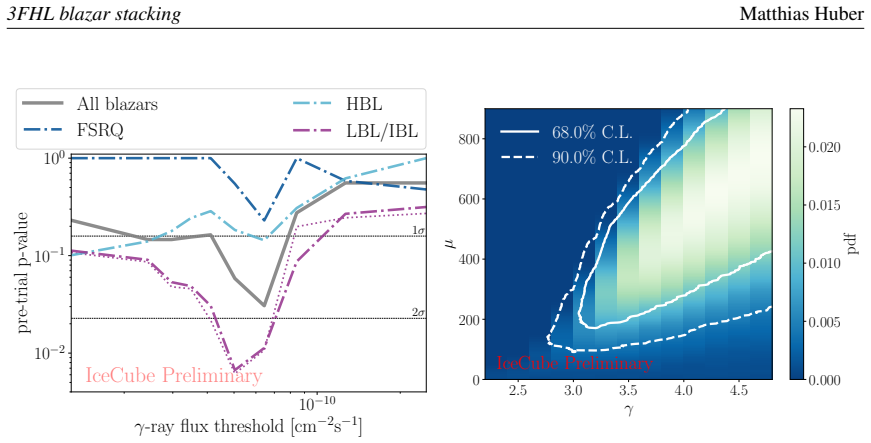
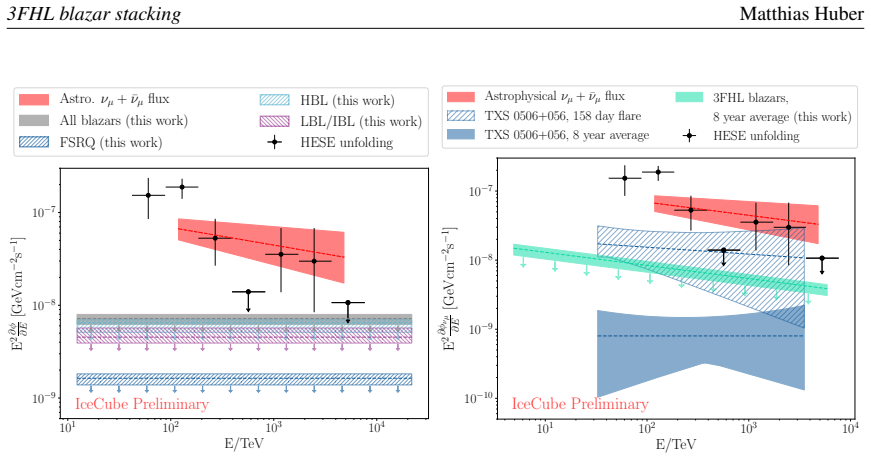
The paper reports a stacking search for a steady neutrino signal from 1301 blazars in the 3FHL catalog, using roughly 500,000 through-going muon events accumulated over eight years by the South Pole neutrino telescope. None of the tested samples—all blazars, FSRQs, HBLs, or LBL/IBLs—shows a significant excess; the smallest post-trial p-value, 0.03 for LBL/IBL blazars, is treated as a null result. Converting the null into upper limits, the analysis finds that at 90% C.L. the entire 3FHL blazar population contributes at most 13.0–16.7% of the diffuse astrophysical energy flux between 119 TeV and 4.8 PeV when the population is assumed to share an $E^{-2}$ spectrum, or 9.7–13.9% when the spectrum matches the measured diffuse index $\gamma=2.19$. Removing TXS 0506+056 barely changes the LBL/IBL result, so the most significant subsample is not dominated by that known flaring blazar. The central claim is that steady neutrino emission from these blazars is below the level required to explain the diffuse astrophysical neutrino flux.
Load-bearing premise
The fixed upper limits assume that every 3FHL blazar produces the same neutrino flux at Earth and that the whole population shares one power-law spectral index; if the true neutrino emission is concentrated in a few sources with different spectra, these population limits do not directly constrain that concentrated emission.
Editorial extensions
If this is right
- If the central result is correct, the 3FHL blazar population cannot produce more than 13.0–16.7% of the diffuse muon-neutrino energy flux under an $E^{-2}$ assumption, so another source class or a differently behaving blazar subpopulation must supply most of the observed astrophysical neutrinos.
- The absence of a gamma-ray–neutrino correlation in the flux-threshold scans means gamma-ray brightness alone is not a reliable predictor of steady neutrino output for this catalog.
- The FSRQ subsample is constrained to at most 2.9–3.8% of the diffuse flux, making FSRQs particularly unlikely steady neutrino sources.
- The agreement between the population limits and the TXS 0506+056 flare studies implies that steady stacking is not sensitive to rare flaring sources, which require flare-triggered searches.
- With the assumed diffuse spectral index of $\gamma=2.19$, the maximal contribution falls to 9.7–13.9%, so the conclusion that these blazars are subdominant does not depend on the choice between the two tested spectra.
Reading between the lines
- One consequence the paper leaves implicit: if only a fraction $f$ of the 1301 blazars actually emit neutrinos, the same data allow that active subset to contribute roughly $(13\text{--}17\%)/f$ of the diffuse flux, so the quoted limit constrains the average source rather than every catalog member.
- A natural testable extension is to run the same stacking on southern-sky cascade events, extending population coverage to the whole sky and strengthening the constraint on the blazar contribution to the diffuse flux.
- The mild LBL/IBL excess at p = 0.03, absent in other classes, may hint that low-to-intermediate synchrotron-peaked blazars behave differently from HBLs; allowing per-source spectral indices in a future search would show whether the hint is physical.
- If future gamma-ray catalogs push to fainter fluxes, the cumulative stacking significance pattern could reveal whether neutrino luminosity tracks gamma-ray luminosity or a separate physical property of the jets.
Signed reviews
Editorial analysis
A structured set of objections, weighed in public.
Referee Report
Summary. The paper reports a stacking search for steady high-energy neutrino emission from 1301 blazars in the 3FHL catalog using eight years of IceCube through-going muon data from the Northern hemisphere. The analysis uses the unbinned likelihood ratio of Eqs. (3.1)-(3.3), with the signal PDF built from per-source detector acceptance and an equal physical flux per source (W_k=1/M), and a global spectral index. No significant excess is found in any of the four tested categories (all blazars, HBL, LBL/IBL, FSRQ); the most significant result is the LBL/IBL sample with a post-trial p-value of 0.03. The paper reports 90% C.L. upper limits on the neutrino flux normalization and maximum contributions to the diffuse astrophysical muon-neutrino flux, concluding that 3FHL blazars can account for at most 13.0-16.7% of the diffuse energy flux for a gamma=2 spectrum and 9.7-13.9% for gamma=2.19. It also checks that removing TXS 0506+056 does not change the LBL/IBL result and compares the steady-source limits with the TXS 0506+056 flare.
Significance. If the result holds, it is an important observational constraint: the collective steady neutrino emission of 3FHL blazars is well below the diffuse astrophysical muon-neutrino flux, leaving room for other source classes. The null result itself is robust: it is based on a large event sample, a standard IceCube likelihood-ratio framework, post-trial correction for the flux-threshold scan, and explicit checks of the most interesting source, TXS 0506+056. The paper also provides the first stacking limits on the 3FHL catalog, and the comparison with the TXS 0506+056 flare is a useful consistency check. The main quantitative claim, however, is conditional on the equal-strength stacking assumption W_k=1/M and on a single global spectral index; the paper partially acknowledges this through bands from different weighting schemes, but the schemes are not defined and the model dependence of the diffuse-flux fraction is understated.
major comments (2)
- [Section 3.2, Eq. (3.3), Section 5, Table 1] The quantitative conclusion in Section 5 that 3FHL blazars 'cannot explain more than 13.0-16.7%' of the diffuse muon-neutrino flux is derived under the equal-flux stacking assumption W_k=1/M stated in Section 3.2. With that choice, the signal PDF in Eq. (3.3) weights each source by its detector acceptance R_k, so low-acceptance sources near the horizon contribute almost nothing; if the true neutrino emission is dominated by a few low-acceptance sources or by sources with very different spectra, the likelihood can be pulled by the many high-acceptance, no-signal sources, and the resulting upper limit may not bound the true total catalog flux. The caption of Fig. 3 refers to 'different weighting schemes' but does not define them, and Table 1 does not state which weights produce the quoted ranges. Please specify the weighting schemes explicitly and add a worst-case weighting such as W_k proportional to 1/R_k, or explicitly qualify the conclusion as applying only to equal-flux populations. Without this, the headline 13.0-16.7% statement overstates the constraint.
- [Section 4, Table 1] The quoted 90% C.L. upper limits and rmax values are presented without any assessment of systematic uncertainties, such as the muon energy scale, angular-resolution uncertainty, or atmospheric neutrino flux normalization. Because the headline result includes flux upper limits quoted to two significant figures, the paper should either include a systematic band or an explicit statement that the limits are statistical only and that a full treatment will appear in a dedicated analysis. This omission does not affect the null detection claim, but it does affect the precision that the reader can assign to the rmax fractions.
minor comments (5)
- [Section 4, footnote] The footnote states that no trial factor is applied for the four blazar categories because none of the outcomes is significant; this is not a valid statistical principle, since the multiplicity should be accounted for a priori. In this case the conclusion would not change (e.g., a Bonferroni correction gives 4x0.03=0.12), but the p-value label should be clarified.
- [Abstract] The phrase 'world largest' should be 'world's largest'.
- [Section 4] The phrase 'pre-trial corrected p-value distributions' appears to be a typo; the distributions shown are pre-trial p-values before the flux-threshold scan correction.
- [Eq. (3.1)] The notation mu_s^j and N^j_tot is introduced without explicit definitions; a short sentence defining these quantities would help the reader, especially because the stacked signal PDF in Eq. (3.3) omits the sample index j.
- [Figure 3 caption] The caption mentions a '1 sigma central band' arising from different weighting schemes, but neither the confidence level of the band nor the weighting schemes are defined; this is related to the major comment and should be specified.
Circularity Check
No significant circularity: the stacking bounds are computed from the data likelihood and are not recycled as predictions.
full rationale
The paper's derivation chain is self-contained in the sense required by the circularity review. The signal hypothesis is a steady point-source population modeled by the unbinned likelihood ratio of Eqs. (3.1)-(3.3), with the stacking signal pdf S_stack defined as a weighted superposition of single-source signal pdfs; the weights contain detector acceptance R_k and a theoretical weight W_k. Section 3.2 explicitly sets W_k = 1/M ('all blazars are assumed to produce a neutrino signal at Earth with the same strength'), which is a stated assumption, not a quantity fitted from the data and then renamed as a prediction. The test statistic Lambda in Eq. (3.2) is maximized over mu_s and gamma, but the reported upper limits are evaluated for fixed spectral indices gamma = 2 and gamma = 2.19 (Table 1, Section 5), so no fitted parameter is recycled as the predicted quantity. The p-values are obtained from the standard likelihood-ratio test against the atmospheric background model, and the null result is robust to the listed alternative weightings (the dark-shaded bands in Figure 3 from 'different weighting schemes'). The conclusion that 3FHL blazars cannot explain more than 13.0-16.7% (for gamma=2) or 9.7-13.9% (for gamma=2.19) of the diffuse muon-neutrino energy flux is conditional on the equal-strength steady-source assumption and on the reference diffuse flux from IceCube proceedings [10,11]; a conditional upper limit and a comparison against an external benchmark are not circularity. The use of IceCube collaboration references for the detector, the TXS 0506+056 observations, and the diffuse flux is normal self-citation and is not load-bearing in the sense of importing an unverified premise that makes the conclusion true by construction. No fitted input is called a prediction, no uniqueness theorem is imported from the authors, and no known result is renamed. The honest finding is no significant circularity.
Assumptions & free parameters
free parameters (2)
- mu_s (mean number of signal events) =
not reported numerically; contours shown in Figure 2
- gamma (global spectral index) =
fixed to 2.0 or 2.19 for limits; best-fit soft for LBL/IBL
assumptions (5)
- ad hoc to paper All blazars in a tested category emit the same neutrino flux at Earth (W_k = 1/M)
- domain assumption The neutrino signal follows a single unbroken power law with a common spectral index gamma
- domain assumption The detector response (effective area, angular resolution, energy resolution) for the through-going muon sample is known
- domain assumption The 3FHL catalog positions and classifications are accurate for the tested blazars
- domain assumption Atmospheric background model is correct
Cite this review
Pith. "Pith review of Searches for steady neutrino emission from 3FHLblazars using eight years of IceCube data from the Northern hemisphere." pith.science (2026). https://pith.science/paper/JAEL3BTY
@misc{pith2026190808458,
  author       = {Pith},
  title        = {Pith review of: Searches for steady neutrino emission from 3FHLblazars using eight years of IceCube data from the Northern hemisphere},
  year         = {2026},
  howpublished = {\url{https://pith.science/paper/JAEL3BTY}},
  note         = {Machine review of arXiv:1908.08458}
}
read the original abstract
Located at the South Pole, the IceCube Neutrino Observatory is the world largest neutrino telescope, instrumenting one cubic kilometre of Antarctic ice at a depth between 1450m to 2450m. In 2013 IceCube reported the first observations of a diffuse astrophysical high-energy neutrino flux. Although the IceCube Collaboration has identified more than 100 high-energy neutrino events, the origin of this neutrino flux is still not known. Blazars, a subclass of Active Galactic Nuclei and one of the most powerful classes of objects in the Universe, have long been considered promising sources of high energy neutrinos. A blazar origin of this high-energy neutrino flux can be examined using stacking methods testing the correlation between IceCube neutrinos and catalogs of hypothesized sources. Here we present the results of a stacking analysis for 1301 blazars from the third catalog of hard \textit{Fermi}-LAT sources (3FHL). The analysis is performed on 8 years of through-going muon data from the Northern Hemisphere, recorded by IceCube between 2009 and 2016. No excess of neutrinos from the blazar position was found and first limits on the neutrino production of these sources will be shown.
Figures

Reference graph
Works this paper leans on
-
[1]
write newline
" write newline "" before.all 'output.state := FUNCTION blank.sep after.quote 'output.state := FUNCTION fin.entry output.state after.quoted.block = 'skip 'add.period if write newline FUNCTION new.block output.state before.all = 'skip output.state after.quote = after.quoted.block 'output.state := after.block 'output.state := if if FUNCTION new.sentence out...
-
[2]
IceCube, Fermi-LAT, MAGIC, AGILE, ASAS-SN, HAWC, H.E.S.S., INTEGRAL, Kanata, Kiso, Kapteyn, Liverpool Telescope, Subaru, Swift NuSTAR, VERITAS, VLA/17B-403 Collaboration, M. G. Aartsen et al., Science 361 (2018) eaat1378
work page 2018
-
[3]
IceCube Collaboration, M. G. Aartsen et al., Science 361 (2018) 147--151
work page 2018
-
[4]
C. M. Urry and P. Padovani, Publ. Astron. Soc. Pac. 107 (1995) 803
work page 1995
-
[5]
P. Padovani and E. Resconi, Mon. Not. Roy. Astron. Soc. 443 (2014) 474--484
work page 2014
-
[6]
Fermi-LAT Collaboration, M. Ajello et al., Astrophys. J. Suppl. 232 (2017) 18
work page 2017
-
[7]
IceCube Collaboration, M. G. Aartsen et al., JINST 12 (2017) P03012
2017
-
[8]
IceCube Collaboration, M. G. Aartsen et al., Astrophys. J. 835 (2017) 151
2017
Show all 17 references
-
[9]
S. R. Kelner and F. A. Aharonian, Phys. Rev. D 78 (Aug, 2008) 034013
2008
-
[10]
Padovani, E
P. Padovani, E. Resconi, P. Giommi, B. Arsioli, and Y. L. Chang, Mon. Not. Roy. Astron. Soc. 457 (2016) 3582--3592
2016
-
[11]
IceCube Collaboration, PoS(ICRC2017)1005 (these proceedings)
-
[12]
IceCube Collaboration, PoS(ICRC2017)981 (these proceedings)
-
[13]
IceCube Collaboration, PoS(ICRC2015)1099 (2016)
2016
-
[14]
IceCube-Gen2 Collaboration, PoS(ICRC2017)1052 (2018)
2018
-
[15]
IceCube Collaboration, PoS(ICRC2019)xyz (these proceedings)
-
[16]
IceCube Collaboration, M. G. Aartsen et al. , JINST 12 (2017) P03012
2017
-
[17]
Waxman and J
E. Waxman and J. N. Bahcall, Phys. Rev. D59 (1999) 023002
1999
Reviewed August 14, 2026 · model on record in the stance chip above.
Discussion (0). Continue with ORCID to comment.